Migrant tales
Menu
  • #MakeRacismHistory “In Your Eyes”
  • About Migrant Tales
  • It’s all about Human Rights
  • Literary
  • Migrant Tales Media Monitoring
  • NoHateFinland.org
  • Tales from Europe
Menu

Tag: Perussuomalaiset

Kunnollisvaalit -blogi: EIT:n ennakkotapaus vai poliisin väärä epäily?

Posted on January 2, 2013 by Migrant Tales

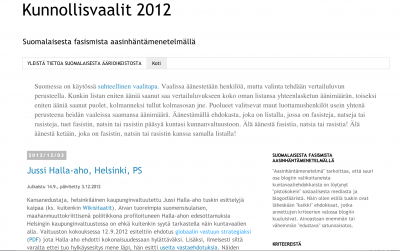
Susannah toivottaa kaikille hyvää uutta vuotta, mutta joutui suutahtamaan taas. Miksi korkean koulutuksen maassa ei osata lukea lakia? Kyseessä on tietenkin asiallinen Kunnollisvaalit – blogi, jossa paljastettiin eri puolueiden äärioikeistolaisin mielipitein esiintyviä kunnallisvaaliehdokkaita. (esim.http://kunnollisvaalit-2012.blogspot.fi/)

Lakimiehen sana lakiasioista on Susannahin mielestä aika pätevä tulkinta lakiasioista, joten:

http://sakutimonen.blogit.fi/hippasilla/

Siis, jos tätä Kunnollisvaalit-blogia poliisikin ahdistelee, ja asia sattuisi etenemään suomalaisessa oikeusjärjestelmässä- tuossa on ihan selvä ennakkotapaus siitä, että tästä poliisin asenteessa (toistaiseksi epäily) voi tulla antirasistien sananvapauden vakava rajoittaminen.

Kuten Sakari Timonen kirjoittaa:

“Kunnollisvaalit-blogin tekijät ovat linkistä ensimmäisenä avautuvasta lehdistötiedotteesta päätellen perehtyneet lakiin ja oikeuskäytäntöön. Siinä viitataan (Euroopan ihmisoikeustuomioistuin) EIT:n antamaan päätökseen ns. Jersild-tapauksessa.
Siinä toimittajan rankaiseminen kiihottamisesta kansanryhmää vastaan loukkasi toimittajan sananvapautta. Tiedonvälityksen vapauteen kuuluu oikeus kirjoittaa ja raportoida rasistisista ryhmistä, niiden toiminnasta ja mielipiteistä. Jersildin toimittamaan ohjelmaan oli sisältynyt esim. haastattelukohtauksia, jotka sinällään täyttivät rikoksen tunnusmerkistön. Niiden sisällyttämistä rasisminvastaiseen ohjelmaan ei pidetty rikoksena.”

Onko Suomella enää varaa EIT:n langettavaan päätökseen?

Kuvankaappaus 2013-1-2 kello 20.50.39


Promoting tolerance now and tomorrow

Posted on December 31, 2012 by Migrant Tales

In Migrant Tales’ Finland & Cultural Diversity 2012 review, it’s clear that a lot more work needs to be done to promote tolerance. Thanks to Umayya Abu-Hanna’s column on Sunday’s Helsingin Sanomat,* our collective complacency was once again shamefully revealed.

Racism, or the lack of acceptance of other ethnic groups as equals in our society, is a social illness that spreads unabated in Europe and in countries like Finland. It is empowered by our silence, fear, cultural myths, low self-esteem and mocks every day at our apathy.

How do you explain the historic rise of a party like the Perussuomalaiset (PS), which is hostile to immigrants and cultural diversity, in last year’s parliamentary elections?

What is even more shameful is the acceptance by the media and too many politicians that PS chairman, Timo Soini, is the good guy that is keeping openly hostile and racist party members in line.

Hate crimes rose in Finland by 7% in 2011 compared with the previous year, according to the Police College of Finland. Irrespective of the rise, few if any politicians raised the issue.

Mark wrote about how the police perpetuate hate crimes in Finland in one of the most commented and widely read blog entries of December.

He writes: “One effect of hate crime statistics being published in Finland is that it brings up once again the unwelcome question of whether Finns are more racist than other nations. This isn’t my question, by the way, but it is one that Finns tend to dwell on, as if there were an acceptable level of racism that a country is allowed to have!”

Are the police, like the rest of society, serious about hate crimes and racism?

Considering that the majority of hate crimes go unreported, it’s clear that these types of crimes reported to the police are only the tip of the iceberg.

The fact that one policeman in Mikkeli suggested to immigrant students that they should not report racist harassment cases to them shows that there is no common policy.

The Mikkeli policeman equated racist harassment to when he gets hassled in his hometown by the locals, who remind him that he is a policeman. “Just ignore them [if they harass you in a racist fashion],” he said.

If its evident that the police are part of the problem, part of the blame must go to the victim. It will be very difficult to challenge hate crimes in our society as long as immigrants and visible minorities don’t report such cases.

Ignorance of one’s rights, language barriers, fear of reprisals and lack of trust are some reasons why black and visible minorities don’t report racist harassment to the police, according to a Race Council Cymru study reported by Migrant Tales.

There’s a very good piece on ekathimerini.com on how hate crimes threaten our society.

Kuvankaappaus 2012-12-31 kello 8.43.46

Read whole story here.

Morten Kjaerum and Janez Lenarcic write: ”Hate crime offenders send a clear message that some of us are lesser human beings, lesser citizens who can be harmed with impunity. Their actions are, therefore, serious affronts to the fundamental right to human dignity and equal treatment.”

The key argument made by the authors, that our fundamental right to human dignity and equal treatment are breached, is the issue. When we permit such an injustice to happen, we undermine our civil rights. If it can happen to “them” it can happen to “us.”

Barbara Spectre, founding director of Paideia of Sweden, believes that the ongoing transformation of European societies from being “monolithic to multicultural” is at the heart of European anti-Semitism.

“I think there’s a resurgence of anti-Semitism because this point in time Europe has not yet learned to be multicultural…” she said. “It’s a huge transformation for Europe to make. They are now going into a multicultural mode. ”

While I disagree with Spectre that the issue is simply moving from being “monolithic to multicultural,” the issue goes much deeper. Anti-Semitism should not be seen as a threat to Jews but to all minorities living in Europe.

The foundations of Europe’s racism, which has brought terrible wars and enabled colonialism to spread globally, is at the heart of the problem.

Europe has always been culturally diverse. The problem is that we have used racism to hide our diversity through social exclusion. We only see ourselves in a racist society.

Finnish racism isn’t any different. Since we want to see only ourselves in this society, it explains why there’s so much opposition to cultural diversity.

Less social exclusion would make us acknowledge that there are other groups living amongst us.

_______________

*Erkki Perälä, a Green Party Helsinki city councilman, wrote a so-called sarcastic piece about Abu-Hanna’s column. I considered the use of the Musta Pekka Golliwog as offensive.

Why is it that I never get “great” ideas like Perälä when writing about a social ill like racism?

If I’m not the victim due to my ethnicity, I don’t try to write about it with sarcasm since I’d only be asking for trouble.

What do you think?

Finland & Cultural Diversity 2012*

Posted on December 28, 2012 by Migrant Tales

If 2011 was a watershed year for Finland with the historic rise of  a hostile party against immigrants and visible minorities in last year’s parliamentary elections, 2012 will be seen as a bittersweet turning point for the Perussuomalaiset (PS). 

The year will be remembered as a very violent one for immigrants as well. During “Black February,” three Muslims died under violent circumstances in a span of about three weeks in the cities of Oulu and Espoo.

There was no shortage of news about immigrants and minorities in Finland. Some of these were: fines for hate speech to PS politicians like MP Jussi Halla-aho; Helena Eronen’s blog entry suggesting armbands for immigrants;  racial profiling complaints to the Ombudsman of Minorities; Migrant Tales got deactivated for about 13 hours without warning from WordPress.

Kuvankaappaus 2012-12-28 kello 12.22.32

Rebecka Holm, 14, who was awarded the Red Cross Award on the UN Day Against Racism. Holm denounced racial harassment against her friends and herself and wrote about it to Swedish -language daily HBL. She is a good example for immigrants and visible minorities living in Finland.

Visits to Migrant Tales during the year rose by 70% versus 2011.

What grade would Finland receive for promoting and defending cultural diversity in 2012? If the grade was a 5 (below average) in 2011, this year it would go up a tad to +5.

Below is a quarter-by-quarter account of what made news on the immigration and visible minority front in Finland during the year:

First quarter (January-March)

Without a doubt, the biggest story in the first quarter of the year was the presidential elections of January. After the historic victory of the PS in 2011, which won 39 seats in parliament compared with 5 previously, all eyes were on its chairman and hopeful, Timo Soini. Would he repeat the party’s 2011 election result?

The presidential election turned out to be a sour disappointment for the PS.  Not only did an openly gay presidential Green Party candidate, Pekka Haavisto, beat Soini but also another anti-EU Center Party’s hopeful Paavo Väyrynen.

The election showed that voters had started to turn their backs on the PS’ anti-EU and anti-immigration rhetoric. Soini’s poor showing (9.4%) and Väyrynen’s better showing (17.5%) confirm the latter. The next hurdle for the PS would be the municipal elections of October 28.

Migrant Tales was cited during the presidential election by Sveriges Radio.

Black February, which involved the death of three Muslims, a suicide and an injured man, started on January 30 in Oulu after eighteen-year-old Abdirashid Jirde fled from three Finns who barged into his home. Fearing for his safety, the young Somali leaped unsuccessfully from his sixth-floor apartment to his neighbor’s balcony.

His brother, Absie Jirde, wrote a letter about his brother’s death that was published on Migrant Tales after the tragedy.

abdirashidThis picture sent by the brother of the victim (baby) was sent to Migrant Tales by the brother of the victim.

On February 17 Migrant Tales was tipped off about the death of a second Somali youth, Abdisalam Mohamed Abdulahi, who died violently at the hands of a white Finn. Both the assailant and the victim knew each other.
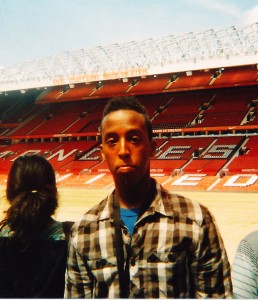
Abdisalam-Mohamed-Abdulahi1The second Muslim to lose his life violently in Black February was Abdisalam Mohamed Abdulahi, 18. The eighteen-year-old youth was a Manchester United fan.

An Espoo District Court sentenced  Abdulahi’s killer  in July to a six-year jail term for manslaughter.

Migrant Tales spoke to Abdisalam’s father about the death of his son.

The final chapter of Black February took place the day after on Sunday at an Oulu pizzeria after Abdulahi’s tragic death, when a white Finn shot and killed one worker and wounded another one. The killer took his life after the shooting.

On the night of the tragic events that happened in Oulu, PS councilman Tommi Rautio wrote on his Facebook page the following comment: “If Janne is the one [who shot the foreigners at the pizzeria] then we should give Janne a medal.”

Rautio’s comment caused him to be sacked from the PS in March and convicted and fined 120 euros by a local court for inciting ethnic hatred.

Setting aside the tragic events that marked Black February, few politicians denounced publicly what happened except for Olli Mäntylahti, a National Coalition Party candidate for the city of Helsinki. Migrant Tales was, together with Mäntylahti, the first ones to break the news about Rautio’s comments on Facebook.

Migrant Tales was the target of a number of attacks at the end of the first quarter. The first attack came from a megaboard site called Ylilauta, which was followed by a deactivation by WordPress of  the blog on March 27 for about 13 hours.

Writes Mark: “Migrant Tales is under attack. The blog’s founder is receiving threats of violence, is being defamed and ridiculed in public forums, is being harassed even to the point of having his workplace invaded by defamatory communications. It is not an easy time for Enrique or his family…”

Termination of Service-2While some were dancing prematurely on Migrant Tales’ grave, we received an apology from WordPress for the mistake. Making sure that we never have to suffer such censorship again, Migrant Tales moved to its present site on May 17.

Freddy Van Wonterghem, a PS Kotka city councilman, was convictedby a court on March 30 for inciting ethnic hatred. On another blog, this editor asked Van Wonterghem if he regretted what he wrote.

“I don’t regret what I wrote…” he responded. “Perhaps [at the most] it wasn’t nicely said.”

Second quarter (April-June)

The biggest stories during this quarter were: Helena Eronen’s blog entry suggesting that immigrants should start wearing armbands, and a Supreme Court ruling that slapped Halla-aho with a fine for defaming a religion and inciting ethnic hatred.

As a result of the court ruling, Halla-aho was forced to resign in June as chairman of the administration committee.

The Supreme Court sentence turned out to be a showdown between Soini’s Rural Party and Halla-aho’s Suomen Sisu faction. Halla-aho suggested that MP Juho Eerola should replace him as chairman of the administration committee.

Soini’s candiate, MP Pirkko Mattila, was elected by the parliamentary group. The result was a clear defeat for the PS Counterjihadists.

Eronen knew she was asking for trouble when she published her infamous blog entry on ethnic profiling.

What did she write?

You’ll find the original blog entry number eighteen on MP James Hirivsaari’s website: “If every foreigner were required to use an armband of his/her national background, the police could immediately spot whether that ‘aha, that is a Muslim from Somalia’ or ‘aha. that is a beggar from Romania.’ Muslims could [use sleeve badges] with a half moon…Russians [with] a hammer and sickle, Kampucheans could have field mines, a burger [could be used to distinguish] Americans…”

Eronen’s story, which was widely covered by the Finnish media, spread rapidly to Russia, Sweden and other countries.

Eronen, who openly supported the far-right Muutos 2011 party, resigned in August as Hirvisaari’s aide.  There was speculation that one reason why she resigned was because Hirvisaari’s wife suspected her of having an affair with her boss.

Kuvankaappaus 2012-12-27 kello 8.14.33

The Council for Mass Media in Finland (JSN) exonerated Kirkko&Kaupunki in May after a cartoon published on December 2011 mocking a group of Perussuomalaiset (PS) party MPs. It reads: “A Merry Christmas to you all Finnish heterosexuals and white conservatives! We wish the rest a shitty Christmas!”

Setting aside the contempt that the PS has for immigrants and visible minorities, Finland’s media was a constant target of attack by the party, especially newspapers like Turun Sanomat, which reported on Eronen’s sleeve badge blog entry.

Attempts by the PS to tell newspapers what and how they should write about the PS is a good example of the party’s anti-democratic credentials. PS members like Matti Putkonen and MP Halla-aho expressed on a number of occasions their anger with the media.

PS MP Olli Immonen, a hardline Counterjihadist, announced that he would boycot YLE “for a while.” Instead of answering difficult questions posed by reporters, the response of some PS members is to avoid the media altogether.

A clear indication of the growing influence of the extremist Suomen Sisu wing of the PS, was the naming in May of Matias Turkkila as the new editor-in chief of the party’s newspaper and web page.

If there is a person who has helped spread Halla-aho’s hate speech in Finland, that person is Turkkila. He’s the editor of  anti-immigration hate site called Hommaforum which is closely related to Scripta, Halla-aho’s blog.

Other stories that Migrant Tales reported were Finland’s first suspected terrorism case involving Somalis, ethnic profiling complaints by immigrants to the Ombudsman of Minorities, an elderly Somali woman who got assaulted at a Helsinki metro station, the costly saga of family reunification, and www.migranttales.net begins on May 17.

Third quarter (July-September)

As Anders Breivik was convicted by an Oslo court to 21 years for the murder of 77 innocent victims on July 22, 2011, Peter Mangs, was sentenced to life imprisonment by a Mälmö court in Sweden on two counts of murder and five attempted murders. He was finally sentenced in November after undergoing psychological tests, which showed him to be sane.

Another story that ignited debate was a movie about “black” Marshal Carl Mannerheim, Finland’s George Washington. One of the aims of Erkko Lyytinen, the movie’s producer, was to challenge challenge Mannerheim’s sacred image.

Mannerheim (1)

 Black and white Marshal Mannerheim spurred a lot of debate in Finland.

The Per-Looks blog, which  outraged some PS party members, was widely debated in the media. While the pictures published on Per-Looks aim to give an image that the PS are a bunch of Finnish hillbillies, the blog gave the hostile party to immigrants a taste of its own medicine.

By September the heat of the municipal elections could be clearly felt. A very good blog, Kunnolisvaalit 2012,** appeared exposing the far-right and anti-immigration stands of candidates running for city council. While the majority of the candidates on the blog belong to the PS, there are others from parties like Muutos 2011, Center Party, and National Coalition Party.

ristohelin2 (1)

Risto Helin of the PS, who got elected to the Vaasa city council, is pictured with a “white power blood & honor” on Kunnollisvaalit 2012 blog.  

Another PS municipal candidate that got elected from Kotka, Amon Rautiainen, got in trouble in September for suggesting on his Facebook page that government ministers should be shot and that Muslims should be boiled alive.

Despite constant denials by Soini that the PS wants to weed out racists from running in the municipal election, the party’s policy towards refugees shows that the latter is only lip service.  The party’s municipal election program clearly states that municipalities should not accept refugees.  The best place to help these people is in crowded refugee camps where “they would be culturally” closer to home, according to the party.

In the end of September, a poll published by YLE shows that the PS will be the biggest winners of the municipal elections.  The poll sees the PS getting 17.2% of the votes versus 5.4% in 2008 with the Center Party being the biggest loser.

Fourth quarter (October-December)

The biggest story in this quarter and probably the whole year was the municipal election result. Contrary to what the September poll suggested, the clear winner of the election was the Center Party (18.7%) and the biggest losers were the Greens (8.5%). The PS, which was expected to do well, won 12.3% of the vote. Even if the result was a disappointment to Soini, the party was able to raise the number of city councilpersons by 752 to 1,195.

The National Coalition Party (21.9%) and the Social Democrats (19.6%) came in fist and second place, respectively.

Campaigns like iCount that aim to activate the immigrant vote were active during the election.

The 2012 municipal elections were historic for Finland since a record number were candidates, according to YLE. The highest number of immigrant candidates can be found in the Social Democratic Party (118) followed by the National Coalition Party (81), Left Wing Alliance (56), Green Party (55) and Center Party (around 50).

Unconfirmed reports see the immigrant vote doubling to about 40% in the recent elections. If this is true, it shows that Finland’s anti-immigration climate has empowered immigrants to act.

Contrarily, PS Counterjihadist candidates as well as others that were strongly anti-immigration and against cultural diversity did well in the municipal elections.

Kuva 58

PS councilman Harri Turtianen of Kemi is one examples of many of how intolerance has grown and become more acceptable in Finland.

About two weeks after the election, PS MP Hirvisaari said that his party did poorly in the municipal elections because it wasn’t as outspoken on immigration issues as before the 2011 parliamentary elections, according to YLE.

While the campaign in the municipal election became more vicious and anti-immigration rhetoric picked up as October 28 neared, their hostile campaign against immigrants and cultural diversity continued after the election. A draft law spearheaded by Halla-aho aims to make deportations of convicted immigrants mandatory. Three PS MPs have drafted legislation to make begging illegal in public places, and MP Vesa-Matti Saarakkala aims to ban male circumcision in Finland.

Veteran National Coalition Party politician Pertti Salolainen got himself in hot water in early December when he said that on a TV talk show that American Jews have vast control over the wealth and media in the United States. Salolainen, who is vice chairman of the foreign policy committee, felt that pro-Israel lobby groups in the U.S. prevented Washington from taking a neutral stand on the Israeli-Palestinian conflict.

Kuva 95


Suspected hate-crime cases were published on December 19. Last year, 2010 figures were made public on October 27.

A total of 918 suspected hate crimes were reported in Finland in 2011, which is a 7% rise from 860 cases in the previous year, according to the Police College of Finland. Compared with the previous years, suspected hate crime cases have not risen significantly, according to researcher Iina Sahramäki.

Mark published two good blog entries after the Police College of Finland published its hate crime cases for last year. The first one, Approaching hate crimes in Finland: problem solver or angry boss and the one that followed, Police College of Finland: are they perpetuating hate, asks some tough questions of the police concerning hate crimes.

He writes: “What adds to the injury is that people rely on these statistics to create profiles of particular national groups as being much more racist than they actually are, and much more racist than Finns. So, hate crime statistics that are presented in such a way that they actually perpetuate hate crime!”

Finnish law doesn’t recognize hate crimes as crimes per se.

In an exclusive interview with Migrant Tales in December, Rainer Hiltunen, Ombudsman for Minorities head of office, said that talks have taken place with the Finnish police to draft new guidelines and more effective monitoring to ensure that ethnic profiling doesn’t happen.

The new guidelines are expected to be in force in 2013.

*See also Finland & Cultural Diversity 2011

** The blog can be read here.



Finland and cultural diversity in 2012 will be published on December 28

Posted on December 23, 2012 by Migrant Tales

Migrant Tales will publish on December 28 its review of the major events that shaped 2012 on the cultural diversity and immigration front in Finland. Contrary to 2011, this year’s review will be called Finland and cultural diversity in 2012.

8_eelisheikkila-copy_edited-1

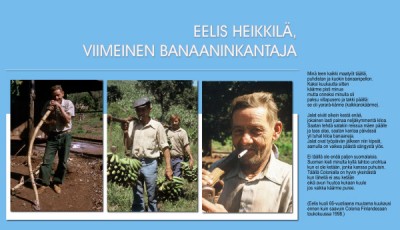
Finns colonized Argentina in 1906. Some, like Eelis Heikkilä, made a meager living by picking bananas.

Why have we changed the name?

The answer is simple: The real issue being debated in this country isn’t immigration per se but acceptance of cultural diversity. How inclusive is our society to “otherness?”

As far as we can tell, there is one party as well as many politicians from other parties who are fighting tooth and nail to keep Finland white physically and spiritually. In their myopic world, the only “good” Finn is a white Finn.

We disagree. Being Finnish is a personal matter and does not hinge on how anti-immigration parties and groups define it.

Thanks to the over 1.2 million Finns that left this country between 1860 and 1999, Finnish culture and identity is richer than some people would like to admit.

No matter how many obstacles these anti-immigration and counterjihadist groups place on our path, the tide turned many decades ago. The ever-growing cultural diversity we see within our borders today is fueling a new sense of Finnishness that is proud and diverse.

If you have any suggestions you would like to make concerning the most important events that took place in Finland in 2012 on the cultural diversity and immigration front, please drop us a line ([email protected]).

Thank you for your support and for making Migrant Tales one of Finland’s most successful blogs.


The same face of intolerance lives amongst us today

Posted on December 22, 2012 by Migrant Tales

When I was growing up in the 1970s, one of the matters that followed me around was the constant news of the mass murder and cemetery silence imposed by ruthless Latin American dictatorships. If you lived in one of those countries where human rights violations were the rule, you were confronted by two options: take up arms or be quiet. 

Kuvankaappaus 2012-12-21 kello 9.18.35
Read “Uncovering Crimes of Argentina’s Junta” here.

Much of the bloodshed that took place in Latin America during that tumultous decade could have been averted if there would have existed democratic institutions and respect for civil liberties.

It is a tragedy that millions of people were denied the right to express their opinions democratically.

In many respects, but in a different context, the same type of exclusion is taking place in many parts of Europe today. Ethnic groups like the Roma, Somalis, Turks, blacks, Muslims, Jews and other minorities are still treated like third-class citizens and with contempt in some countries.

Even if these groups are not persecuted in the same way like political dissidents in Latin America were four decades ago, they are treated with contempt. We can never be at peace as long as we allow poverty, ignorance and apathy to silence whole groups.

In many respects, but in a different context, too many Finnish politicians have shown too little interest for the rights and welfare of immigrants and visible minorities. The fact that we grant asylum to refugees and then force them to live separated for years from their families is one of many examples of their scorn.

If we look at the arguments used by right-wing anti-immigration extremist groups in Europe and Finland today, they have the same aim that autocratic regimes had to socially exclude and silence whole groups.

How long can a minority be forced to remain silent? In the United States, it took centuries before Rosa Parks ignited the Civil Rights Movement in December 1955. Hopefully different minorities in Europe react much faster.

The most important lesson we can learn from social movements like the above is that change must come from the group.

One of the oddest arguments one hears in Finland every now and then is that the anti-immigration Perussuomalaiset (PS), a party that is the breathing ground for right-wing extremism,  has helped integrate troubled politicians who are multiculturally challenged into the system.

Such a preposterous argument is, in my opinion, only a justification for our fascination with modern-day fascism.

Democracy and civil rights is not a right that one group can own at the expense of others.

Keeping it from other groups is sowing the seeds of tomorrow’s violence.


Taming the beast of right-wing extremism in the EU and Finland

Posted on December 15, 2012 by Migrant Tales

Our reaction to racism should be first and foremost a reaction. 

A comprehensive report published recently by the Institute for Strategic Studies in Sweden not only exposes far-right or right-wing extremism in ten European Union countries, but its historical roots as well. While these extremist groups may have different names in different countries, they are all bonded by one overriding factor: intolerance. 

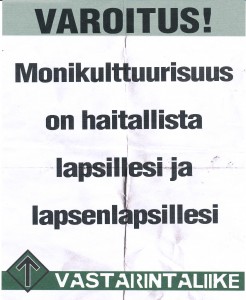
Image1-44_edited-1“Multiculturalism is hazardous to your children and grandchildren,” reads a flyer of the Neo-Nazi  Suomen Kansalinen Vastarintaliike. They have become so bold that they openly spread their far-rght ideology in public and in people’s mail boxes.  This is possible thanks to the rise of parties like the Perussuomalaiset, which are the birthsite for right-wing extremism.

How is it possible that a region like the European Union, never mind a country like Finland which has one of the best educational systems in the world, can become the breeding ground for right-wing extremism and intolerance?

Some culprits could be our own national myths and the global recession, which has caused unemployment to soar.

If anything, the present threat by extremist parties to Europe and Finland should be a wake up call for us on how little work we have done in the past to challenge intolerance.

Setting aside countries like Hungary, where anti-Semitism and racism are the order of the day, Finland is probably a good candidate that could follow the same route if we don’t react soon enough.

The 19.1% victory of the anti-EU, anti-immigration and especially anti-Islam Perussuomalaiset (PS) party in 2011 is a good example of how extremists have regrouped and organized effectively within existing political parties that enjoy popular legitimacy.

What should be clear is that their brand of popular legitimacy is far from mainstream or anything that is close to our way of life and values. It is a Trojan Horse with a politically volatile and hostile brew packed with intolerance, populism, extremism, fascism, racism and Counterjihadism.

The deception of intolerance to its avid and silent followers is that you can control it by keeping it on a short leash. Apart from impoverishing our society in many ways, nobody can control racism because it knows no master.

If you disagree, why not ask Anders Breivik.

Institute for Strategic Studies: Preventing and Countering Far-Right Extremism – European Cooperation

Posted on December 15, 2012 by Migrant Tales

Here’s a good country-by-country report on the history and modern growth of right-wing extremism in ten European Union countries  (Sweden, UK, the Netherlands, Norway, Finland, Denmark, Germany, Poland, Hungary, and the Slovak Republic).  

Kuva 101

Read full report here.

As Migrant Tales has correctly reported time and again, the biggest sources of right-wing extremism in Finland are the Perussuomalaiset (PS) party, Suomen Sisu, Hommaforum, Suomalaisuuden liitto and others.

The aim of these groups is to make right-wing extremist ideology, which always comprises of racism and xenophobia, as natural as Finnish blueberry pie.

Here are some of the main points of the report by Anne-Cahtherine Jungar:

  • Right-wing extremism has, with some exceptions, tended to develop in the form of parliamentary political parties, and has therefore probably been less prone to extra-parliamentary violence than the phenomenon in other European countries;
  • One third of the 39 True Finns parliamentarians have a background online, both with Hommaforum and Suomen Sisu. These representatives have been particularly influential in radicalizing the True Finns’ immigration policies.
  • Historically, right-wing extremism was spearheaded by the Academic Karelia Society (Akateeminen Karjala Seura) during 1922-44, the Laupa Movement (Lapua liike) during 1929-32, and Patriotic People’s Movment (Isänmaallinen Kansanliike) during 1932-44. The peace treaty with Moscow banned fascist organizations in Finland;
  • Those right-wing extremist groups which did mobilize in the late 1990s are better organised, more internationally connected, and aim for more political influence than the skinhead groups in the late 1980s;
  • According to SUPO (the Finnish security police unorganized right-wing extremism decreased towards the beginning of the 21st Century; it has recently resurged again. SUPO estimates that there are 1000 to 2000 individuals involved in the Finnish right-wing extremist environment today;
  • The Internet has been a key tool for spreading far-right ideology. The best known platforms are Hommaforum, Tundratabloids, Scripta and Varashammer. Right-wing extremism in Finland comes in the form of counterjihadism;
  • A more successful route for the extreme right milieu has been to engage with existing political parties that enjoy popular legitimacy, as Suomen Sisu has done with the True Finns.


UPDATE: Former Finnish PS councilman slapped with 120-euro fine for inciting ethnic hatred

Posted on December 12, 2012 by Migrant Tales

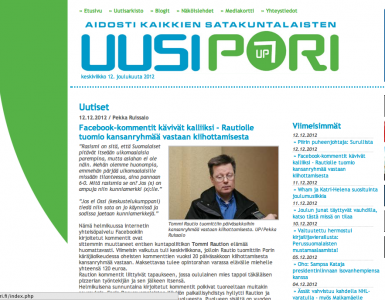
Tommi Rautio, the former city councillor of Köyliö in western Finland, who suggested giving a medal to a killer after he shot and killed a Muslim at an Oulu pizzeria in February, was convicted and fined 120 euros Wednesday by a Satakunta regional court for inciting ethnic hatred, reports Uusi Pori. 

Rautio, who said he was not guilty of the charges, is unemployed and depends on student aid for his livelihood.

Kuva 100


The former city councilman said that his writings on Facebook were done ironically.

Rautio wrote on his Facebook page:  ”If Janne is the one [who shot the foreigners at the pizzeria] then we should give Janne a medal…there is already a war going on and in every war [soldiers] are decorated.”

Rautio was sacked in March from the PS.

The former councilman ran again for councilman but was not reelected. He got nine votes.

Former Finnish PS councilman to be charged for inciting ethnic hatred

Posted on December 12, 2012 by Migrant Tales

Tommi Rautio, the former city councillor of Köyliö in western Finland, who suggested giving a medal to a killer after he shot and killed a Muslim at an Oulu pizzeria in February, will be charged for inciting ethnic hatred, reports YLE. 

Kuva 97

YLE reported that the Satakunta region prosecutor wants to slap Rautio with “a heavy fine” for threatening, defamatory and abusive language against immigrants.

Rautio wrote on his Facebook page:  “If Janne is the one [who shot the foreigners at the pizzeria] then we should give Janne a medal…there is already a war going on and in every war [soldiers] are decorated.”

The cold-blooded killing in Oulu, was one of four Muslim deaths reported during a tragic four-week period in January-February.

Rautio was sacked in March from the PS.

The former councilman ran again for councilman but was not reelected. He got nine votes.

One of the matters that raised some eyebrows after the Rautio affair was being covered nationally by the media, were plans by the police to not investigate the case.

The police announced three days later that it would, however, carry out an investigation whether Rautio incited racial hatred with his statements.


Social inclusion is never voluntary in a land where racism is king

Posted on December 10, 2012 by Migrant Tales

Freedom is never voluntarily given by the oppressor; it must be demanded by the oppressed.

Martin Luther King Jr.

Even if the late King Jr. was gunned down in 1968, that quote is still valid today. In Finland it would read in the following manner: “Social equality is never voluntarily given by the majority; it must be demanded by the oppressed.” 

We have discussed on many Migrant Tales blog entries about racism and social exclusion. If we look at this social ill in Finland, it could be placed in two periods: pre- and post-April 2011.

Before last year’s historic parliamentary election, when an anti-EU, anti-immigration and especially anti-Islam party won 39 seats, it’s clear that racism and xenophobia are influential political forces that not only give you votes, but power.

No modern political party in this country has ever tapped the undercurrent of Finnish racism as successfully as the Perussuomalaiset (PS).  Even if the popularity of the PS has weaned from 2011, its anti-immigration candidates did well in the October municipal elections.

Racism has found a good home in Finland to spread roots and survive. The same social ill that is impoverishing our country today by scaring away skilled immigrants and foreign investment, has been around since we became an independent nation in 1917.

Back then, our racism and xenophobia were mainly fueled by the former Soviet Union and Russia.

Racism flourishes in these parts because it is profitable and because too many want to keep it that way.

Racism destroys lives in Finland by robbing opportunities. If you aren’t resourceful to challenge this social ill as an immigrant or visible minority, it will keep you in limbo indefinitely.

One reason why large political parties in Finland have been so slow to react to the menace of the PS is that they too are white. Many house the same reactive attitudes about “otherness” as the PS.

Some parties are now waking up to the PS threat. It’s not because they are anti-racist, but because they see that party as a threat to their political base.

Since we understand a little how racism operates and grows in these parts, the most important step we should take is to trust ourselves.  We are the only ones who will spearhead our inclusion and acceptance issues in this society.

Here are some things you can do now to start changing things:

  • Learn as much as you can about the society you live in
  • Learn how social exclusion and racism thrive in such a society
  • Standing up for your rights will help your discover your new identity in your new homeland
  • Start up a blog or join one like Migrant Tales
  • Get politically active and speak out
  • Be outspoken, brave and have empathy
  • Demonstrate if needed
  • Go on hunger strike if needed
  • Start a petition if needed
  • Lead by example (we cannot change the world but we can influence those around us)
  • Be patient and persistent


  • Previous
  • 1
  • …
  • 124
  • 125
  • 126
  • 127
  • 128
  • 129
  • 130
  • …
  • 161
  • Next
Read more about documentary film
Read more

Recent Posts

  • Finland’s tabloids Iltalehti and Ilta-Sanomat are the pits
  • Riikka Purra’s Dr Jekyll and Mr Hyde mask
  • Double standards
  • Perussuomalaiset: Uusi logo, sama vanha juttu
  • Taco Trump

Recent Comments

  1. Absolutely Socking: Racist Finnish Facebook group against human rights gets flooded with socks on Musta Barbaari’s mother and sister charged by the police in “ethnic profiling” case
  2. Ilkka Nuotio on Pekka Myrskylä: “Tilastot kertovat toista kuin poliittinen keskustelu”
  3. Genrih Soinkara on The war in Ukraine and the Russian-Finnish border crisis are showing Finland’s ugly side
  4. Ahti Tolvanen on Comment by Ahti Tolvanen on the Helsinki +50 conference
  5. Angel Barrientos on Angel Barrientos is one of the kind beacons of Finland’s Chilean community

Archives

  • June 2026
  • May 2026
  • April 2026
  • March 2026
  • February 2026
  • January 2026
  • December 2025
  • November 2025
  • October 2025
  • September 2025
  • August 2025
  • July 2025
  • June 2025
  • May 2025
  • April 2025
  • March 2025
  • February 2025
  • January 2025
  • December 2024
  • November 2024
  • October 2024
  • September 2024
  • August 2024
  • July 2024
  • June 2024
  • May 2024
  • April 2024
  • March 2024
  • February 2024
  • January 2024
  • December 2023
  • November 2023
  • October 2023
  • September 2023
  • August 2023
  • July 2023
  • June 2023
  • May 2023
  • April 2023
  • March 2023
  • February 2023
  • January 2023
  • December 2022
  • November 2022
  • October 2022
  • September 2022
  • August 2022
  • July 2022
  • June 2022
  • May 2022
  • April 2022
  • March 2022
  • February 2022
  • January 2022
  • December 2021
  • November 2021
  • October 2021
  • September 2021
  • August 2021
  • July 2021
  • June 2021
  • May 2021
  • April 2021
  • March 2021
  • February 2021
  • January 2021
  • December 2020
  • November 2020
  • October 2020
  • September 2020
  • August 2020
  • July 2020
  • June 2020
  • May 2020
  • April 2020
  • March 2020
  • February 2020
  • January 2020
  • December 2019
  • November 2019
  • October 2019
  • September 2019
  • August 2019
  • July 2019
  • June 2019
  • May 2019
  • April 2019
  • March 2019
  • February 2019
  • January 2019
  • December 2018
  • November 2018
  • October 2018
  • September 2018
  • August 2018
  • July 2018
  • June 2018
  • May 2018
  • April 2018
  • March 2018
  • February 2018
  • January 2018
  • December 2017
  • November 2017
  • October 2017
  • September 2017
  • August 2017
  • July 2017
  • June 2017
  • May 2017
  • April 2017
  • March 2017
  • February 2017
  • January 2017
  • December 2016
  • November 2016
  • October 2016
  • September 2016
  • August 2016
  • July 2016
  • June 2016
  • May 2016
  • April 2016
  • March 2016
  • February 2016
  • January 2016
  • December 2015
  • November 2015
  • October 2015
  • September 2015
  • August 2015
  • July 2015
  • June 2015
  • May 2015
  • April 2015
  • March 2015
  • February 2015
  • January 2015
  • December 2014
  • November 2014
  • October 2014
  • September 2014
  • August 2014
  • July 2014
  • June 2014
  • May 2014
  • April 2014
  • March 2014
  • February 2014
  • January 2014
  • December 2013
  • November 2013
  • October 2013
  • September 2013
  • August 2013
  • July 2013
  • June 2013
  • May 2013
  • April 2013
  • March 2013
  • February 2013
  • January 2013
  • December 2012
  • November 2012
  • October 2012
  • September 2012
  • August 2012
  • July 2012
  • June 2012
  • May 2012
  • April 2012
  • March 2012
  • February 2012
  • January 2012
  • December 2011
  • November 2011
  • October 2011
  • September 2011
  • August 2011
  • July 2011
  • June 2011
  • May 2011
  • April 2011
  • March 2011
  • February 2011
  • January 2011
  • December 2010
  • November 2010
  • October 2010
  • September 2010
  • August 2010
  • July 2010
  • June 2010
  • May 2010
  • April 2010
  • March 2010
  • February 2010
  • January 2010
  • December 2009
  • November 2009
  • October 2009
  • September 2009
  • August 2009
  • July 2009
  • December 2008
  • November 2008
  • October 2008
  • September 2008
  • August 2008
  • July 2008
  • June 2008
  • May 2008
  • April 2008
  • March 2008
  • February 2008
  • January 2008
  • November 2007
  • October 2007
  • September 2007
  • August 2007
  • July 2007
  • June 2007
  • May 2007

Categories

  • ?? Gia L?c
  • ????? ?????? ????? ???????? ?? ??????
  • ???????
  • @HerraAhmed
  • @mondepasrond
  • @nohatefinland
  • @oula_silver
  • @Varathas
  • A Pakistani family
  • äärioikeisto
  • Abbas Bahmanpour
  • Abdi Muhis
  • Abdirahim Hussein Mohamed
  • Abdirahim Husu Hussein
  • Abdirisak Mahamed
  • About Migrant Tales
  • activism
  • Adam Al-Sawad
  • Adel Abidin
  • Afrofinland
  • Ahmed IJ
  • Ahti Tolvanen
  • Aino Pennanen
  • Aisha Maniar
  • Alan Ali
  • Alan Anstead
  • Alejandro Díaz Ortiz
  • Alekey Bulavsev
  • Aleksander Hemon
  • Aleksanterinliitto
  • Aleksanterinliitto ry
  • Aleksanterinliitto ry:n hallitus
  • Alex Alex
  • Alex Mckie
  • Alexander Nix
  • Alexandra Ayse Albayrak
  • Alexis Neuberg
  • Ali Asaad Hasan Alzuhairi
  • Ali Hossein Mir Ali
  • Ali Rashid
  • Ali Sagal Abdikarim
  • Alina Tsui
  • Aline Müller
  • All categories
  • Aman Heidari
  • Amiirah Salleh-Hoddin & Jana Turk
  • Amin A. Alem
  • Amir Zuhairi
  • Amkelwa Mbekeni
  • Ana María Gutiérrez Sorainen
  • Anachoma
  • Anders Adlecreutz
  • Angeliina Koskinen
  • Anna De Mutiis
  • Anna María Gutiérrez Sorainen
  • Anna-Kaisa Kuusisto ja Jaakko Tuominen
  • Annastiina Kallius
  • Anneli Juise Friman Lindeman
  • Announcement
  • Anonymous
  • Antero Leitzinger
  • anti-black racism
  • Anti-Hate Crime Organisation Finland
  • Anudari Boldbaatar
  • Arshiya Nasser
  • Aspergers Syndrome
  • Asylum Corner
  • Asylum seeker 406
  • Athena Griffin and Joe Feagin
  • Autism
  • Avaaz.org
  • Awale Olad
  • Ayan Said Mohamed
  • AYY
  • Barachiel
  • Bashy Quraishy
  • Beatrice Kabutakapua
  • Beri Jamal
  • Beri Jamal and Enrique Tessieri
  • Bertolt Brecht
  • Boiata
  • Boodi Kabbani
  • Bruno Gronow
  • Carmen Pekkarinen
  • Çelen Oben and Sheila Riikonen
  • Chiara Costa-Virtanen
  • Chiara Costa-Virtanen
  • Chiara Sorbello
  • Christian Thibault
  • Christopher Wylie
  • Clara Dublanc
  • Dana
  • Daniel Malpica
  • Danilo Canguçu
  • David Papineau
  • David Schneider
  • Dexter He
  • Don Flynn
  • Dr Masoud Kamali
  • Dr. Faith Mkwesha
  • Dr. Theodoros Fouskas
  • Edna Chun
  • Eeva Kilpi
  • Emanuela Susheela
  • En castellano
  • ENAR
  • Enrique
  • Enrique Tessieri
  • Enrique Tessieri & Raghad Mchawh
  • Enrique Tessieri & Yahya Rouissi
  • Enrique Tessieri and Muhammed Shire
  • Enrique Tessieri and Sira Moksi
  • Enrique Tessieri and Tom Vandenbosch
  • Enrique Tessieri and Wael Che
  • Enrique Tessieri and Yahya Rouissi
  • Enrique Tessieri and Zimema Mhone
  • Epäluottamusmies
  • EU
  • Europe
  • European Islamophobia Report
  • European Islamophobia Report 2019,
  • European Union
  • Eve Kyntäjä
  • Ezequiel Caldeiro
  • Facebook
  • Fadumo Dayib
  • Faisa Kahiye
  • Farhad Manjoo
  • Fasismi
  • Finland
  • Fizza Qureshi
  • Flyktingar och asyl
  • Foreign Student
  • Fozia Mir-Ali
  • Frances Webber
  • Frida Selim
  • Gareth Rice
  • Ghyslain Vedeaux
  • Global Art Point
  • Great Replacement
  • Habiba Ali
  • Hami Bahadori
  • Hami Bahdori
  • Hamid
  • Hamid Alsaameere
  • Hamid Bahdori
  • Handshake
  • Harmit Athwal
  • Hassan Abdi Ali
  • Hassan Muhumud
  • Heikki Huttunen
  • Heikki Wilenius
  • Helsingin Sanomat
  • Henning van der Hoeven
  • Henrika Mälmsröm
  • Hser Hser
  • Hser Hser ja Mustafa Isman
  • Husein Muhammed
  • Hussain Kazemian
  • Hussain Kazmenian
  • Ibrahim Khan
  • Ida
  • Ignacio Pérez Pérez
  • Iise Ali Hassan
  • Ilari Kaila & Tuomas Kaila
  • Imam Ka
  • inside-an-airport
  • Institute of Race Relations
  • Iraqi asylum seeker
  • IRR European News Team
  • IRR News Team
  • Islamic Society of Norhern FInland
  • Islamic Society of Northern Finland
  • Islamophobia
  • Jacobinmag.com
  • Jallow Momodou
  • Jan Holmberg
  • Jane Elliott
  • Jani Mäkelä
  • Jari Luoto
  • Jari Taponen
  • Jegor Nazarov
  • Jenni Stammeier
  • Jenny Bourne
  • Jessie Daniels
  • Joe Davidow
  • Johannes Koski
  • John D. Foster
  • John Grayson
  • John Marriott
  • Jon Burnett
  • Jorma Härkönen
  • Jos Schuurmans
  • José León Toro Mejías
  • Josue Tumayine
  • Jouni Karnasaari
  • Juan Camilo
  • Jukka Eräkare
  • Julian Abagond
  • Julie Pascoet
  • Jussi Halla-aho
  • Jussi Hallla-aho
  • Jussi Jalonen
  • JusticeDemon
  • Kadar Gelle
  • Kaksoiskansalaisuus
  • Kansainvälinen Mikkeli
  • Kansainvälinen Mikkeli ry
  • Katherine Tonkiss
  • Kati Lepistö
  • Kati van der Hoeven-Lepistö
  • Katie Bell
  • Kättely
  • Kerstin Ögård
  • Keshia Fredua-Mensah & Jamie Schearer
  • Khadidiatou Sylla
  • Khadra Abdirazak Sugulle
  • Kiihotus kansanryhmää vastaan
  • Kirsi Crowley
  • Koko Hubara
  • Kristiina Toivikko
  • Kubra Amini
  • KuRI
  • La Colectiva
  • La incitación al odio
  • Laura Huhtasaari
  • Lauri Finér
  • Leif Hagert
  • Léo Custódio
  • Leo Honka
  • Leontios Christodoulou
  • Lessie Branch
  • Lex Gaudius
  • Leyes de Finlandia
  • Liikkukaa!
  • Linda Hyökki
  • Liz Fekete
  • M. Blanc
  • Maarit Snellman
  • Mahad Sheikh Musse
  • Maija Vilkkumaa
  • Malmin Kebab Pizzeria Port Arthur
  • Marcell Lorincz
  • Mari Aaltola
  • María Paz López
  • Maria Rittis Ikola
  • Maria Tjader
  • Marja-Liisa Tolvanen
  • Mark
  • Markku Heikkinen
  • Marshall Niles
  • Martin Al-Laji
  • Maryan Siyad
  • Matt Carr
  • Mauricio Farah Gebara
  • Media Monitoring Group of Finland
  • Micah J. Christian
  • Michael McEachrane
  • Michele Levoy
  • Michelle Kaila
  • Migrant Tales
  • Migrant Tales Literary
  • Migrantes News
  • Migrants' Rights Network
  • MigriLeaks
  • Mikko Kapanen
  • Miriam Attias and Camila Haavisto
  • Mohamed Adan
  • Mohammad Javid
  • Mohammad M.
  • Monikulttuurisuus
  • Monisha Bhatia and Victoria Canning
  • Mor Ndiaye
  • Muh'ed
  • Muhamed Abdimajed Murshid
  • Muhammed Shire
  • Muhammed Shire and Enrique Tessieri
  • Muhis Azizi
  • Musimenta Dansila
  • Muslimiviha
  • Musulmanes
  • Namir al-Azzawi
  • Natsismi
  • Neurodiversity
  • New Women Connectors
  • Nils Muižnieks
  • No Labels No Walls
  • Noel Dandes
  • Nuor Dawood
  • Omar Khan
  • Otavanmedia
  • Oula Silvennoinen
  • Paco Diop
  • Pakistani family
  • Pentti Stranius
  • Perussuomalaiset
  • perustuslaki
  • Petra Laiti
  • Petri Cederlöf
  • Pia Grochowski
  • Podcast-lukija Bea Bergholm
  • Pohjois – Suomen Islamilainen Yhdyskunta
  • Pohjois Suomen Islamilainen Yhyskunta
  • Polina Kopylova
  • Race Files
  • racism
  • Racism Review
  • Raghad Mchawh
  • Ranska
  • Rashid H. and Migrant Tales
  • Rasismi
  • Raul Perez
  • Rebecka Holm
  • Reem Abu-Hayyeh
  • Refugees
  • Reija Härkönen
  • Remiel
  • Reza Nasri
  • Richard Gresswell
  • Riikka Purra
  • Risto Laakkonen
  • Rita Chahda
  • Ritva Kondi
  • Robito Ibrahim
  • Roble Bashir
  • Rockhaya Sylla
  • Rodolfo Walsh
  • Roger Casale
  • Rostam Atai
  • Roxana Crisólogo Correa
  • Ruth Grove-White
  • Ruth Waweru-Folabit
  • S-worldview
  • Sadio Ali Nuur
  • Sami Rusanen
  • Sandhu Bhamra
  • Sara de Jong
  • Sarah Crowther
  • Sari Alhariri
  • Sarkawt Khalil
  • Sasu
  • Scot Nakagawa
  • Shabana Ahmadzai
  • Shada Islam
  • Sharon Chang blogs
  • Shenita Ann McLean
  • Shirlene Green Newball
  • Sini Savolainen
  • Sira Moksi
  • Sonia K.
  • Sonia Maria Koo
  • Steverp
  • Stop Deportations
  • Suldaan Said Ahmed
  • Suomen mediaseurantakollektiivi
  • Suomen Muslimifoorumi ry
  • Suomen viharikosvastainen yhdistys
  • Suomen viharikosvastainen yhdistys ry
  • Suomi
  • Supermen
  • Susannah
  • Suva
  • Syrjintä
  • Talous
  • Tapio Tuomala
  • Taw Reh
  • Teivo Teivainen
  • The Daily Show
  • The Heino
  • The Supermen
  • Thomas Elfgren
  • Thulfiqar Abdulkarim
  • Tim McGettigan
  • Tino Singh
  • Tito Moustafa Sliem
  • Tobias Hübinette and L. Janelle Dance
  • Transport
  • Trica Danielle Keaton
  • Trilce Garcia
  • Trish Pääkkönen
  • Trish Pääkkönen and Enrique Tessieri
  • Tuulia Reponen
  • Uncategorized
  • UNITED
  • University of Eastern Finland
  • Uyi Osazee
  • Väkivalta
  • Vapaa Liikkuvuus
  • Venla-Sofia Saariaho
  • Vieraskynä
  • W. Che
  • W. Che an Enrique Tessieri
  • Wael Ch.
  • Wan Wei
  • Women for Refugee Women
  • Xaan Kaafi Maxamed Xalane
  • Xassan Kaafi Maxamed Xalane
  • Xassan-Kaafi Mohamed Halane & Enrique Tessieri
  • Yahya Rouissi
  • Yasmin Yusuf
  • Yassen Ghaleb
  • Yle Puhe
  • Yuliet Tresa
  • Yve Shepherd
  • Zahra Khavari
  • Zaker
  • Zalina Ametova
  • Zamzam Ahmed Ali
  • Zeinab Amini ja Soheila Khavari
  • Zimema Mahone and Enrique Tessieri
  • Zimema Mhone
  • Zoila Forss Crespo Moreyra
  • ZT
  • Zulma Sierra
  • Zuzeeko Tegha Abeng
© 2026 Migrant tales | Powered by Minimalist Blog WordPress Theme