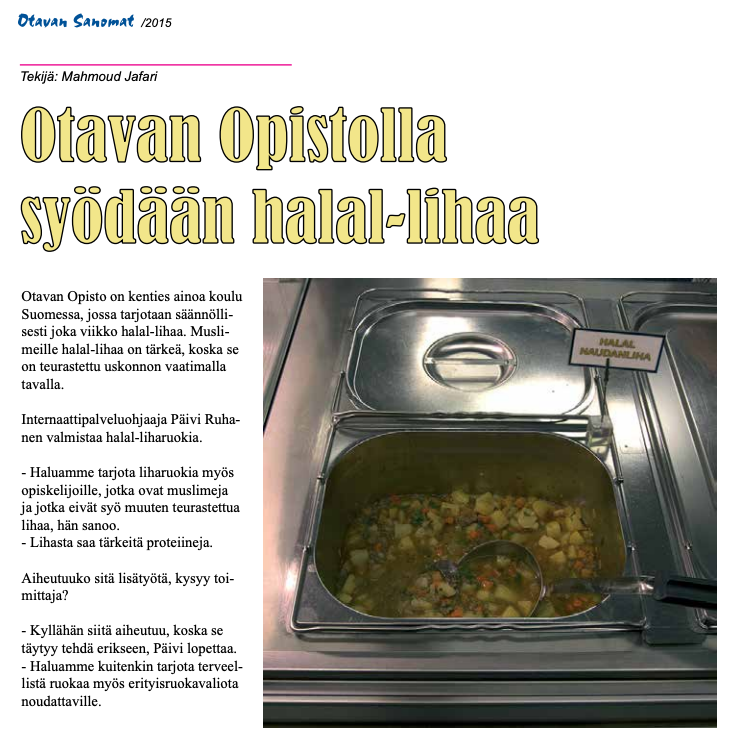
In 2010, when Otava Folk High School, located 14 km from Mikkeli, started offering halal meat on a regular weekly basis to its Muslim students, it became one of the first, if not the first, learning institutions to offer such meat to students. All of this, however, came to an abrupt end when the principal, Harri Jokinen, discontinued the service a few years later.
Jokinen blamed cost-cutting for the decision.
Päivi Ruhanen, who was a cook at the school’s cafeteria, stated that the primary motivation for serving halal meat to Muslim students was to provide them with a source of protein, which is an essential component of their diet.
When asked if preparing halal meat dishes caused more work for the cafeteria staff, she said that it did.
“Yes, it does,” Ruhanen was quoted as saying in the school publication Otavan Sanomat, “because it has to be done separately. However, we also want to offer healthy food for those who follow special diets.”
Considering that Islam is the second-biggest religion in Finland offering halal meat is still an exception in Finland. Even if cities like Helsinki, Vantaa, Espoo, Tampere and Turku have a large number of people who don’t speak Finnish or Swedish as their mother tongue, all five cities take special dietary requirements into account (allergies, vegetarian/vegan food). However, none of them offer at their schools halal meat on a regular basis.
From 1 August 2023 to 29 January 2024 a total of 1,271 persons sought asylum at the Finnish-Russian border. Well over 90% of the refugees are from Muslim countries like Syria (491), Somalia (360), Yemen (120), and Iraq (57). The total amount does not include some 200 Russians in legal limbo awaiting an interview by the Finnish Migration Service (Migri).
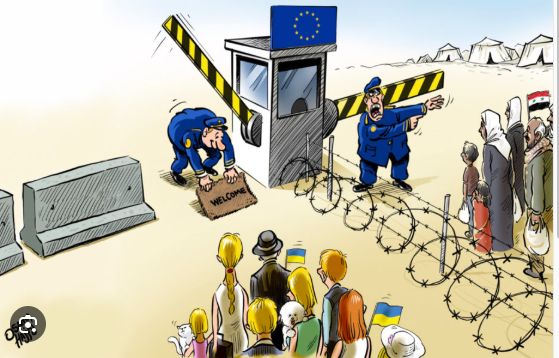
On 24 November, all border checkpoints were closed for the first time. Citing classified information, Interior Minister Mari Rantanen claims that people seeking asylum are “a threat to national security.” This is an odd statement because over 6 million Ukrainians who have fled to Europe since the outbreak of the war. None of them are considered “a threat to national security.”
Migrant Tales had the opportunity to interview some of these asylum seekers. While we cannot independently confirm it, pushbacks at the border appear to begun in December, according to the asylum seekers. Some Finnish border guards even used physical force on some and threatened at the border to “kick” some of them back to Russia.
One asylum seeker who entered Finland in November said he did not consider himself to be a threat to national security as the Finnish government claims. “If you think of it, Russia is our enemy because it has bombed cities and killed our people in places like Aleppo,” said Amir who spoke on condition of anonymity because he was applying for asylum. “For us, Russia was only a transit point to enter Finland.”
All of those interviewed by me had a long a difficult road to Finland. Some had gone first to Belarus and tried to cross the border without luck to Poland, Lithuania, and Latvia.
“It was very hard to be in the forest in the autumn cold in Belarus,” continued Amir. “The border guards in Latvia were the worst of the worst. They even used electric prods to turn us back.”
Thanks to social media, some found out that there was an opportunity to cross the border to Finland. Their greatest fear was that they’d be pushed back at the Finnish border to Russia.
“For a Syrian, this would mean almost certain death,” said another asylum seeker called Khaled, who also spoke on condition of anonymity. “It would mean deportation back to Syria, where you would face certain imprisonment and death.”
Amir said he had stayed in Russia at a hotel in Vyborg and was told to leave at 7 am to the border. At noon, he was taken to another checkpoint about 8 km from the Finnish border, where he was interviewed, registered, fingerprinted and passport stamped.
“The guards asked us if there was anyone smuggling people and who was going to seek asylum but everyone remained silent,” said Khalid. “We all bought bikes. Mine cost 300 euros.”
The money for the bike included a ride to the border. “When we got out of the car, the Russian guards told us to ride ahead and not look back. We did what they said.”
Khalid does not remember the name of the border crossing, possibly Vaalimaa, but he does remember the Finnish border guard who first told him to go back to Russia. “He said that he’d kick me back to Russia,” he continued. “I insisted and he finally accepted my plea for asylum.”
Länsiväyläis a community newspaper that lives off advertising revenues. One story on Ukrainian refugees raking a park in Kirkonnummi, a city near Helsinki, is another chapter in framing Ukrainian refugees as “good” refugees, while similar people from the Middle East are viewed as “bad” refugees.
One PS politician states:
“These Ukrainians are pretty different from many who sought asylum in Finland.
Thankfulness is shown in this way (raking a park lawn. See picture below.)
I hope that some of them remain in Finland when the war ends.
They are needed here.
I believe they will not be over-represented in crime statistics. “
Iraqi asylum seekers raking leaves in a story published in 2015. Source: YleA far-right Perussuomalaiset politician praising Ukrainian refugees in order to hit Muslim refugees below the belt. Source: Facebook
Instead of framing “good” and “bad” migrants, it would be good for the media to show that we are as a society humane and ready to help others. If we can open our hearts to Ukrainians, why couldn’t we do the same for people from the Middle East and Africa?
Twenty-year-old Fardowsa Mahamoud’s questioning why the hijab, or veil, is not permitted in the Finnish military brought a sense of déjà-vu. About six years ago, Busman Gill Sukhdarshan Singh won after a year-long legal battle to wear a turban at work.
In Finland, Sikh bus drivers won the right to use turbans at work, while in the United Kingdom granted such a right in 1969.
Singh’s struggle and Mahamud’s rejection by the Finnish military are all examples of how some sectors of Finland continue to believe that they are the only one’s living in this country. Even if our official adaption policy is supposed to be a two-way street, it is a one-way process (assimilation), full stop.
Mahamud wanted to enroll in the army to serve later as a peacekeeper, which is her dream. Her efforts came to an abrupt end when an interview with the Karelia Brigade said they did not permit hijabs for safety reasons and that uniforms had to have the same appearance.
“I was disappointed to learn this,” she was quoted as saying in Yle News. “I wouldn’t have applied for service if I didn’t accept what they wear in the army, but the hijab is my choice and decision. It’s important to me.”
Islamophobia in all of its forms is cancer that is spreading at this moment throughout Europe. People who attempt to stand up to this social ill are intimidated and attacked. Farid Hafez, whom I know personally and edits the European Islamophobia Report, the most comprehensive report published annually on the topic, is charged for alleged terrorism.
Apart from his activism and bringing attention to Islamophobia, he is a non-resident researcher at Georgetown University, was a Fulbright Professor at UC Berkeley and a leading scholar of Islamophobia Studies.
It wasn’t too long ago when I received an email from Hafez:
“[I] write you today in a personal capacity. I am sure, most of you are following the troubling news on the increasing attacks on academia in France and elsewhere. As you are also aware of, an attack happened killing four innocent people in the streets of Vienna on 2 November 2020. Officially unrelated to this event, but in an atmosphere of having to counter-terrorism, the Austrian government raided the homes of 30 alleged terrorists one week later. It was the largest raid since 1945. Unbelievable but true, I was amongst the targeted ones.”
The video below gives a glimpse of Hafez’ case.
Without bringing any formal charges except based on suspicion and hearsay, Hafez is suspected of terrorism by the Austrian authorities. A question: Is this what happens when you can organize your words and challenge state Islamophobia?
In Argentina, where over 30,000 vanished during the so-called dirty war (1976-83), the de facto government’s methods were seen as state-sponsored terrorism.
In the same light, all types of intimidation, promotion, and spreading anti-Muslim racism by legal and official means could be classified as state Islamophobia.
The search warrant alleges that Hafez is a member of an organization intent on overthrowing the Egyptian government regime of Abdel Fattah el-Sisi, destroying Israel and creating a global caliphate in Jerusalem, its capital.
“Would it not be serious,” said Hafez, “this would sound like a joke.”
The political scientist and one of the editors of the European Islamophobia Report, is confident that all the charges brought against him will be dropped.
“I am very convinced that no single allegation will stay,” he added.
The cost of the raid and the action of the Austrian government:
The case will take three years in the courts and cost an estimated 100,000 euros.
Hafez’ bank account and assets are frozen and cannot sell his house.
The Austrian government is drafting a law that makes “political Islam” a criminal offense, which would make it easier to criminalize every kind of Muslimness.
The latest hijab ban ruling by the Austrian Constitutional Court is seen as a signal against political Islam by its lawmakers.
Who could forget the former minister of immigration and integration, Inger Stojberg? Apart from her Islamophobic rhetoric, she is also remembered with a cake celebrating in 2017 the 50th tightening of Danish immigration laws.
There seems to be no shortages of Islamophobic politicians in Denmark.
The former minister is in a lot of hot water today for misleading parliament on the illegal order of separating certain married couples at asylum reception centers, reports The Local.
Writes The Local: “A further conclusion of the report is that the former minister, during the parliamentary hearings, ‘gave a different impression of the directive as it was communicated to the (immigration) service than was the case (in reality).’”
Bashy Quraishy, an anti-racism activist, wrote on Facebook: “Shouldn’t Inger Stjoberg be disqualified from her political position, and the law should punish her as Erik Ninn Hansen was after the Tamil Case?”
When he was minister of justice, Hansen tried to hinder Tamil refugees’ family reunification despite their legal rights as stipulated in Danish law.
The scandal led to the resignation of Poul Schlüter’s government in 1993.
Cartoon (left): Former minister of immigration and integration, Inger Stojberg tells the little girl if she does not have arms, she cannot have any cake.
I imagine one of the reasons people cling to their hates so stubbornly is because they sense, once hate is gone, they will be forced to deal with pain.
James Baldwin (1924-87)
Ir, there is one matter that the killings in France have reinforced, it is the disenfranchisement of the Muslim community of France. How is it possible that two deranged persons that caused tragic deaths to end up with the Franch state placing a gun at the Muslim community’s head?
The short leash that Prime Minister Emanuel Macron wants to place on France’s 5.7-million-strong Muslim community speaks volumes about the racism in that country.
Not only is the French state aiming to educate its own Muslims under the new anti-separatist law, but it plans a crackdown on more than 50 Muslim organizations. One of these includes anti-racist organizations such as the Collective Against Islamophobia in France (CCIF).
In these troubled times for Muslims, there is a good matter to remember:
One of the matters that the coronavirus has exposed as well. is how populist anti-immigration parties like the Perussuomalaiset (PS)* assail migrants and minorities, especially Muslims.
Helsinki Mayor Jan Vapaavuori was quoted as saying in statementthat he is concerned by the rapid rise of coronavirus infections among the Somali speaking community.
“Close to 200 cases have been identified to date, which translates to 1.8 percent of the Somali community in the capital, compared with the 0.2 percent average among all of Helsinki’s residents,” the statement said. “In light of this recent worrying trend, the City of Helsinki and HUS hospitals have stepped up their efforts to prevent further contagion.”
While Migrant Tales alerted its readers about how minorities could be more susceptible to infection, the PS has criticized state-owned broadcaster Yle for offering information about coronavirus in the Somali, Kurdish, Farsi and Arabic languages.
One PS official that was highly critical of the broadcasts was party secretary Simo Grönroos. “On morning TV they suggested that broadcasts in [these people’s] mother tongue should be expanded. This is not the way to go. If they want to hear the news in Arabic they should move to an Arabic-speaking country.”
It was last summer that PS MP Ano Turtiainen thanked the ebola virus for doing its part in keeping population growth in Africa.
Back then, he had no idea that the white people like him in Europe would be the victims of a deadly killer called coronavirus.
While exceptionalism and many other blindspots may keep us from seeing inequality in our health care system in Finland and other EU countries, the European Network Against Racism is spot on by stating, the #inequality doesn’t just make pandemics like #Covid_19 worse – it could cause them.
Look out also for a racist blame game against minorities for higher coronavirus infections.
Social inequality is the culprit, not the minorities’ fault because his or her illtreatment, microaggressions, and social exclusion may have undermined his language and social skills.
If I had to choose the worst journalism in Finland this year, that would be the media coverage to the sexual assault cases of minors that took place from November 2018 to before the parliamentary elections of April 14.
If you speak with some Muslims in Oulu, they will tell you that the hysteria died down after the April parliamentary elections.
In all fairness, I would like to point out that Finland has, fortunately, newsmagazines like Suomen Kuvalehti and other regional papers that try to report fairly and objectively about the plight of Muslims and minorities in Finland.
Many stories published in the Finnish media reinforce stereotypes about Muslims. This story, published in September 2018, is one of the worst examples. The woman wearing a niqab in the picture does not represent a political party even if the story was about niqab and burka bans in Finland. The picture was taken down shortly after it was published. Source: Yle.
If one can describe the frenzy that was fuelled by the media, police, and politicians concerning the Oulu sexual assault cases, it would be similar to the incitement of a lynch mob before they are about to hang a person in public.
Even if a real lynching is different from one that takes place on social media, both have the same aim. If a real lynching publicly murders a person, a social media lynching kills over and over again a scapegoat, which is often an ethnic group.
Turkish writer Mehmet Muran Ildan described the act of lynching in the following words: “A society with lynch culture needs a big zoo, not for the animals definitely, but for the very people themselves!”
When the media is in “lynch mode,” fair reporting is the first victim that is sacrificed. State Broadcasting Company Yle is a sad example of the latter. It threw in the dustbin and permitted its prejudices and biased reporting to get the best of it.
Just like the coverage of the Oulu sexual assault cases, the coverage of the repatriation of about 11 Finnish women and 30 children from the al-Hol camp in Syria was characterized by disinformation and lack of information. This illustration used in a Helsingin Sanomat story has women apparently wearing burkas even if they use niqabs. See Migrant Tales.
An example of Yle’s biased and unbalanced reporting were the stories it published between November 27 and February 13 on the Oulu sexual assault cases. A total of 77 stories were published during the period under review. In one day, Yle published 13 stories about the topic!
Even if it appeared from the media, police statements and politicians that Finland was suffering an epidemic of sexual abuses by migrants, only eight were convicted and given prison sentences.
While not criticising the media, Päivi Happonen, a Yle reporter, wrote in her blog the over-enthusiastic communications policy of the Oulu police. “So what bad did [Oulu police’s communication] inflict?” she asked. “A lot. Many have the impression that Oulu became the crime capital of Finland, where asylum seekers rape all the children they can.”
The unbalanced and overzealous reporting spread fear as well in the Muslim community. According to Imam Abdul Mannan of Oulu, Muslims did not feel safe and avoided going to the city center.
Another matter that sparked excesses by the media’s reporting was that parliamentary and European parliamentary elections were going to be held in April and May, respectively. Politicians from the governing party demanded tougher laws on crime and even tests on Finnish values to asylum seekers. The City of Oulu went as far as to ban asylum seekersfrom visiting daycare centres and elementary schools.
Even if the governing National Coalition Party and Center Party attempted to gain from the situation with their ever-get-tough stance on “people of foreign origin,” which is code for non-EU citizen or Muslim, the party that reaped the most from the situation was the Islamophobic and populist Perussuomalaiset (PS).*
This is reinforced by opinion polls published monthly by Helsingin Sanomat, and Yle. Yes, you read correctly: monthly polls.
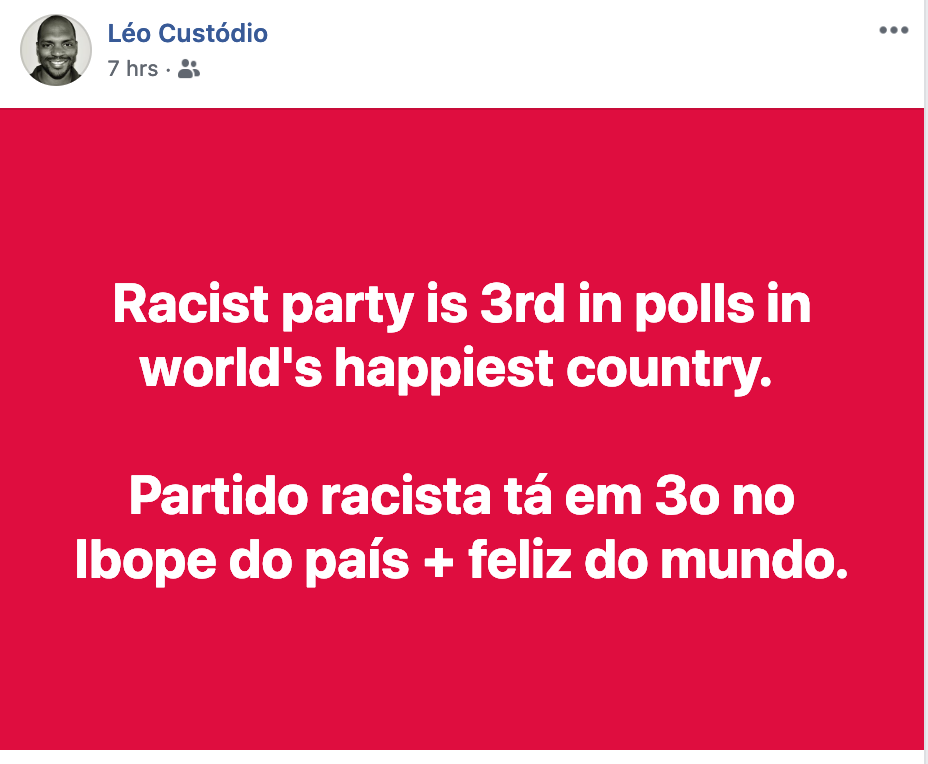
One such poll showed the popularity of the PS rising by an impressive 13.7 percentage points in a year, from 8.7% to 22.4% in November.
Léo Cutódio published at the end of March the following posting on Facebook. In March, a Yle poll showed the PS with 15.1% and trailing behind the Social Democratic Party and the National Coalition Party.
Emilia Palonen, a University of Helsinki lecturer, was quoted as confirming that “anti-immigration sentiment” is the cause for the rise in popularity of the PS. Even if Palonen does not state it directly, one of the causes of the growth in such anti-immigration sentiment is due to Oulu.
One wonders how a country like Finland, which scores high on the World Press Freedom Index, so many important newspapers get it wrong when it comes to writing about Muslims and minorities.
There are various reasons why news coverage of Muslims and other minority groups is unbalanced:
Muslim and minority sources and experts are rarely used as authorities in a balanced news story.
The media too often paint Muslims, and minorities with a single brush and underline a narrative of “Us” versus “Them.”
There are no Muslim editors and there is an underwhelming number of visible minorities working in newsrooms as staffers.
Some media continue to give inflated respectability, importance, and space to Islamophobes and xenophobes.
Helsingin Sanomat’s staff is celebrating the daily’s 130th anniversary in November. Do you see any minorities? Only one person in the picture has a so-called foreign-sounding name. With about 16% of Helsinki’s population is non-white Finnish, Muslims and minorities are underrepresented in the newsroom. Source: Helsingin Sanomat.
If there is something that publications like Helsingin Sanomat and Yle could do is to write critically about the racism and Islamophobia in parties like the PS and not to treat their politicians in a neural-friendly manner.
The media is a crucial watchdog that looks over people’s rights irrespective of their backgrounds. If Finland doesn’t watch out, and especially its media, the slippery slope to Viktor Orbán’s Hungary is not too faraway.
The tragedy that took place Tuesday in Kuopio, which claimed the life of a person and left ten injured, including the suspect, raises a lot of questions. One of these is if we should treat what happened as a terrorist act or just some mentally troubled lone wolf?
The National Board of Investigation (Keskusrikospoliisi) Detective Chief Inspector Olli Töyräs was quoted as saying in Yle that the motive of the crime is still unknown and under investigation. According to the latest information, the police believe that the suspect acted alone and had no ties to organized crime.
The suspect, who was a student at the Savo Vocational School, did not know any of the victims. He allegedly set a fire in the building that was quickly put out.
Helsingin Sanomatreported today that the suspect was not in a relationship with any of the victims.
Speculation was rife on social media that the suspect was a foreigner.
The reaction of some Finns on social media was disgraceful. Some blamed the attack on a foreigner and appeared to be disappointed when it was confirmed that the suspect was a white Finn.
The Perussuomalaiset*, which specializes in fear-mongering and spreading racist hatred of groups like Muslims, were strangely quiet on Tuesday.
Green Party Interior Minister Maria Ohisalo said that despite what happened in Kuopio, Finland is still one of the safest countries in the world.
True, Minister Ohisalo, but for whom? Remember what happened after the Turku stabbings in August 2017? Migrants and especially Muslims were harassed and attacked and blamed by white Finns for the stabbings. If the attacker in Kuopio were a Muslim, what type of violence would be unleashed against non-white Finns and migrants?
Would Ohisalo reassure us then that Finland is one of the safest counties in the world?
Even without these types of crimes, Finland is not a safe country for too many migrants, especially people of color.
* The far-right Perussuomalaiset (PS) party imploded on June 13, 2017, into two factions, the PS and New Alternative, which is now called Blue Reform. In the last parliamentary election, Blue Reform has wiped off the Finnish political map when they saw their numbers in parliament plummet from 18 MPs to none. A direct translation of Perussuomalaiset in English would be something like “basic” or “fundamental Finn.” Official translations of the Finnish name of the party, such as Finns Party or True Finns, promote in our opinion nativist nationalism and racism. We, therefore, at Migrant Tales prefer to use in our postings the Finnish name of the party once and after that the acronym PS.