Migrant tales
Menu
  • #MakeRacismHistory “In Your Eyes”
  • About Migrant Tales
  • It’s all about Human Rights
  • Literary
  • Migrant Tales Media Monitoring
  • NoHateFinland.org
  • Tales from Europe
Menu

Tag: Multiculturalism

Sweden Democrats openly attack cultural diversity – will the PS of Finland follow their example?

Posted on December 15, 2014 by Migrant Tales

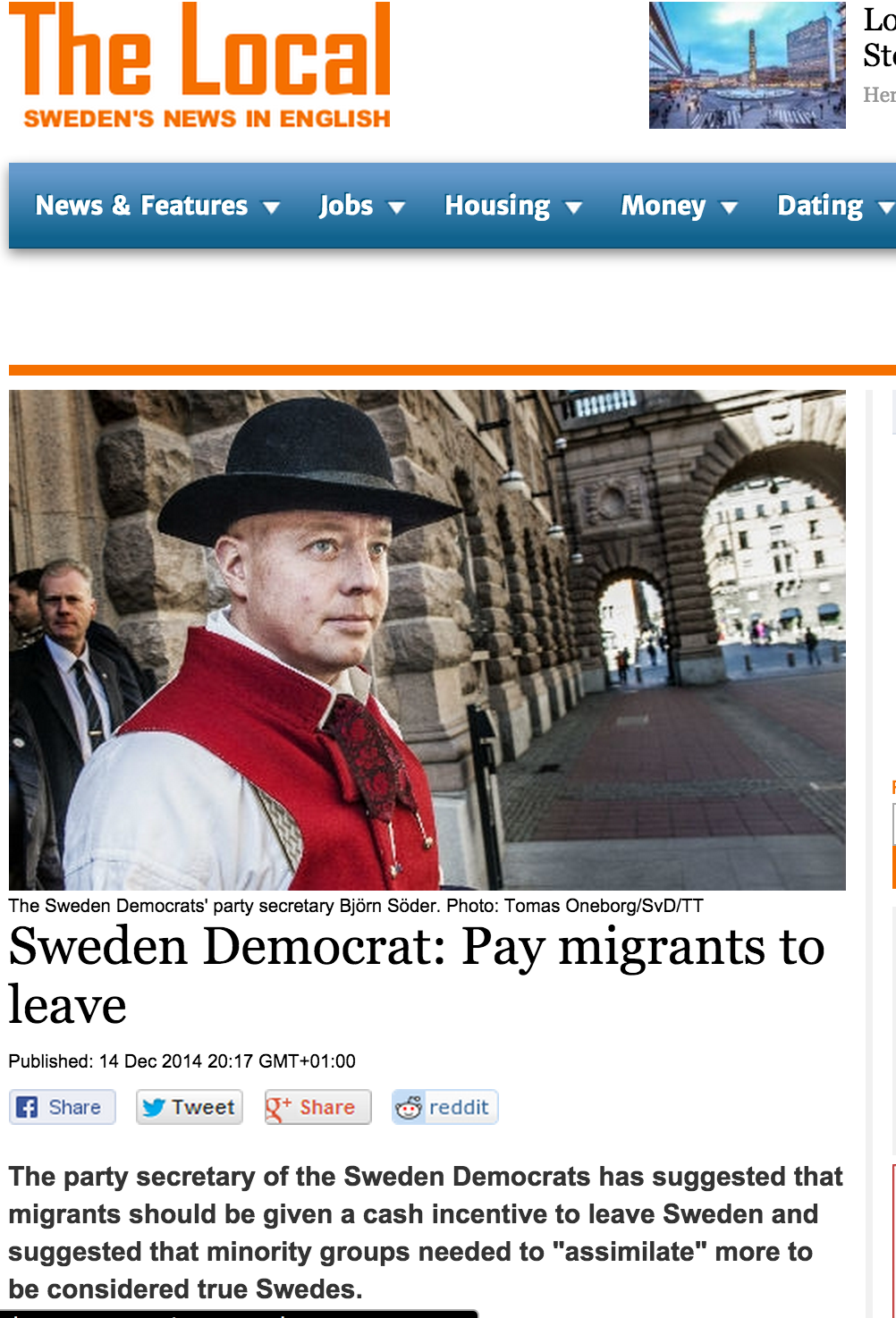
In a clear attempt to cash in on the anti-immigration sentiment, Sweden Democrat party secretary Björn Söder said that minorities like the Saami could never be Swedes and was willing to pay immigrants to leave the country, reports The Local.

The mere suggestion that Sweden is only a country of white Swedes reveals the racist and exclusive mindset of the Sweden Democrats. In a US context it would be something like encouraging Hispanics, blacks and other minorities to go back to where they came from because white USAmericans rule the country.

“Yes, and that is good,” Söder was quoted as saying on The Local. “We must make it easer for those considering moving back to their country. Then we’ll be in a better condition to create a society of common identity.”

Näyttökuva 2014-12-15 kello 0.17.03

 Read full story here.

In Söder’s views, Jews, Kurds and the Sami are examples of groups that are Swedish citizens but cannot be considered “true” Swedes if they don’t assimilate into Swedish society.

Has anybody asked Söder who is a so-called “true” Swede? Why does he think he is a “true” Swede? Is there any such thing as a “true” Swede?

What Söder is claiming is what is exactly wrong in the Nordic region. White Nordic people think that this land is exclusively theirs. This is malarkey.

The language of the Sweden Democrat party secretary is regurgitated by parties like the Perussuomalaiset (PS) of Finland, Danish People’s Party and Progress Party of Norway. All four of them believe that only white Nordic people are the right people that should live in this region.

Willy Silberstein, chairperson of the Swedish committee against anti-Semitism disagrees with Söder.

“I am Jewish and born in Sweden,” he said. “I am just as much Swedish as Björn Söder. There is an us and them mentality which I think is a characteristic of the party.”

While the PS in Finland have distanced themselves from the Sweden Democrats, their success in the March elections will be watched closely by the PS. Finland holds parliamentary elections in April 2015.

* The Finnish name for the Finns Party is the Perussuomalaiset (PS). The names adopted by the PS, like True Finns or Finns Party, promote in our opinion nativist nationalism and xenophobia. We therefore prefer to use the Finnish name of the party on our postings.

World Café ponders if Porvoo, Finland, is a multicultural city

Posted on June 12, 2014 by Migrant Tales

Migrant Tales insight:  The World Café concept is an excellent way to empower and encourage people to participate and promote active citizenship. This World Café session, which took place in Porvoo on May 17, and asked participants to give their views on how cultural diversity is faring in the city.

One of the important findings of the event was that Porvoo needed to do more work in inclusion of migrants. Write the organizers: “All agreed Porvoo is a good place to live and the issues here are no different from any other city in Finland. There will be an even greater racial mix but this does not mean we will understand or communicate better with each other unless we take action now to make this happen.”

The event was organized by Citizens’ Forum, whose mission is to build civil society through culture and civic education offered by organizations.

___________________

The idea

The hearing was a part of the Participatory Community work –project of Citizens´ Forum. The project had two main elements; Identity work and active citizenship. The hearing in Porvoo concentrated on the latter. The idea in Porvoo was to build an open space for discussion of the people in Porvoo. The theme for the hearing was Porvoo – the city of many cultures. It was selected because we wanted to raise the issue that there are many people from other countries living in Porvoo who are not a problem or a threat but a possibility and a source for building a better Porvoo.


This video will give you an idea of how the World Café concepts works.

The basic work

We noticed that to be able to do participatory community work in the real sense of the word we had to find some way to get a position in the community where we can have a dialogue with the different actors (Finns, ethnic minorities, officials of the city, associations, educational institutions) who work with the theme of multiculturalism. One challenge for us was also to find ways to support the co-operation between the different institutions with common goals.

To do this basic work Alex McKie from Citizens´ Forum worked in Porvoo for three months before the Word Café Hearing. He also made tight co-operation with Kepa and the Mahdollisuuksien tori project group which was organising the Mahdollisuuksien Tori (Marketplace of Possibilities) event 2014 in Porvoo. To get the synergy effects there was a decision made that the Citizens´ Forum World Café will take place on the same day as the Mahdollisuuksien tori on the 17th of May.

In the process of making the hearing possible there were many actors working together with us. We have to mention some of the partners in the network. The Culture House Grand was giving us the possibility to use the culture house as a venue for the hearing. Amisto – ammattiopisto prepared a devising drama performance with which the hearing was opened. Luckan was helping us to connect us with many important actors eg. the ombudsman for minorities Eva Biaudet. Eva Biaudet sent a video greeting to the participants of the hearing. We also had contact with Mikaela Nylander, a member of the Parliament and the chair of the Porvoo city council. The Red Cross of Porvoo was marketing the event actively and they also had a work shop on Young people and voluntary work right after the World Café on the 17th of May.

The Word Café

It was a long process to choose the actual method for the hearing. We were first thinking of a panel on our theme but we decided that it was not deliberative enough to meet our needs. For a long time we were discussing whether the hearing should be organized as a World Café or as an open space discussion. As we didn’t know if 5 or 50 people would turn up or how many languages the discussion would include etc. , we decided to do it as a Word Café.

In the process we had four Café tables and for questions: Is Porvoo Multicultural? How has multiculturalism affected your life? How can people from different cultures talk together? How will my Porvoo look like in the year 2020? We also had four discussion rounds, so each participant could discuss all the themes.

We had a team of facilitators which reflected the cultural and language construction of the Porvoo community. About 20 citizens turned up. As all of them were able to communicate in English we decided to make the hearing in English.

The four discussion round lasted about one hour. Afterwards we had a feedback discussion where the facilitators of each Café table introduced the discussions which had taken place in their group. These introductions are presented beneath.

Café Table nr 1: Is Porvoo multicultural?

The initial response to this question was: yes, and this was given without hesitation. However, with each group there was also the same response that there are not many people from other cultures visible, at least not in the city centre. They also seem to keep a low profile wherever they are. A group of six young ethnic minority youth disclosed that if you are from an ethnic minority group you are more likely to be picked on. People know that what they are doing is wrong but they do it anyway. The young participants also felt that they are blamed for most things before their white counterparts. They especially didn’t feel listened to or understood by their teachers and their message to them was: “open your ears”.

Other group members who have had contact with newcomers to Finland stated that it is very hard for people from ethnic minority groups to access mainstream services and they gave sport as an example. People from ethnic minority groups are likely to live in two areas of the city and don’t tend to travel beyond these areas. They also spoke of young people who are acting as carers for the rest of the family due their language skills. They felt that many people from ethnic minority groups are isolated and especially they need courage to access anything mainstream.

All agreed that Porvoo is multicultural but only in the smallest sense. The mere fact that there are people from many cultures in Porvoo, doesn’t make Porvoo Multicultural in strict meaning of the word. What matters is the quality of the dialogue between the people and cultures. Some participants thought that there is an expectation for ethnic minorities to assimilate into Finnish Culture at the cost of their own.

There was a sense of disappointment. At the same time the Mahdollisuuksien tori (Marketplace for Possibilities) was taking place outside and candidates of the European election were campaigning and yet so few people were willing to discuss such important issues. They felt that we spend a lot of time in festivals and events, which are multicultural but there is no open discussion of the effects of multiculturalism. This dismay was expressed as to why there were no city officials taking part in the forum and why were these issues being avoided.

Café Table nr 2: How has multiculturalism affected your life.

All participants of this discussion felt that multiculturalism had affected their lives in positive ways. The overall view was that in last five years Porvoo has become a much better place for different cultures to live together. This cultural mix gives new ideas and freshens to the society. There were also positive ideas about what newcomers contribute to the economy and culture of the city.

Many of the white Finnish participants said they work together with people from ethnic minority groups on a daily basis and they feel it has improved their lives. They feel that the attitude is important and if you have an international view of the world it helps you accept other cultures. In their work they come across vulnerable people from other cultures and they feel that helping them is an important step in building mutual trust.
The participants felt that friendship between cultures is possible when we see the person as human beings. There can be some challenges, but if you do the work, it enriches every ones life.

Café Table nr 3: How can people from different cultures talk together?

The participants felt that one of the key obstacles to intercultural communication is language. People have to have some kind of common language to be able to communicate with each other. But this is not enough. We have to build a solid foundation for people to have an opportunity to communicate as equals. First of all there should implement a measurable integration strategy. This strategy take into account the holistic needs of individuals and their families (incl. questions of education, employment, social services and rights as citizens).

There should be education on multiculturalism in schools as early as possible and education for employers to recognize the skills and professionalism of ethnic minorities. The Media should also have a clear agenda in questions relating to multiculturalism. In this way we would get more of a balanced perspective and understanding about the underlying issues.

There are very good examples of cultural cooperation between people in Porvoo. But many issues that immigrants face in their every day lives are not spoken of. It was thought that there is not a good mix of the different cultural groups in Porvoo and people tend to stay within their own culture. This was one of the contributory features of isolation and creates barriers to positive interaction.

All agreed there was a need to empower and strengthen ethnic minority groups in positive ways which would include them in decision making processes. Some examples where this kind of participation could take place are decisions about social services, recreation and education. Sport was also an area of concern, because there are many young people who would like to take part in sports but don’t. They consider the main reason for this is an inadequate understanding of the needs of these young people by the coaches and the overall atmosphere which makes it difficult to join.

Café Table nr 4: What will my Porvoo look like in the year 2020?

Porvoo will become more international and less traditional due to the expansion of the Helsinki metropolis. There will be a greater cultural mix but this will not necessarily lead to better understanding of each other. Dialogue between cultures will become an even more complicated issue. Although we will be more aware of other cultures there may be little interaction between groups if we don’t take action to address this issue. The participants recommended that we take positive steps towards creating spaces for cultural interaction. This would be where different cultures can meet equally and take proactive action to strengthen cultural identity and encourage inclusion. They would like to see more meeting points where issues can be discussed and give Citeizens’ Forum World Café as an example.

The younger members of the forum also described Porvoo as the best place to live and expressed this in writing on the table cloths of the World Café: “Porvoo is best”. In the discussions there was a sense of optimism that Porvoo is a good place to live and that the issues raised are to be found all over the country. They feel that there are the resources and will to meet the needs of 2020 Porvoo. However, this needs openness and a place where contrasting views can be heard.

Conclusions and recommendations.

Porvoo is multicultural and that is not going to change. This gives the citizens many challenges and experiences that can improve the quality of our lives. For this to happen we need to listen and to learn from each other. The forum was described by its members as the first time they had been able to learn from others in this way about the themes of multiculturalism. One of the biggest issues that all expressed was the disappointment that city officials and politicians had not taken part in the forum. They also wondered why it is so difficult to talk about issues we are not so comfortable with like discrimination end exclusion.

On a positive note they think that they have now found their voices and a way to work together that can find a way forward. But for this to happen it needs greater awareness and understanding of how discrimination affects the quality of people’s lives. For attitudes to change there needs to be more forums like this Citizens’ forum World Café.

We had spoken of the need to break down stereotypes and to start to look at each other as people. This worked both ways and a need was identified for ethnic minorities to stop stereotyping our Finnish counterparts and to understand their situation and story as well. The forum had established trust between us as people free from institutional or cultural constraints.

We identified many issues but did not have the time to form actions. We felt that to do this we would want to give our decisions to the representatives of the local government of Porvoo to decide what action can be taken.

Jussi Halla-aho: France the football giant

Posted on June 8, 2014 by Migrant Tales


Migrant Tales insight: We get a lot of email and tip-offs from our readers. The latest one we got is of three blog entry translations in English of Perussuomalaiset (PS)* MEP Jussi Halla-aho, who was convicted for ethnic agitation. This second one, France the football giant, was published in Scripta on July 2, 2006.

Apart from understanding how racism in Finland thrives and which arguments are used to spread hatred of other groups, one matter is clear from all three writings: They are repulsive and we apologize if anyone is offended by them. The writings have nothing to do with a PhD’s critical thinking; they are simply urban tales and prejudices that have been piled high and deep. 

Another important aspect that we must acknowledge about these writings is that they are hostile towards migrants and intended for gullible Finns. They are hateful writings that fuel prejudice, which in turn fuels social exclusion. 

Acceptance of these two anti-immigration parties this week in the ECR with “MEPs with criminal records,” proves that shoplifting is a worse offense for a politician today than being sentenced for ethnic agitation. It sadly exposes as well why racism has grown in Europe and why mainstream politicians and the media have helped fuel such intolerance. 

Our only motive for publishing these blog entries is so that other Europeans who don’t speak Finnish can read what kind of politician Halla-aho is. 

For more insight into the PS, take a look Far-right and anti-immigration quotes in English by the PS.

Migrant Tales will publish Monday the last of the three blog entries, Do not tolerate the intolerant one (2007).

* The Finnish name for the Finns Party is the Perussuomalaiset (PS). The names adopted by the PS, like True Finns or Finns Party, promote in our opinion nativist nationalism and xenophobia. We therefore prefer to use the Finnish name of the party on our postings. 

_____________________________

The headline includes an obvious allusion to my earlier article Bahrain the Sports Giant, and those who know me already sense what is eating me this time…

…and those who are ignorant of soccer, let me introduce the French team, victorious at least as yet, those dashing descendants of Asterix, Charlemagne, Louis the 14th, Montesquieu, de Gaulle, and Sartre:

Fabien Barthes

Jean-Alain Boumsong

Eric Abidal


Patrick Vieira

William Gallas

Claude Makelele


Florent Malouda

Vikash Dhorasoo

Sidney Govou


Zinedine Zidane

Sylvain Wiltord

Thierry Henry


Mikael Silvestre

Louis Saha

Lilian Thuram


Gael Givet

Alou Diarra

Willy Sagnol


David Trezeguet

Pascal Chimbonda

Frank Ribery

That’s fine, as far as it’s about sports, it’s probably all the same who is kicking the ball, as far as he is kicking it with skill and emotion. However, the fact that it’s the team representing France, of all countries, raises questions about comparability, representativity and role casting.

What does it mean for a team to be the national team? When the line-up listed above wins a tournament, does it mean that France is the winner? Does this team represent France in the way, say, the Spanish team represents Spain? In one word, are the Spanish and French national teams national in the same sense, and are their exploits comparable in the sense of national team sports? (I am thinking of the philosophical side, not of juridical technicalities.)

Somebody could say that this team obviously represents French and Frenchmen, because Frenchness isn’t what it was half a century ago. Still, there are problems here.

The first problem: The fact that there are black players in the United States national soccer team feels, still philosophically speaking, natural, as their presence in North America is as old as the United States as a country. Black people are thus an integral part of the American nation just like White people, whatever our idea of their contribution to the success of the nation. French, on the other side, has existed in a Celto-Romano-Germanic continuum as a state and a nation for more than one thousand years. Blacks and Arabs have abruptly entered the country after World War II. The players of the national team are either first-generation or second-generation immigrants, and in my opinion it is justified to ask whether they represent France at all, except in the sense of the above-mentioned juridical technicalities.

The second problem: Even if we forget about historical continuities, it is questionable, whether the above- mentioned line-up even represents today’s happily multicultural Frenchness. Even at the present stage about 80 per cent of the inhabitants of France are Frenchmen according to my own narrow definition. A little more than 10 per cent are Muslims, and less than 5 per cent are Blacks.

Of course it is impossible to introduce ethnical quotas for national teams, but in my opinion a team of 21 players, where 13 players are Black, two are Arabs, one is from the Indian subcontinent and one is some strange kind of Tahitian is essentially a different lot than the nation it is supposed to represent. I might have not remembered or noted to emphasize this in my article about Bahrain, but the point is that I am not disturbed by the presence of Blacks in the French team. Some French (in today’s sense of the word) are Blacks after all.

What does disturb me is that France, predominantly White, has a national team where 60 per cent of the players are Black. In my opinion it would be just fine if Finland was represented by a Romani or a Sami, because Romanis and Samis are historically part of Finnishness. On the other side I’d find it peculiar if the national team of Finland (in any sports event) would suddenly be manned exclusively by Nepalis living in Finland.

…as a matter of principle, this ethnical disproportion between representative and represented makes me think that the Western hidalgo, in all his multicultural tolerance, has outsourced physical stress and endurance to the Negro.  Why dontcha go runnin’ after that ball for massa, boooy…  [English in the original.] (Let me add here that the multiculturally tolerant lot is also enthusiastically outsourcing the wiping of their arses and the mopping of their floors to the Negro. “Who will work our menial jobs if we don’t increase immigration?”) Even in athletics, France has had a pitch-black national team for years. When white French and English spectators are sitting and watching TV, supporting their own Africans, I can’t help thinking of Roman gladiator school owners threatening each other that “my Nubian Negro is going to kick your Nubian Negro’s ass”.

[Followup discussion in Halla-aho’s blog]

Name: Kumma

What I am doing: Starting a discussion

Message: How come a Negro couldn’t be French? There have always been people coming to France from God knows where.  Now that better traffic connections and tolerance have brought Negros there, hey presto! – the new arrivals shouldn’t be French any more!

July 2, 2006

Answer: I understand that there are lots of people who don’t want to read my stuff, but I do find it difficult to grasp why anyone not reading it still should comment upon it. In my opinion the problem is one of representativity. Whether we accept the Negro as a Frenchman or not, the team does not represent France as she is today.

Moreover, I find it justified to ask whether the Negro is French in the sense Jean-Pierre is, if the Negro has entered the country just thirty years ago, and if his only real role in society (in addition to ghetto rioting) is doing sports for France.


How long will the Finnish police resist ethnic and cultural diversity?

Posted on June 8, 2014 by Migrant Tales

Much of Finland is still living in a world where nothing is supposed to change as our society becomes ever-culturally and ethnically diverse. We read about the Sikh busman Gill Sukhdarshan Singh, who had to wait for a year to get the right to wear a turban at work, a Muslim woman who was fired the first day at work for wearing a headscarf, and yet another case of a Muslim woman who was not admitted to the police training school because she wouldn’t take off her headscarf during working hours. 

While some companies are allowing their workers to use headscarves, institutions like the police service appear to be resisting tooth and nail our cultural and ethnic diversity.

Näyttökuva 2014-6-8 kello 15.37.13

Migrant Tales wrote in April about a Muslim woman who could not enter the police training school because she wore a headscarf. Read full story here.

Peter Holley, a PhD candidate, highlighted on his Facebook page the official reasons why the National Police Board of Finland prohibits religious headwear:

  • Scarves and turbans could cause health and safety risk to the wearer or his colleague (strangulation or other injury);
  • Headgear could cause aggression or a negative attitude in people the police come in contact with;
  • Allowing headgear could lead to other requests for religion-related rights, for example the right to break for prayer;
  • Use of headgear could risk the police reputation for impartiality and trustworthiness.

Holley responds to each of the arguments put by the National Police Board of Finland:

  •  If other countries (such as the UK and Sweden) have managed to include religious headwear in their uniforms without endangering officers’ safety, why is the Finnish Police Force unable to do so?
  • This justification could be used for prohibiting women and ethnic minorities from serving in the police force. Is this perhaps why we see so few women and ethnic minorities in Poliisi uniforms?
  •  Does allowing such headwear really open the floodgates for such claims? This seems highly suspect to me. 
  • Is the Poliisi uniform responsible for the its reputation as impartial and trustworthy? Or to put this question another way, is the reputation the police as an institution dependent to a large extent upon the uniform its officers wear? I’m of the opinion that the reputation of the police as impartial and trustworthy would be strengthened by the accommodation of religious headwear and the inclusion of ethnic minorities. Can one remain impartial and trustworthy if others remain unrepresented?

Migrant Tales got in touch with Dr. Jonathan Hadley, a consultant and senior fellow at UNICRI – United Nations Interregional Crime and Justice research Institute.

His approach to the decision by the National Police Board of Finland not to allow headscarves is highlighted in a long paper, Policing and Integration in Britain: A Question of Social Change,* which we’ll publish a part of the introduction below. In a nuthsel, the matter hinges a lot on inclusion of multicultural individuals and acknowledging that that shouldn’t be a disadvantage.

One of the questions I asked Dr. Hadley is what we observe too many time in Finland: integration is the rule in theory but what happens too often is assimilation.

He writes in an email:

…Based on work by David Theo Goldberg in the 1990s that seems even more relevant today than then, it basically rejects models of ‘assimilation’ and ‘integration’ as flawed by the same premise of the host’s power relationship over the ‘immigrant’. Instead, it advocates an ‘incorporative’ model as a more ‘authentic multiculturalism’ premised on the equalization of power relations through the transformational impact of cultural hybridity.   

Below are a quote and two paragraphs of Policing and Integration in Britain; A Question of Social Change that synthesize the issue in Finland.

A truly multicultural society is one which is composed of multicultural individuals; people who are able to synthesize different worlds in one body and live comfortably with these different worlds. In order for a society to tolerate such individuals the society must by definition be open, fluid and confident. In other words, the society must be everything that Britain was not when the first Caribbean migrants stepped off the ships in the 1940s and 1950s.”[1]

(Caryl Phillips 2002. The Pioneers)

Introduction

Born in postcolonial St Kitts, Caryl Phillips reflects deeply upon what it means to be both of and not of Britain as the country of his parent’s migration in the late fifties. His argument, in a collection of essays that acknowledge the continued legacy of racism in Britain, is that there is ‘a new world order’ of cultural plurality emerging – one that is being promoted by the increasingly central role of the migrant and the refugee in the modern world[2]. This may be a challenge for policing: for where the police role is to maintain the status quo, at a societal and symbolic level that can also include conservative ideas of national identity and related values. Thus policing may find itself in conflict with a culturally diverse society and contemporary ideas of multiculturalism.

In an anthology of positive police roles for immigrant integration in Finland, the contribution of this chapter is to reflect upon the long and deeply troubled experience of policing and immigrant integration in modern Britain. It is told primarily, but not exclusively, through the post-war experience of West Indian/African-Caribbean migration to Britain. The central argument, however, is that contemporary policing – in Britain, Finland or elsewhere – needs to see itself as presiding over a period of significant social change characterized by the cultural plurality brought on by today’s global migration flows. This is not confined to countries with colonial histories. Countries with strong national histories may also feel their sense of identity challenged by European integration on the one hand and immigration from around the world on the other. To be sure, eastern European immigration is fast becoming a populist scapegoat for the present array of perennial social ills.

[1](Phillips 2002) page 279

[2](Phillips 2002)

* Policing and Integration in Britain’. This was translated into Finnish and published as a chapter entitled ‘Poliisitoiminta ja kotouttaminen Britanniassa: sosiaalisen muutoksen merkitys.’ in a 2008 Police College of Finland Publication: Poliisi ja Maahanmuuttajat (Edited by Arno Tanner), Polamk Report 67/2008.


The high price of being too alike and not thinking outside the ethnic and national box

Posted on April 24, 2014 by Migrant Tales

Some may correctly ask what is the price Finland pays today for its lack of cultural and ethnic diversity. Finding answers to this question would require some serious thinking outside our ethnic and national box.

This question is an important one today for two reasons: Our population is seeing dramatic changes due to the graying of the population while the growth of anti-immigration sentiment is becoming more visible through parties like the Perussuomalaiset (PS).

Bl0QVu_IgAA_S47.png_large
These are the lies that parties like the Ukip are spreading. Nigel Farage of the Ukip and Timo Soini of the PS are political and ideological soul mates.

According to one forecast by Statistics Finland, the number of pensioners will rise from the present 17% (905,000 persons who are older than 65 years) to 27% by 2040 and 29% (1.79 million) by 2060. Better medicare will fuel this trend. Persons over 85 years in Finland will rise from 2% (108,000) to 7% (463,000).

While such parties and voices want to make Finland white again, the fact is that this can never happen but promise voters that they’ll do just that. Dutch Islamophobe Geert Wilders shocked Holland recently when to supporters that “we’re going to take care” that there would be less Moroccans in Holland.

Here’s a question politicians like PS MP Jussi Halla-aho or Wilders won’t answer: If you are so much against multiculturalism, what will happen to those people you constantly loathe after you tighten immigration policy and close your borders to the visible migrants and refugees?

When I moved to Finland, there were very few foreigners. In 1980, there were officially 12,843 migrants.

Unfriendly labels were given to non-Finns back then like muukalainen, or alien. In order not to upset our giant eastern neighbor, the former Soviet Union, refugees from that country weren’t called as such but known officially as loikkarit, or defectors.

While hundreds of thousands of Finns emigrated from this land between 1860 and 1999, our foreign population has been relatively small. During independence, it reached a peak in 1928 of 29,685 migrants and hit an all-time low in 1970 of 5,483 migrants, according to three sources cited by the Migration Institute.

Matters have changed since EU membership in 1995. Finland’s foreign population has grown steadily and last year 195,511 people, accounting for 3.6% of the country’s total population, lived here, according to the Population Register Center.

If we look at the Restricting Act of 1939, which effectively shut Finland from foreign investment and foreigners, and that first aliens act that came into force in 1983, or 66 years after independence, it’s pretty clear that we haven’t been a nation that has accepted foreigners with open arms.

This attitude and suspicion of the outsiders creeps in everywhere. In the 1970s, when Finland considered bringing foreign workers to compensate for the over 700,000 Finns had emigrated to Sweden after World War 2, the government decided against bringing foreign migrants.

Returning back to the original question, has our lack of cultural and ethnic diversity been a positive or negative matter, sheds light in my opinion on many of our economic, social and political problems. Does our lack of cultural and ethnic diversity explain the rise of the Perussuomalaiset (PS), Finland’s ever-growing anti-immigration sentiment, and some who are quite open these days about their fascination with fascism?

Matters would be quite different today if Finland were a more culturally and ethnically diverse society like Sweden. I’m certain that issues like racism and discrimination would get more attention and we’d challenge such social ills with more resolve.

One matter that is difficult for me to understand in the ongoing debate about our ever-growing cultural and ethnic diversity is how we’ve forgotten who we are. Over 1.2 million people emigrated from Finland between 1860 and 1999. Think about how much these people mixed culturally with other groups. How come we’ve nearly forsaken them?

While those that loathe cultural diversity will invest a lot of time stressing how different and Other we are, our answer to them should be the following: This land is much as mine as it is yours.

Espoo city council votes against racism

Posted on April 15, 2014 by Migrant Tales

A proposal by the Perussuomalaiset (PS) to rewrite the City of Espoo’s multicultural programme because it stated that city residents “don’t tolerate racism” were voted down 64-10, reports Länsiväylä. 

Näyttökuva 2014-4-15 kello 12.28.26

Two PS councilmen, Simon Elo (left) and Teemu Lahtinen,  loathe Muslims and cultural diversity. Read full story (in Finnish) here.

If one reads closely the position of the PS, an anti-EU, anti-immigration and especially anti-Islam party, it reveals more ignorance about racism than anything else. In their narrow-minded world, everyone in Finland is equal. Sex and ethnicity aren’t factors that fuel discrimination.

PS Espoo city councilman, Teemu Lahtinen, criticized the multicultural program because it doesn’t take into account how some neighborhoods are becoming marginalized because of migrants. He was especially against affirmative action measures and the special treatment migrants get for cultural programs with tax payer’s money.

There’s one good matter happening in Finland albeit slowly: More Finns are becoming aware that intolerance is an issue we should address and not deny.

If we weigh Lahtinen’s and the PS’ message, what come in loud and clear is their opposition to cultural diversity. They are fighting tooth and nail to keep Finland white.

They never tell you this in plain Finnish but that it what they mean.

Finland never was, is, and will be only “white”

Posted on July 3, 2013 by Migrant Tales

Whenever a far right politician like Perussuomalaiset (PS) MP Olli Immonen, Jussi Halla-aho or James Hirvisaari comment on what is or who has the right to be Finnish, they always get it wrong. Their views, that Finland is only white, is not only wrong but a hostile act towards the tens of thousands of Finns who have foreign parent(s). 

46252958887

Finns with multiethnic backgrounds are more than some would want to admit. Why are politicians, especially from the PS, denying these people the right to be accepted and treated as equals in this society? Why doesn’t anyone, like Migrant Tales, speak up courageously for them?

The extreme nationalistic view of these PS politicians is not only harmful to Finland but to the people they label and exclude as equal members of this society. Why? Because they aren’t white.

Politicians, the media and the general public should send a clear message to those who label others in such a pernicious way. This is important because the aim of these anti-immigration politicians is to divide Finland along ethnic lines. Not only do they aim to make life as hard as possible, but destroy their self-esteem as Finns.

Immonen, who is chairman of the extremist Suomen Sisu association that aims to keep Finland white, writes on an Uusi Suomi blog entry: “This national cohesion [of white Finland] shouldn’t be upset by a no boundary utopian ideological world that is based on mass immigration and a multicultural social policy.”

Has anyone ever told Immonen and his pundits that Finland never was, is or will a so-called monocultural country? No country can ever be monocultural. It is a ludicrous claim like stating that all members of Group X are criminals or that Group Y are lazy.

That social construct, which Immonen refers to, was built during the last century thanks to myths born from Finland’s extreme isolation and fear of the outside world.  

Instead of trying to breathe life into an ethnic Frankenstein that never existed, Immonen and his cronies should look at ways to encourage social and national cohesion through a policy of inclusion, acceptance and respect for cultural diversity.

Finland is a rapidly becoming a culturally diverse society and we must learn to live with this fact. Hiding our diversity or brushing it under the rug,  like Immonen aims to do, is harmful to Finland.

No matter how much anti-immigration politicians and political parties may want to opportunistically kick and bitch about the fact that cultural diversity is here to stay, there’s nothing they can do about it.

It’s time to get real and embrace diversity for the sake of Finland’s present and future social cohesion.

Where are you from?

Posted on June 10, 2013 by Migrant Tales

Even if I have lived most of my adult life in Finland and my mother is Finnish, I’m still asked occasionally where I’m from. In a spirit of mutual respect, I ask the person the same question. Some don’t like it. 

The innocent question, where are you from, reveals a lot about our prejudices and ignorance about who we consider Finns.

In order to emphasize their Finnishness at the cost of your Otherness, you’ll even get sometimes a lesson in race-and-blood myths and how their ancestors have lived for centuries in Finland.

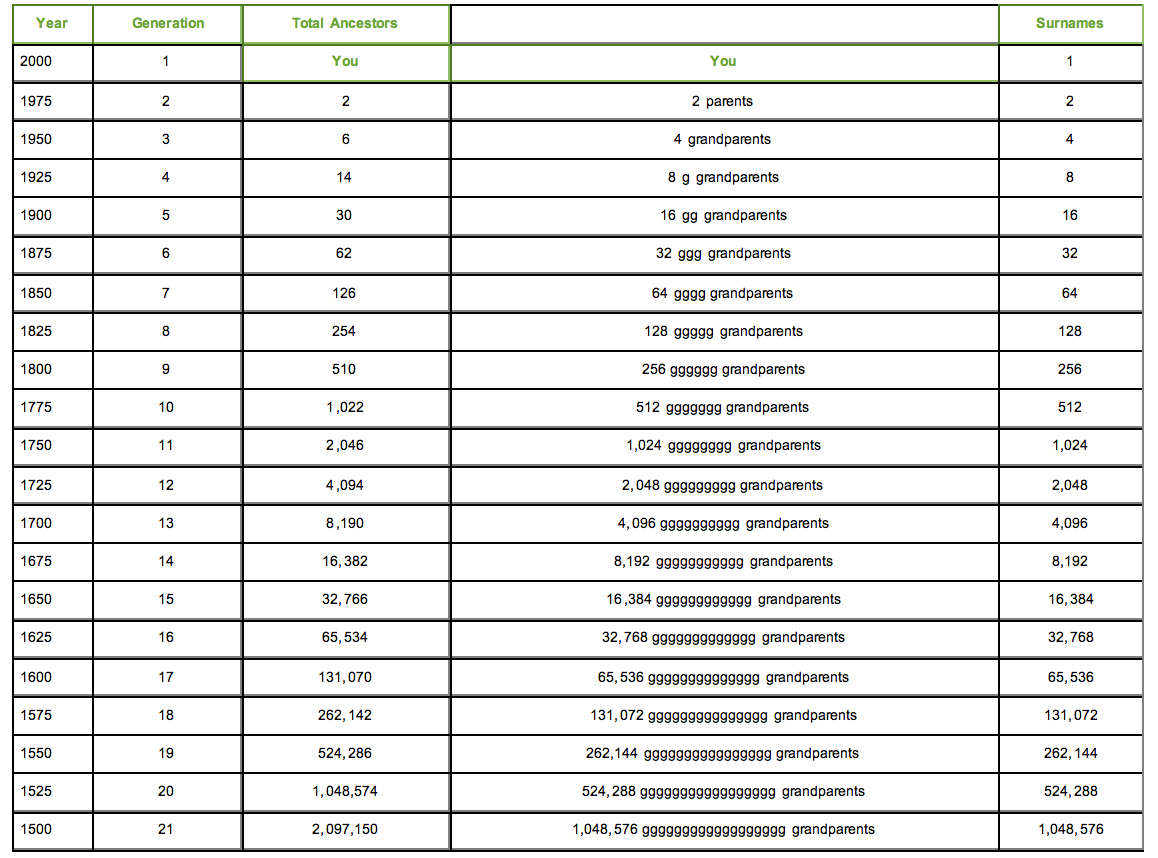
When faced with such exclusive views of who is a Finn, I ask them how many ancestors they’d have if they went back 20 generations. The answer is about one million.

Kuvankaappaus 2013-6-10 kello 8.23.30Read full story here.

Then there are those who claim they are as old as Methuselah, a biblical figure who died at the age of 969. Those who play Methuselah claim that their great grandparents fought in this and that war and built this land from scratch even if they had never seen war never mind suffered poverty.

I ask them a simple question: Are you 150 years old?

One matter that gives hope about building a more inclusive society is that we are still a young nation. Our national identity, which is nothing more than a social construct,  was built by and large on wars and our loathing of Russia. This must change in order to make our society more inclusive and acceptant of cultural diversity.

Certainly we should respect our veterans. Even if they had no choice but to fight in trenches and die in battlefields, we don’t have to be there with them since the Winter (1939-40) and Continuation War (1941-44) ended over sixty years ago. We have to forgive and move on. The longer we stay in those trenches the longer we’ll be resentful and suspicious of the outside world.

Despite all the challenges facing us during this century as we become a culturally diverse society, I’m confident that we’ll succeed at the task.

Our Nordic democratic social welfare state values and the spirit of our laws ensure success.


“Only Finnish spoken here” versus cultural diversity

Posted on June 8, 2013 by Migrant Tales

What would you do if you saw on an elementary school classroom door the following message: Only Finnish spoken here? Would you ask if speaking Swedish is ok? Would it raise disturbing memories of how minorities like the Saami were persecuted and discouraged at school especially after World War 2 for speaking their own language?

Kuvankaappaus 2013-6-8 kello 8.19.15

The Saami minority were one of many groups that were victims of white Finnish assimilation.

Here’s the double-standard and conflict: It would be disturbing to see such a sign at a school in Lapland today but we wouldn’t think anything of it if the message was intended for third-culture children, or those who have one or two immigrant parents.

One of the issues that we see over and over in the ongoing debate on immigration and immigrants is our acceptance of cultural diversity. In the last century, Finland dealt with cultural diversity in the following way:

  • discouraging “Otherness” and assimilation of minorities like the Saami, which began in the nineteenth century*
  • systematically prohibit immigration and foreign investment to the country 

If we consider that it took Finland 65 years after independence to have its first Aliens Act in force in 1983, and that the Restricting Act of 1939, which severely undermined foreign investment to the country and was shelved in 1992, our assimilation policy included immigrants and foreign investment.

Finland is a very different country today than it was in the last century. We live in a globalized world and our society is becoming ever-culturally diverse. Since our assimilation policy was systematic in the last century after independence, it’s easy to understand why some Finns oppose and are hostile to cultural diversity.

A good example of the latter are anti-immigration parties like the Perussuomalaiset (PS), which would never suggest to their voters the things  they do for immigrants. It explains as well why we don’t think twice about “only Finnish spoken here” signs at schools.

“While I believe that our school system in Finland strives to promote cultural diversity, the truth is that we have a long way to go. Killing and discouraging diversity has distorted our view of ourselves and how we accept others in our society.

One example of the latter is how some schools continue to label third-culture children as “students with immigrant backgrounds,” even if they were born and grew up in this country. Such labels serve in too many cases to promote social inequality.

If you want a culprit that is holding us back today and which promotes intolerance, you’ll find it in our assimilation policies and the way we were brought up and taught to see ourselves as an exclusive national group. With more immigrants moving to this country, we need to promote inclusion and acceptance.

One association that played an important role in our assimilation policy in the last century was Suomalaisuuden liitto. Should it surprise us that the association, which has been taken over by the PS, has spearheaded a campaign to demote the Swedish language to elective status at schools.

* Vesa Puuronen: Rasistinen Suomi. Gaudeamus, Helsinki 2011. pp. 111-163.

Migrant Tales Literary: Boycott ?????

Posted on May 15, 2013 by Dana

By Dana

?? ???? ? ???????                  ???? ?? ?? ?? ?????
?? ?? ? ?? ?????? ???        ??? ???? ? ??? ? ?? ???
?? ???? ? ???? ? ???           ??? ?? ?????? ???
??????? ?? ??? ???                 ??? ??? ???? ????
?? ??? ????? ?????                  ???? ???? ?? ?? ???
??? ???? ? ?????            ??? ? ?????? ??? ? ????
???? ???? ???                         ???? ?? ?? ?????
???? ????? ??? ????                 ??? ?? ???? ?? ????
????? ???? ??? ???                 ??? ???? ?? ??? ???
??? ????? ?? ?????                       ?? ?? ???? ?????

???? ?? ?? ?? ?? ????             ?? ??? ??????????

mail.google1.com

Land of walls: Finland       Finland or prejudice

Prejudice, maybe banter             Banter, wow, a hunter

A hunter of humanity             Humanity screams out in this land

Land of doubts, a sick land of doubts           Thoughts that doubt, a land of colossal hurt

Land of hurt or Finland           Finland, yes, a land of sin

Land of sin or ding dong land          Ding dong land or land of hate

Land of hate or land of fakes           Land of fakes and land that shakes

Scam scam scammers          I give you fair waning: scam is a shark

Walls oh walls look at those walls          Here, there  and everywhere

They play games behind the walls               Behind the walls that are inhabited by the darkness.


  • Previous
  • 1
  • 2
  • 3
  • 4
  • 5
  • …
  • 13
  • Next
Read more about documentary film
Read more

Recent Posts

  • Finland’s tabloids Iltalehti and Ilta-Sanomat are the pits
  • Riikka Purra’s Dr Jekyll and Mr Hyde mask
  • Double standards
  • Perussuomalaiset: Uusi logo, sama vanha juttu
  • Taco Trump

Recent Comments

  1. Absolutely Socking: Racist Finnish Facebook group against human rights gets flooded with socks on Musta Barbaari’s mother and sister charged by the police in “ethnic profiling” case
  2. Ilkka Nuotio on Pekka Myrskylä: “Tilastot kertovat toista kuin poliittinen keskustelu”
  3. Genrih Soinkara on The war in Ukraine and the Russian-Finnish border crisis are showing Finland’s ugly side
  4. Ahti Tolvanen on Comment by Ahti Tolvanen on the Helsinki +50 conference
  5. Angel Barrientos on Angel Barrientos is one of the kind beacons of Finland’s Chilean community

Archives

  • June 2026
  • May 2026
  • April 2026
  • March 2026
  • February 2026
  • January 2026
  • December 2025
  • November 2025
  • October 2025
  • September 2025
  • August 2025
  • July 2025
  • June 2025
  • May 2025
  • April 2025
  • March 2025
  • February 2025
  • January 2025
  • December 2024
  • November 2024
  • October 2024
  • September 2024
  • August 2024
  • July 2024
  • June 2024
  • May 2024
  • April 2024
  • March 2024
  • February 2024
  • January 2024
  • December 2023
  • November 2023
  • October 2023
  • September 2023
  • August 2023
  • July 2023
  • June 2023
  • May 2023
  • April 2023
  • March 2023
  • February 2023
  • January 2023
  • December 2022
  • November 2022
  • October 2022
  • September 2022
  • August 2022
  • July 2022
  • June 2022
  • May 2022
  • April 2022
  • March 2022
  • February 2022
  • January 2022
  • December 2021
  • November 2021
  • October 2021
  • September 2021
  • August 2021
  • July 2021
  • June 2021
  • May 2021
  • April 2021
  • March 2021
  • February 2021
  • January 2021
  • December 2020
  • November 2020
  • October 2020
  • September 2020
  • August 2020
  • July 2020
  • June 2020
  • May 2020
  • April 2020
  • March 2020
  • February 2020
  • January 2020
  • December 2019
  • November 2019
  • October 2019
  • September 2019
  • August 2019
  • July 2019
  • June 2019
  • May 2019
  • April 2019
  • March 2019
  • February 2019
  • January 2019
  • December 2018
  • November 2018
  • October 2018
  • September 2018
  • August 2018
  • July 2018
  • June 2018
  • May 2018
  • April 2018
  • March 2018
  • February 2018
  • January 2018
  • December 2017
  • November 2017
  • October 2017
  • September 2017
  • August 2017
  • July 2017
  • June 2017
  • May 2017
  • April 2017
  • March 2017
  • February 2017
  • January 2017
  • December 2016
  • November 2016
  • October 2016
  • September 2016
  • August 2016
  • July 2016
  • June 2016
  • May 2016
  • April 2016
  • March 2016
  • February 2016
  • January 2016
  • December 2015
  • November 2015
  • October 2015
  • September 2015
  • August 2015
  • July 2015
  • June 2015
  • May 2015
  • April 2015
  • March 2015
  • February 2015
  • January 2015
  • December 2014
  • November 2014
  • October 2014
  • September 2014
  • August 2014
  • July 2014
  • June 2014
  • May 2014
  • April 2014
  • March 2014
  • February 2014
  • January 2014
  • December 2013
  • November 2013
  • October 2013
  • September 2013
  • August 2013
  • July 2013
  • June 2013
  • May 2013
  • April 2013
  • March 2013
  • February 2013
  • January 2013
  • December 2012
  • November 2012
  • October 2012
  • September 2012
  • August 2012
  • July 2012
  • June 2012
  • May 2012
  • April 2012
  • March 2012
  • February 2012
  • January 2012
  • December 2011
  • November 2011
  • October 2011
  • September 2011
  • August 2011
  • July 2011
  • June 2011
  • May 2011
  • April 2011
  • March 2011
  • February 2011
  • January 2011
  • December 2010
  • November 2010
  • October 2010
  • September 2010
  • August 2010
  • July 2010
  • June 2010
  • May 2010
  • April 2010
  • March 2010
  • February 2010
  • January 2010
  • December 2009
  • November 2009
  • October 2009
  • September 2009
  • August 2009
  • July 2009
  • December 2008
  • November 2008
  • October 2008
  • September 2008
  • August 2008
  • July 2008
  • June 2008
  • May 2008
  • April 2008
  • March 2008
  • February 2008
  • January 2008
  • November 2007
  • October 2007
  • September 2007
  • August 2007
  • July 2007
  • June 2007
  • May 2007

Categories

  • ?? Gia L?c
  • ????? ?????? ????? ???????? ?? ??????
  • ???????
  • @HerraAhmed
  • @mondepasrond
  • @nohatefinland
  • @oula_silver
  • @Varathas
  • A Pakistani family
  • äärioikeisto
  • Abbas Bahmanpour
  • Abdi Muhis
  • Abdirahim Hussein Mohamed
  • Abdirahim Husu Hussein
  • Abdirisak Mahamed
  • About Migrant Tales
  • activism
  • Adam Al-Sawad
  • Adel Abidin
  • Afrofinland
  • Ahmed IJ
  • Ahti Tolvanen
  • Aino Pennanen
  • Aisha Maniar
  • Alan Ali
  • Alan Anstead
  • Alejandro Díaz Ortiz
  • Alekey Bulavsev
  • Aleksander Hemon
  • Aleksanterinliitto
  • Aleksanterinliitto ry
  • Aleksanterinliitto ry:n hallitus
  • Alex Alex
  • Alex Mckie
  • Alexander Nix
  • Alexandra Ayse Albayrak
  • Alexis Neuberg
  • Ali Asaad Hasan Alzuhairi
  • Ali Hossein Mir Ali
  • Ali Rashid
  • Ali Sagal Abdikarim
  • Alina Tsui
  • Aline Müller
  • All categories
  • Aman Heidari
  • Amiirah Salleh-Hoddin & Jana Turk
  • Amin A. Alem
  • Amir Zuhairi
  • Amkelwa Mbekeni
  • Ana María Gutiérrez Sorainen
  • Anachoma
  • Anders Adlecreutz
  • Angeliina Koskinen
  • Anna De Mutiis
  • Anna María Gutiérrez Sorainen
  • Anna-Kaisa Kuusisto ja Jaakko Tuominen
  • Annastiina Kallius
  • Anneli Juise Friman Lindeman
  • Announcement
  • Anonymous
  • Antero Leitzinger
  • anti-black racism
  • Anti-Hate Crime Organisation Finland
  • Anudari Boldbaatar
  • Arshiya Nasser
  • Aspergers Syndrome
  • Asylum Corner
  • Asylum seeker 406
  • Athena Griffin and Joe Feagin
  • Autism
  • Avaaz.org
  • Awale Olad
  • Ayan Said Mohamed
  • AYY
  • Barachiel
  • Bashy Quraishy
  • Beatrice Kabutakapua
  • Beri Jamal
  • Beri Jamal and Enrique Tessieri
  • Bertolt Brecht
  • Boiata
  • Boodi Kabbani
  • Bruno Gronow
  • Carmen Pekkarinen
  • Çelen Oben and Sheila Riikonen
  • Chiara Costa-Virtanen
  • Chiara Costa-Virtanen
  • Chiara Sorbello
  • Christian Thibault
  • Christopher Wylie
  • Clara Dublanc
  • Dana
  • Daniel Malpica
  • Danilo Canguçu
  • David Papineau
  • David Schneider
  • Dexter He
  • Don Flynn
  • Dr Masoud Kamali
  • Dr. Faith Mkwesha
  • Dr. Theodoros Fouskas
  • Edna Chun
  • Eeva Kilpi
  • Emanuela Susheela
  • En castellano
  • ENAR
  • Enrique
  • Enrique Tessieri
  • Enrique Tessieri & Raghad Mchawh
  • Enrique Tessieri & Yahya Rouissi
  • Enrique Tessieri and Muhammed Shire
  • Enrique Tessieri and Sira Moksi
  • Enrique Tessieri and Tom Vandenbosch
  • Enrique Tessieri and Wael Che
  • Enrique Tessieri and Yahya Rouissi
  • Enrique Tessieri and Zimema Mhone
  • Epäluottamusmies
  • EU
  • Europe
  • European Islamophobia Report
  • European Islamophobia Report 2019,
  • European Union
  • Eve Kyntäjä
  • Ezequiel Caldeiro
  • Facebook
  • Fadumo Dayib
  • Faisa Kahiye
  • Farhad Manjoo
  • Fasismi
  • Finland
  • Fizza Qureshi
  • Flyktingar och asyl
  • Foreign Student
  • Fozia Mir-Ali
  • Frances Webber
  • Frida Selim
  • Gareth Rice
  • Ghyslain Vedeaux
  • Global Art Point
  • Great Replacement
  • Habiba Ali
  • Hami Bahadori
  • Hami Bahdori
  • Hamid
  • Hamid Alsaameere
  • Hamid Bahdori
  • Handshake
  • Harmit Athwal
  • Hassan Abdi Ali
  • Hassan Muhumud
  • Heikki Huttunen
  • Heikki Wilenius
  • Helsingin Sanomat
  • Henning van der Hoeven
  • Henrika Mälmsröm
  • Hser Hser
  • Hser Hser ja Mustafa Isman
  • Husein Muhammed
  • Hussain Kazemian
  • Hussain Kazmenian
  • Ibrahim Khan
  • Ida
  • Ignacio Pérez Pérez
  • Iise Ali Hassan
  • Ilari Kaila & Tuomas Kaila
  • Imam Ka
  • inside-an-airport
  • Institute of Race Relations
  • Iraqi asylum seeker
  • IRR European News Team
  • IRR News Team
  • Islamic Society of Norhern FInland
  • Islamic Society of Northern Finland
  • Islamophobia
  • Jacobinmag.com
  • Jallow Momodou
  • Jan Holmberg
  • Jane Elliott
  • Jani Mäkelä
  • Jari Luoto
  • Jari Taponen
  • Jegor Nazarov
  • Jenni Stammeier
  • Jenny Bourne
  • Jessie Daniels
  • Joe Davidow
  • Johannes Koski
  • John D. Foster
  • John Grayson
  • John Marriott
  • Jon Burnett
  • Jorma Härkönen
  • Jos Schuurmans
  • José León Toro Mejías
  • Josue Tumayine
  • Jouni Karnasaari
  • Juan Camilo
  • Jukka Eräkare
  • Julian Abagond
  • Julie Pascoet
  • Jussi Halla-aho
  • Jussi Hallla-aho
  • Jussi Jalonen
  • JusticeDemon
  • Kadar Gelle
  • Kaksoiskansalaisuus
  • Kansainvälinen Mikkeli
  • Kansainvälinen Mikkeli ry
  • Katherine Tonkiss
  • Kati Lepistö
  • Kati van der Hoeven-Lepistö
  • Katie Bell
  • Kättely
  • Kerstin Ögård
  • Keshia Fredua-Mensah & Jamie Schearer
  • Khadidiatou Sylla
  • Khadra Abdirazak Sugulle
  • Kiihotus kansanryhmää vastaan
  • Kirsi Crowley
  • Koko Hubara
  • Kristiina Toivikko
  • Kubra Amini
  • KuRI
  • La Colectiva
  • La incitación al odio
  • Laura Huhtasaari
  • Lauri Finér
  • Leif Hagert
  • Léo Custódio
  • Leo Honka
  • Leontios Christodoulou
  • Lessie Branch
  • Lex Gaudius
  • Leyes de Finlandia
  • Liikkukaa!
  • Linda Hyökki
  • Liz Fekete
  • M. Blanc
  • Maarit Snellman
  • Mahad Sheikh Musse
  • Maija Vilkkumaa
  • Malmin Kebab Pizzeria Port Arthur
  • Marcell Lorincz
  • Mari Aaltola
  • María Paz López
  • Maria Rittis Ikola
  • Maria Tjader
  • Marja-Liisa Tolvanen
  • Mark
  • Markku Heikkinen
  • Marshall Niles
  • Martin Al-Laji
  • Maryan Siyad
  • Matt Carr
  • Mauricio Farah Gebara
  • Media Monitoring Group of Finland
  • Micah J. Christian
  • Michael McEachrane
  • Michele Levoy
  • Michelle Kaila
  • Migrant Tales
  • Migrant Tales Literary
  • Migrantes News
  • Migrants' Rights Network
  • MigriLeaks
  • Mikko Kapanen
  • Miriam Attias and Camila Haavisto
  • Mohamed Adan
  • Mohammad Javid
  • Mohammad M.
  • Monikulttuurisuus
  • Monisha Bhatia and Victoria Canning
  • Mor Ndiaye
  • Muh'ed
  • Muhamed Abdimajed Murshid
  • Muhammed Shire
  • Muhammed Shire and Enrique Tessieri
  • Muhis Azizi
  • Musimenta Dansila
  • Muslimiviha
  • Musulmanes
  • Namir al-Azzawi
  • Natsismi
  • Neurodiversity
  • New Women Connectors
  • Nils Muižnieks
  • No Labels No Walls
  • Noel Dandes
  • Nuor Dawood
  • Omar Khan
  • Otavanmedia
  • Oula Silvennoinen
  • Paco Diop
  • Pakistani family
  • Pentti Stranius
  • Perussuomalaiset
  • perustuslaki
  • Petra Laiti
  • Petri Cederlöf
  • Pia Grochowski
  • Podcast-lukija Bea Bergholm
  • Pohjois – Suomen Islamilainen Yhdyskunta
  • Pohjois Suomen Islamilainen Yhyskunta
  • Polina Kopylova
  • Race Files
  • racism
  • Racism Review
  • Raghad Mchawh
  • Ranska
  • Rashid H. and Migrant Tales
  • Rasismi
  • Raul Perez
  • Rebecka Holm
  • Reem Abu-Hayyeh
  • Refugees
  • Reija Härkönen
  • Remiel
  • Reza Nasri
  • Richard Gresswell
  • Riikka Purra
  • Risto Laakkonen
  • Rita Chahda
  • Ritva Kondi
  • Robito Ibrahim
  • Roble Bashir
  • Rockhaya Sylla
  • Rodolfo Walsh
  • Roger Casale
  • Rostam Atai
  • Roxana Crisólogo Correa
  • Ruth Grove-White
  • Ruth Waweru-Folabit
  • S-worldview
  • Sadio Ali Nuur
  • Sami Rusanen
  • Sandhu Bhamra
  • Sara de Jong
  • Sarah Crowther
  • Sari Alhariri
  • Sarkawt Khalil
  • Sasu
  • Scot Nakagawa
  • Shabana Ahmadzai
  • Shada Islam
  • Sharon Chang blogs
  • Shenita Ann McLean
  • Shirlene Green Newball
  • Sini Savolainen
  • Sira Moksi
  • Sonia K.
  • Sonia Maria Koo
  • Steverp
  • Stop Deportations
  • Suldaan Said Ahmed
  • Suomen mediaseurantakollektiivi
  • Suomen Muslimifoorumi ry
  • Suomen viharikosvastainen yhdistys
  • Suomen viharikosvastainen yhdistys ry
  • Suomi
  • Supermen
  • Susannah
  • Suva
  • Syrjintä
  • Talous
  • Tapio Tuomala
  • Taw Reh
  • Teivo Teivainen
  • The Daily Show
  • The Heino
  • The Supermen
  • Thomas Elfgren
  • Thulfiqar Abdulkarim
  • Tim McGettigan
  • Tino Singh
  • Tito Moustafa Sliem
  • Tobias Hübinette and L. Janelle Dance
  • Transport
  • Trica Danielle Keaton
  • Trilce Garcia
  • Trish Pääkkönen
  • Trish Pääkkönen and Enrique Tessieri
  • Tuulia Reponen
  • Uncategorized
  • UNITED
  • University of Eastern Finland
  • Uyi Osazee
  • Väkivalta
  • Vapaa Liikkuvuus
  • Venla-Sofia Saariaho
  • Vieraskynä
  • W. Che
  • W. Che an Enrique Tessieri
  • Wael Ch.
  • Wan Wei
  • Women for Refugee Women
  • Xaan Kaafi Maxamed Xalane
  • Xassan Kaafi Maxamed Xalane
  • Xassan-Kaafi Mohamed Halane & Enrique Tessieri
  • Yahya Rouissi
  • Yasmin Yusuf
  • Yassen Ghaleb
  • Yle Puhe
  • Yuliet Tresa
  • Yve Shepherd
  • Zahra Khavari
  • Zaker
  • Zalina Ametova
  • Zamzam Ahmed Ali
  • Zeinab Amini ja Soheila Khavari
  • Zimema Mahone and Enrique Tessieri
  • Zimema Mhone
  • Zoila Forss Crespo Moreyra
  • ZT
  • Zulma Sierra
  • Zuzeeko Tegha Abeng
© 2026 Migrant tales | Powered by Minimalist Blog WordPress Theme