The recent case of a “youth gang” terrorizing a predominantly white neighborhood in western Helsinki exposes the knee-jerk reaction about how the media and public see suspected crime by brown and black Finns.
During the last week of August, a group of youths with covered faces at the Lauttasaari metro station allegedly attempted to rob a primary school child, who escaped home, according to Helsingin Sanomat.
“The police are aware that in [the neighborhood of] Lauttasaari there have been cases of threatening behavior, following young people, and other forms of harassment. According to the police, a group of young people aged between 15 and 17 have been causing concern in the area,” reported the daily.
What drives the government, particularly Minister of the Interior Mari Rantanen of Perussuomalaiset (PS), to give utmost attention and tackle the issue of youth street gangs? Is it a sincere attempt to solve such a social problem, or an opportunity to further victimize migrants and minorities in Finland?
The assertion isn’t far-fetched. The PS is historically the first major contemporary Finnish party to benefit stigmatizing other groups, such as Muslims, Africans, and other non-EU nationals, as less valuable.
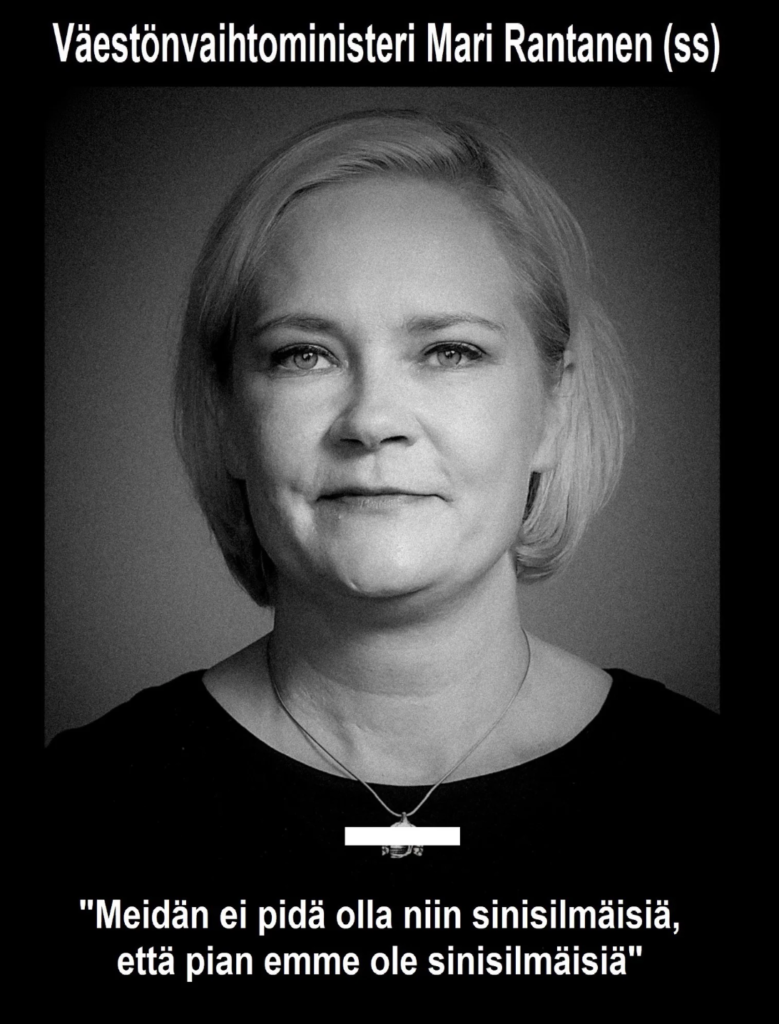
Many of Rantanen’s social media posts before the April election, which were deleted and white-cleaned after the election, were based on racist far-right conspiracy theories. “We shouldn’t be so blue-eyed that soon we won’t be blue-eyed,” is one of her infamous quotes. Sinisilmänen, or blue-eyed, means being naive in Finnish.
Moreover, although these types of quotes do not instill credibility in Rantanen’s ability to find solutions to youth problems, her efforts are further shot to pieces when she blames the “problem” on the “wrong” type of immigration policy.
Another takeaway is the government’s statements about clamping down on youth crime and its near-silence on far-right terrorism.
Another matter that raises red flags is the PS’s track record. In all the general elections in 2011, 2015, 2019, and 2022, the party has used successfully a migrant crime theme to attract voters to the polls.
Neighboring Sweden held its election in September 2022 against a backdrop of spiraling gang violence where over 60 people were killed.
By promising to get tough on such crime, the Sweden Democrats, a party with neo-Nazi roots, and the Moderate Party led the right-wing bloc to victory. Their success also provided the PS with an important migrant crime theme to exploit politically. The problem, however, was that Finland’s youth gang problem was small compared with Sweden’s.
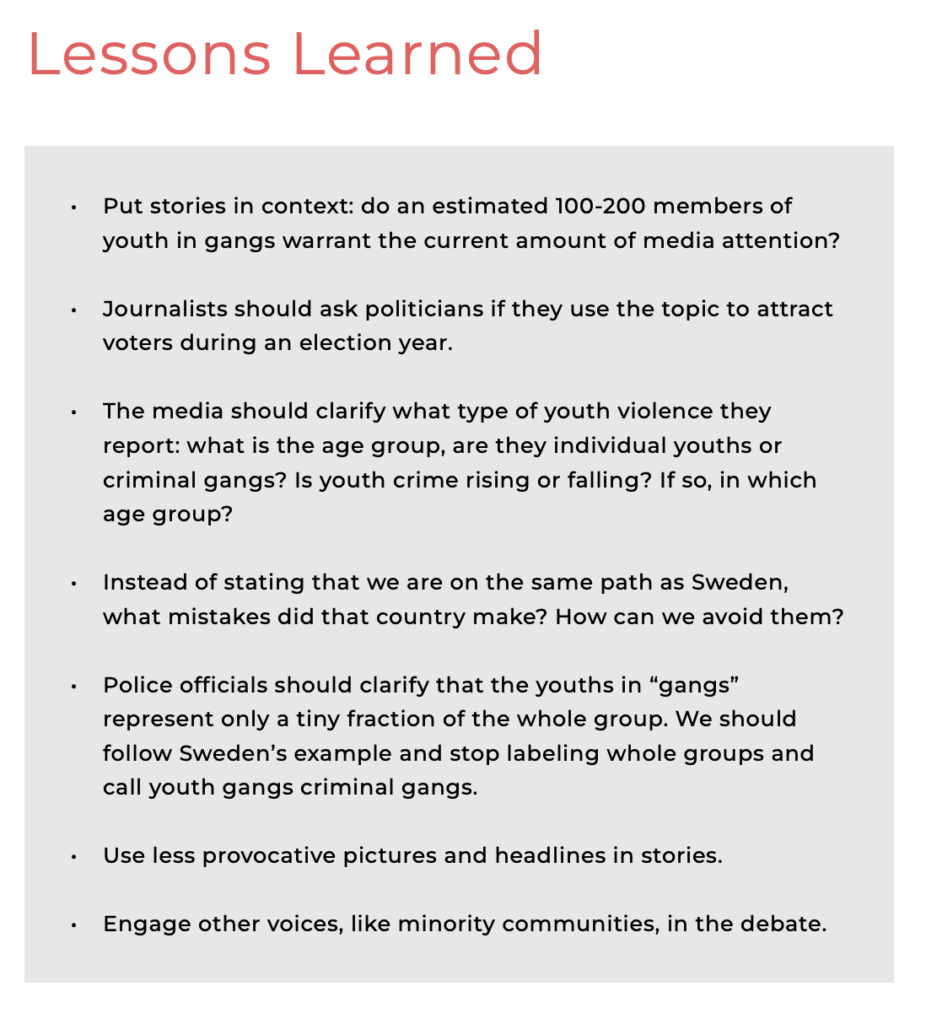
In the autumn of last year, the police estimated that there were 100-200 gang members in Helsinki and Turku.
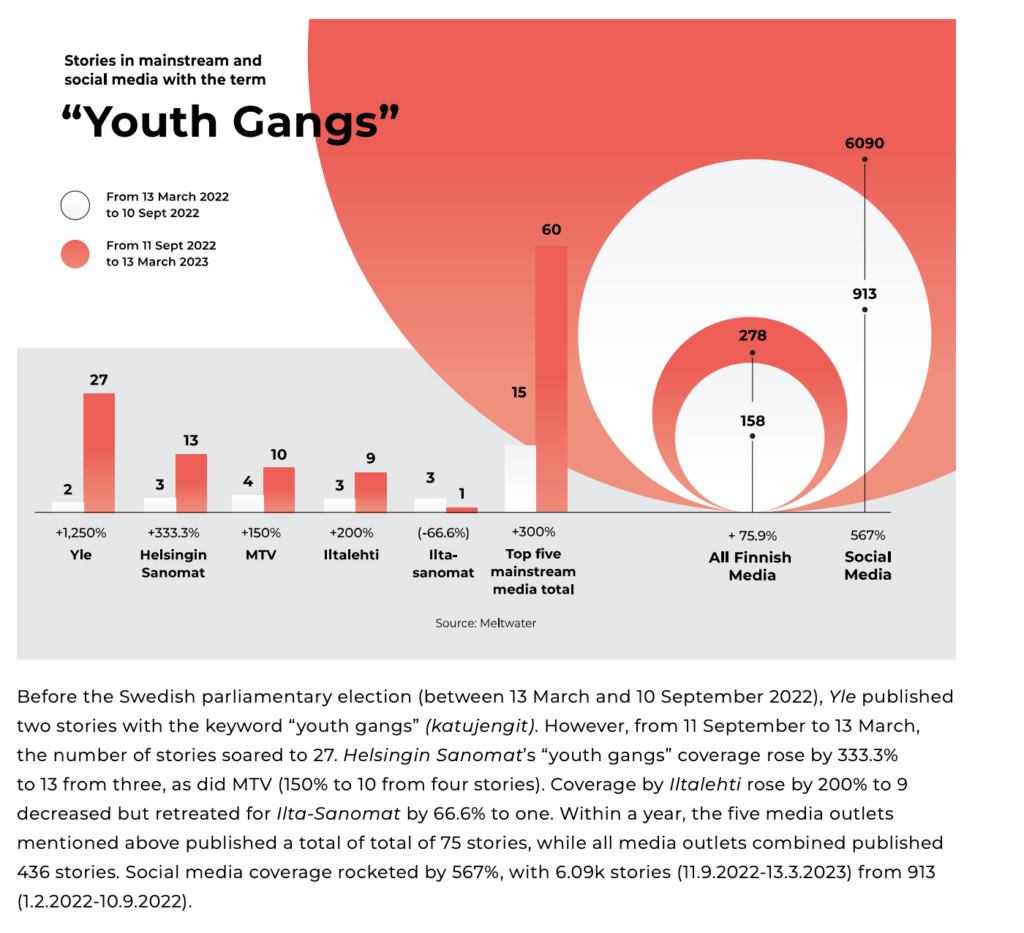
As crime is usually an important topic covered by the media, it attracts more attention if so-called people of foreign backgrounds are part of the narrative. Should it surprise us that coverage of Finland’s youth gang “problem” started to grow rapidly in October after the September elections of Sweden?
The Islamophobic Perussuomalaiset (PS)* party has had a long love affair with Denmark’s anti-Muslim immigration policy, one of the toughest in Europe. With loaded guns in government, the PS must be happy that they can adopt, with the blessings of National Coalition Party (NCP) Prime Minister Petteri Orpo and the two minor coalition partners, the Swedish People’s Party (SPP) and Christian Democrats (KD), that country’s harsh immigration policy.
The Danish People’s Party (DPP) used to call the anti-immigration shots in government but in recent years their support has declined abruptly. In the 2022 election, the DPP lost 11 seats to remain with five seats in parliament, which is a far cry from the 37 seats they won in 2015.
The fortunes of the DPP have been undermined by the Social Democrats who have adopted and succumbed to the same hardline immigration policy and rehotirc of the far-right party.
While some are debating if a radical right party becomes more moderate when in government, Denmark offers us an answer: it radicalizes other parties who must adopt more hostile stances in order to survive and not be devoured by a populist party.
Apart from the government’s immigration policy that disenfranchises migrants by weakening more their civil rights and making them vulnerable to exploitation by employers, one wonders how far the PS – with the blessing of the NCP, SPP and KD – will go in order to make life difficult for migrants.
in Denmark, the DPP went as far as to force migrants to speak only Danish at home and deport whole families if a member is convicted of a crime. When will we see the following aims below in Finland?
Spearheading these radical changes in Finland’s immigration policy is PS Interior Minister Mari Rantanen. She recently announced plans to speed up the asylum process to four weeks. The asylum seeker will wait for the decision at the border.
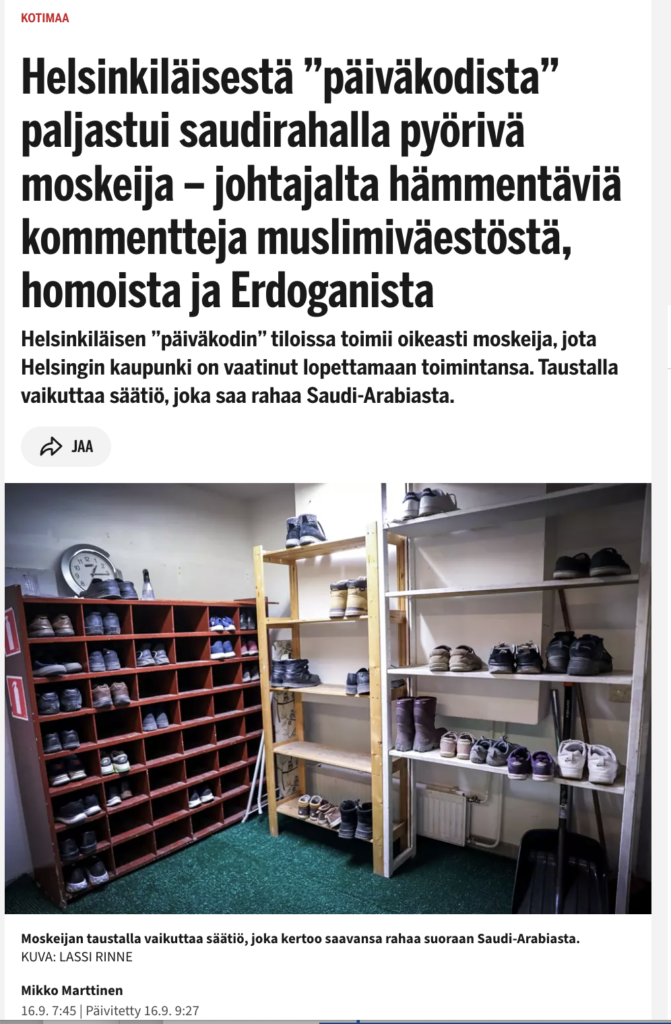
If there is a big divide and mistrust between the media and the Muslim community it was exposed by a scoop the tabloid ilta-Sanomaton a secret “mosque” in a Helsinki nursery. Throughout the years, some Muslim imams and other members of the community have expressed apprehension of the Finnish media.
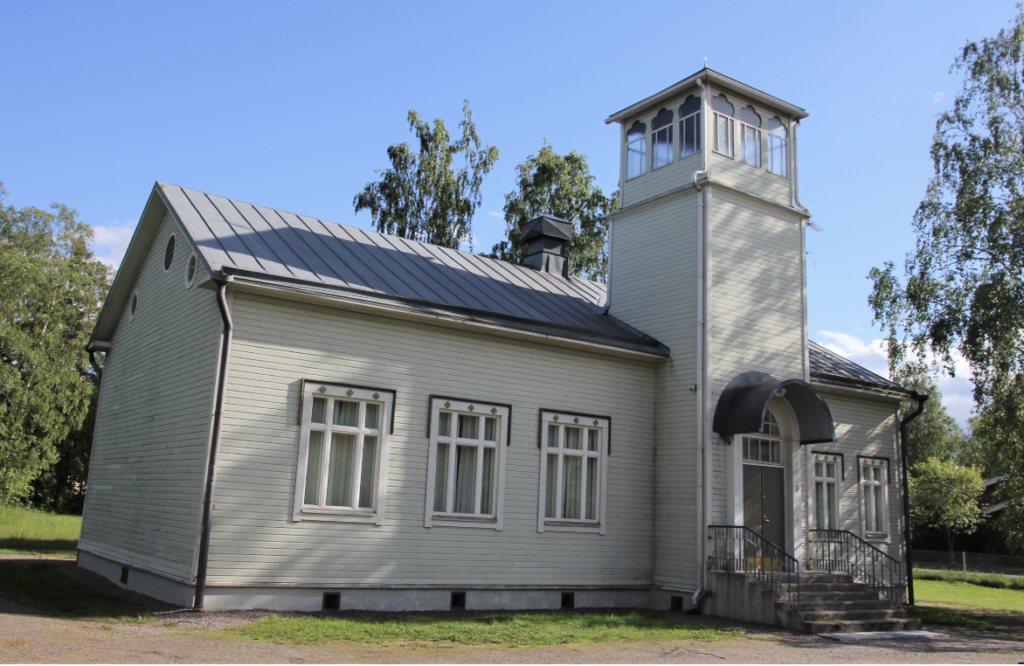
For those who may not know, Finland has only one mosque built in the 1940s located in Järvenpää, a short drive north of Helsinki. All the rest of these mosques without a minaret are, in fact, prayer rooms.
Finland’s only mosque with a minaret is located in Järvenpää and was built in the 1940s. Source: Helsingin Sanomat.
True, some Muslims call prayer rooms mosques.
While many will disagree with Suomen Muslimifoorumi’s Aladin Maher about his views on gay marriage and the great replacement conspiracy theory, the underlying message of the stories written about the “mosque” reveals a deep-seated mistrust of Muslims that is amplified by politicians from parties like the Perussuomalaiset (PS)*and National Coalition Party.
The story about the mosque awoke Finland’s Islamophobic hardliners like Interior Minister Mari Rantanen, Justice Minister Leena Meri, Minister Wille Rydman, MPs like Atte Kaleva, Joakim Vigelius, never mind the thousands of hostile comments on social media.
All of these politicians and ministers had something bad to say about the mosque and Maher and exposed their hypocrisy.
We shouldn’t be surprised the these hostile comments came mostly from the Islamophobic PS and National Coalition Party.
If the ongoing hostile comments are anything to go by, it shows that any meaningful dialogue between some sectors of Finnish society and the Muslim community is light years away.
Rejection by the media and certain politicians of Muslims ensures that nothing will change.
It is concerning for migrants and minorities in Finland that we have a government that is openly hostile to them. As in Juha Sipilä’s (2015-2019) government, there was an agreement that migration policy would be handled by the Perussuomalaiset (PS)* party in exchange for the National Coalition Party (NCP) and Center Partry dictating economic policy.
It is the same situation now: The NCP remains silent on migration policy and the PS is silent on austerity measures in exchange for dictating migration policy.
Looking at the PS’ track record and its use of conspiracy theories to drive home its xenophobic message, one wonders if just erasing previous racist posts is enough to restore credibility in ministers like Mari Rantanen.
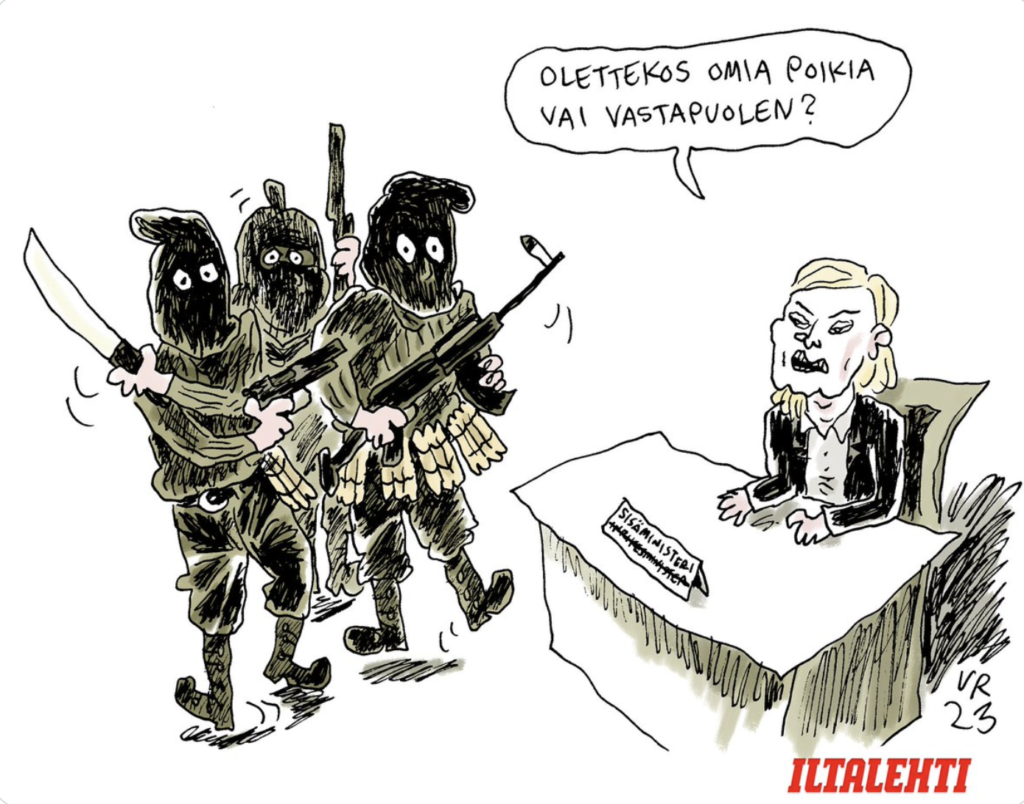
“Are you on our side or the other side’s,” asks PS Interior Minister Mari Rantanen. Source Ville Ranta, Iltalehti.
The question is not far-fetched. The PS is historically the first major contemporary Finnish party to have profited politically by promoting the polarization between different groups by claiming that Muslims, Africans, and other non-EU nationals, as less valuable.
Many of Rantanen’s social media posts before the 4 April election, which were deleted and whitewashed after the elections, were based on conspiracy theories, such as the great replacement. “We shouldn’t be so blue-eyed that soon we won’t be blue-eyed?” is one of his more unusual quotes.
In Finnish, being “blue-eyed” means being naive.
Moreover, even if these types of posts do not increase credulity, how can one even attempt to find a solution to the youth problem in society if Rantanen and her party blame social problems like pinning youth gang violence on ‘harmful migration?
How is it possible that we do not hear a word from the government about three suspects tried on terrorism charges in Lahti. Helsingin Sanomat published an editorial Tuesday about the threat of far-right violence in Finland.
Writes Helsingin Sanomat: “However, the case is a fresh reminder that the extreme right is a real threat to Finland’s security. The assessment made by the Finnish Security Police (SUPO) a couple of years ago is correct; in addition to the terrorist threat from radical Islamists, the terrorist threat from the far right has increased.”
As if trying to divert attention from far-right terrorism, Interior Minister Mari Rantanen has preferred to talk about migrant youth gang violence and new questionable methods to give the police more search- and-seizure powers.
For many years, groups like Migrant Tales, historian Oula Silvenoinen, and columnist Saku Timonen have warned about the ties of the radical-right Perussuomalaiset (PS)* party and far-right groups. Is it a surprise that one of the main suspects in the terrorist trial in Lahti is a former PS member Viljam Nyman?
Finnish prosecutors have charged four men in the Lahti terrorism trial that are believed to be able to produce semiautomatic weapons using a 3D printer and attacking critical infrastructure, politicians, anti-racism activists and NGOs. One of the targets was believed to be former prime minister, Sanna Marin.
Finnish news server YLE reported that the four suspects follow neo-Nazi ideology linked to accelerationism, which claims that fundamental societal transformations can be achieved only by accelerating different processes in society.
Can anyone really trust Mari Rantanen, the Interior Minister of Perussuoalaiset (PS)* of Finland? All it took to whitewash her far-right racist views was to take down such posts from her social media sites after the election and claim that she does not believe in conspiracy theories.
What a coward! She spreads all these far-right racist conspiracy theories and then does not have the guts to stand by them.
What does that show?
It reveals moral cowardice and bravado.
One of her many infamous quotes is: “We must not be so blue-eyed that soon we will not be blue-eyed.” “Blue-eyed in Finnish means naive.
She has also wished that asylum seekers drown in Greek waters, Europe will turn into an Africa, and that if steps are not taken to halt non-white migrants, Europe is threatened with civil war.
PS Interior Minister Mari Rantanen is proof that far-right racism rooted in conspiracy theories will take you far in politics. Source: X (formerly Twitter).
Looking at Minister Rantanen’s racist track record, it’s clear that she is bankrupt of all credibility. How can you trust a minister who is openly racist and too chicken to stand by her toxic views? How much of an opportunist is she, and how much harm has she inflicted on Finland? A generous amount, I believe.
Her loathing of Muslims and other minorities is clearly evident. Take for example the so-called youth gang “problem,” which is a direct copy from Sweden’s election and helped boost the Sweden Democrats, a party with neo-Nazi roots, to victory.
One clear aspect of Finland’s heated debate about racism is how politicians, especially from the Perussuoomalaiset (PS) party, claim ignorance about what racism is. PS MP Joakim Vigelius went as far as to claim that the term “racism” has suffered from inflation.
I wonder if victims of racism and microaggression feel the same way.
As can be seen with Vigelius’ view of racism, it is always a white person setting the narrative and definitions about such a social ill.
Another politician, MP Jani Mäkelä, the head of the PS parliamentary group, said in Helsingin Sanomat that other groups define the term to fit their political needs.
“They take this term, arbitrarily define its content according to their own definition,” he said.
One of the most unusual comments that Mäkelä made to Helsingin Sanomat was his definition of racism. According to him, the law protects the individual from discrimination but this cannot apply to immigration policy, cultural and national groups.
He said that cultures, where women and sexual minorities are treated badly, cannot be considered equal to Finnish culture.
“Such a culture should be seen as inferior if it treats people like that,” added Mäkelä.
In other words, Finnish law protects individual rights against discrimination but it isn’t racist to speak demeaningly of groups like Muslims.
As one navigates through the denials and smoke screens from politicians about racism, it’s easy to understand that such tactics aim to deceive.
Some friendly advice: If you have difficulty figuring out what is racism, ask and do some research. That is how we did it in California: one can achieve a lot with the help of cultural sensitivity and the willingness to learn.
Unless you have lived isolated from people, there is no reason why you should blame ignorance on your racism.
Another piece of advice: if you want people to treat you with respect, then you should treat them with respect, too.
The big question is what impact will the racism scandals that have rocked Prime Minister Petteri Orpo’s government. For one, they reveal an era when politicians can say anything they want and face little to no accountability.
Perussuomalaiset (PS)* Finance Minister Riikka Purra’s racist and violent comments of 2008 have put her in a difficult bind. She has tried to mitigate the damage by stating that the posts are old and she wrote them before entering politics.
Sure, Purra, you were a 31-year-old adult doing Ph.D. research at the time.
Writes Politico: “Purra — from the right-wing populist Finns Party [PS] — has been accused of writing: “Is anyone up for spitting on beggars … ?” as well as using racist slurs historically used to demean Black people. The racist comments were published under the acronym “riikka” in the guestbook of former Finns Party leader Jussi Halla-aho’s online blog Scripta.”
A good example of how an Islamophobic party like the PS covers its hatred for Muslims. In the top picture, the PS claims that Muslim women are oppressed because they wear certain Muslim attire. In the second cartoon below, the PS gives its real opinion: “Why don’t you go back to where you came from? That dress has no place in Finland.”Purra made a comment in 2019 of a woman with a “black sack” which she hasn’t apologized.
Purra also threatened in her posts to kill migrant youths on a commuter train and called Turks “monkeys.”
How many of us would think of joining a racist site like Purra did and writing racist comments to our heart’s content?
I wouldn’t.
In a normal world, any politician, never mind a minster, would be forced to resign after writing such racist things. The fact that the Purra and other ministers like Wille Rydman don’t want to resign, shows how politics in Finland want to defy the law of political gravity.
If I am honest with you, I tried to stay as far away as possible from the toxic speeches at the Perussuomalaiset (PS)* Congress. In those speeches, like the one by the party’s leader Riikka Purra, you wondered in what alternate reality the radical-right party lives.
Those speeches by Purra, Matti Purkonen, who slammed the media as “spineless liars,” and others are tragic because for those of us who have lived many years in Finland, have seen a complete about-turn in politics and society. What was considered unthinkable before, like racism, is now normalized. It’s all about hate of difference with a huge “H.”
Contrary to what people wanted to believe, the threat does not come from abroad but is homegrown and sits and grows right under our noses.
Take for instance Purra’s speech Saturday, when she concentrated on attacking the media for doing their job and publishing her racist posts from 2008 and 2019.
Iltalehti published (in Finish) all of “riikka’s” 185 posts. In them, she threatens to shoot migrant youths on a commuter train, her posts are homophobic, Islamophobic, sexist, and outright racist.
Upper left: “The problem isn’t that WE speak like racists or that we are racists.“
Upper right: “The problem is that you call us racists.“
Lower left: “The problem ends when you stop [calling us racists].“
Lower right: “YOU are the culprits.” Source: X (formerly Twitter)
Imagine, she was a 31-year-old adult PhD student who, I imagine, should have known better.
Even if one of here defense arguments is that the posts were written before her political career began, how many of us would write such racist and violent posts?