Migrant Tales insight: Remember 2015? It was the year when over 30,000 asylum seekers, mainly from Iraq and Afghanistan, came to Finland. Do you remember the reaction of some Finns who attacked fourteen asylum reception centers? Why weren’t these acts of violence classified as domestic terrorism?
This disgraceful story is dedicated to Perussuomalaiset (PS)* MP Ano Turtiainen, who is in the news for all the wrong reasons and, who, was convicted in 2018 of inciting violence against the Finnish Red Cross, which manages many asylum reception centers. The conviction has its roots in 2015 Facebook post that was liked by PS MEP Laura Huhtasaari.
The fact that fourteen asylum reception centers have been attacked in Finland since mid-September is scandalous. According to the police service of Kangasala, an asylum seeker was beaten by two or three men Saturday evening near the Kaivanto reception center, reportsYLE News.
And the news doesn’t stop here: Neo-Nazi vigilante patrols, one Perussuomalaiset (PS)* substitute MP from Kankaanpää, Juha Maenpää, stated in December that god had answered his prayers after a reception center that was supposed to house asylum seekers was razed to the ground. If an asylum seeker commits a crime there is a social media lynch mob ready 24/7.
If it is a Finn that rapes a woman the public, politicians and the media don’t appear too interested.
Double-standards and xenophobia are rife in Finland today.
In the ever-worsening anti-immigration atmosphere, some politicians and the government are even showing some understanding to the hostility against asylum seekers, which has spread and affected all migrants and minorities living in this country. Interior Minister Petteri Orpo blamed asylum seekers on YLEfor these attacks by stating that is would calm matters down by tightening immigration policy even more.
You may be asking why the National Coalition Party and Center Party aren’t even raising a finger against the PS’ obsession against immigrants and asylum seekers. These two parties need the support of the PS to streamline the welfare state. In return, the PS can tighten immigration policy and thereby appease their racist voters.
Like in all the attacks against the reception centers this fall and early winter, only one suspect was caught in Kouvola (24.9.2015), a middle-aged man was charged and given a one-year prison sentence.
How big will this disgraceful list grow below?
Attacks against asylum reception centers in Finland
National Coalition Party chairperson Petteri Orpo tweets that “I condemn the vandalism against the Turku Synagog and I’m satisfied that the Turku city council signed a motion [condemning] what happened.”
Orpo’s support is important, but the question that arises from what happened is if there are different scales of importance when it comes to vandalism motivated by hate.
When the Resalat Shia mosque in Eastern Helsinki was in March when it was vandalized with hate graffiti a day before the Christchurch mosque shootings, no politician expressed outrage.
Petteri Orpo tweets:“I condemn the vandalism against the Turku Synagog and I’m satisfied that the Turku city council signed a motion [condemning] what happened.”
This is a sad example of political hypocrisy even if both cases are equally alarming.
On the left is the Turku Synagogue and on the right, the Resalat Shia Mosque in Eastern Helsinki. Sources: Yle and Facebook.
Another matter that does not seem right in Orpo’s condemnation is his anti-immigration track record when he was interior minister and later finance minister.
Below are some of the questionable matters that Orpo and the previous government (2015-2019) of Prime Minister Juha Sipilä “had to be reviewed” in the face of an “unseen wave” of asylum seekers that came in 2015:
Free legal representation restricted to applicants who required exceptional grounds for assistance;
Deadline for appeals was lowered from 30 to 21 days after a second rejection and to 14 days after the third rejection;
The government tightened appeal times in the hope of ejecting asylum seekers faster from Finland;
There were further administrative restrictions and practical difficulties making the application process more complicated;
Tightened family reunification laws;
No time limit on detaining families with children in immigration removal centers like Joutseno and Metsälä;
Lack of government leadership in tackling Islamophobia and racism contributed to Finland’s hostile environment affecting migrants and inhumane immigration policy.
Finnish politicians like Orpo condemn racist acts with one hand but with another encourage them.
After the populist anti-immigration Perussuomalaiset (PS)* was left out in the cold from the government in 2017, the election blow suffered by the Danish People’s Party in 2019, and now the exit of the Progress Party (FrP) from the Norwegian government, the Nordic region is momentarily free of Islamophobic populist parties in government.
After six years and two months as part of Prime Minister Erna Solberg’s government, FrP party leader, Siv Jensen, announced her party’s decision.
Then Finance Minister Siv Jensen landed in hot water in 2017 after posing with a Pocahontas dress and mocking the Saami at a ministry costume party. Source: bydeposten.no.
Apart from differences with the conservatives, the FrP ditched the government because of the repatriation of a woman allegedly linked with Isis and her five-year-old child who needed medical treatment.
Writes the Local: “The Progress Party has strongly criticized the decision, arguing that that the risk of allowing a person linked to Isis into Norway outweighs the country’s humanitarian duty to help the child.”
FrP’s decision will be interesting to watch how it impacts matters in Finland. The government of Prime Minister Sanna Marin has agreed to accept women and their children from the al-Hol refugee camp in Syria on a one-by-one basis.
Even if there are no longer any openly Islamophobic parties in any of the Nordic countries, it does not mean that the threat is over.
In Sweden, the far-right Sweden Democrats lead in the polls as do the PS in Finland.
In the meantime, the news of FrP’s exist from government is good news.
A total of 31 ethnic agitation cases were placed on the desk of the public prosecutor in 2019, which is a 59.2% drop from 76 cases in the previous year, according to Yle.
The number of ethnic agitation cases looks even more somber if we compare them with the cases that ended up in court. In 2016, only 11.9% ended up in court; the corresponding figure for 2017 and 2018 was 16.7% and 58.1%, respectively.
Ethnic agitation cases that ended up in district court in 2018. Even if such cases rose by 138.5% last year to 31, it is still only the microscopic tip of the iceberg. Source: Justice Ministry. The number of ethnic agitation cases brought to the public prosecutor during 2016-2018.
Like hate crime and ethnic agitation cases, reporting sexual assault cases face the same challenges.
If Green League MP Iris Suomela is to be believed, she said in parliament in September that there are “hundreds of thousands” rape cases in Finland, of which 50,000 are reported annually to Victim Support Finland (RIKU). Of these, the police record about 1,200 cases of which around 200 get sentences.
Yle blames the lack of funding for the sharp drop in ethnic agitation cases investigated by the police.
“One reason is that the police don’t investigate online hate speech as actively as before,” Yle reports. In 2017, funds were earmarked to the police to recruit more police to investigate, among other matters, online hate speech.”
The number of online police officers has been scaled back. Police inspector Måns Enqvist of the National Board of Police of Finland said that there at the most 10 online police officers monitoring hate speech.
In the face of rising hate speech and ethnic friction, it is bad news for migrants and minorities in Finland.
Apart from funding, an important question we could ask is if the police prioritize hate crime cases and if they care. Sure, we can hear all the lip service about how the police have zero tolerance for racism, but in many cases, some of their actions speak louder than words.
Below are some incidents that eat away at police credibility and their standing in our culturally diverse community:
The national police commissioner, Seppo Kolehmainen, said in 2018 that wants more funds for future “no-go zones” in Finland;
A 2016 poll showed that close to 80% of the police in a survey considered the asylum seeker crisis as the most serious* threat to Finnish security;
The same poll above revealed that 25.1% of those polled voted for the National Coalition Party (NCP) and 24.4% for the Perussuomalaiset (PS) [1]. The PS and NCP parties are the most anti-immigration parties in parliament;
Ethnic profiling by the police is more widespread than believed. A comprehensive ethnic profiling study in 2018 confirmed the latter;
In the light of a drop in funds to investigate online hate crime and the questionable record of the police concerning racism among its ranks, there is only one conclusion: Online hate crime isn’t a high-priority issue for the police that exposes society’s exceptionalism.
On July 19, Hussein tweets from India: “Was yesterday’s tweet update too much for you? Let me be more concrete. All of the Perussuomalaiset and their voters/supporters are racists. Yes i said it. Do you need proof? Look at your history and how you were elected as Finland’s second-biggest party [in parliament].”
Perussuomalaiset (PS)* First Vice-President, MP and ethnonationalist alarmist Riikka Purra is at it again. In her latest tirade, she blames the government of Prime Minister Sanna Marin for looking the other way concerning the exploitation of migrants in the labor market.
This is a total snow job. PS MP Riikka Purra expresses concern about migrant labor market exploitation. She would not care an iota for migrant workers. All she and her party want is to keep migrants from entering the Finnish labor market.
If we want to understand why Purra and other PS politicians want to raise a fuss about this type of exploitation, one matter is for sure: It has nothing to do with helping migrants in the labor market.
The PS believes that migrants come to Finland and work for lower-than-average salaries, thus driving down wages paid to white Finns.
Instead of blaming migrants, why don’t parties like the PS state that the authorities and unions should do everything possible to protect the rights of migrants in the labor markets?
They don’t because it is the same argument they use for Muslim women: We want to prohibit such women from using Muslim attire because we want to “liberate” them.
Nothing could be further from the truth. The last matter that Purra and her ilk want is to “liberate” Muslim women so their whitewashing process can begin. The same goes for migrant labor rights.
If I had to choose the worst journalism in Finland this year, that would be the media coverage to the sexual assault cases of minors that took place from November 2018 to before the parliamentary elections of April 14.
If you speak with some Muslims in Oulu, they will tell you that the hysteria died down after the April parliamentary elections.
In all fairness, I would like to point out that Finland has, fortunately, newsmagazines like Suomen Kuvalehti and other regional papers that try to report fairly and objectively about the plight of Muslims and minorities in Finland.
Many stories published in the Finnish media reinforce stereotypes about Muslims. This story, published in September 2018, is one of the worst examples. The woman wearing a niqab in the picture does not represent a political party even if the story was about niqab and burka bans in Finland. The picture was taken down shortly after it was published. Source: Yle.
If one can describe the frenzy that was fuelled by the media, police, and politicians concerning the Oulu sexual assault cases, it would be similar to the incitement of a lynch mob before they are about to hang a person in public.
Even if a real lynching is different from one that takes place on social media, both have the same aim. If a real lynching publicly murders a person, a social media lynching kills over and over again a scapegoat, which is often an ethnic group.
Turkish writer Mehmet Muran Ildan described the act of lynching in the following words: “A society with lynch culture needs a big zoo, not for the animals definitely, but for the very people themselves!”
When the media is in “lynch mode,” fair reporting is the first victim that is sacrificed. State Broadcasting Company Yle is a sad example of the latter. It threw in the dustbin and permitted its prejudices and biased reporting to get the best of it.
Just like the coverage of the Oulu sexual assault cases, the coverage of the repatriation of about 11 Finnish women and 30 children from the al-Hol camp in Syria was characterized by disinformation and lack of information. This illustration used in a Helsingin Sanomat story has women apparently wearing burkas even if they use niqabs. See Migrant Tales.
An example of Yle’s biased and unbalanced reporting were the stories it published between November 27 and February 13 on the Oulu sexual assault cases. A total of 77 stories were published during the period under review. In one day, Yle published 13 stories about the topic!
Even if it appeared from the media, police statements and politicians that Finland was suffering an epidemic of sexual abuses by migrants, only eight were convicted and given prison sentences.
While not criticising the media, Päivi Happonen, a Yle reporter, wrote in her blog the over-enthusiastic communications policy of the Oulu police. “So what bad did [Oulu police’s communication] inflict?” she asked. “A lot. Many have the impression that Oulu became the crime capital of Finland, where asylum seekers rape all the children they can.”
The unbalanced and overzealous reporting spread fear as well in the Muslim community. According to Imam Abdul Mannan of Oulu, Muslims did not feel safe and avoided going to the city center.
Another matter that sparked excesses by the media’s reporting was that parliamentary and European parliamentary elections were going to be held in April and May, respectively. Politicians from the governing party demanded tougher laws on crime and even tests on Finnish values to asylum seekers. The City of Oulu went as far as to ban asylum seekersfrom visiting daycare centres and elementary schools.
Even if the governing National Coalition Party and Center Party attempted to gain from the situation with their ever-get-tough stance on “people of foreign origin,” which is code for non-EU citizen or Muslim, the party that reaped the most from the situation was the Islamophobic and populist Perussuomalaiset (PS).*
This is reinforced by opinion polls published monthly by Helsingin Sanomat, and Yle. Yes, you read correctly: monthly polls.
One such poll showed the popularity of the PS rising by an impressive 13.7 percentage points in a year, from 8.7% to 22.4% in November.
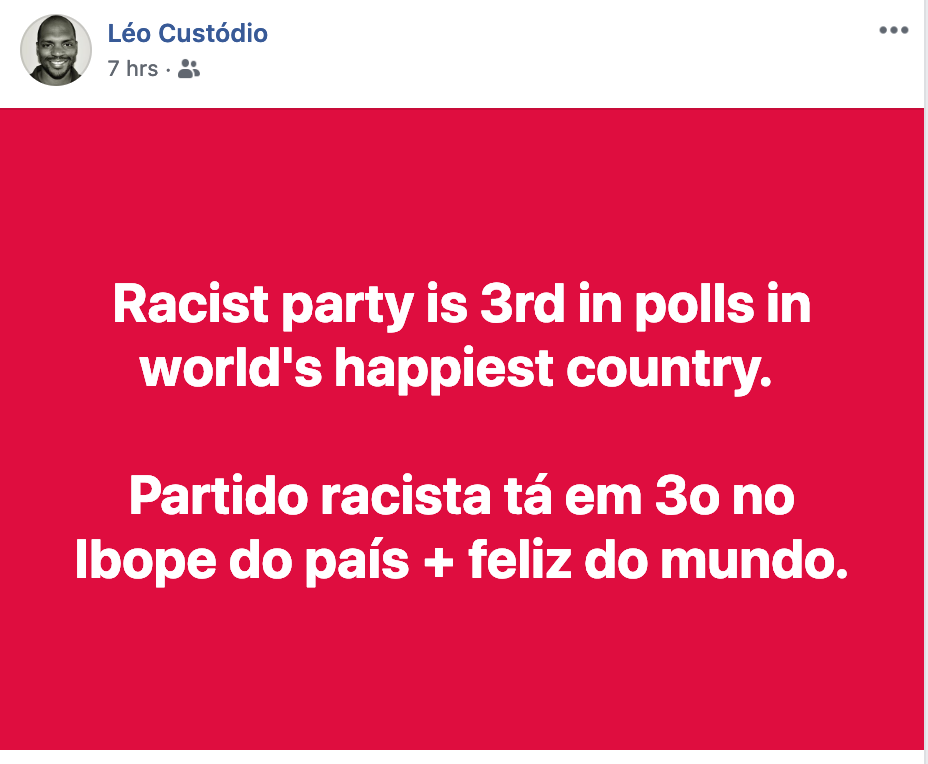
Léo Cutódio published at the end of March the following posting on Facebook. In March, a Yle poll showed the PS with 15.1% and trailing behind the Social Democratic Party and the National Coalition Party.
Emilia Palonen, a University of Helsinki lecturer, was quoted as confirming that “anti-immigration sentiment” is the cause for the rise in popularity of the PS. Even if Palonen does not state it directly, one of the causes of the growth in such anti-immigration sentiment is due to Oulu.
One wonders how a country like Finland, which scores high on the World Press Freedom Index, so many important newspapers get it wrong when it comes to writing about Muslims and minorities.
There are various reasons why news coverage of Muslims and other minority groups is unbalanced:
Muslim and minority sources and experts are rarely used as authorities in a balanced news story.
The media too often paint Muslims, and minorities with a single brush and underline a narrative of “Us” versus “Them.”
There are no Muslim editors and there is an underwhelming number of visible minorities working in newsrooms as staffers.
Some media continue to give inflated respectability, importance, and space to Islamophobes and xenophobes.
Helsingin Sanomat’s staff is celebrating the daily’s 130th anniversary in November. Do you see any minorities? Only one person in the picture has a so-called foreign-sounding name. With about 16% of Helsinki’s population is non-white Finnish, Muslims and minorities are underrepresented in the newsroom. Source: Helsingin Sanomat.
If there is something that publications like Helsingin Sanomat and Yle could do is to write critically about the racism and Islamophobia in parties like the PS and not to treat their politicians in a neural-friendly manner.
The media is a crucial watchdog that looks over people’s rights irrespective of their backgrounds. If Finland doesn’t watch out, and especially its media, the slippery slope to Viktor Orbán’s Hungary is not too faraway.
The Center Party of Finland is a liability to the future of Prime Minister Sanna Marin’s government. We already saw how they forced former Prime Minister Antti Rinne to resign. And then, we witnessed Finance Minister Katri Kulmuni’s Instagram poll.
Kulmuni’s post not only exposed her total disregard for human lives and the country’s international obligations but was a warning that some politicians, even ministers, are ready to leave the fate of their citizens to public opinion and chance.
She asked in the Instagram poll whether it would be ok repatriating “[Finnish] children only” or “children and [Finnish] mothers” from the al-Hol camp in Syria.
Andrew Stroehlein of Human Rights Watch was one of many who were awestruck what Kulmuni’s post. “Seriously, Finland? This is awful, if true,” he tweeted Thursday.
Finland has always been good at getting the maximum mileage from its international image by hiding its problematic social sore spots.
One of these is women’s rights and equality. Women still make about 20% less than men and a recent survey found Finland to be the second-most violent country for women.
Even if some brag about how Finland became the first to grant women the right to vote in 1906, it was not until 1984 when women were able to grant citizenship to their children through jus sanguinis.
Finland also had draconian laws against foreigners and foreign investment thanks to the Restricting Act of 1939 (Law 219/1939), which was made redundant in 1992.
Moreover, Finland got its first Aliens Act in 1983, or about 66 years after independence in 1917. Finland had total disregard for human rights when in the Cold War it returned Soviet citizens back to the USSR without granting asylum. Finland has serious issues with racism, hate crime and asylum policy.
And here lay the question of questions that reveal how deep our collective heads are stuck in the mud: How can such a perfect society, which is supposed to be the happiest in the world, have an openly racist and misogynist party like the Perussuomalaiset (PS)* leading in the polls?
Even if our media scores high on the World Press Freedom Index, why is much of the reporting uncritical when it comes to serious social issues like migrant and minority discrimination and rights? The fact far-right populism is breathing down the necks of mainstream parties is a good indication of the failure of the media to challenge such social ills.
Let’s get real. What Finance Minister Kulmuni posted is a symptom of our denial in confronting those sore spots that only help cover and play down our more serious social problems.
The sooner we understand this, the sooner we can begin to start making Finland a good country to live in for all of its inhabitants irrespective of their backgrounds.
Finland will wake up too late when incompetent populist parties, their politicians and policies lead us to the doorsteps of hell just like what happened in Germany after 1933.
Even if Finland ranks second in the World Press Freedom Index after Norway, how high does it score when it writes about populism, radical-right nationalism, policies that fuel social exclusion, and racism?
The fact that Finland’s largest daily, Helsingin Sanomat, has not written an editorial denouncing racism and how damaging populism is to the country, tell us of the extent of our denial.
Why have no dailies investigated how Finland’s geopolitical isolation during the Cold War helps the country to fall prey to populist and racist parties like the Perussuomalaiset (PS)*?
Since almost everyone, especially most of the Finnish mainstream media, is fascinated with opinion polls these days, it’s clear that dailies like Helsingin Sanomat will give parties like the PS space and the benefit of the doubt.
A media that turns a blind eye to a threat like the PS is leaving our future to chance. Fortunately, Finland does have – even if only a few – solid columnists like Yrjö Rautio, who offers well-rounded analyses of the PS in his columns.
A recent interview Saturday in Helsingin Sanomat of PS chairperson Jussi Halla-aho is a good example of uncritical journalism. Halla-aho built his political career by inciting hatred on groups like Muslims with Islamophobia, homophobia, and racism to name only a few.
In 2012, he was convicted of ethnic agitation and for breaching the sanctity of religion.
You can read some of his most racist quotes in English here.
This list is the DNA of the Perussuomalaiset party but is rarely asked about them.
It is unfortunate for our democracy that the Finnish media doesn’t do more to hold parties like the PS accountable for what they say and do.
A tweet by @TuomoKondie gives us a ten-point list of some questions that Helsingin Sanomat and other media could ask Halla-aho:
Racism spread by the PS;
Links with neo-Nazi groups;
Pipedream [and neo-liberal] economic policies;
Why they sympathize with Russian leader Vladimir Putin?
Scapegoating migrants for all of Finland’s problems;
Systematic lying;
Why PS politicians have the most criminal convictions than of any other party?
Harassing those that oppose the PS;
Climate change denial and naivety;
Unqualified politicians.
Here is something that every journalist in Finland should take into account when writing about the PS:
The Perussuomalaiset is not a normal party. It isn’t normal because it built its base on racism, far-right extremism, and neo-liberal economic and social models. It has an utter disrespect for our Nordic values. One of these is Section 6 of the Constitution that states: “No one shall, without an acceptable reason, be treated differently from other persons on the ground of sex, age, origin, language, religion, conviction, opinion, health, disability or other reason that concerns his or her person.”
Below are more examples and disappointments of how uncritically the Finnish media writes about the PS.
Too few of them put the PS in the hot seat and why they spread and support social discrimination, exclusion, racism, and scapegoat near-constantly migrants for all of the country’s problems.
The postal strike is over but not the foul Perussuomaaiset (PS)* stench that lingers from the usual scapegoating and liesabout migrants.
When the postal strike started, MP Riikka Purra and the PS had nothing better to do but to blame migrants for the labor dispute.
Migrant Taleswrote about Purra’s and her party’s victimization of migrants and how they cooked the facts to serve their argument.
This video is in Finnish.
Her first claim was that even if migrants make up about 20% of Posti’s total workforce, this was apparently a bad matter since foreigners worked and paid taxes.
Posti, the postal company, shot down Purra’s claim.
The PS MP was adamant and went even further to scapegoat foreigners by exaggerating a bogus claim: 98% of employees that carry your post in the early morning are so-called “people of foreign origin.”
She cited as her “source” the management of the Finnish Post and Logistics Union’s (PAU).
Migrant Tales got in touch with PAU, but they did not answer my calls and never confirmed Purra’s claim. The only one that confirmed her claim was herself.
On top of this, Purra’s little trolls and PS helpers came to her rescue.
One of these trolls is Tiina Wiik, who claims that Purra is right and Posti wrong about the amount of foreign postal workers. I asked her partner, Moroccan-born Junnes Lokka, if he considers himself to be a Finn or a person of foreign origin. He never answered my tweet.
As with the previous statement, Posti rejected Purra’s second claim by stating that about 30% of early morning postal workers are Finns. There is a big difference between Purra’s 98% claim and Posti’s 70%.
But this leads us to the most salient question of all: Who gives a flying f**k if there are non-white people working for Posti? Aren’t they offering a service and paying taxes?
In light of the latter, we should ask why is this such a big issue for the PS?