What would you say about a party that openly supports former US President Donald Trump, “loves” Poland and Hungary, supports far-right French politician Marine Le Pen among other iliberal and populist malarkey? What about if I told you that that party has one aim: destroy Finland’s Nordic welfare state and democracy?
The filibustering we are seeing in parliament today by the Perussuomalaiset (PS)* on the EU stimulus packagecoupled with recent opinion polls that show the Islamophobic party leading, are indications of our grim future.
Exposed in our lack of leadership as well to confront such anti-democratic forces.
It all boils down to one fact: since Finland is mainly a white society, it trusts nothing will happen to it as our democracy is dismantled and undermined. Dead wrong. After the PS deal with the Muslims and other minorities they hate, the next group they will go after is you.
Chairperson of the PS parliamentary group Vill Tavio showing his “love” for the iliberal political systems of Poland and Hungary. Source: Twitter.
Remember the young Muslim who was violently attacked by a gang of white Finns in June in the Western Finnish town of Teuva? According to Fares Al-Obaidi, the police plan to conclude their investigations into the crime in early June.
What happened to Al-Obaidi last year changed his life. He moved away to Espoo to receive professional help to overcome the trauma of what happened. He takes anti-depressants.
“I was a victim of a [violent] crime and it seems that nobody is interested,” he said complaining about the length of the police investigation.
His ordeal began on a Saturday. Fares was first insulted by a group of residents from the town of Teuva and then chased by two cars on the road. Two other cars blocked the road ahead of him and had no choice but to drive the car into a ditch.
Fares tried to run away from his attackers, but it was to no avail. He was beaten so badly by them that he ended up being taken by an ambulance to a hospital in Seinäjoki.
In my hometown of Mikkeli, the local Perussuomalaiset (PS)* chapter acted against a municipal election candidate that was too offensive even for their taste. It was the usual hateful nonsense against Muslims, visible migrants, and women. The PS sacked the candidate, Jorma T. Hartikainen, for being too racistonly after the local daily, Länsi-Savo, exposed the former candidate’s Facebook postings.
While this was a good move on behalf of the local PS chapter some local candidates of the party boasted that they don’t support racism. “We gave Jorma T. Hartikianen the boot. We are against racism,” a PS candidate said.
In an attempt to score political points with a xenophobic post, Tanja Hartonen wrote about the Islamization of Finland and Mäntyharju, a small town (pop. 6,200 in 2014) in Eastern Finland. The blog was taken down by Uusi Suomi because it was racist and offensive. In her PS campaign page, she does not mention the term “migrant” never mind the great replacement theory. Does Hartonen still stand by what she wrote in 2014?
If you look at the list of PS candidates in Mikkeli, you will certainly notice Jussi Marttinen, a taxi driver who goes after all foreigners with fake claims that overflow with xenophobia.
In a letter to the Länsi-Savo editor, we asked Marttinen to substantiate one of his many claims about foreigners on the PS’ online candidate page. According to him, foreigners get “notably” more social welfare than white Finns.
A stabbing that took place on Monday in Helsinki,causing the death of a 24-year-old victim, revealed the police’s power in labeling whole ethnic groups (usually in a negative light) and its gatekeeping role. Even if the stabbing suspect was arrested, the police statement mentioned that “about ten [suspects] mainly people of foreign background” took part in the incident at the Helsinki Railway Station.
Any sensible person should ask how the police frames minorities in Finland. What was the purpose of the police to call the suspect “people of foreign background” if he was in police custody?
Officially, a person with a foreign background is anyone whose both parents aren’t white Finns. Unofficially, the term is code for non-white or non-EU citizens. People of color are often referred to by the police with such ethnic labels.
The story by Yle below confronted the police and the media by asking what their motives were for using such a term. Yle News went even further and did the right thing by not mentioning the demeaning label.
Certainly, if you are white and have had little cultural sensitivity training to challenge your prejudices and racism, it is easy to understand why you don’t have a problem with labeling whole non-white ethnic groups with demeaning terms like “people of foreign background.”
Researcher Erna Bodström tweeted that by mentioning the suspect with such a problematic term in a statement, the police were generalizing and stigmatizing people. Even if the police claim what happened is “a phenomenon,” it is not explained in their statement.
Former Perussuomalaiset (PS) MP Ano Turtiainen has become a real thorn in the side of the far-right Islamophobic party. Apart from hisracist postings of George Floyd, encouraging violence against asylum reception centers, assaulting a fourteen-year-old, wishing that asylum seekers would drown at sea,inciting civil war, anti-vaxxer buffoonery, and other issues.
His latest tweet states that he would be ready to kill people if a friend of his was forced to use a mask.
Uusi Suomi, an online publication that played a key role before the 2011 parliamentary elections in giving the racist rhetoric of the Perussuomalaiset (PS)* party a platform, published today an interview with a cultural researcher, Tuija Saresma, who concluded that Jussi Halla-aho and the PS are racist.
While these types of statements are a foregone conclusion about Halla-aho and the PS, the big question is why Finnish society appears so impotent in the face of these social ills.
How do you explain the rise of a party in 2011, which won 39 seats in parliament from 5 previously, became the most successful party in parliamentary elections during the last decade?
Some factors explaining Finnish society’s racist and exclusive disposition is its near-geopolitical isolation during the Cold War. The lack of cultural and ethnic diversity, and the whitewashing of this history, have also help feed racism and white nationalism.
Any sensible person will conclude that white Finnish nationalism and racism get their power from the PS. Attacking brown and black Finns and other minorities with the intent of polarizing society creates a dilemma for the party and the country.
How can we state with a straight face that we are for social equality and human dignity when we exclude in a hostile manner, other people?
An insightful Op-Ed article in The Guardian by David Bromell on the impact of the Christchurch killings, sheds light on some of the problems that countries like Finland face in tackling hate speech.
He writes: “There will always be idiots who shoot their mouths off – but in a democratic society we need to learn to live together.”
According to Bromell, public policy should focus on the “effect of harm” and not on the emotions of hatred or offence since you cannot regulate this in an open and democratic society.
But here comes the punchline: “Stirring up and inciting discrimination, hostility or violence against members of a social group, however, is and should be a crime. This may involve speech, but incitement can also be written, mimed, memed, graffitied, cartooned or tweeted.”
The rise of a racist party like the PS in Finland entrenched in white nationalism is not only shameful but reveals how vulnerable and unprepared society and institutions are in challenging such social ills.
Events after the storming of the Capitol building in Washington on January 6 exposed white nationalist terrorism as the biggest threat facing the United States. Since the events that took place at the Capitol did not happen spontaneously, are we going to see something similar in Finland’s ever-hostile far-right groups like the PS?
As with the United States, is there a blind spot to this threat if the people spreading violence are white Finns? Does Finnish law enforcement take this threat seriously?
There is a strong indication that law enforcement is not up to the job. One of the problems is that such institutions are white and run by men. With so little participation of minorities such as brown and black Finns in the police, newsrooms, and the halls of power, it is not surprising that the anti-racism debate in this country is one-sided and dominated by whites.
The best example of Finland’s racism blind spot is the rise of the Perussuomalaiset (PS)* party and other far-right groups, which have become more vocal in recent years. It is amusing in a negative light that a party like the PS, where the vast majority of its municipal election candidates are white Finnish males, are dead set on denying minorities equal rights.
Even if we give recognition this week to the UN Anti-Racism Day, behind the chatter we find extraordinarily little action to challenge those institutions that give racism and white nationalism its legitimacy. We don’t do enough as a society because we don’t want to.
Islamophobia in all of its forms is cancer that is spreading at this moment throughout Europe. People who attempt to stand up to this social ill are intimidated and attacked. Farid Hafez, whom I know personally and edits the European Islamophobia Report, the most comprehensive report published annually on the topic, is charged for alleged terrorism.
Apart from his activism and bringing attention to Islamophobia, he is a non-resident researcher at Georgetown University, was a Fulbright Professor at UC Berkeley and a leading scholar of Islamophobia Studies.
It wasn’t too long ago when I received an email from Hafez:
“[I] write you today in a personal capacity. I am sure, most of you are following the troubling news on the increasing attacks on academia in France and elsewhere. As you are also aware of, an attack happened killing four innocent people in the streets of Vienna on 2 November 2020. Officially unrelated to this event, but in an atmosphere of having to counter-terrorism, the Austrian government raided the homes of 30 alleged terrorists one week later. It was the largest raid since 1945. Unbelievable but true, I was amongst the targeted ones.”
The video below gives a glimpse of Hafez’ case.
Without bringing any formal charges except based on suspicion and hearsay, Hafez is suspected of terrorism by the Austrian authorities. A question: Is this what happens when you can organize your words and challenge state Islamophobia?
In Argentina, where over 30,000 vanished during the so-called dirty war (1976-83), the de facto government’s methods were seen as state-sponsored terrorism.
In the same light, all types of intimidation, promotion, and spreading anti-Muslim racism by legal and official means could be classified as state Islamophobia.
The search warrant alleges that Hafez is a member of an organization intent on overthrowing the Egyptian government regime of Abdel Fattah el-Sisi, destroying Israel and creating a global caliphate in Jerusalem, its capital.
“Would it not be serious,” said Hafez, “this would sound like a joke.”
The political scientist and one of the editors of the European Islamophobia Report, is confident that all the charges brought against him will be dropped.
“I am very convinced that no single allegation will stay,” he added.
The cost of the raid and the action of the Austrian government:
The case will take three years in the courts and cost an estimated 100,000 euros.
Hafez’ bank account and assets are frozen and cannot sell his house.
The Austrian government is drafting a law that makes “political Islam” a criminal offense, which would make it easier to criminalize every kind of Muslimness.
The latest hijab ban ruling by the Austrian Constitutional Court is seen as a signal against political Islam by its lawmakers.
Yle revealed in a story today that the far-right Kansallismielisten liittouma has distributed Green League Minister of the Interior Maria Ohisalo’s and Prosecutor General Raija Toiviainen’s home address for harassment purposes.
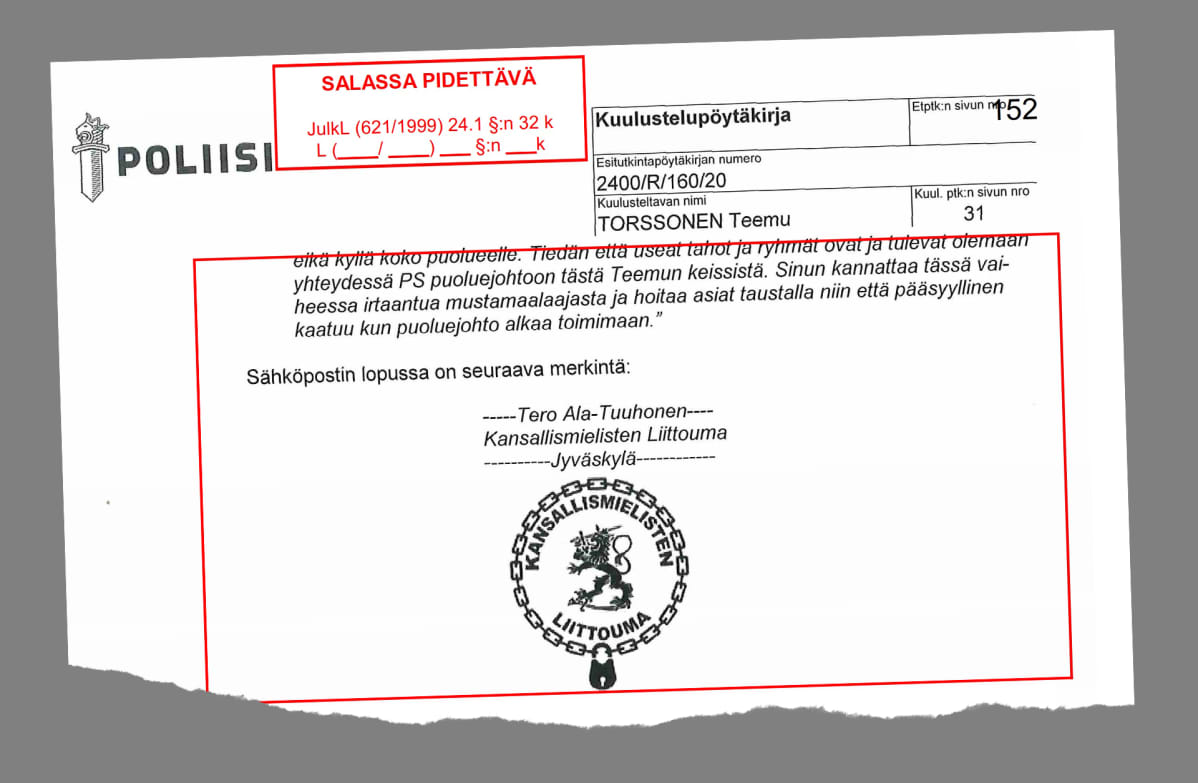
Moreover, Kansallismielisten liittouma chairperson, Tero Ala-Tuuhonen, has been in touch with “a Helsinki police sergeant” who has advised the far-right organization on how to hide weapons and how to beat up asylum seekers without getting caught by the police.
According to Yle, Ala-Tuuhonen had the following conversation with the Helsinki police sergeant:
Ala-Tuuhonen:Jyväskylässä on matujengi alkanut uhittelemaan katupartoijille. Käydään lauantai iltana etsimässä niitä isommalla porukalla [kieliasu alkuperäinen].
Ala-Tuuhonen: “In Jyväskylä, an asylum seeker gang [uses the derogatory term matu] has started to threaten street patrols [they should be called vigilante group]. Let’s go search for them with a bigger group [of vigilantes].”
After over twenty years in journalism and writing for some of the world’s most prestigious publications and having worked as a foreign correspondent in countries like Finland, Italy, Colombia, and others, I have learned a thing or two about journalistic style and correctness.
On top of my journalistic experience, I am a sociologist who has researched immigration topics like Finnish immigration to Argentina.
I have written about immigration and minority topics for almost 14 years in Migrant Tales. In those years, Migrant Tales has published 4,990 posts, which is an average of one posting per day.
Below is a list of terms and observations together with recommendations for journalists and others that write about this topic, which I plan to update in the future:
Maahanmuuttajat is the term in Finnish for migrants. By using the term, we perpetuate stereotypes about this vastly diverse group. We generalize and, with it, fall into the trap of perpetuating stereotypes.
When a reporter interviews an Islamophobic politician and uses the term maahanmuuttajat liberally, he gives such a politician a free pass. If we dig deeper and try to decipher what the term means, it is a code word for non-EU nationals who are Muslims and come from Africa.
If you disagree, ask yourself if Swedes and other EU nationals are called maahanmuuttajat.
Using such a term to speak about “foreigners” is the same as grouping all Europeans into one category, which would be absurd. This is misleading and wrong.
The use of terms such as maahanmuuttajat is not only enabling an anti-immigration party to continue labeling and victimizing non-EU citizens, it also helps us to cover up and deny the racism in our society.
Maahanmuuttajataustainen, a person of foreign origin, is a sinister word used by anti-immigration politicians and public officials to intentionally or non-intentionally exclude first-generation Finns.
Here is a question: What would happen if we would drop the concept label “person of foreign origin” from our vocabulary? In my opinion, it would fast-forward inclusion.
One of the biggest question marks that first-generation Finns and minorities have is their exclusion and how their background does not make them “a real” Finn.
Using such terms encourages exclusion and a sense of outsiderness of such people who are equal members of this society on their own terms.
By using “person of foreign origin” on children born here and who speak Finnish as their main language, we strengthen white Finnish privilege. We tell such brown and black Finns that they are outsiders and that white people are the only cultural standard.