If migration policy is based on lies, suspicion and racism, it is doomed to fail.
The attacks and hostility against the migrant and minority community in Finland intensified. The Perussuomalaiset (PS)* party has assured its supporters that there will be a significant tightening of immigration policies. This comes after reaching an agreement with the Swedish People’s Party (SPP) on such policies.
The PS and SPP were at loggerheads over the new government’s immigration policy. While the head of the PS, Riikka Purra, gave an ultimatum that it would pull out of the talks if the Swedish People’s Party did not accept the proposal on immigration policy.
Despite the dramatic nature of the events that unfolded on Saturday, resembling a second-rate soap opera, the PS ate its words and went through some points that the SPP had made.
Helsingin Sanomat, Finland’s leading daily, reported: “The SPP made changes that the tightening of immigration policy must be carried out within the limits of the constitution [and] the right of asylum seekers not to be deported will be respected.”
Yes, you read right. The SPP is asking that any tightening of immigration policy must respect the constitution and deportation bans will also be respected.
Finland is suffering from a chronic labor shortage in the face of an ever-shrinking labor force and graying of the population. If you want some friendly advice, Finland would be one of the last countries in Europe I’d move to. There are several reasons you should think twice before moving here.
One of the main reasons you should choose a friendlier country to build your future and bring up a family is that Finland is a hostile country towards migrants, especially Muslims and visible migrants.
We have asylum seekers who have been in legal limbo for eight years. Anywhere up to 10,000 people, according to some estimates, are undocumented.
Don’t be fooled by superficial surveys that claim Finland to be the happiest country in the world. It’s only a PR stunt. But here is the question: How can the happiest country have its second-biggest party in parliament, the Perussuomalaiaset (PS)*, be openly racist and hostile to migrants?
You have a choice: If you are white and can flow with the xenophobia, Finland could be a good country for you. Who knows, maybe you can become an example of a super migrant as seen by xenophobic politicians.
There are two opinions about the far-right Perussuomalaiset (PS)* membership in a future coalition government led by the National Coalition Party (Kokoomus): Let them join so the public will see who they are – a cantankerous and messy jumble of bitter hot air; and others point to giving former President Donald Trump the benefit of the doubt, which gave us his toxic polarizing legacy.
We are going through the same arguments about the PS as after the 2011 election when the party scored a historic victory when the party got 39 MPs elected from 5 MPs previously.
“Don’t worry,” some pointed out back then. “It will only be a matter of time before the PS will implode like what happened with the Rural Party (SMP) in the 1970s,”
In 2017, the election of Jussi Halla-aho as the leader of the PS resulted in a small implosion that divided the party into two factions. This event marked the downfall of former PS chief Timo Soini and serves as a prime example of karma. Politically exploiting racism is akin to handling a rabid dog that may bite back with force beyond your control.
Soini is today a wounded politician with his credibility in tatters.
The same fate that Soini suffered threatens Petteri Orpo and the National Coalition Party (Kokoomus).
We should not be surprised that the PS’ second chairperson after Soini, Riikka Purra, considers our constitutional and human rights obstacles to her political ambitions and goals. Her political ideology like that of the party, is based on Finnish white supremacy.
Riikka Purra tweets: “The Finnish government has little chance of influencing anything if you ask the left. The obstacles are at least human rights, the constitution, the EU, international treaties, morality, empathy, [international] image, press freedom, and of course, the correct conclusion[s] of botched investigation[s].”
It would be simplistic to blame only Soini for the rise of a far-right party in Finland. The list includes the whole political spectrum, the media, the education sector, institutions like the police, and denial with a towering D.
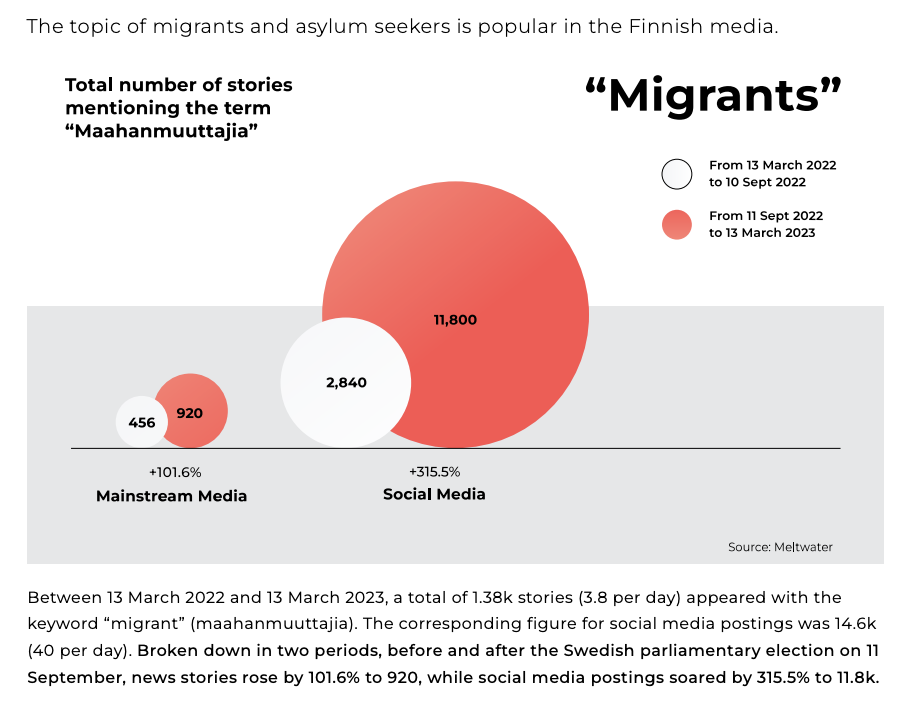
As Migrant Tales correctly predicted, interest in the so-called “youth gang” problem has tanked in the media and social media after the parliamentary election. Twenty-threedays after and before the April 2 election, news on the topic by five media outlets (Helsingin Sanomat, Yle, MTV, Iltalehti, and Ilta-Sanomat) plummeted by 54.5% to five stories from 11, according to a Meltwater search. The most significant drop was seen on social media, diving by 87.4% to 314 posts from 2.56k.
The fall was even more pronounced for all media, sinking by 70.5% to 13 stories from 44 stories.
What do these figures tell us about the fake and exaggerated “youth gang” topic spread by the Islamophobic Perussuomalaiset and its National Coalition Party ally? That was a political stunt to attract voters with the help of fear-mongering. The media (more traffic), the police (more funds to fight crime), and politicians (get voters) all profited from the topic.
The problem with xenophobic parties in the Nordic region is that all promote social exclusion and more social exclusion.
If the elections in Sweden weren’t a preview of the political path of the Nordic region, the April elections in Finland confirmed it. In both countries, parties that base their support on suspicion of minorities and migrants fared well.
Apart from such a recipe for election success in Sweden and Finland, the Sweden Democrats, a party with neo-Nazi roots, and the Perussuomalaiset (PS)* were helped and given political legitimacy by a mainstream conservative party: the Moderates and National Coalition Party (Kokoomus).
For me, the rise of parties whose message is maintaining white-Nordic privilege should not surprise anyone. The exceptionalist view that the Nordics are home of social equality and other noble values is a wise tale. The question a serious student should ask is who enjoys social equality.
If we were to look at how anti-immigration and anti-diversity views take root in the Nordic region, Denmark offers us a case in point.
National Coalition Party head Petteri Orpo and PS’ Riikka Purra in the background. Nordic mainstream parties like Kokoomus have enabled and normalized anti-immigration parties like the PS.
At the beginning of this century, we saw the rise of the staunchly Islamophobic Danish People’s Party (DPP), which influenced politics so that the country turned into one of the most hostile countries for Muslims in the EU.
The DDP, like the Sweden Democrats, could eat and have their racist cakes simultaneously through minority governments.
But in 2019, the Social Democrats, under the leadership of Mette Frederiksen scored a huge victory, with the DPP losing 21 seats. What was the lesson learned? If traditional parties use the same anti-immigration rhetoric as populist parties, they can win elections.
The Danish example suggests that if Sweden and Finland want to deflate the popularity of their Islamophobic parties, they should follow what the Social Democrats did in Denmark.
The other opinion, hoped by some, is to allow the PS to form a government and see how well they come through with their promises. It may mean a nosedive in support.
Polish human rights lawyer Eliza Ruynowski warned Finns in an interview with the Finnish League of Human Rights. “I would urge every Finn to question simple answers to difficult questions. Be wary of those who claim to solve the problem by blaming a group of people – whether it is a minority or those with different political ideas.”
Recently at an Islamophobia conference in Ankara, Turkey, I asked the crowd how a country that won for a sixth consecutive time the title of the happiest country on Earth may have such a big racist party.
Silence responded to my question.
The rise of hostile political parties and public discourse against minorities and migrants reveals how Nordic countries have failed to create social equality.
According to Helsingin Sanomat, the Helsinki city council voted to build a Ghusi facility for Muslims at the Malmi cemetery. In the same way, the Finns washed their dead in saunas before burial, and Muslims in Finland will have the same opportunity to show their respect for their deceased. Even if sensible people would have no qualms about such a matter, there was one person and party that did.
Yes, you guessed correctly. The party is the Perussuomalaiset (PS)*, and the politician, city councilor Laura Korpinen, an MEP candidate on the shameful “let them drown” list.
In 2019, an Alma Median EU election compassasked if it is “the obligation of the EU to save all those migrants who attempt to come to Europe and who are at risk of drowning in the Mediterranean?”
MEP candidates of the PS and National Coalition Party as the most eager to allow migrants to drown in the Mediterranean.
In an earlier tweet, Korpinen claimed that the PS and Christian Democrats voted against the additional facility at the Malmi cemetery. She corrected her Tweet by stating that only the PS voted against such a facility for Muslims. Source: Twitter
Korpinen Tweets: “The Helsinki city council approved a project at the Malmi cemetery to build an [additional] facility for the deceased, which will be pinned on tax-payers for ritual cleansing of Muslims.”
Even if the vote passed in the city council, it showed that the PS lives on a different planet when it comes to cultural diversity and respect for other cultures and religions.
City councilor Björn Månsson of the Swedish People’s Party hit it on the dot: “This is a record new low for the Perussuomalaiset. Now even the deceased are discriminated.”
Finland’s anti-immigration and far-right atmosphere tightened another notch.
An election victory by the Perussuomalaiset (PS),* like in the 2011 election, exposes the same ogre populism and xenophobia. The PS could have never dreamed of joining the major leagues of Finnish politics without the help of the National Coalition Party (Kokoomus), the Social Democratic party, and the Center Party.
While the latter is true, the most critical support came from the Finnish voter. How do you explain the PS winning 39 seats in 2011 from five in the previous election?
The PS should offer gratitude to its victims: immigrants, refugees, and minorities.
What will Sunday’s election reveal behind the mask that covers the many real faces of Finland?
The leading ideologues of the PS are its former head, Timo Soini, and Jussi Halla-aho, who raised to political fame through his hateful blog posts.
TV personality Maryan Abdulkarim has described Soini in the following words:
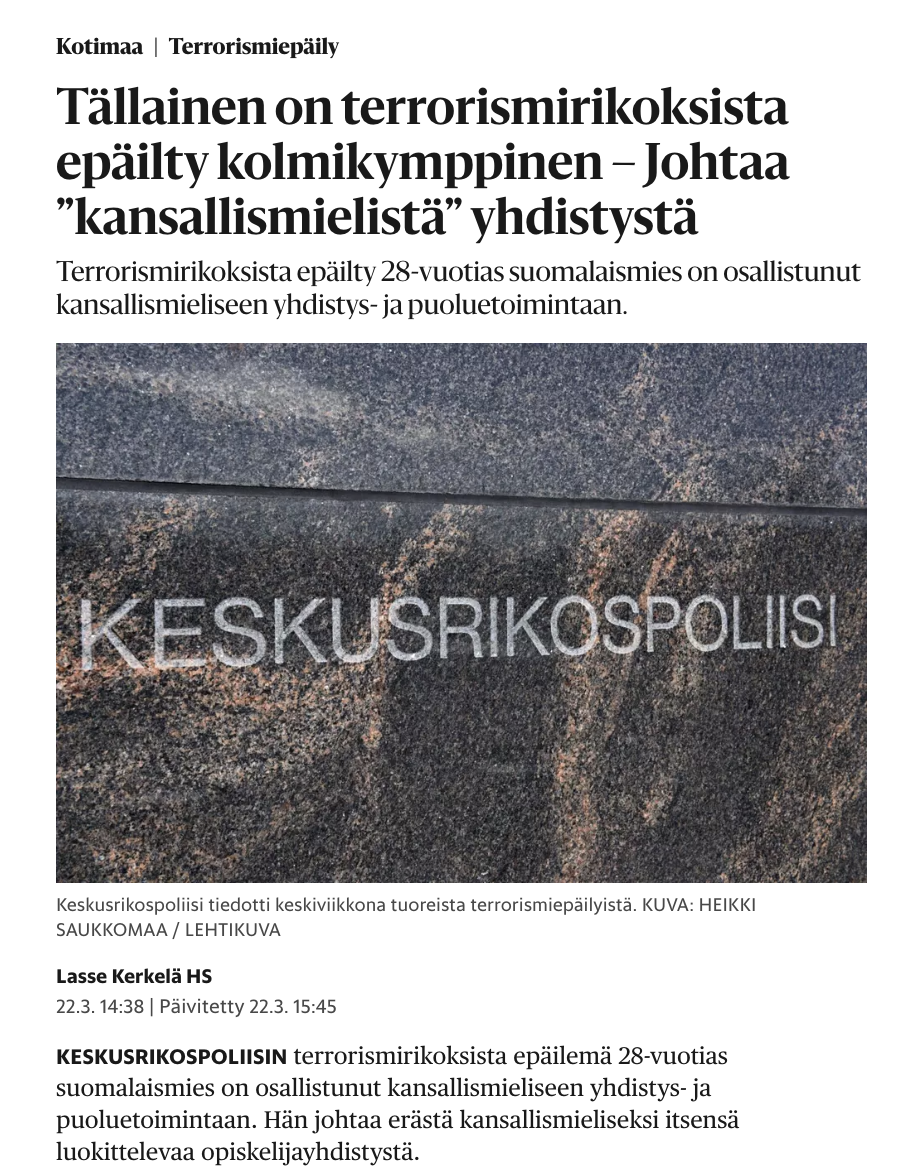
The National Bureau of Investigation (KRP) has remanded in custody a 28-year-old white Finn who used to be a municipal candidate for the Islamophobic Perussuomalaiset (PS)* party but now belongs to the far-right Sinimusta Liike (Blue-and-Black Movement), according to Helsingin Sanomat.
The police’s intelligence gathering of the suspect led to a search of his home, where arms were found. KRP is investigating the suspect’s activities and if other suspects are involved.
The case is not the first white Finnish suspect. In December 2021, the police announced the country’s first far-right terrorist case. In November, detective inspector Toni Sjöblom told Migrant Tales that charges would be brought against five suspects “within a few weeks.” By mid-March, no charges have been brought against the suspects.
The Finnish Security and Intelligence Service’s (SUPO)In National Security Overview 2022 said that the threat of a terrorist attack in Finland would come from “supporters of right-wing extremist or racial Islamist ideology, and from small covert cells [comprising] of such individuals.”
The latest terrorist suspect, who studied law, was a Perussuomalaiset (PS) candidate for councilperson who lobbied at the university against “woke culture” and “cultural Marxism,” a concept used by far-right activists.
The same type of bias in how the media, politicians, and even the police treat “white” terrorism is evident in the case of the 28-year-old. He was active with the PS Youth of Lapland, representing the party’s most far-right views, and was a strong proponent of ethnonationalism.
One active member of the PS Youth of Lapland was Johannes Sipola, who was convicted with Toni Jalonen for ethnic agitation in 2020. Sipola blamed in a tweet below the Christchurch massacre on multiculturalism.
While even the Islamophobic Finns Party (PS) does not object to the arrival of tens of thousands of white Ukrainian refugees to Finland, the treatment of Muslims is different. Politicians and other public officials continue to see Muslims as a threat to national security. The Finnish Immigration Service (Migri) has been the target of criticism for its arbitrary and slow pace of decisions. Finland has asylum seekers from regions like the Middle East who arrived in the country in 2015 and are still waiting for their residence permits.
Continue reading the European Islamophobia Report 2022 here.
Fool me once shame on you fool me twice shame on me.
The question is neither far-fetched nor provocative: The xenophobic Perussuomalaiset (PS)* party has used and exploited in the past three elections of 2011, 2015, and 2019 the migrant crime theme.
Understanding the success that the Sweden Democrats, a party with neo-Nazi roots, and the Moderate Party in September had in the Swedish election with criminal gang violence, PS head Riikka Purra bet she had found the “perfect” story to succeed in Finland’s April election.
But did she? The jury is still out on that one.
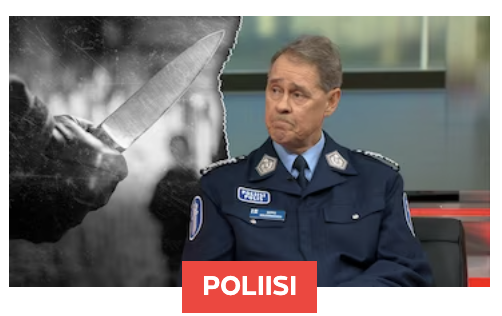
MTVworks closely with the police to spread an image of fear about “youth gangs.” A knife on the left and police chief Seppo Kolehminen. on the right
About eight formerly undocumented immigrants were found guilty of sexually abusing minors in the Oulu cases four years ago. However, a skewed and unfavorable narrative supported by the police, politicians, and media came close to hysteria. Yle published 77 articles on the topic between 14 November 2018 and 13 February 2019, including 13 articles alone on 14 January!
Thanks to the Oulu sexual cases, the PS almost won the election. Even so, the whole issue faded into the background after the election.
Will the same happen to the “youth gang” [1] story?