Migrant tales
Menu
  • #MakeRacismHistory “In Your Eyes”
  • About Migrant Tales
  • It’s all about Human Rights
  • Literary
  • Migrant Tales Media Monitoring
  • NoHateFinland.org
  • Tales from Europe
Menu

Tag: integration

Language plays an important role in migrant adaption but so do acceptance, respect and equal opportunities

Posted on February 28, 2014 by Migrant Tales

With the help of migrants, YLE Uutiset Suoralinja television program Monday at 7.20 pm wants to find out how much do Finnish and Swedish language skills help you integrate and find employment. When teaching migrants one of Finland’s two official languages, what works and what doesn’t?

One interesting question that we could ask is why are we asking this important question today? When speaking of migrant adaption, is the emphasis only language without looking at other important issues as acceptance, respect and equal opportunities?

The answer to that question could reveal a lot about how we integrate and accept newcomers to our society.

Even if we speak of two-way adaption, or integration in the integration act, the expectation and aim appears to be assimilation, or one-way adaption. This means that the migrant does all the adapting while we are not required to change at all.

This, I believe, integration in theory but assimilation is usually the rule, is the crux of the issue. Migrants, and especially Finns who control political and economic power in this country, must do much more to fuel two-way integration.

You can read more about Monday’s program here. What are your thoughts on the topic. You can send your answers to yjr Suora linja team directly at [email protected]  or [email protected].

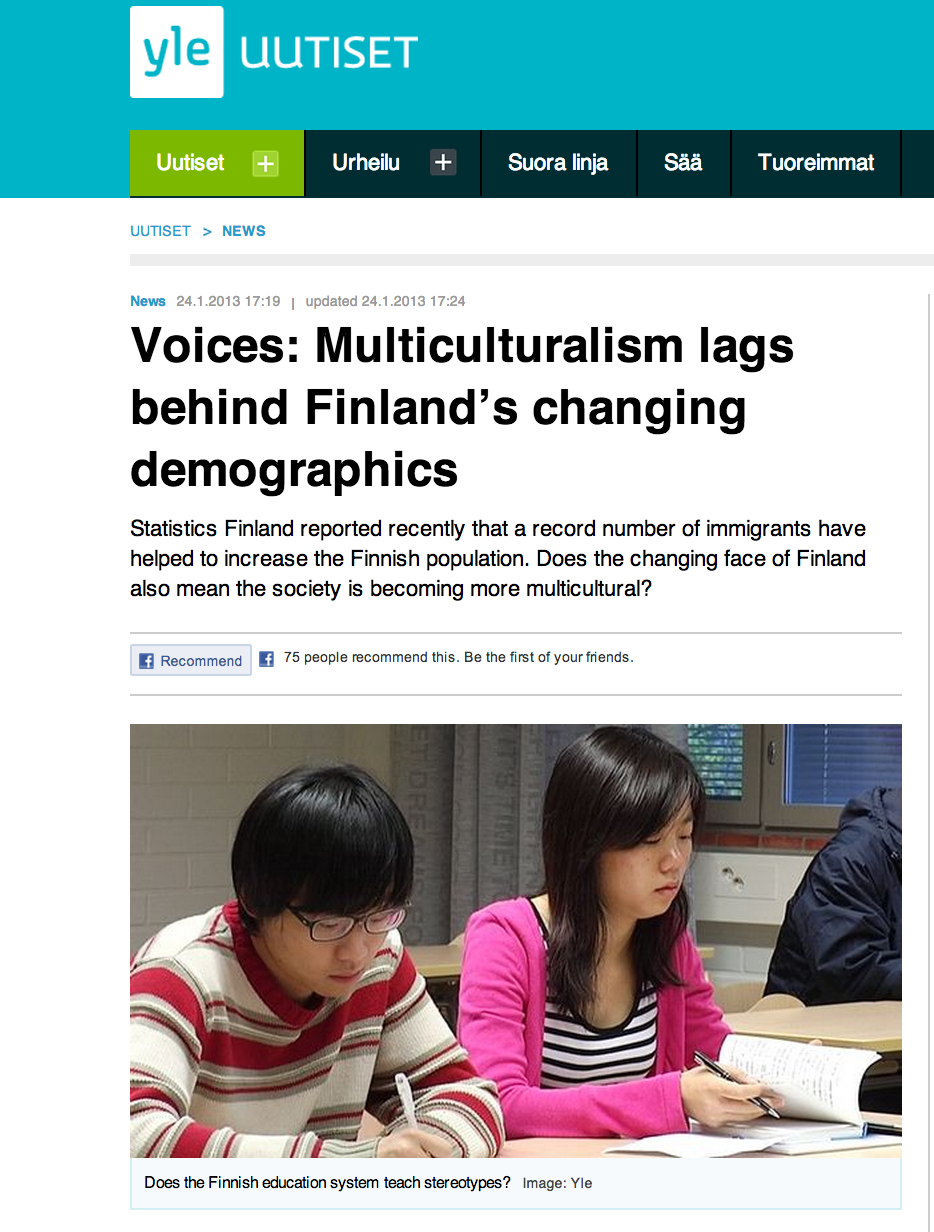
Kuvankaappaus 2014-2-28 kello 11.02.23
There’s nothing wrong with this, but why does the Finnish media many times picture immigrants as blacks or if they are women with head covering?

Here’s what I wrote to YLE Uutiset Suora linja:

Learning Finnish or Swedish is crucial and helps in the integration process of the newcomer. However, language is used in Finland to discriminate people and seen as a panacea on how to integrate successfully into Finnish society. Language is part of your “ethnicity” in Finnish society. Russians are white but still they suffer from discrimination.

The question we should ask as well is why aren’t there enough Finnish-language classes offered to migrants? Is this a way to “control” migrants and keep some groups on short leashes?

There are many countries like Spain that show us that language is only one important factor in the migrant’s adaption process. Why aren’t Latin Americans from Peru, Ecuador and other countries, who speak Spanish as their native language, are Catholics and live in former Spanish colonies, accepted and suffer from discrimination in Spain?

Let’s bring the issue closer to home and look at the history of the Romany minority and Saami in this country. They’ve lived here for centuries and still suffer from discrimination and social exclusion.

So, when you speak of just language as the key to Finnish integration to society and believe that this will help a migrant or a visible minority get employed, you should give that thought a major rethink.

Best wishes,

Does Finland promote two-way or one-way adaption of immigrants?

Posted on September 21, 2013 by Migrant Tales

Our integration law promotes two-way adaption as opposed to assimilation, which is a one-way process. Section 17 of the Finnish Constitution states that each person living in this country has the right to maintain and develop their own language and culture. What do these two important laws mean in practice and how are they applied?

Sensible Finns understand what cultural diversity implies but a poll published by Helsingin Sanomat Friday shows that 53% fully (22%) or partially agreed (31%) that immigrants should aim at becoming as Finnish as possible. That compares with 48% in 2011 an 37% in 2006.

While these types of surveys are problematic because they reveal more the prejudices of the respondents, market research companies and the newspapers that publish the poll results, it shows, among other things, general expectations that give little to no insight on how to move ahead as our society becomes more diverse.

What does being Finnish imply never mind mean? Are we using the nineteenth century cultural yardstick or a totally different one in this century to make our society more inclusive to new groups who are and want to be Finnish according to their cultural backgrounds?

The crux of the matter, in my opinion, is that our ideal is two-way adaption but the rule is one-way assimilation.

This can be even be seen in our exemplary educational system, where we still promote “us” and “them” by openly labeling third-culture pupils as children “with immigrant backgrounds” (maahanmuuttajataustainen).

I personally believe that Finland is on the right track and should continue to promote and defend its present laws that ensure cultural diversity.

If you think of it, the whole debate on immigration and refugees presently taking place in this country hinges on one important point: acceptance of cultural diversity. Do we accept people moving to our country who are from different cultures? What must we give up in order to accommodate these new groups and what must these newcomers do to be included?

We have always spoken of two-way acceptance and respect on Migrant Tales. Why? Because it is inclusive and the most effective way to integrate people.

Why would you want to have a system that fuels prejudice and intolerance? At the end of the day our prejudices will cost us dearly because they will fuel social exclusion and high unemployment already so evident in many European countries.

Even if Finland is a society that has the right tools and resources to promote two-way acceptance and respect between groups, or cultural diversity, our prejudices continue to be part of the problem. They don’t permit us to have a clearer bigger picture of how to move ahead.

The answers and models that can be employed are lying right under our very noses. We have good laws and Nordic democratic values in this country to build a vibrant society where we can celebrate our diversity.

The challenge then is applying these laws and values to include Finland’s new inhabitants.

It’s that simple.

Government announces Future of Migration 2020 Strategy

Posted on June 14, 2013 by Migrant Tales

The government published Thursday its Future of Migration 2020 Strategy. While these types of official strategy reports are important and offer a general view, the big question is if they gives us a bigger picture of the direction our society is heading in this century. 

Read the white paper (in Finnish) here. An English-language version will be available after summer.


Kuvankaappaus 2013-6-14 kello 12.22.53

Read council of state statement here.

One of the matters that surprised me about the strategy report is that it doesn’t use the term ”multiculturalism,” which has been replaced by the term diversity (moninaisuus). In English a good synonym for multiculturalism is cultural diversity. Why does the report only speak of diversity?

These kinds of omissions always raise concern about what the government really thinks of cultural diversity and, most importantly, how it should be promoted and defended.

The Confederation of Finnish Industries (EK) said that the white paper didn’t go far enough, reports YLE in English.

“As someone who has been monitoring immigration policy for a long time, I don’t consider this to be a major change,” says Riitta Wärn, an EK labor market specialist. “There’s not really anything surprising or new laid out in this policy.”

Another question mark is  Interior Minister Päivi Räsänen, who is liked by the anti-immigration Perussuomalaliset (PS) party for her conservative ideas about immigration and stated publicly that homosexuality is a sin.

The positive matter about the 2020 strategy is that it openly speaks out against racism and discrimination and how these latter social ills undermine good ethnic relations.

It states: ”The Future of Migration 2020 Strategy has a number of key objectives: managing the labour market; ensuring equal rights for all employees; improving employment opportunities for people from an immigrant background; pursuing a more successful integration policy; aiming at a faster processing of asylum applications; and fighting discrimination.”

While our laws in Finland ensure that immigrants and visible minorities will be treated equally before the law, it is quite another matter if this always happens in real life. More importantly, do we have the resources and the will to challenge intolerance?

The report suggests, however, that the government is serious about such matters.

Buenos Aires Herald (February 12, 1987): The old-new frontier*

Posted on June 9, 2013 by Migrant Tales

Comment: It’s sad to point out 25 years after writing this opinion piece that Argentina has become a poorer country. Emigration continues to be the rule, not the exception. The opening up of the economy to foreign investment during the 1990s was a disaster. Too many foreign companies did not invest in Argentina to make it more efficient but to pillage its natural resources and markets. Corruption continues to be one of the country’s biggest issues and keeps Argentina from attaining its economic potential. 

______________________

To govern is to populate. 

Juan Bautista Alberdi (1810-84)

Although Alberdi coined the phrase more than a century ago, it is still by and large true even though the statement has in mind Anglo-Saxon emigrants as opposed to Latins never mind Amerindians, blacks or Orientals. 

Image1-4_edited-12

As most long-range programes int his country, Argentina’s immigration policy turned out a failure. The flow  should have been continuous and the vast empty patches of the countryside populated; new blood should have injected viror, social dynamism balanced with tolerance – political stability and economic prosperity should have been the rule.

True, Argentina did gain from the millions of immigrants that helped raise this country’s mid-19th century population of roughly one million to around eight million in 1914, paving the way for Argentina’s present-day 30-million-strong population.

As opposed to Australia, Canada and the US, during the early 20th century Argentina was in its own league when compared to the foreign-to-native ratio.

For instance, in the 1914 census 30 percent of the national population was composed of foreigners and, for Buenos Aires alone, this figure reached 40 percent. Add to these latter percentages the children of these original immigrants and the above-mentioned ratio becomes even more impressive.

No wonder why writer Manuel Gálvez, in a sarcastic allusion to Alberdi, said “to govern is to Argentinize.”

However, a number of internal and external factors – the Great Depression of the 1930s, World War II, domestic strife and instability, among others – curtailed the flow of immigrants thus giving way to a new demographic phenomenon: Argentina emigrants.

For those Argentines that left from the 1960s on, those who had made their homes here for a generation or two, Argentina became a stepping stone in their long search for a country that would offer them a decent existence.

Undoubtedly, the effects of this emigration are self-evident: hundres of thousands of Argentines – many of these qualified professionals – have caused a serious brain and qualified labor drain on the country, let alone speak of the flight of capital, ingenuity and hard work that are synonymous with the latter reality.

Probably the saddest fact was that Argentina could do little about halting this trend And, even today, the economic conditions aren’t attractive enough for Argentines living abroad to return en masse to the country.

 Although the Radical administration [of President Raúl Alfonsín] has roughly 20 months left in power, it has ventured – voluntarily or involuntarily – to open up the closed doors of the economy as the recent 40 percent sell off of Aerolíneas Argentinas to Scandinavian Airlines proves.

This week another important step was taken by deregulating the petchem, steel and iron industry sectors. Naturally, these ar only previews of what will happen to other sectors such as telecommunications, railways, electric power et all as the months unfold ahead.

The interesting question about all this is if these economic structural changes will pave the way for a stronger, self-confident Argentina.

Considering that the country’s economic transformation will be a long, bumpy ride, it is not likely that this Southern Cone nation will be a magnet for Argentines living abroad or foreigners in the near future, which is undoubtedly one of the major obstacles in transforming this country into a modern 21st century republic.

Will anything be done to those political, economic and social impediments that reversed the immigration trend and encouraged Argentines to leave be deal with effectively it the upcoming years?

As one foreign businessman told this journalist: “Although Argentina has 30 million people it functons as a country of two million.”

As far as both Alberdi’s and Gálvez’ phrases are concerned, to govern effectively in the late-20th century is first to modernize and, in the early 21st century, to repatriate and populate.

*This column was originally published in the Buenos Aires Herald on February 12, 1987. 

We speak of two-way integration but too many still believe in assimilation

Posted on May 3, 2013 by Migrant Tales

Finland’s integration law is exemplary in many respects because it aims to integrate newcomers as equals in our society. No law is, however, written in stone and is only as good as the institutions and people that enforce it. One of the matters that some have a difficult time grasping is what two-way adaption, or integration, means and implies. 

Integration is the opposite to assimilation, which is one-way integration. Those who are in favor of assimilation, believe that most if not all of the adapting to cultural diversity will be done on their terms. One of their favorite arguments is: “Why should I adapt to them if they are in my country.”

Assimilation is a lazy and convenient way to exclude and keep others corralled with the help of our suspicion. This integration model is one of the reasons why intolerance is still the rule instead of the exception in many European countries.

Assimilation not only is a lazy model and sustains itself with the help of ethnocentrism, prejudice, white privilege, outright discrimination of whole groups and, worse, by defensive and repeated denials that we don’t have any issue with intolerance.

Take for example Finland’s Romany minority, which have suffered the greatest hostility in our society. They are a good example if any of outright social exclusion.

A US state department human rights report stated recently: ”Groups of Roma have lived in the country for centuries, and Roma are classified as a ’traditional ethnic minority’ in the ombudsman’s report. The Romany minority was the most frequent target of racially motivated discrimination, followed by Russian-speakers, Somalis, and Sami.”

Some Finns are still waiting after 500 years for the Roma, which number about 10,000 in Finland, to turn “white.” By turning white, I mean giving up their traditional dress, identity and ways of life in order to gain greater acceptance.

The paradox, however, is that if they gave up their identity they’d be in worse shape then they are today. The aim of  intolerance and the victimization of groups like the Roma, is to wipe them off the Finnish cultural map.

One matter we should be careful to avoid when promoting two-way integration is exclusion by default. The best of example of this is when elementary schools continue to call third-culture children as students with immigrant backgrounds (maahanmuuttajataustainen) irrespective that they were born and have lived all their lives in this country.

Living in a culturally diverse society where two-way adaption, or integration, is the rule is the most effective and less-expensive way to adapt newcomers.

Even if our society promotes mutual acceptance, our laws and human rights play important roles.

The greatest integrators of all are social justice and equal opportunities – the very values we promote in our laws.

Sport is one of your best passports to acceptance in a new country

Posted on February 5, 2013 by Migrant Tales

Since sports can be your passport to acceptance in a new country, its role should never be underetimated never mind undermined. It’s clear that we need to do more work in Finland to promote sports in order to include more immigrants and their children in this activity.

In the United States I played basketball, track & field, and soccer to gain new friends, respect and acceptance. If you were good at sports in school you were immediately accepted in the so-called elite student class.

Sports is an effective integrator because any sensible coach or trainer understands that racism and discrimination hurt the person’s and team’s performance. Teamwork works best when these latter social ills don’t take the driver’s seat.

Sports offers our integration program a good benchmark. Pereformance is judged by skills not by a sportsman’s or woman’s ethnicity.

Basketball was my passport to acceptance in the United States, track & field helped me to meet new Finnish friends and soccer enabled me to be accepted by Latinos.

Image1-1_edited-1

This is me before the Fosbury flop at a track & field meet in California in 1971 between Hollywood and Eagle Rock High School.

One of the most important moments of my sporting career took place at the regional track & field championship in Varkaus in the early 1970s. I had won the high jump compeition but there was a slight problem.

”We cannot give you the award because you don’t live in Finland,” an official of the event said.

”But I am a Finn,” I responded. “My grandfather was an active sportsman and leader in SVUL [Etelä-Savo sports federation]. I visit Finland every summer.”

After much thought, the ogranizing committee decided to give me the award.

I am eternally grateful to them that they did. I tried to get in touch with the organizers thirty years later and thank them for making the right decision and not allowing nationality to get in the way.

But who had informed them that I didn’t live in Finland at the time?

In the 1970s Finnish citizenship was defined on very narrow terms. Even if my mother is a Finn, I had no right to citizenship. This changed in 1984, when children of Finnish mothers were given citizenship automatically.

One of the challenges facing Finland today is that there are too few immigrants that excel in sports when compared with Sweden or other European countries like England and Holland.

Leena Harjula-Jalonen of the Finnish Multicultural Sports Federation (FIMU) agrees.

”This situation should be better studied in order to address the issue more effectively [so more immigrants and their children can participat and excel in sports],” Harjula-Jalonen told Migrant Tales, adding that high participation costs and targeting state aid to such programs are some of the many challenges facing immigrants.

Here’s an article on Wednesday’s Helsingin Sanomat that sheds more light on the problem.

Labels that fuel discrimination and racism in Finland

Posted on January 28, 2013 by Migrant Tales

When will Finns drop this discriminatory term: Finns with immigrant backgrounds? Many, I suspect, are and should be proud of their background. I am but what happens if these labels and terms ensure that you will continue to be treated as something less equal? 

What do you do if being labeled in such a way undermines your career chances and competing with white Finns for the best jobs?

Fred Dervin, a professor of multicultural education at the University of Helsinki, said the usage of such labels create inequality, especially if the person was born in this country.

“It is dangerous because we create [a sense of] inequality, since not everyone is given the same treatment or opportunities,” he was quoted as saying on YLE in English. 

Kuvankaappaus 2013-1-28 kello 6.59.02Part of the problem aren’t Finns labeling “others” as eternal outsiders, but those who are being labeled accept it! Some of them fall into the trap  and actually believe they are somehow less equal, or don’t have the right to be on equal terms with a white Finn because of their immigrant background.

Some will struggle during their lives to be as white as possible without ever understanding the beauty of their roots.  A valid question we should ask about integration in Finland is what are newcomers supposed to integrate to?  

If Dervin makes a case for those who were born in this country, I would take it even further: What about those that came here as children and have lived most of their lives in this country?

Why are they still considered “foreigners?” How many generations must they live in Finland in order to be accepted as equals?

The same matter that happens in countries with immigrants is happening in Finland but in a different context.  It’s the same discriminatory standard  used to exclude others from being treated as equals in society.

Identity is a personal matter. You are who you think you are. If some have an problem with this, it’s their problem, not yours. 

No matter how you cut it, we should start to better identify and discard from our speech those terms that fuel discrimination and inequality.


What are immigrants supposed to adapt to?

Posted on December 18, 2012 by Migrant Tales

One of the biggest questions when speaking of the integration of immigrants and visible minorities in Europe and Finland is what are they supposed to adapt to. In theory everything sounds perfect in our law books. What happens on the ground, however, is a totally different story. 

Kuva 79

This abandoned Cadillac reveals the crude face of integration. Great expectations but difficult to fulfill because the car has no engine. The children of immigrants are one vulnerable group.

The shameful xenophobic and anti-Semitic events going on in Hungary and Eastern Europe, Greece and elsewhere are enough proof that the region has some serious issues to deal with.

In my home country of Finland, matters have gotten so bad that in 2011 the Perussuomalaiset (PS), an anti-EU, anti-immigration and especially anti-Islam party, rose from the minor leagues to become the country’s third-largest political force in parliament.

The PS is today the fertile breeding ground for right-wing extremism in Finland.

Two crucial articles of our Constitution should not be forgotten when speaking about integration:

Chapter 2 Section 6  (No one shall, without an acceptable reason, be treated differently from other persons on the ground of sex, age, origin, language, religion, conviction, opinion, health, disability or other reason that concerns his or her person).

Chapter 2 Section 17 (The right of everyone to use his or her own language, either Finnish or Swedish, before courts of law and other authorities, and to receive official documents in that language, shall be guaranteed by an Act…The Sami, as an indigenous people, as well as the Roma and other groups, have the right to maintain and develop their own language and culture).

I am confident that Finnish officials have the best intentions in mind when they look at the integration of newcomers. There is, however, a major obstacle when speaking of effective integration and inclusion of immigrants in our society: lack of funds and not seeing any worth in cultural diversity.

This shouldn’t surprise us. The whole social construct of Finnish national identity is based on narrow terms. We need, however, to change that culture radically. Instead of reinforcing our exclusiveness, new generations of Finns should be taught the importance of inclusion, mutual acceptance and respect for diversity.

Why would anyone want to embrace the culture and values of any society that is outright hostile to them?

You have a choice in Finland: Become an an Uncle Tom (Tuomo-setä).

In Finland the definition of aTuomo-setä could be any immigrant or visible minority who betrays other people like himself by becoming and adopting the same values that exclude others socially.

Taking into account the negative atmosphere and the inability of Finnish society to accept and permit cultural diversity to become the standard, it would be naive if not foolhardy to forget your roots and identity when adapting.

Your greatest asset to our society is your culture and identity.

It’s not being third-rate white Finn.

Language is not always your passport to inclusion and acceptance

Posted on May 15, 2012 by Migrant Tales

By Enrique Tessieri

Some politicians and social workers in this country believe that integration is only possible after an immigrant learns  the Finnish or Swedish language. This may be true but there are other factors that  play equally important roles in the integration process of an immigrant.  

An immigrant will have to pass many checkpoints before he is accepted as a member of Finnish society. How many and what those checkpoints are is open to debate.

Promising an immigrant that he’ll be integrated as soon as he learns the language is a bit like telling a child: “When you grow up you’ll have a wife, children and be successful.”

If language were a panacea to an immigrant’s integration problems, why is social exclusion still a problem among the Romany minority, which have lived in this country for centuries?

Another interesting group we could cite are the Latin Americans of Spain. The majority of them speak Spanish as their mother tongue, they are familiar with Spanish culture, and are even Catholics. Despite their command of the most widely spoken language of Spain and knowledge of the local culture, why do some groups like the Bolivians, Ecuadorians and blacks suffer from high unemployment and social exclusion?

What would you say if a person has lived most of his life in Finland, speaks Finnish as a native but admits: “The worst thing in Finland is that if you have a different religion, culture and language, you are left on the fringes of society. No matter how much you try to integrate you are always left outside.”

Would enrolling in a Finnish-language course be the solution?

Probably not.

The three examples above suggest that integration is a more complex matter than just learning a new language. Attitudes and acceptance by the host society may play equally important roles in the integration process of an immigrant.

One of the reasons why too many politicians and social workers like to speak of integration in simple learn-language terms may be because they are unaware of a wider problem.

As long as we don’t address that side of the integration problem, which is acceptance by the host society, we will never challenge the wider problem of integration effectively.

Is Finland ready for cultural diversity?

Posted on March 22, 2012 by Migrant Tales

By Enrique Tessieri

In light of social ills like racism and social exclusion in Finland, J. W. Berry of Queen’s University of Canada offers us an opportunity to ask a very important question: Are we in Finland ready for cultural diversity? If we still aren’t quite there yet, how long will it take? 

Nationalism is a double-edged sword. It served to unite and mold a social construct like the national identity of the Finns but in the process it excluded other groups.

While great injustices were committed against us by Stalin, we have to learn to forgive and move on. This is necessary if we want to build a well-functioning culturally diverse society that reaps synergies and grows successfully. But taking into account the political situation in Russia, such a task can be challenging.

We should, however, not mix the Russian people and individuals with its past and present political system and leaders.

Our national identity should not hinge on those rivers of blood from former wars but how we turned this society after those wars into a successful Nordic welfare state. Lasting values like social equality and social justice should unite us today, not the hatred that lingers from those conflicts.

Doing away with our ethnic and national myths, which constantly remind us that we are under threat from the outside world and that war is only a heartbeat away, will be easier said than done.

Certainly I would want to be an optimist and state that this wretched period is only a short temporary phase.  Admitting that things will be better in a few years time is, however, an exercise in self-deception.

I hope, however, that time will prove me wrong.

But let’s look at Berry’s view* on the factors that make a culturally diverse society possible. According to him, there are four criteria:

  1. There needs to be a general support for cultural diversity as a valuable resource for a society.
  2. There should be overall low levels of prejudice in the population.
  3. There should be generally positive mutual attitudes among the various ethnocultural groups that constitute the society.
  4. There needs to be a degree of attachment to the larger national society.

All these points could be debated for and against about our society. Possibly some would claim that all four points are met with flying colors by our society. Others would disagree.

I believe it’s not a question whether we are ready or not for culturally diversity. The fact is that our society is culturally diverse and we should deal with it.

If the aim of political parties like the Perussuomalaiset [1] has been to make Finland white again, then it’s clear that they’ve failed.

* J. W. Berry: Prejudice, Ethnocentrism and Racism. Siirtolaisuus-Migration 2/1996. pp. 5-9.

[1] The Finnish name of the Finns Party is the Perussuomalaiset (PS). The English names adopted by the PS, like True Finns or Finns Party, promote in our opinion nativist nationalism and xenophobia. We therefore prefer to use the Finnish name of the party on our postings.

  • Previous
  • 1
  • 2
  • 3
  • 4
  • Next
Read more about documentary film
Read more

Recent Posts

  • Finland’s tabloids Iltalehti and Ilta-Sanomat are the pits
  • Riikka Purra’s Dr Jekyll and Mr Hyde mask
  • Double standards
  • Perussuomalaiset: Uusi logo, sama vanha juttu
  • Taco Trump

Recent Comments

  1. Absolutely Socking: Racist Finnish Facebook group against human rights gets flooded with socks on Musta Barbaari’s mother and sister charged by the police in “ethnic profiling” case
  2. Ilkka Nuotio on Pekka Myrskylä: “Tilastot kertovat toista kuin poliittinen keskustelu”
  3. Genrih Soinkara on The war in Ukraine and the Russian-Finnish border crisis are showing Finland’s ugly side
  4. Ahti Tolvanen on Comment by Ahti Tolvanen on the Helsinki +50 conference
  5. Angel Barrientos on Angel Barrientos is one of the kind beacons of Finland’s Chilean community

Archives

  • June 2026
  • May 2026
  • April 2026
  • March 2026
  • February 2026
  • January 2026
  • December 2025
  • November 2025
  • October 2025
  • September 2025
  • August 2025
  • July 2025
  • June 2025
  • May 2025
  • April 2025
  • March 2025
  • February 2025
  • January 2025
  • December 2024
  • November 2024
  • October 2024
  • September 2024
  • August 2024
  • July 2024
  • June 2024
  • May 2024
  • April 2024
  • March 2024
  • February 2024
  • January 2024
  • December 2023
  • November 2023
  • October 2023
  • September 2023
  • August 2023
  • July 2023
  • June 2023
  • May 2023
  • April 2023
  • March 2023
  • February 2023
  • January 2023
  • December 2022
  • November 2022
  • October 2022
  • September 2022
  • August 2022
  • July 2022
  • June 2022
  • May 2022
  • April 2022
  • March 2022
  • February 2022
  • January 2022
  • December 2021
  • November 2021
  • October 2021
  • September 2021
  • August 2021
  • July 2021
  • June 2021
  • May 2021
  • April 2021
  • March 2021
  • February 2021
  • January 2021
  • December 2020
  • November 2020
  • October 2020
  • September 2020
  • August 2020
  • July 2020
  • June 2020
  • May 2020
  • April 2020
  • March 2020
  • February 2020
  • January 2020
  • December 2019
  • November 2019
  • October 2019
  • September 2019
  • August 2019
  • July 2019
  • June 2019
  • May 2019
  • April 2019
  • March 2019
  • February 2019
  • January 2019
  • December 2018
  • November 2018
  • October 2018
  • September 2018
  • August 2018
  • July 2018
  • June 2018
  • May 2018
  • April 2018
  • March 2018
  • February 2018
  • January 2018
  • December 2017
  • November 2017
  • October 2017
  • September 2017
  • August 2017
  • July 2017
  • June 2017
  • May 2017
  • April 2017
  • March 2017
  • February 2017
  • January 2017
  • December 2016
  • November 2016
  • October 2016
  • September 2016
  • August 2016
  • July 2016
  • June 2016
  • May 2016
  • April 2016
  • March 2016
  • February 2016
  • January 2016
  • December 2015
  • November 2015
  • October 2015
  • September 2015
  • August 2015
  • July 2015
  • June 2015
  • May 2015
  • April 2015
  • March 2015
  • February 2015
  • January 2015
  • December 2014
  • November 2014
  • October 2014
  • September 2014
  • August 2014
  • July 2014
  • June 2014
  • May 2014
  • April 2014
  • March 2014
  • February 2014
  • January 2014
  • December 2013
  • November 2013
  • October 2013
  • September 2013
  • August 2013
  • July 2013
  • June 2013
  • May 2013
  • April 2013
  • March 2013
  • February 2013
  • January 2013
  • December 2012
  • November 2012
  • October 2012
  • September 2012
  • August 2012
  • July 2012
  • June 2012
  • May 2012
  • April 2012
  • March 2012
  • February 2012
  • January 2012
  • December 2011
  • November 2011
  • October 2011
  • September 2011
  • August 2011
  • July 2011
  • June 2011
  • May 2011
  • April 2011
  • March 2011
  • February 2011
  • January 2011
  • December 2010
  • November 2010
  • October 2010
  • September 2010
  • August 2010
  • July 2010
  • June 2010
  • May 2010
  • April 2010
  • March 2010
  • February 2010
  • January 2010
  • December 2009
  • November 2009
  • October 2009
  • September 2009
  • August 2009
  • July 2009
  • December 2008
  • November 2008
  • October 2008
  • September 2008
  • August 2008
  • July 2008
  • June 2008
  • May 2008
  • April 2008
  • March 2008
  • February 2008
  • January 2008
  • November 2007
  • October 2007
  • September 2007
  • August 2007
  • July 2007
  • June 2007
  • May 2007

Categories

  • ?? Gia L?c
  • ????? ?????? ????? ???????? ?? ??????
  • ???????
  • @HerraAhmed
  • @mondepasrond
  • @nohatefinland
  • @oula_silver
  • @Varathas
  • A Pakistani family
  • äärioikeisto
  • Abbas Bahmanpour
  • Abdi Muhis
  • Abdirahim Hussein Mohamed
  • Abdirahim Husu Hussein
  • Abdirisak Mahamed
  • About Migrant Tales
  • activism
  • Adam Al-Sawad
  • Adel Abidin
  • Afrofinland
  • Ahmed IJ
  • Ahti Tolvanen
  • Aino Pennanen
  • Aisha Maniar
  • Alan Ali
  • Alan Anstead
  • Alejandro Díaz Ortiz
  • Alekey Bulavsev
  • Aleksander Hemon
  • Aleksanterinliitto
  • Aleksanterinliitto ry
  • Aleksanterinliitto ry:n hallitus
  • Alex Alex
  • Alex Mckie
  • Alexander Nix
  • Alexandra Ayse Albayrak
  • Alexis Neuberg
  • Ali Asaad Hasan Alzuhairi
  • Ali Hossein Mir Ali
  • Ali Rashid
  • Ali Sagal Abdikarim
  • Alina Tsui
  • Aline Müller
  • All categories
  • Aman Heidari
  • Amiirah Salleh-Hoddin & Jana Turk
  • Amin A. Alem
  • Amir Zuhairi
  • Amkelwa Mbekeni
  • Ana María Gutiérrez Sorainen
  • Anachoma
  • Anders Adlecreutz
  • Angeliina Koskinen
  • Anna De Mutiis
  • Anna María Gutiérrez Sorainen
  • Anna-Kaisa Kuusisto ja Jaakko Tuominen
  • Annastiina Kallius
  • Anneli Juise Friman Lindeman
  • Announcement
  • Anonymous
  • Antero Leitzinger
  • anti-black racism
  • Anti-Hate Crime Organisation Finland
  • Anudari Boldbaatar
  • Arshiya Nasser
  • Aspergers Syndrome
  • Asylum Corner
  • Asylum seeker 406
  • Athena Griffin and Joe Feagin
  • Autism
  • Avaaz.org
  • Awale Olad
  • Ayan Said Mohamed
  • AYY
  • Barachiel
  • Bashy Quraishy
  • Beatrice Kabutakapua
  • Beri Jamal
  • Beri Jamal and Enrique Tessieri
  • Bertolt Brecht
  • Boiata
  • Boodi Kabbani
  • Bruno Gronow
  • Carmen Pekkarinen
  • Çelen Oben and Sheila Riikonen
  • Chiara Costa-Virtanen
  • Chiara Costa-Virtanen
  • Chiara Sorbello
  • Christian Thibault
  • Christopher Wylie
  • Clara Dublanc
  • Dana
  • Daniel Malpica
  • Danilo Canguçu
  • David Papineau
  • David Schneider
  • Dexter He
  • Don Flynn
  • Dr Masoud Kamali
  • Dr. Faith Mkwesha
  • Dr. Theodoros Fouskas
  • Edna Chun
  • Eeva Kilpi
  • Emanuela Susheela
  • En castellano
  • ENAR
  • Enrique
  • Enrique Tessieri
  • Enrique Tessieri & Raghad Mchawh
  • Enrique Tessieri & Yahya Rouissi
  • Enrique Tessieri and Muhammed Shire
  • Enrique Tessieri and Sira Moksi
  • Enrique Tessieri and Tom Vandenbosch
  • Enrique Tessieri and Wael Che
  • Enrique Tessieri and Yahya Rouissi
  • Enrique Tessieri and Zimema Mhone
  • Epäluottamusmies
  • EU
  • Europe
  • European Islamophobia Report
  • European Islamophobia Report 2019,
  • European Union
  • Eve Kyntäjä
  • Ezequiel Caldeiro
  • Facebook
  • Fadumo Dayib
  • Faisa Kahiye
  • Farhad Manjoo
  • Fasismi
  • Finland
  • Fizza Qureshi
  • Flyktingar och asyl
  • Foreign Student
  • Fozia Mir-Ali
  • Frances Webber
  • Frida Selim
  • Gareth Rice
  • Ghyslain Vedeaux
  • Global Art Point
  • Great Replacement
  • Habiba Ali
  • Hami Bahadori
  • Hami Bahdori
  • Hamid
  • Hamid Alsaameere
  • Hamid Bahdori
  • Handshake
  • Harmit Athwal
  • Hassan Abdi Ali
  • Hassan Muhumud
  • Heikki Huttunen
  • Heikki Wilenius
  • Helsingin Sanomat
  • Henning van der Hoeven
  • Henrika Mälmsröm
  • Hser Hser
  • Hser Hser ja Mustafa Isman
  • Husein Muhammed
  • Hussain Kazemian
  • Hussain Kazmenian
  • Ibrahim Khan
  • Ida
  • Ignacio Pérez Pérez
  • Iise Ali Hassan
  • Ilari Kaila & Tuomas Kaila
  • Imam Ka
  • inside-an-airport
  • Institute of Race Relations
  • Iraqi asylum seeker
  • IRR European News Team
  • IRR News Team
  • Islamic Society of Norhern FInland
  • Islamic Society of Northern Finland
  • Islamophobia
  • Jacobinmag.com
  • Jallow Momodou
  • Jan Holmberg
  • Jane Elliott
  • Jani Mäkelä
  • Jari Luoto
  • Jari Taponen
  • Jegor Nazarov
  • Jenni Stammeier
  • Jenny Bourne
  • Jessie Daniels
  • Joe Davidow
  • Johannes Koski
  • John D. Foster
  • John Grayson
  • John Marriott
  • Jon Burnett
  • Jorma Härkönen
  • Jos Schuurmans
  • José León Toro Mejías
  • Josue Tumayine
  • Jouni Karnasaari
  • Juan Camilo
  • Jukka Eräkare
  • Julian Abagond
  • Julie Pascoet
  • Jussi Halla-aho
  • Jussi Hallla-aho
  • Jussi Jalonen
  • JusticeDemon
  • Kadar Gelle
  • Kaksoiskansalaisuus
  • Kansainvälinen Mikkeli
  • Kansainvälinen Mikkeli ry
  • Katherine Tonkiss
  • Kati Lepistö
  • Kati van der Hoeven-Lepistö
  • Katie Bell
  • Kättely
  • Kerstin Ögård
  • Keshia Fredua-Mensah & Jamie Schearer
  • Khadidiatou Sylla
  • Khadra Abdirazak Sugulle
  • Kiihotus kansanryhmää vastaan
  • Kirsi Crowley
  • Koko Hubara
  • Kristiina Toivikko
  • Kubra Amini
  • KuRI
  • La Colectiva
  • La incitación al odio
  • Laura Huhtasaari
  • Lauri Finér
  • Leif Hagert
  • Léo Custódio
  • Leo Honka
  • Leontios Christodoulou
  • Lessie Branch
  • Lex Gaudius
  • Leyes de Finlandia
  • Liikkukaa!
  • Linda Hyökki
  • Liz Fekete
  • M. Blanc
  • Maarit Snellman
  • Mahad Sheikh Musse
  • Maija Vilkkumaa
  • Malmin Kebab Pizzeria Port Arthur
  • Marcell Lorincz
  • Mari Aaltola
  • María Paz López
  • Maria Rittis Ikola
  • Maria Tjader
  • Marja-Liisa Tolvanen
  • Mark
  • Markku Heikkinen
  • Marshall Niles
  • Martin Al-Laji
  • Maryan Siyad
  • Matt Carr
  • Mauricio Farah Gebara
  • Media Monitoring Group of Finland
  • Micah J. Christian
  • Michael McEachrane
  • Michele Levoy
  • Michelle Kaila
  • Migrant Tales
  • Migrant Tales Literary
  • Migrantes News
  • Migrants' Rights Network
  • MigriLeaks
  • Mikko Kapanen
  • Miriam Attias and Camila Haavisto
  • Mohamed Adan
  • Mohammad Javid
  • Mohammad M.
  • Monikulttuurisuus
  • Monisha Bhatia and Victoria Canning
  • Mor Ndiaye
  • Muh'ed
  • Muhamed Abdimajed Murshid
  • Muhammed Shire
  • Muhammed Shire and Enrique Tessieri
  • Muhis Azizi
  • Musimenta Dansila
  • Muslimiviha
  • Musulmanes
  • Namir al-Azzawi
  • Natsismi
  • Neurodiversity
  • New Women Connectors
  • Nils Muižnieks
  • No Labels No Walls
  • Noel Dandes
  • Nuor Dawood
  • Omar Khan
  • Otavanmedia
  • Oula Silvennoinen
  • Paco Diop
  • Pakistani family
  • Pentti Stranius
  • Perussuomalaiset
  • perustuslaki
  • Petra Laiti
  • Petri Cederlöf
  • Pia Grochowski
  • Podcast-lukija Bea Bergholm
  • Pohjois – Suomen Islamilainen Yhdyskunta
  • Pohjois Suomen Islamilainen Yhyskunta
  • Polina Kopylova
  • Race Files
  • racism
  • Racism Review
  • Raghad Mchawh
  • Ranska
  • Rashid H. and Migrant Tales
  • Rasismi
  • Raul Perez
  • Rebecka Holm
  • Reem Abu-Hayyeh
  • Refugees
  • Reija Härkönen
  • Remiel
  • Reza Nasri
  • Richard Gresswell
  • Riikka Purra
  • Risto Laakkonen
  • Rita Chahda
  • Ritva Kondi
  • Robito Ibrahim
  • Roble Bashir
  • Rockhaya Sylla
  • Rodolfo Walsh
  • Roger Casale
  • Rostam Atai
  • Roxana Crisólogo Correa
  • Ruth Grove-White
  • Ruth Waweru-Folabit
  • S-worldview
  • Sadio Ali Nuur
  • Sami Rusanen
  • Sandhu Bhamra
  • Sara de Jong
  • Sarah Crowther
  • Sari Alhariri
  • Sarkawt Khalil
  • Sasu
  • Scot Nakagawa
  • Shabana Ahmadzai
  • Shada Islam
  • Sharon Chang blogs
  • Shenita Ann McLean
  • Shirlene Green Newball
  • Sini Savolainen
  • Sira Moksi
  • Sonia K.
  • Sonia Maria Koo
  • Steverp
  • Stop Deportations
  • Suldaan Said Ahmed
  • Suomen mediaseurantakollektiivi
  • Suomen Muslimifoorumi ry
  • Suomen viharikosvastainen yhdistys
  • Suomen viharikosvastainen yhdistys ry
  • Suomi
  • Supermen
  • Susannah
  • Suva
  • Syrjintä
  • Talous
  • Tapio Tuomala
  • Taw Reh
  • Teivo Teivainen
  • The Daily Show
  • The Heino
  • The Supermen
  • Thomas Elfgren
  • Thulfiqar Abdulkarim
  • Tim McGettigan
  • Tino Singh
  • Tito Moustafa Sliem
  • Tobias Hübinette and L. Janelle Dance
  • Transport
  • Trica Danielle Keaton
  • Trilce Garcia
  • Trish Pääkkönen
  • Trish Pääkkönen and Enrique Tessieri
  • Tuulia Reponen
  • Uncategorized
  • UNITED
  • University of Eastern Finland
  • Uyi Osazee
  • Väkivalta
  • Vapaa Liikkuvuus
  • Venla-Sofia Saariaho
  • Vieraskynä
  • W. Che
  • W. Che an Enrique Tessieri
  • Wael Ch.
  • Wan Wei
  • Women for Refugee Women
  • Xaan Kaafi Maxamed Xalane
  • Xassan Kaafi Maxamed Xalane
  • Xassan-Kaafi Mohamed Halane & Enrique Tessieri
  • Yahya Rouissi
  • Yasmin Yusuf
  • Yassen Ghaleb
  • Yle Puhe
  • Yuliet Tresa
  • Yve Shepherd
  • Zahra Khavari
  • Zaker
  • Zalina Ametova
  • Zamzam Ahmed Ali
  • Zeinab Amini ja Soheila Khavari
  • Zimema Mahone and Enrique Tessieri
  • Zimema Mhone
  • Zoila Forss Crespo Moreyra
  • ZT
  • Zulma Sierra
  • Zuzeeko Tegha Abeng
© 2026 Migrant tales | Powered by Minimalist Blog WordPress Theme