Migrant tales
Menu
  • #MakeRacismHistory “In Your Eyes”
  • About Migrant Tales
  • It’s all about Human Rights
  • Literary
  • Migrant Tales Media Monitoring
  • NoHateFinland.org
  • Tales from Europe
Menu

Tag: Immigration policy

Finland’s Foreign Minister Timo Soini is against European Commission plans to spread refugees among EU states

Posted on June 15, 2015 by Migrant Tales

In a ploki, a nationalistic Finnish translation of blog, Perussuomalaiset (PS)* Foreign Minister Timo Soini writes that he’s against European Commission (EC) plans to spread refugees throughout the community. 

“Every country is responsible for the asylum seekers [that come to their country],” he wrote. “Such policy must be made by the host country. The Commission should have no jurisdiction over [a country’s] immigration policy.”

Soini, who normally gives the image of a “good cop” against the “bad cops” of his party, or those PS members who have been sentenced for ethnic agitation and/or make racist statements to the media, believes that accepting a few refugees from war-torn regions wouldn’t help relieve matters for such refugees.

Continue reading “Finland’s Foreign Minister Timo Soini is against European Commission plans to spread refugees among EU states”

Feeding our amnesia and sidestepping the issues in the immigration and refugee debate

Posted on June 6, 2015 by Migrant Tales

You can remind me four years from today what I’ll say now: Very little will be resolved concerning the challenges facing our ever-growing culturally diverse society except for witch-hunts and underlining the poisonous message of “us” against “them.”

In the plainest English it means very little will be resolved concerning our ever-growing culturally diverse society because the power that parties like the Perussuomalaiset (PS)* of Finland have today is based on nationalistic fear of the outside world and strengthening “us” against “them.”

What will, then, Center Party Prime Minister Juha Sipilä’s government accomplish during its four-year mandate except for greater social inequality that will in turn fuel greater anti-immigration sentiment?

Most likely it’s greatest “accomplishment” will be the further impoverishment of Finland, ever-growing poverty and society’s polarization.


Näyttökuva 2015-6-6 kello 10.35.21

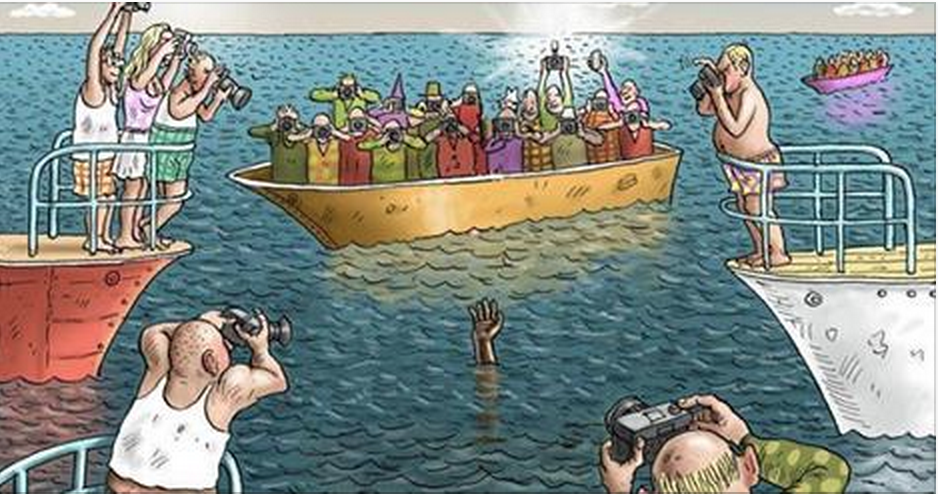
Who will speak up for this dear little girl at sea? Our amnesia?

Former EU’s high representative for foreign and security policy and former secretary general of NATO, Javier Solana, writes in an opinion piece about our collective amnesia. He states:

Continue reading “Feeding our amnesia and sidestepping the issues in the immigration and refugee debate”

Thursday’s A-studio: How the Finnish media and politicians paint immigrants with a single brush

Posted on April 24, 2015 by Migrant Tales

I almost fell off my seat when I watched A-studio Thursday. Perussuomalaiset (PS)* MP Hanna Mäntylä justified the ongoing victimization and labeling of Finland’s small migrant community. She said this was fine because some white Finns are poor. 

“We have in effect people who live and are on the verge of suffering from hunger because they don’t have enough money to pay for food on a daily basis,” said Mäntylä. “Yes, these kinds of stories come in loud and clear on the campaign trail like why we have this kind of immigration policy in Finland.”

One of the problems with this kind of claim by Mäntylä is that she includes all migrants and paints them with a single brush.  Her point is a clear example of scapegoating but neither the host nor the guests brought this up.

Is it the fault of those refugees fleeing war and hunger that some white Finns are, as Mäntylä points out, on the verge of suffering from hunger?

Of course not but she blames all migrants for this.

If we are fair, Mäntylä’s statement reveals the hostility of the PS towards cultural diversity and how they want to keep migrants as second- or third-class citizens.

Mäntylä’s view of immigration – she doesn’t distinguish between migrants and refugees never mind humanitarian immigration – is one matter but when those present like Ilkka Kanerva of the National Coalition Party, Green League MP Ville Niinistö and Antti Kaikkonen of the Center Party don’t challenge such populist statements that too speaks volumes about why migrants are the favorite punching bag of politicians.

Since the majority of migrants are employed in this country and pay taxes, how many of these migrants that Mäntylä cites are we speaking of? How many thousands compared with the hundreds of thousands of Finns who get social welfare? In English we call this a storm in a tea cup. Another good term is scapegoating.

Näyttökuva 2015-4-24 kello 8.41.24


PS MP Hanna Mäntylä states that it’s fine to loathe all migrants and demand a change in immigration policy since there are Finns who are on the verge of suffering from hunger in this country. Her statement is a good example of scapegoating.

Continue reading “Thursday’s A-studio: How the Finnish media and politicians paint immigrants with a single brush”

How the Finnish media gives anti-immigration parties like the PS space, inflated respectability and importance

Posted on July 27, 2014 by Migrant Tales

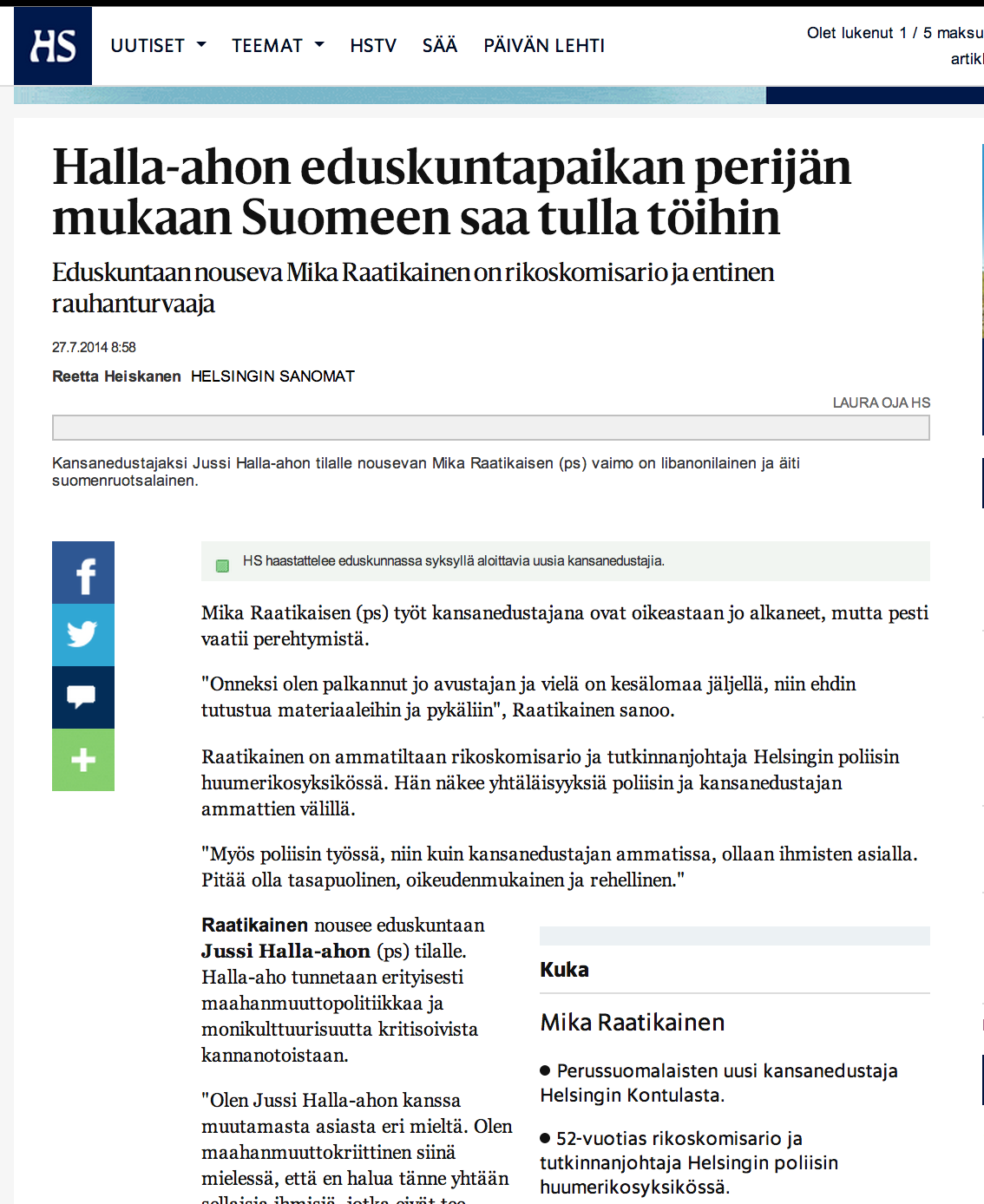
An article in Sunday’s Helsingin Sanomat about Perussuomalaiset (PS)* MP Mika Raatikainen, who will replace former PS MP Jussi Halla-aho’s after he was elected to the European parliament in May, reveals once again this country’s media fascination with racist double-talk and rhetoric that just don’t add up never mind make sense.

If there is a culprit in Finland that has made this country a more hostile place for migrants and minorities, it is the media.They are part of the problem.

An article published this week on migrant crime by Lahti-based Etelä-Suomen Sanomat is another case in point.

The Etelä-Suomen Sanomat journalist makes a disingenuous claim at the bottom of the online version of the story by stating that researchers of The National Research Institute of Legal Policy fear that studying migrant crime will label different national and ethnic groups.

This is exactly what the journalist does in the article.

Even so-called quality dailies like Helsingin Sanomat, which should know better, play into the anti-immigration rhetoric of parties like the PS, which are hostile to our Nordic democratic way of life, migrants, minorities and our ever-growing cultural diversity.

It’s clear that one of the aims of the PS after its historic election victory of 2011 is to become a ‘normal’ mainstream party.

Is this possible? How can a party that spreads ethnic hatred, victimizes certain ethnic and religious groups, polarizes society by stressing ‘us’ and ‘them,’ is homophobic and promotes nativist nationalism can ever become ‘normal.’

Certainly this is what the PS wants but it is quite another story if they can eat and have their populist cake at the same time. Näyttökuva 2014-7-27 kello 11.10.27

Read full story (in Finnish) here.

Why is there so much interest in the Finnish media with a party that openly promotes racism and has had MPs sentenced for ethnic agitation, like Halla-aho? Why does the Finnish media pay so much attention to a party that has had some of its members applied to becoming members of neo-Nazi groups like Kansallinen Vastarinta?

Why isn’t there any mention in the Helsingin Sanomat story about Halla-aho’s and the PS’ ties with the far-right extremist Suomen Sisu association?

The answer is simple: Finland’s media is white. Since it is white it doesn’t have to worry about becoming a victim or target of the PS that near-constantly fuels suspicion of migrants and minorities in this country.

The Helsingin Sanomat story offers us common anti-immigration slogans, such as our social welfare system should not serve the whole world, used by the PS.

I beg your pardon? Is the above possible? Who has made such a claim except for the PS?

If you are a politician and want to fear-monger in this country, a sure way is by stating that hordes of migrants will soon invade the country. Such fear-mongering has been used for decades in Finland.

In the Helsingin Sanomat story, Raatikainen claims that he disagrees with Halla-aho on a few points but but is quick to define himself as an ‘immigration critic’ who is in favor of tight immigration policy. He agrees with Halla-aho in that he doesn’t “want people [migrants to move here] who don’t do anything and are involved in crime.”

If I were the journalist interviewing Raatikainen, I’d ask him which groups in this country want migrants to move here who don’t do anything and commit crime? That question would open a whole new area of discussion that would shed light on his anti-immigration rhetoric.

Raatikainen confuses us with his double-talk, when he first claims that he’s against migrants who don’t want to work and commit crime but those that come here to study, work and do their best are welcome.

Don’t the majority of migrants fall into the latter category?

As in many stories about the PS written in the national media, Raatikainen’s interview reveals a generous pinch of political opportunism.

Parties like the PS don’t have a clear idea of how they’d improve immigration policy never mind how to turn newcomers into dynamic members of our society.

Even if they have no idea about many of the things they talk about, they are right on one matter: Anti-immigration rhetoric is sexy and it appeals to Finnish voters  as well as to the media.


* The Finnish name for the Finns Party is the Perussuomalaiset (PS). The English names of the party adopted by the PS, like True Finns or Finns Party, promote in our opinion nativist nationalism and xenophobia. We therefore prefer to use the Finnish name of the party on our postings.

Finland’s interior minister wants more quota refugees in 2015

Posted on July 9, 2014 by Migrant Tales

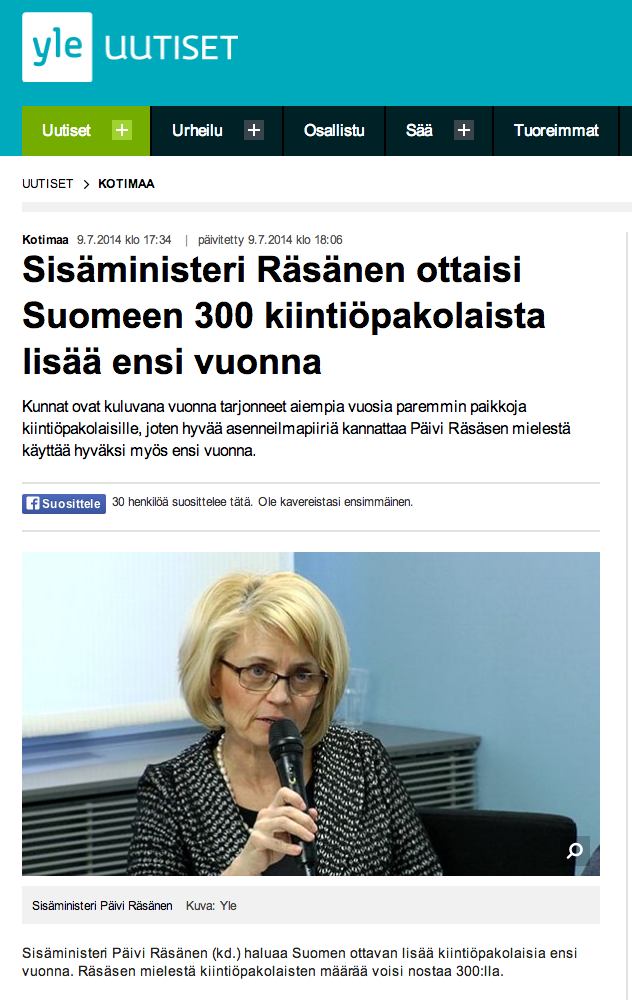
Interior Minister Päivi Räsänen of Finland, who considers homosexuality to be a sin and wants to tighten immigration laws, said on YLE that she would like to raise the number of quota refugees next year by 300 to 1,050 from 750.

While this is welcome news, especially for the few hundred refugees that will get a new life in our country, one wonders why Räsänen is making such a statement in July, when most Finns are on vacation.

Räsänen has been no friend of migrants never mind refugees. This is the same politician that denies ethnic profiling by the police, has done nothing to loosen costly family reunification requirements, and oversees a ministry that detains asylum seekers who are minors.

Does the announcement by her have to do with the fact that Finland takes in so few refugees to begin with?

While even giving one person asylum is important, the 300 extra quota refugees that Räsänen speaks of is a drop in the bucket, even shameful, considering our country can do much more to help families who are victims of war and persecution.


Näyttökuva 2014-7-9 kello 21.39.58

Read full story (in Finnish) here.


Räsänen states that the rise to 300 more quota refugees has to do with the good reception that municipalities have given to refugees.

Räsänen said she’d prefer quota refugees from Syria.

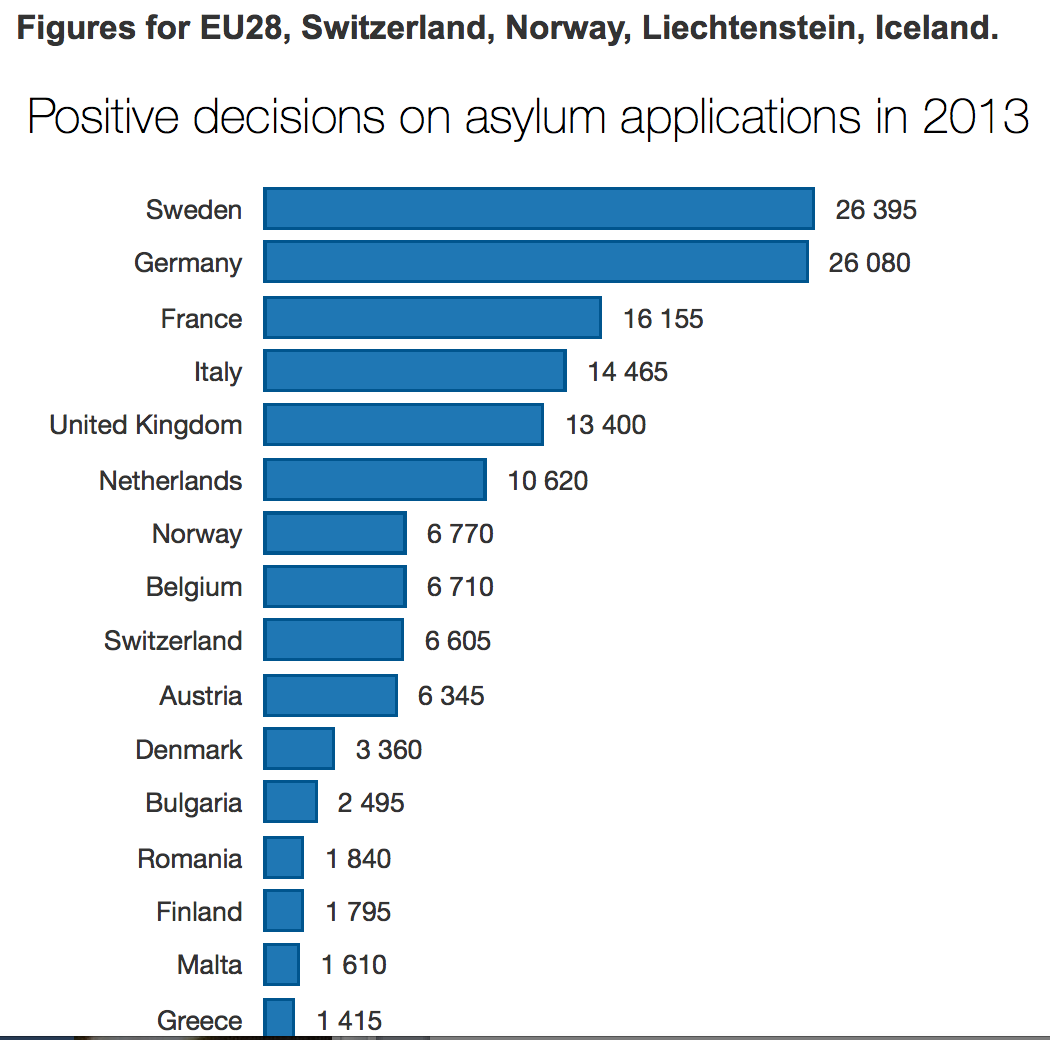
According to Eurostat, Finland gave asylum to 1,795 people and in fourteenth place when compared with other EU countries. Excluding Iceland, which gave asylum to 15 people, Finland took the least amount of refugees in the Nordic region after Sweden (26,395), Norway (6,770) and Denmark (3,360).

Näyttökuva 2014-6-28 kello 13.06.15

Read full Eurostat statement here.


Between 2003 and 2013, Finland has missed its 750-quota refugee target: 746 in 2013, 734 in 2012; 626 in 2011; 634 in 2010; 727 in 2009; 737 in 2008; 727 in 2007; 676 in 2006; 690 in 2005; and 679 in 2004, according to Finnish Immigration Service (FIS).

Interior Minister Päivi Räsänen is on the anti-immigration warpath again

Posted on February 2, 2014 by Migrant Tales

Anti-immigration and anti-gay hardliner Christian Democrat interior minister, Päivi Räsänen, said on YLE in English that she’s in favor of tightening immigration policy further by closing a “loophole” for asylum seekers. Under the present law, those asylum seekers whose application has been turned down, can get temporary residence for two years before acquiring a permanent residence permit. 

While we’re speaking of a “huge” number of asylum seekers – about 200 in all – it’s these types of laws that not only reveal our suspicion of asylum seekers and migrants in general, but ensures that skilled migrants will not move to Finland in significant numbers.

And why would they? Migrants want to move to countries where other migrants live – not some cold place that is unsure about its ever-growing cultural diversity and where too many politicians treat refugees like “welfare shoppers.”

What’s wrong if a person wants to move from a country where he has no future to one where there’s opportunity? Isn’t that what over 1.2 million Finnish emigrants did between 1860 and 1999? Can you punish somebody for seeking a better future?

In order for Finland to begin accepting its ever-growing cultural diversity, it has to revisit its history and ask why during most of the last century until 1995, when Finland became an EU member, did it do everything possible to hinder migrants and foreign investment to the country.

Kuvankaappaus 2014-2-2 kello 10.26.28

Read full story here.

Räsänen’s get-tough stand on a handful of asylum seekers isn’t surprising since it’s the same policy and attitude that many politicians have about refugees, migrants and our ever-growing cultural diversity.  It’s a good example of the usual overkill by them.

According to YLE in English, the change in the law would affect asylum seekers especially from Afghanistan, Iraq and Somalia, which are ravaged by war.

“A person that does not voluntarily leave to a country seen as safe gets a temporary residence permit, that after two years becomes a permanent residence permit,” Räsänen was quoted as saying on Yle in English. “We propose that the law is changed so that temporary residence permits are no longer granted on that basis.”

Some human rights associations believe that the new law will encourage asylum seekers to become undocumented migrants.

Migrants’ Rights Network: Another tragedy in Lampedusa, one too many

Posted on October 10, 2013 by Migrant Tales

Clara Dublanc*

clara_web_0


The migrant boat disaster off Lampedusa has highlighted the struggle of Southern EU members to deal with migrant flows. It is time that Europe steps up and accepts shared responsibilities for the external borders of the Union.

Last Thursday 3rd October, the small Italian island of Lampedusa witnessed one of its most tragic days. A vessel, carrying an approximate number of 500 Eritrean, Somalian and Ghanian migrants sank after catching fire, leaving hundreds of deaths.

At the moment of writing the number rises to 110 dead and 159 survivors, leaving approximately 200 dispersed. Divers have started searching underwater trying to recover the rest of the corpses. Lampedusa, which is 70 kilometers away from the the Libyan shores, is one of the main ports of entry for thousands of migrants traveling from the  African continent.

As the tragedy unfolds, we hear Italian politicians from all parties giving their opinions, condolences and speeches. Italy has declared a day of mourning and Italian’s president Giorgio Napolitano has called for the EU to accept that this is an European tragedy and not only an Italian one. Voices have raised about putting a stop to the continued tragedies that see much too often hundreds of victims dying in their traverse from North African to European shores.

Some of the proposals have been to provide more founding for Frontex to cooperate with Lybia in the implementation of more efficient immigration checks in Libya, stopping the migration flow before they embark on the sea travel. Under the Dublin Regulation, the responsibility of migrants falls under the single member state where the migrant arrives. Italy argues that given the extent of its shores, this needs to be considered as a European responsibility and not only national one.

Some of Italian left wing politicians have raised their voices to condemn the last immigration reform, that passed under the last Berlusconi government. The Bossi-Fini law, which takes the the names of the two ministers from the last Berlusconi alliance government that drafted it, provides greater powers to the Italian Navy to block the entry to Italian waters to migrants boats crossing the Mediterranean when they are still in international waters.

Furthermore, the law was successively modified to include a a criminality clause to anyone who aids clandestine migrants to enter the country. This applies also to fishermen and commercial boats that lend a hand to migrants vessels in need of help. This clause has been challenged several times on human rights basis. In 2007,  four Tunisian fishermen that aided a sinking ship with 44 survivors and brought them to Italian shores, were accused of aiding illegal migration.

Although they were absolved, the process lasted 4 years. Since then, fishermen have been afraid of helping sinking boats under the threat of being criminally accused. Actually, it seems that on Thursday there were some fishermen that saw the vessel on fire but were too afraid to help.

According to Fortress Europe, since 2011 there are approximately 6 migrants that die everyday in the crossing of the Mediterranean.

It is time that the Italian immigration law undergoes an urgent review to abolish clauses that push single individuals to violate human rights. Furthermore, it is time that Europe accepts shared responsibilities on the external borders of the Union.

Read original story here.

This piece was reprinted by Migrant Tales with permission.

* Clara Dublanc is a postgraduate in International Relations from the University of Bologna, with an academic background in migration policies, integration and belonging. She currently works as business developer, launching start-ups and enterprises to support local development.


Migrants’ Rights Network: Attitudes to immigration, polarisation or convergence?

Posted on July 3, 2012 by Migrant Tales
By Juan Camilo
Research published last month shows that attitudes to immigration in Britain are more polarised than in other countries, with older, poorer, and less educated people tending to have much more negative views than younger, well educated, financially secure and ethnically mixed people. Will a generational shift bring about more positive attitudes to migration or will growing inequality lead to marked divides in attitudes?

High levels of concern in the UK over immigration expressed by public opinion through polling have been taken as a cue by political leaders, sections of the media and those opposing immigration to favour a tougher approach to immigration policy. The strong sentiment that migration must be reduced has been interpreted by the current government as a  ‘mandate’ for their policy of reducing net-immigration.

Recent studies have attempted to look more closely at the question of public attitudes to immigration, yielding a much more nuanced picture. Rob Ford’s recent report, Parochial and Cosmopolitan Britain is a welcome addition to our knowledge of attitudes on migration. It highlights differences in attitudes according to the socio-economic profile of respondents published that hint to some optimism but also alerts to challenges about public opinion on immigration in the future.

We already know that opinion on immigration is not monolithic once you start asking about different types of migrants. Last year’s report by the Migration Observatory’s on understanding public opinion found that, when given the chance to differentiate between different types of migrants and routes where they would like to see reductions in levels of immigration, people tend to state a preference for reduction in low skilled workers, extended family and asylum seekers and much less appetite for reductions in students and high skilled workers. The paradox is that the government has strong policy levers for the latter but limited options on family, asylum seekers and low-skilled European workers so they are forced to make the largest cuts amongst those groups that public opinion actually do not see as a problem.

Rob Ford’s analysis is innovative in looking into the differences in attitudes between different population groups. His data, from the Transatlantic Trends annual survey on attitudes to migration across Europe and in North America, confirms that larger proportions of respondents in the UK have negative views on immigration than in most other countries. However, he also found that British respondents were also more divided in their views along generational and socio-economic lines. Young respondents, those that are better educated and financially well-off and the children of migrants tend to have more positive views than those who are older, less educated and poorer.

These factors often overlap, giving rise to distinct groups with varying attitudes to immigration:

‘The cumulative effects of these overlapping differences lead to a strong social polarization in immigration attitudes. At one pole are “parochial pensioners” who grew up in an immobile, mono-ethnic society where university education was a preserve of the elite, and contact with someone from another country was a rarity. At the other pole are the “cosmopolitan young”: highly educated, economically secure, and used to effortless travel across borders and regular mixing with people of different ethnic and racial backgrounds.’

Ford suggests that in the future, as the young, cosmopolitan and educated replaces the older generation, tough policies towards immigration could alienate them as voters opening up a political space for more positive approaches on the part of political parties. On the other hand, older voters are much more likely to vote and political parties will be wary of losing their vote on this issue in the short term.

These conclusions could be tempered in two ways. The first, with regards to the older generation, is that more work needs to be done to find creative ways to reach older people who often find the changes brought about by migration more challenging. There are already examples of projects that try to bring this generation closer to new migrants to develop more personal relations with the newcomers and get a better understanding of who they are and why they are here.  One example is the failte-isteach initiative in Ireland where older volunteers teach English to new migrants. This type of initiative builds on the fact that the elderly are often involved in community activities in their areas to bring them in contact with newcomers who can also benefit from their support.

The second issue is related to inequality. Britain is amongst the most unequal countries in the West and inequality seems to be increasing. Education and economic well-being, two factors identified by Ford, are important in this increase.  Inequality is a big issue for migrants generally: they are often over-represented amongst those in low paid jobs and with poor housing and health outcomes. But Ford’s findings add another layer of concern about inequality to those direct effects: that higher inequality could bring harsher views on immigration amongst those who are at on the lower rungs. Perhaps it’s not the top concern when thinking about inequality but it is a further issue to think ahead, whether its permanence and growth mean an even more polarised debate on immigration rather than a convergence of views and attitudes.

Read original story here.

This piece was reprinted by Migrant Tales with permission.


Family reunification: Interior Ministry calls for comments

Posted on May 21, 2012 by JusticeDemon

The Finnish Ministry of the Interior recently published a working group report on the present state of family reunification of refugees and displaced persons in Finland. This report seeks to clarify the background to family reunification and to examine the prospects for amending the associated regulations.

The report was prepared in response to the programme of the Katainen government, which envisages harmonisation of family reunification practices in Finland with those of the other Nordic countries. The working group was an internal committee of civil servants from the Ministry’s Immigration Department.

There is nothing objectionable in principle about a closed ministerial committee preparing a preliminary factual review. However, this report also includes one very important “proposal” that is, to all intents and purposes, a policy recommendation. This is described in the abstract as follows:

Selvityksessä ehdotetaan, että asetetaan hanke ulkomaalaislain perhesidelupia koskevien säännösten muuttamiseksi tavoitteena Suomessa jo käytössä olevan toimeentuloedellytyksen laajentaminen koskemaan myös humanitaarista suojelua saavien perheen yhdistämistilanteita.

“The report proposes a project to amend the provisions of the Aliens Act governing permits issued on family grounds, with a view to extending the income condition already applied in Finland to include reunification of the families of recipients of humanitarian protection.”

This would scrap the exemption that humanitarian immigrants currently enjoy from the income condition that otherwise governs family reunification.

It is interesting that this exemption would nevertheless continue to apply to the families of citizens of Finland and other Nordic countries.

In concrete terms, and applying current rates, this means that a person displaced by civil war, for example, would have to demonstrate a net monthly income of EUR 1,530 to bring a spouse to Finland plus a further EUR 450 for each additional child. The national average monthly wage in Finland is currently just over EUR 3,000 before taxes and contributions.

The Interior Ministry has requested comments on the report by no later than 6 July 2012.

Finland & Cultural Diversity 2011

Posted on December 29, 2011 by Migrant Tales

By Enrique Tessieri

In many respects 2011 was a watershed year for Finland and Europe concerning the rise of anti-immigration parties and xenophobia. The biggest news to hit Finland this year was without a doubt the April 17 election, which saw the anti-immigration Perussuomalaiset (PS) party win 39 seats compared with only 5 in 2007. On July 22 Anders Breivik gunned down most of his 77 victims in Norway. 

If you are an immigrant or a visible minority in Finland,  2011 will go down as one the worst years in a very long time. Certainly anti-immigration parties in Europe have gained strength by the ever-worsening economic situation, the euro crisis and financial bailouts of countries like Greece, Ireland and Portugal.

Below is a quarter-by-quarter account of what made news on the immigration front in Finland during 2011:

First quarter 

The year kicked off in January with news of the death of Eveline Fadayel, an Egyptian grandmother who was granted a  residence permit after a lengthy process with immigration officials. The late woman’s legal battle to remain in Finland with her naturalized Finnish son triggered lots of concern and public debate over her plight as well as on immigration policy.

Her case highlights problems with our immigration policy and family reunification. A similar example are minors who have been granted refugee status by this country but who are forced to live separated from their parents. The government has announced plans to tighten family reunification rules further.

With the PS looking better in the polls as the historic April election neared, the party published its election manifesto in February. What is odd about the PS’ manifesto is that it does not differ radically from the government’s immigration policy, which suggests that most political parties in Finland take a tough line on immigration policy.

PS chairman, Timo Soini, told a group of German journalists in April before the election that he supported the government’s immigration policy.

With the anti-immigration atmosphere thickening in Finland, concern over the rights of minorities like the Swedish speakers in Finland was expressed by Sweden’s Integration Minister Erik Ullenhage. Then foreign minister, Alexander Stubb, said the debating atmosphere on immigrants and refugees in this country had become “oppressive.”

Second quarter

The election on April 17 dominated national and even international attention for quite a while. Newly elected PS MPs like Teuvo Hakkarainen became instant household names and the darlings of the tabloids with their racist and derogatory statements about blacks, refugees and immigrants. Racism, holocaust denial and off-the-cuff remarks by PS MPs and others would put Soini under the media spotlight throughout the year.

While Soini tried to calm Europe after the election by stating that the PS wasn’t an extremist party and that “Europe could sleep safely,” the news of the PS’ election victory did not go down well with some. Writer Sofi Oksanen was quoted as saying on Rome-based daily La Reppublica that the PS has its roots in Hitler’s Germany.

Emboldened by the election result, the Finnish media started to report more closely hate crimes. One of these that was reported by a tabloid about the speaker of parliament, Ben Zyskowicz, who was almost attacked by an unidentified person after he was called a Jew.

PS MP Jussi Halla-aho, who leads the far-right Suomen Sisu anti-immigration wing of Soini’s party, was elected to chair the administration committee, which among other things oversees immigration policy.

Despite the election victory fanfare of the PS, a group of 1,000 immigrants and Finns demonstrated in front of parliament against the PS.  The demonstration was organized by My Finland is International on Facebook. It was a historic event since the last time that immigrants and Finns demonstrated together in such large numbers was in October 1982.

The PS decided to sit it out in the opposition instead of forming part of government due to differences over EU policy. Even if the PS are now in the opposition, it does not mean that the other parties can’t feel its shadow. This became clear when the government appointed Christian Democrat Päivi Räsänen to head the interior ministry in charge of immigration policy.

The PS has approved and expressed satisfaction with Räsänen’s appointment. The Christian Democrat’s provocative views on homosexuality caused a large exodus of people to abandon the Lutheran Church.

Third quarter

The holiday month of July in Finland was rudely awoken when news of  Breivik’s mass-killing crusade to save Europe from “Islamization” and “cultural Marxists” became known to the world.  While Breivik had quoted Halla-aho in his manifesto, far-right parties and Islamophobic websites like the Gates of Vienna and anti-immigration politicians distanced themselves from the mass killer.

Others like PS MP James Hirvissari blamed the mass killings in Norway on the “100% rapes” committed by foreigners in Norway.

Europe and especially the Nordic region was never the same after 22/7. The ever-growing support that anti-immigration party’s thought that would never end hit a wall. For some Finnish parties like the Social Democrats, it was a wake up call to the threat that the far right and populist parties pose on society.

The tragic evens in Norway had as well an  impact on elections in Norway and Denmark.  Even the far-right Sweden Democrats had taken a hit in the opinion polls. One explanation why we haven’t seen a big fall in support for the PS in Finland is because it has profiled itself for now as an anti-EU party as one opposed to immigration and Islam.

There was more news that we read about in the third quarter like the  Romany minority evictions in Helsinki, former President Martti Ahtisaari asking Finns to invite immigrants for coffee, and news of hate crimes and racism emerging in Eastern Finnish towns like  Iisalmi and Lieksa.

Like in the beginning of the year, another poll showed that parents in Southern Finland want to limit at their school the number of children with immigrant backgrounds.

The Police College of Finland reported in October that hate crimes had fallen in 2010 by 15% compared with the previous year. Some, like Migrant Tales, treated this news with skepticism.

Finns learned in the end of July of Ulla Pyysalo, PS MP Juho Eerola’s aide, who posted a racist joke  on Facebook about Green Party MP Jani Toivola, who is black and gay.  She would gain more notoriety in early November when hackers uncovered her name on a neo-Nazi association membership list. MP Eerola, who has written positively about Benito Mussolini’s economic policies, does not believe belonging to a neo-Nazi association is grounds for dismissal.

Researcher Vesa Puuronen claimed  at the end of July that there are “tens of thousands” of far-right supporters in Finland. Secret police Supo does not consider the far right to be a threat in Finland  but is keeping a close eye on such groups.

My Finland is International organized in the end of July a demonstration in show of support for Breivik’s victims and against a culture of silence with respect to hate crimes and racism.

The PS change their English name to “The Finns.”

Fourth quarter

As in the previous three quarters of the year, there was no shortage of news on the immigration and hate-speech and crime front.  Migrant Tales has criticized on a number of occasions the Finnish media, politicians and public officials for their lack of leadership concerning the growth of racism and parties like the PS.

Helsingin Sanomat editor,  Riikka Venäläinen, offered in early November a humble mea culpa.  She said: “…our job is to give background information, analysis and develop the story from a certain angle.When that is done  on a tight schedule, it’s pretty certain that we are guilty of very short-sighted conclusions. I accept the criticism that has to do with reporting on immigration issues.”

Former Helsingin Sanomat Janne Virkkunen was not as apologetic. He expressed concern over the anti-immigration atmosphere in Finland and partly blamed its rise on the PS.

If the media turned a partial blind eye on PS candidates for their membership in extremist associations like Suomen Sisu,  the silence of too many politicians and the PS’ lame stance on racism and neo-Nazi groups is equally worrying. One of the biggest anti-immigration extremists of the PS and Suomen Sisu member, MP Hirvisaari, got fined in mid-December for hate speech.

All eyes are now on PS chairman Soini, who has said publicly that any member who got “convicted for racism” would be kicked out of the party. Soini said that he will make a decision on Hirvisaari after an appeal has been heard by the Supreme Court.

PS MP Pentti Oinonen refused to attend the president’s independence day reception on December 6 because he thought homosexuals dancing together at the reception were an insult to veterans. A local party boss of the PS claimed the homosexuality led to pedophilia.

In order to show the government’s get-tough stance against immigrants, refugees and in the process steal some of the political thunder of the PS, Minister of Interior Räsänen reinforced plans to tighten family reunification rules.

One of the bright spots in December has been President Tarja Halonen, who has been outspoken against discrimination and exclusion.  In early December she said   on a popular talk show that racism will not do away with injustice. She said that journalists, politicians, the clergy and teachers must break the cycle of hate speech.

Halonen commented as well on a poll by Helsingin Sanomat, which showed that two thirds of Finns felt there is much or a fair amount of racism in Finland. The poll revealed that PS supporters were twice as likely to recognize racism in themselves than others surveyed.  “People who recognise racism in themselves have ended up voting for the True Finns,” said Halonen. The comment angered a lot of PS supporters including Soini.

The credibility of such surveys, which highlight a serious social problem in Finland, have been questioned by researchers like Migration Institute director Ismo Söderling.

With a pretty dismal year ending, what kind of  new year do we expect in 2012 concerning immigration and our ever-growing cultural diversity as a society?

At the present pace it’s evident that there will be no shortages of news next year!

  • Previous
  • 1
  • …
  • 5
  • 6
  • 7
  • 8
  • 9
  • 10
  • Next
Read more about documentary film
Read more

Recent Posts

  • Finland’s tabloids Iltalehti and Ilta-Sanomat are the pits
  • Riikka Purra’s Dr Jekyll and Mr Hyde mask
  • Double standards
  • Perussuomalaiset: Uusi logo, sama vanha juttu
  • Taco Trump

Recent Comments

  1. Absolutely Socking: Racist Finnish Facebook group against human rights gets flooded with socks on Musta Barbaari’s mother and sister charged by the police in “ethnic profiling” case
  2. Ilkka Nuotio on Pekka Myrskylä: “Tilastot kertovat toista kuin poliittinen keskustelu”
  3. Genrih Soinkara on The war in Ukraine and the Russian-Finnish border crisis are showing Finland’s ugly side
  4. Ahti Tolvanen on Comment by Ahti Tolvanen on the Helsinki +50 conference
  5. Angel Barrientos on Angel Barrientos is one of the kind beacons of Finland’s Chilean community

Archives

  • June 2026
  • May 2026
  • April 2026
  • March 2026
  • February 2026
  • January 2026
  • December 2025
  • November 2025
  • October 2025
  • September 2025
  • August 2025
  • July 2025
  • June 2025
  • May 2025
  • April 2025
  • March 2025
  • February 2025
  • January 2025
  • December 2024
  • November 2024
  • October 2024
  • September 2024
  • August 2024
  • July 2024
  • June 2024
  • May 2024
  • April 2024
  • March 2024
  • February 2024
  • January 2024
  • December 2023
  • November 2023
  • October 2023
  • September 2023
  • August 2023
  • July 2023
  • June 2023
  • May 2023
  • April 2023
  • March 2023
  • February 2023
  • January 2023
  • December 2022
  • November 2022
  • October 2022
  • September 2022
  • August 2022
  • July 2022
  • June 2022
  • May 2022
  • April 2022
  • March 2022
  • February 2022
  • January 2022
  • December 2021
  • November 2021
  • October 2021
  • September 2021
  • August 2021
  • July 2021
  • June 2021
  • May 2021
  • April 2021
  • March 2021
  • February 2021
  • January 2021
  • December 2020
  • November 2020
  • October 2020
  • September 2020
  • August 2020
  • July 2020
  • June 2020
  • May 2020
  • April 2020
  • March 2020
  • February 2020
  • January 2020
  • December 2019
  • November 2019
  • October 2019
  • September 2019
  • August 2019
  • July 2019
  • June 2019
  • May 2019
  • April 2019
  • March 2019
  • February 2019
  • January 2019
  • December 2018
  • November 2018
  • October 2018
  • September 2018
  • August 2018
  • July 2018
  • June 2018
  • May 2018
  • April 2018
  • March 2018
  • February 2018
  • January 2018
  • December 2017
  • November 2017
  • October 2017
  • September 2017
  • August 2017
  • July 2017
  • June 2017
  • May 2017
  • April 2017
  • March 2017
  • February 2017
  • January 2017
  • December 2016
  • November 2016
  • October 2016
  • September 2016
  • August 2016
  • July 2016
  • June 2016
  • May 2016
  • April 2016
  • March 2016
  • February 2016
  • January 2016
  • December 2015
  • November 2015
  • October 2015
  • September 2015
  • August 2015
  • July 2015
  • June 2015
  • May 2015
  • April 2015
  • March 2015
  • February 2015
  • January 2015
  • December 2014
  • November 2014
  • October 2014
  • September 2014
  • August 2014
  • July 2014
  • June 2014
  • May 2014
  • April 2014
  • March 2014
  • February 2014
  • January 2014
  • December 2013
  • November 2013
  • October 2013
  • September 2013
  • August 2013
  • July 2013
  • June 2013
  • May 2013
  • April 2013
  • March 2013
  • February 2013
  • January 2013
  • December 2012
  • November 2012
  • October 2012
  • September 2012
  • August 2012
  • July 2012
  • June 2012
  • May 2012
  • April 2012
  • March 2012
  • February 2012
  • January 2012
  • December 2011
  • November 2011
  • October 2011
  • September 2011
  • August 2011
  • July 2011
  • June 2011
  • May 2011
  • April 2011
  • March 2011
  • February 2011
  • January 2011
  • December 2010
  • November 2010
  • October 2010
  • September 2010
  • August 2010
  • July 2010
  • June 2010
  • May 2010
  • April 2010
  • March 2010
  • February 2010
  • January 2010
  • December 2009
  • November 2009
  • October 2009
  • September 2009
  • August 2009
  • July 2009
  • December 2008
  • November 2008
  • October 2008
  • September 2008
  • August 2008
  • July 2008
  • June 2008
  • May 2008
  • April 2008
  • March 2008
  • February 2008
  • January 2008
  • November 2007
  • October 2007
  • September 2007
  • August 2007
  • July 2007
  • June 2007
  • May 2007

Categories

  • ?? Gia L?c
  • ????? ?????? ????? ???????? ?? ??????
  • ???????
  • @HerraAhmed
  • @mondepasrond
  • @nohatefinland
  • @oula_silver
  • @Varathas
  • A Pakistani family
  • äärioikeisto
  • Abbas Bahmanpour
  • Abdi Muhis
  • Abdirahim Hussein Mohamed
  • Abdirahim Husu Hussein
  • Abdirisak Mahamed
  • About Migrant Tales
  • activism
  • Adam Al-Sawad
  • Adel Abidin
  • Afrofinland
  • Ahmed IJ
  • Ahti Tolvanen
  • Aino Pennanen
  • Aisha Maniar
  • Alan Ali
  • Alan Anstead
  • Alejandro Díaz Ortiz
  • Alekey Bulavsev
  • Aleksander Hemon
  • Aleksanterinliitto
  • Aleksanterinliitto ry
  • Aleksanterinliitto ry:n hallitus
  • Alex Alex
  • Alex Mckie
  • Alexander Nix
  • Alexandra Ayse Albayrak
  • Alexis Neuberg
  • Ali Asaad Hasan Alzuhairi
  • Ali Hossein Mir Ali
  • Ali Rashid
  • Ali Sagal Abdikarim
  • Alina Tsui
  • Aline Müller
  • All categories
  • Aman Heidari
  • Amiirah Salleh-Hoddin & Jana Turk
  • Amin A. Alem
  • Amir Zuhairi
  • Amkelwa Mbekeni
  • Ana María Gutiérrez Sorainen
  • Anachoma
  • Anders Adlecreutz
  • Angeliina Koskinen
  • Anna De Mutiis
  • Anna María Gutiérrez Sorainen
  • Anna-Kaisa Kuusisto ja Jaakko Tuominen
  • Annastiina Kallius
  • Anneli Juise Friman Lindeman
  • Announcement
  • Anonymous
  • Antero Leitzinger
  • anti-black racism
  • Anti-Hate Crime Organisation Finland
  • Anudari Boldbaatar
  • Arshiya Nasser
  • Aspergers Syndrome
  • Asylum Corner
  • Asylum seeker 406
  • Athena Griffin and Joe Feagin
  • Autism
  • Avaaz.org
  • Awale Olad
  • Ayan Said Mohamed
  • AYY
  • Barachiel
  • Bashy Quraishy
  • Beatrice Kabutakapua
  • Beri Jamal
  • Beri Jamal and Enrique Tessieri
  • Bertolt Brecht
  • Boiata
  • Boodi Kabbani
  • Bruno Gronow
  • Carmen Pekkarinen
  • Çelen Oben and Sheila Riikonen
  • Chiara Costa-Virtanen
  • Chiara Costa-Virtanen
  • Chiara Sorbello
  • Christian Thibault
  • Christopher Wylie
  • Clara Dublanc
  • Dana
  • Daniel Malpica
  • Danilo Canguçu
  • David Papineau
  • David Schneider
  • Dexter He
  • Don Flynn
  • Dr Masoud Kamali
  • Dr. Faith Mkwesha
  • Dr. Theodoros Fouskas
  • Edna Chun
  • Eeva Kilpi
  • Emanuela Susheela
  • En castellano
  • ENAR
  • Enrique
  • Enrique Tessieri
  • Enrique Tessieri & Raghad Mchawh
  • Enrique Tessieri & Yahya Rouissi
  • Enrique Tessieri and Muhammed Shire
  • Enrique Tessieri and Sira Moksi
  • Enrique Tessieri and Tom Vandenbosch
  • Enrique Tessieri and Wael Che
  • Enrique Tessieri and Yahya Rouissi
  • Enrique Tessieri and Zimema Mhone
  • Epäluottamusmies
  • EU
  • Europe
  • European Islamophobia Report
  • European Islamophobia Report 2019,
  • European Union
  • Eve Kyntäjä
  • Ezequiel Caldeiro
  • Facebook
  • Fadumo Dayib
  • Faisa Kahiye
  • Farhad Manjoo
  • Fasismi
  • Finland
  • Fizza Qureshi
  • Flyktingar och asyl
  • Foreign Student
  • Fozia Mir-Ali
  • Frances Webber
  • Frida Selim
  • Gareth Rice
  • Ghyslain Vedeaux
  • Global Art Point
  • Great Replacement
  • Habiba Ali
  • Hami Bahadori
  • Hami Bahdori
  • Hamid
  • Hamid Alsaameere
  • Hamid Bahdori
  • Handshake
  • Harmit Athwal
  • Hassan Abdi Ali
  • Hassan Muhumud
  • Heikki Huttunen
  • Heikki Wilenius
  • Helsingin Sanomat
  • Henning van der Hoeven
  • Henrika Mälmsröm
  • Hser Hser
  • Hser Hser ja Mustafa Isman
  • Husein Muhammed
  • Hussain Kazemian
  • Hussain Kazmenian
  • Ibrahim Khan
  • Ida
  • Ignacio Pérez Pérez
  • Iise Ali Hassan
  • Ilari Kaila & Tuomas Kaila
  • Imam Ka
  • inside-an-airport
  • Institute of Race Relations
  • Iraqi asylum seeker
  • IRR European News Team
  • IRR News Team
  • Islamic Society of Norhern FInland
  • Islamic Society of Northern Finland
  • Islamophobia
  • Jacobinmag.com
  • Jallow Momodou
  • Jan Holmberg
  • Jane Elliott
  • Jani Mäkelä
  • Jari Luoto
  • Jari Taponen
  • Jegor Nazarov
  • Jenni Stammeier
  • Jenny Bourne
  • Jessie Daniels
  • Joe Davidow
  • Johannes Koski
  • John D. Foster
  • John Grayson
  • John Marriott
  • Jon Burnett
  • Jorma Härkönen
  • Jos Schuurmans
  • José León Toro Mejías
  • Josue Tumayine
  • Jouni Karnasaari
  • Juan Camilo
  • Jukka Eräkare
  • Julian Abagond
  • Julie Pascoet
  • Jussi Halla-aho
  • Jussi Hallla-aho
  • Jussi Jalonen
  • JusticeDemon
  • Kadar Gelle
  • Kaksoiskansalaisuus
  • Kansainvälinen Mikkeli
  • Kansainvälinen Mikkeli ry
  • Katherine Tonkiss
  • Kati Lepistö
  • Kati van der Hoeven-Lepistö
  • Katie Bell
  • Kättely
  • Kerstin Ögård
  • Keshia Fredua-Mensah & Jamie Schearer
  • Khadidiatou Sylla
  • Khadra Abdirazak Sugulle
  • Kiihotus kansanryhmää vastaan
  • Kirsi Crowley
  • Koko Hubara
  • Kristiina Toivikko
  • Kubra Amini
  • KuRI
  • La Colectiva
  • La incitación al odio
  • Laura Huhtasaari
  • Lauri Finér
  • Leif Hagert
  • Léo Custódio
  • Leo Honka
  • Leontios Christodoulou
  • Lessie Branch
  • Lex Gaudius
  • Leyes de Finlandia
  • Liikkukaa!
  • Linda Hyökki
  • Liz Fekete
  • M. Blanc
  • Maarit Snellman
  • Mahad Sheikh Musse
  • Maija Vilkkumaa
  • Malmin Kebab Pizzeria Port Arthur
  • Marcell Lorincz
  • Mari Aaltola
  • María Paz López
  • Maria Rittis Ikola
  • Maria Tjader
  • Marja-Liisa Tolvanen
  • Mark
  • Markku Heikkinen
  • Marshall Niles
  • Martin Al-Laji
  • Maryan Siyad
  • Matt Carr
  • Mauricio Farah Gebara
  • Media Monitoring Group of Finland
  • Micah J. Christian
  • Michael McEachrane
  • Michele Levoy
  • Michelle Kaila
  • Migrant Tales
  • Migrant Tales Literary
  • Migrantes News
  • Migrants' Rights Network
  • MigriLeaks
  • Mikko Kapanen
  • Miriam Attias and Camila Haavisto
  • Mohamed Adan
  • Mohammad Javid
  • Mohammad M.
  • Monikulttuurisuus
  • Monisha Bhatia and Victoria Canning
  • Mor Ndiaye
  • Muh'ed
  • Muhamed Abdimajed Murshid
  • Muhammed Shire
  • Muhammed Shire and Enrique Tessieri
  • Muhis Azizi
  • Musimenta Dansila
  • Muslimiviha
  • Musulmanes
  • Namir al-Azzawi
  • Natsismi
  • Neurodiversity
  • New Women Connectors
  • Nils Muižnieks
  • No Labels No Walls
  • Noel Dandes
  • Nuor Dawood
  • Omar Khan
  • Otavanmedia
  • Oula Silvennoinen
  • Paco Diop
  • Pakistani family
  • Pentti Stranius
  • Perussuomalaiset
  • perustuslaki
  • Petra Laiti
  • Petri Cederlöf
  • Pia Grochowski
  • Podcast-lukija Bea Bergholm
  • Pohjois – Suomen Islamilainen Yhdyskunta
  • Pohjois Suomen Islamilainen Yhyskunta
  • Polina Kopylova
  • Race Files
  • racism
  • Racism Review
  • Raghad Mchawh
  • Ranska
  • Rashid H. and Migrant Tales
  • Rasismi
  • Raul Perez
  • Rebecka Holm
  • Reem Abu-Hayyeh
  • Refugees
  • Reija Härkönen
  • Remiel
  • Reza Nasri
  • Richard Gresswell
  • Riikka Purra
  • Risto Laakkonen
  • Rita Chahda
  • Ritva Kondi
  • Robito Ibrahim
  • Roble Bashir
  • Rockhaya Sylla
  • Rodolfo Walsh
  • Roger Casale
  • Rostam Atai
  • Roxana Crisólogo Correa
  • Ruth Grove-White
  • Ruth Waweru-Folabit
  • S-worldview
  • Sadio Ali Nuur
  • Sami Rusanen
  • Sandhu Bhamra
  • Sara de Jong
  • Sarah Crowther
  • Sari Alhariri
  • Sarkawt Khalil
  • Sasu
  • Scot Nakagawa
  • Shabana Ahmadzai
  • Shada Islam
  • Sharon Chang blogs
  • Shenita Ann McLean
  • Shirlene Green Newball
  • Sini Savolainen
  • Sira Moksi
  • Sonia K.
  • Sonia Maria Koo
  • Steverp
  • Stop Deportations
  • Suldaan Said Ahmed
  • Suomen mediaseurantakollektiivi
  • Suomen Muslimifoorumi ry
  • Suomen viharikosvastainen yhdistys
  • Suomen viharikosvastainen yhdistys ry
  • Suomi
  • Supermen
  • Susannah
  • Suva
  • Syrjintä
  • Talous
  • Tapio Tuomala
  • Taw Reh
  • Teivo Teivainen
  • The Daily Show
  • The Heino
  • The Supermen
  • Thomas Elfgren
  • Thulfiqar Abdulkarim
  • Tim McGettigan
  • Tino Singh
  • Tito Moustafa Sliem
  • Tobias Hübinette and L. Janelle Dance
  • Transport
  • Trica Danielle Keaton
  • Trilce Garcia
  • Trish Pääkkönen
  • Trish Pääkkönen and Enrique Tessieri
  • Tuulia Reponen
  • Uncategorized
  • UNITED
  • University of Eastern Finland
  • Uyi Osazee
  • Väkivalta
  • Vapaa Liikkuvuus
  • Venla-Sofia Saariaho
  • Vieraskynä
  • W. Che
  • W. Che an Enrique Tessieri
  • Wael Ch.
  • Wan Wei
  • Women for Refugee Women
  • Xaan Kaafi Maxamed Xalane
  • Xassan Kaafi Maxamed Xalane
  • Xassan-Kaafi Mohamed Halane & Enrique Tessieri
  • Yahya Rouissi
  • Yasmin Yusuf
  • Yassen Ghaleb
  • Yle Puhe
  • Yuliet Tresa
  • Yve Shepherd
  • Zahra Khavari
  • Zaker
  • Zalina Ametova
  • Zamzam Ahmed Ali
  • Zeinab Amini ja Soheila Khavari
  • Zimema Mahone and Enrique Tessieri
  • Zimema Mhone
  • Zoila Forss Crespo Moreyra
  • ZT
  • Zulma Sierra
  • Zuzeeko Tegha Abeng
© 2026 Migrant tales | Powered by Minimalist Blog WordPress Theme