Migrant Tales published Monday a story about how mobile phone operators in Finland require immigrants to make at least a 300-euro deposit and be a resident of this country for two years to get a mobile phone line.
The Ombudsman for Minorities is a good place to inquire about your rights. They have a customer service line that one can call on weekdays 10-12 at +358 (0)71 878 8666
Thanks to Stephen Penny, whose blog entries have been published previously on Migrant Tales, wrote to us about the problems he’s been having in getting a mobile phone line in Helsinki. “Nightmare!” he tweeted. “I went to get a pre-paid SIM at the weekend, & was told 5 years for a mobile contract or EUR300-500 up front deposit!”
Penny said that one operator, Elisa, told him that it would take as long as five years before he could get a contract. He said that the 300-500-euro deposit would only be refunded when the contract ended, normally after 24 months.
Asking a potential customer to pay a 300-500-euro deposit can be a tall order if you are a refugee and living off social assistance, which amounts to a few hundred euros a month.
An official at the Ombudsman for Minorities told Migrant Tales that the only reason why a phone operator can ask a potential client to meet the two-year residence requirement is if the person doesn’t have a credit history.
Another official at the National Discrimination Tribunal of Finland (Syrjintälautakunta) said that there was no cases brought to the tribunal’s attention concerning the two-year-or-more residence requirement by Finnish mobile phone operators.
Another interesting story that was brought to our attention Tuesday was how some Finnish insurance companies like IF require immigrants to have a social security institution Kela card for two years to get life insurance.
Writes Joe: ”I had a similar experience when I tried to get a life insurance policy here and was told that, even though I’m an EU citizen, I would have to live in Finland for between 2 and 5 years before any insurance company would consider me.”
Carlos Loarca confirmed in an email what Joe said: ”My experience about the insurance company IF [one of the biggest or the biggest in Scandinavia] told me that I can not apply for a personal insurance after I have my Kela card for longer than 2 years.”
The official from the Ombudsman for Minorities office was unaware that insurance companies like IF require immigrants to have a Kela card for two years to get life insurance.
One way of moving ahead would be to complain to the Ombudsman for Minorities with some concrete cases and/or bring it to the attention of the National Discrimination Tribunal of Finland as well.
If you want your case to be heard by the Ombudsman for Minorities, write to [email protected] .
Comment: This blog entry was first published on November 28, 2011. For some reason, it’s impossible to access this posting from the old Migrant Tales site. I have reposted it on www.migranttales.net.
_____________________
Is there such a concept as Uncle Tom in Finland? @HelsinkiObs helped me out with this question: “It’s Setä Tuomo (older style) or Tuomo-setä if you mean this context.”
A New York Times opinion-piece gives the meaning of Uncle Tom: “Today, of course, the book has a decidedly different reputation, thanks to the popular image of its titular character, Uncle Tom — whose name has become a byword for a spineless sellout, a black man who betrays his race.”
In Finland the definition would be the same as in the United States. A Tuomo-setä could be any immigrant who betrays other people like him by becoming and adopting the same values that fuel racism.
The Finnish Uncle Tom is a pretty opportunistic person. He or she believes that the only way to escape discrimination is by becoming the culprit.
There are a lot of Tuomo-setäs out there who are more racist than some Finns.
What do you think would be a good name for an Uncle Tom that lives in Finland?
Intolerance doesn’t only originate from the majority group, but is alive and kicking among some immigrants as well. White immigrants may have prejudices against their fellow black ones, gays against heterosexuals, religion x against religion y. In sum, there’s a lot of intolerance promoted out there that reveals itself in the most surprising places.
One of the pillars of our integration program in Finland should be to teach immigrants how to live in a culturally diverse society and the importance of mutual acceptance and respect for others. This may be easier said than done, taking into account that immigration and cultural diversity are new to some Finns.
Here’s the crux of the problem: If we don’t practice what we teach we encourage at the end of the day newcomers to hold the same negative values as us. Don’t we make a mockery of our own values like social equality (tasa-arvo) if we don’t practice what we preach?
Some immigrants have adapted so well to our society that they even parrot the language and jokes of those that loathe them.
I was quite surprised to hear an immigrant make a joke about another immigrant.
Here’s what he said: There was a bomb explosion at a white Finns’ and immigrants’ home. Why didn’t the Finns die?
Answer: Because the Finns were at work and their children at school. The immigrants were all at home because neither their parents were employed nor did their children attend school.
What?!
A black unemployed immigrant telling such a tasteless “joke” about other immigrants in Finland?
As far as our integration program is concerned, it got a big “FAIL” with this person.
Since sports can be your passport to acceptance in a new country, its role should never be underetimated never mind undermined. It’s clear that we need to do more work in Finland to promote sports in order to include more immigrants and their children in this activity.
In the United States I played basketball, track & field, and soccer to gain new friends, respect and acceptance. If you were good at sports in school you were immediately accepted in the so-called elite student class.
Sports is an effective integrator because any sensible coach or trainer understands that racism and discrimination hurt the person’s and team’s performance. Teamwork works best when these latter social ills don’t take the driver’s seat.
Sports offers our integration program a good benchmark. Pereformance is judged by skills not by a sportsman’s or woman’s ethnicity.
Basketball was my passport to acceptance in the United States, track & field helped me to meet new Finnish friends and soccer enabled me to be accepted by Latinos.
This is me before the Fosbury flop at a track & field meet in California in 1971 between Hollywood and Eagle Rock High School.
One of the most important moments of my sporting career took place at the regional track & field championship in Varkaus in the early 1970s. I had won the high jump compeition but there was a slight problem.
”We cannot give you the award because you don’t live in Finland,” an official of the event said.
”But I am a Finn,” I responded. “My grandfather was an active sportsman and leader in SVUL [Etelä-Savo sports federation]. I visit Finland every summer.”
After much thought, the ogranizing committee decided to give me the award.
I am eternally grateful to them that they did. I tried to get in touch with the organizers thirty years later and thank them for making the right decision and not allowing nationality to get in the way.
But who had informed them that I didn’t live in Finland at the time?
In the 1970s Finnish citizenship was defined on very narrow terms. Even if my mother is a Finn, I had no right to citizenship. This changed in 1984, when children of Finnish mothers were given citizenship automatically.
One of the challenges facing Finland today is that there are too few immigrants that excel in sports when compared with Sweden or other European countries like England and Holland.
”This situation should be better studied in order to address the issue more effectively [so more immigrants and their children can participat and excel in sports],” Harjula-Jalonen told Migrant Tales, adding that high participation costs and targeting state aid to such programs are some of the many challenges facing immigrants.
Here’s an article on Wednesday’s Helsingin Sanomat that sheds more light on the problem.
In Finland where finance and politics are no longer barriers to achieve star status in sports, what challenges do minorities face? Do female athletes, persons with disabilities, or those coming from immigrant backgrounds have equal opportunities in Finnish society?
You can visit Nooralotta Neziri official website here.
Nooralotta Neziri just won the women’s 60-meter hurdle on February 3, 2013 at the Star Atlethics in Tampere (“Tähtien kisoista ja 23-vuotiaiden EM-kisoissa “). She achieved this with an impressive 8.14, while the second fastest Lotta Harala came at 8.20. Already a national record holder and U20 European champion, Nooralotta now looks forward to the European Championships 2013 in Göteborg, Sweden.
The authors Celen Oben (North Cyprus) and Sheila Riikonen (Philippines) travelled in Finland and Cyprus to interview sports figures from a minority background in a span of 10 days in December 2012. Here is the excerpt of the interview with her:
Nooralotta Neziri, 21 years old, first talked about what inspired her. “I started running at the age of 7. My inspiration was my uncle who encouraged me to join a running club to get friends as we moved to a new place. My family and parents are very proud of me and they never doubted my goals. They are always very supportive.”
She currently studies Master of Economic Sciences in Pori. Describing her career, her biggest records are the U20 European Championships Gold medal, U18 European Olympic Festival Gold medal and own national senior record 13.10.
Other achievements are National Champion 2012, U18 World championships 5th, U20 World championships 5th, and Youth national record.
Sponsors and big companies do not mean the same thing, she said. “Yes, they are big companies here, but the amount of money isn’t too big yet. Last year I made the contracts myself but nowadays I have a manager to do those things. So I don’t have to use my energy to them.”
We spoke to her about some countries for example North Cyprus, when female athletes get married and have children; they stop running – what is her case?
“Usually, in Finland it’s the same. But I think it shouldn’t be over if you have a good motivation to continue training after giving a birth. There are many female athletes winning a medal in the Olympics who are mothers. It’s about your own motivation and how supportive your family is.”
Using drugs and doping are a sensitive issue where top-level athletes have been penalized. “I would never even consider using that. I think it’s unfair towards others. And I wouldn’t risk my health with drugs. I believe I can become a world champion without ever seeing them, “ she said.
Nooralotta’s dad is a Macedonian Albanian while her mother is a Finn. “So I’m 50% Albanian 50% Finnish. I think that’s my strength, I have always been a bit different from everyone else and I think it so cool! I’ve learned to like my difference. My goal is to be the best hurdle runner in the world!”
While there are challenges in everyday life and seemingly insurmountable odds in international competitions, athletes like Nooralotta persevered. Families and relationships are big factors in their success. The role of mentors and clubs are also important. A passion for sports and healthy lifestyle are enabling factors to succeed.
This month Six Degrees magazine ran multiple features on the theme of ethnic food and restaurants, “Dining with an Ethnic Twist: The popularity of ethnic restaurants in Finland continues to grow swiftly”. The proportion of ethnic restaurants in Finland continues to grow, making up 20% of the restaurant sector in Finland. It is worth noting many of these restaurants are also immigrant owned. Much of this is celebrated in that locals now have the chance to enjoy ethnic food closer to home: for vegetarians like myself it can become quite easy which restaurants to select when going out. Much of this is seen as supported as a representation of multiculturalism. What however is not talked about is the segmentation of the restaurant industry. Having worked a few years in the restaurant industry in Finland myself some key elements must be discussed before this is celebrated.
First of all, the restaurant industry is highly unregulated in terms of labour laws. Non-Finns working in these industries are often not appropriately informed of their rights, many of them can spend their entire days working in a restaurant that they don’t own. When I would meet colleagues after work some of them barely could orientate themselves in Helsinki as they never had the chance to leave their workplace. Others due to limited language ability are not capable of describing the abuse they face, or learn what is appropriate and decent working conditions. Immigrants can be easily exploited in the restaurant industry. They are also less likely to have the social ties or linguistic ability to direct a complaint. I do take care to watch for key elements of labour law abuse when visiting a restaurant, low prices, a single lonely worker running the whole place can be a telltale sign.
Secondly, there is an ethnic hierarchy in the industry. Immigrants make up a large portion of the restaurant sector, but similar too many other places in Finland face a glass ceiling. If you ever have the chance to go to a restaurant in central Helsinki, be it Italian, Finnish or other; much of the front end staff (wait staff, bartenders, host and hostesses) are Finnish or white. Finns working at ethnic restaurants (other than Finnish owned ethnic restaurants) are few and far between, this is a representation of differential pay increments. Ethnic restaurants often offer lower salaries. Back room staff (cooks, chefs, food-runners, dishwashers, cleaners) tends to be more diverse. I have rarely seen anything but an African-origin dishwasher. What surprises me about many I have spoken to is how well educated they are and their high language ability in Finnish and English. They could do much more than working as a dishwashing for less than 10€ and hour. The reason why they aren’t the elephant in the room we are all speaking of. There are few exceptions, however its apparent to me that many higher end restaurants seem to prefer a white face up front.
Which brings me to my final point. While there are some few changes being made up front: what is clear here, and what can’t be ignored is a clear barrier to immigrants in this sector-like many others. Many, if they want to advance in the sector would have to start their business: and hope it’s a success. This is facilitated by starttiraha, its one of the few avenues that is clearly open for immigrants to escape the dead end jobs in the restaurant business. The large portion of kebab shops for example aren’t are manifestation of Finnish demands for lean cuts of meat on bread: but rather a representation of a large portion of immigrants, particularly from the Middle East, unable to access decent employment by other means. Popularity and an interest in ethnic food make the starting up of ethnic restaurants more likely to be a success or lead to a sustainable livelihood.
Before celebrating the creation of ethnic restaurants, one should look at the social forces behind the fact that 3% of the population makes up 20% of a particular sector. One that is well documented to be one of the most exploitive.
A good question we can ask about Finland’s integration act is what it reflects about our views and expectations of newcomers. Can any law integrate people effectively?
If you want to speak of one- or two-way adaption, one should ask some of Finland’s oldest minorities like the Roma and Saami what memories such a law may evoke.
Considering that children who spoke Saami at school in the 1960s were punished in Finland, it’s natural that there are a lot of bad feelings and distrust of white Finns’ intentions.
Apart form the lack of resources that the present integration law faces, another challenge is if it offers a big picture of our ever-growing culturally diverse society. How, for example, does it promote acceptance as well as respect for new Finnishness and other new identities?
It would be too simplistic to claim that the integration law is a utter failure. For one it keeps those who are hostile to our ever-growing cultural diversity at bay. Its existence permits it to indirectly integrate Finns as well to the idea that we are becoming a culturally diverse society.
What does the act reflect about our views and expectations of newcomers? In many respects it reflects our expectations and too little of those that are being integrated. Thus we speak of two-way integration but in practice it’s one-way.
Canadian Social psychologist J. W. Berry highlighted three important matters in order to manage successfully a culturally diverse society. Even if he speaks of multiculturalism, it can apply well to Finland, which accepts culturally diversity in its laws.
Writes Berry:
In our view there needs to be general support for cultural diversity as a valuable resource for a society;
There should be overall low levels of prejudice in the population;
There should be generally positive mutual attitudes among the various ethnocultural groups that constitute the society;
There needs to be a degree of attachment to the larger national society.
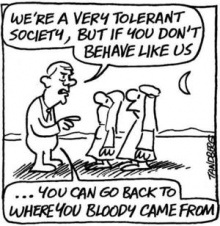
Sometimes when I read about how immigrants, their children and grandchildren are treated in some European countries, this cartoon comes to mind.
After the first warning and after you understand fully the but after the ” we’re a very tolerant society…” line, many will encounter the wall of institutional racism, the final icing of your integration cake that ensures you will never compete as an equal member of society because of your ethnic background.
It’s squandering people’s abilities and dwarfing their potential.
Racism is like a greedy monopoly, which would rarely if ever admit that it is a monopoly. Its aim is to kill competition in order to benefit itself at the cost of everyone.
People support such an order of things because, one way or another, they think they benefit from it as well.