Migrant tales
Menu
  • #MakeRacismHistory “In Your Eyes”
  • About Migrant Tales
  • It’s all about Human Rights
  • Literary
  • Migrant Tales Media Monitoring
  • NoHateFinland.org
  • Tales from Europe
Menu

Tag: Finnish media

Finland’s tabloids are the worst when it comes to spreading bigotry and racism

Posted on May 4, 2020 by Migrant Tales

Racism sells. Us and them sell. Spreading and reinforcing prejudices sells. Bigotry and racism sell. Biased journalism sells. These examples sum up pretty well how tabloids like Iltalehti and Ilta-Sanomat make money by reinforcing old hatreds and suspicions of Others.

One of their latest stories on the far-right vigilante group, the Soldiers of Odin, is an example of their toxic journalism. It would be something like publishing a story about the lighter side of a Ku Klux Klan member and how they laugh and enjoy life like other “normal” USAmericans.

One of the criticisms of the Iltalehti story is that it gives credibility to the Soldiers of Odin, in the same league as the Ku Klux Klan, and whose leader and founder, Mika Ranta, admits being a neo-Nazi.

The article about the Soldiers of Odin does not put the vigilante group’s bigotry and racism in context. If I were writing such an article, I’d point out how Finland has exported racism through the Soldiers of Odin to other parts of the world.
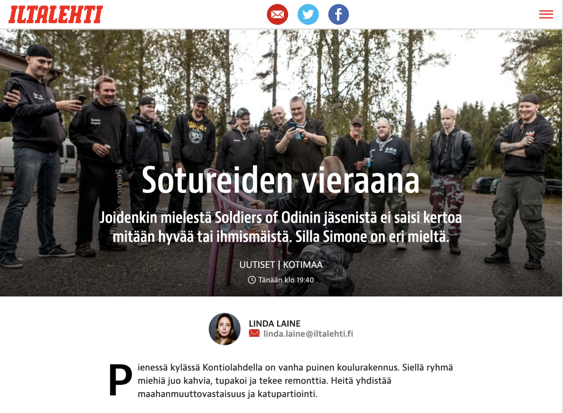
Why are some people and newspapers like Iltalehti fascinated by racism and the far-right? Read the full story (in Finnish) here.

Migrant Tales has not only pointed out in the past the shortfalls of Finnish journalism when writing about groups like Muslims, but it has also traced the roots of such stories to the 1990s and beyond.

Tabloids like Ilta-Sanomat and Iltalehti should formally apologize for all the racism and hatred they have spread about migrants and minorities.
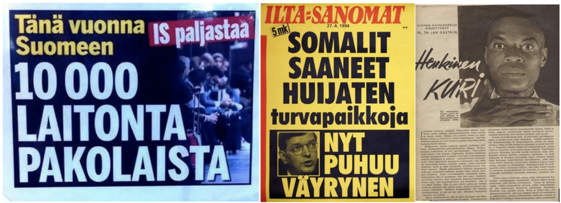
Three racist and misleading articles by the Finnish media in 2015, 1994, and 1940. The headline on the left claims that “10,000 illegal refugees” are coming to Finland. The second one, in the middle, claims that Somali refugees got asylum by deceiving the authorities. The magazine article on the far-right argues with the help of fiction that the European white man was superior to blacks on the battlefield. Finland would have lost the Winter War because one group of blacks in the East Indies run amuck when faced with danger. Sources: Ilta-Sanomat and Suomen Kuvalehti.

Who killed the 18-year-old Somali Finn? Was it a hate crime or not?

Posted on April 29, 2020 by Migrant Tales

There are pictures and names of the two suspects killed by knife stabbing an eighteen-year-old Somali on Sunday. The police are tightlipped and have not given any other information than “the investigation is ongoing.”

If, and there is a big if here, the identity of the suspects is correct and have Finnish last names, the police should mention and investigate if what happened was a hate crime.

I’d ask the police as well if the suspects belonged or hung around some white supremacist group.

It is not the first time that I have covered such a case. One of the great sources of the anxiety of the police is reprisals by members of the victim’s ethnic group.

This was the case during Black February when for over three weeks in 2012 we read about the death of three Muslims , a suicide and a Perussuomalaiset (PS)* councilman who offered a medal to a white Finn for killing one of these victims in an Oulu pizzeria in cold blood before shooting himself.

Mursal Abdulah, the father of Abdisalam Mohamed Abdulah, one of the victims who was killed, wasn’t at all happy with how the police had handled the investigation.

He said that apart from not expressing any empathy for the parents’ grief, it was difficult to get any information from the police about the crime.

It is a fact that the victim was an eighteen-year-old Somali Finn and no confirmation that his attackers had Finnish surnames and belonged to a white supremacist group.

“We were treated coldly and felt like we were the criminals,” he said. “The police appeared to be more concerned about keeping the case under wraps because they feared a revenge attack by Somalis.”

A more recent case involves Rashid H., a Pakistani migrant who was stabbed up to thirty times in February 2018. The wife said that after crime took place on Friday, a police officer called her and said that it wasn’t a hate crime.

I interviewed the investigating officer concerning Rasheed’s case who told me that he spoke to the three suspects and “concluded they weren’t racists.”

The police have asked the migrant community not to publish anything about the Kannelmäki case for fear of spreading false rumors.

If one remembers the Oulu sexual assault cases of minors in December 2018-April 2019, the Oulu police was especially active in putting out statements, labeling Muslims, and helping the media to uncover the nationality of the suspects.

The actions of the Oulu police, the media, politicians, the Prime Minister Juha Sipilä’s government and President Sauli Niinistö were well below par. If anything, it showed that these institutions are no friends of asylum seekers and Muslims.

And who could forget in August when the Islamophobic PS tried to exploit again for its political aims the case of two gunmen who shot two police officers in Porvoo? PS politicians were demanding the ethnic identity of the suspects because they believed they were Muslims and/or asylum seekers.

The PS ended up looking like a horse’s ass when it became clear that the two suspects were Finns who lived in Sweden.

The tragedy that took place in Kannelmäki has impacted especially hard the Somali community because they fear what happened to the Somali Finn could happen to them.

While I hope that the perpetrators will be brought to justice and pay for their crimes, the police has a good opportunity as well to raise its credibility in the eyes of the Somali and visible migrant community.

One member of that community asked if the police are going to sweep what happened under the rug by sanitizing the crime’s racism aspect? “Are they going to conclude that the suspects had mental issues, were under the influence of alcohol or drugs,” she said, “or that they grew up in broken homes?”

The following days will provide an answer to that very crucial question.

Shame on the Finnish media for stereotyping Muslim women. It’s called biased and racist journalism.

Posted on March 18, 2020 by Migrant Tales

Why are Muslims, especially women, usually pictured covering their faces? Do these types of images in the media reinforce our stereotypes about Muslim women?

Helsingin Sanomat, Finland’s leading daily, is one representative of the media that reinforces stereotypes about Muslim women.

While the article is important because it talks about forced marriages, why can’t it write about the topic without stereotypes of Muslims, which in turn reinforce anti-Muslim racism?

The depictions in the media appear to go to great lengths to racialize an issue.

Why is this woman covering herself? Do all Muslim women cover themselves in public? Read the full story (in Finnish) here.

After writing several opinion pieces for newspapers such as Savon Sanomat, Kainuun Sanomat, Suomen Kuvalehti, Karjalainen and others, I am sometimes disappointed with the pictures that go with my story.

Burkas or niqabs or western stereotypes? Read the full story (in Finnish) here.

The most offensive story that I have ever read in Finland depicting Muslim women was by Yle in September 2018.


One of the latest cases (below) of such reporting was by the state-run Finnish Broadcasting Company (Yle). The story was a poll about what different parties’ views was of migration and migrants. In the cover picture of the story, there are all the leaders of the political parties in parliament and a woman wearing a niqab. Part of the headline of the story was that only two parties would ban the “burka.” The picture with the woman wearing the niqab was later removed. Source: Yle.

Iltalehti does it again: Spreading hatred and degrading asylum seekers

Posted on February 19, 2020 by Migrant Tales

Finland’s tabloids, Iltalehti and Ilta-Sanomat, are part of the country’s racism and Islamophobia problem. Back in 2015, Ilta-Sanomat stated on a billboard that 10,000 “illegal refugees” will come to Finland.

This biased and racist journalism exposes how biased and unbalanced some Finnish media is.

In their ever-alarming way to boost sales, Iltalehti led a story with the following headline:

“This is how Finland prepares if a lot of illegal migrants cross the eastern border: ‘People can sleep safely,” Interior Minister Maria Ohisalo is quoted as saying.

The question: Are people crossing the eastern border “illegal migrants” or asylum seekers?

Read the original story (in Finnish) here.
See the original posting (in Finnish) here. Ila-Sanomat claims that “this year 10,000 illegal refugees will come to Finland.” Illegal refugees? No such thing. Source: Facebook.

The national media and far-right populism: Maintaining the myth of Finnish innocence with the pillars of exceptionalism

Posted on January 19, 2020 by Migrant Tales

A good example of how the media maintains the myth of Finnish innocence and its exceptionalism is how it plays down the impact of the Perussuomalaiset* (PS) party on the country’s far-right journey.

Helsingin Sanomat’s Marko Junkkari appears a lot on TV talk shows to give his opinion of current events. He recently appeared on Yle with media researcher Anu Koivunen. In their analysis of former PS leader Timo Soini, neither of them said anything about how the former PS leader was instrumental in giving the far right a platform to expand its political agenda.

Yle talk-show host Heikki Valkaman talking to Anu Koivunen and Marko Junkkari. Source: Yle.

Moreover, neither Koivunen or Junkkari explained the impact that the PS has had on Finland, especially on Muslims, people of color and minorities in general.

It appears that the best analysis that Junkkari could offer about the PS was when the party was under Soini’s leadership.

“I have explained a hundred times to foreign correspondents that the Perussuomalaiset under Timo Soini is a different populist party than those in France and Sweden,” said Junkkari.

True, but why didn’t you give us your opinion on how the PS has shifted further to the right under Halla-aho and what was Soini’s role in the latter?

The only explanation I can find is how too many Finnish journalists and the media mirror Finnish innocence and exceptionalism.

Is the PS today a far-right party? History researcher Oula Silvenoinen has some academic views about this.

Not all far-right parties are the same but they are bonded ideologically by their Islamophobia and anti-immigration rhetoric as well as their anti-EU stances.

Media coverage of the women and children refugees of the al-Hol camp is a low for Finnish journalism

Posted on December 22, 2019 by Migrant Tales

The Finnish media should stop using a bazooka to kill an ant.

Is the Finnish media fair when it reports about migrants and minorities like Muslims? Is its reporting biased and unbalanced? The Oulu sexual assault cases and the debate surrounding the al-Hol are the latest examples.

Certainly, State Broadcasting Company Yle’s coverage of the Oulu sexual assault cases is a low point and an example of overkill. From November 27 to February 13 is a case in point. Back then, the state-owned broadcaster published a whopping 77 stories on the topic. On January 14, Yle published 13 stories about the issue.

Not only did the media cover the story disproportionately, but politicians and even the police poured fuel on the flames of suspicion and racism. Matters got so bad that Muslims feared to go to the city center and were barred by the city of Oulu from visiting child-care centers and elementary schools.

Even if the media, politicians and the police suggested that the sexual assaults of Oulu pointed to an epidemic, only eight were convicted.

Another example of overkill by the Finnish media is the repatriation of some 30 children, and possibly their mothers to Finland.

Helsingin Sanomat published 36 stories that dealt with the al-Hol camp in Syria. Source: Helsingin Sanomat.

Just like in the stories written about Oulu cases earlier this year, Yle published 71 stories during twenty days (December 2-21), with Helsingin Sanomat publishing 36. The average number of stories that Yle and Helsingin Sanomat published daily was 3.5 and 1.8 stories, respectively.

The most active day for Yle was December 19, when it published 11 stories, and for Helsingin Sanomat it was December 17 and 16, when it published six stories a day apiece.

Considering that Finland does have good journalists like Jessica Aro and the country scores second on the World Press Freedom Index after Norway, I wonder where the Finnish media would stand on its coverage of minorities like Muslims?

The top-six countries on the World Press Freedom Index, Norway, Finland, Sweden, Holland, Denmark, and Switzerland, are inflicted by social ills like Islamophobia. Add to the latter the underwhelming size of minorities working as staffers, and we can decipher why media coverage is biased and unbalanced.

Considering that 16% of Helsinki’s population is not white Finnish, Helsingin Sanomat appears to not have a single journalist who is a minority and a full-time staffer. Source: Helsingin Sanoamt.

How do we get more balanced and less biased reporting of minorities? One important step would be to hire more journalists who don’t have only a white perspective of society.

What is better: Scoring high on the World Press Freedom Index or uncritical reporting?

Posted on December 1, 2019 by Migrant Tales

THIS STORY WAS UPDATED

Finland will wake up too late when incompetent populist parties, their politicians and policies lead us to the doorsteps of hell just like what happened in Germany after 1933.

Even if Finland ranks second in the World Press Freedom Index after Norway, how high does it score when it writes about populism, radical-right nationalism, policies that fuel social exclusion, and racism?

The fact that Finland’s largest daily, Helsingin Sanomat, has not written an editorial denouncing racism and how damaging populism is to the country, tell us of the extent of our denial.

Why have no dailies investigated how Finland’s geopolitical isolation during the Cold War helps the country to fall prey to populist and racist parties like the Perussuomalaiset (PS)*?

Since almost everyone, especially most of the Finnish mainstream media, is fascinated with opinion polls these days, it’s clear that dailies like Helsingin Sanomat will give parties like the PS space and the benefit of the doubt.

A media that turns a blind eye to a threat like the PS is leaving our future to chance. Fortunately, Finland does have – even if only a few – solid columnists like Yrjö Rautio, who offers well-rounded analyses of the PS in his columns.

A recent interview Saturday in Helsingin Sanomat of PS chairperson Jussi Halla-aho is a good example of uncritical journalism. Halla-aho built his political career by inciting hatred on groups like Muslims with Islamophobia, homophobia, and racism to name only a few.

In 2012, he was convicted of ethnic agitation and for breaching the sanctity of religion.

You can read some of his most racist quotes in English here.

This list is the DNA of the Perussuomalaiset party but is rarely asked about them.

It is unfortunate for our democracy that the Finnish media doesn’t do more to hold parties like the PS accountable for what they say and do.

A tweet by @TuomoKondie gives us a ten-point list of some questions that Helsingin Sanomat and other media could ask Halla-aho:

  • Racism spread by the PS;
  • Links with neo-Nazi groups;
  • Pipedream [and neo-liberal] economic policies;
  • Why they sympathize with Russian leader Vladimir Putin?
  • Scapegoating migrants for all of Finland’s problems;
  • Systematic lying;
  • Why PS politicians have the most criminal convictions than of any other party?
  • Harassing those that oppose the PS;
  • Climate change denial and naivety;
  • Unqualified politicians.

Here is something that every journalist in Finland should take into account when writing about the PS:

The Perussuomalaiset is not a normal party. It isn’t normal because it built its base on racism, far-right extremism, and neo-liberal economic and social models. It has an utter disrespect for our Nordic values. One of these is Section 6 of the Constitution that states: “No one shall, without an acceptable reason, be treated differently from other persons on the ground of sex, age, origin, language, religion, conviction, opinion, health, disability or other reason that concerns his or her person.”

Below are more examples and disappointments of how uncritically the Finnish media writes about the PS.

Too few of them put the PS in the hot seat and why they spread and support social discrimination, exclusion, racism, and scapegoat near-constantly migrants for all of the country’s problems.

  • Helsingin Sanomat (30.11): Jussi Halla-aho uskoo, että perus­suomalaisten kannatus­huippu on vielä edessä: ”Vaikka valkoinen hetero olisi kuinka paha, hänellä on kuitenkin äänioikeus edelleen”
  • Iltalehti (29.11): 10 syytä miksi gallupien ykkönen perussuomalaiset vetoaa äänestäjiin
  • Helsingin Sanomat (28.11): HS-gallup kertoo dramaattisesta muutoksesta: perussuomalaisia kannattaa jopa 100 000 ihmistä, jotka eivät viimeksi äänestäneet lainkaan
  • Ilta-Sanomat (28.11): Kommentti: Hajurako kokoomukseen kasvaa – Perussuomalaiset yrittää valtaan omillaan
  • Tamperelainen (28.11): Perussuomalaiset jatkaa gallupkärjessä – HS: Näistä syistä se Tampereen yliopiston tutkijan mukaan johtuu
  • Helsingin Sanomat (27.11): Perussuomalaisten kannatus nousi taas roimasti – näin tutkijat ja puolue itse kommentoivat ennätysmäistä suosiota
  • Yle (10.11): Tutkijat: Perussuomalaisten kasvava kannatus tuo esiin yhä ulkomaalaisvastaisempia mielipiteitä

The Finnish media should check their facts better when it comes to news about migrants

Posted on August 10, 2019 by Migrant Tales

Migrant Tales has published a lot of stories about how the Finnish media portrays migrants and minorities in its stories. In 2015, we published a series of articles called Migrant Tales’ Hall of Fame of Poor and Sloppy Journalism.

Finland has a lot of top-quality journalists. Even so, the coverage of migrants like asylum seekers by the media is in too many cases not only slanted and unfair but deficient, even racist and misleading at times.

 Helsingin Sanomat. called last month The Squad, who are four congresswomen of color as “people of migrant origin.” On the left is the first take and on the right the corrected headline.  

A recent example of such opinionated and poor journalism was the coverage of migrants suspected of sexual assault in Oulu. Migrant Tales documented 77 stories published between November 27 and February 13. On January 14, Yle published in one day 13 stories about the topic!  

In its coverage of the Oulu sexual assault cases, Yle forgot one of its most important rules: fairness. You don’t need a bazooka to kill an ant.

Having been a journalist and foreign correspondent in countries like Spain, Argentina, Italy, Colombia, and Finland for over 20 years have taught me a thing or two about how the media frame migrants and minorities.

Without getting into a more in-depth discussion about the topic, I am always amazed at how a far-right Islamophobic party like the Perussuomalaiset (PS)* has set the pace and given its anti-immigration rhetoric a lot of weight.

The PS is always bringing up new fear-mongering topics for public consumption. The latest one is a pseudo-theory about how white Finns in the face of migration will end up becoming a minority in their county.

Even if these pseudo-theories are racist and misogynistic, the PS would care less. Making outrageous claims is one of the communication strategies of racist parties like the PS. Below is an example of how it works:

 A politician makes an outrageous claim to a journalist, who doesn’t even bother to question its veracity. Eventually, the journalist may do some investigating and find out that he or she was fed malarkey. By then it’s too late because the story is already out there.

Journalists should watch out for the following matters when writing about the PS’ and other parties’ anti-immigration stances:

They rarely say directly that they are targeting Muslims;

-They use code to refer to Muslim asylum seekers/people of color such as “harmful immigration,” “social welfare freeloaders,” “mass immigraion,” “person/people of foreign origin” and others;

-Since they are speaking of these groups, who are mostly Muslims and asylum seekers, they refer to about 10% of all migrants in Finland;

-When a PS politician starts to speak about these groups, the reporter should ask what group they mean and how many people he or she is talking about;

-Since the media allows the PS to speak of migrants in the most general terms, it gives the impression that all or most migrants in Finland are asylum seekers;

-Do some journalists and the media write this way because they too are Islamophobic?

* The far-right Perussuomalaiset (PS) party imploded on June 13, 2017, into two factions, the PS and New Alternative, which is now called Blue Reform. In the last parliamentary election, Blue Reform has wiped off the Finnish political map when they saw their numbers in parliament plummet from 18 MPs to none. A direct translation of Perussuomalaiset in English would be something like “basic” or “fundamental Finn.” Official translations of the Finnish name of the party, such as Finns Party or True Finns, promote in our opinion nativist nationalism and racism. We, therefore, at Migrant Tales prefer to use in our postings the Finnish name of the party once and after that the acronym PS.

White Finnish media story of the day*: Use words that promote inclusion and public spaces to people of color and other minorities

Posted on July 15, 2019 by Migrant Tales

A headline in a Helsingin Sanomat news story about US President Donald Trump’s racist tweets to “the Squad,” four progressive women elected to congress in 2018, highlights how the media racializes non-white people in Finland.

While the story uses the Finnish News Agency (STT) and AFP as sources, the copy editors at Helsingin Sanomat could do a much better job instead of labeling people of color as people of migrant origin.

Helsingin Sanomat calls the four congresswomen, Alexandria Ocasio-Cortez, Rashida Tlaib, Ayanna Pressley, and Ilhan Omar, “people of migrant origin” when, in fact, they should be called people of color or minorities.

In my opinion, people of migrant origin is a convenient term to deny people of color and other minorities the right to be equal members of society. How can one be equal if you are constantly reminded with problematic labels that you are outsiders and eternal migrants?

I wonder how the four US congresswomen would react in an interview if a white Finnish journalist called them “people of migrant origin.”

They would, I suspect, be surprised. It would prompt a swift reaction: Who isn’t a person of migrant origin in the United States, they’d ask.

Even if some ethnonationalist groups in Finland like to romanticize that they were chipping stones right after the Ice Age, every white Finn, every single one, in this country is “a person of migrant origin.”

Helsingin Sanomat calls congresswomen Alexandria Ocasio-Cortez, Rashida Tlaib, Ayanna Pressley, and Ilhan Omar “people of migrant origin.” Give me a break! Read the original story here.

That label used by Finland’s largest newspaper is not only offensive but shows Helsingin Sanomat’s ignorance and prejudice towards people of color. It reveals how racialized the media is when it speaks of non-white people in Finland.

Instead of seeing Finland through racialized lenses, the media should show leadership in promoting inclusion and public spaces to people of color instead of constantly reinforcing their exclusion with labels made up by them.

Does the Finnish language have a translation for the term people of color? If it doesn’t like integration (kotoutuminen) about twenty years ago, it should find one.

In the late-1990s and apart from the term integroituminen, Finland had to invent a new term for integration because there was no appropriate word in the Finnish language.

*White Finnish media story of the day highlights how the national media racializes Finland’s ever-growing culturally and ethnically diverse society by maintaining antiquated, even racist and exclusive views about who has the right to belong and call this country their home.

White Finnish media story of the day: Muslims are grossly underrepresented in the media

Posted on July 11, 2019 by Migrant Tales

Media studies that look into social ills like Islamophobia and racism in general in Britain offer us a view of how matters could be in Finland. With little scrutiny of institutional racism in the Finnish police, similar studies of the mainstream media still appear light-years away.

A study published by The Muslim Council of Britain revealed that 59% of all coverage of Muslims in the British media “has a negative theme.” Another study by the University of Leeds of The Mail, The Sun, The Guardian, and The Independent, showed that 70% of the stories were hostile to Muslims.

Sexual assault is one common theme found in the Finnish media is about “asylum seekers,” which is code for Muslim.

With respect to the Oulu sexual assault cases in which former and present “asylum seekers” were implicated, Migrant Tales reported that from November 27 to February 13, only the state-owned broadcaster Yle published 77 stories on the topic. On January 14 alone, Yle published 13 stories about the topic.

When compared with a similar sexual abuse case of minors involving white Finns, there was a different reaction. The story about the pedophile ring accused of sexually abusing 6-15-year-old boys lasted only a week in the news with 7 stories published by Yle.

Which dailies in Finland would have the most negative coverage of Muslims? Yle? Iltalehti? Ilta-Sanomat? Uusi Suomi? Kaleva? Helsingin Sanomat? Others?

Why don’t we know the answer to that question and what does it reveal about denial?

A documentary about Islamophobia in the UK published by Redfish offers us some answers about how the mainstream media portrays Muslims and migrants in Finland.

Roshan Muhammed Salih is a journalist of UK-based 5 Pillars after he left mainstream journalism.

Salih states:

“The mainstream media is institutionally Islamophobic in my point of view. We have had inquires into the police that are institutionally racist, but we haven’t had the same scrutiny of the media. The Sadiq (?) University says that 94% of British journalists are white. There are three million Muslims in the country and that equates to 5% of the total population, but it is something like 0.3-0.4% are journalists.

So you can see how woefully Muslims are underrepresented in the mainstream media and the Muslim journalists that are in the mainstream media don’t tend to kind of reflect their community. Their answer to underrepresentation is tokenism. It’s not the dressing that is the root issue how do we tell the story of minorities communities, but let’s get some brown or black faces who say exactly the same thing as the white faces.”


As Salih of 5 Pillars pointed out, Muslims account for 5% of Britain’s population but only 0.3-0.4% are journalists. What would the corresponding figure be for Finland? Zero?

Finland’s Muslim population is estimated at 100,000 people, accounting for 1.8% of the total population.

  • Previous
  • 1
  • 2
  • 3
  • 4
  • 5
  • 6
  • …
  • 10
  • Next
Read more about documentary film
Read more

Recent Posts

  • Finland’s tabloids Iltalehti and Ilta-Sanomat are the pits
  • Riikka Purra’s Dr Jekyll and Mr Hyde mask
  • Double standards
  • Perussuomalaiset: Uusi logo, sama vanha juttu
  • Taco Trump

Recent Comments

  1. Absolutely Socking: Racist Finnish Facebook group against human rights gets flooded with socks on Musta Barbaari’s mother and sister charged by the police in “ethnic profiling” case
  2. Ilkka Nuotio on Pekka Myrskylä: “Tilastot kertovat toista kuin poliittinen keskustelu”
  3. Genrih Soinkara on The war in Ukraine and the Russian-Finnish border crisis are showing Finland’s ugly side
  4. Ahti Tolvanen on Comment by Ahti Tolvanen on the Helsinki +50 conference
  5. Angel Barrientos on Angel Barrientos is one of the kind beacons of Finland’s Chilean community

Archives

  • June 2026
  • May 2026
  • April 2026
  • March 2026
  • February 2026
  • January 2026
  • December 2025
  • November 2025
  • October 2025
  • September 2025
  • August 2025
  • July 2025
  • June 2025
  • May 2025
  • April 2025
  • March 2025
  • February 2025
  • January 2025
  • December 2024
  • November 2024
  • October 2024
  • September 2024
  • August 2024
  • July 2024
  • June 2024
  • May 2024
  • April 2024
  • March 2024
  • February 2024
  • January 2024
  • December 2023
  • November 2023
  • October 2023
  • September 2023
  • August 2023
  • July 2023
  • June 2023
  • May 2023
  • April 2023
  • March 2023
  • February 2023
  • January 2023
  • December 2022
  • November 2022
  • October 2022
  • September 2022
  • August 2022
  • July 2022
  • June 2022
  • May 2022
  • April 2022
  • March 2022
  • February 2022
  • January 2022
  • December 2021
  • November 2021
  • October 2021
  • September 2021
  • August 2021
  • July 2021
  • June 2021
  • May 2021
  • April 2021
  • March 2021
  • February 2021
  • January 2021
  • December 2020
  • November 2020
  • October 2020
  • September 2020
  • August 2020
  • July 2020
  • June 2020
  • May 2020
  • April 2020
  • March 2020
  • February 2020
  • January 2020
  • December 2019
  • November 2019
  • October 2019
  • September 2019
  • August 2019
  • July 2019
  • June 2019
  • May 2019
  • April 2019
  • March 2019
  • February 2019
  • January 2019
  • December 2018
  • November 2018
  • October 2018
  • September 2018
  • August 2018
  • July 2018
  • June 2018
  • May 2018
  • April 2018
  • March 2018
  • February 2018
  • January 2018
  • December 2017
  • November 2017
  • October 2017
  • September 2017
  • August 2017
  • July 2017
  • June 2017
  • May 2017
  • April 2017
  • March 2017
  • February 2017
  • January 2017
  • December 2016
  • November 2016
  • October 2016
  • September 2016
  • August 2016
  • July 2016
  • June 2016
  • May 2016
  • April 2016
  • March 2016
  • February 2016
  • January 2016
  • December 2015
  • November 2015
  • October 2015
  • September 2015
  • August 2015
  • July 2015
  • June 2015
  • May 2015
  • April 2015
  • March 2015
  • February 2015
  • January 2015
  • December 2014
  • November 2014
  • October 2014
  • September 2014
  • August 2014
  • July 2014
  • June 2014
  • May 2014
  • April 2014
  • March 2014
  • February 2014
  • January 2014
  • December 2013
  • November 2013
  • October 2013
  • September 2013
  • August 2013
  • July 2013
  • June 2013
  • May 2013
  • April 2013
  • March 2013
  • February 2013
  • January 2013
  • December 2012
  • November 2012
  • October 2012
  • September 2012
  • August 2012
  • July 2012
  • June 2012
  • May 2012
  • April 2012
  • March 2012
  • February 2012
  • January 2012
  • December 2011
  • November 2011
  • October 2011
  • September 2011
  • August 2011
  • July 2011
  • June 2011
  • May 2011
  • April 2011
  • March 2011
  • February 2011
  • January 2011
  • December 2010
  • November 2010
  • October 2010
  • September 2010
  • August 2010
  • July 2010
  • June 2010
  • May 2010
  • April 2010
  • March 2010
  • February 2010
  • January 2010
  • December 2009
  • November 2009
  • October 2009
  • September 2009
  • August 2009
  • July 2009
  • December 2008
  • November 2008
  • October 2008
  • September 2008
  • August 2008
  • July 2008
  • June 2008
  • May 2008
  • April 2008
  • March 2008
  • February 2008
  • January 2008
  • November 2007
  • October 2007
  • September 2007
  • August 2007
  • July 2007
  • June 2007
  • May 2007

Categories

  • ?? Gia L?c
  • ????? ?????? ????? ???????? ?? ??????
  • ???????
  • @HerraAhmed
  • @mondepasrond
  • @nohatefinland
  • @oula_silver
  • @Varathas
  • A Pakistani family
  • äärioikeisto
  • Abbas Bahmanpour
  • Abdi Muhis
  • Abdirahim Hussein Mohamed
  • Abdirahim Husu Hussein
  • Abdirisak Mahamed
  • About Migrant Tales
  • activism
  • Adam Al-Sawad
  • Adel Abidin
  • Afrofinland
  • Ahmed IJ
  • Ahti Tolvanen
  • Aino Pennanen
  • Aisha Maniar
  • Alan Ali
  • Alan Anstead
  • Alejandro Díaz Ortiz
  • Alekey Bulavsev
  • Aleksander Hemon
  • Aleksanterinliitto
  • Aleksanterinliitto ry
  • Aleksanterinliitto ry:n hallitus
  • Alex Alex
  • Alex Mckie
  • Alexander Nix
  • Alexandra Ayse Albayrak
  • Alexis Neuberg
  • Ali Asaad Hasan Alzuhairi
  • Ali Hossein Mir Ali
  • Ali Rashid
  • Ali Sagal Abdikarim
  • Alina Tsui
  • Aline Müller
  • All categories
  • Aman Heidari
  • Amiirah Salleh-Hoddin & Jana Turk
  • Amin A. Alem
  • Amir Zuhairi
  • Amkelwa Mbekeni
  • Ana María Gutiérrez Sorainen
  • Anachoma
  • Anders Adlecreutz
  • Angeliina Koskinen
  • Anna De Mutiis
  • Anna María Gutiérrez Sorainen
  • Anna-Kaisa Kuusisto ja Jaakko Tuominen
  • Annastiina Kallius
  • Anneli Juise Friman Lindeman
  • Announcement
  • Anonymous
  • Antero Leitzinger
  • anti-black racism
  • Anti-Hate Crime Organisation Finland
  • Anudari Boldbaatar
  • Arshiya Nasser
  • Aspergers Syndrome
  • Asylum Corner
  • Asylum seeker 406
  • Athena Griffin and Joe Feagin
  • Autism
  • Avaaz.org
  • Awale Olad
  • Ayan Said Mohamed
  • AYY
  • Barachiel
  • Bashy Quraishy
  • Beatrice Kabutakapua
  • Beri Jamal
  • Beri Jamal and Enrique Tessieri
  • Bertolt Brecht
  • Boiata
  • Boodi Kabbani
  • Bruno Gronow
  • Carmen Pekkarinen
  • Çelen Oben and Sheila Riikonen
  • Chiara Costa-Virtanen
  • Chiara Costa-Virtanen
  • Chiara Sorbello
  • Christian Thibault
  • Christopher Wylie
  • Clara Dublanc
  • Dana
  • Daniel Malpica
  • Danilo Canguçu
  • David Papineau
  • David Schneider
  • Dexter He
  • Don Flynn
  • Dr Masoud Kamali
  • Dr. Faith Mkwesha
  • Dr. Theodoros Fouskas
  • Edna Chun
  • Eeva Kilpi
  • Emanuela Susheela
  • En castellano
  • ENAR
  • Enrique
  • Enrique Tessieri
  • Enrique Tessieri & Raghad Mchawh
  • Enrique Tessieri & Yahya Rouissi
  • Enrique Tessieri and Muhammed Shire
  • Enrique Tessieri and Sira Moksi
  • Enrique Tessieri and Tom Vandenbosch
  • Enrique Tessieri and Wael Che
  • Enrique Tessieri and Yahya Rouissi
  • Enrique Tessieri and Zimema Mhone
  • Epäluottamusmies
  • EU
  • Europe
  • European Islamophobia Report
  • European Islamophobia Report 2019,
  • European Union
  • Eve Kyntäjä
  • Ezequiel Caldeiro
  • Facebook
  • Fadumo Dayib
  • Faisa Kahiye
  • Farhad Manjoo
  • Fasismi
  • Finland
  • Fizza Qureshi
  • Flyktingar och asyl
  • Foreign Student
  • Fozia Mir-Ali
  • Frances Webber
  • Frida Selim
  • Gareth Rice
  • Ghyslain Vedeaux
  • Global Art Point
  • Great Replacement
  • Habiba Ali
  • Hami Bahadori
  • Hami Bahdori
  • Hamid
  • Hamid Alsaameere
  • Hamid Bahdori
  • Handshake
  • Harmit Athwal
  • Hassan Abdi Ali
  • Hassan Muhumud
  • Heikki Huttunen
  • Heikki Wilenius
  • Helsingin Sanomat
  • Henning van der Hoeven
  • Henrika Mälmsröm
  • Hser Hser
  • Hser Hser ja Mustafa Isman
  • Husein Muhammed
  • Hussain Kazemian
  • Hussain Kazmenian
  • Ibrahim Khan
  • Ida
  • Ignacio Pérez Pérez
  • Iise Ali Hassan
  • Ilari Kaila & Tuomas Kaila
  • Imam Ka
  • inside-an-airport
  • Institute of Race Relations
  • Iraqi asylum seeker
  • IRR European News Team
  • IRR News Team
  • Islamic Society of Norhern FInland
  • Islamic Society of Northern Finland
  • Islamophobia
  • Jacobinmag.com
  • Jallow Momodou
  • Jan Holmberg
  • Jane Elliott
  • Jani Mäkelä
  • Jari Luoto
  • Jari Taponen
  • Jegor Nazarov
  • Jenni Stammeier
  • Jenny Bourne
  • Jessie Daniels
  • Joe Davidow
  • Johannes Koski
  • John D. Foster
  • John Grayson
  • John Marriott
  • Jon Burnett
  • Jorma Härkönen
  • Jos Schuurmans
  • José León Toro Mejías
  • Josue Tumayine
  • Jouni Karnasaari
  • Juan Camilo
  • Jukka Eräkare
  • Julian Abagond
  • Julie Pascoet
  • Jussi Halla-aho
  • Jussi Hallla-aho
  • Jussi Jalonen
  • JusticeDemon
  • Kadar Gelle
  • Kaksoiskansalaisuus
  • Kansainvälinen Mikkeli
  • Kansainvälinen Mikkeli ry
  • Katherine Tonkiss
  • Kati Lepistö
  • Kati van der Hoeven-Lepistö
  • Katie Bell
  • Kättely
  • Kerstin Ögård
  • Keshia Fredua-Mensah & Jamie Schearer
  • Khadidiatou Sylla
  • Khadra Abdirazak Sugulle
  • Kiihotus kansanryhmää vastaan
  • Kirsi Crowley
  • Koko Hubara
  • Kristiina Toivikko
  • Kubra Amini
  • KuRI
  • La Colectiva
  • La incitación al odio
  • Laura Huhtasaari
  • Lauri Finér
  • Leif Hagert
  • Léo Custódio
  • Leo Honka
  • Leontios Christodoulou
  • Lessie Branch
  • Lex Gaudius
  • Leyes de Finlandia
  • Liikkukaa!
  • Linda Hyökki
  • Liz Fekete
  • M. Blanc
  • Maarit Snellman
  • Mahad Sheikh Musse
  • Maija Vilkkumaa
  • Malmin Kebab Pizzeria Port Arthur
  • Marcell Lorincz
  • Mari Aaltola
  • María Paz López
  • Maria Rittis Ikola
  • Maria Tjader
  • Marja-Liisa Tolvanen
  • Mark
  • Markku Heikkinen
  • Marshall Niles
  • Martin Al-Laji
  • Maryan Siyad
  • Matt Carr
  • Mauricio Farah Gebara
  • Media Monitoring Group of Finland
  • Micah J. Christian
  • Michael McEachrane
  • Michele Levoy
  • Michelle Kaila
  • Migrant Tales
  • Migrant Tales Literary
  • Migrantes News
  • Migrants' Rights Network
  • MigriLeaks
  • Mikko Kapanen
  • Miriam Attias and Camila Haavisto
  • Mohamed Adan
  • Mohammad Javid
  • Mohammad M.
  • Monikulttuurisuus
  • Monisha Bhatia and Victoria Canning
  • Mor Ndiaye
  • Muh'ed
  • Muhamed Abdimajed Murshid
  • Muhammed Shire
  • Muhammed Shire and Enrique Tessieri
  • Muhis Azizi
  • Musimenta Dansila
  • Muslimiviha
  • Musulmanes
  • Namir al-Azzawi
  • Natsismi
  • Neurodiversity
  • New Women Connectors
  • Nils Muižnieks
  • No Labels No Walls
  • Noel Dandes
  • Nuor Dawood
  • Omar Khan
  • Otavanmedia
  • Oula Silvennoinen
  • Paco Diop
  • Pakistani family
  • Pentti Stranius
  • Perussuomalaiset
  • perustuslaki
  • Petra Laiti
  • Petri Cederlöf
  • Pia Grochowski
  • Podcast-lukija Bea Bergholm
  • Pohjois – Suomen Islamilainen Yhdyskunta
  • Pohjois Suomen Islamilainen Yhyskunta
  • Polina Kopylova
  • Race Files
  • racism
  • Racism Review
  • Raghad Mchawh
  • Ranska
  • Rashid H. and Migrant Tales
  • Rasismi
  • Raul Perez
  • Rebecka Holm
  • Reem Abu-Hayyeh
  • Refugees
  • Reija Härkönen
  • Remiel
  • Reza Nasri
  • Richard Gresswell
  • Riikka Purra
  • Risto Laakkonen
  • Rita Chahda
  • Ritva Kondi
  • Robito Ibrahim
  • Roble Bashir
  • Rockhaya Sylla
  • Rodolfo Walsh
  • Roger Casale
  • Rostam Atai
  • Roxana Crisólogo Correa
  • Ruth Grove-White
  • Ruth Waweru-Folabit
  • S-worldview
  • Sadio Ali Nuur
  • Sami Rusanen
  • Sandhu Bhamra
  • Sara de Jong
  • Sarah Crowther
  • Sari Alhariri
  • Sarkawt Khalil
  • Sasu
  • Scot Nakagawa
  • Shabana Ahmadzai
  • Shada Islam
  • Sharon Chang blogs
  • Shenita Ann McLean
  • Shirlene Green Newball
  • Sini Savolainen
  • Sira Moksi
  • Sonia K.
  • Sonia Maria Koo
  • Steverp
  • Stop Deportations
  • Suldaan Said Ahmed
  • Suomen mediaseurantakollektiivi
  • Suomen Muslimifoorumi ry
  • Suomen viharikosvastainen yhdistys
  • Suomen viharikosvastainen yhdistys ry
  • Suomi
  • Supermen
  • Susannah
  • Suva
  • Syrjintä
  • Talous
  • Tapio Tuomala
  • Taw Reh
  • Teivo Teivainen
  • The Daily Show
  • The Heino
  • The Supermen
  • Thomas Elfgren
  • Thulfiqar Abdulkarim
  • Tim McGettigan
  • Tino Singh
  • Tito Moustafa Sliem
  • Tobias Hübinette and L. Janelle Dance
  • Transport
  • Trica Danielle Keaton
  • Trilce Garcia
  • Trish Pääkkönen
  • Trish Pääkkönen and Enrique Tessieri
  • Tuulia Reponen
  • Uncategorized
  • UNITED
  • University of Eastern Finland
  • Uyi Osazee
  • Väkivalta
  • Vapaa Liikkuvuus
  • Venla-Sofia Saariaho
  • Vieraskynä
  • W. Che
  • W. Che an Enrique Tessieri
  • Wael Ch.
  • Wan Wei
  • Women for Refugee Women
  • Xaan Kaafi Maxamed Xalane
  • Xassan Kaafi Maxamed Xalane
  • Xassan-Kaafi Mohamed Halane & Enrique Tessieri
  • Yahya Rouissi
  • Yasmin Yusuf
  • Yassen Ghaleb
  • Yle Puhe
  • Yuliet Tresa
  • Yve Shepherd
  • Zahra Khavari
  • Zaker
  • Zalina Ametova
  • Zamzam Ahmed Ali
  • Zeinab Amini ja Soheila Khavari
  • Zimema Mahone and Enrique Tessieri
  • Zimema Mhone
  • Zoila Forss Crespo Moreyra
  • ZT
  • Zulma Sierra
  • Zuzeeko Tegha Abeng
© 2026 Migrant tales | Powered by Minimalist Blog WordPress Theme