
Migrant tales
Menu
  • #MakeRacismHistory “In Your Eyes”
  • About Migrant Tales
  • It’s all about Human Rights
  • Literary
  • Migrant Tales Media Monitoring
  • NoHateFinland.org
  • Tales from Europe
Menu

Tag: Finnish educational system

Nura Farah: A blooming flower with a pen that many aimed to destroy

Posted on October 21, 2014 by Migrant Tales

There is an interesting interview of Nura Farah, Finland’s first Somali-born writer, who speaks openly about growing up as a black person in this country from the 1990s, when even middle-school teachers took part in the racist bullying of non-white Finns.

Racist bullying and racism are white privilege weapons used by this society to destroy another person by wiping out his or her self-esteem.

Migrant Tales has published a number of stories about racist bullying at Finnish schools. While it’s clear that some Finnish teachers didn’t take part in this type of school vigilante behavior, those who did are a shame to our school system and society, especially those who remained silent.

One of the problems of the 1990s concerning racism and racist bullying was that it wasn’t even seen as a problem at schools. If it occurred, it was given low priority by the teacher, school and society.

A story by YLE (in Finnish) tells about how hostile this society was to some non-white Finns and migrants during the 1990s, when our migrant population started to grow rapidly.

Racist bullying doesn’t end after you leave the school but can continue in the town where the victim grew up. And why shouldn’t racist bullying continue to be a problem at our schools and society? Aren’t National Coalition Party MP Pia Kauma and Perussuomalaiset (PS)* MP Tom Packalén unfortunate recent examples of this type of behavior?

It should be made clear that racism and racist bullying at school are hostile acts that aim to destroy the victim’s self-esteem and shatter him or her into tiny pieces. You’re not supposed to ever pick up those pieces of your shattered self.

But you can be defiant and strong and do something bold like accepting yourself.

This is what Farah did when she was 20.


Näyttökuva 2014-10-21 kello 8.21.18

Read full story (in Finnish) here.


Farah’s family moved to the eastern Helsinki neighborhood of Kontula in the 1990s. She was 13 years old.

According to her, racism in the 1990s was terrible. Even some middle-school teachers took part in the bullying using the n-word freely and even asking in class why don’t Somalis go back to where they came from.

Somalia has been gripped by a terrible civil war since 1991, when then de facto President Siad Barre was toppled and fled the country.

Another very important message that Farah gives is that children born in Finland, irrespective if they come from different ethnic and cultural backgrounds,  shouldn’t be made to feel like outsiders. She said that the most important matter for third-culture children is to learn the language well and to get involved.

One important step in the latter direction is, in my opinion, to stop using terms like ‘pupil with migrant background,’ or maahanmuuttajataustainen,  to label non-white or third-culture students at school. In today’s strong anti-Otherness context, such labels have a tendency to remind the pupil that he or she is an outsider.

It’s clear that with writers like Farah we’re taking those first important steps in ensuring that our children and grandchildren don’t get treated in the same way as some of us did at school.

* The Finnish name for the Finns Party is the Perussuomalaiset (PS). The English names of the party adopted by the PS, like True Finns or Finns Party, promote in our opinion nativist nationalism and xenophobia. We therefore prefer to use the Finnish name of the party on our postings.

THL survey in Finland says first-generation migrants more likely to experience bullying, physical and sexual harassment

Posted on September 17, 2014 by Migrant Tales

A new survey shows that first-generation immigrants are more likely to experience bullying, physical threats and sexual harassment than white Finns, according to YLE in English, which cites the National Institute for Health and Welfare (THL).

The survey revealed some 32% of “immigrant” children found it difficult to access school welfare officers.

Should the findings of the study surprise us taking into account the negative atmosphere in this country against migrants, minorities and cultural diversity? Moreover, why is so little known about  the health and well-being of “immigrant” children and young people?

THL admitted in the statement that there has been up to know very little information about this groups of minors.

THL researcher, Anni Matikka, said that immigrants are a heterogenous group and that not all of them need help.

“However, there are young immigrants who are facing several challenges in their health and well-being, and therefore these individuals need special support,” she added.

Matikka said that families of children with “immigrant” backgrounds should have access to good information about support and student welfare services. “At the same time they could strive to increase trust in the providers of these services among immigrant background youth,” she said.


Näyttökuva 2014-9-17 kello 18.03.28

Read full story here.


While sexual harassment (unwanted intimate touching, pressure or coercion to have sex or an offer to buy sex) was common at school with one in three girls experiencing such violence or harassment and one in four in upper secondary schools, the survey showed that sexual harassment was more common among first-generation “immigrant” boys (32% experienced sexual violence) than among “immigrant” girls (28%).

It showed as well that 42% of first-generation immigrant boys had experienced physical violence in the last year compared with 33% second-generation “immigrant” boys.

While the THL survey was done in 2014, in the 1990s matters were either worse or the same.

It is a positive matter and always a step in the right direction that there is concern about the welfare of third-culture Finns at schools. Migrant Tales has written a lot about the matter.

A Somali Finn wrote on our blog that his brief honeymoon with Finland ended abruptly in the 1990s when he started elementary school. He was the school’s first and only black student. “That’s when the bullying started; I was even attacked physically by my classmates,” he said. “Something bad happened to me almost every day at school.”

Read what Ida, Abdulah and Joseph have to say about being Other in Finland here.

I remember when one of my children was harassed and insulted at a Helsinki school in the late-1980s because of ethnic background. The matter that surprised me the most was how little importance the teacher gave to the incident.

The THL survey defines first-generation immigrants as children who weren’t born in Finland and have non-Finnish parents; second generation migrants were born in Finland to non-Finnish parents. Native-born Finns are those whose parents were born in Finland.

Taking into account the definition by THL of first- or second-generation immigrants and native-born Finns, the mere definition highlights part of the problem. Are these children, irrespective if their parents were born elsewhere, “immigrants” or “Finns” with multicultural or third-culture backgrounds?

The term immigrant isn’t a country but an abstract concept. Does it promote inclusion or exclusion when used?

The label used at some Finnish school such as “children with immigrant backgrounds” promotes in my opinion “us” and “them.” Does the label, which is apparently used quite commonly at Finnish schools, promote our values of social equality or does it relegate the person to second- or third-class status?

These types of labels, which are placed by the majority culture on the minority, may shed some light on why teachers and school-welfare workers are so hard to get in touch with by “immigrant” children.

Over 180,000 children and young people in Finland took part in the survey.


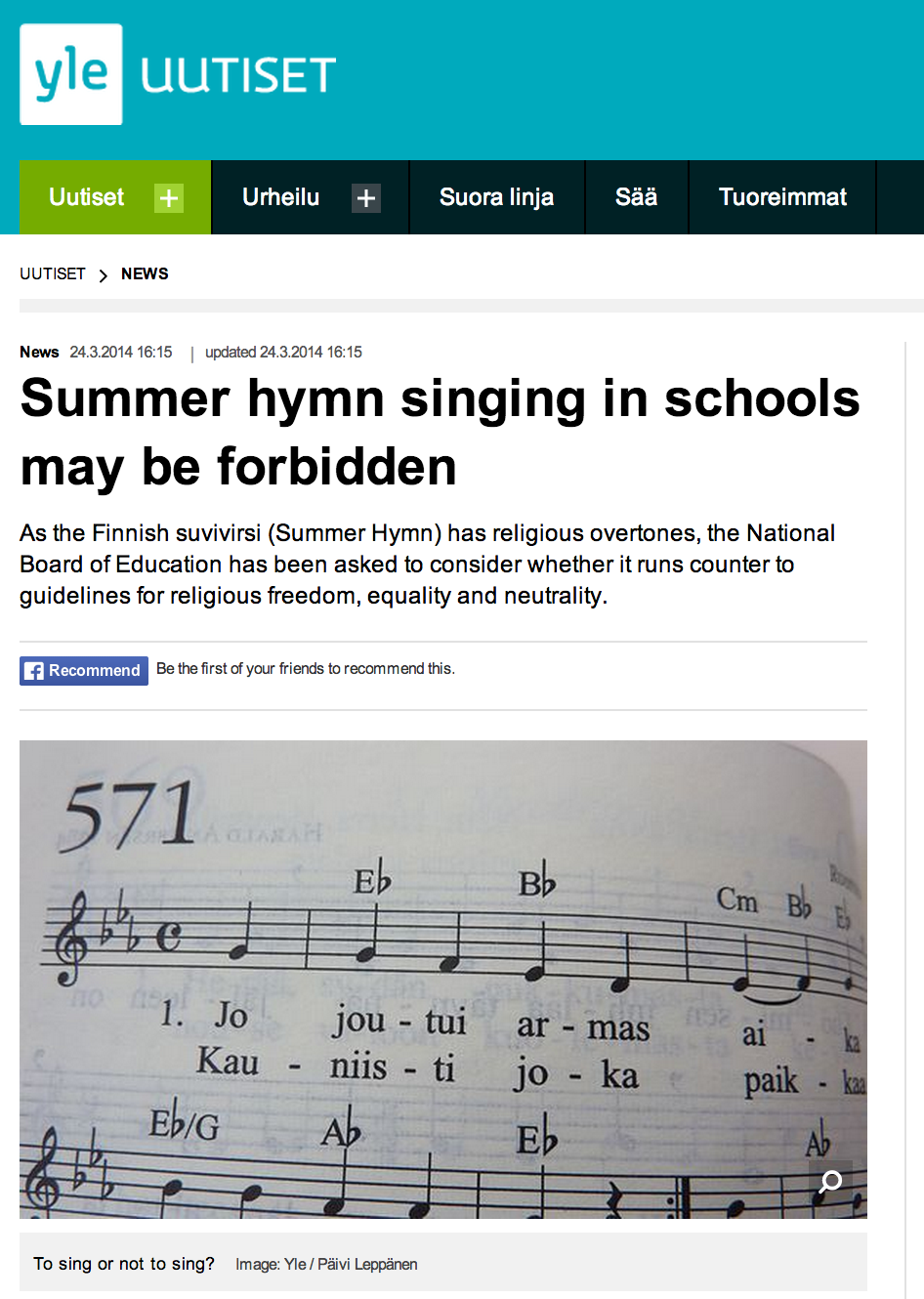
Finland ponders whether to forbid the Summer Hymn at schools

Posted on March 25, 2014 by Migrant Tales

The Finnish suvivirsi, or Summer Hymn, may be forbidden at schools for having religious overtones, according to YLE in English. Such plans, which are under review by the national board of education, have raised stiff opposition from Finland’s most conservative and nationalistic politicians like Interior Minister Päivi Räsänen and anti-immigration Perussuomlaiset (PS) chairman, Timo Soini.

Näyttökuva 2014-3-25 kello 8.27.15

Read full story here.

Deputy Chancellor of Justice Mikko Puumalainen called on the Board of Education to see if the suvivirsi runs counter to religious freedom, equality and neutrality at Finnish schools.  

In order to understand this debate, we’d have to look at it from Räsänen’s and Soini’s perspective.

Räsänen, who is a member of the Christian Democratic party and who considers homosexuality to be a sin, said that the board of education and schools should not under any circumstances forbid the suvivirsi. “…the best practices and traditions inherent in Finnish culture are weighed again in very conflictive interpretations,” she wrote on her Uusi Suomi blog.

Soini, who is a staunch Catholic that opposes abortion and gay marriage, is naturally against forbidding the singing of the suvivirsi at schools. “It a part of Finland’s spiritual landscape and cultural traditions,” he was quoted as saying on Ilta-Sanomat. “This is totally incomprehensible.”

Räsänen and Soini represent, in my opinion, a Finland that still believes that our society must not change even if our society becomes ever-culturally and ethnically diverse.

The fact that our society is more diverse today puts under scrutiny some of our traditions like the  suvivirsi.

Instead of attacking minorities and migrants in this country for putting the suvivirsi under the spotlight, we should ask why schools should be secular institutions and the role of religious freedom in our society, which is not under question.


Cost-cutting measures in education will hit migrant and visible minority students especially hard in Finland

Posted on January 27, 2014 by Migrant Tales

Whenever there are cost-cutting measures that target education or social welfare, you know who’s going to get hit the hardest. Some obvious groups include the socially marginalized, unemployed, some migrants and visible minorities. 

Trade Union of Education in Finland (OAJ) president Olli Luukkainen was quoted as saying on tabloid Iltalehti Monday that budget cuts on education have fueled greater social inequality at schools.Kuvankaappaus 2014-1-27 kello 10.46.10

Read full story (in Finnish) here.

Since intolerance plays a role in Finland as well, it’s clear that while cost-cutting measures are impacting our educational sector, it will be especially hard on migrant and visible minority students.

A good indicator of social inequality and intolerance in Finland is the high migrant unemployment rate, which is two- to three-times higher than the national average, which rose by one percentage point in December to 7.9% versus a year ago.

If in times of economic abundance and growth our educational system continued to treat some of their Finnish students as pupils with “migrant backgrounds,” and still don’t grasp that a Finn doesn’t have to be white to be treated as an equal member of this society, it’s clear that migrant and visible minority students are going to get hit the hardest by the budget cuts.

Disagree? Why then are students who aren’t white respected and treated at schools like white Finns who have different ethnic and national backgrounds? Why are they labelled maahanmuuttajataustainen, or student with immigrant background?

The answer is obvious. They are labelled a non-inclusive name like the above because the majority culture wants to remind that they are “Other” and aren’t white. Why? To promote social inequality, or “us” and “them.”

Why are we, Migrant Tales, the only ones writing about this very worrying situation?

Shouldn’t anti-racist groups and the parents of these migrant and visible minorities be up in arms about the impact that budget cuts will have on the lives of their children?

Why so much complacent silence?

Teach me that we are more alike than different…

Posted on September 9, 2012 by Migrant Tales

 …teach me not to hate. Teach me the lie and shame of racism [because] it hurts all people. Teach me to learn from you and to learn about me… 

Inspirational words from the Center for the Healing of Racism that should be the guiding light enshrined in our national curriculum for schools (opetussuunnitelma) concerning cultural diversity.

What is our aim when we speak of integration of elementary school students?

Is the goal of the teacher to convert these students into ”white Finns” or to socially exclude them by pointing out how different they are? Is the aim between these two extremes?

Identity is a personal matter. Who you are depends on who you think you are. If some have a problem with this, it should be viewed as their problem, not yours.

Social exclusion is like a toxic poison. If  you take away a child’s identity at an early age by seeing no worth in his ethnicity and background, you’ll end up undermining his or her self-esteem. People with low self-esteem do poorly at school.

Low self-esteem is a factor behind prejudice as well, according to a study published by Psychological Science.

In the same way as racism is costly to society, it can impair children’s learning abilities, according to a study by Essex University.

Even if Finland has become more culturally diverse from the 1990s, the biggest mistake we can make – in my opinion – is forgetting the importance of diversity and values such as mutual acceptance and respect.

Thus Finnish schools should teach their students that we are more alike than different..the lie and shame of racism because it hurts all people.

It should teach student the value of their culture and the culture of others.


Opettaja: Lukijakysely: Maahanmuuttajat ovat kouluille rikkaus ja rasite

Posted on February 23, 2011 by Migrant Tales

Comment: This survey that was published in Opettaja shows that 41% of teachers that were polled would like to place caps on children with immigrant backgrounds at their schools.  Contrarily one third of those polled would not place any such limits.  According to every fourth teacher, larger numbers of immigrant children increase commotion and noise in class as well as violence in schools.

For some the results of the survey is no surprise since other ones have shown that teachers’ attitudes of immigrants have been as negative as the police.

The poll brings forth interesting questions. One of these is if public servants like teachers can limit who they will serve.  Can the police do the same? Is segregating schools by placing caps constitutional?

Everyone knows that if such an extraordinary measure were to be taken, it would be by the government – not by teachers.

At best these surveys show how difficult it is for some in Finland to still accept cultural diversity as a normal matter of our society. A lot of work must be still done.

Do you agree?

_____________

Lukijakysely: Maahanmuuttajat ovat kouluille rikkaus ja rasite. Kolmannes riittäisi osuudeksi Väkivalta lisääntyy, kantaväestön ja ja maahanmuuttajien välit kiristyvät ja opettajat siirtyvät muihin kouluihin, kun maahanmuuttajien osuus koulun oppilaista kasvaa suureksi. Lähes joka toisen opettajan mielestä maahanmuuttajien määrä pitäisi koulussa rajata 20–30 prosenttiin.

To keep on reading click here.

Helsingin Sanomat: Joka kolmas uusmaalainen kannattaa kouluihin maahanmuuttajille kiintiöitä

Posted on January 10, 2011 by Migrant Tales
Comment: Here is another poll with a loaded and obvious question where you know the answer before you ask the question. The poll commissioned by Helsingin Sanomat showed , however, that only one third want to have quotas on the amount of children with immigrant backgrounds at schools.

What constitutional conflicts would arise if Finnish parents got the school board to limit the amount of children of immigrants at a particular school? Is this legally possible if they live in the same area as the school? Or are they going to ship them to another school due to their background? This, in my opinion, would be a flagrant example of prejudice.

There is also a good column written in Finnish by Green Party MP hopeful Hussein Muhammed on Uusi Suomi.


What do you think?

___________________

Johanna Tikkanen
Helsingin Sanomat

Joka kolmas uusmaalainen rajoittaisi maahanmuuttajataustaisten oppilaiden määrää kouluissa.

HS:n Suomen Gallupilla teettämän kyselyn mukaan rajoituksia asettaisivat hanakimmin perussuomalaisten kannattajat. Heistä miltei joka toinen puuttuisi koulukohtaisiin oppilasmääriin. Helsinkiläisistä keskustapuolueen kannattajista yli 40 prosenttia on samoilla linjoilla. Kuitenkaan enemmistö seudun asukkaista ei asettaisi etnisiä kiintiöitä kouluihin.

Maahanmuuttajataustaisten oppilaiden keskittyminen tiettyihin kouluihin on yleistynyt etenkin Espoossa ja Helsingissä.

Joissakin kouluissa maahanmuuttajataustaisia lapsia on jo yli puolet oppilaista. Toisissa oppilaina ei ole lainkaan maahanmuuttajia.

“Suomen oppiminen ja kotoutuminen on vaikeampaa, kun enemmistö puhuu muuta kieltä kuin suomea”, toteaa rehtori Leila Lindqvist Helsingin Malmilla sijaitsevasta Soinisen koulusta. Siellä maahanmuuttajataustaisia oppilaita on 57 prosenttia.

The tale of two racist spray paintings in an eastern Finnish city

Posted on October 24, 2010 by Migrant Tales

A new association called Kansavinvälinen Mikkeli (International Mikkeli) was registered on September 23. One of its most important aims is to serve as a forum where Finns and immigrants can openly debate topics that affect each other and create a greater sense of community.

One of the first matters that the association tackled was racist graffiti on the walls of the Kattilansilta School and underpass in Mikkeli.  To our surprise, the disturbing messages of both spray paintings had been there for months. The first one, at the school for children with learning disorders, had been noticed by one of the teachers in spring. The second one had been seen for the first time about seven months ago.

This spray painting was first noticed in spring by a teacher at the school for students with learning disorders. The school states on its website the following: We aim to foster the development of young people by meeting their needs and giving them the confidence and competence to lead independent, purposeful and enjoyable lives.

Even though the work of these spray-paintings is that of a deranged person, the most worrying matter is that some of the teachers didn’t think it was an urgent enough issue to address immediately.

Here is a discussion I had with one of the teachers of the Kattilansilta School in September:

“That sign has been there since spring,” he admitted. “They don’t represent my values.”

After a brief silence, the teacher continues: “Why is it that groups such as the (anti-immigration) True Finns and Muutos 2011 are labelled racist whenever they criticize immigrants for getting more social welfare than Finns?”

I asked him how he knew that some immigrants got more social welfare than Finns. He responded the local media as his main source.

This case at the school and my brief discussion with one of the teachers is,  in my opinion, a case in point why racism is still acceptable among some circles in Finland. It is done through silent approval or disapproval. The reaction could be compared with what happens in countries where human rights violations are the order of the day. Nobody dares to say anything in the erroneous belief or fear that nothing will ever happen to them.

After a call to the principal of Vanamo Special School, the graffiti was pained over the next day. The principal has his office in Vanamo Special School,  which reveals that the teachers of Kattilansilta School never brought the matter to his attention.

Here is one of the walls of the school where two of the three “white power” graffiti was sprayed.

The “Niggers Out” (apologies for the racist content of the photograph below) is still on the wall of an underpass after the association had got in touch in early October with the municipality.

This graffiti was first noticed on a wall of a Mikkeli underpass about seven months ago.These spray paintings appear to be the work of a neo-Nazi sympathizer(s).

Raseborg: To headscarf or not?

Posted on May 20, 2010 by Migrant Tales

I was very surprised to read that the educational board of  Raseborg, a town located in southwest Finland, had retracted apparently grudgingly from a decision to ban Muslims from wearing headscarves at school. The Raseborg school district is the only one in the country that had in force such restrictions.

Here is an update on the matter in Helsingin Sanomat (in Finnish), which shows that the attitude in Finland towards wearing headscarves at educational institutions and at work is quite flexible. Raseborg’s decision to ban headscarves at schools has not been followed anywhere else in the country.

Even though such a ban was done in the name of furthering equality, did it or was it a bad case of ethnocentric policing? If you want to promote equality and our way of life, do you do it by prohibiting certain cultural practices of other groups? By banning headscarves, did Raseborg send a message to the children that they should be ashamed of their culture?

Headscarves, as well as all other religious symbols, were banned from French schools in 2004. Source: France 24

While I am all for equality and the social welfare-state model, there are certain limits to what the state can impose on us.  One of the roles of society is to offer opportunities to all of its members, even in the area of cultural diversity. Therefore it is our right to decide which one of these is suitable as long as no laws are breached.

If the educational board of Raseborg is truly interested in advancing the noble cause of  social equality as we define it in our culture, its energies would be better spent if it promoted and defended our inalienable right to cultural diversity and to free choice.

Living in a society that abides by the spirit of our constitution and laws means that we also share public spaces with other cultures.

Children who grow up in two cultures have enough adaption challenges they have to deal with. If we are as a society truly interested in their welfare and rights, one of the first matters that our educational system must teach them is that there are many lifestyles in our society.

Read more about documentary film
Read more

Recent Posts

  • Finland’s tabloids Iltalehti and Ilta-Sanomat are the pits
  • Riikka Purra’s Dr Jekyll and Mr Hyde mask
  • Double standards
  • Perussuomalaiset: Uusi logo, sama vanha juttu
  • Taco Trump

Recent Comments

  1. Absolutely Socking: Racist Finnish Facebook group against human rights gets flooded with socks on Musta Barbaari’s mother and sister charged by the police in “ethnic profiling” case
  2. Ilkka Nuotio on Pekka Myrskylä: “Tilastot kertovat toista kuin poliittinen keskustelu”
  3. Genrih Soinkara on The war in Ukraine and the Russian-Finnish border crisis are showing Finland’s ugly side
  4. Ahti Tolvanen on Comment by Ahti Tolvanen on the Helsinki +50 conference
  5. Angel Barrientos on Angel Barrientos is one of the kind beacons of Finland’s Chilean community

Archives

  • June 2026
  • May 2026
  • April 2026
  • March 2026
  • February 2026
  • January 2026
  • December 2025
  • November 2025
  • October 2025
  • September 2025
  • August 2025
  • July 2025
  • June 2025
  • May 2025
  • April 2025
  • March 2025
  • February 2025
  • January 2025
  • December 2024
  • November 2024
  • October 2024
  • September 2024
  • August 2024
  • July 2024
  • June 2024
  • May 2024
  • April 2024
  • March 2024
  • February 2024
  • January 2024
  • December 2023
  • November 2023
  • October 2023
  • September 2023
  • August 2023
  • July 2023
  • June 2023
  • May 2023
  • April 2023
  • March 2023
  • February 2023
  • January 2023
  • December 2022
  • November 2022
  • October 2022
  • September 2022
  • August 2022
  • July 2022
  • June 2022
  • May 2022
  • April 2022
  • March 2022
  • February 2022
  • January 2022
  • December 2021
  • November 2021
  • October 2021
  • September 2021
  • August 2021
  • July 2021
  • June 2021
  • May 2021
  • April 2021
  • March 2021
  • February 2021
  • January 2021
  • December 2020
  • November 2020
  • October 2020
  • September 2020
  • August 2020
  • July 2020
  • June 2020
  • May 2020
  • April 2020
  • March 2020
  • February 2020
  • January 2020
  • December 2019
  • November 2019
  • October 2019
  • September 2019
  • August 2019
  • July 2019
  • June 2019
  • May 2019
  • April 2019
  • March 2019
  • February 2019
  • January 2019
  • December 2018
  • November 2018
  • October 2018
  • September 2018
  • August 2018
  • July 2018
  • June 2018
  • May 2018
  • April 2018
  • March 2018
  • February 2018
  • January 2018
  • December 2017
  • November 2017
  • October 2017
  • September 2017
  • August 2017
  • July 2017
  • June 2017
  • May 2017
  • April 2017
  • March 2017
  • February 2017
  • January 2017
  • December 2016
  • November 2016
  • October 2016
  • September 2016
  • August 2016
  • July 2016
  • June 2016
  • May 2016
  • April 2016
  • March 2016
  • February 2016
  • January 2016
  • December 2015
  • November 2015
  • October 2015
  • September 2015
  • August 2015
  • July 2015
  • June 2015
  • May 2015
  • April 2015
  • March 2015
  • February 2015
  • January 2015
  • December 2014
  • November 2014
  • October 2014
  • September 2014
  • August 2014
  • July 2014
  • June 2014
  • May 2014
  • April 2014
  • March 2014
  • February 2014
  • January 2014
  • December 2013
  • November 2013
  • October 2013
  • September 2013
  • August 2013
  • July 2013
  • June 2013
  • May 2013
  • April 2013
  • March 2013
  • February 2013
  • January 2013
  • December 2012
  • November 2012
  • October 2012
  • September 2012
  • August 2012
  • July 2012
  • June 2012
  • May 2012
  • April 2012
  • March 2012
  • February 2012
  • January 2012
  • December 2011
  • November 2011
  • October 2011
  • September 2011
  • August 2011
  • July 2011
  • June 2011
  • May 2011
  • April 2011
  • March 2011
  • February 2011
  • January 2011
  • December 2010
  • November 2010
  • October 2010
  • September 2010
  • August 2010
  • July 2010
  • June 2010
  • May 2010
  • April 2010
  • March 2010
  • February 2010
  • January 2010
  • December 2009
  • November 2009
  • October 2009
  • September 2009
  • August 2009
  • July 2009
  • December 2008
  • November 2008
  • October 2008
  • September 2008
  • August 2008
  • July 2008
  • June 2008
  • May 2008
  • April 2008
  • March 2008
  • February 2008
  • January 2008
  • November 2007
  • October 2007
  • September 2007
  • August 2007
  • July 2007
  • June 2007
  • May 2007

Categories

  • ?? Gia L?c
  • ????? ?????? ????? ???????? ?? ??????
  • ???????
  • @HerraAhmed
  • @mondepasrond
  • @nohatefinland
  • @oula_silver
  • @Varathas
  • A Pakistani family
  • äärioikeisto
  • Abbas Bahmanpour
  • Abdi Muhis
  • Abdirahim Hussein Mohamed
  • Abdirahim Husu Hussein
  • Abdirisak Mahamed
  • About Migrant Tales
  • activism
  • Adam Al-Sawad
  • Adel Abidin
  • Afrofinland
  • Ahmed IJ
  • Ahti Tolvanen
  • Aino Pennanen
  • Aisha Maniar
  • Alan Ali
  • Alan Anstead
  • Alejandro Díaz Ortiz
  • Alekey Bulavsev
  • Aleksander Hemon
  • Aleksanterinliitto
  • Aleksanterinliitto ry
  • Aleksanterinliitto ry:n hallitus
  • Alex Alex
  • Alex Mckie
  • Alexander Nix
  • Alexandra Ayse Albayrak
  • Alexis Neuberg
  • Ali Asaad Hasan Alzuhairi
  • Ali Hossein Mir Ali
  • Ali Rashid
  • Ali Sagal Abdikarim
  • Alina Tsui
  • Aline Müller
  • All categories
  • Aman Heidari
  • Amiirah Salleh-Hoddin & Jana Turk
  • Amin A. Alem
  • Amir Zuhairi
  • Amkelwa Mbekeni
  • Ana María Gutiérrez Sorainen
  • Anachoma
  • Anders Adlecreutz
  • Angeliina Koskinen
  • Anna De Mutiis
  • Anna María Gutiérrez Sorainen
  • Anna-Kaisa Kuusisto ja Jaakko Tuominen
  • Annastiina Kallius
  • Anneli Juise Friman Lindeman
  • Announcement
  • Anonymous
  • Antero Leitzinger
  • anti-black racism
  • Anti-Hate Crime Organisation Finland
  • Anudari Boldbaatar
  • Arshiya Nasser
  • Aspergers Syndrome
  • Asylum Corner
  • Asylum seeker 406
  • Athena Griffin and Joe Feagin
  • Autism
  • Avaaz.org
  • Awale Olad
  • Ayan Said Mohamed
  • AYY
  • Barachiel
  • Bashy Quraishy
  • Beatrice Kabutakapua
  • Beri Jamal
  • Beri Jamal and Enrique Tessieri
  • Bertolt Brecht
  • Boiata
  • Boodi Kabbani
  • Bruno Gronow
  • Carmen Pekkarinen
  • Çelen Oben and Sheila Riikonen
  • Chiara Costa-Virtanen
  • Chiara Costa-Virtanen
  • Chiara Sorbello
  • Christian Thibault
  • Christopher Wylie
  • Clara Dublanc
  • Dana
  • Daniel Malpica
  • Danilo Canguçu
  • David Papineau
  • David Schneider
  • Dexter He
  • Don Flynn
  • Dr Masoud Kamali
  • Dr. Faith Mkwesha
  • Dr. Theodoros Fouskas
  • Edna Chun
  • Eeva Kilpi
  • Emanuela Susheela
  • En castellano
  • ENAR
  • Enrique
  • Enrique Tessieri
  • Enrique Tessieri & Raghad Mchawh
  • Enrique Tessieri & Yahya Rouissi
  • Enrique Tessieri and Muhammed Shire
  • Enrique Tessieri and Sira Moksi
  • Enrique Tessieri and Tom Vandenbosch
  • Enrique Tessieri and Wael Che
  • Enrique Tessieri and Yahya Rouissi
  • Enrique Tessieri and Zimema Mhone
  • Epäluottamusmies
  • EU
  • Europe
  • European Islamophobia Report
  • European Islamophobia Report 2019,
  • European Union
  • Eve Kyntäjä
  • Ezequiel Caldeiro
  • Facebook
  • Fadumo Dayib
  • Faisa Kahiye
  • Farhad Manjoo
  • Fasismi
  • Finland
  • Fizza Qureshi
  • Flyktingar och asyl
  • Foreign Student
  • Fozia Mir-Ali
  • Frances Webber
  • Frida Selim
  • Gareth Rice
  • Ghyslain Vedeaux
  • Global Art Point
  • Great Replacement
  • Habiba Ali
  • Hami Bahadori
  • Hami Bahdori
  • Hamid
  • Hamid Alsaameere
  • Hamid Bahdori
  • Handshake
  • Harmit Athwal
  • Hassan Abdi Ali
  • Hassan Muhumud
  • Heikki Huttunen
  • Heikki Wilenius
  • Helsingin Sanomat
  • Henning van der Hoeven
  • Henrika Mälmsröm
  • Hser Hser
  • Hser Hser ja Mustafa Isman
  • Husein Muhammed
  • Hussain Kazemian
  • Hussain Kazmenian
  • Ibrahim Khan
  • Ida
  • Ignacio Pérez Pérez
  • Iise Ali Hassan
  • Ilari Kaila & Tuomas Kaila
  • Imam Ka
  • inside-an-airport
  • Institute of Race Relations
  • Iraqi asylum seeker
  • IRR European News Team
  • IRR News Team
  • Islamic Society of Norhern FInland
  • Islamic Society of Northern Finland
  • Islamophobia
  • Jacobinmag.com
  • Jallow Momodou
  • Jan Holmberg
  • Jane Elliott
  • Jani Mäkelä
  • Jari Luoto
  • Jari Taponen
  • Jegor Nazarov
  • Jenni Stammeier
  • Jenny Bourne
  • Jessie Daniels
  • Joe Davidow
  • Johannes Koski
  • John D. Foster
  • John Grayson
  • John Marriott
  • Jon Burnett
  • Jorma Härkönen
  • Jos Schuurmans
  • José León Toro Mejías
  • Josue Tumayine
  • Jouni Karnasaari
  • Juan Camilo
  • Jukka Eräkare
  • Julian Abagond
  • Julie Pascoet
  • Jussi Halla-aho
  • Jussi Hallla-aho
  • Jussi Jalonen
  • JusticeDemon
  • Kadar Gelle
  • Kaksoiskansalaisuus
  • Kansainvälinen Mikkeli
  • Kansainvälinen Mikkeli ry
  • Katherine Tonkiss
  • Kati Lepistö
  • Kati van der Hoeven-Lepistö
  • Katie Bell
  • Kättely
  • Kerstin Ögård
  • Keshia Fredua-Mensah & Jamie Schearer
  • Khadidiatou Sylla
  • Khadra Abdirazak Sugulle
  • Kiihotus kansanryhmää vastaan
  • Kirsi Crowley
  • Koko Hubara
  • Kristiina Toivikko
  • Kubra Amini
  • KuRI
  • La Colectiva
  • La incitación al odio
  • Laura Huhtasaari
  • Lauri Finér
  • Leif Hagert
  • Léo Custódio
  • Leo Honka
  • Leontios Christodoulou
  • Lessie Branch
  • Lex Gaudius
  • Leyes de Finlandia
  • Liikkukaa!
  • Linda Hyökki
  • Liz Fekete
  • M. Blanc
  • Maarit Snellman
  • Mahad Sheikh Musse
  • Maija Vilkkumaa
  • Malmin Kebab Pizzeria Port Arthur
  • Marcell Lorincz
  • Mari Aaltola
  • María Paz López
  • Maria Rittis Ikola
  • Maria Tjader
  • Marja-Liisa Tolvanen
  • Mark
  • Markku Heikkinen
  • Marshall Niles
  • Martin Al-Laji
  • Maryan Siyad
  • Matt Carr
  • Mauricio Farah Gebara
  • Media Monitoring Group of Finland
  • Micah J. Christian
  • Michael McEachrane
  • Michele Levoy
  • Michelle Kaila
  • Migrant Tales
  • Migrant Tales Literary
  • Migrantes News
  • Migrants' Rights Network
  • MigriLeaks
  • Mikko Kapanen
  • Miriam Attias and Camila Haavisto
  • Mohamed Adan
  • Mohammad Javid
  • Mohammad M.
  • Monikulttuurisuus
  • Monisha Bhatia and Victoria Canning
  • Mor Ndiaye
  • Muh'ed
  • Muhamed Abdimajed Murshid
  • Muhammed Shire
  • Muhammed Shire and Enrique Tessieri
  • Muhis Azizi
  • Musimenta Dansila
  • Muslimiviha
  • Musulmanes
  • Namir al-Azzawi
  • Natsismi
  • Neurodiversity
  • New Women Connectors
  • Nils Muižnieks
  • No Labels No Walls
  • Noel Dandes
  • Nuor Dawood
  • Omar Khan
  • Otavanmedia
  • Oula Silvennoinen
  • Paco Diop
  • Pakistani family
  • Pentti Stranius
  • Perussuomalaiset
  • perustuslaki
  • Petra Laiti
  • Petri Cederlöf
  • Pia Grochowski
  • Podcast-lukija Bea Bergholm
  • Pohjois – Suomen Islamilainen Yhdyskunta
  • Pohjois Suomen Islamilainen Yhyskunta
  • Polina Kopylova
  • Race Files
  • racism
  • Racism Review
  • Raghad Mchawh
  • Ranska
  • Rashid H. and Migrant Tales
  • Rasismi
  • Raul Perez
  • Rebecka Holm
  • Reem Abu-Hayyeh
  • Refugees
  • Reija Härkönen
  • Remiel
  • Reza Nasri
  • Richard Gresswell
  • Riikka Purra
  • Risto Laakkonen
  • Rita Chahda
  • Ritva Kondi
  • Robito Ibrahim
  • Roble Bashir
  • Rockhaya Sylla
  • Rodolfo Walsh
  • Roger Casale
  • Rostam Atai
  • Roxana Crisólogo Correa
  • Ruth Grove-White
  • Ruth Waweru-Folabit
  • S-worldview
  • Sadio Ali Nuur
  • Sami Rusanen
  • Sandhu Bhamra
  • Sara de Jong
  • Sarah Crowther
  • Sari Alhariri
  • Sarkawt Khalil
  • Sasu
  • Scot Nakagawa
  • Shabana Ahmadzai
  • Shada Islam
  • Sharon Chang blogs
  • Shenita Ann McLean
  • Shirlene Green Newball
  • Sini Savolainen
  • Sira Moksi
  • Sonia K.
  • Sonia Maria Koo
  • Steverp
  • Stop Deportations
  • Suldaan Said Ahmed
  • Suomen mediaseurantakollektiivi
  • Suomen Muslimifoorumi ry
  • Suomen viharikosvastainen yhdistys
  • Suomen viharikosvastainen yhdistys ry
  • Suomi
  • Supermen
  • Susannah
  • Suva
  • Syrjintä
  • Talous
  • Tapio Tuomala
  • Taw Reh
  • Teivo Teivainen
  • The Daily Show
  • The Heino
  • The Supermen
  • Thomas Elfgren
  • Thulfiqar Abdulkarim
  • Tim McGettigan
  • Tino Singh
  • Tito Moustafa Sliem
  • Tobias Hübinette and L. Janelle Dance
  • Transport
  • Trica Danielle Keaton
  • Trilce Garcia
  • Trish Pääkkönen
  • Trish Pääkkönen and Enrique Tessieri
  • Tuulia Reponen
  • Uncategorized
  • UNITED
  • University of Eastern Finland
  • Uyi Osazee
  • Väkivalta
  • Vapaa Liikkuvuus
  • Venla-Sofia Saariaho
  • Vieraskynä
  • W. Che
  • W. Che an Enrique Tessieri
  • Wael Ch.
  • Wan Wei
  • Women for Refugee Women
  • Xaan Kaafi Maxamed Xalane
  • Xassan Kaafi Maxamed Xalane
  • Xassan-Kaafi Mohamed Halane & Enrique Tessieri
  • Yahya Rouissi
  • Yasmin Yusuf
  • Yassen Ghaleb
  • Yle Puhe
  • Yuliet Tresa
  • Yve Shepherd
  • Zahra Khavari
  • Zaker
  • Zalina Ametova
  • Zamzam Ahmed Ali
  • Zeinab Amini ja Soheila Khavari
  • Zimema Mahone and Enrique Tessieri
  • Zimema Mhone
  • Zoila Forss Crespo Moreyra
  • ZT
  • Zulma Sierra
  • Zuzeeko Tegha Abeng
© 2026 Migrant tales | Powered by Minimalist Blog WordPress Theme