Where they burn books, they will ultimately burn people also.
Heinrich Heine
Thanks to Social Democrat Prime Minister Sanna Marin, leaders of the Left Alliance, Green League, and the Swedish People’s Party, there is a public reaction to the radical right and blatantly racist campaign promises by the Perussuomalaiset (PS).*Prime Minister Marin recently slammed the PS as a racist party and said that it would not be part of a government with it.
In the face of the rise of Islamophobia in Europe, Finland is at the forefront depending on the election success of the PS, our version of the Sweden Democrats, a highly Islamophobic party with roots in Nazism.
The PS, too, has links with far-right and neo-Nazi groups that are also violent.
PS MP Sanna Antikainen tweeted: “Rasmus Palaudan burned the Koran. According to the authorities, it is a so- called a hate crime, but the death threats that Palaudan receives aren’t [a hate crime].”
How many Finnish politicians, never mind members of the PS, have condemned what Palaudan did?
Silence.
It is how researcher Farid Hafez wrote in a Haaretz column: “What is worse, while these anti-Muslim rallies were intensely debated in Swedish media, it happened for the wrong reason. The debates did not focus on the racist dimensions of the Koran burning. Rather, they focused on the importance of protecting free speech and, even more problematically, how to maintain law and order.”
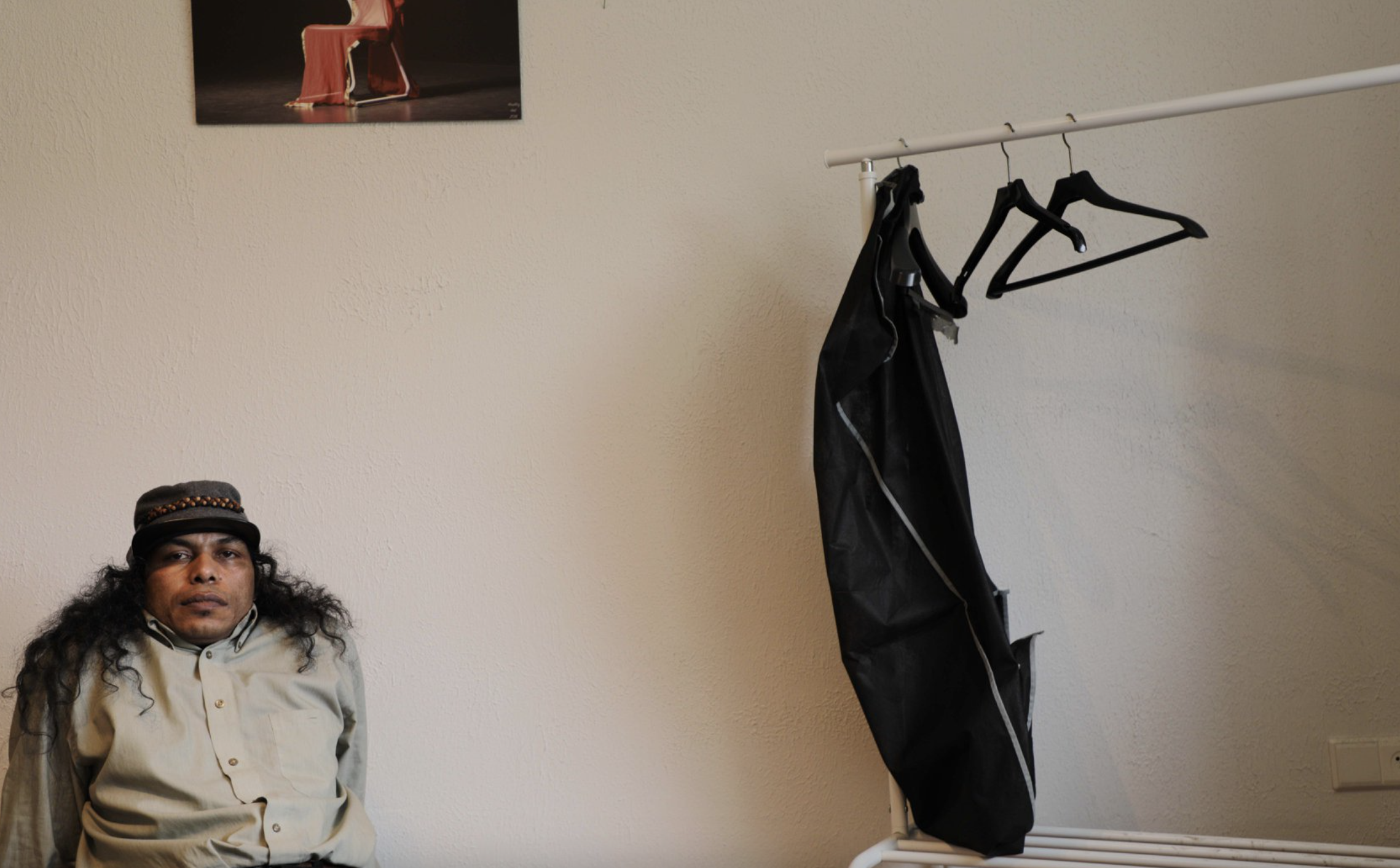
It was only a heartbeat from the New Year when I met Suva at his Kallio apartment in Helsinki. His room is cozy and full of his instruments and artwork. After moving to Finland in 2007, he reached an important phase: Migri (Finnish Immigration Service), which makes or breaks migrants, granted him a long-awaited permanent resident permit.
“I now have a “P” permit,” he said. “It was on 27 December that I learned about it. I was hoping to get it in November, but it turned out to be a late Christmas present. The wait and the process of getting the [permanent residence] permit were stressful.”
Suva likes philosophy, but he considers himself an artist above all. If you try to get a feel for the man, his room, his home, they manifest themselves roaring silence that leads you to a human characterized by humility and a strong desire for independence.
“I don’t follow any philosophers but my thought process is philosophic, which I make it work through actions,” he added, “and the form evolves as tactile and audible; and sometimes I make art edible. But I don’t like editing ]my works] but just present as they are or as I am! But rough but with depth.”
Suva said that he has always admired underdogs and people who are weaker and treated unjustly by society.
“All I try to do with my art is to express myself, which is not so easy in this fucked up society,” he continued. My heroes are the weakest and most vulnerable members of society who dare to say, ‘stop it!'”
Suva said that as an art teacher in India, he would give special help to those students that were the weakest.
A native of Meghalaya, Shillong in the North-Eastern part of India, Suva’s estrangement from his culture began with his left hand. “In India, left-handed people are seen as disrespectful,” he said. “When I was a child, they attempted to make me right-handed by tying my left hand, [a practice like that is commonly known as tiger parenting], so that,I would get used to using my right hand and the memory as such is very distinct, that I recall.…It didn’t work,” he added.
Suva completed his MA degree in Visual Arts from Delhi College of Arts affiliated to Delhi University, India, specializing in Sculpture (2004). He received his MA degree in Live Arts and Performance Studies from Uniarts, Theater Academy (2015).
Photo by Hussein Kazmenian.
One of Suva’s prized possessions is his instruments, made from scratch. Since 2008, when he started to live in Finland he has made a total of 22 instruments.
“For me, when I do a work of art [like an instrument and pyrography] and when I see the material, I see the form,” he continued. “I do not do sketches.”
I don’t like the excessive amount of influence of text in today’s art circles with reference to dead Western philosophers. I call this section of people “academonic inter-textual species”, a form of artistocracy. We have a saying in India: You must cut hot iron with a hot iron.” Therefore In my works I also use text as a visual element but with logic and thoughts that are mine and not borrowed from some pages of such thoughts.’
For example, the instrument he calls synthesis carries such a name for philosophical reasons. The Indians have their version of Hagel’s dialectic, where thesis and antithesis give birth to synthesis. After that, the thought process begins again: thesis, antithesis, and synthesis.
Suva playing the synthesis instrument. Photo: Suva
Pyrography is Suva’s way to express many questionable issues and calls it “ink of fire”. “I do pyrographies whenever I have the time and mood,” he continued.
“Currently I am working five days a week, eight hours a day, so…I get tired when coming home, but I manage to get some energy to continue creating work whether it is from visual or performative in semblance.” Suva works today as kitchen assistant. He has had various jobs from paper delivery to cleaning. “The only way, in my opinion, to find work [in Finland] is through somebody you know,” he said. “Getting a job is very difficult and there is a huge amount of nepotism in the artistic field.”
Yle’s Viimienen sana invited three guests to talk about Finland’s alleged youth gang problem and how the media treats the topic. The three guests clearly indicated how the talk show would frame the topic.
In the first place, there were no minorities taking part in the debate. All of the guests were white Finns.
Viimeinen sana did not a word about Marko Forss’ past, the policeman invited to the program and from questionable backgrounds.
Forss has a shady history when it comes to minorities and migrants. Even if a racist joke about the Romany minority is a minor matter for him, he was an admin of a racist and secret Facebook page that Long Play uncovered.
The Facebook group where Forss was the admin consisted of over 2,800 members, or about one-third of Finland’s police force of 7,000, according to Long Play.
Did any of the police officers in the group get reprimanded? What about Forss?
MTV: “Violent juvenile crime has soared, even 10 year-olds rob [people]”Helsingin Sanomat: “Children manage organized drug trade in Espoo. “Pockets filled with money.” Etelä-Saimaa: “This is how international street gangs are coming to Helsinki, even 13-year-olds is bad company. National Bureau of Investigation: ‘Same system as in Denmark and Sweden.'”MTV: “Youth gangs beat children and youths in East Helsinki.” Different sensationalist captions by “respected” media in Finland. Source: Viimeinen sana
The other two guests were Tiia Palmén from MTV, which writes pretty biased stories about migrant youths (see above), and Matti Näsi of Helsinki University.
While Näsi pointed out that the gang problem in Sweden is light years from Finland, a minority youth worker and even I would have given a different view of things.
Two important questions weren’t answered on the program:
Perussouomalaiset (PS)* head Riikka Purra wasn’t the only one overjoyed by the latestHelsingin Sanomat opinion poll, which showed the radical-right party overtaking the Social Democrats to second place after the National Coalition Party (Kokoomus). Behind Purra was Kokoomus chief Petteri Orpo, gleeing.
Finns will go to the polls on April 4 to elect 200 MPs.
While observers debate the reasons behind the good showing of the PS, we can cite three:
Fear-mongering about minority youths in gangs.
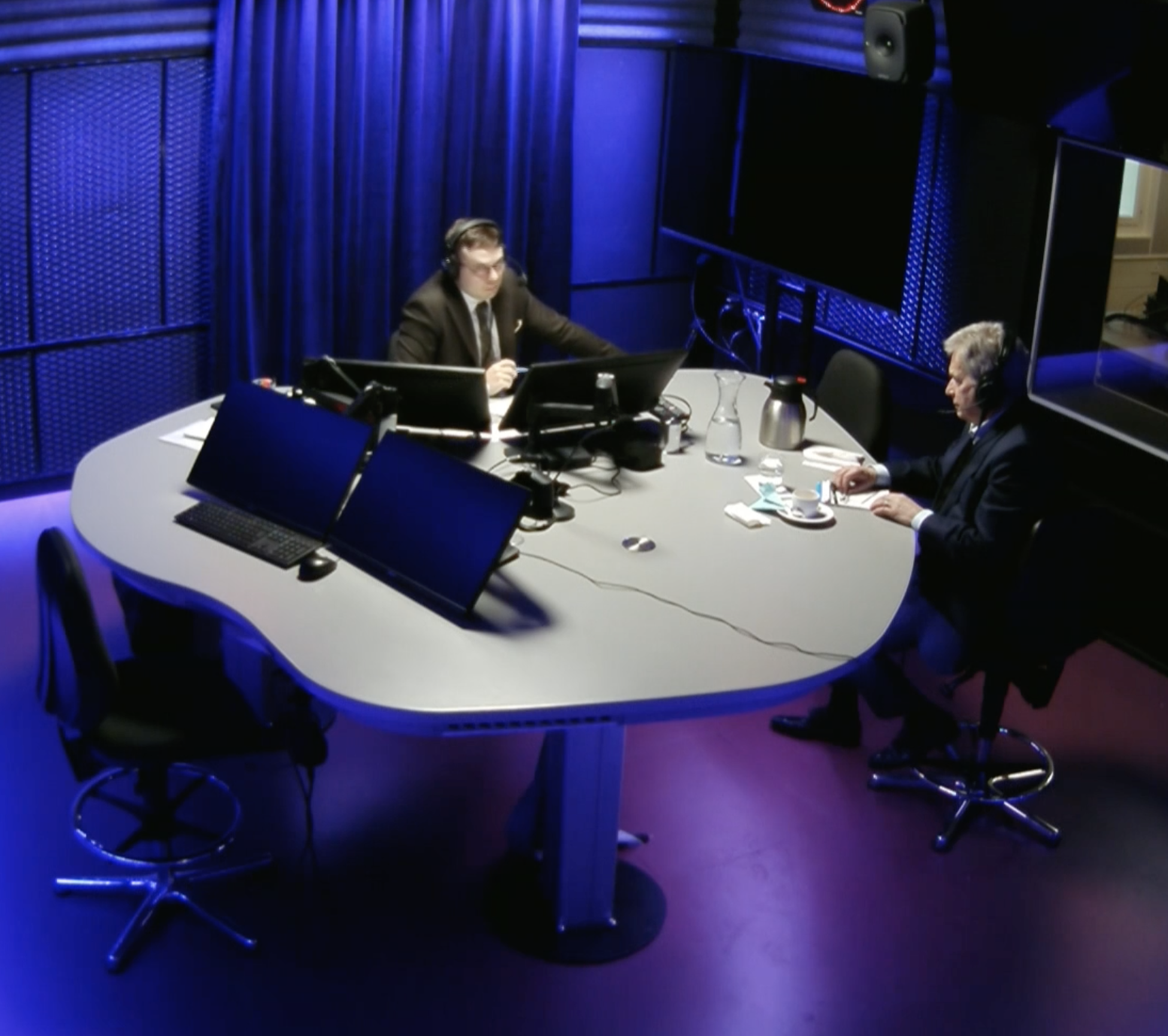
President Sauli Niinistö’s endorsement of that fear.
Kokoomus’ willingness to form a right-wing government with the PS.
Then Interior Minister Petteri Orpo said that Finland will immigration removal centers to deport asylum seekers whose asylum application has been rejected. Source: Yle.
Orpo and former Prime Minister Juho Sipilä rejected the PS in 2017 after the party split in two because the party was led by Jussi Halla-aho, who was convicted in 2012 for ethnic agitation and for breaching the sanctity of religion.
Sipilä’s government didn’t need the PS since the newly formed faction, Blue Reform, was there to offer its support to keep the government intact.
I am worried about the amnesia of political parties like Kokoomus, the media, and many politicians who don’t see racism as a problem. One good example is Purra’s promotion of ethnonationalist ideology by suggesting that Finland should exclude foreigners from getting social welfare. Not one newspaper in Finland, never mind a single politician, denounced what she said.
Those who are worried about the blow to the credibility of the security guards due to several scandals that even led to the death of a woman in Espoo are quick to point out one should not jump to conclusions and label all security guards and the sector.
True, we should always be careful not to generalize.
There is, however, something wrong with that defense. The same people who are saying that we must not generalize are the ones who constantly generalize about migrants.
President Sauli Niinistö, who is no friend of Finland’s culturally diverse communities, added more feathers to tarred minority youths in the ongoing debate on youth crime. Source: Yle
Downplaying the problem is also an important part of the narrative about white crime versus crime committed by minorities.
Politicians like Prime Minister Sanna Marin have offered long-overdue leadership when challenging racism in Finnish politics by stating what many know: The Perussuomalaiset (PS)* is a racist party.
“Looking at the speeches of individual [PS] MPs, these speeches have been racist and genuinely hostile to certain minorities,” said Marin in a debate with Petteri Orpo, the chairperson of the National Coalition Party (Kokoomus). “There is no denying this; it is a fact. I don’t understand why we politicians should smile and pretend that these speeches are not real.”
Two PS MPs, Vilhelm Junnil and Veikko Vallin, showing off their MAGA caps by former President Urho Kekkonen’s bust. Does a “normal” party cack President Donald Trump after all the revelations of financial crimes and coup plotting? Source: Facebook
Finnish politicians need to be faster to react to the rise of the PS. In the 2011 parliamentary election, when it won 39 seats from 5 seats previously, Finnish political parties like the Social Democrats wanted to capitalize politically on anti-immigration sentiment.
After the leaders of the Social Democrats, Greens, and Left Alliance announced that they would not form part of a future government with the radical-right Perussuomalaiset (PS),* Riikka Purra has lashed out against her party’s critics.
The latest racist talking points of the PS is excluding foreigners from getting social welfare and creating a modern Nordic apartheid state where foreigners would be legally second-class citizens.
The knee-jerk reaction by Purra is because the three parties don’t see the PS as “a normal party” and therefore do not wish to sit in the same government as her Islamophobic party.
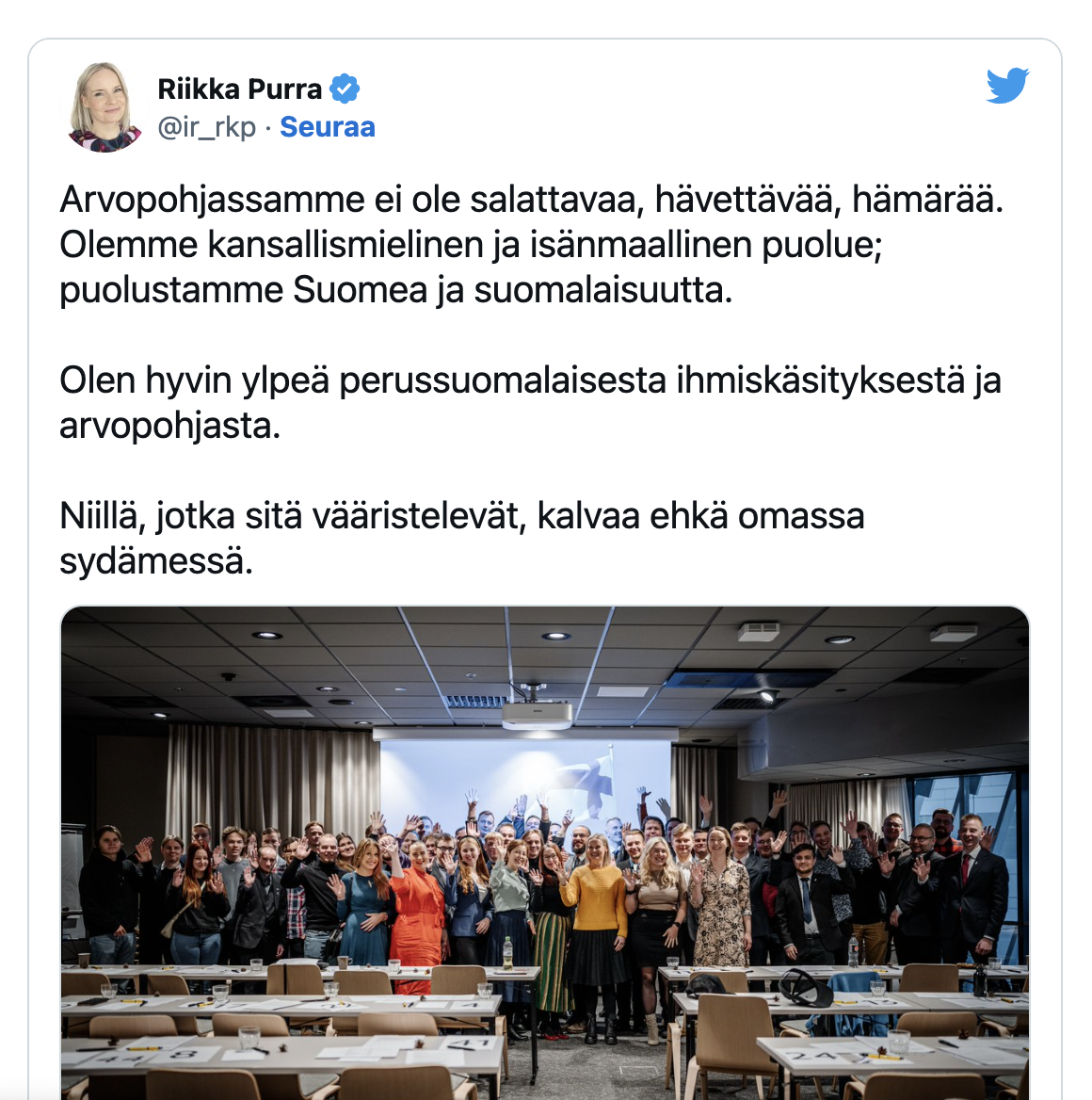
Purra tweets: “There is nothing to hide, nothing to be ashamed of, nothing to hide about our (party’s) values. We are a nationalist and patriotic party defending Finland and Finnishness. I am very proud of our concept of humanity and our values.”
I always ask if the politician or public official will change anything or keep the status quo. The answer you may get offers rapid insight into the problem.
The security business scandal grew Thursday when a former Securitas manager is suspected of aggravated fraud in a fictitious case involving protection for a possible victim of an honor killing. The amount of money obtained fraudulently, together with a social worker of the Center for Economic Development, Transport and the Environment (ELY Centres), was “about three million euros,” according to MTV.
The alleged crime happened between November 2021 and September 2022. The suspect was detained for a month by the police and freed in November, but he is still a suspect.
The different shortcomings, even fatal as happened in Iso Omena on Saturday, of security companies, reveal a wider problem that has come to the public light thanks to the little scrutiny of the business.
It is a good matter that Minister of the Interior Krista Mikkonen wants a full investigation of the sector. “It is safe to say that these are not isolated cases, as there have been several recently,” she was quoted as saying in Yle.
Good start Minister Mikkonen but why do you make such a statement now? Didn’t you suspect anything before?
If we follow the news, some matters reveal themselves: downplaying the problem by the heads of Securitas, Jarmo Mikkonen, and Avarn Security, Niklas Saklén; (2) downplaying the problem by politicians like Perussuomalaiset (PS)* MP Mari Rantanen; (3) downplaying the problem by using the police and so-called “security experts” as sources by the media; (4) downplaying or not even citing ethnic profiling by security guards.
PS MP Rantanen, who heads the parliamentary administration committee, said in A-studio, that the scandal has surprised her and that we should not label all security workers.
Bravo, Social Democratic Prime Minister Sanna Marin! Bravo, Green League Minister of the Environment Maria Ohisalo! Bravo, Left Alliance Minister of Education and Culture Li Anderson! Bravo for stating in plain Finnish that your parties would not form part of a new government with the radical right Perussuomalaiset (PS).*
When the PS took 39 seats in the 2011 parliamentary elections from 5 seats previously, the country has not been the same. But could you expect from a party that bases its support on racism, nationalism, and fascism.
Academic researchers like Oul Silvenoinen consider the PS a radical-right party with ties to openly hostile and violent groups like Suomen Sisu, Soldiers of Odin, Kansallismielisten liitouma (National Alliance), Sinimusta Liike (Black-and-Blue Movement), the banned neo-Nazi Pohjoismainen vastarintaliike, and others.
If you listen to the PS chairperson, Riikka Purra, she wants to turn Finland into a Nordic apartheid state where white and naturalized Finns have all the rights. Her latest outburst is to exclude foreigners from getting social welfare.
It’s been 11 years since the 2011 election, and, certainly, the PS believes and wants you to believe it is “a normal” party, which explains why the party appears offended by the SDP, Green League, and Left Alliance not wanting to be in the same government as it.
A PS ad for the municipal elections. It reads: “National clean-up day. A woman with dyed blonde hair and wearing a national dress is throwing parties like the Left Alliance, Center Party, SDP, and Greens into the hazardous waste bin. UFFE, which aims to promote ecological, social, and economic sustainability, recycles Antifa, feminism, communism, globalism, and BLM. Source: FacebookContinue reading “The PS is “offended” because they are not treated as a “normal” party”
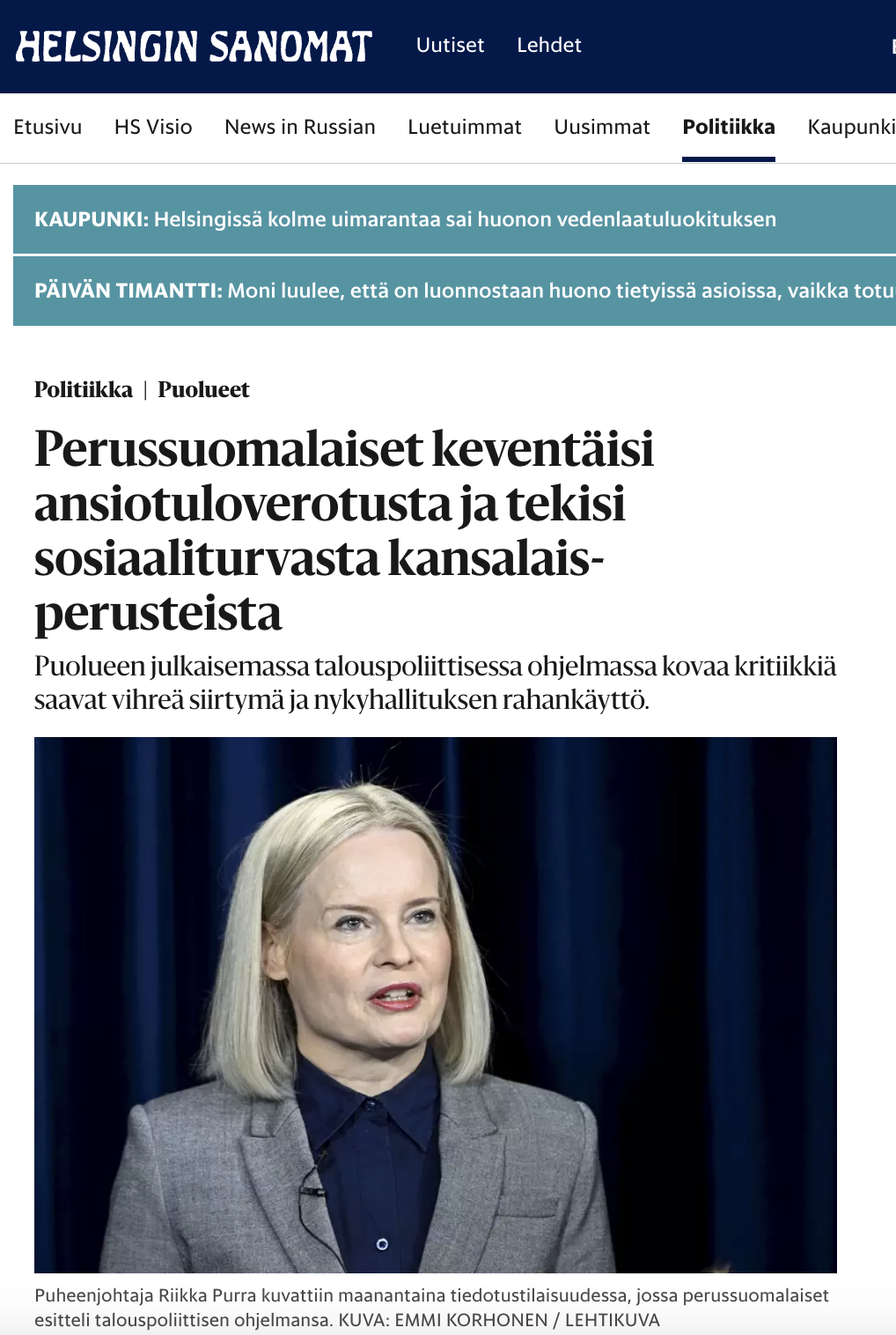
Perussuomalaiset (PS)* party chairperson, Riikka Purra, has actively promoted her racist talking points. Some of these are the far-right great replacement theory and, most recently, her party’s aim to exclude non-Finnish citizens from getting social welfare.
While such a suggestion may appear for now a political stunt to lure voters, Purra’s suggestion is outrageous, to say the least. Did the media see it in the same way?
Nope.
Did any newspaper write an editorial about Purra’s statement?
Nope.
Apart from demonizing foreigners and minorities, her plan has the same ring as the Nurenburg Race Laws, which effectively excluded Jews from German society.
Even if the Nurenburg Race Laws came into force in 1935, Purra’s suggestion could be a modern version of the latter. The idea is the same: label, victimize and exclude whole groups.
Helsingin Sanomat does some fine reporting, but sometimes it falls flat on its face.
The story about Purra’s suggestion to exclude foreigners from receiving social welfare is a good example of deficient or lazy reporting.