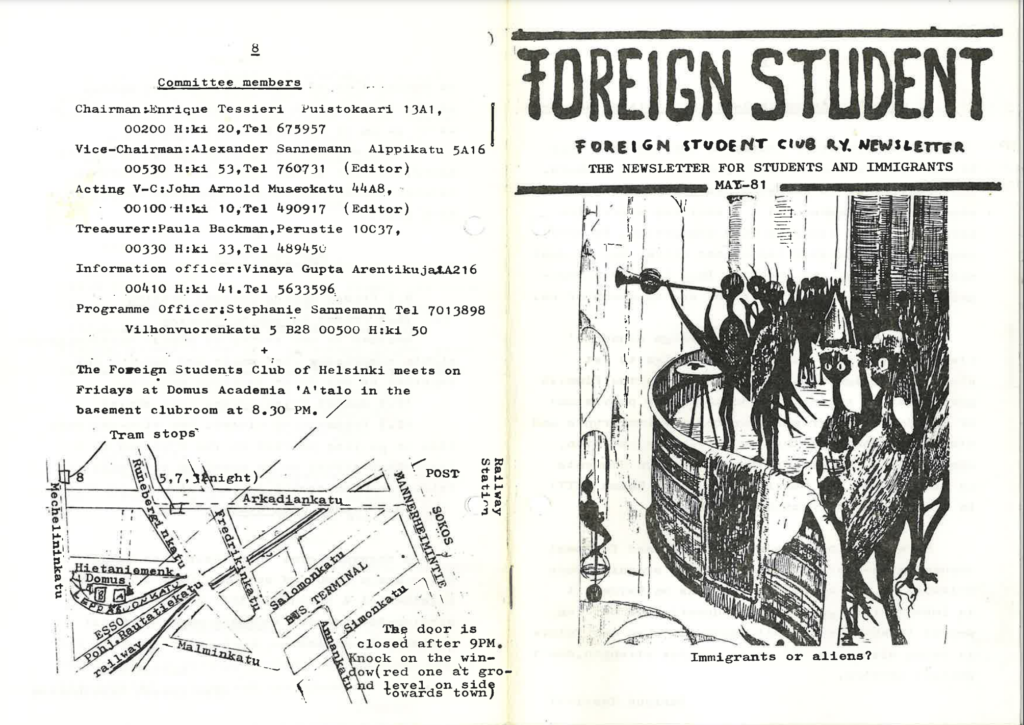
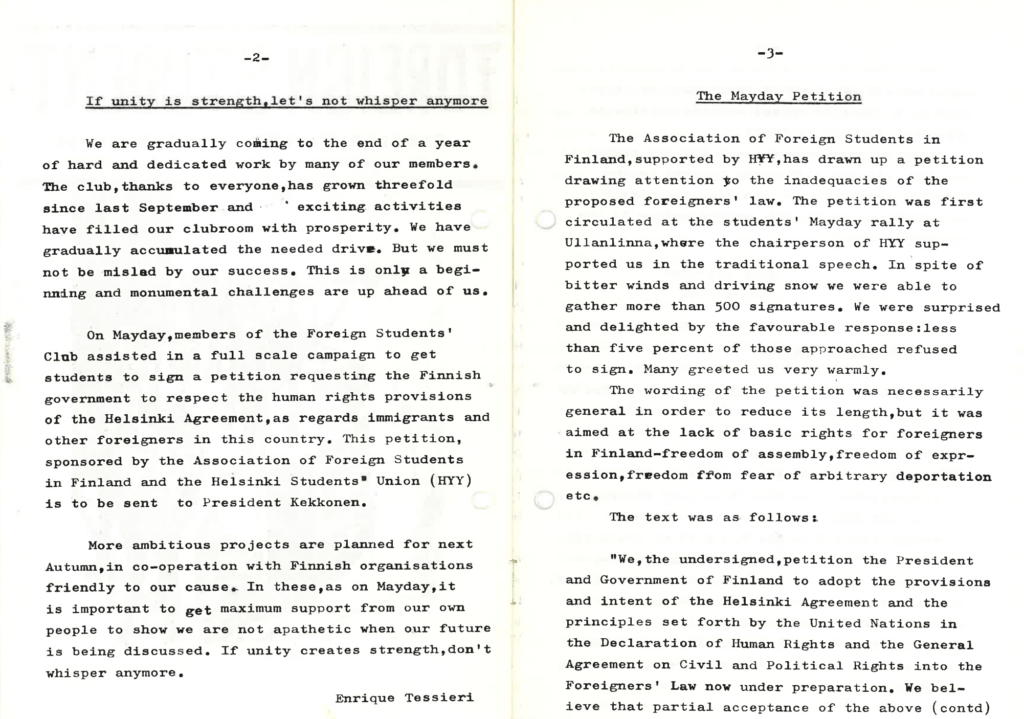
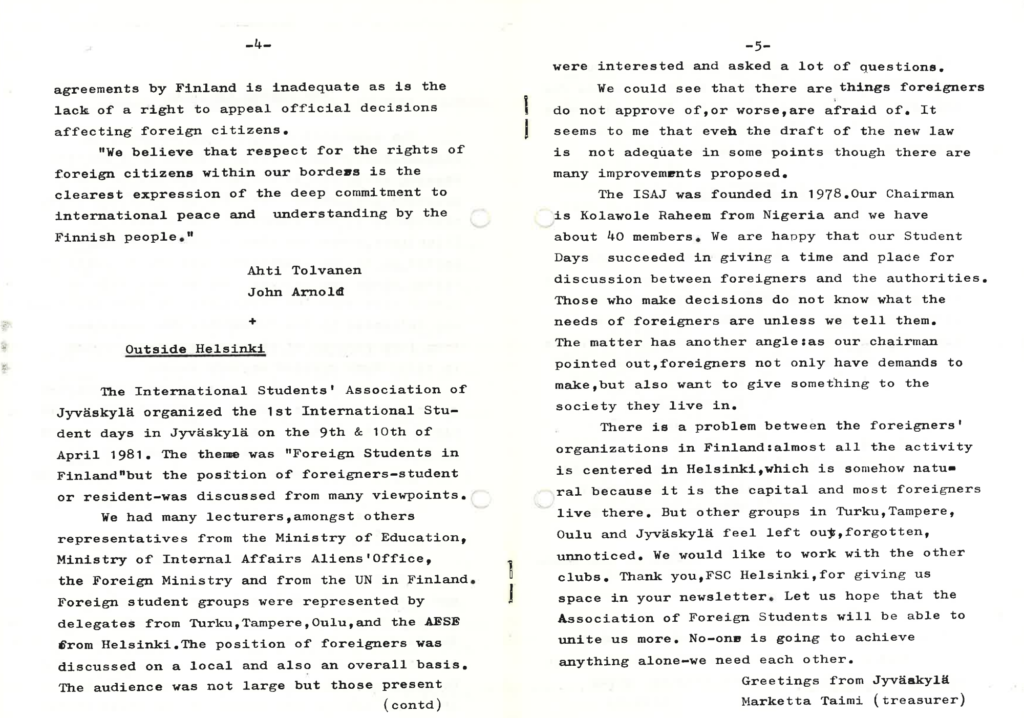
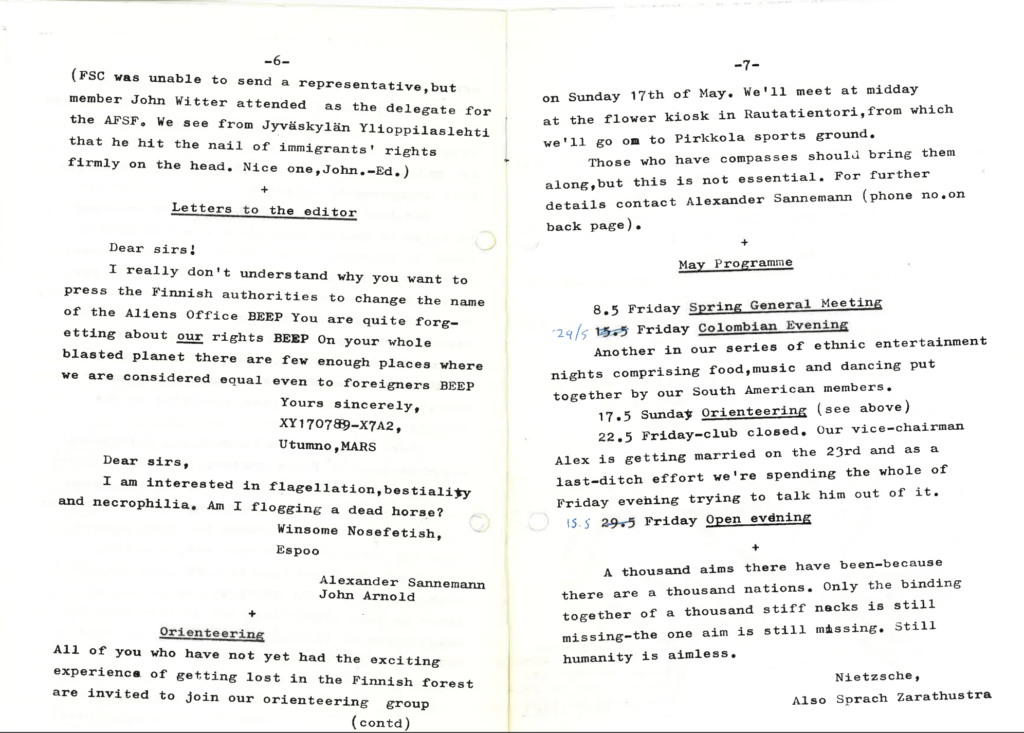
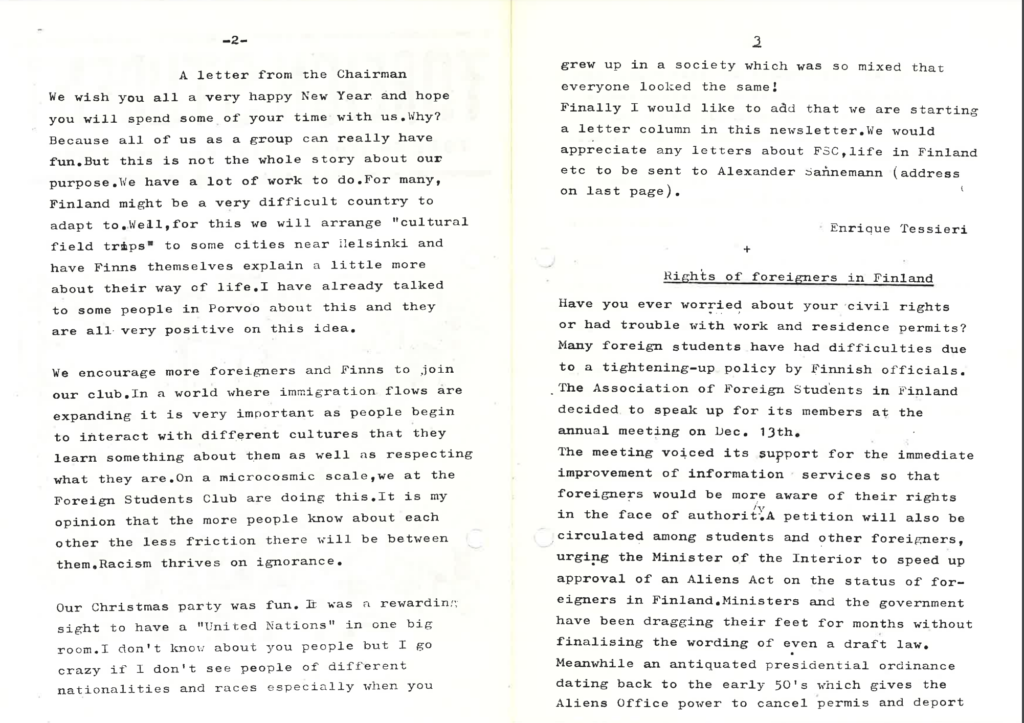
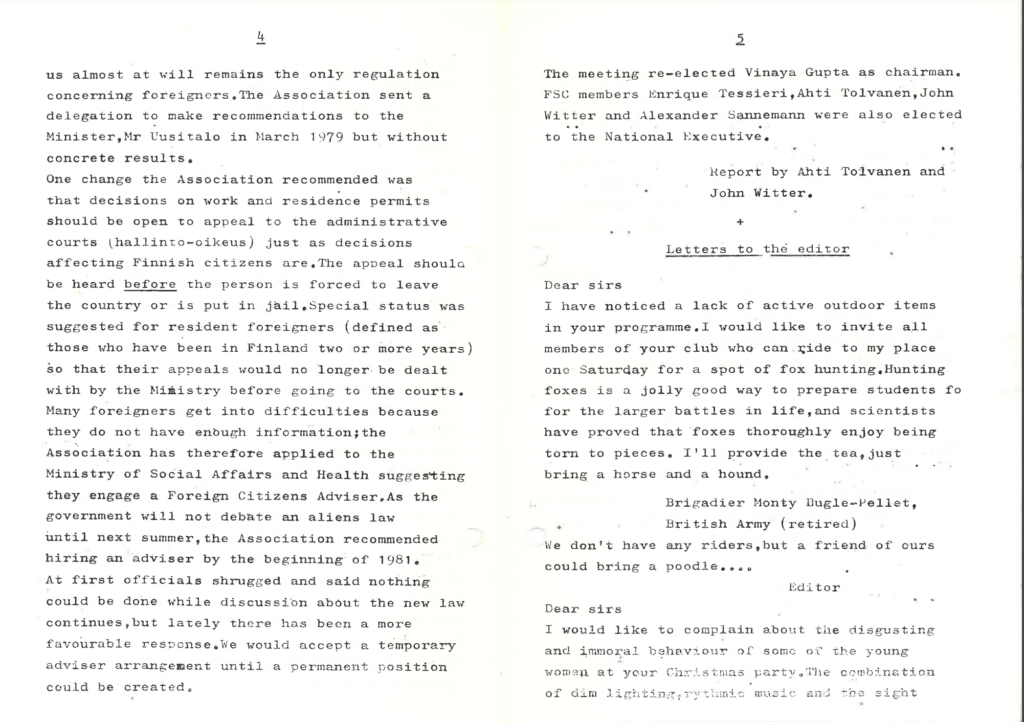
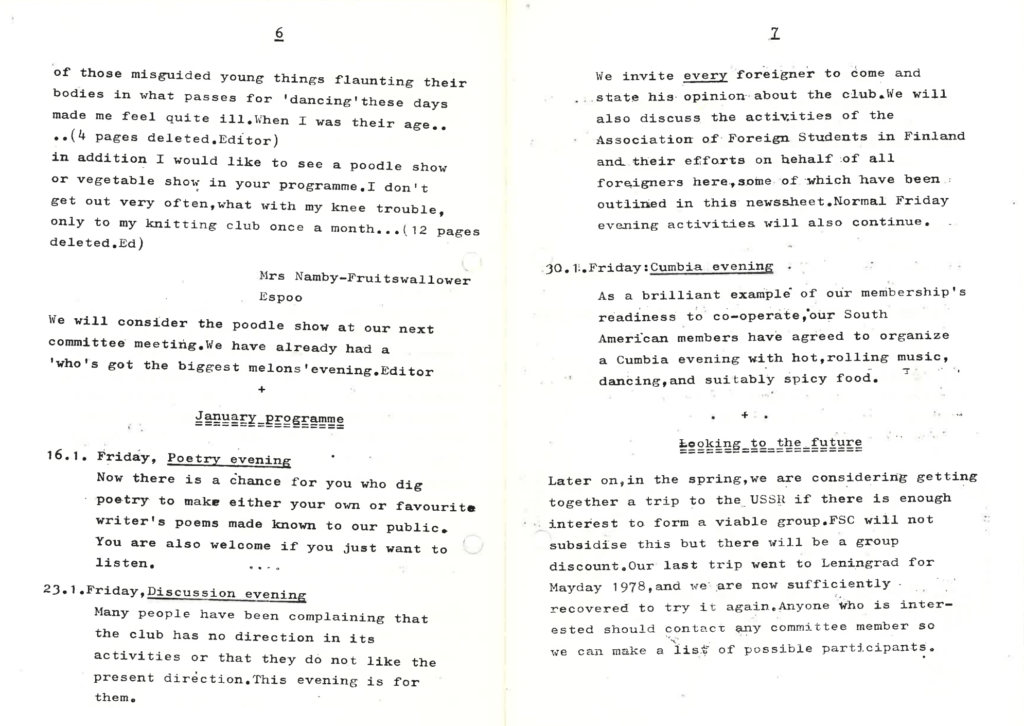
In the May 1981 issue, the Foreign Student continued to mirror the activism of some of the Foreign Students Club’s members against Finland’s arbitrary and unjust treatment of foreigners. The newsletter reported on the Mayday petition, which received over 500 signatures demanding basic human rights for foreigners.
“If unity creates strength, don’t whisper anymore,” wrote the May issue of the Foreign Student.
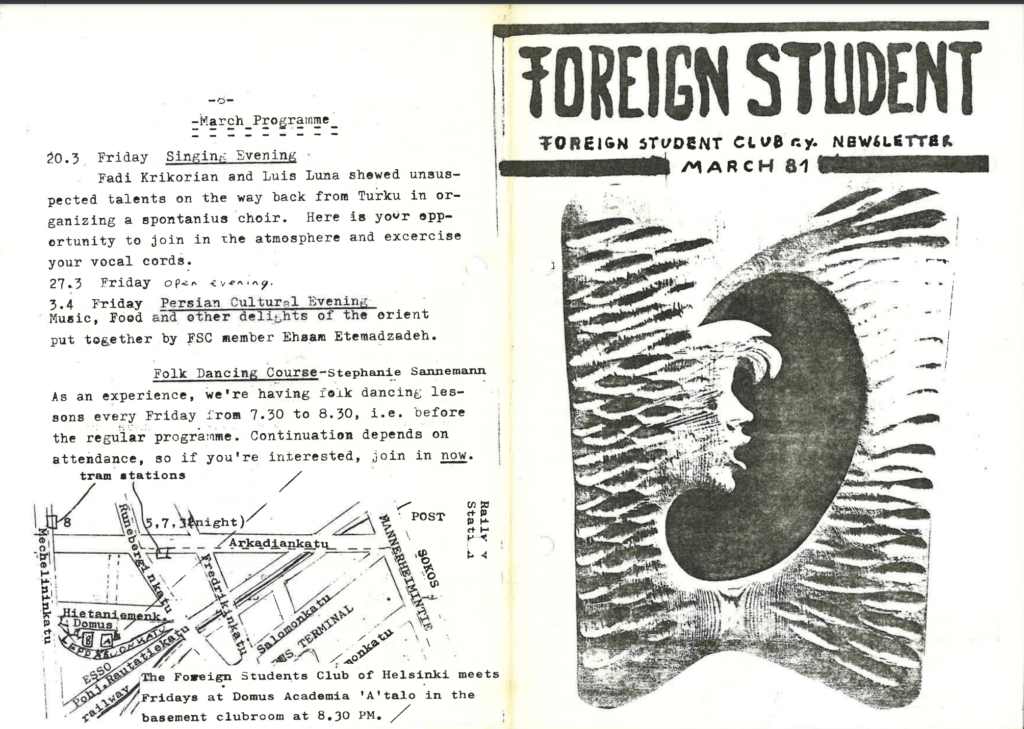
Migrant Tales will publish all of the eleven issues of the Foreign Student, the newsletter of the Foreign Students Club of Helsinki. The March 1981 issue continued to test the waters by speaking out for foreigners’ rights.
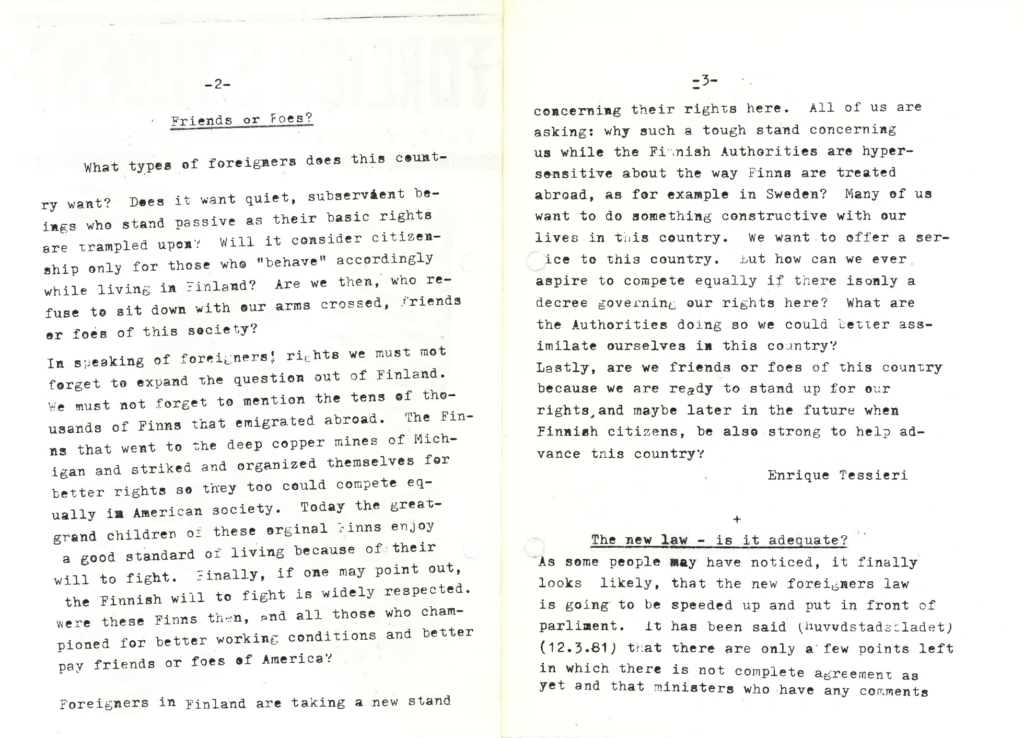
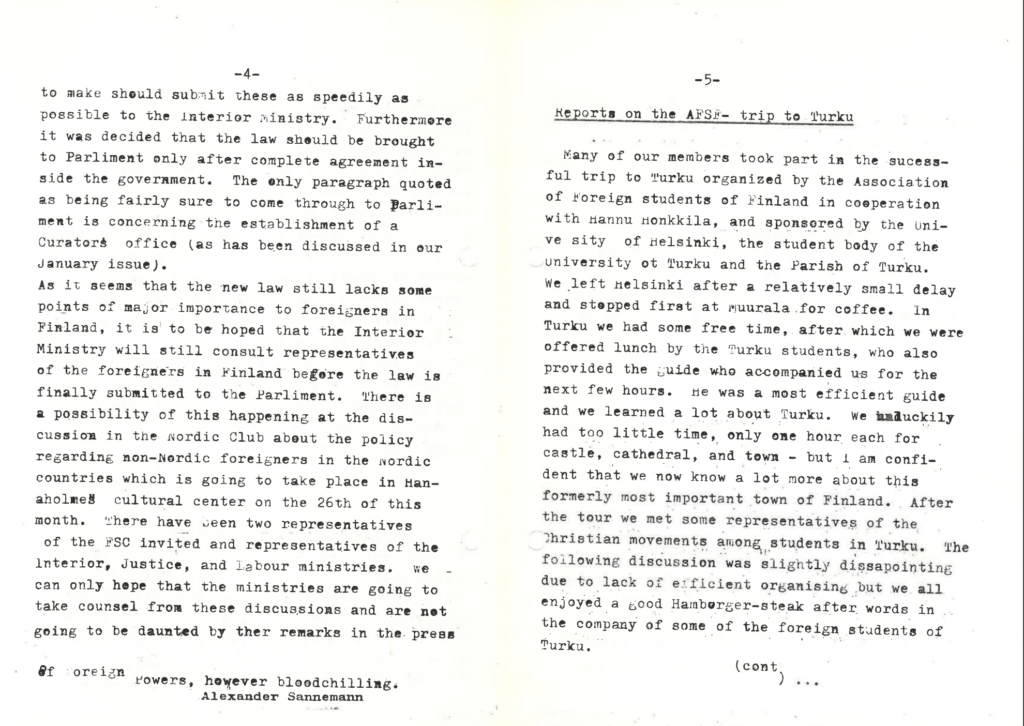
Writes the Foreign Student: “Foreigners in Finland are taking a new stand concerning their rights here. All of us are asking: why such a tough stand concerning us while the Finnish Authorities are hypersensitive about the way Finns are treated aboard, as for example in Sweden?”
The February 1981 issue was the second of eleven newsletters that came out. The Foreign Student played an important role in giving migrants a voice during a period when foreigners were supposed to remain quiet about their civil rights.
Published in 1981, I wouldn’t have used today words like “Gypsy” and “Lapp” to refer to the Roma and Saami, respectively.
The second issue tried to speak about immigration and question Finland’s very restrictive policy towards foreigners.
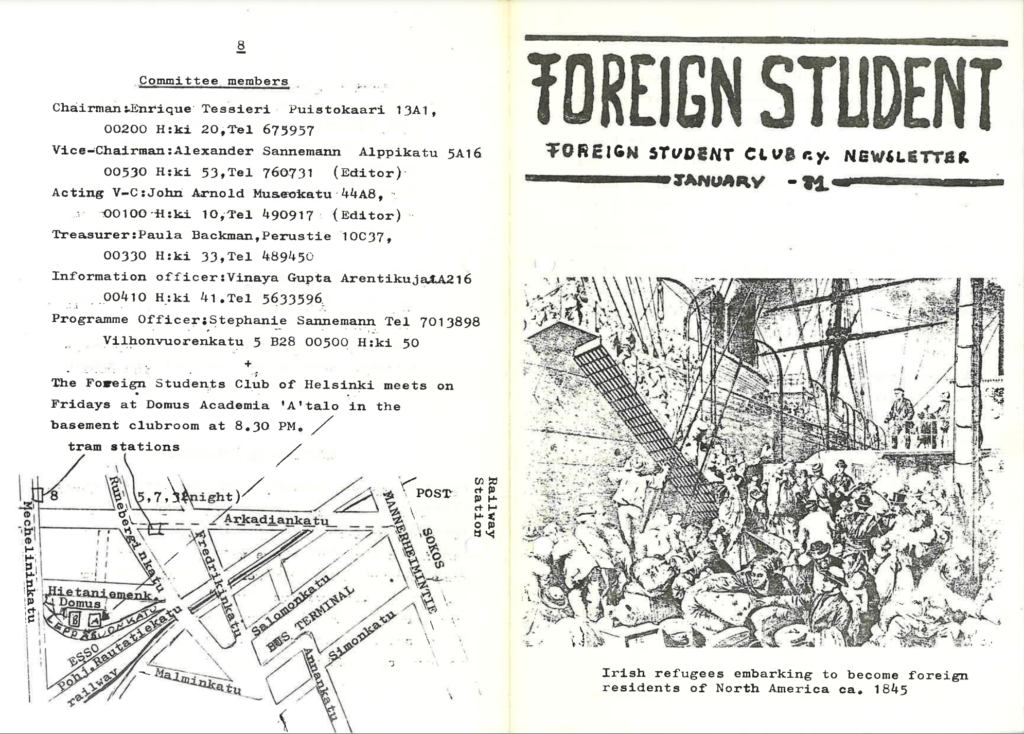
Migrant Tales will begin to publish the Foreign Student, the newsletter of the Foreign Students Club of Helsinki. The January 1981 issue was the first newsletter, which came out 11 times until January 1982. The Foreign Student played an important role in giving migrants a voice during a period when foreigners were supposed to remain quiet about their civil rights.
When the Foreign Student was published about 11,000 foreigners lived in Finland. Most of these foreigners were Finns who were naturalized Swedes.
It also helped to drive up membership of the club and gave the foreign community a needed voice.
The Islamophobic Perussuomalaiset (PS)* party has had a long love affair with Denmark’s anti-Muslim immigration policy, one of the toughest in Europe. With loaded guns in government, the PS must be happy that they can adopt, with the blessings of National Coalition Party (NCP) Prime Minister Petteri Orpo and the two minor coalition partners, the Swedish People’s Party (SPP) and Christian Democrats (KD), that country’s harsh immigration policy.
The Danish People’s Party (DPP) used to call the anti-immigration shots in government but in recent years their support has declined abruptly. In the 2022 election, the DPP lost 11 seats to remain with five seats in parliament, which is a far cry from the 37 seats they won in 2015.
The fortunes of the DPP have been undermined by the Social Democrats who have adopted and succumbed to the same hardline immigration policy and rehotirc of the far-right party.
While some are debating if a radical right party becomes more moderate when in government, Denmark offers us an answer: it radicalizes other parties who must adopt more hostile stances in order to survive and not be devoured by a populist party.
Apart from the government’s immigration policy that disenfranchises migrants by weakening more their civil rights and making them vulnerable to exploitation by employers, one wonders how far the PS – with the blessing of the NCP, SPP and KD – will go in order to make life difficult for migrants.
in Denmark, the DPP went as far as to force migrants to speak only Danish at home and deport whole families if a member is convicted of a crime. When will we see the following aims below in Finland?
Spearheading these radical changes in Finland’s immigration policy is PS Interior Minister Mari Rantanen. She recently announced plans to speed up the asylum process to four weeks. The asylum seeker will wait for the decision at the border.
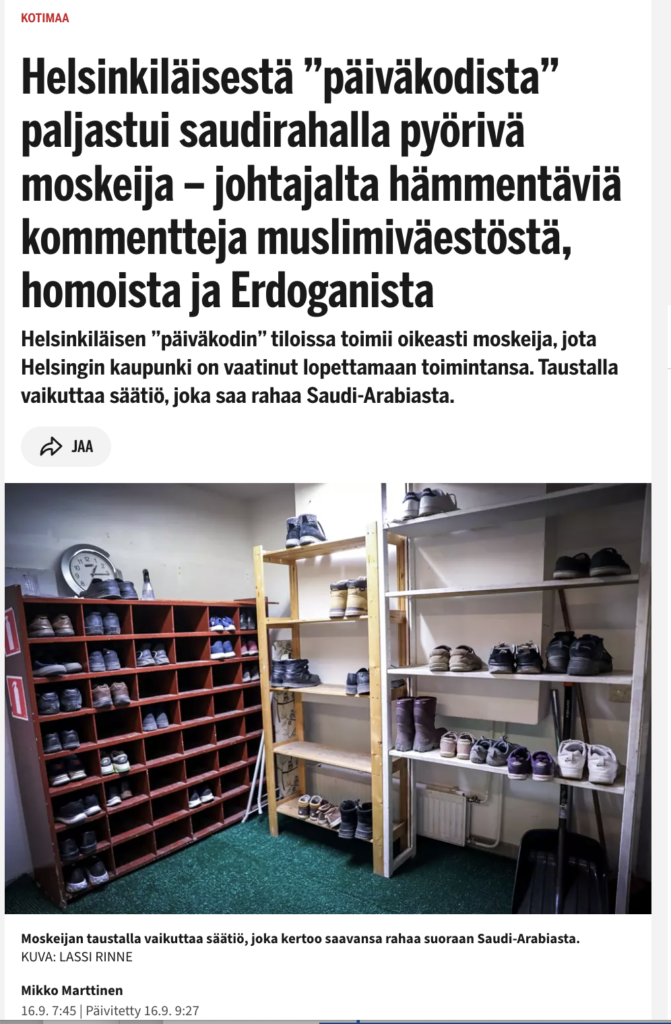
If there is a big divide and mistrust between the media and the Muslim community it was exposed by a scoop the tabloid ilta-Sanomaton a secret “mosque” in a Helsinki nursery. Throughout the years, some Muslim imams and other members of the community have expressed apprehension of the Finnish media.
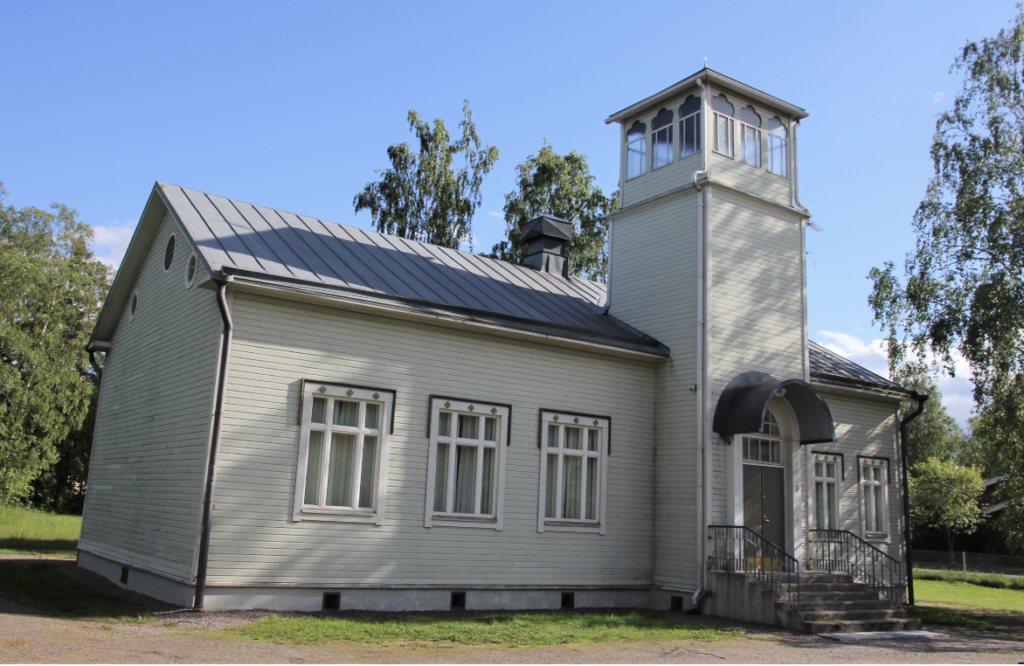
For those who may not know, Finland has only one mosque built in the 1940s located in Järvenpää, a short drive north of Helsinki. All the rest of these mosques without a minaret are, in fact, prayer rooms.
Finland’s only mosque with a minaret is located in Järvenpää and was built in the 1940s. Source: Helsingin Sanomat.
True, some Muslims call prayer rooms mosques.
While many will disagree with Suomen Muslimifoorumi’s Aladin Maher about his views on gay marriage and the great replacement conspiracy theory, the underlying message of the stories written about the “mosque” reveals a deep-seated mistrust of Muslims that is amplified by politicians from parties like the Perussuomalaiset (PS)*and National Coalition Party.
The story about the mosque awoke Finland’s Islamophobic hardliners like Interior Minister Mari Rantanen, Justice Minister Leena Meri, Minister Wille Rydman, MPs like Atte Kaleva, Joakim Vigelius, never mind the thousands of hostile comments on social media.
All of these politicians and ministers had something bad to say about the mosque and Maher and exposed their hypocrisy.
We shouldn’t be surprised the these hostile comments came mostly from the Islamophobic PS and National Coalition Party.
If the ongoing hostile comments are anything to go by, it shows that any meaningful dialogue between some sectors of Finnish society and the Muslim community is light years away.
Rejection by the media and certain politicians of Muslims ensures that nothing will change.
The Finnish Swimming Teaching and Lifesaving Federation (SUH), in collaboration with a representative from the University of Jyväskylä and the Finnish National Agency for Education, conducted a nationwide swimming proficiency study in 2022 (SUH, 2023). The study revealed that a staggering 45% of sixth-graders either lacked sufficient swimming skills or couldn’t swim at all. Reports submitted to the Finnish Safety and Chemicals Agency (Tukes) indicated that children’s insufficient swimming skills led to serious water-related incidents and accidents.
Finland has witnessed several cases related to racism and anti-immigrant sentiments in swimming pools and other public spaces. These incidents underscore the need to combat such behavior and provide better training and guidance to staff to effectively address hate speech and racism. Promoting water safety and ensuring the safety of all residents in aquatic environments is crucial, considering Finland’s strong cultural focus on lakes, seashores, and saunas.
In the summer of 2023, Liikkukaa – Sports For All Ry conducted a case study related to swimming pools. The study is part of a larger research project undertaken by the EU Erasmus+ Monitora program. The research consists of 20 interviews and 2 case studies in each partner country, coordinated and evaluated by the
The impact of National Coalition Party (NCP) Prime Minister Petteri Orpo’s government (Perussuomalaiset PS*, Swedish People’s Party and Christian Democrats) on Finland will be devastating. It will be a regression into the darkest corners of nationalism, xenophobia, chest-thumping, and bravado.
With the help of these social ills, there are plans to displace Finland’s liberal roots that gained force after it became an EU member in 1995. A lot of good laws were drafted at the end of the 1990s such as the new constitution, which guarantees that everyone, irrespective of their background, are equal before the law.
PS Interioir Minister Mari Rantanen speaking at A-studio, where she wants to give police rights in certain neighborhoods to stop and frisk people even if they are not suspected of crime. The proposal has raised concern about its legal problems. Rantanen states that such a model is being copied from Denmark, which is considered by some the most Islamophobic countries in Europe.
Plans to turn migrants legally into second-class members of society is one of the many threats by the government like paying foreigners less social welfare. There is a concerted plan to disenfranchise migrants.
Apart from the latter, Finland’s most right-wing government since the 1930s will do all it can to erect monuments to forgetting racism and worsening social inequality.
The racism scandals of summer are a case in point. They give us clear insight on how the government white-cleans its past.
A seven-point guide on how to create a new image and appear as a “normal” politician despite your racist background:
It is concerning for migrants and minorities in Finland that we have a government that is openly hostile to them. As in Juha Sipilä’s (2015-2019) government, there was an agreement that migration policy would be handled by the Perussuomalaiset (PS)* party in exchange for the National Coalition Party (NCP) and Center Partry dictating economic policy.
It is the same situation now: The NCP remains silent on migration policy and the PS is silent on austerity measures in exchange for dictating migration policy.
Looking at the PS’ track record and its use of conspiracy theories to drive home its xenophobic message, one wonders if just erasing previous racist posts is enough to restore credibility in ministers like Mari Rantanen.
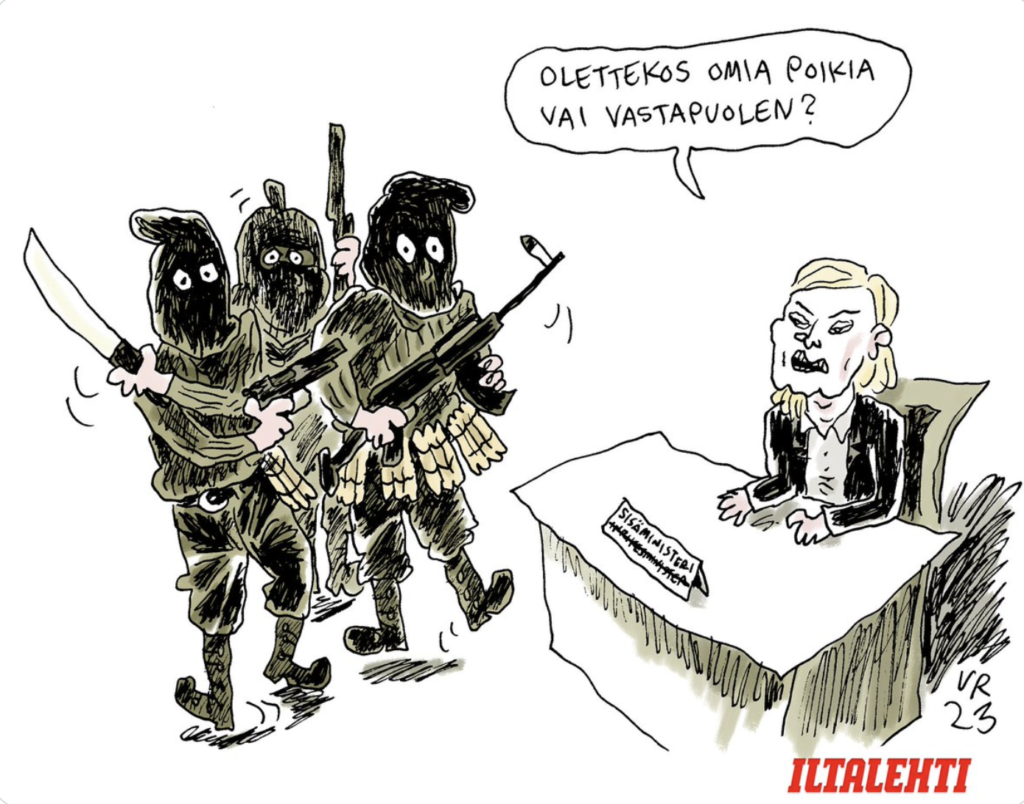
“Are you on our side or the other side’s,” asks PS Interior Minister Mari Rantanen. Source Ville Ranta, Iltalehti.
The question is not far-fetched. The PS is historically the first major contemporary Finnish party to have profited politically by promoting the polarization between different groups by claiming that Muslims, Africans, and other non-EU nationals, as less valuable.
Many of Rantanen’s social media posts before the 4 April election, which were deleted and whitewashed after the elections, were based on conspiracy theories, such as the great replacement. “We shouldn’t be so blue-eyed that soon we won’t be blue-eyed?” is one of his more unusual quotes.
In Finnish, being “blue-eyed” means being naive.
Moreover, even if these types of posts do not increase credulity, how can one even attempt to find a solution to the youth problem in society if Rantanen and her party blame social problems like pinning youth gang violence on ‘harmful migration?
How is it possible that we do not hear a word from the government about three suspects tried on terrorism charges in Lahti. Helsingin Sanomat published an editorial Tuesday about the threat of far-right violence in Finland.
Writes Helsingin Sanomat: “However, the case is a fresh reminder that the extreme right is a real threat to Finland’s security. The assessment made by the Finnish Security Police (SUPO) a couple of years ago is correct; in addition to the terrorist threat from radical Islamists, the terrorist threat from the far right has increased.”
As if trying to divert attention from far-right terrorism, Interior Minister Mari Rantanen has preferred to talk about migrant youth gang violence and new questionable methods to give the police more search- and-seizure powers.
For many years, groups like Migrant Tales, historian Oula Silvenoinen, and columnist Saku Timonen have warned about the ties of the radical-right Perussuomalaiset (PS)* party and far-right groups. Is it a surprise that one of the main suspects in the terrorist trial in Lahti is a former PS member Viljam Nyman?
Finnish prosecutors have charged four men in the Lahti terrorism trial that are believed to be able to produce semiautomatic weapons using a 3D printer and attacking critical infrastructure, politicians, anti-racism activists and NGOs. One of the targets was believed to be former prime minister, Sanna Marin.
Finnish news server YLE reported that the four suspects follow neo-Nazi ideology linked to accelerationism, which claims that fundamental societal transformations can be achieved only by accelerating different processes in society.