The paper, written by Enrique Tessieri in 2009 for the Social Science Department of Turku University, explains how sociological intervention helped promote and strengthen cultural sensitivity at a folk high school 14 kilometers from the Eastern Finnish city of Mikkeli. From 2010-2011, Otava Folk High School became the first school in Eastern Finland – if not nationally- to offer halal meat regularly to its Muslim students.
One of the positive changes that sociological intervention brought was bringing down the fences between us and them by creating a more inclusive climate. “Otava Folk High School was one of the first in 2010 to serve regularly halal meat in Finland 2-3 times a week to students, which are mostly Muslims. In order to promote inclusiveness, students are no longer called migrant students but multicultural students. Otava Folk High School offers different types of education but the most important for multicultural students include upper secondary school, comprehensive school, predatory comprehensive school, and Finnish language and culture courses for asylum seekers.” (See “The Shifting Global World of Youth and Education,” edited by Mabel Ann Brown, Routledge, 2018, page 105).
While these changes were promoted with the help of sociological intervention and cultural sensitivity, they were short-lived in 2018 by Principal Harri Jokinen, who cited economic factors.
If you are going to promote cultural diversity and sensitivity at a school, it depends a lot on the management, in the case of Otava Folk High School,, on the principal.
The problem with this law is that it calls into question the whole idea of the rule of law. It allows the Finnish government to declare that there is a threat at the border of a “hybrid invasion”. This declaration can be made based on secret security information the government may claim to have and no court can examine and rule on the validity of the information. The declaration of a hybrid invasion will allow the border authorities to turn away anyone and everyone no matter what danger they are facing. This can include both foreigners and Finnish citizens as the authorities have emergency powers to forgo examination of documents and identities. In fact as Minister Mari Rantanen has stated, the persons crossing the border may not even know themselves that they are involved in a hybrid invasion. So there is no real way of knowing who the government is “pushing back” at the border or why or what will happen to them outside Finland. In fact, if there are people the government does not like, the government now has the powers to expel, beat up or even shoot dead persons they do not like without legal accountability. All they have to do is wait until these unlikeable people are at a border point and then enact this new so-called law which can be done in very short order.
“Pushbacks” carried out under this law are not appealable or open to judicial review. Backers of the law argue that it will only be applied in rare and unusual situations.
They said the same about the Valtalaki when it was adopted. It was enacted for the first time during the Corona epidemic to close off Uusimaa from the rest of the country. The problem is that when such laws for rare powers are adopted, the government soon finds ways to use them to extend their power, The Valtalaki was challenged in Parliament and eventually ended by a vote by MPs. The “Pushback Law” is special in that it has no provision for parliamentary review. The EU human rights court may yet weigh in on the law but there are forces at work to also erode the rule of law in the EU with a similar law EU wide. And you thought the rule of law was sometning Finland champions in the world?
*Ahti Tolavanen is a regular Migrant Tales contributor and a member of the editorial board.
In light of the rise of the far right and the anti-migration megaphone getting louder in Finland and Europe, are we at a crossroads? Does it boil down to two factors: inclusion or exclusion?
One of the matters missing today in our ever-growing culturally diverse society is credible pathways to inclusion and citizenship. This may be easier said than done considering how narratives are stacked against migrants and minorities by politicians, the media, and the public.
But how can we speak and advance inclusion and citizenship if our politicians, and institutions are more interested in stressing us versus them?
Historically, Finland has done everything possible to put the breaks on migration. In the 1970s, when Finns were emigrating in droves to Sweden, the government at the time could plug the labor shortage with migrants.
You guessed right: it turned down such an opportunity and today we are paying a high price for such short-sightedness.
And let’s not forget the hostile environment, which like in the UK in 2012, passed laws to make staying in the country as difficult as possible.
Few if any brave voices are coming out from the jungle to challenge institutional racism and exclusion.
Let’s look at Finland’s migration policy, which Interior Minister Mari Rantanen has called a paradigm shift. Such policies are driven by mistrust and suspicion of our ever-growing culturally diverse communities. If we continue on this ruinous path, we will fail at building a well-functioning society.
Here is the sobering news: To alleviate our demographic woes and the negative environment against migrants and minorities, we will have to rewrite our new identity based on inclusion and citizenship.
Who we are and how we ientify depends on us and must be respected. The aim is not to become a carbon copy of Matti or Maija Meikeläinen but to celebrate our identity on our own terms.
If Finland fought heroically in the Winter War (1939-40) against all odds, it can overcome the next challenge that is based on its future survival and wellbeing
About 20% – if not more – of Finnish voters are racist di**heads.
Few, if any, were alarmed by the Perussuomalaiset (PS)* victory in the 2011 election, which raised the number of MPs to 39 from five previously. Too many believed, incorrectly, that the PS would implode like what happened with the Rural Party in 1972 after winning two years earlier 17 seats from one previously.
The PS did not implode but became the most successful party in general elections and continued its assault and chipping away at Finnish democracy. The PS and others like the National Coalition Party (NCP) disagree with the country’s liberal opening up after it became an EU member in 1995.
Many reforms were made at the end of the 1990s like the new Constitution, citizenship law, and others that encouraged inclusion and non-discrimination.
Apart from making Finland a more inclusive country that guarantees Human Rights and social equality, the present government is taking us in the opposite direction. Apart from trade union and the most vulnerable members of our society, the government is tearing away at the rights of migrants and asylum seekers.
The iliberal reforms even encouraged parliament in July to pass a law that shelves Human Rights, our constitutional rights, and international obligations by denying people asylum at the Finnish-Russian border.
The sentencing of a respected scholar on racism of aggravated defamation by a Turku Court is more of a warning to others who may protest against ethnic profiling by security guards and the police. The verdict raises a lot of answered questions.
One of these is why was the seventeen-year-old put in handcuffs for not having a valid ticket. If he were white, would he have received the same treatment by the ticket inspectors and security guards?
The Helsinki Police, and the Finnish police in general, have a dismal reputation for dealing with ethnic profiling. It wasn’t too long ago when the police admitted that they did not ethnically profile anyone.
Why did the media think it is important to constantly identify the victim as “a dark-skinned” person?
Finland, a bright yesterday, so vivid one feels he can still touch it: a society striving for better living standards, equitable opportunities, and ideals of fundamental human rights, a happy nation where almost all its inhabitants did not feel a sharp gap between the rich and the poor, a country that did not leave the poor (low-income or vulnerable people) to fend for themselves… or behind.
While promising a better tomorrow, the future echoes a growing economic divide, which will come with social tension, mental anguish, and an era of unrest, to be the next generation’s inheritance. An inheritance of an incohesive society, deteriorating public welfare systems, decline of social safety nets particularly for low-income people, seniors, and retirees, racism and fears instead of inheriting a world of endless possibilities. The promised magic wand turned out to be a grim scissors.
The drivers, while ignoring perhaps one of the most troubling aspects of this regressive trajectory, insist on (shifting from a society that celebrates openness and liberal values to one that is increasingly closed-off and xenophobic, eroding the fundamental human rights and disregarding the basic principles of human dignity), and is on its way to ‘no-‘ where they succeeded to tarnish to some extent the Finnish reputation on the global stage, the legacy of tolerance and progress that was built over years and years. It is being overshadowed by the very few, our happy four members in government have managed to do.
For there was nothing more fruitful for the political “leaders” but to blame it all on the “strangers” to their ideals, ideals that fit in few words, “whites, but not any, and with blue eyes but not from elsewhere.” No landmark was more celebrated on their way than how swift and effective it is, to approve and pass a law that pushes back those who are not welcome or desired. As the ‘car’ is effectively unreliable there were more than just frequent stops to fuel more hate and share some racism to “touch base” and distract the curious followers questioning the destination.
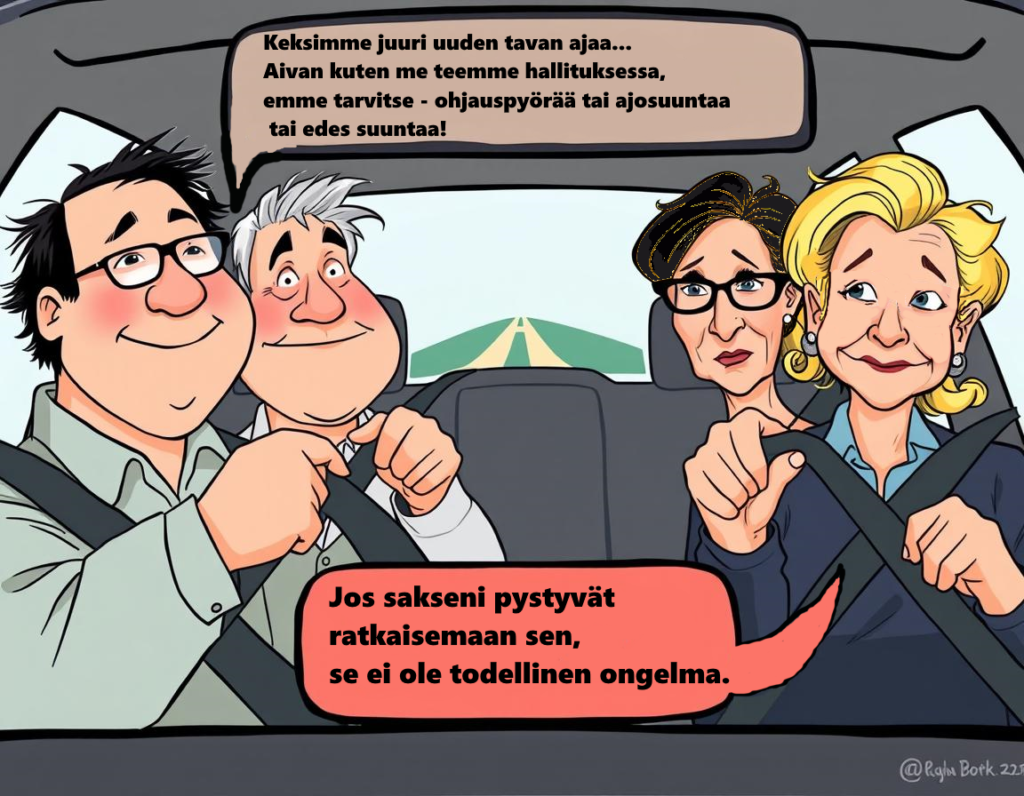
Ai generated image by the author. “We just invented a new way to drive…Just like we do in government, we don’t need a steering wheel, driving direction, or even direction. If y scissors can find a solution, it should not be seen as a real problem.”
If immigrants and their contribution to society, the economy, and professional labor are the issues, one should think if the ones that are accepted or needed would not accept a better offer, with lighter workloads and better pay elsewhere, from very close nations that for them people are valued, nations that have become favored for among others like Finnish professionals to move and work in.
Two-headed car from the famous Uuno Turhapuro movie, ”Uuno Espanjassa”
From ‘Kaksipäinen auto’ from Uuno Espanjassa that brought laughter and joy to ‘kaksipäinen hallitusohjelma‘ of our ‘Leaders’ which does not in any way bring more than gloom. The peculiar car in many ways portray the contradictions, open but very closed, liberal but very conservative, “Zero tolerance” but very racist and government program to combat racism but the program they came up with!
The government’s celebration of their way out of many racist scandals ‘Me Puhumme Teoin’ (Action, not only words) campaign reminded me of a saying I heard:
“Not every bump in a belly is a ‘blessed’ baby, more often than not, it’s just gas.“
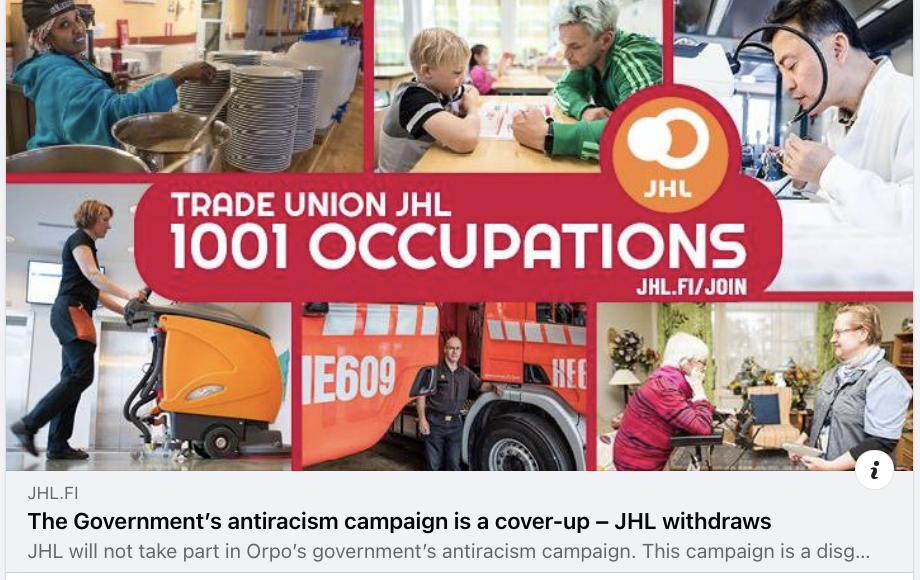
Few will deny in the face of racism scandals in the summer of 2023 that the government’s anti-racism plan is a cover-up, according to the Trade Union for the Public and Welfare Sectors (JHL).
“We thank warmly all experts who have participated in the planning of this [government anti-racism Action Plan] campaign for their good work,” said JHL’s Chief Executive Officer Mari Keturi. “Unfortunately, the government’s actions blatantly conflict with the objectives of the campaign. We speak with action…”
Racism is like a diehard stain. It’s tough work to rub it off society.
With Finland suffering from an economic downturn and rocketing health sector costs, it is beyond me how parties like the National Coalition Party (NCP) don’t see the elephant in the room, the Perussuomalaiset (PS)* party.
The PS loathes migrants, especially Muslims and visible minorities, but have never justified the reasoning behind their hatred. Why does the PS and the government tighten dramatically Finland’s migration policy during an economic downturn.
Thanks to the Ukrainians, Finland received a net sum of 58,000 migrants last year. That is expected to plummet in 2024 to 30,000 and in 2025 to 15,000, according to the ministry of economy.
Swedish People’s Party Education Minister Anders Adlecreutz suggested that Finland should aim to get annually net 40,000 migrants in order to plug the labor shortage.
The suggestion was given the thumbs down by PS parliamentary group leader Jani Mäkelä, who said that it was a bad idea to bring more people from abroad than newborns, which amounted to 43,000 in 2023, according to Statistics Finland.
Historically, during the cold war, Finland has done everything possible to limit the amount of migrants to Finland. In the 1970s, when thousands of Finns were emigrating to Sweden, Finland decided not to take in foreign migrants to compensate for the shortfall.
With parties like the PS in government dictating migrant policy with the support of the National Coalition Party, it’s clear that these parties and Finland are way behind the times. The shortsightedness of their policies has already caused damage to the country.
Finland’s xenophobic message has been based foryears on lies. Instead of lying, why not ratchet up the hostile environment against migrants and minorities? Be honest with yourself. The government is now spearheading these lies to justify their inhumane and counterproductive policies.
Just like in the UK in 2012, Finland is passing laws to make staying in the country as difficult as possible.
Considering Finland suffers from a labor shortage due to its aging population, what is the motive for tightening further migration laws, or as Perussuomalaiset (PS) Interior Minister Mari Rantanen called a paradigm shift?
Another example of the hostile environment was a government announcement in July to prohibit basic health care for undocumented migrants. Source: Yle News
Thank you Ambrosius @ambrowoll for the heads-up!
Pasi Saukkonen, senior researcher at the Urban Research and Statistics unit of the City of Helsinki, said what has been known for a very long time: “Finland has never been a major destination for international migration. The share of the foreign-born population is among the lowest in Europe. Refugee numbers have been low, with more asylum seekers arriving only in the early 1990s and in 2015.”