Migrant tales
Menu
  • #MakeRacismHistory “In Your Eyes”
  • About Migrant Tales
  • It’s all about Human Rights
  • Literary
  • Migrant Tales Media Monitoring
  • NoHateFinland.org
  • Tales from Europe
Menu

Tag: European Union

Financial Times: MEP Jussi Halla-aho racist track record leaves PS out in the cold

Posted on May 28, 2014 by Migrant Tales

Success comes with a high political price especially if you base that success on spreading racism and prejudice. That is exactly the case of the Perussuomalaiset (PS),* who are hoping to join the European Conservatives and Reformists (ECR) in Brussels but have been rejected by them because they see PS MEP Jussi Halla-aho as too racist, according to the Financial Times.

The Financial Times writes in another story that the freshly elected MEP, who was convicted in 2012 for “stirring ethnic tensions,” said “…something about the prophet Muhammad that we dare not repeat on a family blog. The True Finns [PS] also briefly suspended him from the party after he suggested that Greece’s debt problems could only be solved by a military junta [he retracted the comments].”

What is interesting to note is that the same anti-immigration and anti-Islam message spearheaded by Halla-aho and his cronies that was decisive for the PS’ historic victory in the 2011 parliamentary elections, is turning into its political epitaph to ever becoming a credible and mainstream political party.

The 12.9% showing of the PS on Sunday is still a long way off from the 19.1% it won in 2011. The PS’ showing in the presidential (9.4%) and municipal elections (12.3%) were equally disappointing.

If the same trend continues, it means that the PS will face a big upset in next year’s parliamentary elections.

Näyttökuva 2014-5-28 kello 22.34.38

Read full story here.

Knocking at the ECR’s door is another close ally of the PS, the far-right Danish People’s Party (DPP), which won the euro elections in its country by doubling the number of MEPs to 4 from 2009.

According to the Financial Times, both the PS and DPP both have MEPs that were convicted for ethnic agitation and therefore carry a lot of political baggage.

I find it very difficult to believe that [David] Cameron’s Conservatives, with whom we work closely to promote innovative, open and competitive societies, would team up with the True Finns whose rise is to large extent based on xenophobia and backward-looking 1980s nostalgia, writes the Financial Times, quoting one senior Finnish official.

While it’s clear that the PS is eyeing next year’s parliamentary elections and therefore is keen on joining the ECR group in order to get greater respectability, the big question is where they’ll end up in Brussels.

Moreover, even if the PS wishes to make its anti-EU, anti-immigration, homophobic and especially anti-Islam stand mainstream, it’s another question if Europe’s mainstream parties will permit them to join their club.

PS leader Timo Soini says that joining Marine Le Pen’s is out of the question even if the National Front leader has courted the PS to join the European Alliance for Freedom, a new hard-right group spearheaded by the French politician.

That leaves the PS with Nigel Farage’s UKIP and the Europe Freedom and Democracy group (EFD), where members like the Lega Nord of Italy, which praised Anders Breivik for murdering 77 innocent victims on 22/7, are defecting.

Will Farage and Le Penn join forces? Will the PS be part of that new political group?

Time will tell.

Even if anti-EU and anti-immigration groups made gains in countries like France and the United Kingdom, 70% of the European parliament’s 751 MEPs belong to pro-EU groups in the center-left and center-right.

* The Finnish name for the Finns Party is the Perussuomalaiset (PS). The names adopted by the PS promote nativist nationalism and xenophobia. We therefore prefer to use the Finnish name of the party on our postings. 
Disingenuous Finnish PS MEP-elect Jussi Halla-aho fears image would suffer with parties like far-right National Front

Posted on May 27, 2014 by Migrant Tales

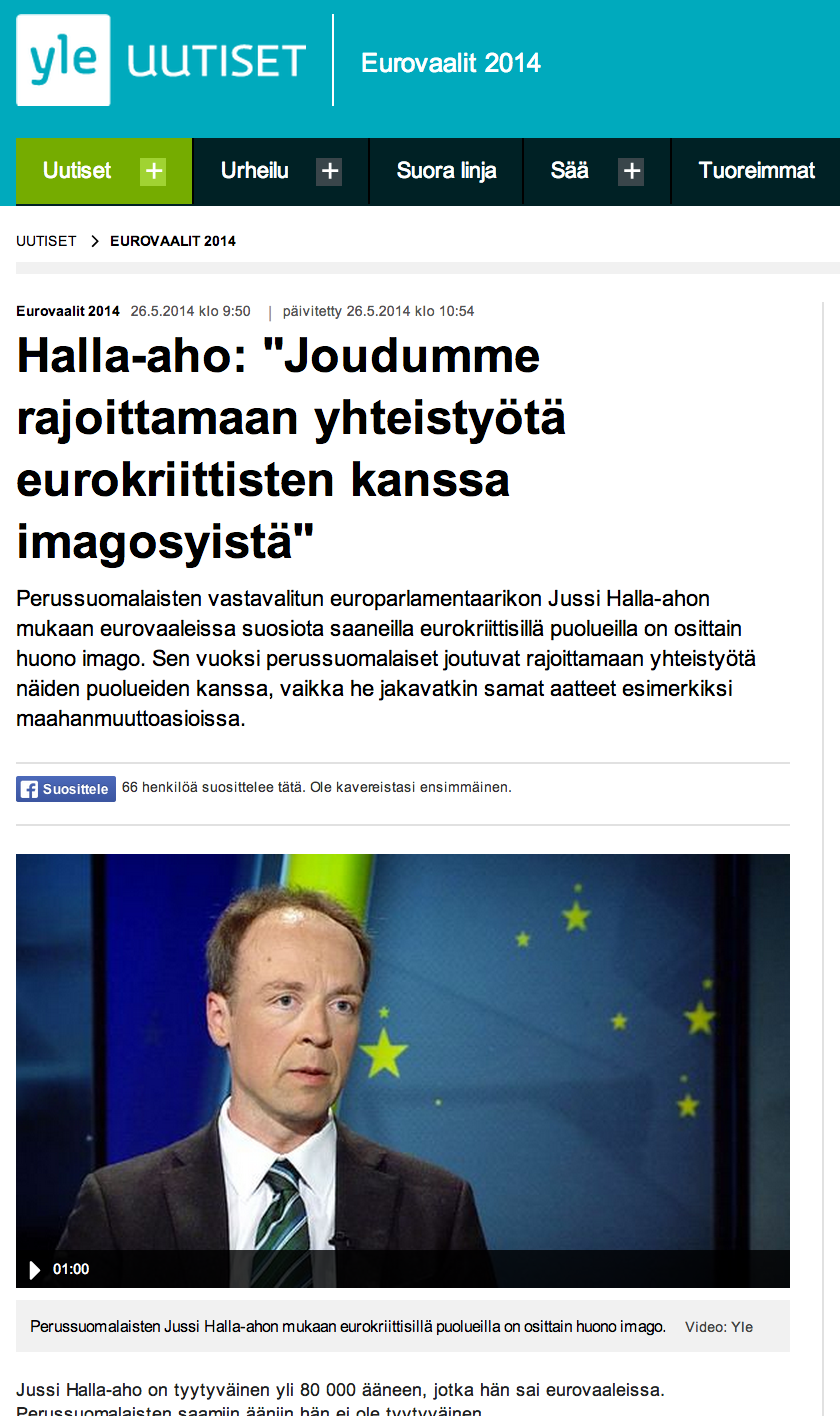
In an interview on YLE, Perussuomalaiset (PS) newly elected MEP Jussi Halla-aho said that it was doubtful that the anti-immigration party would form part of a parliamentary group with far-right parties like the National Front of France “because the party’s image would suffer.”

What a disingenuous statement by a politician who has based his career together with the PS on spreading racism and hatred of Muslims and migrants. Moreover, hasn’t he considered that the only group where the PS will be accepted is the present one, or the Europe for Freedom and Democracy?

If put in the right context, Halla-aho is saying that the PS’ image would suffer ever-greater damage if it grouped with parties like the National Front.

The French xenophobic party’s leader, Marine Le Pen, has said that she would like the PS to form part of her new group in the European parliament.

Näyttökuva 2014-5-27 kello 7.07.39

Read full story here.


Without naming the National Front or Geert Wilders’ Party for Freedom, Halla-aho said that far-right anti-immigration parties in Europe were in the same ideological ballpark as the PS.

In the face of Halla-aho’s comments, what then is the difference between the Lega Nord of Italy, which praised Anders Breivik after he murdered 77 victims on 22/7, and parties like the National Front?

The PS can blame itself and its actions for its right-wing populist, far-right and nationalistic anti-immigration, homophobic and especially anti-Islam image.

The PS forms part to the same European parliament group as the Lega Nord, Danish People’s Party, UKIP and others in the Europe of Freedom and Democracy group.


Pew Research Center survey: Anti-immigration and anti-minority sentiment runs high before Euro elections

Posted on May 17, 2014 by Migrant Tales

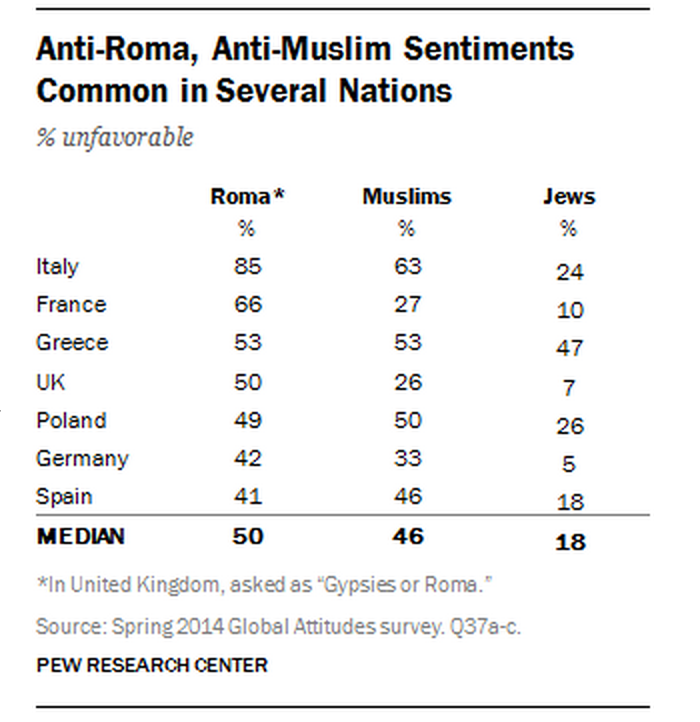
Pew Research Center, a Washington-based “fact tank,” reveals in a survey just before the European parliamentary elections on May 22-25 that anti-immigration and anti-minority sentiment runs  in countries like Poland, Germany, France, UK, Spain, Italy and Greece.

Euro MEP candidates like Jussi Halla-aho and Juho Eerola of the PS have used anti-immigration sentiment to attract voters. Halla-aho’s visit in February to Lieksa in eastern Finland is a good example of how he promotes anti-immigration sentiment by demonizing Muslims.

Some parties with strong anti-immigration campaigns include Britain’s UKIP, a close ideological ally of the Perussuomalaiset (PS) of Finland, France’s National Front, Greece’s neo-Nazi Golden Dawn.

Näyttökuva 2014-5-17 kello 0.36.00

The Pew Research Center survey revealed that an average of 55% of respondents in the seven EU countries said they want fewer migrants. The strongest anti-immigration sentiment was found in Greece (86%) followed by Italy (80%).

If views of migrants was negative, so were attitudes of minorities like the Roma, Muslims and to a lesser extent Jews.

The survey revealed that the Roma are viewed as the most unfavorable (50%) minority with the Muslims (46%) trailing closely behind. While attitude towards Jews weren’t as negative as those towards the Roma and Muslims, they were especially high in Greece (47%), Poland (26%) and Italy (24%).

Still confused about how racist parties like the UKIP are? Check out this video clip below where the head of the UKIP, Nigel Farage, answers some hard questions in the same way that PS chairman Timo Soini did when he was interviewed on BBC’s Hard Talk in 2013.

UKIP’s Farage political views are very similar to Soini’s. Listening to the interview by LBC’s James O’Brien of Farage shows close similarities of how Soini speaks to the Finnish media. 


The Ukraine-Russia crisis can spark ethnic hatred across Europe

Posted on March 7, 2014 by Migrant Tales

The crisis and standoff between the Ukraine and Russia is worrying for many reasons. One of these, which isn’t being covered enough by the European media, is how the crisis is fueling xenophobia and age-old diehard ethnic hatred. 

There has been, however, a lot of coverage of the ethnic crisis between the Ukrainians and Russians.

Kuvankaappaus 2014-3-7 kello 23.30.24

The 2009 EU-MIDIS’r survey on European Union minorities and discrimination shows that intolerance is a big issue in the region.  Why do these problems still exist in Europe? Read full report here.

In Finland, where anti-Russian sentiment has always been strong, two MPs warned this week that the crisis in the Ukraine could fuel anti-Russian sentiment and target individual Russians in the country. While Finland is one case, what could happen in countries like Estonia, Latvia and Lithuania, where there live large Russian-speaking minorites?

If the crisis in the Ukraine escalates, it’s pretty certain it will not only have a negative knock-on effect on ethnic Russians in other countries, but on migrants and visible minorities as well.

Apart from the rise of neo-Nazi groups and anti-Semitism, there is concern that 150,000 ethnic Hungarians living in the Ukraine could be targeted by far-right nationalistic groups, according to AFP.

Extremist and right-wing populist parties, which can take the far-right path in the snap of a finger, could use the present crisis to boost their anti-immigration and anti-minority message as European MEP elections near on May 25.

In Finland, however, the crisis in the Ukraine has hit the anti-EU and anti-immigration Perussuomalaiset (PS) party. In a recent poll, support for the populist party fell below 17%, according to YLE in English. The last time support for the party dipped below 17% was in 2012.

Some analysts believe that the crisis in the Ukraine may have scared some of PS’ supporters due to its anti-EU stance. Possibly being a part of the EU is not such a bad idea after all when it comes to Finland’s national security.

Meanwhile, it’s clear that a country that passes anti-gay laws like Russia isn’t very credible when it criticizes human rights violations in the European Union.

In an official annual human rights report on Europe, Russia highlighted the problems that were taking place in Finland. It cited, among other violations, that Finland hadn’t ratified Convention No. 169, which deals specifically with the rights of indigenous and tribal peoples, and discrimination against the Romany minority, Somalis and Russians.

While all the above should concern us, the question is why is Europe such a tinderbox when it comes to ethnicity? Wasn’t anti-Semitism, ethnic hatred and hocuspocus ethnic myths laid to rest after the fall of Nazi Germany in 1945?

Apparently not.

Statement: EU elections 2014: the way towards more equality in Europe, 7 demands from ENAR

Posted on March 7, 2014 by Migrant Tales

The next European Parliament to be elected in May 2014 has a crucial role to play when it comes to reducing the entrenched inequalities faced by its citizens and residents. Among these are ethnic minorities and migrants who often face discrimination on multiple grounds: ethnic origin, nationality, social status, income, gender or age. The European Network Against Racism (ENAR) therefore puts forward 7 key demands for more equality in Europe to upcoming Members of the European Parliament. Leading Members of the European Parliament have already endorsed our demands because they are convinced that they will lead to a better and more equal Europe and are also sound, concrete and achievable.

Kuvankaappaus 2014-3-7 kello 19.25.59
Read full statement here.

Starting with the basics, we ask parties to open up their lists and decision making structures to ethnic minorities and migrants. Fighting toxic and xenophobic political discourses and policies as well as structural discrimination starts at home. Political decision makers need to be exemplary to generate constructive emulation within broader society. We need a more diverse European Parliament. As a minimum, the next European Parliament and its political groups should hire professionals from minority communities..

“If you are not counted, you don’t count”: combating discrimination begins with knowing the extent of it. Today, we only have comparable and reliable Europe-wide equality data on the grounds of sex and age. We need more. There are 6 grounds of discrimination covered by the EU treaties and 17 by the Charter of Fundamental Rights – there is thus much room for improvement in collecting and analysing data about discrimination in Europe. Ethnic and religious groups want to count and to use data to ask governments to be accountable for their actions. These 60 million Europeans deserve justice.

Racist violence has multiple effects on individual victims, but also on their families and communities. They are not targeted randomly by perpetrators, but because of who they are. The European Parliament has a crucial role to play in bringing the European Commission and Member States to support victims in seeking redress and avoiding re-victimisation. Equality at work is not just a matter of preventing discrimination from happening. It is also about ensuring the workplace caters for the needs of an increasingly diverse workforce. Accommodating diversity at work will result in developing workers’ potential, employee retention, a safe working environment and a better work-life balance. The adoption of the European framework for national Roma integration strategies demonstrated the EU’s political will to fight discrimination against its largest ethnic minority. Black Europeans, People of African Descent, Muslims and Jews need to benefit from similar strategies which will ensure their social inclusion and protection from discrimination, and therefore contribute to the overall reduction of poverty and exclusion in Europe.

Finally, we call for the continuation of the current Anti-Racism and Diversity Intergroup in the European Parliament. This will ensure MEPs committed to equality have a platform to voice and tackle challenges relating to inequality and discrimination.

Our 7 demands can contribute to a leap forward towards equality in Europe. Time for commitment has come. The future of a diverse and resilient Europe is at stake: we encourage parties and individual candidates to endorse them and mainstream them in their own programmes ahead – and after – the elections.

Workshop highlights perceptions, problems and challenges of immigration in Greece

Posted on March 4, 2014 by Migrant Tales

Workshops that debate and challenge immigration issues in economically hard-hit countries like Greece are never too many. One of these took place on Friday at the University of Peloponnese and was organized by the Scientific Association of Young Political Scientists.

Kuvankaappaus 2014-3-4 kello 1.33.31

According to a statement:

The issue of immigration has become a major national issue and is treated as such by Greek immigration policy. Due to its geographical position, Greece has become the most accessible initial stopover – otherwise known as the “gateway to the European Union” – for international immigration and refugees flows, whose final destination is West or North European countries; and due to the magnitude of the problem, it is regarded as not a Greek, but a European one which demands a European solution.

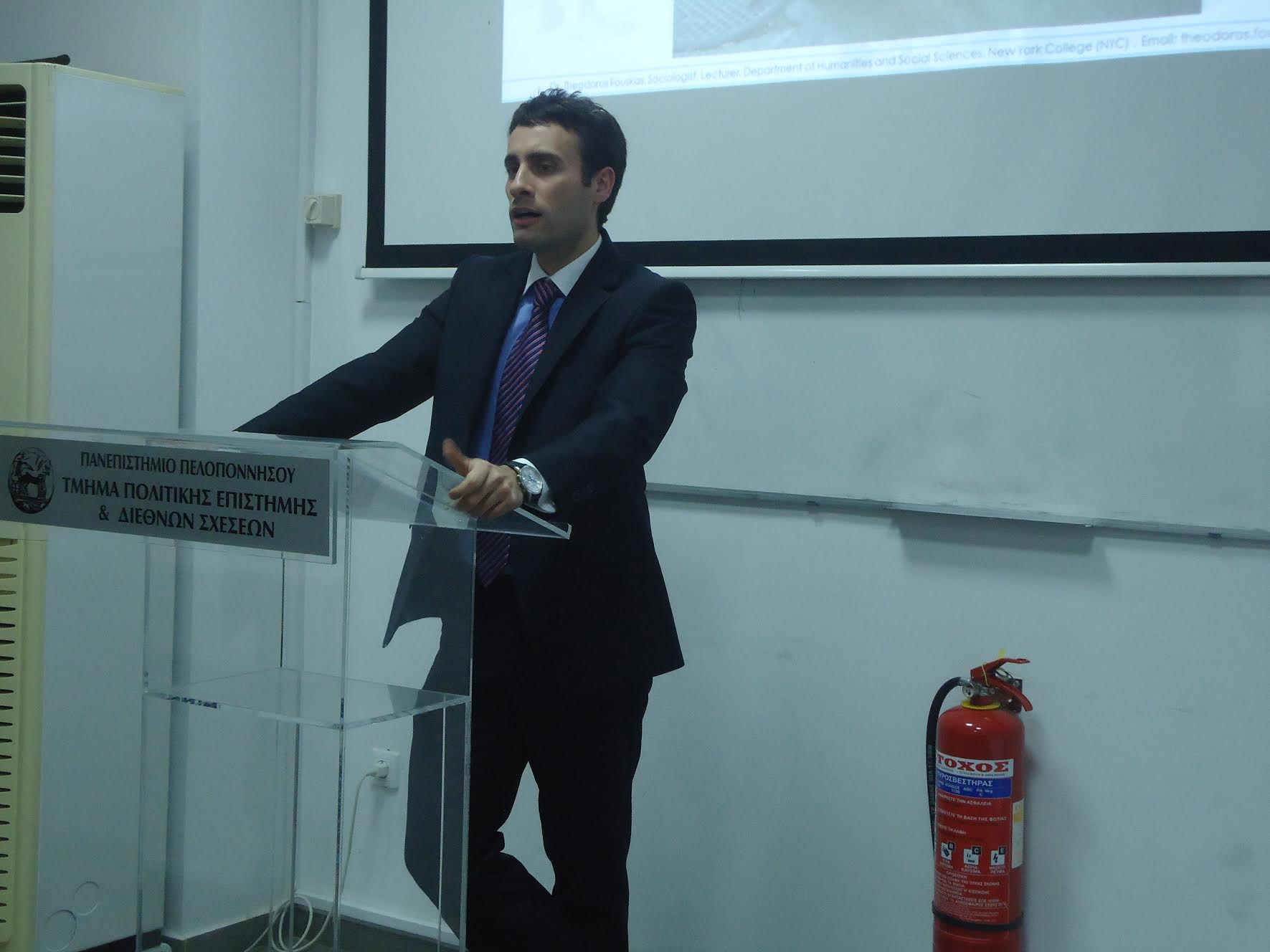
One of the biggest challenges of immigration management is that it is now one of the top priorities for both Greece and the EU, according to Dr. Theodoros Fouskas, who was responsible for the workshop’s scientific organization. He is a sociologist and lecturer of the Department of Humanities and Social Sciences, New York College (NYC).

Greece. “Since Greece deals with 90% of illegal immigration flows to the EU, European aid, assistance and solidarity are imperative,” he said. “But after twenty-five years of huge illegal migration flows, what should be taken into account are the international ramifications that the migratory phenomenon has caused in the 21st century.”

Dr. Fouskas focused his talk on the impact of international labor migration, especially low-status work by Nigerian migrants,* who are the object of his latest research. Low-wage Nigerian migrants in Greece are mainly employed in the service industry, which include manual labor jobs, farming, construction, crafts, housework, cleaning services, prostitution and others.

“What is currently observed is a mobile, temporary workforce, which is occupied in casual, non-permanent, low-prestige jobs,” he said. “[Nigerian] immigrants of both genders are exposed to all forms of exploitation, to flexible working ours and unsettled, low-level and unstable lifestyle.”

greeceworkshop

Dr Theodoros Fouskas speaking at the workshop on perceptions, problems and challenges of immigration in Greece.

According to Dr Fouskas, the life of low-wage immigrants in Greece is more than challenging under the present circumstances.

“They are disconnected, detached from the past, with no memory of collectivization or personal efforts and claims,” he said. “Nigerian immigrants’ work is characterized by exhausting working hours, exceptionally low wages, appalling working conditions, non-permanent employment with frequent employer changes, no National Health benefits, unstable residence status, fear of arrest and deportation…”

Other speakers that took part in the workshop were Pantelis Sklias, Symeon Sidiropoulos, George Hilal, Panagiota Theodosi, Konstantinos Kazanas and Jamil M. Sayed.

* Fouskas, Theodoros (201-) Nigerian Immigrants in Greece: Low-Status Work, Community, and Decollectivization, Research Monograph under contract, and Fouskas, Theodoros (2014) “‘Community’ found or lost in the city? The consequences of low-status work on association participation of Nigerian immigrant workers in Athens”, in: Fouskas, Theodoros and Vassileios, Tsevrenis (2014) (Eds.), Contemporary Immigration in Greece: A Sourcebook. Athens: European Public Law Organization (EPLO) (forthcoming 2014). Foudkas, Theodoros (2013) “Los-Status Work Consequences on Immigrant Workers’ Organization”, International Review of Sociology, Volume 23, Issue 3, 2013 pp. 671-698.

Yes Swiss vote against “mass migration” will impact MEP elections in May

Posted on February 11, 2014 by Migrant Tales

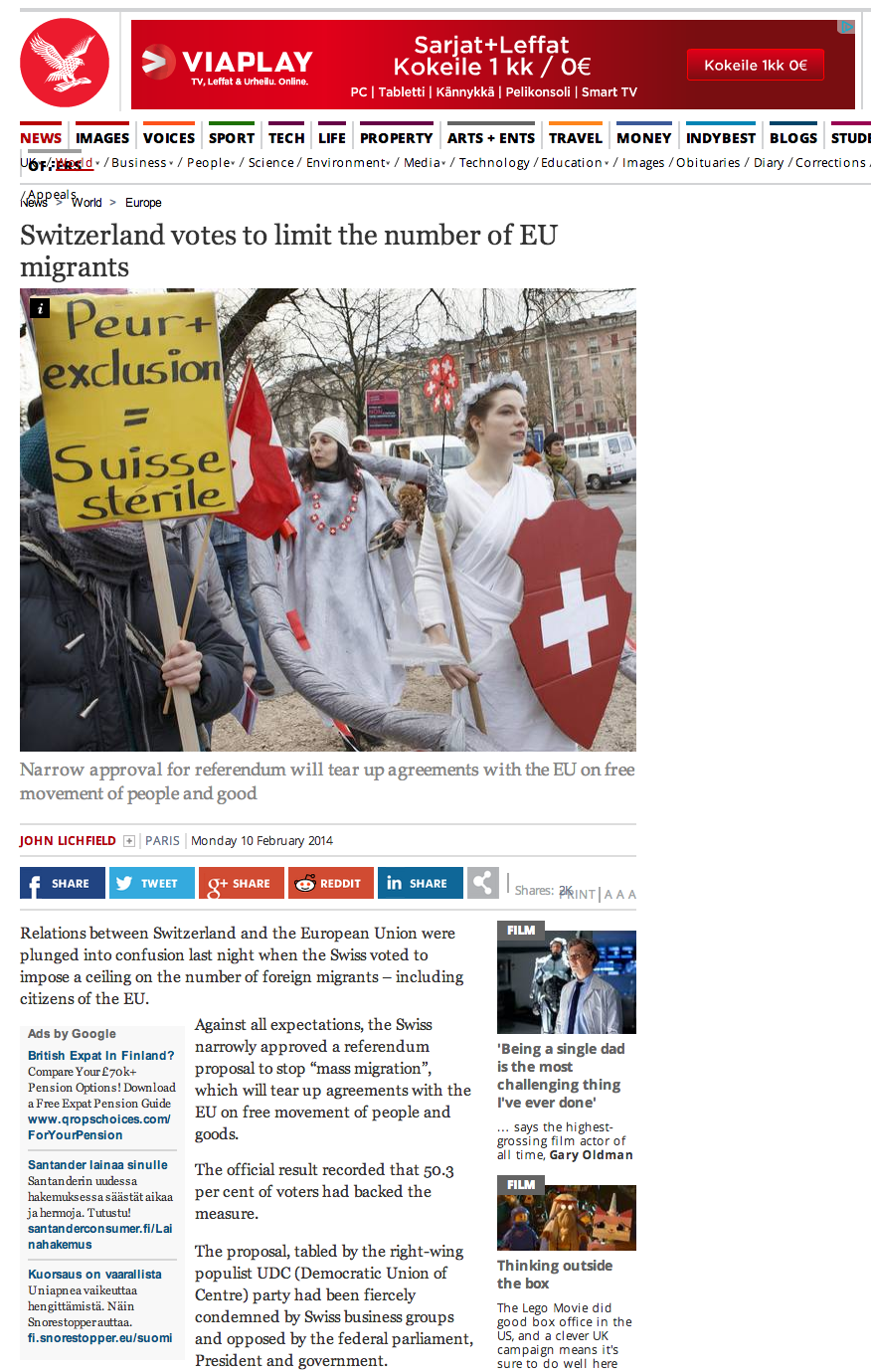
Switzerland voted on Sunday to narrowly approve a referendum proposal to stop “mass migration,” reports The Independent. The immediate impact of the referendum, which the “yes” camp won with a slim 50.3% majority, will mean an end to the free movement of people and goods between Switzerland and the EU.

Apart from having an immediate economic impact on Switzerland, the really bad news is that the referendum may boost anti-immigration sentiment, which is one of the campaign issues of right-wing populist and far-right political parties throughout Europe, in the May 25 MEP elections.  Kuvankaappaus 2014-2-11 kello 0.45.51

Read full story here.

In Finland, the anti-EU, anti-immigration and especially anti-Islam Perussuomalaiset (PS) must be jumping for joy about the Swiss referendum outcome since they see the vote as a boost to their negative stand on cultural diversity.

One of the most incredible claims of the Swiss right-wing populist Democratic Union of Center (UDC) during the campaign to stop “mass migration” was that housing, health, education and transport services would collapse under the pressure from the “foreign invasion.”

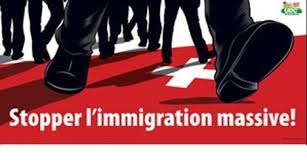
There are a lot of loaded words that are common in the anti-immigration vocabulary like “invasion” and “mass immigration” that were effectively used by the UDC. The “yes” campaign posters even showed black legs walking purposefully over a Swiss flag.

lataus (3)

A poster of the “yes” camp against so-called “mass migration.” Source: www.thelocal.ch

The most recent referendum in Switzerland is part of a worrying trend that is gripping Europe. While some may claim it has to do with the recession, the real reason behind the undercurrent of intolerance throughout the region is our own doing since because a part of our education teaches us national and ethnic superiority over other groups.

If we aren’t careful, we will fall victim to the horrors we saw in Nazi Germany from 1933 and in the former Yugoslavia in the 1990s to name a few conflicts that have gripped Europe.

Higher unemployment and economic woes spell big trouble for migrants and visible minorities

Posted on January 23, 2014 by Migrant Tales

Finland got shocking news Thursday when postal company Itella announced that it may shed up to 1,200 jobs, according to Yle in English. Taking into account that unemployment shot up in 2013 to 7.9% from 6.9% in the previous year, what do these two news stories mean for the migrant and visible minority community?

Those who lived through the early 1990s in Finland, when this country suffered its worst economic downturn in a century and when unemployment soared to around 18%, it’s nothing unusual that migrants were hit especially hard back then.

Since migrant unemployment is normally two to three times higher than the national average in Finland, that means the jobless rate for migrants at that time was 53% in 1994!

Kuvankaappaus 2014-1-23 kello 21.08.33

Read full story here.

While unemployment in Finland is still lower today than that 10.5% average for the European Union, migrants and visible minorities have a lot to worry about since the recession will be especially harsh with them during two consecutive election years.

Just like about twenty years ago, the dire economic situation will offer self-declared and closet racists the opportunity to layoff migrants or to make their life miserable at work. How? By letting them know that the shadow of unemployment hangs constantly over them.

Contrary to the early 1990s, when Finland didn’t have a large anti-immigration party like the Perussuomalaiset today, migrants and visible minorities will be scapegoated and victimized relentlessly by greedy and opportunistic politicians.

With the Euro MP elections in May and the parliamentary elections in April 2015, the going for migrants and visible minorities in Finland and Europe is going to get tougher.

The situation resembles a sinking ship where most of the passengers will be sacrificed to the chilling waters because there are too few lifeboats for everyone.

What will make matters worse is the dog-eat-dog climate that will discourage solidarity.


Migrants’ Rights Network: Another tragedy in Lampedusa, one too many

Posted on October 10, 2013 by Migrant Tales

Clara Dublanc*

clara_web_0


The migrant boat disaster off Lampedusa has highlighted the struggle of Southern EU members to deal with migrant flows. It is time that Europe steps up and accepts shared responsibilities for the external borders of the Union.

Last Thursday 3rd October, the small Italian island of Lampedusa witnessed one of its most tragic days. A vessel, carrying an approximate number of 500 Eritrean, Somalian and Ghanian migrants sank after catching fire, leaving hundreds of deaths.

At the moment of writing the number rises to 110 dead and 159 survivors, leaving approximately 200 dispersed. Divers have started searching underwater trying to recover the rest of the corpses. Lampedusa, which is 70 kilometers away from the the Libyan shores, is one of the main ports of entry for thousands of migrants traveling from the  African continent.

As the tragedy unfolds, we hear Italian politicians from all parties giving their opinions, condolences and speeches. Italy has declared a day of mourning and Italian’s president Giorgio Napolitano has called for the EU to accept that this is an European tragedy and not only an Italian one. Voices have raised about putting a stop to the continued tragedies that see much too often hundreds of victims dying in their traverse from North African to European shores.

Some of the proposals have been to provide more founding for Frontex to cooperate with Lybia in the implementation of more efficient immigration checks in Libya, stopping the migration flow before they embark on the sea travel. Under the Dublin Regulation, the responsibility of migrants falls under the single member state where the migrant arrives. Italy argues that given the extent of its shores, this needs to be considered as a European responsibility and not only national one.

Some of Italian left wing politicians have raised their voices to condemn the last immigration reform, that passed under the last Berlusconi government. The Bossi-Fini law, which takes the the names of the two ministers from the last Berlusconi alliance government that drafted it, provides greater powers to the Italian Navy to block the entry to Italian waters to migrants boats crossing the Mediterranean when they are still in international waters.

Furthermore, the law was successively modified to include a a criminality clause to anyone who aids clandestine migrants to enter the country. This applies also to fishermen and commercial boats that lend a hand to migrants vessels in need of help. This clause has been challenged several times on human rights basis. In 2007,  four Tunisian fishermen that aided a sinking ship with 44 survivors and brought them to Italian shores, were accused of aiding illegal migration.

Although they were absolved, the process lasted 4 years. Since then, fishermen have been afraid of helping sinking boats under the threat of being criminally accused. Actually, it seems that on Thursday there were some fishermen that saw the vessel on fire but were too afraid to help.

According to Fortress Europe, since 2011 there are approximately 6 migrants that die everyday in the crossing of the Mediterranean.

It is time that the Italian immigration law undergoes an urgent review to abolish clauses that push single individuals to violate human rights. Furthermore, it is time that Europe accepts shared responsibilities on the external borders of the Union.

Read original story here.

This piece was reprinted by Migrant Tales with permission.

* Clara Dublanc is a postgraduate in International Relations from the University of Bologna, with an academic background in migration policies, integration and belonging. She currently works as business developer, launching start-ups and enterprises to support local development.


Migrant Tales Literary with Le monde n’est pas: Around Europe by Miguel Velayos

Posted on April 1, 2013 by Migrant Tales

Comment: I came across this neat website on Twitter called Le monde n’est pas rond  (The world is not round). The website describes itself as “an international artistic newspaper, based in Luxembourg, that explores the contemporary realities of migration, borders, and human rights through the publication of articles, art and illustration, photography, prose and poetry.”

Why not pay it a visit.

See original link here.
  • Previous
  • 1
  • 2
  • 3
  • 4
  • 5
  • 6
  • Next
Read more about documentary film
Read more

Recent Posts

  • Finland’s tabloids Iltalehti and Ilta-Sanomat are the pits
  • Riikka Purra’s Dr Jekyll and Mr Hyde mask
  • Double standards
  • Perussuomalaiset: Uusi logo, sama vanha juttu
  • Taco Trump

Recent Comments

  1. Absolutely Socking: Racist Finnish Facebook group against human rights gets flooded with socks on Musta Barbaari’s mother and sister charged by the police in “ethnic profiling” case
  2. Ilkka Nuotio on Pekka Myrskylä: “Tilastot kertovat toista kuin poliittinen keskustelu”
  3. Genrih Soinkara on The war in Ukraine and the Russian-Finnish border crisis are showing Finland’s ugly side
  4. Ahti Tolvanen on Comment by Ahti Tolvanen on the Helsinki +50 conference
  5. Angel Barrientos on Angel Barrientos is one of the kind beacons of Finland’s Chilean community

Archives

  • June 2026
  • May 2026
  • April 2026
  • March 2026
  • February 2026
  • January 2026
  • December 2025
  • November 2025
  • October 2025
  • September 2025
  • August 2025
  • July 2025
  • June 2025
  • May 2025
  • April 2025
  • March 2025
  • February 2025
  • January 2025
  • December 2024
  • November 2024
  • October 2024
  • September 2024
  • August 2024
  • July 2024
  • June 2024
  • May 2024
  • April 2024
  • March 2024
  • February 2024
  • January 2024
  • December 2023
  • November 2023
  • October 2023
  • September 2023
  • August 2023
  • July 2023
  • June 2023
  • May 2023
  • April 2023
  • March 2023
  • February 2023
  • January 2023
  • December 2022
  • November 2022
  • October 2022
  • September 2022
  • August 2022
  • July 2022
  • June 2022
  • May 2022
  • April 2022
  • March 2022
  • February 2022
  • January 2022
  • December 2021
  • November 2021
  • October 2021
  • September 2021
  • August 2021
  • July 2021
  • June 2021
  • May 2021
  • April 2021
  • March 2021
  • February 2021
  • January 2021
  • December 2020
  • November 2020
  • October 2020
  • September 2020
  • August 2020
  • July 2020
  • June 2020
  • May 2020
  • April 2020
  • March 2020
  • February 2020
  • January 2020
  • December 2019
  • November 2019
  • October 2019
  • September 2019
  • August 2019
  • July 2019
  • June 2019
  • May 2019
  • April 2019
  • March 2019
  • February 2019
  • January 2019
  • December 2018
  • November 2018
  • October 2018
  • September 2018
  • August 2018
  • July 2018
  • June 2018
  • May 2018
  • April 2018
  • March 2018
  • February 2018
  • January 2018
  • December 2017
  • November 2017
  • October 2017
  • September 2017
  • August 2017
  • July 2017
  • June 2017
  • May 2017
  • April 2017
  • March 2017
  • February 2017
  • January 2017
  • December 2016
  • November 2016
  • October 2016
  • September 2016
  • August 2016
  • July 2016
  • June 2016
  • May 2016
  • April 2016
  • March 2016
  • February 2016
  • January 2016
  • December 2015
  • November 2015
  • October 2015
  • September 2015
  • August 2015
  • July 2015
  • June 2015
  • May 2015
  • April 2015
  • March 2015
  • February 2015
  • January 2015
  • December 2014
  • November 2014
  • October 2014
  • September 2014
  • August 2014
  • July 2014
  • June 2014
  • May 2014
  • April 2014
  • March 2014
  • February 2014
  • January 2014
  • December 2013
  • November 2013
  • October 2013
  • September 2013
  • August 2013
  • July 2013
  • June 2013
  • May 2013
  • April 2013
  • March 2013
  • February 2013
  • January 2013
  • December 2012
  • November 2012
  • October 2012
  • September 2012
  • August 2012
  • July 2012
  • June 2012
  • May 2012
  • April 2012
  • March 2012
  • February 2012
  • January 2012
  • December 2011
  • November 2011
  • October 2011
  • September 2011
  • August 2011
  • July 2011
  • June 2011
  • May 2011
  • April 2011
  • March 2011
  • February 2011
  • January 2011
  • December 2010
  • November 2010
  • October 2010
  • September 2010
  • August 2010
  • July 2010
  • June 2010
  • May 2010
  • April 2010
  • March 2010
  • February 2010
  • January 2010
  • December 2009
  • November 2009
  • October 2009
  • September 2009
  • August 2009
  • July 2009
  • December 2008
  • November 2008
  • October 2008
  • September 2008
  • August 2008
  • July 2008
  • June 2008
  • May 2008
  • April 2008
  • March 2008
  • February 2008
  • January 2008
  • November 2007
  • October 2007
  • September 2007
  • August 2007
  • July 2007
  • June 2007
  • May 2007

Categories

  • ?? Gia L?c
  • ????? ?????? ????? ???????? ?? ??????
  • ???????
  • @HerraAhmed
  • @mondepasrond
  • @nohatefinland
  • @oula_silver
  • @Varathas
  • A Pakistani family
  • äärioikeisto
  • Abbas Bahmanpour
  • Abdi Muhis
  • Abdirahim Hussein Mohamed
  • Abdirahim Husu Hussein
  • Abdirisak Mahamed
  • About Migrant Tales
  • activism
  • Adam Al-Sawad
  • Adel Abidin
  • Afrofinland
  • Ahmed IJ
  • Ahti Tolvanen
  • Aino Pennanen
  • Aisha Maniar
  • Alan Ali
  • Alan Anstead
  • Alejandro Díaz Ortiz
  • Alekey Bulavsev
  • Aleksander Hemon
  • Aleksanterinliitto
  • Aleksanterinliitto ry
  • Aleksanterinliitto ry:n hallitus
  • Alex Alex
  • Alex Mckie
  • Alexander Nix
  • Alexandra Ayse Albayrak
  • Alexis Neuberg
  • Ali Asaad Hasan Alzuhairi
  • Ali Hossein Mir Ali
  • Ali Rashid
  • Ali Sagal Abdikarim
  • Alina Tsui
  • Aline Müller
  • All categories
  • Aman Heidari
  • Amiirah Salleh-Hoddin & Jana Turk
  • Amin A. Alem
  • Amir Zuhairi
  • Amkelwa Mbekeni
  • Ana María Gutiérrez Sorainen
  • Anachoma
  • Anders Adlecreutz
  • Angeliina Koskinen
  • Anna De Mutiis
  • Anna María Gutiérrez Sorainen
  • Anna-Kaisa Kuusisto ja Jaakko Tuominen
  • Annastiina Kallius
  • Anneli Juise Friman Lindeman
  • Announcement
  • Anonymous
  • Antero Leitzinger
  • anti-black racism
  • Anti-Hate Crime Organisation Finland
  • Anudari Boldbaatar
  • Arshiya Nasser
  • Aspergers Syndrome
  • Asylum Corner
  • Asylum seeker 406
  • Athena Griffin and Joe Feagin
  • Autism
  • Avaaz.org
  • Awale Olad
  • Ayan Said Mohamed
  • AYY
  • Barachiel
  • Bashy Quraishy
  • Beatrice Kabutakapua
  • Beri Jamal
  • Beri Jamal and Enrique Tessieri
  • Bertolt Brecht
  • Boiata
  • Boodi Kabbani
  • Bruno Gronow
  • Carmen Pekkarinen
  • Çelen Oben and Sheila Riikonen
  • Chiara Costa-Virtanen
  • Chiara Costa-Virtanen
  • Chiara Sorbello
  • Christian Thibault
  • Christopher Wylie
  • Clara Dublanc
  • Dana
  • Daniel Malpica
  • Danilo Canguçu
  • David Papineau
  • David Schneider
  • Dexter He
  • Don Flynn
  • Dr Masoud Kamali
  • Dr. Faith Mkwesha
  • Dr. Theodoros Fouskas
  • Edna Chun
  • Eeva Kilpi
  • Emanuela Susheela
  • En castellano
  • ENAR
  • Enrique
  • Enrique Tessieri
  • Enrique Tessieri & Raghad Mchawh
  • Enrique Tessieri & Yahya Rouissi
  • Enrique Tessieri and Muhammed Shire
  • Enrique Tessieri and Sira Moksi
  • Enrique Tessieri and Tom Vandenbosch
  • Enrique Tessieri and Wael Che
  • Enrique Tessieri and Yahya Rouissi
  • Enrique Tessieri and Zimema Mhone
  • Epäluottamusmies
  • EU
  • Europe
  • European Islamophobia Report
  • European Islamophobia Report 2019,
  • European Union
  • Eve Kyntäjä
  • Ezequiel Caldeiro
  • Facebook
  • Fadumo Dayib
  • Faisa Kahiye
  • Farhad Manjoo
  • Fasismi
  • Finland
  • Fizza Qureshi
  • Flyktingar och asyl
  • Foreign Student
  • Fozia Mir-Ali
  • Frances Webber
  • Frida Selim
  • Gareth Rice
  • Ghyslain Vedeaux
  • Global Art Point
  • Great Replacement
  • Habiba Ali
  • Hami Bahadori
  • Hami Bahdori
  • Hamid
  • Hamid Alsaameere
  • Hamid Bahdori
  • Handshake
  • Harmit Athwal
  • Hassan Abdi Ali
  • Hassan Muhumud
  • Heikki Huttunen
  • Heikki Wilenius
  • Helsingin Sanomat
  • Henning van der Hoeven
  • Henrika Mälmsröm
  • Hser Hser
  • Hser Hser ja Mustafa Isman
  • Husein Muhammed
  • Hussain Kazemian
  • Hussain Kazmenian
  • Ibrahim Khan
  • Ida
  • Ignacio Pérez Pérez
  • Iise Ali Hassan
  • Ilari Kaila & Tuomas Kaila
  • Imam Ka
  • inside-an-airport
  • Institute of Race Relations
  • Iraqi asylum seeker
  • IRR European News Team
  • IRR News Team
  • Islamic Society of Norhern FInland
  • Islamic Society of Northern Finland
  • Islamophobia
  • Jacobinmag.com
  • Jallow Momodou
  • Jan Holmberg
  • Jane Elliott
  • Jani Mäkelä
  • Jari Luoto
  • Jari Taponen
  • Jegor Nazarov
  • Jenni Stammeier
  • Jenny Bourne
  • Jessie Daniels
  • Joe Davidow
  • Johannes Koski
  • John D. Foster
  • John Grayson
  • John Marriott
  • Jon Burnett
  • Jorma Härkönen
  • Jos Schuurmans
  • José León Toro Mejías
  • Josue Tumayine
  • Jouni Karnasaari
  • Juan Camilo
  • Jukka Eräkare
  • Julian Abagond
  • Julie Pascoet
  • Jussi Halla-aho
  • Jussi Hallla-aho
  • Jussi Jalonen
  • JusticeDemon
  • Kadar Gelle
  • Kaksoiskansalaisuus
  • Kansainvälinen Mikkeli
  • Kansainvälinen Mikkeli ry
  • Katherine Tonkiss
  • Kati Lepistö
  • Kati van der Hoeven-Lepistö
  • Katie Bell
  • Kättely
  • Kerstin Ögård
  • Keshia Fredua-Mensah & Jamie Schearer
  • Khadidiatou Sylla
  • Khadra Abdirazak Sugulle
  • Kiihotus kansanryhmää vastaan
  • Kirsi Crowley
  • Koko Hubara
  • Kristiina Toivikko
  • Kubra Amini
  • KuRI
  • La Colectiva
  • La incitación al odio
  • Laura Huhtasaari
  • Lauri Finér
  • Leif Hagert
  • Léo Custódio
  • Leo Honka
  • Leontios Christodoulou
  • Lessie Branch
  • Lex Gaudius
  • Leyes de Finlandia
  • Liikkukaa!
  • Linda Hyökki
  • Liz Fekete
  • M. Blanc
  • Maarit Snellman
  • Mahad Sheikh Musse
  • Maija Vilkkumaa
  • Malmin Kebab Pizzeria Port Arthur
  • Marcell Lorincz
  • Mari Aaltola
  • María Paz López
  • Maria Rittis Ikola
  • Maria Tjader
  • Marja-Liisa Tolvanen
  • Mark
  • Markku Heikkinen
  • Marshall Niles
  • Martin Al-Laji
  • Maryan Siyad
  • Matt Carr
  • Mauricio Farah Gebara
  • Media Monitoring Group of Finland
  • Micah J. Christian
  • Michael McEachrane
  • Michele Levoy
  • Michelle Kaila
  • Migrant Tales
  • Migrant Tales Literary
  • Migrantes News
  • Migrants' Rights Network
  • MigriLeaks
  • Mikko Kapanen
  • Miriam Attias and Camila Haavisto
  • Mohamed Adan
  • Mohammad Javid
  • Mohammad M.
  • Monikulttuurisuus
  • Monisha Bhatia and Victoria Canning
  • Mor Ndiaye
  • Muh'ed
  • Muhamed Abdimajed Murshid
  • Muhammed Shire
  • Muhammed Shire and Enrique Tessieri
  • Muhis Azizi
  • Musimenta Dansila
  • Muslimiviha
  • Musulmanes
  • Namir al-Azzawi
  • Natsismi
  • Neurodiversity
  • New Women Connectors
  • Nils Muižnieks
  • No Labels No Walls
  • Noel Dandes
  • Nuor Dawood
  • Omar Khan
  • Otavanmedia
  • Oula Silvennoinen
  • Paco Diop
  • Pakistani family
  • Pentti Stranius
  • Perussuomalaiset
  • perustuslaki
  • Petra Laiti
  • Petri Cederlöf
  • Pia Grochowski
  • Podcast-lukija Bea Bergholm
  • Pohjois – Suomen Islamilainen Yhdyskunta
  • Pohjois Suomen Islamilainen Yhyskunta
  • Polina Kopylova
  • Race Files
  • racism
  • Racism Review
  • Raghad Mchawh
  • Ranska
  • Rashid H. and Migrant Tales
  • Rasismi
  • Raul Perez
  • Rebecka Holm
  • Reem Abu-Hayyeh
  • Refugees
  • Reija Härkönen
  • Remiel
  • Reza Nasri
  • Richard Gresswell
  • Riikka Purra
  • Risto Laakkonen
  • Rita Chahda
  • Ritva Kondi
  • Robito Ibrahim
  • Roble Bashir
  • Rockhaya Sylla
  • Rodolfo Walsh
  • Roger Casale
  • Rostam Atai
  • Roxana Crisólogo Correa
  • Ruth Grove-White
  • Ruth Waweru-Folabit
  • S-worldview
  • Sadio Ali Nuur
  • Sami Rusanen
  • Sandhu Bhamra
  • Sara de Jong
  • Sarah Crowther
  • Sari Alhariri
  • Sarkawt Khalil
  • Sasu
  • Scot Nakagawa
  • Shabana Ahmadzai
  • Shada Islam
  • Sharon Chang blogs
  • Shenita Ann McLean
  • Shirlene Green Newball
  • Sini Savolainen
  • Sira Moksi
  • Sonia K.
  • Sonia Maria Koo
  • Steverp
  • Stop Deportations
  • Suldaan Said Ahmed
  • Suomen mediaseurantakollektiivi
  • Suomen Muslimifoorumi ry
  • Suomen viharikosvastainen yhdistys
  • Suomen viharikosvastainen yhdistys ry
  • Suomi
  • Supermen
  • Susannah
  • Suva
  • Syrjintä
  • Talous
  • Tapio Tuomala
  • Taw Reh
  • Teivo Teivainen
  • The Daily Show
  • The Heino
  • The Supermen
  • Thomas Elfgren
  • Thulfiqar Abdulkarim
  • Tim McGettigan
  • Tino Singh
  • Tito Moustafa Sliem
  • Tobias Hübinette and L. Janelle Dance
  • Transport
  • Trica Danielle Keaton
  • Trilce Garcia
  • Trish Pääkkönen
  • Trish Pääkkönen and Enrique Tessieri
  • Tuulia Reponen
  • Uncategorized
  • UNITED
  • University of Eastern Finland
  • Uyi Osazee
  • Väkivalta
  • Vapaa Liikkuvuus
  • Venla-Sofia Saariaho
  • Vieraskynä
  • W. Che
  • W. Che an Enrique Tessieri
  • Wael Ch.
  • Wan Wei
  • Women for Refugee Women
  • Xaan Kaafi Maxamed Xalane
  • Xassan Kaafi Maxamed Xalane
  • Xassan-Kaafi Mohamed Halane & Enrique Tessieri
  • Yahya Rouissi
  • Yasmin Yusuf
  • Yassen Ghaleb
  • Yle Puhe
  • Yuliet Tresa
  • Yve Shepherd
  • Zahra Khavari
  • Zaker
  • Zalina Ametova
  • Zamzam Ahmed Ali
  • Zeinab Amini ja Soheila Khavari
  • Zimema Mahone and Enrique Tessieri
  • Zimema Mhone
  • Zoila Forss Crespo Moreyra
  • ZT
  • Zulma Sierra
  • Zuzeeko Tegha Abeng
© 2026 Migrant tales | Powered by Minimalist Blog WordPress Theme