
Migrant tales
Menu
  • #MakeRacismHistory “In Your Eyes”
  • About Migrant Tales
  • It’s all about Human Rights
  • Literary
  • Migrant Tales Media Monitoring
  • NoHateFinland.org
  • Tales from Europe
Menu

Tag: Europe

Finland’s and Japan’s demographic and economic decline

Posted on July 11, 2012 by Migrant Tales

You don’t have to be an expert to understand that Europe and especially Finland are speeding towards a demographic and economic decline of untold proportions. The calamity we face will not come from outside our borders per se but will have the “Made in Finland” label on it.  

There’s an interesting story on the Guardian about how cultural traits  fueled the Fukushima nuclear catastrophe in Japan. The panel’s findings on the disaster could be eerily similar to a future report that studied the causes behind our own demographic and economic decline.

Kiyoshi Kurokawa, a professor emeritus at Tokyo University, states: “Its fundamental causes are to be found in the ingrained conventions of Japanese culture: our reflexive obedience; our reluctance to question authority; our devotion to ‘sticking with the programme’; our groupism; and our insularity.”

As the euro financial crisis deepens, which fuels our ever-growing skepticism and fear of the outside world, our response to the challenges facing our country and region has been ever-bigger doses of nationalism.

Source: Northern Denim Co. 

Our reaction to the euro and various political corruption scandals was the election of April 2011, which paved the way for an anti-EU, anti-immigration and anti-Islam party. How is it possible that a right-wing populist party like the Perussuomalaiset can attract 19.1% (39 seats) of the votes compared with 4.05% (5 seats) in 2007?

Part of the answer to that question must be in our insularity, scapegoating and ever-growing skepticism of the outside world.

Even if some used to call Finland the Japan of Europe in the 1980s, our country resembles today a nation that is inching towards permanent demographic and economic decline.

Foreign workers are moving to Japan these days to fill jobs and to compensate for the extremely low birth rate. Like in Finland, the ramifications of an ever-growing influx of immigrants into a society that has based its identity on ethnic purity are enormous to say the least.

Despite the difficulties we face, there’s still time to save Finland and Europe.

Europe’s future lies in its ability to deal with the challenges posed by its ever-growing cultural diversity and globalization.

That is why we need to learn from countries like Canada, the United States and Australia that have reaped synergies from their diversity more effectively than us.


Go for the values and weaknesses of a group if you aim to destroy their self-esteem

Posted on July 7, 2012 by Migrant Tales

How would you go about destroying the self-esteem of a group? If you were an anti-immigration politician, certainly you’d target the group’s values (religion) and exploit your racist arguments by pointing the finger at their most vulnerable weaknesses, like high unemployment. 

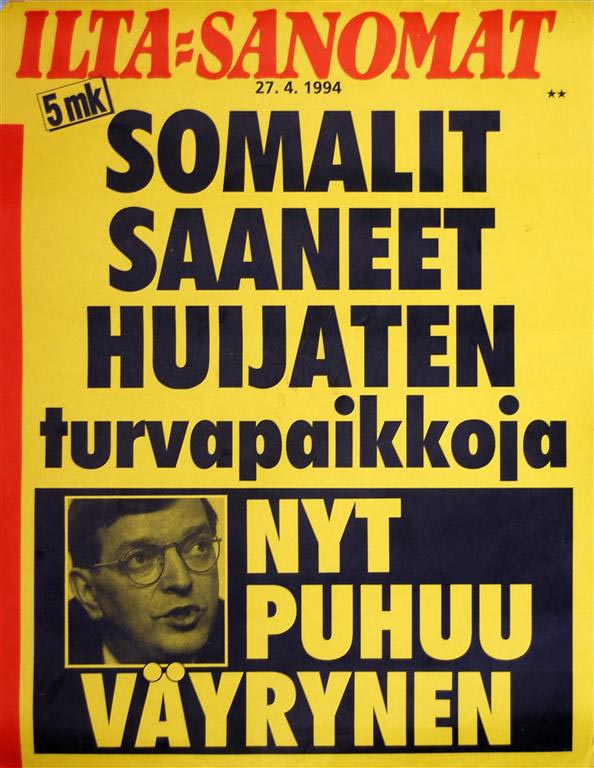
Prejudice and racism are diehard social ills because they take generations to wear off.  It may have taken a few months to label a small group of Somali refugees that came to Finland in the early 1990s, but it will be a very long time before they wash off their stigma.

The Romany minority of Finland are a good example of how negative labels can follow a group like a shadow for centuries.

 The Ilta-Sanomat tabloid claims that Somalis swindled authorities in granting them political asylum in Finland.

If it wasn’t a tabloid billboard that spread and reinforced racism and suspicion of groups like the Somalis in the 1990s, the icing on the cake was provided by the tacit silence of the politicians and society in general.  Even if one group was being singled out, it was an attack on all immigrants living in this country at the time.

As the old saying claims, there is no evil that lasts 100 years. In the United States, it took centuries to end slavery before we saw the rise of the Civil Rights Movement in the 1950s and 1960s. The Arab Spring movements last year are good recent examples of how “no evil can last 100 years.”

There is a problem with the saying, however, since it implies that evil cannot exist over 100 years because a person cannot live past that age. History reveals that evil is more like Methuselah, the Biblical figure that lived to be 969 years old.

The findings of a study in Britain published exclusively by the Guardian claim that unchecked corporate power, unrepresentative politicians and apathetic voters are fueling today the decline of British democracy.  The same illness has spread to other parts of Europe, like Finland.

The Guardian writes: “A study into the state of democracy in Britain over the last decade warns that it is in ‘long-term terminal decline’ as the power of corporations keeps growing, politicians become less representative of their constituencies and disillusioned citizens stop voting or even discussing current affairs.”

Finnish society, which used to be perceived as the least corrupt country in the world, according to Transparency International, has had its image seriously tarnished by greedy politicians and corporate leaders.

In the same way that corruption undermines a society’s values and sends it into decline, similarly prejudice and racism constitute serious threat to it as well.

If people are excluded socially and their only aim in life it to live off welfare, certainly they have every right to challenge their situation.

The only way you can avoid violence in society is by empowering people to change their situation through our democratic institutions. Two matters can happen if people lose faith in them: indefinite (very costly) social exclusion and/or violence.

In Europe not thinking today about how to tackle social exclusion and racism is thinking little or erroneously.

Thus the roots of the problem are not the marginalized groups, far-right parties or opportunistic anti-immigration politicians, but our apathy, greed and the fact that some of us have forgotten that we are social animals.


The crux of European racism: Too little inclusion, too much race and blood

Posted on June 16, 2012 by Migrant Tales

Much of the way Europeans perceive themselves as a group today is still deeply embedded in racism. The fact that we haven’t yet even started to confront the legacy of colonialism, which fuels our ”us” and ”them” view of the world, reveals a disturbing fact: There’s still too little inclusion and acceptance in this part of the world. 

Sadder still is the fact that too few of us openly promote more inclusion and acceptance in our society. How many times have you heard your local politician use terms like “mutual acceptance” and “respect” when speaking of immigrants and visible minorities?

Our race-and- blood view of ourselves and “others” explains why some Europeans still have difficulty overcoming the “us vs. them” mindset.

It would be naive, even foolhardy, to claim that the root of European racism does not date back to the nineteenth century, when we were a colonial power.

Racist views of other groups, especially blacks, is still predominant. The drawing is from the Golden Book Encyclopedia. The 1959 edition sold over 60 million volumes. 

While nineteenth century evolutionism played a crucial role in justifying the exploitation of Africans, Asians and other regions, it was a very effective excuse to justify our domination of other groups. These same arguments are still used today by different groups to justify our racist views.

Julian Abagond asks in a blog entry whether blacks would have raided, pillaged and enslaved so many people if they had had guns and ocean-going ships before whites.

He writes: “Technology advances and spreads unevenly. It is common for one region to have a technological edge over another – yet it is rare for it to lead to genocide, even when the edge is military.”

While Europe’s new inhabitants want to adapt and see their living standards rise in their new homeland, they too are part of the “us-vs.-them” problem. Some immigrants come from countries and societies that are just as racist as Europe.

While the latter may be true, everyone can learn new rules and values in our new or old homelands that promote a well-functioning society.  We should learn that racism and social exclusion are our biggest threats.

European Uncle Toms are as much of a danger to our ever-growing culturally diverse society as far-right groups. They are hindering the creation of a more-inclusive and culturally diverse Europe that can live side by side in harmony and reap synergies.

Writes Migrant Tales:  “The Finnish Uncle Tom is a pretty opportunistic person. He or she believes that the only way to escape discrimination is by accepting those values that promote social exclusion of other groups like immigrants.”

In order to avoid the terrible wars that once ravaged this part of the world, we must strive to create and teach present and future European generations the crucial role that mutual acceptance and respect play in inclusion.

Racism  is the shovel we Europeans use to dig our common grave.

We need more social inclusion in Europe to build a better society tomorrow.


Do we write too little or too much about a social ill like racism?

Posted on May 17, 2012 by Migrant Tales

By Enrique Tessieri

A friend of mine recently said that one of the reasons why some don’t like Migrant Tales (MT) is because we write too much about racism.  Do we treat a social issue like racism fairly on MT? Do we write too much or too little about it?

Certainly I would be happy if there were no reasons to write about such a social ill in this country. I even hope that what I write on this blog isn’t true.

Having written a lot about this topic, given talks and debated with many Finns for a number of years, there’s one matter that must be taken into account:  Some Finns feel offended if a foreigner tells them that there’s racism in their country.

Our aim on MT is certainly not to offend anyone but to debate an issue openly. If we can identify the problem, we can take  steps to challenge  and correct it.

Racism, xenophobia and hatred are greater threats to our values and society than some may believe.  Apart from ruining lives and holding back the  potential of a country, these social vices have been the smoking guns behind almost all the wars that have ever taken place in Europe.

Why do we still write about Nazi Germany if the fall of Berlin took place 67 years ago?  Why would we even want to bring to justice, never mind write about the crimes committed by Bosnian Serb wartime commander, Ratko Mladic, whose trial began Wednesday in The Hague?

Among the many war atrocities that Mladic is believed to have been responsible for are the deaths of up to 8,000 Muslim men and boys in Srebrenica in July 1995.

You may correctly ask why crimes like the Final Solution or ethnic cleansing in the former Yugoslavia took place?  Haven’t we learned from our past wars and mistakes?

Even if our collective memory is too short for comfort, those same phantoms of xenophobia, racism and hatred that spooked us into war in the past continue to roam those same streets inhabited by our fear and ignorance.

But let’s return to the original question: Do we write too little or too much about racism on MT?

There’s probably no consensus, but there are two answers:  Those who are most affected by racism believe too little attention is given to the issue, while those who are least affected by it claim the contrary.

Whatever the case, we should never give refuge to a social ill like racism through our silence.


Social inclusion is vital to a well-functioning society

Posted on May 9, 2012 by Migrant Tales

By Enrique Tessieri

Why are we so passionate at Migrant Tales about immigrant and minority rights? Because such groups are effective yardsticks that reveal the state of civil rights and democracy. The more social inclusion we succeed in promoting, the healthier our society is. 

There are clear examples in some recent elections in Europe that blaming immigrants and minorities for a country’s problems has become the trend.

We have even seen the rise of political parties that are keen on promoting social exclusion. Naturally they will not tell you this outright but may resemble the neo-Nazi Golden Eagle of Greece, which won 7% of the vote on Sunday.

This video clip of the party’s leader, Nikolaos Michaloliakos, is a good example of what a financial meltdown can bring. And it’s not at all pretty.

http://www.youtube.com/watch?v=E4AXJx3IzdY

In a very common style, Michaloliakos pointed his guns at Greece’s undocmunented immigrants: “Out of my country, out of my home! How will we do it? Use your imagination.”

Do we have far-right groups in Finland? What does it say about the state of our society if a right-wing populist party like the Perussuomalaiset (PS) sees its support rise fivefold in last year’s election?

One thing that is clear about the PS is that it is anti-EU, anti-immigration and especially anti-Islam.

The way of thinking in anti-immigration parties, “this is our country so leave if you don’t like it,” is one of the reasons why integration isn’t working as effectively as it should.

One of the worst lies told about immigrants is that they do not want to adapt.

A Somali I met on Monday while interviewing the father of Abdisalam Mohamed Abdulahi revealed what we know but don’t want to admit. He speaks Finnish like a native. He’s lived in this country two thirds of his life.

“The worst thing in Finland is that if you have a different religion, culture and language, you are left on the  fringes of society,” he said. “No matter how much you try to integrate you are always left outside.”

Spreading an urban myth like “immigrants don’t want to integrate” is a very effective way to exclude whole groups and build high walls around them.

Why do we do this?

To control resources like wealth and jobs by excluding other groups.

It is no myth that excluding others and promoting social inequality is the costliest approach in social and financial terms.

Racism Review: Free Speech for Anti-Semites and Other Racist Folks: Debates in Europe

Posted on May 6, 2012 by Migrant Tales
By Joe

There are some important and interesting debates on hate speech in Europe, with critics of new and old hate-speech laws often parroting “first amendment” arguments one often hears in the US.

The useful e-zine called Eurozine has several interesting article now on various sides of this debate. Check it out here.

And there seem to be more interesting websites debating “free speech,” such as this one, Free Speech Debate.

Read original blog entry here.

This piece was reprinted by Migrant Tales with permission.

Finland’s interior minister wants to make begging illegal

Posted on April 16, 2012 by Migrant Tales

By Enrique Tessieri

Christian Democrat (KD) Interior Minister Päivi Räsänen was quoted as saying on MTV3 that she is in favor of making begging illegal in Finland.  Just like many past suggestions by the conservative Räsänen, like her provocative views on homosexuality that caused last year an exodus from the Lutheran Church, her views on begging and how to deal with a group like the Roma of Eastern Europe doesn’t come as a surprise. 

While Räsänen uses the term “organized” begging, it’s clear that she is targeting Roma beggars from Eastern Europe that come to Finland.

In order to understand the dynamics of the Finnish government’s tough stand on immigration and its views of certain ethnic groups, Kokoomus Prime Minister appointed last year Räsänen to head the interior ministry in charge of immigration policy.

Her appointment was a clear attempt by the government to not only calm the Perussuomalaiset (PS) party, which had gained a historic 39 seats in last year’s election, but to rob it of its anti-immigration thunder.

Räsänen’s stand on gay rights and marriage reflect her conservative views on immigration and Finland’s ever-growing cultural diversity.  Last year she said there are plans to tighten once again family reunification laws, which were tightened by the previous government.

Her views on immigration are pretty well summed up on a blog entry she wrote on Uusi Suomi:  “Our country’s culture, values and morals have been built around Christian ethics and we must not abandon them starting from our homes, day care centers and when bringing up children.”

What Räsänen is saying in the quote is that she doesn’t believe in cultural diversity but that immigrants should assimilate — not integrate — to Finnish society.  Assimilation is one-way integration, or something like sitting on your behind and requiring immigrants to adapt to your culture while you do nothing except watch.

Some have criticized Räsänen’s double standards. On the one hand she claims to uphold Christian values concerning the family but doesn’t appear to be bothered by minors who are refugees in Finland that are forced to live without their parents because of strict reunification laws.

While Räsänen likes to give the public simple answers to complex problems, her latest view on begging will not resolve anything but complicate the problem even more. We will soon see pictures of the Finnish police rounding up, arresting and deporting women and children from Finland. It will reveal and reinforce the image that we are an intolerant country that doesn’t have a clue on how to deal with a social problem like begging in our society.

It prefers instead to brush the problem under the rug by making “poverty illegal” by patronizing to parties like the PS.

Our Finnish national identity in the new century

Posted on April 14, 2012 by Migrant Tales

By Enrique Tessieri

Glancing through a pile of documents and certificates my late grandfather (1892-1979) had is like entering a time machine. Two certificates catch my attention: a Finnish-language test in 1925 and another one when he changed his surname from Hantwargh to Harvo.  Both documents offer us a glimpse of how a social construct like Finnish national identity was forged in the last century.

Taking into account how some Finns define it today an ever- globalized world, it’s easy to see that their definition of a Finn has its roots in those two documents.

Being a Finn had little to do with your place of birth but is due to jus sanguinis, right of blood. Your citizenship is not determined by place of birth but by having one or both parents as citizens of that country.

The first document proving that my grandfather spoke perfect Finnish is understandable in the jus sanguinis context. The second one, which was from 1931, states at the following:

In light of the petition made by military instructor Harald Vilhelm Handtwargh, the governor of the province of Mikkeli grants his family permission to change their  surname to Harvo; this is backed by statements from the vicar [of the Lutheran church], Suomen Sukututkimusseura [Finnish Genealogical Society] and the Suomalaisuuden Liitto [Association of Finnish Culture and Identity]…

Taking on a new national identity was relatively  easy in the last century as long as you were white, nationalistic and didn’t make too public your foreign roots. In the case of my grandfather it was his Jewish background.

Today there are totally new demands placed on our society with respect to inclusion and “us.”  How we included and excluded people and groups in the last century is, I believe, what is causing us to fall flat on our faces and hindering us from seeing the bigger picture of what Finnish identity is in the new century.

Since we are a young nation with a young identity there is time to make it more inclusive. But for that change to happen it requires us to see the world in a radically different way than today.  A good example is some of our feelings towards the Russians and that fear of being a small nation constantly under threat.

It’s clear that in order to build a more inclusive and culturally dynamic society, we have to break away from our past hatreds, prejudices and myths.

But let’s not fool ourselves, breaking free from them will be a long process that will take a concerted effort and generations.

This document gave my grandfather the right to change his surname from Handtwargh to Harvo in 1931. 

One good way to become a more inclusive society today would be to change Section 5 of the Constitution from jus sanguinis to jus solis, right of the soil, nationality or citizenship granted to a person born in country.

The whole idea of jus sanguinis is deeply rooted in how ethnicity and nationality were defined in the nineteenth and greater part of the twentieth century.

While I am happy that Finland is an independent country today, we cannot escape the fact that it was built on nationalism and racism that was ever-present in Europe before and even today.  Thus our independence was in many respects an ethnic thing. We didn’t like the Russians never mind Russification.

The racism and nationalism that existed in Europe in the nineteenth century had a clear role: It justified the colonization and exploitation of other people in Africa and Asia. It was very ethnocentric as well. We thought that we were the epitome of civilization and therefore it was our right to  exploit others because they were less “advanced.”

As we know, World War I exposed the barbarism of our “civilized ways” and was pretty good reality check.

Hopefully our culturally diverse identity will not resemble an excerpt from Heikki Waris’ “An introduction to Finnish history” on page two:

“A fourth aspect is the high degree of homogeneity of Finnish society. Racial homogeneity particularly characterizes the Finnish people who have practically no racial minorities, the less than three thousand Lapps in the northernmost arctic communities making up the largest racial minority group. Consequently, racial prejudice and discrimination are nonexistent.”

Apart from avoiding mention of the Roma of Finland and Finnish expats and those with international backgrounds, Waris’ affirmation are quite humorous from today’s perspective.

The "us"-and-"them" smoking-gun statement that once justified mass murder in Europe

Posted on February 26, 2012 by Migrant Tales

One of the matters that surprises me about some politicians in Europe and Finland continue to flirt with ideologies that led Europe down a path of near-total destruction in the 1940s. The younger they are, and the further their time perspective of those times, the more they appear to flirt and idolize with fascism. To them I would like to give them a quote by Rudolf Hoess, the notorious commandant of the Aushcwitz concentration camp during 1940-43. 

When we speak of fascism we should put it in a 2010s context. It has different enemies but is the same political beast.

In order to understand the horrors of World War 2 and especially those of the Nazi régime, a very good starting point to understand those harrowing times is reading up on the Nuremberg Trials.

Hoess was not tried at Nuremberg but in Poland, where he was tried by a Polish military tribunal and hanged at Auschwitz on April 7, 1947.

One of the matters that strikes you when you read about Hoess, and all those that were tried for genocide and war crimes after the war, is how they played down their roles.

There is one quote by Hoess that, in my opinion, gives us the smoking gun to the madness, racism, hatred and mass murder that roamed Europe freely at the time.

This is how Hoess justified what he did that caused the death of about 2.5 million Jews at Auschwitz.*

Hoess: “I had my personal orders from [Heinrich] Himmler [to exterminate Jews].”

Question: “Did you ever protest?”

Hoess: “I couldn’t do that. The reasons Himmler gave me I had to accept.”

Question: “In other words, you think it was justified to kill 2.5 million men, women, and children?”

Hoess: “Not justified – but Himmler told me that if the Jews were not exterminated at that time, then the German people would be exterminated for all time by the Jews.”

The last quote by Hoess is chilling and reveals the smoking gun that justified mass murder by the Nazi régime. What is even scarier today is that it is still used by people to justify their racism and declarations of wars against other groups. Some of these are groups, politicians and individuals who claim that Muslims will take over Europe. They make up their stories with the help of high birth rates and a pocket calculator.

If predicting the future were so easy, then we have invented a time machine to the future (sic!).

* Leo Goldensohn: Nuremberg Interviews. Vintage Books. New York 2004. p. 296.

The Migrant Tales Manifesto (for Finland and Europe)

Posted on January 28, 2012 by Migrant Tales

By Enrique Tessieri

Thanks to the growing number of supporters, Migrant Tales has become that “voice for those whose views and situation are understood poorly and heard faintly by the media, politicians and public.” During these past years we have read and debated many points of views and have complied some recommendations on how to move forward. 

The list is far from being a final one. We can add and change parts of it but the overriding message should be mutual acceptance, respect and equal opportunities. All these three terms add up to social equality, or tasa-arvo.

Migrant Tales Manifesto 

  • An effective way to make cultural diversity work is by heralding mutual acceptance, respect and equal opportunities
  • We like the term tolerance, or suvaitsevaisuus in Finnish, but acceptance, hyväksyntä, is an even better term that describes how we build bridges between different ethnic groups and minorities in our society
  • New studies should bring out — not hide — how Finns have been, are and will be a culturally diverse society
  • The first step in that acceptance of our cultural diversity are the children, grandchildren and great grandchildren of the 1.2 million Finns that migrated between 1860 and 1999
  • Cultural management/diversity should be mandatory and started at elementary school
  • We must learn to forgive those countries and people that put us in harm’s way
  • When we advance the rights of minorities we advance those of all
  • A member of society can never learn mutual acceptance and respect if he has low self-esteem
  • Empowering all members of society, especially minorities, helps build self-esteem
  • Inclusion means asking people their opinion, empowering and encouraging them to take part especially in the decision-making process that affects their lives and future in the community
  • Racism, prejudice and all type of discrimination that excludes individuals and groups should be strongly discouraged
  • Discrimination should be seen as a threat to our values and community because it hinders  inclusion
  •  The biggest excluder in society is apathy and silence
  • Politicians that do not speak out against racism and prejudice when given the opportunity are just as responsible as those who encourage such a social ill
  • Inclusion does not only mirror one of our most important values of our society like social equality, it costs the tax payer less and is a more effective pathway to integration
  • In order to free up tax resources for more projects that strengthen inclusion in our society, we should strongly discourage building walls of hate in our society
  • Mutual acceptance means people in our society can make lifestyle choices. These are not only ensured in our laws, but are protected on an individual and group level
  • We treat people with the same respect we treat our own group
  • Equal opportunities are a key component to building a successful, dynamic and content society
  • The more opportunities we offer the more pathways we create to our culturally diverse community
  • Everyone should strive to learn the best Finnish and/or Swedish he or she can.  This is as important as speaking other languages, like the one we learned at home
  • Since we are all different, we learn languages at different paces. Language should, however, never be a tool to discriminate
  • We should strive to keep politicians, policy makers and officials focused on our goal during this century as a country: mutual acceptance, respect and equal opportunities
  • The sum total of these terms is social equality
  • Finland is our home because we are a part of a wonderful country that has accepted and empowered us.
  • Previous
  • 1
  • …
  • 5
  • 6
  • 7
  • 8
  • 9
  • 10
  • 11
  • 12
  • Next
Read more about documentary film
Read more

Recent Posts

  • Finland’s tabloids Iltalehti and Ilta-Sanomat are the pits
  • Riikka Purra’s Dr Jekyll and Mr Hyde mask
  • Double standards
  • Perussuomalaiset: Uusi logo, sama vanha juttu
  • Taco Trump

Recent Comments

  1. Absolutely Socking: Racist Finnish Facebook group against human rights gets flooded with socks on Musta Barbaari’s mother and sister charged by the police in “ethnic profiling” case
  2. Ilkka Nuotio on Pekka Myrskylä: “Tilastot kertovat toista kuin poliittinen keskustelu”
  3. Genrih Soinkara on The war in Ukraine and the Russian-Finnish border crisis are showing Finland’s ugly side
  4. Ahti Tolvanen on Comment by Ahti Tolvanen on the Helsinki +50 conference
  5. Angel Barrientos on Angel Barrientos is one of the kind beacons of Finland’s Chilean community

Archives

  • June 2026
  • May 2026
  • April 2026
  • March 2026
  • February 2026
  • January 2026
  • December 2025
  • November 2025
  • October 2025
  • September 2025
  • August 2025
  • July 2025
  • June 2025
  • May 2025
  • April 2025
  • March 2025
  • February 2025
  • January 2025
  • December 2024
  • November 2024
  • October 2024
  • September 2024
  • August 2024
  • July 2024
  • June 2024
  • May 2024
  • April 2024
  • March 2024
  • February 2024
  • January 2024
  • December 2023
  • November 2023
  • October 2023
  • September 2023
  • August 2023
  • July 2023
  • June 2023
  • May 2023
  • April 2023
  • March 2023
  • February 2023
  • January 2023
  • December 2022
  • November 2022
  • October 2022
  • September 2022
  • August 2022
  • July 2022
  • June 2022
  • May 2022
  • April 2022
  • March 2022
  • February 2022
  • January 2022
  • December 2021
  • November 2021
  • October 2021
  • September 2021
  • August 2021
  • July 2021
  • June 2021
  • May 2021
  • April 2021
  • March 2021
  • February 2021
  • January 2021
  • December 2020
  • November 2020
  • October 2020
  • September 2020
  • August 2020
  • July 2020
  • June 2020
  • May 2020
  • April 2020
  • March 2020
  • February 2020
  • January 2020
  • December 2019
  • November 2019
  • October 2019
  • September 2019
  • August 2019
  • July 2019
  • June 2019
  • May 2019
  • April 2019
  • March 2019
  • February 2019
  • January 2019
  • December 2018
  • November 2018
  • October 2018
  • September 2018
  • August 2018
  • July 2018
  • June 2018
  • May 2018
  • April 2018
  • March 2018
  • February 2018
  • January 2018
  • December 2017
  • November 2017
  • October 2017
  • September 2017
  • August 2017
  • July 2017
  • June 2017
  • May 2017
  • April 2017
  • March 2017
  • February 2017
  • January 2017
  • December 2016
  • November 2016
  • October 2016
  • September 2016
  • August 2016
  • July 2016
  • June 2016
  • May 2016
  • April 2016
  • March 2016
  • February 2016
  • January 2016
  • December 2015
  • November 2015
  • October 2015
  • September 2015
  • August 2015
  • July 2015
  • June 2015
  • May 2015
  • April 2015
  • March 2015
  • February 2015
  • January 2015
  • December 2014
  • November 2014
  • October 2014
  • September 2014
  • August 2014
  • July 2014
  • June 2014
  • May 2014
  • April 2014
  • March 2014
  • February 2014
  • January 2014
  • December 2013
  • November 2013
  • October 2013
  • September 2013
  • August 2013
  • July 2013
  • June 2013
  • May 2013
  • April 2013
  • March 2013
  • February 2013
  • January 2013
  • December 2012
  • November 2012
  • October 2012
  • September 2012
  • August 2012
  • July 2012
  • June 2012
  • May 2012
  • April 2012
  • March 2012
  • February 2012
  • January 2012
  • December 2011
  • November 2011
  • October 2011
  • September 2011
  • August 2011
  • July 2011
  • June 2011
  • May 2011
  • April 2011
  • March 2011
  • February 2011
  • January 2011
  • December 2010
  • November 2010
  • October 2010
  • September 2010
  • August 2010
  • July 2010
  • June 2010
  • May 2010
  • April 2010
  • March 2010
  • February 2010
  • January 2010
  • December 2009
  • November 2009
  • October 2009
  • September 2009
  • August 2009
  • July 2009
  • December 2008
  • November 2008
  • October 2008
  • September 2008
  • August 2008
  • July 2008
  • June 2008
  • May 2008
  • April 2008
  • March 2008
  • February 2008
  • January 2008
  • November 2007
  • October 2007
  • September 2007
  • August 2007
  • July 2007
  • June 2007
  • May 2007

Categories

  • ?? Gia L?c
  • ????? ?????? ????? ???????? ?? ??????
  • ???????
  • @HerraAhmed
  • @mondepasrond
  • @nohatefinland
  • @oula_silver
  • @Varathas
  • A Pakistani family
  • äärioikeisto
  • Abbas Bahmanpour
  • Abdi Muhis
  • Abdirahim Hussein Mohamed
  • Abdirahim Husu Hussein
  • Abdirisak Mahamed
  • About Migrant Tales
  • activism
  • Adam Al-Sawad
  • Adel Abidin
  • Afrofinland
  • Ahmed IJ
  • Ahti Tolvanen
  • Aino Pennanen
  • Aisha Maniar
  • Alan Ali
  • Alan Anstead
  • Alejandro Díaz Ortiz
  • Alekey Bulavsev
  • Aleksander Hemon
  • Aleksanterinliitto
  • Aleksanterinliitto ry
  • Aleksanterinliitto ry:n hallitus
  • Alex Alex
  • Alex Mckie
  • Alexander Nix
  • Alexandra Ayse Albayrak
  • Alexis Neuberg
  • Ali Asaad Hasan Alzuhairi
  • Ali Hossein Mir Ali
  • Ali Rashid
  • Ali Sagal Abdikarim
  • Alina Tsui
  • Aline Müller
  • All categories
  • Aman Heidari
  • Amiirah Salleh-Hoddin & Jana Turk
  • Amin A. Alem
  • Amir Zuhairi
  • Amkelwa Mbekeni
  • Ana María Gutiérrez Sorainen
  • Anachoma
  • Anders Adlecreutz
  • Angeliina Koskinen
  • Anna De Mutiis
  • Anna María Gutiérrez Sorainen
  • Anna-Kaisa Kuusisto ja Jaakko Tuominen
  • Annastiina Kallius
  • Anneli Juise Friman Lindeman
  • Announcement
  • Anonymous
  • Antero Leitzinger
  • anti-black racism
  • Anti-Hate Crime Organisation Finland
  • Anudari Boldbaatar
  • Arshiya Nasser
  • Aspergers Syndrome
  • Asylum Corner
  • Asylum seeker 406
  • Athena Griffin and Joe Feagin
  • Autism
  • Avaaz.org
  • Awale Olad
  • Ayan Said Mohamed
  • AYY
  • Barachiel
  • Bashy Quraishy
  • Beatrice Kabutakapua
  • Beri Jamal
  • Beri Jamal and Enrique Tessieri
  • Bertolt Brecht
  • Boiata
  • Boodi Kabbani
  • Bruno Gronow
  • Carmen Pekkarinen
  • Çelen Oben and Sheila Riikonen
  • Chiara Costa-Virtanen
  • Chiara Costa-Virtanen
  • Chiara Sorbello
  • Christian Thibault
  • Christopher Wylie
  • Clara Dublanc
  • Dana
  • Daniel Malpica
  • Danilo Canguçu
  • David Papineau
  • David Schneider
  • Dexter He
  • Don Flynn
  • Dr Masoud Kamali
  • Dr. Faith Mkwesha
  • Dr. Theodoros Fouskas
  • Edna Chun
  • Eeva Kilpi
  • Emanuela Susheela
  • En castellano
  • ENAR
  • Enrique
  • Enrique Tessieri
  • Enrique Tessieri & Raghad Mchawh
  • Enrique Tessieri & Yahya Rouissi
  • Enrique Tessieri and Muhammed Shire
  • Enrique Tessieri and Sira Moksi
  • Enrique Tessieri and Tom Vandenbosch
  • Enrique Tessieri and Wael Che
  • Enrique Tessieri and Yahya Rouissi
  • Enrique Tessieri and Zimema Mhone
  • Epäluottamusmies
  • EU
  • Europe
  • European Islamophobia Report
  • European Islamophobia Report 2019,
  • European Union
  • Eve Kyntäjä
  • Ezequiel Caldeiro
  • Facebook
  • Fadumo Dayib
  • Faisa Kahiye
  • Farhad Manjoo
  • Fasismi
  • Finland
  • Fizza Qureshi
  • Flyktingar och asyl
  • Foreign Student
  • Fozia Mir-Ali
  • Frances Webber
  • Frida Selim
  • Gareth Rice
  • Ghyslain Vedeaux
  • Global Art Point
  • Great Replacement
  • Habiba Ali
  • Hami Bahadori
  • Hami Bahdori
  • Hamid
  • Hamid Alsaameere
  • Hamid Bahdori
  • Handshake
  • Harmit Athwal
  • Hassan Abdi Ali
  • Hassan Muhumud
  • Heikki Huttunen
  • Heikki Wilenius
  • Helsingin Sanomat
  • Henning van der Hoeven
  • Henrika Mälmsröm
  • Hser Hser
  • Hser Hser ja Mustafa Isman
  • Husein Muhammed
  • Hussain Kazemian
  • Hussain Kazmenian
  • Ibrahim Khan
  • Ida
  • Ignacio Pérez Pérez
  • Iise Ali Hassan
  • Ilari Kaila & Tuomas Kaila
  • Imam Ka
  • inside-an-airport
  • Institute of Race Relations
  • Iraqi asylum seeker
  • IRR European News Team
  • IRR News Team
  • Islamic Society of Norhern FInland
  • Islamic Society of Northern Finland
  • Islamophobia
  • Jacobinmag.com
  • Jallow Momodou
  • Jan Holmberg
  • Jane Elliott
  • Jani Mäkelä
  • Jari Luoto
  • Jari Taponen
  • Jegor Nazarov
  • Jenni Stammeier
  • Jenny Bourne
  • Jessie Daniels
  • Joe Davidow
  • Johannes Koski
  • John D. Foster
  • John Grayson
  • John Marriott
  • Jon Burnett
  • Jorma Härkönen
  • Jos Schuurmans
  • José León Toro Mejías
  • Josue Tumayine
  • Jouni Karnasaari
  • Juan Camilo
  • Jukka Eräkare
  • Julian Abagond
  • Julie Pascoet
  • Jussi Halla-aho
  • Jussi Hallla-aho
  • Jussi Jalonen
  • JusticeDemon
  • Kadar Gelle
  • Kaksoiskansalaisuus
  • Kansainvälinen Mikkeli
  • Kansainvälinen Mikkeli ry
  • Katherine Tonkiss
  • Kati Lepistö
  • Kati van der Hoeven-Lepistö
  • Katie Bell
  • Kättely
  • Kerstin Ögård
  • Keshia Fredua-Mensah & Jamie Schearer
  • Khadidiatou Sylla
  • Khadra Abdirazak Sugulle
  • Kiihotus kansanryhmää vastaan
  • Kirsi Crowley
  • Koko Hubara
  • Kristiina Toivikko
  • Kubra Amini
  • KuRI
  • La Colectiva
  • La incitación al odio
  • Laura Huhtasaari
  • Lauri Finér
  • Leif Hagert
  • Léo Custódio
  • Leo Honka
  • Leontios Christodoulou
  • Lessie Branch
  • Lex Gaudius
  • Leyes de Finlandia
  • Liikkukaa!
  • Linda Hyökki
  • Liz Fekete
  • M. Blanc
  • Maarit Snellman
  • Mahad Sheikh Musse
  • Maija Vilkkumaa
  • Malmin Kebab Pizzeria Port Arthur
  • Marcell Lorincz
  • Mari Aaltola
  • María Paz López
  • Maria Rittis Ikola
  • Maria Tjader
  • Marja-Liisa Tolvanen
  • Mark
  • Markku Heikkinen
  • Marshall Niles
  • Martin Al-Laji
  • Maryan Siyad
  • Matt Carr
  • Mauricio Farah Gebara
  • Media Monitoring Group of Finland
  • Micah J. Christian
  • Michael McEachrane
  • Michele Levoy
  • Michelle Kaila
  • Migrant Tales
  • Migrant Tales Literary
  • Migrantes News
  • Migrants' Rights Network
  • MigriLeaks
  • Mikko Kapanen
  • Miriam Attias and Camila Haavisto
  • Mohamed Adan
  • Mohammad Javid
  • Mohammad M.
  • Monikulttuurisuus
  • Monisha Bhatia and Victoria Canning
  • Mor Ndiaye
  • Muh'ed
  • Muhamed Abdimajed Murshid
  • Muhammed Shire
  • Muhammed Shire and Enrique Tessieri
  • Muhis Azizi
  • Musimenta Dansila
  • Muslimiviha
  • Musulmanes
  • Namir al-Azzawi
  • Natsismi
  • Neurodiversity
  • New Women Connectors
  • Nils Muižnieks
  • No Labels No Walls
  • Noel Dandes
  • Nuor Dawood
  • Omar Khan
  • Otavanmedia
  • Oula Silvennoinen
  • Paco Diop
  • Pakistani family
  • Pentti Stranius
  • Perussuomalaiset
  • perustuslaki
  • Petra Laiti
  • Petri Cederlöf
  • Pia Grochowski
  • Podcast-lukija Bea Bergholm
  • Pohjois – Suomen Islamilainen Yhdyskunta
  • Pohjois Suomen Islamilainen Yhyskunta
  • Polina Kopylova
  • Race Files
  • racism
  • Racism Review
  • Raghad Mchawh
  • Ranska
  • Rashid H. and Migrant Tales
  • Rasismi
  • Raul Perez
  • Rebecka Holm
  • Reem Abu-Hayyeh
  • Refugees
  • Reija Härkönen
  • Remiel
  • Reza Nasri
  • Richard Gresswell
  • Riikka Purra
  • Risto Laakkonen
  • Rita Chahda
  • Ritva Kondi
  • Robito Ibrahim
  • Roble Bashir
  • Rockhaya Sylla
  • Rodolfo Walsh
  • Roger Casale
  • Rostam Atai
  • Roxana Crisólogo Correa
  • Ruth Grove-White
  • Ruth Waweru-Folabit
  • S-worldview
  • Sadio Ali Nuur
  • Sami Rusanen
  • Sandhu Bhamra
  • Sara de Jong
  • Sarah Crowther
  • Sari Alhariri
  • Sarkawt Khalil
  • Sasu
  • Scot Nakagawa
  • Shabana Ahmadzai
  • Shada Islam
  • Sharon Chang blogs
  • Shenita Ann McLean
  • Shirlene Green Newball
  • Sini Savolainen
  • Sira Moksi
  • Sonia K.
  • Sonia Maria Koo
  • Steverp
  • Stop Deportations
  • Suldaan Said Ahmed
  • Suomen mediaseurantakollektiivi
  • Suomen Muslimifoorumi ry
  • Suomen viharikosvastainen yhdistys
  • Suomen viharikosvastainen yhdistys ry
  • Suomi
  • Supermen
  • Susannah
  • Suva
  • Syrjintä
  • Talous
  • Tapio Tuomala
  • Taw Reh
  • Teivo Teivainen
  • The Daily Show
  • The Heino
  • The Supermen
  • Thomas Elfgren
  • Thulfiqar Abdulkarim
  • Tim McGettigan
  • Tino Singh
  • Tito Moustafa Sliem
  • Tobias Hübinette and L. Janelle Dance
  • Transport
  • Trica Danielle Keaton
  • Trilce Garcia
  • Trish Pääkkönen
  • Trish Pääkkönen and Enrique Tessieri
  • Tuulia Reponen
  • Uncategorized
  • UNITED
  • University of Eastern Finland
  • Uyi Osazee
  • Väkivalta
  • Vapaa Liikkuvuus
  • Venla-Sofia Saariaho
  • Vieraskynä
  • W. Che
  • W. Che an Enrique Tessieri
  • Wael Ch.
  • Wan Wei
  • Women for Refugee Women
  • Xaan Kaafi Maxamed Xalane
  • Xassan Kaafi Maxamed Xalane
  • Xassan-Kaafi Mohamed Halane & Enrique Tessieri
  • Yahya Rouissi
  • Yasmin Yusuf
  • Yassen Ghaleb
  • Yle Puhe
  • Yuliet Tresa
  • Yve Shepherd
  • Zahra Khavari
  • Zaker
  • Zalina Ametova
  • Zamzam Ahmed Ali
  • Zeinab Amini ja Soheila Khavari
  • Zimema Mahone and Enrique Tessieri
  • Zimema Mhone
  • Zoila Forss Crespo Moreyra
  • ZT
  • Zulma Sierra
  • Zuzeeko Tegha Abeng
© 2026 Migrant tales | Powered by Minimalist Blog WordPress Theme