Migrant tales
Menu
  • #MakeRacismHistory “In Your Eyes”
  • About Migrant Tales
  • It’s all about Human Rights
  • Literary
  • Migrant Tales Media Monitoring
  • NoHateFinland.org
  • Tales from Europe
Menu

Tag: Europe

A cartoon that reveals a truth about integration and diversity in Europe

Posted on January 7, 2013 by Migrant Tales

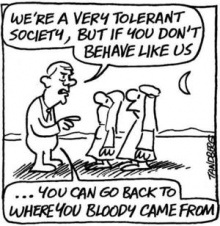
Sometimes when I read about how immigrants, their children and grandchildren are treated in some European countries, this cartoon comes to mind. 

After the first warning and after you understand fully the but after the ” we’re a very tolerant society…” line,  many will encounter the wall of  institutional racism, the final icing of your integration cake that ensures you will never compete as an equal member of society because of your ethnic background.

220px-svvalues_narrowweb_300x3080

Source: Rec. Soc. blog.

What is racism?

It’s squandering people’s abilities and dwarfing their potential.

Racism is like a greedy monopoly, which would rarely if ever admit that it is a monopoly. Its aim is to kill competition in order to benefit itself at the cost of everyone.

People support such an order of things because, one way or another, they think they benefit from it as well.


Promoting tolerance now and tomorrow

Posted on December 31, 2012 by Migrant Tales

In Migrant Tales’ Finland & Cultural Diversity 2012 review, it’s clear that a lot more work needs to be done to promote tolerance. Thanks to Umayya Abu-Hanna’s column on Sunday’s Helsingin Sanomat,* our collective complacency was once again shamefully revealed.

Racism, or the lack of acceptance of other ethnic groups as equals in our society, is a social illness that spreads unabated in Europe and in countries like Finland. It is empowered by our silence, fear, cultural myths, low self-esteem and mocks every day at our apathy.

How do you explain the historic rise of a party like the Perussuomalaiset (PS), which is hostile to immigrants and cultural diversity, in last year’s parliamentary elections?

What is even more shameful is the acceptance by the media and too many politicians that PS chairman, Timo Soini, is the good guy that is keeping openly hostile and racist party members in line.

Hate crimes rose in Finland by 7% in 2011 compared with the previous year, according to the Police College of Finland. Irrespective of the rise, few if any politicians raised the issue.

Mark wrote about how the police perpetuate hate crimes in Finland in one of the most commented and widely read blog entries of December.

He writes: “One effect of hate crime statistics being published in Finland is that it brings up once again the unwelcome question of whether Finns are more racist than other nations. This isn’t my question, by the way, but it is one that Finns tend to dwell on, as if there were an acceptable level of racism that a country is allowed to have!”

Are the police, like the rest of society, serious about hate crimes and racism?

Considering that the majority of hate crimes go unreported, it’s clear that these types of crimes reported to the police are only the tip of the iceberg.

The fact that one policeman in Mikkeli suggested to immigrant students that they should not report racist harassment cases to them shows that there is no common policy.

The Mikkeli policeman equated racist harassment to when he gets hassled in his hometown by the locals, who remind him that he is a policeman. “Just ignore them [if they harass you in a racist fashion],” he said.

If its evident that the police are part of the problem, part of the blame must go to the victim. It will be very difficult to challenge hate crimes in our society as long as immigrants and visible minorities don’t report such cases.

Ignorance of one’s rights, language barriers, fear of reprisals and lack of trust are some reasons why black and visible minorities don’t report racist harassment to the police, according to a Race Council Cymru study reported by Migrant Tales.

There’s a very good piece on ekathimerini.com on how hate crimes threaten our society.

Kuvankaappaus 2012-12-31 kello 8.43.46

Read whole story here.

Morten Kjaerum and Janez Lenarcic write: ”Hate crime offenders send a clear message that some of us are lesser human beings, lesser citizens who can be harmed with impunity. Their actions are, therefore, serious affronts to the fundamental right to human dignity and equal treatment.”

The key argument made by the authors, that our fundamental right to human dignity and equal treatment are breached, is the issue. When we permit such an injustice to happen, we undermine our civil rights. If it can happen to “them” it can happen to “us.”

Barbara Spectre, founding director of Paideia of Sweden, believes that the ongoing transformation of European societies from being “monolithic to multicultural” is at the heart of European anti-Semitism.

“I think there’s a resurgence of anti-Semitism because this point in time Europe has not yet learned to be multicultural…” she said. “It’s a huge transformation for Europe to make. They are now going into a multicultural mode. ”

While I disagree with Spectre that the issue is simply moving from being “monolithic to multicultural,” the issue goes much deeper. Anti-Semitism should not be seen as a threat to Jews but to all minorities living in Europe.

The foundations of Europe’s racism, which has brought terrible wars and enabled colonialism to spread globally, is at the heart of the problem.

Europe has always been culturally diverse. The problem is that we have used racism to hide our diversity through social exclusion. We only see ourselves in a racist society.

Finnish racism isn’t any different. Since we want to see only ourselves in this society, it explains why there’s so much opposition to cultural diversity.

Less social exclusion would make us acknowledge that there are other groups living amongst us.

_______________

*Erkki Perälä, a Green Party Helsinki city councilman, wrote a so-called sarcastic piece about Abu-Hanna’s column. I considered the use of the Musta Pekka Golliwog as offensive.

Why is it that I never get “great” ideas like Perälä when writing about a social ill like racism?

If I’m not the victim due to my ethnicity, I don’t try to write about it with sarcasm since I’d only be asking for trouble.

What do you think?

Timo Soini on racism: See no evil, hear no evil

Posted on October 25, 2012 by Migrant Tales

It is surprising how a politician like Timo Soini of the Perussuomalaiset (PS) party can argue anything he wants on television about immigrants and visible minorities. His objection to positive discrimination on a debate on MTV3 Wednesday is a case in point. 

Migrant Tales has  written in the past about colorblind racism, which is one of the most common forms of racism in Finland. On the surface, racial colorblindness may sound fair but the truth is that skin color and ethnic background still play powerful roles in our society.

Writes Psychology Today: “Colorblindness is the racial ideology that posits the best way to end discrimination is by treating individuals as equally as possible, without regard to race, culture, or ethnicity…However, colorblindness alone is not sufficient to heal racial wounds on a national or personal level. It is only a half-measure that in the end operates as a form of racism.”

I still have a hard time figuring out what is worse: Soini’s colorblind statements or the fact that some journalists and politicians still don’t challenge this form of racism more strongly.

Imagine what a political scandal Soini would have faced if he asked to abolish positive discrimination in countries that are culturally diverse and have large immigrant populations.  The PS chairman’s stand on the issue is in the same political league as other far-right parties like the British National Party, Danish People’s Party and teabaggers of the U.S.

I met a member of Hommaforum at a seminar recently who was totally against positive discrimination. Sitting next to us was a black woman from Africa.

I asked him if he thought that Finland was today a society that was way past racism and discrimination. “Do ethnicity and cultural background play a role?” I asked. “What you are saying is that it makes no difference whether you are black or white.”

It’s clear that the PS’ stand on immigration and cultural diversity suffers from colorblindness.

The party’s declaration against all forms of racism in May 2011 is a good example of the colorblind racism that afflicts the PS.

The party may claim that it is for labor immigration and that it has a handful of white immigrant candidates running for city council.  This is only a red herring that aims to cover up the party’s issues with cultural diversity.

Here is a recent blog entry by Migrant Tales that puts in perspective the PS’ thinking on what kinds of immigrants should apply to come to Finland and how they should integrate into our society.


New World Finn: Open the doors

Posted on October 3, 2012 by Migrant Tales

Twenty-five years ago, when I worked briefly for the Buenos Aires Herald as a young reporter, I wrote a column about how Argentina’s past could come to haunt it in the future. The last military regime (1976-83) that ruled the country was one of the most ruthless that Latin America had seen during the last century. Tens of thousands of people disappeared in a civil war that was characterized by habeas corpus writs and the silence of cemeteries.

The same concern I wrote about in that column a long time ago has resurfaced in Europe today.

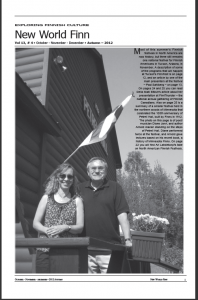
New World Finn is a quarterly exploring Finnish culture in the New World.
The column, Open the doors, raised the following points: “True, there is in present-day Argentina a consensus against military-run governments. However, even though these last years of democracy have instigated a new political era, there are still precious little questions being asked not only about our past – how different sectors such as politicians, unions, member of the clergy, historians, journalists, the U.S. embassy, among others, colluded in making a mockery of democracy and human rights – but most importantly, where we’re supposed to go from here.”

Could history be repeating itself again in Europe and Finland?

As our economic woes deepen in this part of the world, the louder we’re hearing the diatribes of far right and right-wing populist groups. We saw in Finland last year the rise of the Finns Party, which is anti-EU, anti-immigration and especially anti-Islam. The Finns Party, which only got 5 seats in 2007, won 39 seats in the last election!

The next hurdle for the Finns Party will be the municipal elections of October 28. A recent poll by YLE revealed that the Finns Party would be the biggest winner of the municipal election. If the party gets 15.8% of the votes as the poll suggests, it will be a big leap from 5.4% that the party got in the 2008 municipal elections. The poll sees that the National Coalition Party getting in October 22.7% compared with 23.5% in 2008. That would be followed by the Social Democrats with 18.7% (21.2%), and the Center Party with 16.6% (20.1%).

While all political parties in Finland are officially against all forms of racism and discrimination, it’s not clear what their real views are on the issue. How do they promote cultural diversity and how often do they speak out against racism? You will find in all Finnish parties members who are for or against immigrants and immigration. Even so, no other party has so many openly anti-immigration members like the Finns Party.

The Greens and Swedish People’s Party, and even the Left Wing Alliance with some reservations, appear to be the most open to immigration and cultural diversity, according to some polls.

“Intolerance is taking root throughout Europe and Finland. We witnessed with shock last year its ugliest side, when Anders Behring Breivik went on his murderous rampage killing 77 innocent victims. Europe witnessed this spring intolerance form a young Arab in Southern France who gunned down Jewish schoolchildren.

Contrary to North America, some claim that our view of ourselves as ethnic groups in Europe hinges too much on “race and blood.” The concept dates back to 1935, when a Jewish doctor in Germany was sent to a concentration camp for saving a patient’s life by donating his blood. This same idea, that blood and ethnicity are related, is how some Europeans see themselves ethnically today.

In order not to repeat the mistakes of the past, we have to look at our history. Finland, which was ravaged by internal and external wars during the first twenty-five years of its independence, built a model society based on respect, acceptance and social equality. The fruits of those efforts are everywhere today. In order to build the same type of society in this century, we must take great care not to exclude different ethnic groups.

We could look across the Atlantic as well for good cultural-diversity models. Even if racism is an issue in many parts of the Americas, countries like the United States, Canada, Brazil, Argentina and others understand that racism and discrimination are social ills that must be challenged.

The last paragraph of the Buenos Aires Herald column I wrote stated the following: “There are a lot of pending questions and, as long as Argentina does not accept the difficult challenge of answering them, the door of this country will remain closed, isolation will prevail, and despotism will one day flourish as it always has in the past. It will not come from abroad, however, as many would have us believe, but from our backyard.”

The column appeared in the autumn 2012 issue of New World Finn.

ENAR: Hate crime victims finally recognised with European Parliament vote

Posted on September 17, 2012 by Migrant Tales

Comment: Without a doubt, this is an important piece of legislation by the European Parliament, which will require EU states to systematically collect data on hate crimes.  Even if the Finnish police collects such data, reporting hate crimes to the police may be more complicated for an immigrant than meets the eye. 

The key question that we should therefore ask is how seriously does the police take hate crime. 

In 2010, the Police College of Finland reported that there were 860 hate crimes reported, which is a 15% fall from 1,007 cases in the previous year. 

Does this mean that hate crimes have fallen sharply in Finland or does it show how distrustful some immigrant groups are of the police?

_______________

The European Parliament voted today to protect and grant basic rights to the estimated 75 million victims of crime across the EU without discrimination. The European Network Against Racism (ENAR) especially welcomes the fact that the specific needs of hate crime victims will be taken into account and that victims will be protected regardless of their residence status.

“The European Parliament’s vote is a great step forward in protecting victims of hate crime in the most appropriate way, and in making sure that irregular migrants – the most vulnerable – are not abandoned to their fate if they fall victim to a crime”, said Chibo Onyeji, ENAR Chair. “We now hope the EU Council of Member States will follow the Parliament’s example”.

Ethnic and religious minority groups face racist crime and violence on a daily basis across Europe but this reality is at worst denied, and at best underestimated.

In addition, evidence shows that hate crimes cause greater harm than ordinary crimes because of the ripple effect it has on entire communities. The 2010-11 British Crime Survey indicates that higher proportions of victims of hate crime reported feelings of shock, fear, depression, anxiety, panic attacks, loss of confidence, difficulty sleeping, compared with victims of similar non-hate crimes.

The report adopted by the European Parliament also calls on EU Member States to systematically collect data on reported crimes and on the victims of crime. This is crucial to assess whether hate crime is on the rise and for the EU to take informed action to tackle the problems identified. “This legislation, once adopted, will send a strong signal to perpetrators of hate crimes that they will not be let off the hook. It is therefore crucial that Member States transpose it into their national laws as soon as possible”, added Onyeji.

More information on racist violence can be found in ENAR’s report Racist violence in Europe.


Alina Tsui: Immigration Reform – The Xenophobic Crisis in Greece

Posted on August 27, 2012 by Migrant Tales

By Alina Tsui

Illegal immigrants are tearing apart the social fabric of Greek society. They’ve been blamed for the spike in crimes and the cause of Greece’s economic woes. At least this is the narrative that’s repeated by the far-right and accepted by most Greeks.  

With no end in sight of the economic crisis and punishing austerity measures, Greeks are feeling the squeeze. This week’s meeting with Germany and France to discuss the terms for the third round of bailouts will without a doubt renew class tensions between locals and immigrants.

At the same time, Golden Dawn, a far-right political group notorious for its hateful and xenophobic rhetoric, has blamed illegal immigrants. Their success in winning 18 seats in June’s parliamentary elections demonstrates at least some level of their views resonating with the masses. This group creates a hostile environment complete with its swastika-like logo and ran on the platform slogan, “Greece for Greeks.” There has been some demonstrations against Golden Dawn, but the scapegoating of illegal immigrants have been somewhat accepted by the masses.

Illegal immigrants make up 10% of the Greek population, and locals view this problem as a scourge. Efforts are being made to demonstrate that Greece is serious about deporting illegal immigrants and tightening its borders.

Several human-rights NGOs have denounced Greece for violating international law in its mass raids of immigrants without making any efforts to check the legal status of the migrants. Furthermore, it was reported on Saturday that Greek police were accused of dumping hundreds of illegal immigrants in the middle of the night in neighboring Macedonia. Locals have grown weary of immigrants and multiculturalism in general. Certainly the economy has played a part. In a Human Rights Watch report, an Athens resident expressed, “I was never a racist but I’ve become one. Why can’t we send them all home?”

Yet illegal immigrants without papers, work, or a place to live are finding their stay in Greece to be very unwelcoming. In the past five months it’s been estimated that 500 people were the victims of racially-motivated attacks. The typical m.o. of these attacks are similar in nature: they typically occur late at night, involving a gang of thugs wielding weapons such as sticks, iron bars and wooden bats. Their intention is to induce fear in their victims. Instances of attacks at home by Golden Dawn members have been reported in the media. Keep in mind that this is in the same network of white supremacist groups that Wisconsin Sikh shooter Wade Michael Page was a member of.

In August during Operation Xenios Zeus (ironically, the god of hospitality), approximately 6,000 migrants were rounded up and detained in Athens resulting in 1,500 people being deported for illegal entry. It seemed the only criteria for being detained was being guilty of having a dark complexion or looking “foreign.” The “success” of this event prompted officials to plan similar raids to other cities in Greece. Six detention centers are already in the works to house the increasing numbers of illegal immigrants.

The rise of the far-right has been accelerating for the past ten years says Jamie Bartlett of UK think tank, Demos. It’s a trend that’s seen all across Europe.  Cultural and national identity remains a  sensitive issue.

The problem that mainstream political parties in Greece face is that they aren’t able to combat the rise of the far-left/right because they’re trying to retain party support, so they’re powerless to change the situation, which leads to greater conflict between an increasingly polarized left-right political spectrum.

The above picture is one taken in a Greek train station of police waiting for an arriving train as part of the raid on illegal immigrants. This YouTube video details the same.

Read original blog entry here.

This piece was reprinted by Migrant Tales with permission.

Race and intelligence

Posted on August 24, 2012 by Migrant Tales

A BBC documentary, Race and Intelligence, asks if there is a racial* pecking order where white people are more intelligent than blacks. It seems unbelievable that this question continues to be asked in the twenty-first century, according to Rageh Omar of the BBC. 

One of the matters that has amazed me personally in Finland and elsewhere is how entrenched in the nineteenth century are some people’s views concerning race or ethnicity.

Neuroscientist Steven Rose says that ”race” is basically a social construct since its definition doesn’t match the biological definition.

According to him, there are greater gene frequencies on average between northern Welsh and Southern Welsh people. ”You wouldn’t call Northern Welch a different race of people from the Southern Welch people,” he said.

Omar asks the neuroscientist why there has been such a debate for such a long time.

Rose takes a deep breath before answering the question: “Because we live in a racist society. It’s very simple. Differences in intelligence between white people and black people wouldn’t make any sense unless you live in a racist society.”

The documentary shows that IQ tests do not test innate intelligence but are a reflection of how you are brought up in society. “[That is why it is important that] all children have access to the same aspirations,” according to Omar.

If IQ is  determined by economic and social factors, then we have nothing to be relived and comforted about, Omar concludes.

*Generally speaking, Europeans use ethnic group as opposed to the United States, where the term race is used.  In the United States, people from Europe were referred to as ethnic groups while blacks and Asians were “races.”  Blacks, like Latinos, consider themselves “a race.” Mexican-Americans call themselves la Raza, or “the Race.”

Der Spiegel names Timo Soini as one of Europe’s most dangerous politicians

Posted on August 7, 2012 by Migrant Tales

German newsmagazine, Der Spiegel, published the top ten most dangerous politicians in Europe concerning the euro crisis. One of these was Perussuomalaiset (PS) chairman Timo Soini, who is in the ”good” company of Geert Wilders, Viktor Orban, Marine Le Pen, Nigel Farage, Silvio Bertlusconi and four others.

Even if Soini is in the opposition, his shadow hangs heavy over the government of Prime Minister Jyrki Katainen, according to Der Spiegel.  “Not a penny more,” he is quoted as saying defiantly about the euro crisis. “We have paid enough.”

Even if Soini is considered as one of the most dangerous politicians of Europe, there’s nothing to be proud of. All of Der Spiegel’s  ten-most dangerous politicians are euroskeptics as well as Islamophobists, populists and even quasi-dictators like Prime Minister Orban of Hungary.

Writes PS MP Reijo Tossavainen on his Uusi Suomi blog: “In my opinion Timo Soini is right. I am satisfied, and even somehow proud, that Soini as well as other Perussuomalaiset members have been against [euro bailouts]…I am pleased that the same trend is evident in other parts of Europe as well.”

I wonder what medicine Soini, Tossavainen and others of the PS will prescribe to Europe if the euro becomes history and we slip into a deep recession.

Will they step up their attack on the usual scapegoats like immigrants, Muslims, homosexuals and other minorities?

I’m afraid that’s happening right now.


Julian Abagond: human zoos

Posted on July 31, 2012 by Migrant Tales

Julian Abagond 

Human zoos (1500s- ), also known as ethnological exhibits, peoples shows (Völkerschau) or Negro villages, showed native peoples at zoos and fairs. They have been common in the West since the time of Columbus, butreached their height from the 1870s to the 1930s – back in the days of Joseph Conrad, Gauguin, minstrel shows and the birth of National Geographic.

They showed people from:

  • the Middle East,
  • Africa,
  • Sri Lanka,
  • the Philippines,
  • Java,
  • New Guinea,
  • the Pacific,
  • the Americas and
  • the Arctic.

They were especially common in

  • Germany (huge),
  • France,
  • Britain and
  • America.

Tens of millions saw them.

Examples:

  • 1896: the Cincinnati Zoo showed Sioux Indians.
  • 1899: “Savage South Africa” in Britain showed Zulus, complete with spears, shields and staged battles.
  • 1904: the St Louis world’s fair showed a “parade of evolutionary progress” with Filipinos and American Indians ranked below whites and with Pygmies just above apes.
  • 1906: the Bronx Zoo showed a Pygmy, Ota Benga, in the same cage as an orangutan.

Iroquois at a 1905 exposition dressed as Plains Indians. Probably in Belgium.

Ever since Columbus natives brought back by sailors were shown to the public, especially at fairs. Few ever made it back home and many did not last long in disease-ridden Europe. A well-known example is Sarah Baartman of South Africa, who was shown in a cage in Britain and part of an animal show in Paris.

“Native villages” were built so white people could see how they lived. Montaigne reported one in Rouen, France in 1533 of Tupinamba Indians from Brazil. Such villages became especially common at zoos and world fairs starting in the 1870s.

To succeed as a native:

  • Play to stereotype;
  • Fit Western ideas of beauty – or go completely against them;
  • Be at ease with audiences;
  • Have a special skill, like ivory carving.

This favoured those who were artists or entertainers in their own land.

The whole thing was staged and played to Western stereotypes:

  • Arabs were like in “Thousand and One Nights” from the 1300s.
  • American Indians were like in the cowboy-and-Indian books of the time.
  • South Sea Islanders were bare breasted and carefree – even though, as Gauguin discovered, that world was long gone if it ever was (but painted it anyway).
  • Black Africans were shown as savage hunters, spears and all, just a step above wild animals – even though most Africans of the time were herders and farmers. One show was called “Gorilla Negroes”.

The Pygmies at the St Louis fair, on the other hand, liked to smoke cigars and wear top hats, which screwed up the show’s racist evolutionary ranking.

Some feared for the safety of white women. In both Victorian England and Nazi Germany, some opposed the shows out of fear of race mixing between black men and white women.

At least as late as 2005 you could still see “African tribesmen” in grass skirts at a Western zoo (in Augsberg, Germany). Butsince the 1930s such things have become uncommon: film, and later television and cheap air travel, were able to give Westerners a much richer-seeming (but not always truer) experience of native peoples.

Read original story here.

 This piece was reprinted by Migrant Tales with permission.


Business Insider: Timo Soini’s “threat” to the world economy

Posted on July 12, 2012 by Migrant Tales

Not only must have Perussuomalaiset (PS) party chairman Timo Soini been swept off his feet with delight for being named by Business Insider  as the seventh-most dangerous person to the global economy, but Finland as well for such a dubious recognition. Who ever heard of Business Insider anyway?

For starters, somebody could inform the online publication that the official English name of the PS isn’t any longer the True Finns, but the Finns Party.

After weighing the old and new English-language official translations of the PS, Migrant Tales (MT) decided last year that we didn’t want any part of this populist nonsense and decided to call Soini’s party by its Finnish name, the Perussuomalaiset.

Timo Soini is a dangerous persons to the global economy, according to Business Insider. 

While we understand  at MT that the PS has been a blow to the credibility of Finland’s international image and to institutions like parliament, the political clout that Soini has hinges by and large on the lack of leadership of  Finland’s major parties, which rolled out the red carpet for him before last year’s election.

Soini’s anti-EU, anti-immigration and especially anti-Islam message appeals to a wide range of politicians in this country.

Why did Business Insider choose Soini as the seventh-most dangerous public figure to the global economy?

The online publication writes: “As the leader of the largest opposition party in Finland’s parliament and one of the biggest eurosceptics in Europe, Timo Soini is in a position of incredible importance with regard to continued euro bailouts.”

I doubt that the PS chairman is any longer in a position of “incredible importance” in Finland. The numerous scandals that have rocked the party and Soini’s disappointing showing in the presidential election have dimmed much of his shine.

Other influential personalities on the Business Insider are: German Chancellor Angela Merkel (1); French President Francois Hollande; German economist Hans-Werner Sinn; Fed Chairman Ben Bernanke; Nkolaus Blome, Bild newspaper deputy editor; and US President Barak Obama.

  • Previous
  • 1
  • …
  • 4
  • 5
  • 6
  • 7
  • 8
  • 9
  • 10
  • …
  • 12
  • Next
Read more about documentary film
Read more

Recent Posts

  • Finland’s tabloids Iltalehti and Ilta-Sanomat are the pits
  • Riikka Purra’s Dr Jekyll and Mr Hyde mask
  • Double standards
  • Perussuomalaiset: Uusi logo, sama vanha juttu
  • Taco Trump

Recent Comments

  1. Absolutely Socking: Racist Finnish Facebook group against human rights gets flooded with socks on Musta Barbaari’s mother and sister charged by the police in “ethnic profiling” case
  2. Ilkka Nuotio on Pekka Myrskylä: “Tilastot kertovat toista kuin poliittinen keskustelu”
  3. Genrih Soinkara on The war in Ukraine and the Russian-Finnish border crisis are showing Finland’s ugly side
  4. Ahti Tolvanen on Comment by Ahti Tolvanen on the Helsinki +50 conference
  5. Angel Barrientos on Angel Barrientos is one of the kind beacons of Finland’s Chilean community

Archives

  • June 2026
  • May 2026
  • April 2026
  • March 2026
  • February 2026
  • January 2026
  • December 2025
  • November 2025
  • October 2025
  • September 2025
  • August 2025
  • July 2025
  • June 2025
  • May 2025
  • April 2025
  • March 2025
  • February 2025
  • January 2025
  • December 2024
  • November 2024
  • October 2024
  • September 2024
  • August 2024
  • July 2024
  • June 2024
  • May 2024
  • April 2024
  • March 2024
  • February 2024
  • January 2024
  • December 2023
  • November 2023
  • October 2023
  • September 2023
  • August 2023
  • July 2023
  • June 2023
  • May 2023
  • April 2023
  • March 2023
  • February 2023
  • January 2023
  • December 2022
  • November 2022
  • October 2022
  • September 2022
  • August 2022
  • July 2022
  • June 2022
  • May 2022
  • April 2022
  • March 2022
  • February 2022
  • January 2022
  • December 2021
  • November 2021
  • October 2021
  • September 2021
  • August 2021
  • July 2021
  • June 2021
  • May 2021
  • April 2021
  • March 2021
  • February 2021
  • January 2021
  • December 2020
  • November 2020
  • October 2020
  • September 2020
  • August 2020
  • July 2020
  • June 2020
  • May 2020
  • April 2020
  • March 2020
  • February 2020
  • January 2020
  • December 2019
  • November 2019
  • October 2019
  • September 2019
  • August 2019
  • July 2019
  • June 2019
  • May 2019
  • April 2019
  • March 2019
  • February 2019
  • January 2019
  • December 2018
  • November 2018
  • October 2018
  • September 2018
  • August 2018
  • July 2018
  • June 2018
  • May 2018
  • April 2018
  • March 2018
  • February 2018
  • January 2018
  • December 2017
  • November 2017
  • October 2017
  • September 2017
  • August 2017
  • July 2017
  • June 2017
  • May 2017
  • April 2017
  • March 2017
  • February 2017
  • January 2017
  • December 2016
  • November 2016
  • October 2016
  • September 2016
  • August 2016
  • July 2016
  • June 2016
  • May 2016
  • April 2016
  • March 2016
  • February 2016
  • January 2016
  • December 2015
  • November 2015
  • October 2015
  • September 2015
  • August 2015
  • July 2015
  • June 2015
  • May 2015
  • April 2015
  • March 2015
  • February 2015
  • January 2015
  • December 2014
  • November 2014
  • October 2014
  • September 2014
  • August 2014
  • July 2014
  • June 2014
  • May 2014
  • April 2014
  • March 2014
  • February 2014
  • January 2014
  • December 2013
  • November 2013
  • October 2013
  • September 2013
  • August 2013
  • July 2013
  • June 2013
  • May 2013
  • April 2013
  • March 2013
  • February 2013
  • January 2013
  • December 2012
  • November 2012
  • October 2012
  • September 2012
  • August 2012
  • July 2012
  • June 2012
  • May 2012
  • April 2012
  • March 2012
  • February 2012
  • January 2012
  • December 2011
  • November 2011
  • October 2011
  • September 2011
  • August 2011
  • July 2011
  • June 2011
  • May 2011
  • April 2011
  • March 2011
  • February 2011
  • January 2011
  • December 2010
  • November 2010
  • October 2010
  • September 2010
  • August 2010
  • July 2010
  • June 2010
  • May 2010
  • April 2010
  • March 2010
  • February 2010
  • January 2010
  • December 2009
  • November 2009
  • October 2009
  • September 2009
  • August 2009
  • July 2009
  • December 2008
  • November 2008
  • October 2008
  • September 2008
  • August 2008
  • July 2008
  • June 2008
  • May 2008
  • April 2008
  • March 2008
  • February 2008
  • January 2008
  • November 2007
  • October 2007
  • September 2007
  • August 2007
  • July 2007
  • June 2007
  • May 2007

Categories

  • ?? Gia L?c
  • ????? ?????? ????? ???????? ?? ??????
  • ???????
  • @HerraAhmed
  • @mondepasrond
  • @nohatefinland
  • @oula_silver
  • @Varathas
  • A Pakistani family
  • äärioikeisto
  • Abbas Bahmanpour
  • Abdi Muhis
  • Abdirahim Hussein Mohamed
  • Abdirahim Husu Hussein
  • Abdirisak Mahamed
  • About Migrant Tales
  • activism
  • Adam Al-Sawad
  • Adel Abidin
  • Afrofinland
  • Ahmed IJ
  • Ahti Tolvanen
  • Aino Pennanen
  • Aisha Maniar
  • Alan Ali
  • Alan Anstead
  • Alejandro Díaz Ortiz
  • Alekey Bulavsev
  • Aleksander Hemon
  • Aleksanterinliitto
  • Aleksanterinliitto ry
  • Aleksanterinliitto ry:n hallitus
  • Alex Alex
  • Alex Mckie
  • Alexander Nix
  • Alexandra Ayse Albayrak
  • Alexis Neuberg
  • Ali Asaad Hasan Alzuhairi
  • Ali Hossein Mir Ali
  • Ali Rashid
  • Ali Sagal Abdikarim
  • Alina Tsui
  • Aline Müller
  • All categories
  • Aman Heidari
  • Amiirah Salleh-Hoddin & Jana Turk
  • Amin A. Alem
  • Amir Zuhairi
  • Amkelwa Mbekeni
  • Ana María Gutiérrez Sorainen
  • Anachoma
  • Anders Adlecreutz
  • Angeliina Koskinen
  • Anna De Mutiis
  • Anna María Gutiérrez Sorainen
  • Anna-Kaisa Kuusisto ja Jaakko Tuominen
  • Annastiina Kallius
  • Anneli Juise Friman Lindeman
  • Announcement
  • Anonymous
  • Antero Leitzinger
  • anti-black racism
  • Anti-Hate Crime Organisation Finland
  • Anudari Boldbaatar
  • Arshiya Nasser
  • Aspergers Syndrome
  • Asylum Corner
  • Asylum seeker 406
  • Athena Griffin and Joe Feagin
  • Autism
  • Avaaz.org
  • Awale Olad
  • Ayan Said Mohamed
  • AYY
  • Barachiel
  • Bashy Quraishy
  • Beatrice Kabutakapua
  • Beri Jamal
  • Beri Jamal and Enrique Tessieri
  • Bertolt Brecht
  • Boiata
  • Boodi Kabbani
  • Bruno Gronow
  • Carmen Pekkarinen
  • Çelen Oben and Sheila Riikonen
  • Chiara Costa-Virtanen
  • Chiara Costa-Virtanen
  • Chiara Sorbello
  • Christian Thibault
  • Christopher Wylie
  • Clara Dublanc
  • Dana
  • Daniel Malpica
  • Danilo Canguçu
  • David Papineau
  • David Schneider
  • Dexter He
  • Don Flynn
  • Dr Masoud Kamali
  • Dr. Faith Mkwesha
  • Dr. Theodoros Fouskas
  • Edna Chun
  • Eeva Kilpi
  • Emanuela Susheela
  • En castellano
  • ENAR
  • Enrique
  • Enrique Tessieri
  • Enrique Tessieri & Raghad Mchawh
  • Enrique Tessieri & Yahya Rouissi
  • Enrique Tessieri and Muhammed Shire
  • Enrique Tessieri and Sira Moksi
  • Enrique Tessieri and Tom Vandenbosch
  • Enrique Tessieri and Wael Che
  • Enrique Tessieri and Yahya Rouissi
  • Enrique Tessieri and Zimema Mhone
  • Epäluottamusmies
  • EU
  • Europe
  • European Islamophobia Report
  • European Islamophobia Report 2019,
  • European Union
  • Eve Kyntäjä
  • Ezequiel Caldeiro
  • Facebook
  • Fadumo Dayib
  • Faisa Kahiye
  • Farhad Manjoo
  • Fasismi
  • Finland
  • Fizza Qureshi
  • Flyktingar och asyl
  • Foreign Student
  • Fozia Mir-Ali
  • Frances Webber
  • Frida Selim
  • Gareth Rice
  • Ghyslain Vedeaux
  • Global Art Point
  • Great Replacement
  • Habiba Ali
  • Hami Bahadori
  • Hami Bahdori
  • Hamid
  • Hamid Alsaameere
  • Hamid Bahdori
  • Handshake
  • Harmit Athwal
  • Hassan Abdi Ali
  • Hassan Muhumud
  • Heikki Huttunen
  • Heikki Wilenius
  • Helsingin Sanomat
  • Henning van der Hoeven
  • Henrika Mälmsröm
  • Hser Hser
  • Hser Hser ja Mustafa Isman
  • Husein Muhammed
  • Hussain Kazemian
  • Hussain Kazmenian
  • Ibrahim Khan
  • Ida
  • Ignacio Pérez Pérez
  • Iise Ali Hassan
  • Ilari Kaila & Tuomas Kaila
  • Imam Ka
  • inside-an-airport
  • Institute of Race Relations
  • Iraqi asylum seeker
  • IRR European News Team
  • IRR News Team
  • Islamic Society of Norhern FInland
  • Islamic Society of Northern Finland
  • Islamophobia
  • Jacobinmag.com
  • Jallow Momodou
  • Jan Holmberg
  • Jane Elliott
  • Jani Mäkelä
  • Jari Luoto
  • Jari Taponen
  • Jegor Nazarov
  • Jenni Stammeier
  • Jenny Bourne
  • Jessie Daniels
  • Joe Davidow
  • Johannes Koski
  • John D. Foster
  • John Grayson
  • John Marriott
  • Jon Burnett
  • Jorma Härkönen
  • Jos Schuurmans
  • José León Toro Mejías
  • Josue Tumayine
  • Jouni Karnasaari
  • Juan Camilo
  • Jukka Eräkare
  • Julian Abagond
  • Julie Pascoet
  • Jussi Halla-aho
  • Jussi Hallla-aho
  • Jussi Jalonen
  • JusticeDemon
  • Kadar Gelle
  • Kaksoiskansalaisuus
  • Kansainvälinen Mikkeli
  • Kansainvälinen Mikkeli ry
  • Katherine Tonkiss
  • Kati Lepistö
  • Kati van der Hoeven-Lepistö
  • Katie Bell
  • Kättely
  • Kerstin Ögård
  • Keshia Fredua-Mensah & Jamie Schearer
  • Khadidiatou Sylla
  • Khadra Abdirazak Sugulle
  • Kiihotus kansanryhmää vastaan
  • Kirsi Crowley
  • Koko Hubara
  • Kristiina Toivikko
  • Kubra Amini
  • KuRI
  • La Colectiva
  • La incitación al odio
  • Laura Huhtasaari
  • Lauri Finér
  • Leif Hagert
  • Léo Custódio
  • Leo Honka
  • Leontios Christodoulou
  • Lessie Branch
  • Lex Gaudius
  • Leyes de Finlandia
  • Liikkukaa!
  • Linda Hyökki
  • Liz Fekete
  • M. Blanc
  • Maarit Snellman
  • Mahad Sheikh Musse
  • Maija Vilkkumaa
  • Malmin Kebab Pizzeria Port Arthur
  • Marcell Lorincz
  • Mari Aaltola
  • María Paz López
  • Maria Rittis Ikola
  • Maria Tjader
  • Marja-Liisa Tolvanen
  • Mark
  • Markku Heikkinen
  • Marshall Niles
  • Martin Al-Laji
  • Maryan Siyad
  • Matt Carr
  • Mauricio Farah Gebara
  • Media Monitoring Group of Finland
  • Micah J. Christian
  • Michael McEachrane
  • Michele Levoy
  • Michelle Kaila
  • Migrant Tales
  • Migrant Tales Literary
  • Migrantes News
  • Migrants' Rights Network
  • MigriLeaks
  • Mikko Kapanen
  • Miriam Attias and Camila Haavisto
  • Mohamed Adan
  • Mohammad Javid
  • Mohammad M.
  • Monikulttuurisuus
  • Monisha Bhatia and Victoria Canning
  • Mor Ndiaye
  • Muh'ed
  • Muhamed Abdimajed Murshid
  • Muhammed Shire
  • Muhammed Shire and Enrique Tessieri
  • Muhis Azizi
  • Musimenta Dansila
  • Muslimiviha
  • Musulmanes
  • Namir al-Azzawi
  • Natsismi
  • Neurodiversity
  • New Women Connectors
  • Nils Muižnieks
  • No Labels No Walls
  • Noel Dandes
  • Nuor Dawood
  • Omar Khan
  • Otavanmedia
  • Oula Silvennoinen
  • Paco Diop
  • Pakistani family
  • Pentti Stranius
  • Perussuomalaiset
  • perustuslaki
  • Petra Laiti
  • Petri Cederlöf
  • Pia Grochowski
  • Podcast-lukija Bea Bergholm
  • Pohjois – Suomen Islamilainen Yhdyskunta
  • Pohjois Suomen Islamilainen Yhyskunta
  • Polina Kopylova
  • Race Files
  • racism
  • Racism Review
  • Raghad Mchawh
  • Ranska
  • Rashid H. and Migrant Tales
  • Rasismi
  • Raul Perez
  • Rebecka Holm
  • Reem Abu-Hayyeh
  • Refugees
  • Reija Härkönen
  • Remiel
  • Reza Nasri
  • Richard Gresswell
  • Riikka Purra
  • Risto Laakkonen
  • Rita Chahda
  • Ritva Kondi
  • Robito Ibrahim
  • Roble Bashir
  • Rockhaya Sylla
  • Rodolfo Walsh
  • Roger Casale
  • Rostam Atai
  • Roxana Crisólogo Correa
  • Ruth Grove-White
  • Ruth Waweru-Folabit
  • S-worldview
  • Sadio Ali Nuur
  • Sami Rusanen
  • Sandhu Bhamra
  • Sara de Jong
  • Sarah Crowther
  • Sari Alhariri
  • Sarkawt Khalil
  • Sasu
  • Scot Nakagawa
  • Shabana Ahmadzai
  • Shada Islam
  • Sharon Chang blogs
  • Shenita Ann McLean
  • Shirlene Green Newball
  • Sini Savolainen
  • Sira Moksi
  • Sonia K.
  • Sonia Maria Koo
  • Steverp
  • Stop Deportations
  • Suldaan Said Ahmed
  • Suomen mediaseurantakollektiivi
  • Suomen Muslimifoorumi ry
  • Suomen viharikosvastainen yhdistys
  • Suomen viharikosvastainen yhdistys ry
  • Suomi
  • Supermen
  • Susannah
  • Suva
  • Syrjintä
  • Talous
  • Tapio Tuomala
  • Taw Reh
  • Teivo Teivainen
  • The Daily Show
  • The Heino
  • The Supermen
  • Thomas Elfgren
  • Thulfiqar Abdulkarim
  • Tim McGettigan
  • Tino Singh
  • Tito Moustafa Sliem
  • Tobias Hübinette and L. Janelle Dance
  • Transport
  • Trica Danielle Keaton
  • Trilce Garcia
  • Trish Pääkkönen
  • Trish Pääkkönen and Enrique Tessieri
  • Tuulia Reponen
  • Uncategorized
  • UNITED
  • University of Eastern Finland
  • Uyi Osazee
  • Väkivalta
  • Vapaa Liikkuvuus
  • Venla-Sofia Saariaho
  • Vieraskynä
  • W. Che
  • W. Che an Enrique Tessieri
  • Wael Ch.
  • Wan Wei
  • Women for Refugee Women
  • Xaan Kaafi Maxamed Xalane
  • Xassan Kaafi Maxamed Xalane
  • Xassan-Kaafi Mohamed Halane & Enrique Tessieri
  • Yahya Rouissi
  • Yasmin Yusuf
  • Yassen Ghaleb
  • Yle Puhe
  • Yuliet Tresa
  • Yve Shepherd
  • Zahra Khavari
  • Zaker
  • Zalina Ametova
  • Zamzam Ahmed Ali
  • Zeinab Amini ja Soheila Khavari
  • Zimema Mahone and Enrique Tessieri
  • Zimema Mhone
  • Zoila Forss Crespo Moreyra
  • ZT
  • Zulma Sierra
  • Zuzeeko Tegha Abeng
© 2026 Migrant tales | Powered by Minimalist Blog WordPress Theme