Migrant tales
Menu
  • #MakeRacismHistory “In Your Eyes”
  • About Migrant Tales
  • It’s all about Human Rights
  • Literary
  • Migrant Tales Media Monitoring
  • NoHateFinland.org
  • Tales from Europe
Menu

Tag: Europe

Social media Frankensteins

Posted on January 30, 2015 by Migrant Tales

Ever wondered how a wannabe becomes a social media hit by spreading hatred and racism? There are a lot of these types of politicians and characters around who with low budgets become famous and even get elected thanks to social media. They are called #SocialMediaFrankensteins. 

Näyttökuva 2015-1-30 kello 9.13.37

With the help of social media and many blind followers, some of these #SocialMediaFrankensteins have become household names because of their hate appeal.

In Finland some who come to mind are MEP Jussi Halla-aho and his faithful follower Muutos 2011 MP James Hirvisaari as well as many others like MPs Olli Immonen, Juho Eerola, Teuvo Hakkarainen, and others.

Isn’t it odd that the majority of them are members of the Perussuomalaiset (PS)* party?

#SocialMediaFrankensteins can be organizations too because they use social media to spread their bigotry. Some of these are: Pegida, English Defense League, PS, Danish People’s Party, Sweden Democrats, Geert Wilders of the Party for Freedom, Front National of France…

This clip from the original Frankenstein movie of 1931 shows the mad Dr. Frankenstein rejoicing after he awakens a human monster from the dead. “It’s alive! It’s alive! It’s alive!..” he yells at the top of his voice. “Now I know how it feels to be god!”


The same revelation that Dr. Frankenstein makes, how it feels to be god, is what #SocialMediaFrankensteins feel after they get followers and become a household name from the wannabe cemetery.

What is a #SocialMediaFrankenstein and how does it relate to the 1931 monster movie starring Boris Karloff?

  • A monster like Frankenstein spreads indiscriminately terror with his hatred. He kills everyone who gets in his way;
  • #SocialMediaFrankensteins spread indiscriminately terrorize whole communities with their racism and bigotry. They label and victimize whole group by painting them with a single brush;
  • A monster like Frankenstein becomes famous only after it stars in a movie;
  • #SocialMediaFrankensteins become famous after they publish their racist diatribe on social media;
  • A monster like Frankenstein is finally burned alive and sent back to the land of the dead;
  • #SocialMediaFrankensteins meet their fate after they get caught at their own game of racism. They are burned online;
  • Frankenstein dies but we never forget his terror;
  • #SocialMediaFrankensteins die and, like the Holocaust, we never forget the terror they spread.


Näyttökuva 2015-1-30 kello 8.36.18
 PS MEP Jussi Halla-aho is a good example of a #SocialMediaFrankenstein. He was created thanks to social media and a xenophobic party like the PS. The poster reads: “Charlie Hebdo 7.1.2015 12 dead. Popcorn thank you. In another place people die while another person eats popcorn and enjoys the show. Let’s not forget to be humans. Your country thanks you.” PS. Source: Paljastettu. 


* The Finnish name for the Finns Party is the Perussuomalaiset (PS). The names adopted by the PS, like True Finns or Finns Party, promote in our opinion nativist nationalism and xenophobia. We therefore prefer to use the Finnish name of the party on our postings. 

Racism Review: Je Ne Suis Pas Charlie: A Critical View

Posted on January 13, 2015 by Migrant Tales
To be frank, the magazine Charlie Hebdo deserves criticism, not praise—despite the horrific events that have unfolded. While I am certainly not condoning the murder of its staff members, I do find them guilty of Islam-bashing and inconsiderately expressing religious intolerance, cultural ethnocentrism, and extremely poor human judgment, issues that should be important to antiracists and those who “review” racism. Additionally, being aware of the angst caused by their racist and tasteless cartoons, I find those associated with the magazines’ campaign against Islam to be instigators and un-thoughtful–not creatively satirical–people directly involved in promoting ethno-racial and religious tensions. See NPR’s 2012 story on the social problems caused by publishing the incendiary cartoons. Again, these individuals ought to be condemned as race baiters, not martyred.

Näyttökuva 2015-1-13 kello 12.32.36

Read full story here.


The ridiculous display of support for ‘Charlie,’ particularly in the news media, is disconcerting and demonstrates that many people are equally as uninformed and culturally insensitive as those who promoted the anti-Islamist cartoons. Since the attack, most news outlets have ignored the racism and Islam-tarnishing of Charlie Hebdo and are in a rush to glorify the magazine and deify their racist cartoonists. Ignoring the potential of further inflaming ethno-racial tensions and promoting further anti-Muslim bigotry, a number of media giants, such as the Washington Post, have even decided to reprint the blasphemous cartoons of Muhammad in defiance of what they feel is a threat to free speech.

To state that what occurred is “an attack on free speech” is misguided and plainly ignorant. This is a destructive myth espoused by most Western media outlets in their discussion of this event. See, for example, John Avlon’s The Daily Beast article, “Why We Stand with Charlie Hebdo-And You Should Too,” which naively presents the free speech argument. What Charlie Hebdo’s anti-Islamist cartoons represent is hate images and speech, a defamation of a major world religion and culture, and an obvious attack on Muslims. To cloud this reality is intellectual dishonesty in the wake of reactionary politics.

Stoking the flames of racial hatred through dehumanizing others and their beliefs is nothing new; yet, today it is claimed that those who de-humanize certain groups are expressing their free speech or righteousness in their actions. One might ask why KKK pamphlets that demean black Americans, white nationalists’ periodicals that vilify Jews, and past campaigns of dehumanization by national groups, like the US’s racist cartoons of Japanese, are viewed as intolerable and unacceptable, yet the demonization of Muslims and Arabs is granted a pass.

Islam bashing, Islamophobia, and anti-Arab sentiments are on the rise in Europe, and particularly in France, in large part do to the de-humanizing tactics of people like those associated with Charlie Hebdo. The dehumanization and discriminatory practices of Charlie cartoons provide ammunition for the anti-Muslim intolerance endorsed by rising far right groups in Europe, like the British Freedom Party, National Front, English Defense League, Alternative for Germany, Freedom Party in Netherlands, and PEGIDA (Patriotic Europeans Against Islamization of the West), to name a few. Problematically, with the aid of people who incite discrimination against Muslims, like the cartoonists and editorial staff at Charlie Hebdo, Islamophobia is now moving from the fringes to the mainstream of European societies. (See Joshua Keating’s Slate article, “Xenophobia is Going Mainstream in Germany.”)

As Dr. Muhammad Abdul Bari notes, “the shockwave of the far right National Front polling nearly one-fifth of French voters is still reverberating. Both the socialist candidate and the incumbent president are wooing the support of Marine le Pen” (see Dr. Bari’s Aljazeera article, “Islamophobia: Europe’s’ New Political Disease.”).Indeed, after the attack, as expected, the National Front is attracting more members and support.

Of course, racist and anti-Muslim dehumanizing cartoons are but a symptom of a larger problem that is not addressed, is misdiagnosed or is inverted: European colonialism and the European-sponsored terrorism or Euroterrorism used to support this centuries-old practice. The Iraq war, Afghanistan war, and other Western-sponsored military campaigns against Muslim countries are colonialist wars in which Western powers are attempting to steal natural resources from Muslim countries and rearrange their political structure so that Western business interests might more easily exploit these countries’ people and land. The deaths of innocent Muslims at the hands of Westerners in their colonialist pursuit of profit and power is pure unadulterated terrorism of the worst kind.

Western colonialism that exploded in the late nineteenth century and has been maintained up to this day relied upon and relies upon unimpeded Westerner violence or terrorism, as a number of analysts have documented. In African Perspectives of Colonialism (1987:26-27), A. Adu Boahen explains that Europe’s late nineteenth century technological advances led by the “maxim-gun” promoted Europeans’ “sudden and forceful occupation” of African lands and set in place the “imposition of the colonial system.” Edward Said’s analysis of colonialism, Europeans’ conquest of non-Western lands, in Orientalism (1979) demonstrates that violence and terrorism associated with European colonialism, particularly the British and French versions, are physical as well as cultural and psychological, in certain cases resembling the discriminatory practices and negative imagery of “the Other” discovered in the pages of Charlie Hebdo. In The Wretched of the Earth (1963:36), Franz Fanon observes that colonialism is “marked by violence” and is characterized by “the exploitation of the native by the settler…carried on by dint of a great array of bayonets and cannons.” Undoubtedly, modern day terrorism originated and persists in the practices of Western colonialism and this fact deserves deliberation in any attempt at understanding the various non-Western terrorist acts in reaction to European terrorism.

France’s colonialist exploitation and terrorism of Muslim African nations is one of the primary reasons for the growth of “radical” Islamist groups. Rather than simply dismissing these militarized Islamist groups as anti-Western, Westerners ought to be a little smarter and ask why wouldn’t Muslims attempt to protect their people, land and culture and, in turn, oppose those who terrorize them. Who are the real terrorists? If we consider the numbers of Muslims killed or brutalized at the hands of Westerners in relation to the number of Westerners killed or brutalized by Muslims, the answer is quite clear: terrorists of the West. Ironically, a Western terrorist, Anders Breivik, slaughtered large numbers of Westerners in his anti-Islamist hatred. His mass killing spree slayed far more Westerners on European soil than any attacks by “radicalized” Muslims. Significantly, Breivik’s terrorism was conflated with Islamist terrorism (see the Guardian).

As long as radicalized Westerners accept the killing of innocent Muslims in drone and missile attacks, discount the atrocities of Abu Ghraib, the CIA “black sites,” and other torture facilities, and fail to see how Western colonialism violently maintains operation across the globe, particularly in Muslim countries, the “battle against terrorism” will continue. Along with Europe, the United States has its own zealots and war hawks who promote terrorism directed at Muslim countries. On virtually any day, one can turn to major US news media outlets and witness a host of extremist US politicians, like Peter King, John McCain, Diane Feinstein, Alan West, Michele Bachmann and Chuck Schumer, calling for war or negative actions against one Muslim or Arab country or another. The rhetoric is careless and, at its roots, are the sparks of Western-styled terrorism.

To support US terrorism, French terrorism and other forms of Western terrorism is unconscionable. Similarly, supporting Charlie Hebdo’s discriminatory practices that naturalize and sanctify Euroterrorism against Muslims is abhorrent. Terrorism begets terrorism in a vicious cycle. Neither form can be justified, but the former is where we should direct our focus. For these reasons, Jen ne suis pas Charlie. For those who identify with Charlie, you might re-consider your senseless ties to the racism that Charlie breeds and the racial conflicts that will result from ignorant acceptance of that religious and ethno-racial intolerance and racist ridicule of Others.

The post Je Ne Suis Pas Charlie: A Critical View appeared first on racismreview.com.

Read original blog entry here.

This piece was reprinted by Migrant Tales with permission.

Are the sour fruits of the Charlie Hebdo attack the usual ones of hypocrisy and denial?

Posted on January 13, 2015 by Migrant Tales

What fruits will the Charlie Hebido attack yield? Will we engage in debate or find comfort in denial? Will we succumb to easy answers and hypocrisy or to openness? 

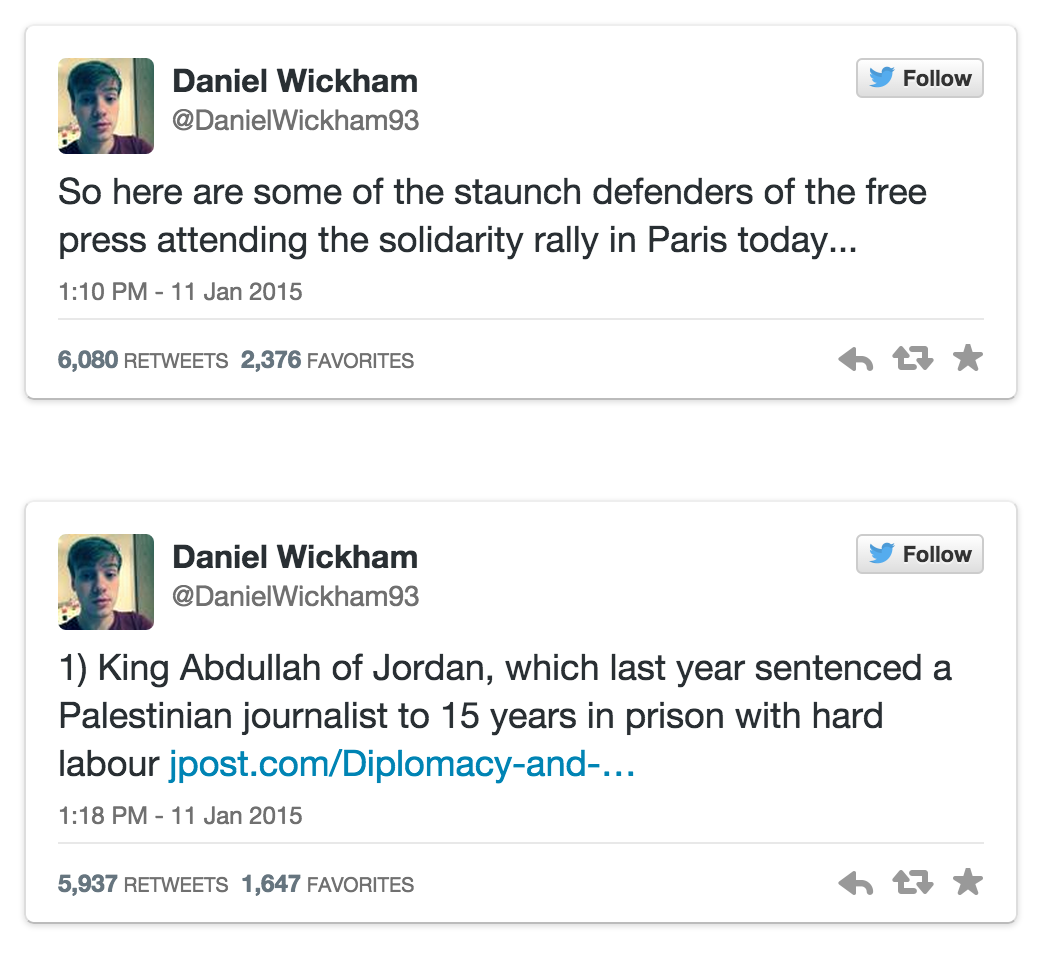
Since some claim that free speech was attacked last week, a tweet by Daniel Wickham raised some poignant questions about Sunday’s march against terrorism. The London School for Economics co-president revealed in 21 tweets how those very world leaders that marched on Sunday persecuted journalists and the media in their countries.

Näyttökuva 2015-1-13 kello 7.30.29

Read full story here.


Umayya Abu-Hanna offers us some insight on the types of fruits the Charlie Hebdo attack will bear on her Facebook wall below. She agrees that hypocrisy and denial will remain but a “general fear in the West” as well.

What do we fear the most? Violence? Muslims? Our usual hubris and imperialism?

Or all of the above?

Näyttökuva 2015-1-12 kello 8.58.37


Finally Gavan Titley sums up the latter questions with a posting on his Facebook page. He said that what he wrote was a reaction after reading a range of columns in the Irish and British Sunday papers.

Näyttökuva 2015-1-12 kello 15.13.42


Arson attack against mosque in Sweden is another red light flashing in the roaring silence

Posted on December 26, 2014 by Migrant Tales

 A mosque in Sweden that was hit by arson on Christmas Day is the latest warning that we cannot stand idly to the ever-rising tide of Islamophobia and far-right violence griping Europe these days. Words are not regular bullets that kill instantly but are time bombs that can explode anywhere and anytime. 

The attack against the mosque that injured five in Eskilstuna, a city with a large immigrant population located west of the capital Stockholm, came after Sweden Democrat party secretary Björn Söder claimed over a week ago that Jews, Kurds and the Saami cannot be considered “true” Sweden unless they assimilate into Swedish society.

Anti-immigration parties support assimilation, or one-way integration of migrants and minorities, while in theory at least the adaption process should be a two-way street (integration).

Näyttökuva 2014-12-26 kello 1.30.41

Read full story here.


Söder’s statement doesn’t only expose his issues with racism but a whole mindset of hostility towards cultural diversity.

In other words, the Sweden Democrats, which brought down on December 3 the minority government of Prime Minister Stefan Löfven, since the far-right party holds the balance of power in the country, believe that migrants and minorities must become white Swedes like him in order to be accepted as “true” Swedes.

What is a true Swede anyway? All Swedes migrated many generations ago to this part of Europe. The Garden of Eden never existed and is only a myth used in nativist ultra-nationalistic discourse.

In such logic we find as well the seeds of hatred and the failed assimilation policies of anti-immigration parties.

Is it only a question of time when such parties – if they ever get enough power – will start drafting modern Nuremberg Laws to stamp out cultural diversity? Can we afford to wait passively to see if this will happen?

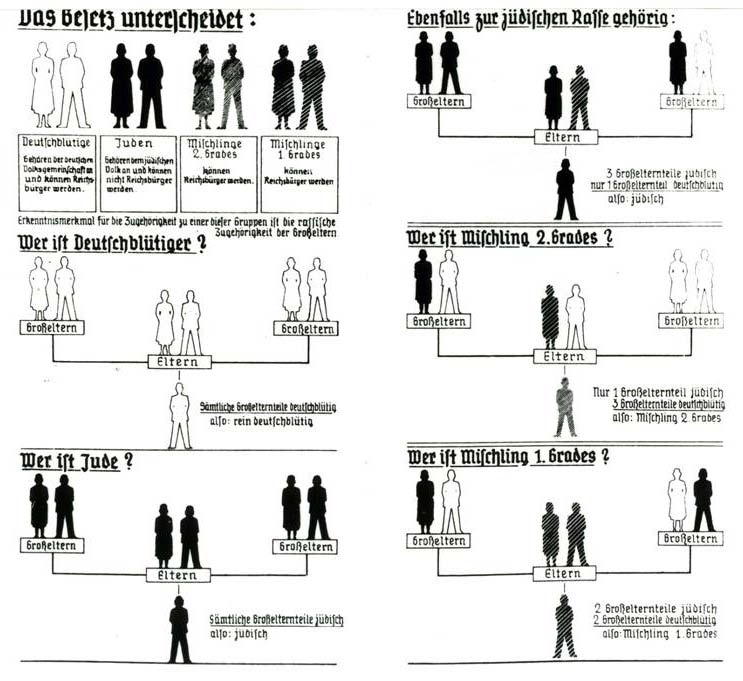
Any sensible person can tell that the classification of who is a “true” Swede, or “true” European, is more than problematic. Nazi Germany found this out when it enacted the Nuremberg Laws and Reich Citizenship Law of 1935 to classify partial Jews, or Mischlinge.

nzakony2

Here’s how Nazi Germany classified Jews: full Jews and Jewish Mischling first or second degree. What these types of classifications revealed was anti-Semitism than anything else. Source: www.neztratitviru.net 


What does a European anti-immigration party mean when it classifies itself as ethnically pure and the rest who are not like it as a threat? What do the Perussuomalaiset (PS)* and far-right Muutos 2011 of Finland mean when they claim that Muslims won’t integrate, Muslims are destroying our way of life, and Muslims are violent? What code does the National Front of France signal to its followers when it makes an anti-kebab statement, or when Jobbik of Hungary, Golden Dawn of Greece and Ukip openly target Jews and immigrants?

Rob Owen Bell wrote on a recent opinion piece claims that Islamophobia in the UK (and in Europe) is code for race-hate and religious bigotry:

While it is only right that we feel pity for the rare victims of this bizarre condition, we cheapen their suffering by continuing to tolerate the use of the term as code for race-hate and religious bigotry. How much longer are we going to give a platform to thugs in suits struggling to keep a straight face for the cameras as they state they’re “not racist, just against radical Islam”, while their mates swill Stella and chuck Nazi salutes in the background?

One matter is for certain: Things will get worse as long as politicians continue to accept such intolerance by remaining silent and treat racism with bandaids. We need more radical steps are needed to challenge the threat to Europe imposed by fascist, crypto-fascist anti-immigration parties.

Change will not take place as long as migrants and minorities are kept out of the decision-making process.

Why does a country like Finland, which has so few migrants when compared with other European countries, voted in 2011 for an anti-immigration party like the PS that become the third-largest bloc in parliament?

In my opinion it shows that most politicians in Finland, as well as our institutions and society, are still very much in the dark about the threat of fascism and nativist nationalism.

Finland’s xenophobia has its roots in the difficult relationship it had with the former Soviet Union in the last century. Everything was acceptable back then, even becoming an ally of Nazi Germany in the Continuation War (1941-44), as long as your reasoning was hatred of the USSR and communism.

We cannot effectively challenge intolerance in Finland as long as we continue to teach at our schools and homes that immigration and cultural diversity are illnesses. We should be teaching the opposite: inclusion and respect for difference and cultural diversity. Acknowledging that over 1.2 million Finns emigrated between 1860 and 1999 is a good starting point.

If Finland has many unanswered questions about how it went to bed with Nazi Germany during the Continuation War, Europe too has a serious issue with its colonial past and which still continues to bolster racism in all forms and shapes. 

Europe needs today a totally new discourse on our identity in the new century and strong anti-discrimination laws that have teeth. As long as we teach the same myths and social constructs of the past, we are only delaying such a crucial debate just like the US delayed and continues to delay black and minority rights.

By delaying that important debate we permit ourselves to be chained by our intolerance.

Racism has always been Europe’s greatest threat.

It’s high time we understand this unless we want to commit the same disastrous mistakes of the past.

* The Finnish name for the Finns Party is the Perussuomalaiset (PS). The English names of the party adopted by the PS, like True Finns or Finns Party, promote in our opinion nativist nationalism and xenophobia. We therefore prefer to use the Finnish name of the party on our postings.

Institute of Race Relations: Roma – fascism’s first victims, again

Posted on November 15, 2014 by Migrant Tales

Liz Fekete

Anti-Roma violence draws strength from fascist ideas that linger on in mainstream European thought.

On 15 September, a Roma man from Romania, homeless in Sweden, died of injuries sustained on 31 August, when a fire broke out at a Roma temporary tent camp in Högdalen, southern Stockholm. We will probably never know whether the man, who has not been named, was the victim of a tragic accident, or whether his tent was deliberately set on fire by racists who, in months previous, had been very vocal on social media disseminating information on the location of Sweden’s temporary Roma encampments. The reason why the truth may prove elusive rests with police officers who, on arriving at the scene of the fire, assumed that it had been caused by the carelessness of the Roma themselves. The Roma had other views, but by the time they persuaded the police to act like investigators and keep an open mind, the damage had been done. As it took the police several hours to cordon off the charred campsite for a forensic examination, what might have been a murder scene was compromised, and vital forensic evidence lost.

lady-in-front-of-burnt-traveller-trailer-300x154

Irish Traveller in front of a trailer destroyed in an arson attack.

THE LEGACY OF FASCIST IDEAS

Given all we know about far-right hated of the Roma, current and historical, why would the police be so quick to rule out a racial motive?

In order to understand the unexceptional tunnel-vision of the Swedish police, it is perhaps necessary to turn to mainstream culture, to consider the ways that Roma, Gypsies and Travellers are discussed on social media, in newspapers, TV, in educational materials and textbooks. (Consider the current protests in Madrid over the twenty-third edition of the dictionary of the Royal Spanish Academy which defined a ‘gypsy’ as ‘one who lies and cheats’.)[1] Not only is there widespread cultural ignorance of the lasting impact of the Holocaust on Roma communities, but also a lack of insight into the ways in which mainstream discourses today replicate, albeit (in most, but by no means all, cases) in muted form, the fascist thinking of the 1930s. At least half a million and perhaps as many as 1.5 million Roma died in the Porajmos, or the Great Devouring, as the Holocaust is known amongst the Roma. While the Nuremburg Laws of 1935 marked the Roma out, alongside the Jews, for the Final Solution, the Roma and Sinti had already been decimated through the Nazi’s social hygiene programmes. At the centre of Nazi ideology was eugenics (improvement of the genetic stock), the ideas surrounding which were not unique to fascism but grew out of Social Darwinism, a mainstream ‘science’ in Europe and the United States in the nineteenth and twentieth centuries. The Nazis were to drive the logic of eugenics forwards to its ultimate barbaric limits. Certain categories of people – the criminal, degenerate, homosexual, idle, feeble-minded, disabled and insane – were selected for forced labour or concentration camps. For the Nazis, they were ‘deviant’, ‘asocial’ and ‘workshy’, summed up in Hitler’s phrase ‘life unworthy of life’ (Lebensunwertes Leben). Under the 1933 Law for the Prevention of Hereditarily Diseased Offspring, Roma and Sinti were selected for compulsory sterilisation and, later, in 1939, for extermination under the Action T-4 forced euthanasia programme. In this way, Roma were treated by the Nazis, as both a social and genetic threat to the ‘master race’, and then, after the Nuremberg Laws, as a ‘racial threat’ . But given that in today’s post-Holocaust Europe, scientific racism is no longer acceptable, it is the social hygiene component of fascism that lingers in modern attitudes towards the Roma. The legacy of fascism is evidenced in our failure to hold to account those who, directly or indirectly, refer to the criminal culture and deviant lifestyle of the Roma.

It should also be remembered that sterilisation programmes persisted in many European countries, long after the end of the second world war. Even in the so-called egalitarian paradise of Sweden, from 1935-1976 the state forcibly sterilised some 60,000 women under a eugenics programme designed to rid the country of inferior racial stock. Meanwhile, the universal failure of European societies to recognise Roma suffering during the Holocaust, meant that textbooks and education materials were not readily scrutinised for anti-Roma content (witness the Spanish dictionary scandal, mentioned above). In fact, in Germany the Porajmos was only officially acknowledged in 1982 and only in 2011 was a Roma representative officially asked to speak at the German Holocaust Memorial Day.[2]

SOCIAL FASCISM IN EASTERN EUROPE

All these failures ensured that hostility and violence against the Roma continued in the post-war period, with barely a ripple of mainstream protest. There were pogroms against the Roma in Hungary and Romania in the 1990s, with the Romanian police actively participating in the most infamous of the attacks in Hãdãreni in 1993, during which three Romani men were killed and eighteen Romani houses were destroyed.[3] During a 14-month period in 2009-10, Hungarian neo-Nazi serial killers murdered six Roma and engaged in countless other attacks, including arson, in nine small towns and villages in central and eastern Hungary.[4] The social hygiene ideas of the Nazis, the equation of Roma lifestyles with social degeneracy, as well as the over-breeding that threatens the ‘racial stock’, linger on across much of eastern Europe, painfully affecting the marginalised and impoverished Roma. In the Slovakian town of Kosice, the Magnificent Seven Party (7 Stato?ných, and, yes, they actually wear cowboy hats), are calling for ‘gypsies’ to be rounded up and put on flights to Europe, and for sterilisation programmes (albeit voluntary, whatever that means in this context) for any Roma women who remain.[5] Between 1971 and 1991, the sterilisation of Roma woman, often during a Caesarean section or an abortion, and without their knowledge, was state practice across Czechoslovakia.[6]

Out of the mouths of respectable politicians, as well as judges, come the same social stereotypes, the same discriminatory words . In April 2014, a judge in a court in Gyula in Békés county, Southeast Hungary, rejecting a bid to dissolve the paramilitaries of the Szebb Jövõt Vigilante Association (closely linked to Jobbik and the previously dissolved Hungarian Guard), summed up by declaring that ‘Being a Roma should not be primarily interpreted as a racial category, rather as a way of life led by a group of people who stand apart from the traditional values of majority society, and whose lifestyle is characterized by the avoidance of work and the disrespect of private property and the norms of living together.’ Meanwhile, on 2 August in the Czech Republic , Tomio Okamura, previously an independent senator loosely aligned with Christian Democrats, but now leader of the breakaway far-right Dawn of Direct Democracy, chose the occasion of Roma Holocaust Day to describe the Lety concentration camp (where Roma were interned during the Nazi occupation, with many sent on to Auschwitz) as a ‘labour camp for persons who were avoiding proper work’, and where people died of old age and ‘diseases they brought with them as a result of their previous travelling lifestyle’. Now, Facebook pages are spring up across the Czech Republic with names and slogans such as ‘We demand impunity for shooting gypsies’, ‘We don’t want to feed the Romani population’ and ‘We Demand the Public Execution of the Executive Director of Romea’.

WESTERN AND NORTHERN EUROPE – IT’S NO JOKE

Anti-Roma hatred is reaching vile levels. But the most shocking aspect of the hate is the tacit support given by respectable politicians – across Europe, from South to North, from East to West – for views that may fall short of denouncing the Roma as a ‘racial threat’, but replicate the Nazi view of Roma as delinquent and workshy and a social threat to Europe.

It’s far too simplistic to label this an eastern European post-Communist problem, (with the snide undercurrent that you can’t expect more from the economically and socially backward East). Vile comments, most often passed off as humour, emanate from the mouths of our supposedly more enlightened western and northern European politicians on a daily basis. Witness the UK’s Maidenhead Conservative councillor’s recent comment (a misplaced joke he claims), at a council meeting, that one way to speed up the council’s evictions of Travellers, would be to ‘Execute them’.[7] Or the comments of Gilles Bourdouleix, the deputy mayor of a constituency in the French Maine-et-Loire region, who remarked, during a confrontation with Roma at a camp in Cholet, that ‘maybe Hitler did not kill enough Gypsies’. (A misunderstanding, his comments aimed at no one in particular, he protests!)[8]

It is in France, where Facebook pages call for the elimination of the Roma, that violence has, according to the League of Human Rights, reached ‘pathological’ levels.[9] The League blames government policies and high-profile eviction programmes. One particularly horrendous incident occurred in June 2014, when a 16-year-old teenager from Romania, known as Gheorghe C, only narrowly escaped death after suffering life-threatening injuries, including a fractured skull, following an ‘attempted lynching’. The teenager was kidnapped from a Roma encampment in the Pierrefitte-sur-Seine area, north of Paris by a gang of hooded men and tortured in the basement of a housing estate in the Seine Sans Denis area, north of Paris. Finally, unconscious, his body was discovered dumped in a shopping trolley left on the side of the national motorway. His violent treatment was greeted with expressions of support on many online portals.

But this is only one in a catalogue of violent attacks across northern and western Europe which, like in Sweden, have centred on Roma living in tent-encampments and other easily-identifiable living spaces. Not a week goes by without the reporting of another disturbing incident. To take just a few of the most recent: in September 2014, in Germany, in the Silberhöhe neighbourhood of Halle, neo-Nazis took over an online rant against the Roma. It started out on Facebook but fascists upped the ante, infiltrating protests, and spraying swastikas and racist comments on buildings, roads and sidewalks.[10] In October, in Ireland, multiple Facebook campaigns appeared around the theme of ‘Get Roma criminal gypsies out’, (Roma were described on posts as ‘cockroaches’ and ‘c***s’). Shortly after, Roma families had to be evacuated from their Waterford home, after around sixty people gathered outside their house, chanting ‘Roma, out, out, out’ and other obscenities.[11] The Pavee Point Traveller and Roma centre is mobilising support for the families.

It’s the same story in France and the UK, where the National Federation of Gypsy Liaison Groups’ most recent report, on Gypsy, Traveller and Roma integration, highlights abusive media coverage and overtly racist statements from local and national politicians as cause for concern. The report carries a photo of the burnt out caravan of a Traveller family forced out of their home.

‘THE HOMELESS DEAD’[12]

But to return to Sweden, and the death of the Romanian Roma man in Högdalen. The police, reporting themselves to their own ethics committee for their handling of the fire,[13] have now admitted that they were unaware of the social media campaign to identify Roma encampments, as well as previous incidents, when Roma had had their tents cut with knives, for instance, or a caravan was set on fire. As one solidarity campaigner I spoke to said, ‘The Roma witnesses believe that the fire was an act of arson, though no one had seen the attacker or attackers, and we now find ourselves in the unfortunate situation that total clarity will probably never be reached on this.’ Meanwhile, the name of the Romanian Roma man who died has not been reported. This will most likely go down in the records as just another death amongst the ranks of the European homeless, a growing proportion of whom, according to the European Federation of National Associations Working with the Homeless, are migrants, and an unknown number Roma.[14]

Read original story here.

This piece was reprinted by Migrant Tales with permission.

RELATED LINKS

IRR Briefing Paper: From pillar to post: pan-European racism and the Roma

European Roma Rights Centre

Pavee Point Roma and Traveller Centre

National Federation of Gypsy and Traveller Liaison Groups

Roma Feminist Association for Diversity (AGFD)

FEANTSA

Europe Roma

References: [1] The protests are being organised by the Association of Feminist Gypsies for Diversity. See ‘Gypsies protest over dictionary definition’, Guardian (30 October 2014). [2] See Ian Hancock, The Pariah Syndrome (Karoma, 1987). [3] The 21-year search for justice for the victims is ongoing. In July 2014, following a case brought by the ERRC and Romani Crises, the Cluj Napoca Court of Appeal found the government had failed to honour previous commitments made to the victims and the community of Hãdãreni. See a European Roma Rights Centre press release (29 July 2014). [4] No government official visited any of the victims’ families or offered an apology. Finally, in the autumn of 2014, the government agreed compensation for those who suffered bodily injuries, or lived in a common household with either the victim or with the person injured during the attacks, or was a close relative. Many of the victims were left disabled for life and with psychological problems, forced to live in the most desperate conditions, without money for medication or food. See Deutsche Welle (2 August 2014). [5] ‘Slovak plan to give Gypsies free flights to the UK’, Croatian Times (16 October 2014). [6] See ‘Forced sterilisation of Romani women – a persisting human rights violation’, Romedia Foundation (7 February 2013). [7] Maidenhead Advertiser (22 October 2014). [8] He was subsequently convicted of hate speech and expelled from the French Union of Democrats and Independents. See ‘French mayor who claimed Hitler “did not kill enough” Roma gypsies avoids jail’, Telegraph (12 August 2014). [9] ‘Forced Evictions in France: absurdly stubborn, stubbornly absurd’, European Roma Rights Centre (7 April 2014). [10]  ‘Hetze gegen Roma. Polizei verstärkt Präsenz in Silberhöhe’, Mitteldeutsche Zeitung (20 July 2014). [11] ‘Ireland: Waterford anti-Roma protests criticised as “cowardly and racist”’, Irish Times (27 October 2014). [12] For an excellent discussion about the problems of trying to account for the homeless who are dying in their droves, see Lise Grout, Cécile Rocca and Christophe Louis, ‘Counting and Describing “The Homeless Dead” – a vital activity to better understand the dead and better help the living’, in Homeless in Europe (magazine of FEANTSA, Winter 2012/2013). [13] ‘Police report themselves over fatal fire at Roma camp’, Radio Sweden (22 September 2014). [14] See ‘Homelessness amongst Immigrants in the EU – a service provider’s perspective’, FEANTSA (June 2013).

The Institute of Race Relations is precluded from expressing a corporate view: any opinions expressed are therefore those of the authors.


European Network Against Racism first hate speech report

Posted on May 8, 2014 by Migrant Tales

In March, the European Network Against Racism (ENAR) and European Region of the International Lesbian, Gay, Bisexual, Trans & Intersex Association (ILGA-Europe) launched an Appeal for an election campaign free from discrimination and intolerance, urging European parties to condemn discriminatory or intolerant remarks during the European Parliament election campaign.
An online form was launched, enabling the public to report discriminatory or intolerant incidents during the campaign. This report compiles submissions received so far.

8 May 2014

After 6 weeks of campaigning, we received 17 valid reports of hate speech against minorities.

Reports consisted mostly of incitement to hatred, prejudice or discrimination, either implicitly (6 in 10) or explicitly (4 in 10). Incidents also included attacks on the dignity of minority groups—and notably migrants, asylum-seekers and ethnic minorities. Derogatory or insulting language was also noted in several cases (4 in 10).

A large number of reports (3 in 10) originated from the United Kingdom; however, language self-selection and the collection methodology means this may not be representative of the genuine occurrence of hate speech across the campaign in the EU.

Finally, reports have mostly come from the political margins, with most coming from candidates with no European party affiliation (6 in 10), or from European parties from the radical right (2 in 10).

We will continue monitoring incidences of hate speech in the context of the campaign, and publish further updates, including possible new reactions by political parties.

Read the full report here

  • nohateep2014_-_report.pdf (PDF – 301.3 kb)


The anti-immigration menace in Europe and Finland is real and we must do something to challenge it

Posted on April 29, 2014 by Migrant Tales

Migrants were very active in the early 1980s and on October 19, 1982 we marched for the first time since a group of East Pakistanis, today Bangladesh, marched from Helsinki to Turku in the early 1970s demanding work.  The march by the East Pakistanis may have been the first by foreigners in Finland. 

Migrants and Finns should join hands as they did in 1982 and the early 1970s demanding civil rights and jobs.

According to a blog by Pekka Myrskylä, Statistics Finland development manager, the majority of  migrants in Finland live in poverty. If this is true, shouldn’t this worry us? Shouldn’t we begin to do something about the ever-growing inequality and poverty among migrants as well as Finns?

The likelihood that anti-immigration and populist political parties will make significant gains in the European parliamentary (MEP) elections on May 25 is other disturbing writing on the wall. Finland’s anti-immigration Perussuomalaiset are expected also to do well in next month’s elections.

The question is what do we do if Europe makes a deeper turn to the populist anti-immigration right. Should we stand idle and silent and see how our rights are being watered down or act?

If we look at the marches of the early 1970s and 1982, the answer is clear: unite and challenge the beast.


Näyttökuva 2014-4-29 kello 15.08.18
A flyer distributed for the October 19, 1982 march demanded hunan and civil rights for migrants.
IMG_2981
A poster asking migrants and Finns to take part in the October 19, 1982 march.


Cultural and ethnic diversity are who we are

Posted on March 23, 2014 by Migrant Tales

When you do everything possible to undermine diversity you end up letting out the genie out of the bottle.        

If we look at the political climate in Finland today with the rise of an anti-EU, anti-immigration and especially anti-Islam party like the Perussuomalaiset (PS) in 2011, it’s clear that the genie that came out of the bottle is out for blood.  

london-2-400x266

Despite the hostility of some Finns and Europeans to our ever-growing culturally and ethnically diverse societies, the million-euro question is how to we challenge those very values that are stoking and fanning hatred?

Is the answer in educating present and future generations on how culturally and ethnically diverse we Europeans have always been?

Finland is a culturally and ethnically diverse society. For one, over 1.2 million Finns emigrated from this land between 1860 and 1999. Moreover, we all came from somewhere else. Some of us have been longer and others a shorter time in Finland.

We are all, however, Finns of different backgrounds and orientations. Most importantly we live in a society that permits us to determine our identity and lifestyles.

The interesting question to ask is why some Finns, or why our official history, still speaks of Finns in terms of one group if there are many?

We all came from somewhere else. Why did it take me so many decades to uncover the Jewish side of my family? Why did many of my relatives rarely bring this up? Why was it swept under the carpet for so many decades?

All Finns, like all Europeans, have a fascinating history to tell but which has been intimidated by intolerance, nationalism, war and a deep suspicion for cultural and ethnic diversity that still exists today.

As we race deeper into the new century,  we should take bolder steps to teach present and future generations about the our cultural and ethnic diversity and, most importantly, that we should respect such an order of things.

European Network Against Racism report highlights Finland’s racism and discrimination challenges

Posted on March 21, 2014 by Migrant Tales

Shadow reports on racism in Europe by the European Network Against Racism (ENAR) reveals something we’ve not known and written about on Migrant Tales for a long time. Apart from racism and discrimination happening in employment, the question behind the question is why is this still an issue? Why are governments still doing too little?

Näyttökuva 2014-3-21 kello 9.26.27

Read full report here.

Unemployment in Finland is three times higher than the national average, which stood at 8.5% in January, according to Statistics Finland. Even so, you rarely if ever hear politicians or the media bring this fact to public attention. Certainly some do but to show how much of a problem and burden migrants are to our society.

While there are some bold moves to change the current situation like the municipality of Helsinki, which is trying out job applications from anonymous job applications, too little is being done.

The Social Democratic Party of Finland is calling that anonymous applications  for state and municipal jobs should be standard practice throughout Finland.

While anonymous job applications clearly show that the migrant unemployment problem may reside with the employer’s prejudices when hiring, one of the key arguments used not to hire migrants and visible minorities is poor Finnish- language skills.

While this may be in some cases, too many Finns, like Finnish-language teachers, place too much emphasis on language. While learning Finnish or Swedish is crucial, it’s not a panacea.

One has only to go to Spain, where there are large Latin American migrant groups who speak Spanish as their native language and are even Catholics. Despite having the same language and religion, discrimination and racism still take place. It shows that adaption and integration are a complex process that hinges on many factors.

Simplifying a social ill like exclusion, racism and discrimination waters down our response to challenge such issues because we lose sight of the other culprits that play equally important roles in the problem.

Just like the U.S. Civil Rights Movement of the 1950s and 1960s, improving employment among migrants and minorities should be a key priority. It should also be a clarion call of migrants and minorities in Finland and Europe.

So what does the ENAR shadow report on Finland, which cites Migrant Tales as a source, say?

Below are some of its recommendations in the 2013 report:

  • There should be a concerted campaign through for, instance, diversity training and race awareness education to counter Finnish employers’ prejudice towards hiring migrants and ethnic minorities.
  • Migrants and ethnic minorities should be encouraged to report discrimination and discriminatory practices at work. They need to be assured by, for example, by NGOS and employment protection bodies such as the Regional State Administrative Agencies about the safeguards against victimisation and harassment prescribed in Finnish legislation.
  • Recruitment regulations should be clear and straightforward, and enshrined in law, with clear penalties and sanctions for violating them.
  • Finnish anti-discrimination legislation should be streamlined, and being able to file complaints under it should be made easier for migrants and other ethnic minorities. At the moment, there are diverse provisions of anti-discrimination legislation, which makes it difficult for migrants and even representatives of the native population to understand them.
  • As a result of the dismantling of the labour offices, which were part of a nationwide reform, such offices should again be available to all unemployed migrants and ethnic minorities.
  • The labour offices should be structured to cater for the employment needs of migrants and ethnic minorities.
  • Trade unions and other non-governmental organizations should be more active in fighting labour market discrimination and promote multiculturalism.

Why are Europe’s Islamophobic politicians and parties so “pro-Israel?”

Posted on March 1, 2014 by Migrant Tales

Are you sometimes surprised to read about how many far-right anti-immigration groups are so pro-Israel? Some, like anti-Islam Perussuomalaiset (PS) MP Juho Eerola of Finland, may go as far as to draft a written question to parliament demanding that Muslims renounce publicly their hatred of gays and Jews.

Kuvankaappaus 2014-3-1 kello 11.10.42

A posting by Migrant Tales reposted on Greece’s UNHCR’s website.

Should we believe Eerola taking into account his loathing of cultural diversity never mind Muslims? Isn’t this the same person who wrote in 2010 that he is attracted to fascism and Benito Mussolini’s economic policies?

Let’s take a step further. Eerola’s aide, Ulla Pyysalo, applied for membership in a neo-Nazi association and has labelled migrants raccoon dogs.

Why do these types of people, who openly support fascism or hate Muslims, may be so pro-Israel? Why do far-right personalities like Geert Wilders of Holland and Pia Kjærsgaard of Denmark “support Israel?” Even if the Sweden Democrats have tried to build a new image from their neo-Nazi past and that the party leader Jimmie Åkesson’s “support Israel,” I wonder how many Jews trust him and the Islamophobic party.

Folks, let’s get real. These so-called “support Israel” politicians insult Jews and the Holocaust with their fake and opportunistic slogans. If these people lived in Europe during the twelve-year Nazi German reign of terror in 1933-45, how many would support Israel and Jews?

Since far-right and anti-immigration politicians and parties need scapegoats, the question we should ask is who is the next victim and group.

It’s a clear warning we’ve heard before in today’s Europe: After the immigrants, you’re next.


  • Previous
  • 1
  • 2
  • 3
  • 4
  • 5
  • 6
  • 7
  • …
  • 12
  • Next
Read more about documentary film
Read more

Recent Posts

  • Finland’s tabloids Iltalehti and Ilta-Sanomat are the pits
  • Riikka Purra’s Dr Jekyll and Mr Hyde mask
  • Double standards
  • Perussuomalaiset: Uusi logo, sama vanha juttu
  • Taco Trump

Recent Comments

  1. Absolutely Socking: Racist Finnish Facebook group against human rights gets flooded with socks on Musta Barbaari’s mother and sister charged by the police in “ethnic profiling” case
  2. Ilkka Nuotio on Pekka Myrskylä: “Tilastot kertovat toista kuin poliittinen keskustelu”
  3. Genrih Soinkara on The war in Ukraine and the Russian-Finnish border crisis are showing Finland’s ugly side
  4. Ahti Tolvanen on Comment by Ahti Tolvanen on the Helsinki +50 conference
  5. Angel Barrientos on Angel Barrientos is one of the kind beacons of Finland’s Chilean community

Archives

  • June 2026
  • May 2026
  • April 2026
  • March 2026
  • February 2026
  • January 2026
  • December 2025
  • November 2025
  • October 2025
  • September 2025
  • August 2025
  • July 2025
  • June 2025
  • May 2025
  • April 2025
  • March 2025
  • February 2025
  • January 2025
  • December 2024
  • November 2024
  • October 2024
  • September 2024
  • August 2024
  • July 2024
  • June 2024
  • May 2024
  • April 2024
  • March 2024
  • February 2024
  • January 2024
  • December 2023
  • November 2023
  • October 2023
  • September 2023
  • August 2023
  • July 2023
  • June 2023
  • May 2023
  • April 2023
  • March 2023
  • February 2023
  • January 2023
  • December 2022
  • November 2022
  • October 2022
  • September 2022
  • August 2022
  • July 2022
  • June 2022
  • May 2022
  • April 2022
  • March 2022
  • February 2022
  • January 2022
  • December 2021
  • November 2021
  • October 2021
  • September 2021
  • August 2021
  • July 2021
  • June 2021
  • May 2021
  • April 2021
  • March 2021
  • February 2021
  • January 2021
  • December 2020
  • November 2020
  • October 2020
  • September 2020
  • August 2020
  • July 2020
  • June 2020
  • May 2020
  • April 2020
  • March 2020
  • February 2020
  • January 2020
  • December 2019
  • November 2019
  • October 2019
  • September 2019
  • August 2019
  • July 2019
  • June 2019
  • May 2019
  • April 2019
  • March 2019
  • February 2019
  • January 2019
  • December 2018
  • November 2018
  • October 2018
  • September 2018
  • August 2018
  • July 2018
  • June 2018
  • May 2018
  • April 2018
  • March 2018
  • February 2018
  • January 2018
  • December 2017
  • November 2017
  • October 2017
  • September 2017
  • August 2017
  • July 2017
  • June 2017
  • May 2017
  • April 2017
  • March 2017
  • February 2017
  • January 2017
  • December 2016
  • November 2016
  • October 2016
  • September 2016
  • August 2016
  • July 2016
  • June 2016
  • May 2016
  • April 2016
  • March 2016
  • February 2016
  • January 2016
  • December 2015
  • November 2015
  • October 2015
  • September 2015
  • August 2015
  • July 2015
  • June 2015
  • May 2015
  • April 2015
  • March 2015
  • February 2015
  • January 2015
  • December 2014
  • November 2014
  • October 2014
  • September 2014
  • August 2014
  • July 2014
  • June 2014
  • May 2014
  • April 2014
  • March 2014
  • February 2014
  • January 2014
  • December 2013
  • November 2013
  • October 2013
  • September 2013
  • August 2013
  • July 2013
  • June 2013
  • May 2013
  • April 2013
  • March 2013
  • February 2013
  • January 2013
  • December 2012
  • November 2012
  • October 2012
  • September 2012
  • August 2012
  • July 2012
  • June 2012
  • May 2012
  • April 2012
  • March 2012
  • February 2012
  • January 2012
  • December 2011
  • November 2011
  • October 2011
  • September 2011
  • August 2011
  • July 2011
  • June 2011
  • May 2011
  • April 2011
  • March 2011
  • February 2011
  • January 2011
  • December 2010
  • November 2010
  • October 2010
  • September 2010
  • August 2010
  • July 2010
  • June 2010
  • May 2010
  • April 2010
  • March 2010
  • February 2010
  • January 2010
  • December 2009
  • November 2009
  • October 2009
  • September 2009
  • August 2009
  • July 2009
  • December 2008
  • November 2008
  • October 2008
  • September 2008
  • August 2008
  • July 2008
  • June 2008
  • May 2008
  • April 2008
  • March 2008
  • February 2008
  • January 2008
  • November 2007
  • October 2007
  • September 2007
  • August 2007
  • July 2007
  • June 2007
  • May 2007

Categories

  • ?? Gia L?c
  • ????? ?????? ????? ???????? ?? ??????
  • ???????
  • @HerraAhmed
  • @mondepasrond
  • @nohatefinland
  • @oula_silver
  • @Varathas
  • A Pakistani family
  • äärioikeisto
  • Abbas Bahmanpour
  • Abdi Muhis
  • Abdirahim Hussein Mohamed
  • Abdirahim Husu Hussein
  • Abdirisak Mahamed
  • About Migrant Tales
  • activism
  • Adam Al-Sawad
  • Adel Abidin
  • Afrofinland
  • Ahmed IJ
  • Ahti Tolvanen
  • Aino Pennanen
  • Aisha Maniar
  • Alan Ali
  • Alan Anstead
  • Alejandro Díaz Ortiz
  • Alekey Bulavsev
  • Aleksander Hemon
  • Aleksanterinliitto
  • Aleksanterinliitto ry
  • Aleksanterinliitto ry:n hallitus
  • Alex Alex
  • Alex Mckie
  • Alexander Nix
  • Alexandra Ayse Albayrak
  • Alexis Neuberg
  • Ali Asaad Hasan Alzuhairi
  • Ali Hossein Mir Ali
  • Ali Rashid
  • Ali Sagal Abdikarim
  • Alina Tsui
  • Aline Müller
  • All categories
  • Aman Heidari
  • Amiirah Salleh-Hoddin & Jana Turk
  • Amin A. Alem
  • Amir Zuhairi
  • Amkelwa Mbekeni
  • Ana María Gutiérrez Sorainen
  • Anachoma
  • Anders Adlecreutz
  • Angeliina Koskinen
  • Anna De Mutiis
  • Anna María Gutiérrez Sorainen
  • Anna-Kaisa Kuusisto ja Jaakko Tuominen
  • Annastiina Kallius
  • Anneli Juise Friman Lindeman
  • Announcement
  • Anonymous
  • Antero Leitzinger
  • anti-black racism
  • Anti-Hate Crime Organisation Finland
  • Anudari Boldbaatar
  • Arshiya Nasser
  • Aspergers Syndrome
  • Asylum Corner
  • Asylum seeker 406
  • Athena Griffin and Joe Feagin
  • Autism
  • Avaaz.org
  • Awale Olad
  • Ayan Said Mohamed
  • AYY
  • Barachiel
  • Bashy Quraishy
  • Beatrice Kabutakapua
  • Beri Jamal
  • Beri Jamal and Enrique Tessieri
  • Bertolt Brecht
  • Boiata
  • Boodi Kabbani
  • Bruno Gronow
  • Carmen Pekkarinen
  • Çelen Oben and Sheila Riikonen
  • Chiara Costa-Virtanen
  • Chiara Costa-Virtanen
  • Chiara Sorbello
  • Christian Thibault
  • Christopher Wylie
  • Clara Dublanc
  • Dana
  • Daniel Malpica
  • Danilo Canguçu
  • David Papineau
  • David Schneider
  • Dexter He
  • Don Flynn
  • Dr Masoud Kamali
  • Dr. Faith Mkwesha
  • Dr. Theodoros Fouskas
  • Edna Chun
  • Eeva Kilpi
  • Emanuela Susheela
  • En castellano
  • ENAR
  • Enrique
  • Enrique Tessieri
  • Enrique Tessieri & Raghad Mchawh
  • Enrique Tessieri & Yahya Rouissi
  • Enrique Tessieri and Muhammed Shire
  • Enrique Tessieri and Sira Moksi
  • Enrique Tessieri and Tom Vandenbosch
  • Enrique Tessieri and Wael Che
  • Enrique Tessieri and Yahya Rouissi
  • Enrique Tessieri and Zimema Mhone
  • Epäluottamusmies
  • EU
  • Europe
  • European Islamophobia Report
  • European Islamophobia Report 2019,
  • European Union
  • Eve Kyntäjä
  • Ezequiel Caldeiro
  • Facebook
  • Fadumo Dayib
  • Faisa Kahiye
  • Farhad Manjoo
  • Fasismi
  • Finland
  • Fizza Qureshi
  • Flyktingar och asyl
  • Foreign Student
  • Fozia Mir-Ali
  • Frances Webber
  • Frida Selim
  • Gareth Rice
  • Ghyslain Vedeaux
  • Global Art Point
  • Great Replacement
  • Habiba Ali
  • Hami Bahadori
  • Hami Bahdori
  • Hamid
  • Hamid Alsaameere
  • Hamid Bahdori
  • Handshake
  • Harmit Athwal
  • Hassan Abdi Ali
  • Hassan Muhumud
  • Heikki Huttunen
  • Heikki Wilenius
  • Helsingin Sanomat
  • Henning van der Hoeven
  • Henrika Mälmsröm
  • Hser Hser
  • Hser Hser ja Mustafa Isman
  • Husein Muhammed
  • Hussain Kazemian
  • Hussain Kazmenian
  • Ibrahim Khan
  • Ida
  • Ignacio Pérez Pérez
  • Iise Ali Hassan
  • Ilari Kaila & Tuomas Kaila
  • Imam Ka
  • inside-an-airport
  • Institute of Race Relations
  • Iraqi asylum seeker
  • IRR European News Team
  • IRR News Team
  • Islamic Society of Norhern FInland
  • Islamic Society of Northern Finland
  • Islamophobia
  • Jacobinmag.com
  • Jallow Momodou
  • Jan Holmberg
  • Jane Elliott
  • Jani Mäkelä
  • Jari Luoto
  • Jari Taponen
  • Jegor Nazarov
  • Jenni Stammeier
  • Jenny Bourne
  • Jessie Daniels
  • Joe Davidow
  • Johannes Koski
  • John D. Foster
  • John Grayson
  • John Marriott
  • Jon Burnett
  • Jorma Härkönen
  • Jos Schuurmans
  • José León Toro Mejías
  • Josue Tumayine
  • Jouni Karnasaari
  • Juan Camilo
  • Jukka Eräkare
  • Julian Abagond
  • Julie Pascoet
  • Jussi Halla-aho
  • Jussi Hallla-aho
  • Jussi Jalonen
  • JusticeDemon
  • Kadar Gelle
  • Kaksoiskansalaisuus
  • Kansainvälinen Mikkeli
  • Kansainvälinen Mikkeli ry
  • Katherine Tonkiss
  • Kati Lepistö
  • Kati van der Hoeven-Lepistö
  • Katie Bell
  • Kättely
  • Kerstin Ögård
  • Keshia Fredua-Mensah & Jamie Schearer
  • Khadidiatou Sylla
  • Khadra Abdirazak Sugulle
  • Kiihotus kansanryhmää vastaan
  • Kirsi Crowley
  • Koko Hubara
  • Kristiina Toivikko
  • Kubra Amini
  • KuRI
  • La Colectiva
  • La incitación al odio
  • Laura Huhtasaari
  • Lauri Finér
  • Leif Hagert
  • Léo Custódio
  • Leo Honka
  • Leontios Christodoulou
  • Lessie Branch
  • Lex Gaudius
  • Leyes de Finlandia
  • Liikkukaa!
  • Linda Hyökki
  • Liz Fekete
  • M. Blanc
  • Maarit Snellman
  • Mahad Sheikh Musse
  • Maija Vilkkumaa
  • Malmin Kebab Pizzeria Port Arthur
  • Marcell Lorincz
  • Mari Aaltola
  • María Paz López
  • Maria Rittis Ikola
  • Maria Tjader
  • Marja-Liisa Tolvanen
  • Mark
  • Markku Heikkinen
  • Marshall Niles
  • Martin Al-Laji
  • Maryan Siyad
  • Matt Carr
  • Mauricio Farah Gebara
  • Media Monitoring Group of Finland
  • Micah J. Christian
  • Michael McEachrane
  • Michele Levoy
  • Michelle Kaila
  • Migrant Tales
  • Migrant Tales Literary
  • Migrantes News
  • Migrants' Rights Network
  • MigriLeaks
  • Mikko Kapanen
  • Miriam Attias and Camila Haavisto
  • Mohamed Adan
  • Mohammad Javid
  • Mohammad M.
  • Monikulttuurisuus
  • Monisha Bhatia and Victoria Canning
  • Mor Ndiaye
  • Muh'ed
  • Muhamed Abdimajed Murshid
  • Muhammed Shire
  • Muhammed Shire and Enrique Tessieri
  • Muhis Azizi
  • Musimenta Dansila
  • Muslimiviha
  • Musulmanes
  • Namir al-Azzawi
  • Natsismi
  • Neurodiversity
  • New Women Connectors
  • Nils Muižnieks
  • No Labels No Walls
  • Noel Dandes
  • Nuor Dawood
  • Omar Khan
  • Otavanmedia
  • Oula Silvennoinen
  • Paco Diop
  • Pakistani family
  • Pentti Stranius
  • Perussuomalaiset
  • perustuslaki
  • Petra Laiti
  • Petri Cederlöf
  • Pia Grochowski
  • Podcast-lukija Bea Bergholm
  • Pohjois – Suomen Islamilainen Yhdyskunta
  • Pohjois Suomen Islamilainen Yhyskunta
  • Polina Kopylova
  • Race Files
  • racism
  • Racism Review
  • Raghad Mchawh
  • Ranska
  • Rashid H. and Migrant Tales
  • Rasismi
  • Raul Perez
  • Rebecka Holm
  • Reem Abu-Hayyeh
  • Refugees
  • Reija Härkönen
  • Remiel
  • Reza Nasri
  • Richard Gresswell
  • Riikka Purra
  • Risto Laakkonen
  • Rita Chahda
  • Ritva Kondi
  • Robito Ibrahim
  • Roble Bashir
  • Rockhaya Sylla
  • Rodolfo Walsh
  • Roger Casale
  • Rostam Atai
  • Roxana Crisólogo Correa
  • Ruth Grove-White
  • Ruth Waweru-Folabit
  • S-worldview
  • Sadio Ali Nuur
  • Sami Rusanen
  • Sandhu Bhamra
  • Sara de Jong
  • Sarah Crowther
  • Sari Alhariri
  • Sarkawt Khalil
  • Sasu
  • Scot Nakagawa
  • Shabana Ahmadzai
  • Shada Islam
  • Sharon Chang blogs
  • Shenita Ann McLean
  • Shirlene Green Newball
  • Sini Savolainen
  • Sira Moksi
  • Sonia K.
  • Sonia Maria Koo
  • Steverp
  • Stop Deportations
  • Suldaan Said Ahmed
  • Suomen mediaseurantakollektiivi
  • Suomen Muslimifoorumi ry
  • Suomen viharikosvastainen yhdistys
  • Suomen viharikosvastainen yhdistys ry
  • Suomi
  • Supermen
  • Susannah
  • Suva
  • Syrjintä
  • Talous
  • Tapio Tuomala
  • Taw Reh
  • Teivo Teivainen
  • The Daily Show
  • The Heino
  • The Supermen
  • Thomas Elfgren
  • Thulfiqar Abdulkarim
  • Tim McGettigan
  • Tino Singh
  • Tito Moustafa Sliem
  • Tobias Hübinette and L. Janelle Dance
  • Transport
  • Trica Danielle Keaton
  • Trilce Garcia
  • Trish Pääkkönen
  • Trish Pääkkönen and Enrique Tessieri
  • Tuulia Reponen
  • Uncategorized
  • UNITED
  • University of Eastern Finland
  • Uyi Osazee
  • Väkivalta
  • Vapaa Liikkuvuus
  • Venla-Sofia Saariaho
  • Vieraskynä
  • W. Che
  • W. Che an Enrique Tessieri
  • Wael Ch.
  • Wan Wei
  • Women for Refugee Women
  • Xaan Kaafi Maxamed Xalane
  • Xassan Kaafi Maxamed Xalane
  • Xassan-Kaafi Mohamed Halane & Enrique Tessieri
  • Yahya Rouissi
  • Yasmin Yusuf
  • Yassen Ghaleb
  • Yle Puhe
  • Yuliet Tresa
  • Yve Shepherd
  • Zahra Khavari
  • Zaker
  • Zalina Ametova
  • Zamzam Ahmed Ali
  • Zeinab Amini ja Soheila Khavari
  • Zimema Mahone and Enrique Tessieri
  • Zimema Mhone
  • Zoila Forss Crespo Moreyra
  • ZT
  • Zulma Sierra
  • Zuzeeko Tegha Abeng
© 2026 Migrant tales | Powered by Minimalist Blog WordPress Theme