Migrant tales
Menu
  • #MakeRacismHistory “In Your Eyes”
  • About Migrant Tales
  • It’s all about Human Rights
  • Literary
  • Migrant Tales Media Monitoring
  • NoHateFinland.org
  • Tales from Europe
Menu

Tag: ethnic profiling

Police ask Romanian Roma “to leave” Tampere

Posted on April 18, 2014 by Migrant Tales

A group of Romania Roma were woken up by the police in the middle of the night as they slept in their cars in a semi-abandoned parking lot of a match factory in Tampere, reports Aamulehti. According to the Romanian Roma, the police asked them to leave Tampere, which is a clear breach of their right to freedom of movement as EU citizens. 

Elviira Davidow, an artist and social activist, told Migrant Tales that while it’s not illegal to sleep in one’s car, the Roma are actively trying to get work in Tampere and have the support of some local activists and residents.

She compared the action of the police to that of a sheriff in a wild west movie, who asks the bandits to leave the town before sundown.

“What is incredible is that these people were pestered by the police in the middle of the night and told to leave Tampere,” she said. “As everyone knows, EU citizen have the right to freedom of  movement so what the police said is a breach of their civil rights.“

“We’re helping them in any way we can,” she continued. “The problem is that they can’t speak Finnish. They’re very interested in finding work and a few have in cleaning up the lot where they camped.“

Näyttökuva 2014-4-18 kello 14.56.26

Read full story (in Finnish) here.

Davidow said that the action of the police in singling out Romanian Roma is quite common in other Finnish cities like Helsinki.

Ethnic profiling doesn’t only happen to the Roma but to other migrants, according to complaints received by the Ombudsman for Minorities.

The Council of Europe expressed concern last year over ethnic profiling by the police in Finland.Davidow said that helping the Roma during these times, when anti-immigration and anti-Roma sentiment are on the rise, people should try to inform themselves and understand the issues and challenges that groups like the Roma face.

“For me this type of activism is the most natural thing to do,” she said.

Meanwhile, Timo Puuska, the real estate superintendent of the plant, told Migrant Tales Saturday that the matter has been cleared up with the police.

“[The police] don’t have the right to touch their things or ask them to leave the premises,” he said. “They can ask someone to leave if they get an order from the district court or somebody needs police help to vacate a property.”

Puuska said that next week the Romanian Roma will begin to work on the lot by sorting scrap metal and furniture.

“In my opinion, these Roma are one of the best sorters in the world,” he said. “Nothing will go to waste when they sort.”


Finland’s ombudsman for minorities says Helsinki social services and health care employees practice ethnic profiling

Posted on January 9, 2014 by Migrant Tales

Finland’s ombudsman for minorities, Eva Biaudet, accused the Helsinki department of social services and health care of ethnic profiling because it requires its employees to check if “a foreign-looking” person has a residence permit, reports Helsingin Sanomat. 

The city of Helsinki said in a statement in June that its social services and health care employees will begin to ask foreign-looking people to prove they are legal residents of the country.

Read the statement (in Finnish) by the ombudsman for minorities here.

Kuvankaappaus 2014-1-9 kello 7.16.02

Read full story here.

The present requirement on social services and health care employees, encourages them to place “unnecessary” attention on a person’s ethnicity, according to Biaudet. In the worst of cases, people like undocumented migrants, may be discouraged from seeking medical attention due to the requirement.

Migrant Tales agrees fully with the ombudsman for minority’s concern over ethnic profiling by Helsinki city employees. The sooner this stops the better.

Taking into account the negative political climate in Finland for migrants and visible minorities after the the 2011 elections, it’s unclear whether the ruling by Helsinki was motivated by a a genuine concern that non-residents such as tourists were abusing the system or simply because of ever-growing anti-immigration sentiment.

Latest drug police scandal sheds light on other issues like ethnic profiling in Finland

Posted on November 19, 2013 by Migrant Tales

The latest police corruption scandal concerning the head of the Helsinki police drug squad, sheds light on two matters: Our naivety as a society about institutional corruption, and the extent of  other issues like ethnic profiling by the police. 

Police corruption is nothing abnormal since it exists everywhere. What is abnormal, however, is believing that our police are immune to corruption. It’s exactly that type of wishful thinking that permits corruption to find fertile ground to grow. 

The Helsinki police drug squad chief facing bribery and conflict-of-interest charges is Jari Aarnio, who has naturally denied any wrongdoing.

According to YLE, citing Helsingin Sanomat, the charged policeman is suspected of having links with criminal organizations and a tracking device company, Trevoc, whose services are used by the police and Finnish Security Intelligence Service (Supo).

Let’s go for a moment back to a story that Migrant Tales published in 2012. After the Ombudsman for Minorities got a number of complaints by people who claimed they were stopped by the police due to their ethnic background, Christian Democrat Interior Minister Päivi Räsänen and the police stated flatly that no ethnic profiling happens in Finland.

Such an absolute claim is highly revealing since it suggests the opposite: ethnic profiling happens more often than we want to admit.

In many respects, it’s the same attitude that must have fueled the latest police corruption scandal. Denying that something doesn’t happen offers an opportunity to abuse the system and laws.

David Burnham, a former New York Times writer, states in the 1970s: “While almost all cops take free meals [in the United States], the idea of getting a break is the platform, the launching pad, from which the bad guys spring. A policeman who commits these acts does so for the same reason that others are thieves – inclination and opportunity.”

“Getting a free meal” can also mean turning a blind eye or playing down a problem like ethnic profiling. It is the launching pad to other abuse by the police of people like immigrants and visible minorities.

The police and the interior minister are, however, still adamant: No ethnic profiling goes on in Finland by the police.

Internal security secretariat head: Many racist crimes go unreported in Finland

Posted on September 1, 2013 by Migrant Tales

Some migrants may not report a racist crime in Finland because of mistrust of the police, poor Finnish-language skills and ignorance of one’s rights, according to Tarja Mankkinen, director of the ministry of the interior’s internal security secretariat. 

The Police College of Finland reported 918 suspected hate crimes in 2011, which is a 7% rise from 860 in the previous year.

For obvious reasons, Perussuomalaiset (PS) chairman Timo Soini is the only politician who has used these statistics to show that hate crime and intolerance aren’t a problem in Finland.

Kuvankaappaus 2013-9-1 kello 13.54.56

Read full story (in Finnish) here.

Without providing any sources to back her claim and that YLE doesn’t cite any migrant or visible minority in the story, Mankkinen states that relations between the police and migrant community are ”very good” when compared with other countries. She is, however,”pretty certain” that many racist crimes go unreported.

How can relations between the migrant community and the police be “very good” if the majority of racist crimes go unreported?

Some reasons why some migrants are inhibited from reporting racist crimes to the police is language, difficulty in filling out forms, and ignorance of one’s rights never mind knowing what a hate crime is.

So what’s the problem? Is it that the migrant community and police have little contact or is their mistrust on both sides?

We have a lot of reason to doubt that matters are ok on the tolerance front.

An internal investigation  revealed last month that judges of the Helsinki Court of Appeal use racist and sexist language and constant denials that the police do not ethnically profile anyone shed light on a much bigger problem that we’re not addressing.

It is a good matter that little by little such issues are brought to light. There are good examples of cooperation in cities like Joensuu, where the police, anti-racist organizations, municipalities and migrants work together, according to YLE.

We need more proactive solutions to move forward rather than the usual denials by officials.

Internal investigation reveals Helsinki Court of Appeal judges use racist and sexist language

Posted on August 9, 2013 by Migrant Tales

What are we to make of a classified internal investigation into the behavior of the Helsinki Court of Appeals, which revealed some judges sexually harassed women at parties, used racist and sexist language during recesses and in meetings outside of the courtroom? If this occurs in our judicial system, how common is it among the police, army, civil servants and teachers?

Minister of Justice Anna-Maja Henriksson spoke out against the conduct of the Helsinki Court of Appeals judges as an ”extremely serious matter.”

“Everyone understands that victims are in a very vulnerable position,” she was quoted as saying on YLE in English. “This type of behavior is unacceptable and does not create confidence in the judicial system. This kind of language will not be tolerated, even behind closed doors.”


Kuvankaappaus 2013-8-9 kello 21.10.41


Read full story (in Finnish) here.

The internal report, which was obtained by MTV 3, shows that Helsinki Court of Appeal judges used derogatory labels for blacks (n-word), Russians, Jews and gays as well as sexually harassed women at parties.

Even if the internal classified report on the unacceptable behavior of some judges is a step in the right directions, there’s been a lot of denial by other institutions in Finland when dealing with a serious problem like intolerance.

If you disagree, ask Interior Minister Päivi Räsänen, who flatly denies that the police ethnically profiles anyone.

Such an absolute denial by her is the best evidence we have yet that it does occur in Finland. It reveals as well that the authorities are doing little to nothing to tackle social ills like intolerance.

The Council of Europe expressed concern last month in a report over ethnic profiling by the Finnish police.

Apart from denial, our society goes to great lengths to avoid the issue of intolerance altogether.

Why does the Finnish media ask immigrants on a program if ethnic profiling happens in Finland? Why doesn’t it ask the Roma, who have lived in Finland for five centuries? Certainly they should know how they are treated by the police.

It will be interesting to see how the authorities deal with the racist and sexist behavior of some judges of the Helsinki Court of Appeal and how many heads will roll as a result, if any.


Ask Finland’s Romany minority about ethnic profiling by the police

Posted on July 10, 2013 by Migrant Tales

Two talk shows today, one on television and another one on radio, on ethnic profiling follows a report published Tuesday by the European Commission Against Racism and Intolerance (ECRI). Contrary to concerns by the ECRI, the police flatly deny in both shows that ethnic profiling takes place even if a policeman at the Helsinki Railway admitted that people are indiscriminately stopped because “they look foreign.”

Ethnic profiling, and denials that it even takes place, not only reveal how strong institutional racism is in Finland but how far the police will go in defending their right to carry out ethnic profiling of immigrants and visible minorities.

All those terms that serve to exonerate Finnish white privilege should be challenged. Why do you think people who were born here and have lived all their lives in this country are labeled “people with immigrant backgrounds?”  The aim of this label is to socially exclude non-whites as equal members of society and citizens.

What is a person with “immigrant background” anyway? Who decides if you have or don’t an immigrant background?

When the police divide the population into white Finns and “people who look like foreigners,” even if they are Finns, they are given a carte blanche to profile people indiscriminately on ethnic grounds.

Kuvankaappaus 2013-7-10 kello 12.14.40

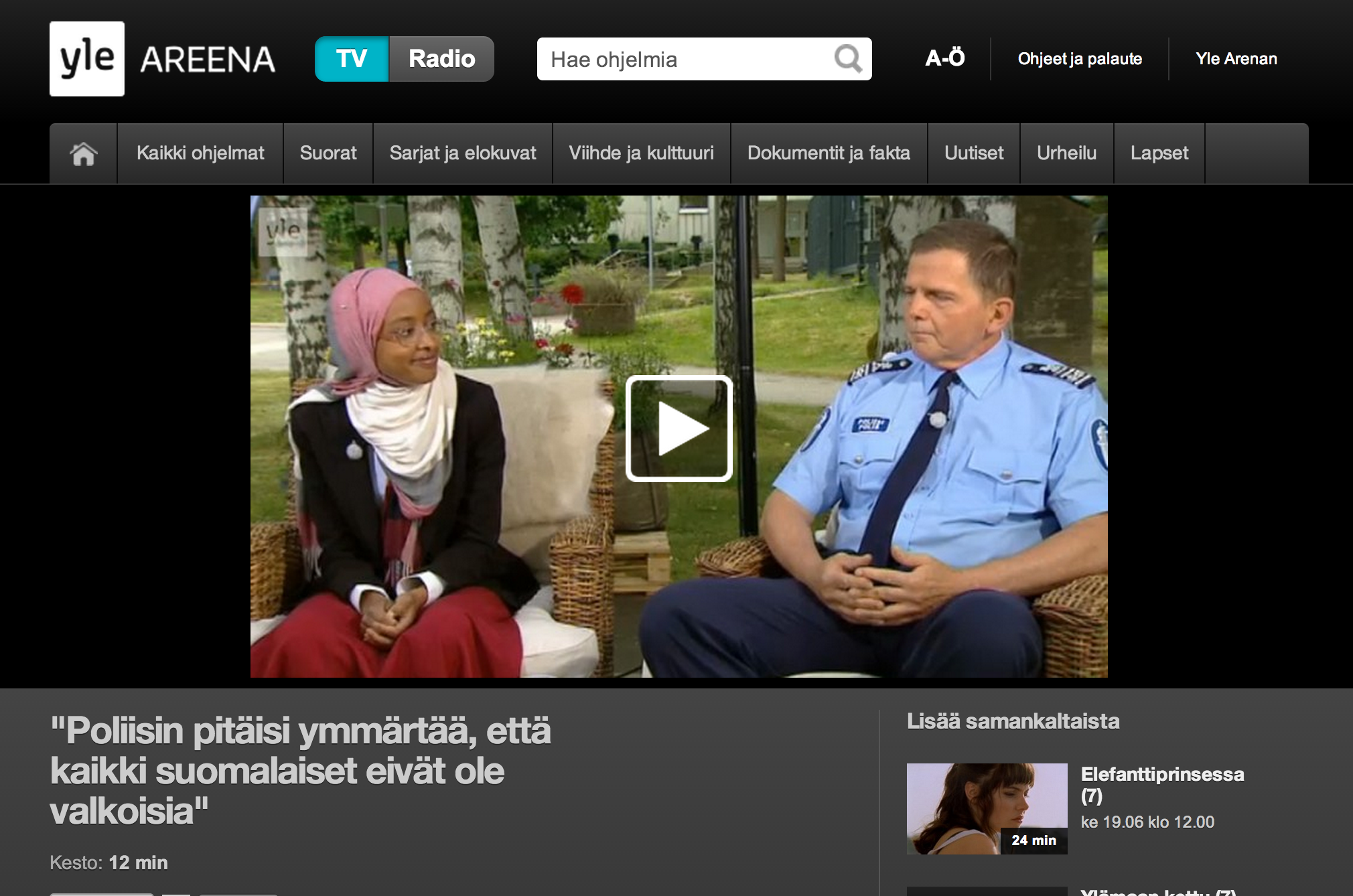
Watch television program here.

While it’s pretty clear that if the ECRI and Ombudsman for Minorities in Finland have expressed concern about ethnic profiling by the Finnish police, there must be something wrong.

Sadly, the whole debate concerning the issue of ethnic profiling in Finland points to denial by the authorities and Interior Minister Päivi Räsänen, who is either covering up for the police or totally ignorant.

Both the police and Räsänen sound like Perussuomalaiset (PS) chairman Timo Soini playing down racism in his party.  It reflects how the police, one of the most conservative institutions in Finland, doesn’t want to acknowledge that we are today an ever-growing culturally diverse society as well as ignorance.

Maryan Abdulkarim, who was interviewed on television today with deputy Helsinki police chief Lasse Aapio, correctly pointed out that not all “foreign-looking” people are immigrants but Finns.

On the radio program, National Coalition Party MP Kari Toivonen, a former policeman who denied that ethnic profiling takes place systematically, reveals his ignorance by pointing out that a foreigner called him a racist because in his country women can be raped freely.

Kuvankaappaus 2013-7-10 kello 12.15.49

Listen to radio program here.

If Toivonen believes this to be the case, it shows a tremendous amount of ignorance on his part and why ethnic profiling continues to take and why the police don’t get it. No culture or any religion accepts rape as something “normal.”

It’s pretty clear that the same arguments used to justify ethnic profiling of groups like the Romany minority in Finland in the past is being used against immigrants today. Whenever immigrants or non-white Finns are stopped by the police it’s because they are either undocumented or victims of human trafficking.

Instead of going around in circles and wasting years on debating whether ethnic profiling takes place or not, why isn’t Finland’s Romany minority asked its opinion on the matter? What they may tell you is extremely unsettling: Even if they have lived for about five centuries in Finland, ethnic profiling – never mind discrimination – still takes place.

A US state department human rights report stated recently: ”Groups of Roma have lived in the country for centuries, and Roma are classified as a ’traditional ethnic minority’ in the ombudsman’s report. The Romany minority was the most frequent target of racially motivated discrimination, followed by Russian-speakers, Somalis, and Sami.”

Migrant Tales will ask members of Finland’s Romany minority for a future blog entry about ethnic profiling by the Finnish police.

Council of Europe concerned about ethnic profiling by police in Finland

Posted on July 9, 2013 by Migrant Tales

Is it a surprise that the Council of Europe’s anti-racism body expressed concern in a report that Finnish police ask people’s ID based on ethnic appearance? No need to get an official answer to find out because ethnic profiling doesn’t happen in Finland. Why not ask immigrants and visible minorities instead if you went a candid answer?

The Council of Europe anti-racism body, the European Commission against Racism and Intolerance (ECRI), published its fourth report Tuesday where it expressed concern over ethnic profiling by the police in Finland, reports YLE in English.

The ECRI report said that the police in Finland have the right to question foreign-looking people in places where they are believed to be causing problems.

Kuvankaappaus 2013-7-9 kello 15.42.05

“There is one [regulation] which increases the risk of racial profiling by the police, so this is the police singling out people based simply on the basis of their visible appearance,” Council of Europe communications officer Andrew Cutting told Yle. “Another issue [the report] raises is that foreigners can be detained whilst their identity can be ascertained in certain situations, and that this too is discriminatory.”

Ethnic profiling is part of the the wider problem of institutional racism in this country.

The fact that the police and Christian Democrat interior minister, Päivi Räsänen, deny any wrongdoing concerning ethnic profiling is highly revealing in itself. Such denials suggest that the contrary does take place and that it is a much wider problem than the authorities want to admit.

The police and the interior minister are, however, adamant: No ethnic profiling goes on in Finland by the police.

But is this the case?

The Ombudsman for Minorities has been in negotiations with the police to have in force this year new anti-ethnic profiling guidelines.

Rainer Hiltunen, the Minority Ombudsman’s head of office, told Migrant Tales last year that he receives calls from foreigners who say they have been repeatedly questioned in the street by police. Some of those stopped are naturalized Finns and visible minorities.

Even if the police and Räsänen claim that foreign-looking people aren’t stopped by the police,  Migrant Tales  understands that the problem is far more common than officials want to admit.

It is, however, a good matter that European organizations like the ECRI are looking into the matter.

Read full ECRI report here.


Crime statistics are used shamelessly by certain groups in Finland to label immigrants

Posted on January 12, 2013 by Migrant Tales

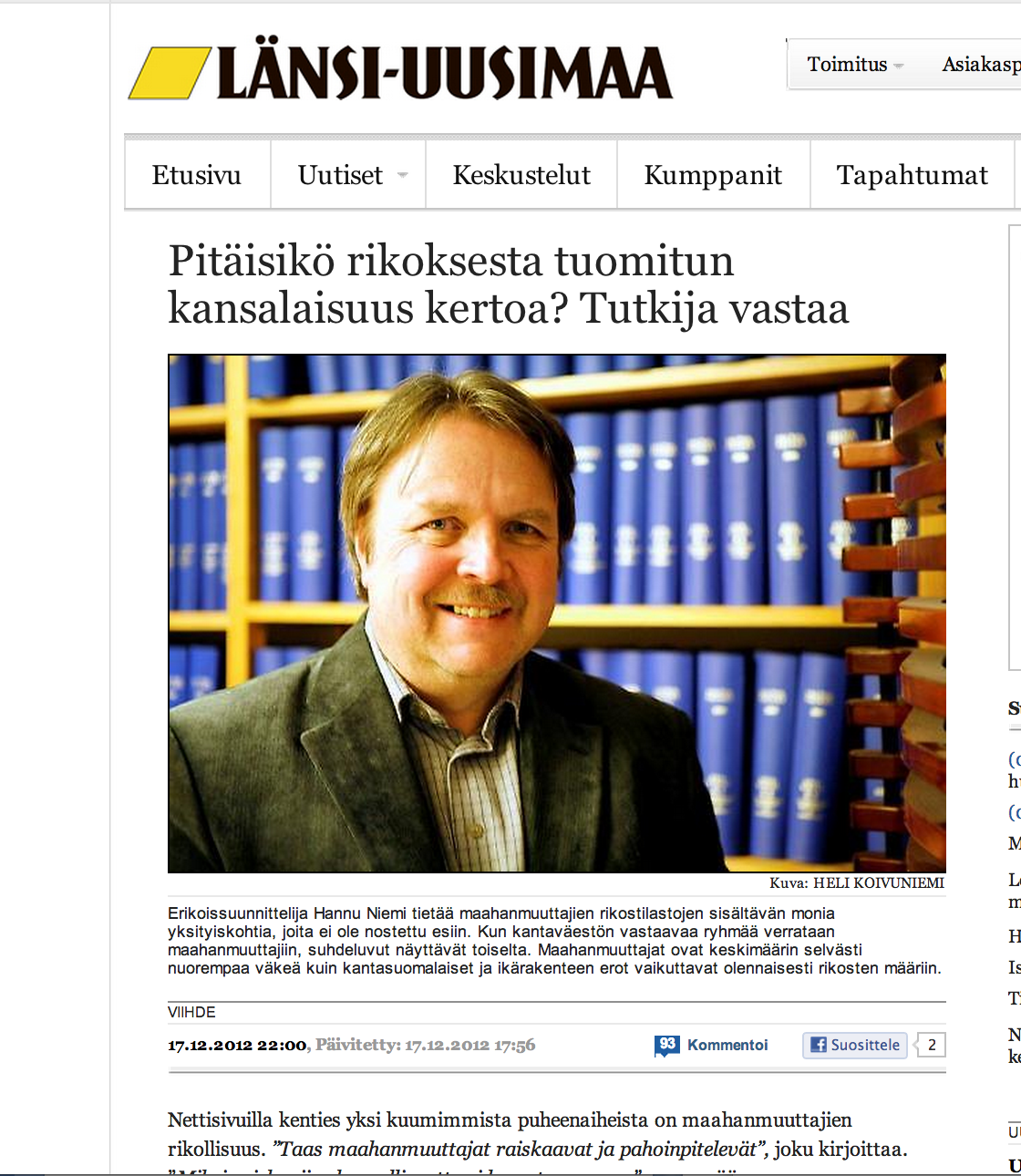
Hannu Niemi, a Justice Ministry researcher, says that crime rates by immigrants in Finland have been exaggerated by the media, report Länsi Uusimaa and Uusi Suomi. He believes that there is a political aim by some groups to cite national origin in crime statistics in order to label whole groups.

Kuvankaappaus 2013-1-12 kello 15.36.02

Migrant Tales spoke with Niemi in the spring, when an Aamulehti story written by a freelancer claimed that immigrants are overrepresented in rape crime statistics in Finland.

One of the matters that becomes clear from the Aamulehti story, as well as another one by A-Studio in August, is that both aim to label immigrants from certain regions like the Middle East as outright rapists.

Both stories place more emphasis on percentage figures rather than actual volumes, which are low. Apart from playing down or not mentioning that Finns commit the vast majority of rape crimes in this country, the A-Studio story went as far as to claim that the Iraqi community had “a problem” because it had the highest amount of rape suspects.

The total number of suspected rape cases by Iraqi immigrants was seven.

Niemi said that the number of rape crimes committed by immigrants is 1-2 per 1,000.

Even if it is clear that certain politicians and anti-immigration groups exaggerate rape and crime statistics for their own political purposes, there is an important factor missing that may shed light on why crime among 15-24 year olds is higher (over 1,600/10,000 immigrants) than among Finns (under 1,200/10,000) in the same age group. The missing factor is ethnic profiling by the police.

Here is a link that offers a comprehensive view of crimes committed by foreigners.

Are certain ethnic groups in Finland more likely to be stopped and arrested by the police than others?

Knowing the answer to this important question could shed light on the problem.

Niemi says that if the immigrant community’s age structure were the same as the Finns’, crime levels would be about the same in both groups.


Finnish police to have new anti-ethnic profiling guidelines in force in 2013

Posted on December 18, 2012 by Migrant Tales

Rainer Hiltunen, Ombudsman for Minorities head of office, told Migrant Tales that talks have taken place with the Finnish police to draft new guidelines and more effective monitoring to ensure that ethnic profiling doesn’t happen. The new guidelines are expected to be in force in 2013. 

Kuva 106

The Ombudsman for Minorities office expressed concern in spring about higher-than-average complaints from foreigners that they were being indiscriminately stopped by the police for spot checks.

Interior Minister Päivi Räsänen confirmed in April that the Finnish police doesn’t ethnically profile anyone.

Foreigners are sometimes stopped in Finland by the police when looking for undocumented immigrants, according to Räsänen.

“One of the problems [concerning ethnic profiling] is that when the police stop a person, they sometimes forget to tell them clearly why they have been stopped,” he said. “Better monitoring of the police in this respect is crucial to discourage ethnic profiling from happening.”

The Ombudsman for Minorities official saw England as a good example for the Finnish police to follow.

“The Stephen Lawrence case is a good case in point that shows how institutional racism can undermine the effectiveness of the Metropolitan Police of London,” he said.


Spiegel Online International: A case that successfully challenged ethnic profiling in Germany

Posted on November 4, 2012 by Migrant Tales

This story, which was published by German Spiegel Online International, offers some good points on how to challenge ethnic profiling. It’s pretty clear that this illegal practice goes on in Finland as well and is more widespread than believed.  

Migrant Tales asked in June blog entry: “How serious is ethnic profiling in Finland? Denials that it doesn’t occur at all by the police suggest that it may be a much wider problem than believed.”

Like any challenge facing society, we need proactive solutions. This story of a black German who was a victim of ethnic profiling on Spiegel Online International is not only inspiring, but offers hope: We can challenge such an injustice with our example.

An important matter to remember if you are harassed in public or are a victim of ethnic profiling and discrimination, is that it’s all about our children and grandchildren. We want them to live in a society that lives up to its values and that its laws should protect everyone.

The black German simply got tired of being constantly stopped by police because of his ethnic background.

“In the two years prior, they [police] had selected me about 10 times for a random check of my identification. It’s a pretty rotten feeling. I was born and raised here. I am German. According to the anti-discrimination law in the constitution, skin color is not grounds for a spot check.”

Read I didn’t want to be treated differently any longer here.


  • Previous
  • 1
  • 2
  • 3
  • 4
  • 5
  • 6
  • Next
Read more about documentary film
Read more

Recent Posts

  • Finland’s tabloids Iltalehti and Ilta-Sanomat are the pits
  • Riikka Purra’s Dr Jekyll and Mr Hyde mask
  • Double standards
  • Perussuomalaiset: Uusi logo, sama vanha juttu
  • Taco Trump

Recent Comments

  1. Absolutely Socking: Racist Finnish Facebook group against human rights gets flooded with socks on Musta Barbaari’s mother and sister charged by the police in “ethnic profiling” case
  2. Ilkka Nuotio on Pekka Myrskylä: “Tilastot kertovat toista kuin poliittinen keskustelu”
  3. Genrih Soinkara on The war in Ukraine and the Russian-Finnish border crisis are showing Finland’s ugly side
  4. Ahti Tolvanen on Comment by Ahti Tolvanen on the Helsinki +50 conference
  5. Angel Barrientos on Angel Barrientos is one of the kind beacons of Finland’s Chilean community

Archives

  • June 2026
  • May 2026
  • April 2026
  • March 2026
  • February 2026
  • January 2026
  • December 2025
  • November 2025
  • October 2025
  • September 2025
  • August 2025
  • July 2025
  • June 2025
  • May 2025
  • April 2025
  • March 2025
  • February 2025
  • January 2025
  • December 2024
  • November 2024
  • October 2024
  • September 2024
  • August 2024
  • July 2024
  • June 2024
  • May 2024
  • April 2024
  • March 2024
  • February 2024
  • January 2024
  • December 2023
  • November 2023
  • October 2023
  • September 2023
  • August 2023
  • July 2023
  • June 2023
  • May 2023
  • April 2023
  • March 2023
  • February 2023
  • January 2023
  • December 2022
  • November 2022
  • October 2022
  • September 2022
  • August 2022
  • July 2022
  • June 2022
  • May 2022
  • April 2022
  • March 2022
  • February 2022
  • January 2022
  • December 2021
  • November 2021
  • October 2021
  • September 2021
  • August 2021
  • July 2021
  • June 2021
  • May 2021
  • April 2021
  • March 2021
  • February 2021
  • January 2021
  • December 2020
  • November 2020
  • October 2020
  • September 2020
  • August 2020
  • July 2020
  • June 2020
  • May 2020
  • April 2020
  • March 2020
  • February 2020
  • January 2020
  • December 2019
  • November 2019
  • October 2019
  • September 2019
  • August 2019
  • July 2019
  • June 2019
  • May 2019
  • April 2019
  • March 2019
  • February 2019
  • January 2019
  • December 2018
  • November 2018
  • October 2018
  • September 2018
  • August 2018
  • July 2018
  • June 2018
  • May 2018
  • April 2018
  • March 2018
  • February 2018
  • January 2018
  • December 2017
  • November 2017
  • October 2017
  • September 2017
  • August 2017
  • July 2017
  • June 2017
  • May 2017
  • April 2017
  • March 2017
  • February 2017
  • January 2017
  • December 2016
  • November 2016
  • October 2016
  • September 2016
  • August 2016
  • July 2016
  • June 2016
  • May 2016
  • April 2016
  • March 2016
  • February 2016
  • January 2016
  • December 2015
  • November 2015
  • October 2015
  • September 2015
  • August 2015
  • July 2015
  • June 2015
  • May 2015
  • April 2015
  • March 2015
  • February 2015
  • January 2015
  • December 2014
  • November 2014
  • October 2014
  • September 2014
  • August 2014
  • July 2014
  • June 2014
  • May 2014
  • April 2014
  • March 2014
  • February 2014
  • January 2014
  • December 2013
  • November 2013
  • October 2013
  • September 2013
  • August 2013
  • July 2013
  • June 2013
  • May 2013
  • April 2013
  • March 2013
  • February 2013
  • January 2013
  • December 2012
  • November 2012
  • October 2012
  • September 2012
  • August 2012
  • July 2012
  • June 2012
  • May 2012
  • April 2012
  • March 2012
  • February 2012
  • January 2012
  • December 2011
  • November 2011
  • October 2011
  • September 2011
  • August 2011
  • July 2011
  • June 2011
  • May 2011
  • April 2011
  • March 2011
  • February 2011
  • January 2011
  • December 2010
  • November 2010
  • October 2010
  • September 2010
  • August 2010
  • July 2010
  • June 2010
  • May 2010
  • April 2010
  • March 2010
  • February 2010
  • January 2010
  • December 2009
  • November 2009
  • October 2009
  • September 2009
  • August 2009
  • July 2009
  • December 2008
  • November 2008
  • October 2008
  • September 2008
  • August 2008
  • July 2008
  • June 2008
  • May 2008
  • April 2008
  • March 2008
  • February 2008
  • January 2008
  • November 2007
  • October 2007
  • September 2007
  • August 2007
  • July 2007
  • June 2007
  • May 2007

Categories

  • ?? Gia L?c
  • ????? ?????? ????? ???????? ?? ??????
  • ???????
  • @HerraAhmed
  • @mondepasrond
  • @nohatefinland
  • @oula_silver
  • @Varathas
  • A Pakistani family
  • äärioikeisto
  • Abbas Bahmanpour
  • Abdi Muhis
  • Abdirahim Hussein Mohamed
  • Abdirahim Husu Hussein
  • Abdirisak Mahamed
  • About Migrant Tales
  • activism
  • Adam Al-Sawad
  • Adel Abidin
  • Afrofinland
  • Ahmed IJ
  • Ahti Tolvanen
  • Aino Pennanen
  • Aisha Maniar
  • Alan Ali
  • Alan Anstead
  • Alejandro Díaz Ortiz
  • Alekey Bulavsev
  • Aleksander Hemon
  • Aleksanterinliitto
  • Aleksanterinliitto ry
  • Aleksanterinliitto ry:n hallitus
  • Alex Alex
  • Alex Mckie
  • Alexander Nix
  • Alexandra Ayse Albayrak
  • Alexis Neuberg
  • Ali Asaad Hasan Alzuhairi
  • Ali Hossein Mir Ali
  • Ali Rashid
  • Ali Sagal Abdikarim
  • Alina Tsui
  • Aline Müller
  • All categories
  • Aman Heidari
  • Amiirah Salleh-Hoddin & Jana Turk
  • Amin A. Alem
  • Amir Zuhairi
  • Amkelwa Mbekeni
  • Ana María Gutiérrez Sorainen
  • Anachoma
  • Anders Adlecreutz
  • Angeliina Koskinen
  • Anna De Mutiis
  • Anna María Gutiérrez Sorainen
  • Anna-Kaisa Kuusisto ja Jaakko Tuominen
  • Annastiina Kallius
  • Anneli Juise Friman Lindeman
  • Announcement
  • Anonymous
  • Antero Leitzinger
  • anti-black racism
  • Anti-Hate Crime Organisation Finland
  • Anudari Boldbaatar
  • Arshiya Nasser
  • Aspergers Syndrome
  • Asylum Corner
  • Asylum seeker 406
  • Athena Griffin and Joe Feagin
  • Autism
  • Avaaz.org
  • Awale Olad
  • Ayan Said Mohamed
  • AYY
  • Barachiel
  • Bashy Quraishy
  • Beatrice Kabutakapua
  • Beri Jamal
  • Beri Jamal and Enrique Tessieri
  • Bertolt Brecht
  • Boiata
  • Boodi Kabbani
  • Bruno Gronow
  • Carmen Pekkarinen
  • Çelen Oben and Sheila Riikonen
  • Chiara Costa-Virtanen
  • Chiara Costa-Virtanen
  • Chiara Sorbello
  • Christian Thibault
  • Christopher Wylie
  • Clara Dublanc
  • Dana
  • Daniel Malpica
  • Danilo Canguçu
  • David Papineau
  • David Schneider
  • Dexter He
  • Don Flynn
  • Dr Masoud Kamali
  • Dr. Faith Mkwesha
  • Dr. Theodoros Fouskas
  • Edna Chun
  • Eeva Kilpi
  • Emanuela Susheela
  • En castellano
  • ENAR
  • Enrique
  • Enrique Tessieri
  • Enrique Tessieri & Raghad Mchawh
  • Enrique Tessieri & Yahya Rouissi
  • Enrique Tessieri and Muhammed Shire
  • Enrique Tessieri and Sira Moksi
  • Enrique Tessieri and Tom Vandenbosch
  • Enrique Tessieri and Wael Che
  • Enrique Tessieri and Yahya Rouissi
  • Enrique Tessieri and Zimema Mhone
  • Epäluottamusmies
  • EU
  • Europe
  • European Islamophobia Report
  • European Islamophobia Report 2019,
  • European Union
  • Eve Kyntäjä
  • Ezequiel Caldeiro
  • Facebook
  • Fadumo Dayib
  • Faisa Kahiye
  • Farhad Manjoo
  • Fasismi
  • Finland
  • Fizza Qureshi
  • Flyktingar och asyl
  • Foreign Student
  • Fozia Mir-Ali
  • Frances Webber
  • Frida Selim
  • Gareth Rice
  • Ghyslain Vedeaux
  • Global Art Point
  • Great Replacement
  • Habiba Ali
  • Hami Bahadori
  • Hami Bahdori
  • Hamid
  • Hamid Alsaameere
  • Hamid Bahdori
  • Handshake
  • Harmit Athwal
  • Hassan Abdi Ali
  • Hassan Muhumud
  • Heikki Huttunen
  • Heikki Wilenius
  • Helsingin Sanomat
  • Henning van der Hoeven
  • Henrika Mälmsröm
  • Hser Hser
  • Hser Hser ja Mustafa Isman
  • Husein Muhammed
  • Hussain Kazemian
  • Hussain Kazmenian
  • Ibrahim Khan
  • Ida
  • Ignacio Pérez Pérez
  • Iise Ali Hassan
  • Ilari Kaila & Tuomas Kaila
  • Imam Ka
  • inside-an-airport
  • Institute of Race Relations
  • Iraqi asylum seeker
  • IRR European News Team
  • IRR News Team
  • Islamic Society of Norhern FInland
  • Islamic Society of Northern Finland
  • Islamophobia
  • Jacobinmag.com
  • Jallow Momodou
  • Jan Holmberg
  • Jane Elliott
  • Jani Mäkelä
  • Jari Luoto
  • Jari Taponen
  • Jegor Nazarov
  • Jenni Stammeier
  • Jenny Bourne
  • Jessie Daniels
  • Joe Davidow
  • Johannes Koski
  • John D. Foster
  • John Grayson
  • John Marriott
  • Jon Burnett
  • Jorma Härkönen
  • Jos Schuurmans
  • José León Toro Mejías
  • Josue Tumayine
  • Jouni Karnasaari
  • Juan Camilo
  • Jukka Eräkare
  • Julian Abagond
  • Julie Pascoet
  • Jussi Halla-aho
  • Jussi Hallla-aho
  • Jussi Jalonen
  • JusticeDemon
  • Kadar Gelle
  • Kaksoiskansalaisuus
  • Kansainvälinen Mikkeli
  • Kansainvälinen Mikkeli ry
  • Katherine Tonkiss
  • Kati Lepistö
  • Kati van der Hoeven-Lepistö
  • Katie Bell
  • Kättely
  • Kerstin Ögård
  • Keshia Fredua-Mensah & Jamie Schearer
  • Khadidiatou Sylla
  • Khadra Abdirazak Sugulle
  • Kiihotus kansanryhmää vastaan
  • Kirsi Crowley
  • Koko Hubara
  • Kristiina Toivikko
  • Kubra Amini
  • KuRI
  • La Colectiva
  • La incitación al odio
  • Laura Huhtasaari
  • Lauri Finér
  • Leif Hagert
  • Léo Custódio
  • Leo Honka
  • Leontios Christodoulou
  • Lessie Branch
  • Lex Gaudius
  • Leyes de Finlandia
  • Liikkukaa!
  • Linda Hyökki
  • Liz Fekete
  • M. Blanc
  • Maarit Snellman
  • Mahad Sheikh Musse
  • Maija Vilkkumaa
  • Malmin Kebab Pizzeria Port Arthur
  • Marcell Lorincz
  • Mari Aaltola
  • María Paz López
  • Maria Rittis Ikola
  • Maria Tjader
  • Marja-Liisa Tolvanen
  • Mark
  • Markku Heikkinen
  • Marshall Niles
  • Martin Al-Laji
  • Maryan Siyad
  • Matt Carr
  • Mauricio Farah Gebara
  • Media Monitoring Group of Finland
  • Micah J. Christian
  • Michael McEachrane
  • Michele Levoy
  • Michelle Kaila
  • Migrant Tales
  • Migrant Tales Literary
  • Migrantes News
  • Migrants' Rights Network
  • MigriLeaks
  • Mikko Kapanen
  • Miriam Attias and Camila Haavisto
  • Mohamed Adan
  • Mohammad Javid
  • Mohammad M.
  • Monikulttuurisuus
  • Monisha Bhatia and Victoria Canning
  • Mor Ndiaye
  • Muh'ed
  • Muhamed Abdimajed Murshid
  • Muhammed Shire
  • Muhammed Shire and Enrique Tessieri
  • Muhis Azizi
  • Musimenta Dansila
  • Muslimiviha
  • Musulmanes
  • Namir al-Azzawi
  • Natsismi
  • Neurodiversity
  • New Women Connectors
  • Nils Muižnieks
  • No Labels No Walls
  • Noel Dandes
  • Nuor Dawood
  • Omar Khan
  • Otavanmedia
  • Oula Silvennoinen
  • Paco Diop
  • Pakistani family
  • Pentti Stranius
  • Perussuomalaiset
  • perustuslaki
  • Petra Laiti
  • Petri Cederlöf
  • Pia Grochowski
  • Podcast-lukija Bea Bergholm
  • Pohjois – Suomen Islamilainen Yhdyskunta
  • Pohjois Suomen Islamilainen Yhyskunta
  • Polina Kopylova
  • Race Files
  • racism
  • Racism Review
  • Raghad Mchawh
  • Ranska
  • Rashid H. and Migrant Tales
  • Rasismi
  • Raul Perez
  • Rebecka Holm
  • Reem Abu-Hayyeh
  • Refugees
  • Reija Härkönen
  • Remiel
  • Reza Nasri
  • Richard Gresswell
  • Riikka Purra
  • Risto Laakkonen
  • Rita Chahda
  • Ritva Kondi
  • Robito Ibrahim
  • Roble Bashir
  • Rockhaya Sylla
  • Rodolfo Walsh
  • Roger Casale
  • Rostam Atai
  • Roxana Crisólogo Correa
  • Ruth Grove-White
  • Ruth Waweru-Folabit
  • S-worldview
  • Sadio Ali Nuur
  • Sami Rusanen
  • Sandhu Bhamra
  • Sara de Jong
  • Sarah Crowther
  • Sari Alhariri
  • Sarkawt Khalil
  • Sasu
  • Scot Nakagawa
  • Shabana Ahmadzai
  • Shada Islam
  • Sharon Chang blogs
  • Shenita Ann McLean
  • Shirlene Green Newball
  • Sini Savolainen
  • Sira Moksi
  • Sonia K.
  • Sonia Maria Koo
  • Steverp
  • Stop Deportations
  • Suldaan Said Ahmed
  • Suomen mediaseurantakollektiivi
  • Suomen Muslimifoorumi ry
  • Suomen viharikosvastainen yhdistys
  • Suomen viharikosvastainen yhdistys ry
  • Suomi
  • Supermen
  • Susannah
  • Suva
  • Syrjintä
  • Talous
  • Tapio Tuomala
  • Taw Reh
  • Teivo Teivainen
  • The Daily Show
  • The Heino
  • The Supermen
  • Thomas Elfgren
  • Thulfiqar Abdulkarim
  • Tim McGettigan
  • Tino Singh
  • Tito Moustafa Sliem
  • Tobias Hübinette and L. Janelle Dance
  • Transport
  • Trica Danielle Keaton
  • Trilce Garcia
  • Trish Pääkkönen
  • Trish Pääkkönen and Enrique Tessieri
  • Tuulia Reponen
  • Uncategorized
  • UNITED
  • University of Eastern Finland
  • Uyi Osazee
  • Väkivalta
  • Vapaa Liikkuvuus
  • Venla-Sofia Saariaho
  • Vieraskynä
  • W. Che
  • W. Che an Enrique Tessieri
  • Wael Ch.
  • Wan Wei
  • Women for Refugee Women
  • Xaan Kaafi Maxamed Xalane
  • Xassan Kaafi Maxamed Xalane
  • Xassan-Kaafi Mohamed Halane & Enrique Tessieri
  • Yahya Rouissi
  • Yasmin Yusuf
  • Yassen Ghaleb
  • Yle Puhe
  • Yuliet Tresa
  • Yve Shepherd
  • Zahra Khavari
  • Zaker
  • Zalina Ametova
  • Zamzam Ahmed Ali
  • Zeinab Amini ja Soheila Khavari
  • Zimema Mahone and Enrique Tessieri
  • Zimema Mhone
  • Zoila Forss Crespo Moreyra
  • ZT
  • Zulma Sierra
  • Zuzeeko Tegha Abeng
© 2026 Migrant tales | Powered by Minimalist Blog WordPress Theme