Migrant tales
Menu
  • #MakeRacismHistory “In Your Eyes”
  • About Migrant Tales
  • It’s all about Human Rights
  • Literary
  • Migrant Tales Media Monitoring
  • NoHateFinland.org
  • Tales from Europe
Menu

Tag: discrimination

Defining white Finnish privilege #14: Losing sight of the real issue

Posted on November 13, 2014 by Migrant Tales

One of the matters that has always surprised me in Finland is that if you speak out against intolerance and racism, you are sometimes seen as the rude one, not the one making the inappropriate comment. Apart from playing down a social ill like intolerance, we too often lose sight of the real issue: the victim. 

There are many factors that make us play down racism. One could be that we don’t want to rock the boat and get involved because intolerance doesn’t affect us directly. The issue is too complicated and hairy.

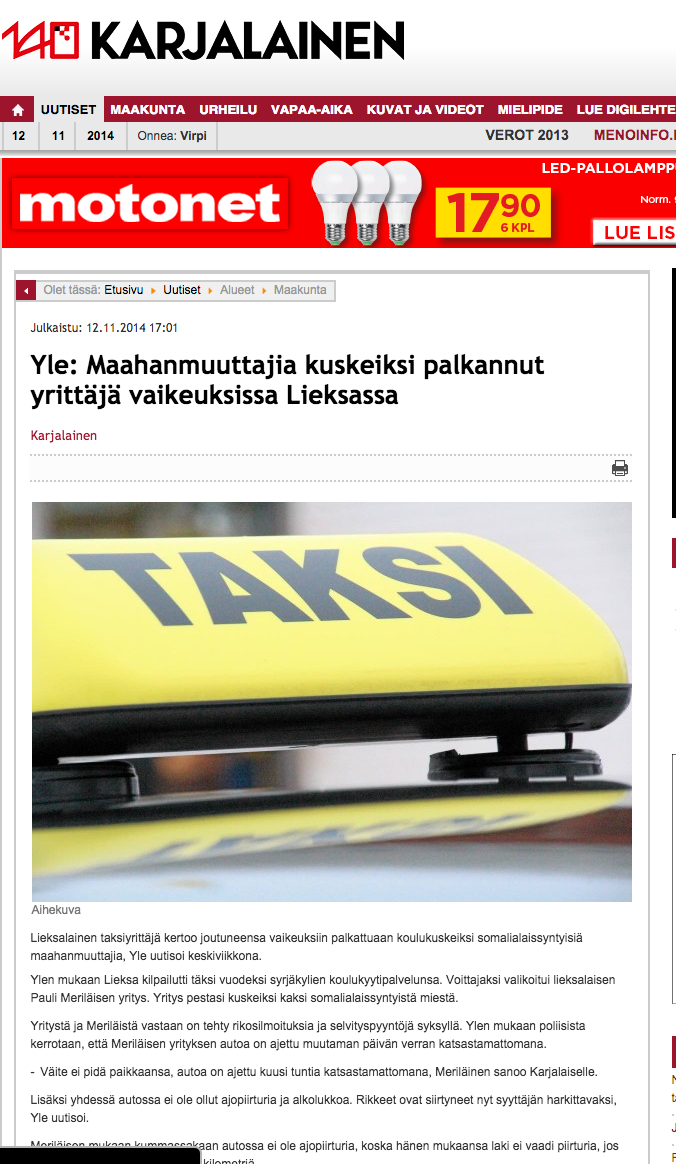
Take for example a recent case in Lieksa where parents don’t want their children to be taken to and from school by Somali drivers because they ‘don’t speak Finnish well enough.’

Näyttökuva 2014-11-12 kello 21.06.30

Read full story here.


The taxi owner, who hired the Somali drivers, claims that the parents’ motives are racist. The parents deny that their actions have anything to do with the drivers’ skin color or nationality.

But what about if both have some complicity in the matter and that we’re losing focus on the real problem?

‘I highly doubt that the man who hired the [Somali] drivers did so because he’s a good Samaritan,’ a Joensuu source told Migrant Tales. ‘Certainly there are racists among the parents but then again has anyone asked if the man who hired the drivers pays them less money [than white Finn driver] in order to maximize profit?’  

Definition #14

While we still don’t know all the facts, white privilege appears to be written all over the most recent case in Lieksa: Parents can demand one thing and the owner of the taxis can say another. Nobody asks the Somali drivers their opinion.

Thus white privilege permits us to miss the real issue at play: suspicion, prejudice and exploitation of migrants.

It’s not always an open-and-shut matter. White privilege permits you to lose sight of the real issue because it is convenient. It allows you to forget the victim, or the taxi drivers, as is the case in Lieksa.

See also:

  • Defining white Finnish privilege #1: I have it and you don’t
  • Defining white Finnish privilege #2: Third culture children versus “pupil with immigrant background” 
  • Defining white Finnish privilege #3 No history, no doctrine, no heroes and no martyrs
  • Defining white Finnish privilege #4 Holding the short end of the stick
  • Defining white Finnish privilege #5 It’s ok to be a racist
  • Defining white Finnish privilege #6 Not having a voice and the media
  • Defining white Finnish privilege #7 A definitive guide
  • Defining white Finnish privilege #8 Underrated and less intelligent
  • Defining white Finnish privilege #9 Mohammad Ali’s insight
  • Defining white Finnish privilege #10 I can victimize and make up any story I like about migrants because I’m white
  • Defining white Finnish privilege #11: Case Teuvo Hakkarainen
  • Defining white Finnish privilege #12: Case Tom Packalén
  • Defining white Finnish privilege #13: Case Matti Putkonen

* The Finnish name for the Finns Party is the Perussuomalaiset (PS). The English names of the party adopted by the PS, like True Finns or Finns Party, promote in our opinion nativist nationalism and xenophobia. We therefore prefer to use the Finnish name of the party on our postings.

November 6, 1981: Address to the international seminar (on the plight of foreign students in Finland)

Posted on November 7, 2014 by Migrant Tales

Enrique Tessieri

Finally the consciousness of the Finnish government and the Finnish public via the press have come to the point where the status of foreigners has been recognized as a problem. The simple fact that this issue has found its way into the public consciousness shows that we’ve come a long way. We’ve made our needs known and more than anything the purpose of the seminar* is to find out and get general agreement upon where do we go from here?
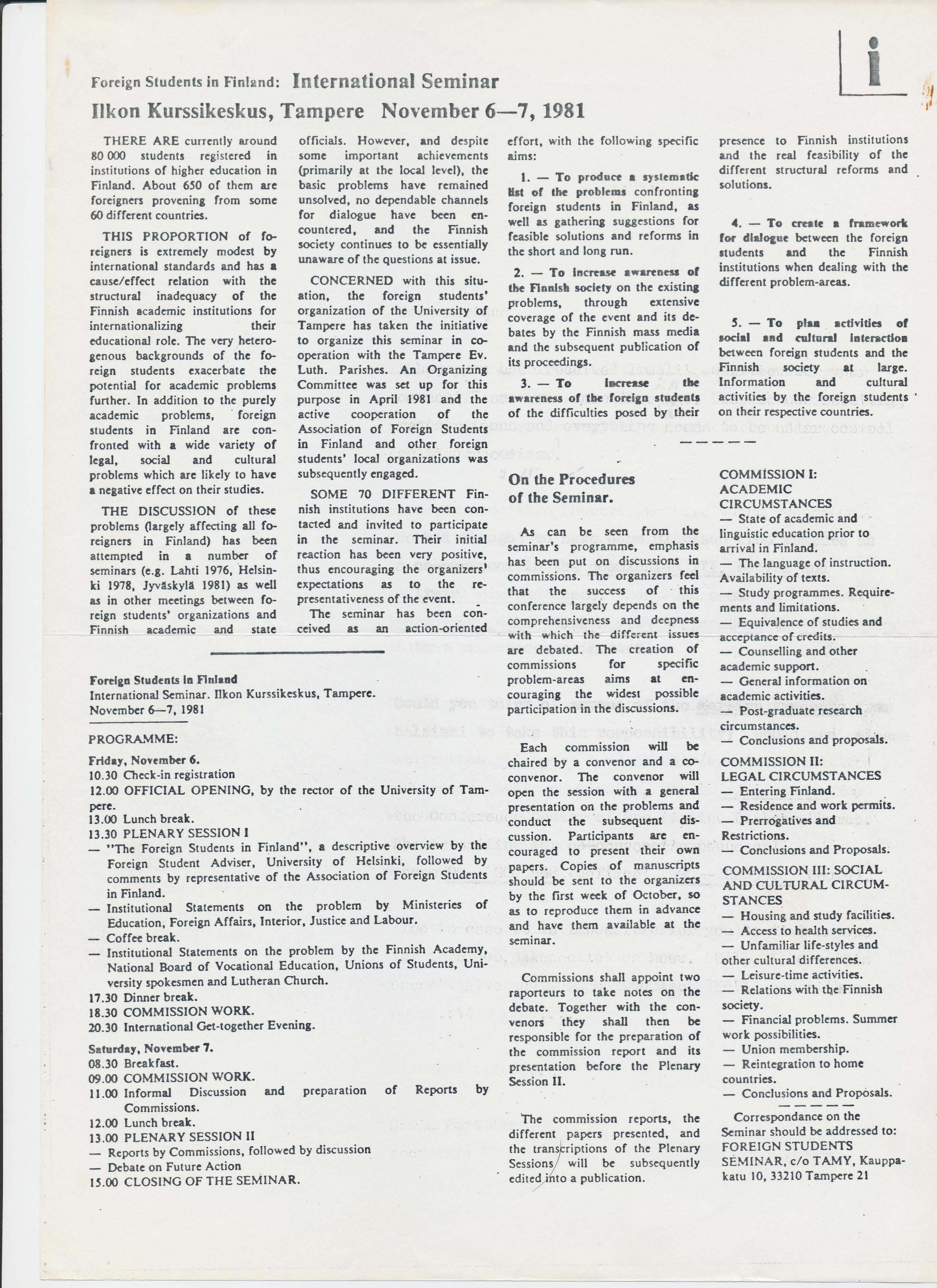
Image1-105_edited-1

Irmeli’s* presentation has given us a good basis for discussion both regarding the statistical realities of our predicament and as a first hand report from a person who has spent a good deal of time dealing with these matters over the years.

What I would like to do today is to lay some philosophical ground work for the hopefully productive discussions to follow in the course of this conference. To do this, we should start by distinguishing the kinds of foreign students in Finland. The first group are the ones with means. These are the scholarship holders, or from well-to-do families, whose intentions and aspirations as to what they shall achieve during their relatively short stay in Finland are specific. Their personal investments in university life and Finnish society at large is limited. Upon finishing their year of study or in some cases a degree program, they return to their country. This groups i the least affected by what Irmeli calls “the uncertainty factor.”

The second category includes the rest of us. The unifying feature of this group is that for some reason, no matter how tenuous that reasoning is, they continue to hang on to the notion that they’ll end up living and working here. When they start to make plans they soon realize the magnitude of “the uncertainty factor.” Money, has to be gotten by the expenditure of large amounts of energy which usually has nothing to do with their course of study.

The effort to keep family, studies, and household together should be described in terms no less than heroic. I think I don’t have to describe this subject any further since all of use here know exactly what I am talking about.

Why does all this uncertainty exist? For the second groups clearly it cannot be confined to academic categories – if you cant’ eat you can’t study. The American poet Gertrud Stein once explained that public opinion was what it was because people “love what they know,” and by large, foreign people are seen by the police, by the Office of Alien Affairs, and by that part of the population who lack the opportunity or the ability  to communicate with us, as unknowns. In short we are not loved. No matter how much we bitch or kick our heels it won’t change the situation and thus lay a foundation for the reforms we seek.

We have not come to this conference to complain to each other; we know the score. If there is an abuse of our rights or deficiency in our legal status, let’s ask ourselves what we can do about it here and what the Finnish authorities can themselves do about it.

Let’s focus our energies on the three areas we have come to discuss: our legal status, the academic set up, and our integration into this society.

LEGAL STATUS

Finland’s xenophobia is clearly reflected in her laws concerning foreigners. Proper manipulation of these laws by the authorities no doubt is connected to the underwhelming size of the foreign population of this country and probably exerts and effect on keeping the number of foreign students down. Remember Irmeli’s observation that healthy student bodies contain as much as 10% foreign population? Our population is 1/12 of that!

The first and foremost factor is the distinctly negative approach the laws has taken towards foreigners. Much of our rights are defined in terms of what we may not do. We cannot vote, we cannot participate in demonstrations, we cannot buy land, we cannot edit newspapers, we don’t even have the right to appeal upon deportation. Obviously these laws have been made to protect the citizenry of this country, but in all fairness, do foreign students represent the kind of threat to property, to national security, or the ideology of the official representatives of this country to justify blanket condemnation under the law? By and large, the foreign student population has very little influence on the financial and political fate of this nation and the laws were made with other interests in mind. The other Scandinavian countries have realized the discrepancy and have gone far to ameliorate it. This has been done by the reaction of an immigrant or permanent resident status. Uncertainly is removed because the foreigner has limited power in controlling his destiny and this is what it’s all about. Under this status a foreigner takes on the responsibilities of what could be called a quasi-citizenship; he votes locally, pays taxes, and participates in the construction of society. As far as foreign students are concerned, most of us end up being qualified for such status after a couple of years. So why doesn’t this status exist?

The second undesirable factor concerning legal status is the tremendous waste of personal talents and time. Constant reapplication for work and residence permits, as well as the limits placed on the kinds of labor we are permitted to do (generally language teaching or menial labor) prevents Finland from realizing the benefit of a fully actualized foreign population. This is based in some part on the unfair perception that without limits foreigners would deny citizens of employment but in practice it means any new avenues of creative endeavor, or said the other way, “the benefits of new blood in the system” are very effectively thwarted. Who gains by all this? As a final note, I would like to ask those preparing  proposals on changing legal status to keep those proposals positively worded.

THE ACADEMIC SET UP

Not too long ago I was told by a Finnish leader of a certain immigration organization that I could not aspire to ever hold a university post. He pointed out that since my Finnish would never be at the same level as that of a native I could never have a chance. He told me that my best bet would be to get into the restaurant hotel business since I was kind mannered and spoke languages. If this is true we might all as well switch over to the “ravintola ja hotelli opistot.” Certainly my experience with foreign teachers in the University of California leads me to believe this need not be the case. The bad news is that any foreigner who aspires to academic success must be able to communicate fluently even gracefully in Finnish and as long as a foreign student fails to rationalize this he will always remain among the academically disadvantaged.

But even assuming the foreign student makes a serious effort to learn Finnish he must still confront completely unjustified academic pretense of the educational system here. The “osta kotimaista” mentality is well rooted in Finnish academic tradition and often results in the foreign scholar’s sad realization that his is having to cope with nothing more than simple provinciality cloaked in a dress of bureaucratic paper and regulations. Against we might ask: Who is anybody gains from such attitudes?

INTEGRATION INTO FINNISH SOCIETY

What I am discussing here are really nothing more than aspects of barriers to comfortable integration into this society and perhaps we can do greatest justice to foreign students by taking a holistic approach to their problems. When foreign students can eat properly, house themselves, and possess greater power in determining their academic and economic futures, they can solve their other problems by themselves. In return for greater freedoms within this culture, foreign students should be made aware that they will also have to shoulder greater social responsibilities. Joining a club is never grounds for sustained membership, we will always have to be proving ourselves.

The foreign students who stay on, most likely will be the future leaders of the foreign community. Presently, that community numbers 10,000 (not counting our children) larger than the Lapp and gypsy minorities put together. We could say we constitute a pretty sizable minority, albeit fragmented. This minority speaks many languages, and follows many customs. But we are all unified in the extent of our exclusion from the majority culture. Until we begin to speak for ourselves, until we begin to document our history and until we assess our efforts to integrate with this society, our improved status will never be justified in the minds of the authorities or the Finnish public. This is a long-range project, but hopefully we can plant some seeds of understanding in the course of these seminars whose growth will have meaningful benefit for all of us.

Have a good conference.


*International Seminar, Ilkon Kurssikeskus (Nov. 6-7, 1981), Tampere, Finland.

* Irmeli Tammivaara-Balaam, Helsinki University foreign student advisor.

Municipal politician’s prison sentence speaks volumes about the PS’ anti-immigration rhetoric

Posted on November 2, 2014 by Migrant Tales

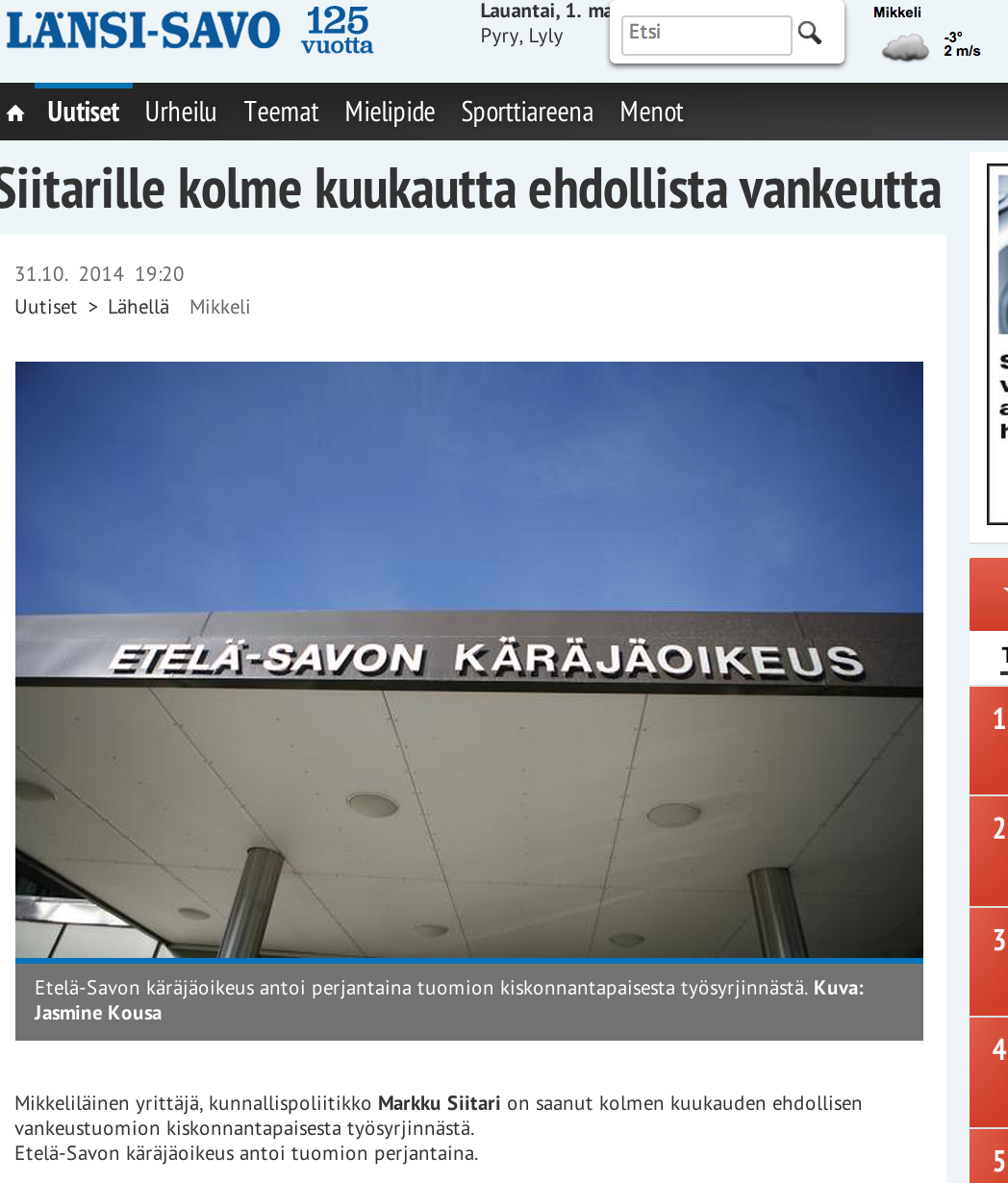
The sentencing by a court on Friday of a Perussuomalaiset (PS)* city councilman and member of the Mikkeli city board to three months in prison speaks volumes about the party’s anti-immigration rhetoric, according to Länsi-Savo.

Matti Siitari, who was general manager of M-S Metalli between 2006 and 2010, forced 17 Estonian employees to work 13-hour days seven days a week without rest never mind holidays and pay.

Contrarily, Finnish employees at the company worked eight-hour days five days a week and were paid overtime and holiday pay.

M-S Metalli filed for bankruptcy in 2010 and owes the Estonian workers 500,000 euros in back payments, according to Länsi-Savo.

Siitari is a typical PS politician when it comes to his views on immigration and immigrants. The PS municipal politician is all for tighter immigration policy. Even so, Finland’s already tight migration policy didn’t help the 17 Estonian employees working for him.

Siitari has not yet announced his resignation as councilman or member of the city board.

Näyttökuva 2014-11-1 kello 22.14.51

Read full story (in Finnish) here.


On his Facebook page, the PS politician ‘likes’ MP Olli Immonen and Espoo city councilman Teemu Lahtinen.

Immonen’s anti-immigration and especially Islamophobic stances are well known. He is chairman of Suomen Sisu, a far-right association that is against white Finns marrying foreigners.

Lahtinen, who was caught “liking” neo-Nazi Facebook page Kansallinen Vastarinta, was  a member in the 1990s of Isänmaalinen Kansanliike (IKL), a fascist political group that idolized Benito Mussolini when it first existed between 1932 and 1944.

In the 1990s, the IKL used to have close ties with far-right parties such as the National Front of France, Belgian Vlaams Belang and Sweden Democrats.

Siitari’s prison sentence sheds a dubious light on this week’s statement by PS’ Matti Putkonen, who raised the party’s estimate of the cost of immigration from 1-1.5 billion euros on Friday to close to 2 billion euros.

Putkonen’s claim is outright ridiculous since the majority of migrants living in Finland work, pay taxes and consume.

* The Finnish name for the Finns Party is the Perussuomalaiset (PS). The English names of the party adopted by the PS, like True Finns or Finns Party, promote in our opinion nativist nationalism and xenophobia. We therefore prefer to use the Finnish name of the party on our postings.

An effective way of putting racism in context in Finland

Posted on October 26, 2014 by Migrant Tales

There are many ways to understand ethnic hatred and racism in Finland. One of these is by substituting the word ‘migrant’ for your ethnic group and/or ‘woman’ in a text that’s aimed at fueling ‘us’ and ‘them.’ Let’s take the recent claims of two politicians, MPs Tom Packalén and Pia Kauma, to see how passions are fueled or can be smothered. 

Original claim by Perussuomalaiset (PS)* MP Packalén.

Before: Gangs made up only of young people with migrant backgrounds said their motives are racist because their aim is to hurt white Finns.

After: Gangs made up of only young white Finns said their motives are racist because their aim is to hurt migrants and minorities.

Näyttökuva 2014-10-26 kello 10.24.24

Before and after. Racism is like the fly agaric (Amanita muscaria) mushroom. It looks beautiful when it fruits and may invite some to eat its hallucinogenic poison. Time, like racism, reveals the true face of this mushroom when it ages and dies.


As we all know, Packalén pulled a fast one on the media and public. The problem with the PS MP’s claim is that it just isn’t true and an inflated exaggeration. Even so, his claims have spread fear and labelled non-white Finns, encouraging even neo-Nazi groups like the Kansallinen Vastarinta and members of the PS to patrol the streets of Helsinki.

Here’s National Coalition Party MP Kauma’s claim.

Before: Migrant mothers buy new baby carriages with social aid.

After: White Finnish mothers buy new baby carriages with social aid.

Like with Packalén, Kauma’s claim is stuffed as well with lots of baloney.

Even if these two MPs made up these stories in light of the April parliamentary elections, is one point. But the other very important one is that they succeeded at getting a lot of media coverage, which was their original aim.

Check out the two postings below on how by just changing a few key words in a vengeful and racist text reveals the underhanded motives of the writer and brings the topic closer to home:

  • Let’s play fill in the blanks with far-right Finnish MP Teuvo Hakkarainen
  • Let’s play fill in the blanks with far-right Finnish MP James Hirvisaari

If you still are trying to grasp these two disgraceful examples, why not replace migrant or ethnic group with ‘woman.’

Remember how urban tales about women were and still may be rampant in Finland? Women can’t drive, they’re poor in math, all they know what to do is have babies and cook…This is the exact anatomy of racist discourse in Finland today. Migrants live off welfare, they’re lazy, sly and shouldn’t be trusted…

How many generations did such outright lies about women still continue to oppress them?

Ever figure out how it feels to be in a university math class and be the only women? Think about how much pressure there is on that woman and how much energy she must expend to prove that she’s just as good as her male classmates.

This exact feeling is what many migrants feel in society. They’re constantly trying to prove that they are just as good and worthy of being treated as equal members of society.

Thus there is nothing harmless when politicians reinforce prejudices about migrants. On the contrary – it is a violent act that aims through power to dominate others.

Add to the latter the near-silence of society and a bigger picture of the social ill emerges.

Racism is not only costly to society but especially to the victim.


* The Finnish name for the Finns Party is the Perussuomalaiset (PS). The English names of the party adopted by the PS, like True Finns or Finns Party, promote in our opinion nativist nationalism and xenophobia. We therefore prefer to use the Finnish name of the party on our postings.

Finnish NCP youth league gives thumbs down to cultural diversity

Posted on October 24, 2014 by Migrant Tales

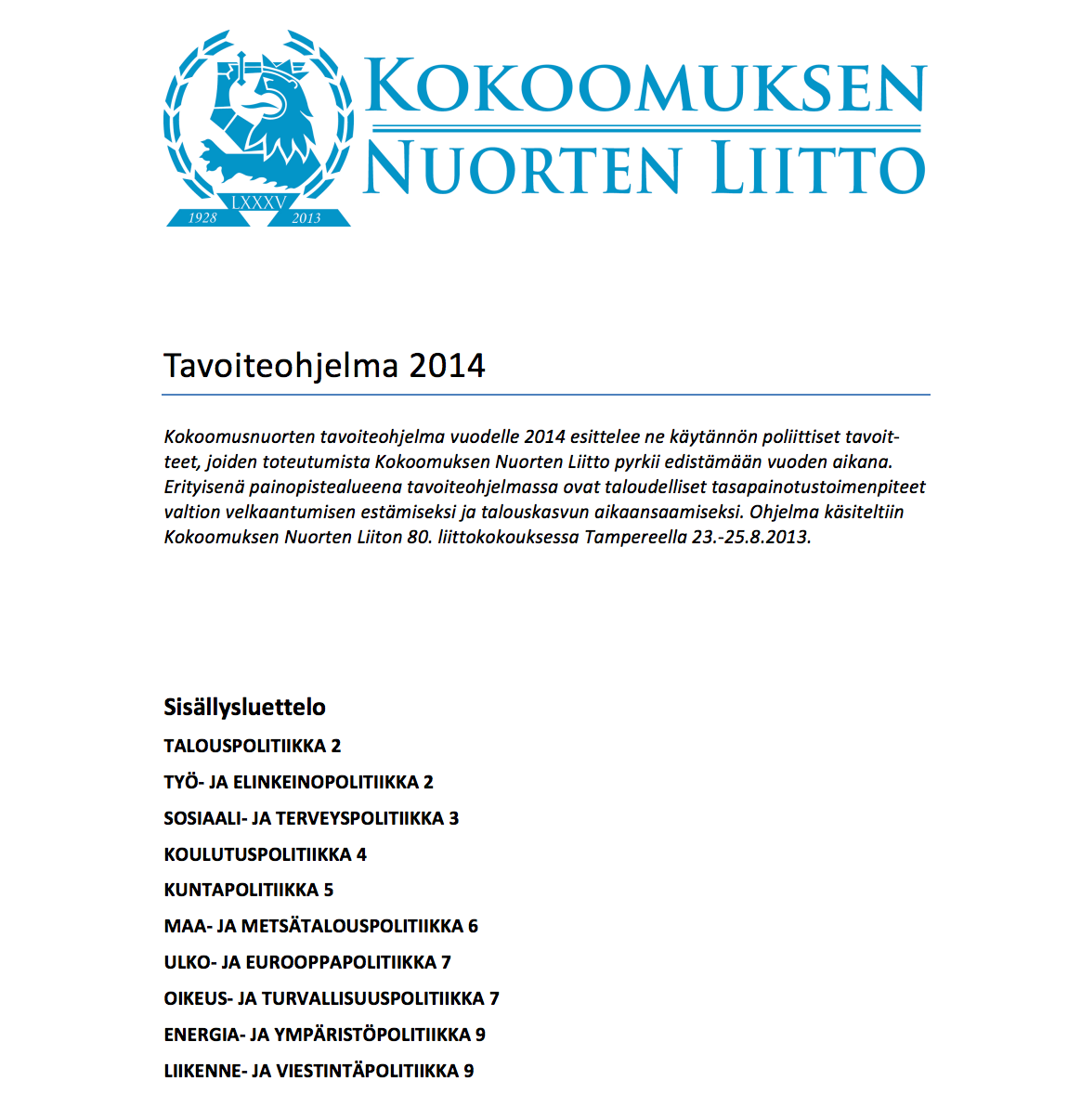
Remember the proposals that the Youth League of the National Coalition Party (NCP) made last year concerning the type of society they’d like Finland to be in the future? Some of the many proposals that raised eyebrows and created quite a media storm back then included plans to scrap the Ombudsman for Minorities as well as ethnic agitation laws.

If last year’s proposals got them in hot water, their latest “wish list” could be criticized for what has been omitted or doesn’t say. For example, there is no mention whatsoever about Finland’s ever-growing cultural diversity but it does favor plans to undermine religious freedom. If the youth league had its way, it would drop religion classes for migrants and concentrate more on teaching Finnish at schools.

Isn’t that what happens today?


Näyttökuva 2014-10-24 kello 11.17.38

Read full NCP youth league program (in Finnish) here.


It is odd that those that drafted these proposals believe that by not teaching a non-Lutheran religion at school will automatically enhance these migrants’ and minorities’ chances of speaking Finnish.

There’s nothing new in this proposal. Youth Wing NCP former head, Wille Rydman, said the same thing when he suggested that multiculturalism should be substituted for Finnish-language courses.

Another proposal by the youth league is to deport those migrants who have been sentenced for a crime and that the government should do everything possible to invite skilled labor to Finland.

What the Youth Wing of the NCP means by inviting skilled labor to this country is that labor markets should give employers better opportunities to hire cheap labor.

It shouldn’t come to any surprise that the Youth Wing of the NCP has striking ideological similarities with the Perussuomalaiset.*

Both are in the business of coercion and domination of migrants by encouraging future Uncle Toms, or mamus.


* The Finnish name for the Finns Party is the Perussuomalaiset (PS). The English names of the party adopted by the PS, like True Finns or Finns Party, promote in our opinion nativist nationalism and xenophobia. We therefore prefer to use the Finnish name of the party on our postings.

Over two thirds of Finnish Roma surveyed said they had experienced discrimination in the past year

Posted on August 10, 2014 by Migrant Tales

A study by the Ombudsman for Minorities of Finland reveals that a bit over two thirds of Finnish Roma that were surveyed said they had experienced discrimination in the past year, according to Turku-based Turun Sanomat.* Two-hundred and forty-nine Roma of different ages took part in the study. 

Näyttökuva 2014-8-10 kello 16.33.26

Read full story (in Finnish) here.


The majority of the discrimination cases took place at stores and gas stations. Some respondents said that one of most humiliating matters at stores or other public places was when they were followed by employees or security guards.

Half of  the respondents said they had suffered discrimination when seeking employment.

Meanwhile, the Pori District Court is looking into an extensive discrimination case involving 13 restaurant workers from nine restaurants in the western city of Pori that are suspected of discrimination on ethnic grounds, according to Turun Sanomat.

The accusations  are being brought by four Roma, who are joined by a white Finnish witnesses as well as a journalist of Pori-based daily Satakunnan Kansa.

One of the Roma at the trial asked the restaurant employee why he and three other Roma weren’t permitted to enter the premises. The employee responded: “Because you’re Gypsies.”


*Thank you Helena Kosonen for the heads-up.

Death of Colombian in police custody in Finland sheds light on the desperate plight of many undocumented migrants

Posted on August 2, 2014 by Migrant Tales

The tragic death* of a twenty-six-year-old Colombian should awaken us to the many dangers that some undocumented migrants face in Europe. According to the Finnish police, Sergio Camilo Becerra González, committed suicide while his parents suspect he was a victim of xenophobia, according to Caracol. 

Both outcomes, death by suicide or xenophobia, are harrowing reminders of the vulnerability that undocumented migrants face in Europe.

The question we should be asking is why did this young man die in the first place and could his death been prevented?

The father of the victim, Rafael Becerra, was quoted as saying on Noticias Capital  that he had heard five similar cases of migrants dying in Finland while in custody. He doesn’t source his claim.

See Noticias Capital news report (in Spanish) here.


Becerra González’ tragic fate sheds light as well on a disturbing fact: our lack of caring for the plight of others.

According to unofficial reports by advocacy groups, up to 10,000 migrants have died crossing the Mediterranean in about twenty years. These so-called boat migrants are estimated to account for less than 10% of  the over 1 million new immigrants entering the European Union from non-EU countries by air, land or sea each year, according to FactTank. 

Näyttökuva 2014-8-2 kello 12.26.02

Read full story here.


One of the questions we should be asking in light of what happened to Becerra González and others like him, is if spending billions of euros to erect higher walls and more effective surveillance in Europe effective solutions.

What is wrong if a person flees war or searches for a better life elsewhere? Didn’t Europeans emigrate to the Americas by the millions at the end of the nineteenth century and early twentieth century? What about European involvement in slavery, exploitation and genocide of indigenous group in Africa, the Americas and elsewhere during colonialism?

In Finland alone, over 1.2 million Finns emigrated between 1860 and 1999 in search of better opportunities.

Part of the narrative on migration in Europe comprises of generous doses of amnesia and fear.

Tightening immigration policy and attacking people who search for better lives in Europe, especially when your country’s standard of living has benefited from the exploitation and war in other countries, is disingenuous to say the least.

Halting migration, especially undocumented migration, is as absurd as was prohibiting entrepreneurship in the former USSR. The present campaign against undocumented migrants in Europe resembles the present war on drugs, which is based on lies and myths that benefit the budgets and wallets of border enforcement agencies and drug traffickers, respectively.

We have to find more effective solutions to immigration than just the usual get-tough stances spread by anti-immigration and even mainstream party politicians.

As long as there is poverty and grossly unequal living standards between countries, immigration will soar, not subside, in the future.


*Read Friday’s story about the tragic death of Sergio Becerra González here.  


Helsingin Sanomat poll reinforces why unfair hiring practices are probably widespread in Finland

Posted on July 28, 2014 by Migrant Tales

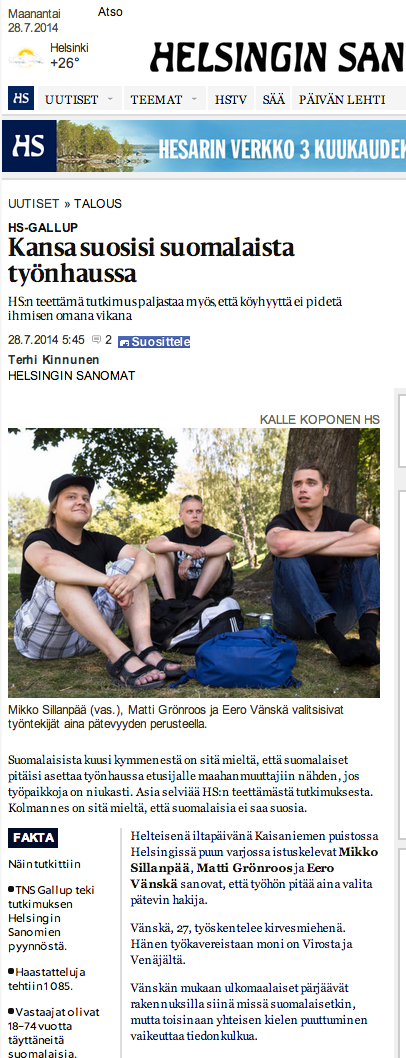
A survey commissioned by Helsingin Sanomat reveals what we’ve known all along about the causes of unfair hiring practices, high migrant unemployment and discrimination.  The survey revealed that six out of 10 people polled would hire a Finn over a migrant if jobs were scarce. 

Is scarcity the real factor? Even during good economic times, migrant unemployment has been 2-3 times higher than the national average.

The country’s largest daily didn’t have to commission an expensive poll to tell us something we already know. What is sad about the results and the Helsingin Sanomat story is that  no solutions are given on how to lessen unfair hiring practices and discrimination.

One high-profile alleged unfair hiring case that came in the public eye this month was Dr. Gareth Rice case at the University of Helsinki, which raised a wider issue that migrants face in this country.

According to educational background, the survey revealed that the majority (66%) of those with a comprehensive school backgrounds agreed that Finns should be hired over foreigners when jobs are scarce. That was followed by ‘other educational backgrounds’ (60%) and academic backgrounds (41%).

The poll will get little attention in Finland since it was published in July, when most Finns are on holiday.

Näyttökuva 2014-7-28 kello 8.27.37
Read full story (in Finnish) here. 


European Commission to take Finland to the EU Court of Justice for not having racial equality body

Posted on July 10, 2014 by Migrant Tales

The European Commission (EC) will take Finland to the EU Court of Justice for not having a racial equality body for employment matters, according to an EC statement. Article 13 of the Racial Equality Directive requires member states to set up a national equality body whose tasks, among other aims, include providing assistance to victims, conducting and publishing independent surveys and reports.

Writes Yle in English: “The release also specified that the Commission’s action against Finland is due to the Ombudsman for Equality not receiving any special tasks concerning racial discrimination in working life.”

Even if the government wants to draft a new non-discrimination act as it proposed to parliament in April, the EC said that it did not comply with EU directives, reports YLE in English.

The first question that comes to mind is why doesn’t Finland have a racial equality body?

Näyttökuva 2014-7-10 kello 22.53.30

Read full European Agency for Fundamental Rights 2010 report here.


In a nutshell, the Racial Equality Directive sets a number of minimum standards like the creation of equity bodies. There is as well a burden of proof clause that requires the complainant to show ”from which it may be presumed that discrimination occurred.” Thus it is the defendant that has to prove that the principal of equal treatment has not ben breached at the workplace.

There are many things that worry me when I read statements like these. Do they show that Finland is still decades behind other European countries on how to challenge discrimination and promote cultural diversity?

Finland’s past record on cultural diversity is questionable. Thanks to the Restricting Act of 1939 (law 219/1939),Finland did everything possible to keep foreign investment out of the country until 1992, when it became redundant. It was only in 1983, 65 years after it gained independence, that it had in force its first aliens act. Finland was together with Romania the last European country to grant citizenship rights to Jews in 1918.

Russofobia is still alive and kicking in this country as well.

Pekka Myrksylä’s blog reveals that the majority of migrants in this country live in poverty. If what Myrskylä claims is true, it sheds a disturbing light on the power and domination relationships between migrants, minorities and white Finnish-speaking Finns and their institutions.

While it’s important to point out that there is good will in this country to promote respect for cultural diversity and social equality, is enough being done? Is it perfectly clear to public servants such as the police, teachers, media, politicians, employers and others that cultural diversity is a two-way process and not integration by perkele.

How is two-way integration promoted in Finland? If migrant unemployment is on average about two to three times higher than the national average, what does this disturbing fact reveal? Does it reveal that we aren’t doing enough on the discrimination front?


Defining white Finnish privilege #6: Not having a voice and the media

Posted on July 5, 2014 by Migrant Tales

In many respects white privilege, or specifically white Finnish privilege, is a good way to understand some of the challenges that migrants and especially non-white Finns face in this country. Migrant Tales invites readers to share their thoughts on the social ill.

Please send your comments on the topic to [email protected]. We’d love to hear from you.

The blog entry by Pekka Myrskylä below refutes one of the biggest claims used by anti-immigration politicians that migrants get more social welfare than Finns. While Myrskylä, a development manager at Statistics Finland, states that the majority of migrants in Finland live in poverty, this news didn’t get much attention in the national media.

He writes:

Generous social welfare benefits to migrants appear to be an urban legend. Since migrants make a quarter less than natives, welfare benefits are smaller since they hinge on earnings-related subsidies.

For a sociologist, or particularly a critical discourse analysts, who study the use of written and spoken texts to uncover the relationship of power, abuse and control in society, it’s clear why there was so little attention given to what Myrskylä wrote.

Näyttökuva 2014-7-5 kello 10.48.33


Read full blog entry (in Finnish) here.

____________

Definition #6

Since the media is – like most politicians – the humble servant of white Finnish privilege, migrants and visible minorities don’t count in the media.

The tiny impact that Myrskylä’s blog entry reinforces the latter affirmation. States critical discourse analyst Teun Van Dijk about why migrants and minorities don’t have a voice in the media:* “It obviously has to do with power and control. When you have power you control what they [migrants and minorities] can do and what they can’t do. You limit their freedom…”

White Finnish privilege, or specifically privilege controlled by white male ethnic Finnish-speaking Finns, will not be relinquished to minorities and women. Why? Because they don’t want to or have to.

One institution that understands this loud and clear is the Finnish media.

*There are some migrants who are in the media like Abdirahim Husu Hussein, Ali Jahangiri, Wali Hashi and others have radio shows and are employed by YLE. This is a good sign and good news but we still have a long way to go for migrants and their children to have a bigger voice in the media. One of the interesting questions to ask is under whose terms they report the news. Is it on theirs or their employers? Can they challenge white Finnish privilege on their shows and articles?

I doubt it. 

See also:

  • Defining white Finnish privilege #1: I have it and you don’t
  • Defining white Finnish privilege #2: Third culture children versus “pupil with immigrant background” 
  • Defining white Finnish privilege #3 No history, no doctrine, no heroes and no martyrs
  • Defining white Finnish privilege #4 Holding the short end of the stick
  • Defining white Finnish privilege #5 It’s ok to be a racist
  • Previous
  • 1
  • …
  • 5
  • 6
  • 7
  • 8
  • 9
  • 10
  • 11
  • …
  • 15
  • Next
Read more about documentary film
Read more

Recent Posts

  • Finland’s tabloids Iltalehti and Ilta-Sanomat are the pits
  • Riikka Purra’s Dr Jekyll and Mr Hyde mask
  • Double standards
  • Perussuomalaiset: Uusi logo, sama vanha juttu
  • Taco Trump

Recent Comments

  1. Absolutely Socking: Racist Finnish Facebook group against human rights gets flooded with socks on Musta Barbaari’s mother and sister charged by the police in “ethnic profiling” case
  2. Ilkka Nuotio on Pekka Myrskylä: “Tilastot kertovat toista kuin poliittinen keskustelu”
  3. Genrih Soinkara on The war in Ukraine and the Russian-Finnish border crisis are showing Finland’s ugly side
  4. Ahti Tolvanen on Comment by Ahti Tolvanen on the Helsinki +50 conference
  5. Angel Barrientos on Angel Barrientos is one of the kind beacons of Finland’s Chilean community

Archives

  • June 2026
  • May 2026
  • April 2026
  • March 2026
  • February 2026
  • January 2026
  • December 2025
  • November 2025
  • October 2025
  • September 2025
  • August 2025
  • July 2025
  • June 2025
  • May 2025
  • April 2025
  • March 2025
  • February 2025
  • January 2025
  • December 2024
  • November 2024
  • October 2024
  • September 2024
  • August 2024
  • July 2024
  • June 2024
  • May 2024
  • April 2024
  • March 2024
  • February 2024
  • January 2024
  • December 2023
  • November 2023
  • October 2023
  • September 2023
  • August 2023
  • July 2023
  • June 2023
  • May 2023
  • April 2023
  • March 2023
  • February 2023
  • January 2023
  • December 2022
  • November 2022
  • October 2022
  • September 2022
  • August 2022
  • July 2022
  • June 2022
  • May 2022
  • April 2022
  • March 2022
  • February 2022
  • January 2022
  • December 2021
  • November 2021
  • October 2021
  • September 2021
  • August 2021
  • July 2021
  • June 2021
  • May 2021
  • April 2021
  • March 2021
  • February 2021
  • January 2021
  • December 2020
  • November 2020
  • October 2020
  • September 2020
  • August 2020
  • July 2020
  • June 2020
  • May 2020
  • April 2020
  • March 2020
  • February 2020
  • January 2020
  • December 2019
  • November 2019
  • October 2019
  • September 2019
  • August 2019
  • July 2019
  • June 2019
  • May 2019
  • April 2019
  • March 2019
  • February 2019
  • January 2019
  • December 2018
  • November 2018
  • October 2018
  • September 2018
  • August 2018
  • July 2018
  • June 2018
  • May 2018
  • April 2018
  • March 2018
  • February 2018
  • January 2018
  • December 2017
  • November 2017
  • October 2017
  • September 2017
  • August 2017
  • July 2017
  • June 2017
  • May 2017
  • April 2017
  • March 2017
  • February 2017
  • January 2017
  • December 2016
  • November 2016
  • October 2016
  • September 2016
  • August 2016
  • July 2016
  • June 2016
  • May 2016
  • April 2016
  • March 2016
  • February 2016
  • January 2016
  • December 2015
  • November 2015
  • October 2015
  • September 2015
  • August 2015
  • July 2015
  • June 2015
  • May 2015
  • April 2015
  • March 2015
  • February 2015
  • January 2015
  • December 2014
  • November 2014
  • October 2014
  • September 2014
  • August 2014
  • July 2014
  • June 2014
  • May 2014
  • April 2014
  • March 2014
  • February 2014
  • January 2014
  • December 2013
  • November 2013
  • October 2013
  • September 2013
  • August 2013
  • July 2013
  • June 2013
  • May 2013
  • April 2013
  • March 2013
  • February 2013
  • January 2013
  • December 2012
  • November 2012
  • October 2012
  • September 2012
  • August 2012
  • July 2012
  • June 2012
  • May 2012
  • April 2012
  • March 2012
  • February 2012
  • January 2012
  • December 2011
  • November 2011
  • October 2011
  • September 2011
  • August 2011
  • July 2011
  • June 2011
  • May 2011
  • April 2011
  • March 2011
  • February 2011
  • January 2011
  • December 2010
  • November 2010
  • October 2010
  • September 2010
  • August 2010
  • July 2010
  • June 2010
  • May 2010
  • April 2010
  • March 2010
  • February 2010
  • January 2010
  • December 2009
  • November 2009
  • October 2009
  • September 2009
  • August 2009
  • July 2009
  • December 2008
  • November 2008
  • October 2008
  • September 2008
  • August 2008
  • July 2008
  • June 2008
  • May 2008
  • April 2008
  • March 2008
  • February 2008
  • January 2008
  • November 2007
  • October 2007
  • September 2007
  • August 2007
  • July 2007
  • June 2007
  • May 2007

Categories

  • ?? Gia L?c
  • ????? ?????? ????? ???????? ?? ??????
  • ???????
  • @HerraAhmed
  • @mondepasrond
  • @nohatefinland
  • @oula_silver
  • @Varathas
  • A Pakistani family
  • äärioikeisto
  • Abbas Bahmanpour
  • Abdi Muhis
  • Abdirahim Hussein Mohamed
  • Abdirahim Husu Hussein
  • Abdirisak Mahamed
  • About Migrant Tales
  • activism
  • Adam Al-Sawad
  • Adel Abidin
  • Afrofinland
  • Ahmed IJ
  • Ahti Tolvanen
  • Aino Pennanen
  • Aisha Maniar
  • Alan Ali
  • Alan Anstead
  • Alejandro Díaz Ortiz
  • Alekey Bulavsev
  • Aleksander Hemon
  • Aleksanterinliitto
  • Aleksanterinliitto ry
  • Aleksanterinliitto ry:n hallitus
  • Alex Alex
  • Alex Mckie
  • Alexander Nix
  • Alexandra Ayse Albayrak
  • Alexis Neuberg
  • Ali Asaad Hasan Alzuhairi
  • Ali Hossein Mir Ali
  • Ali Rashid
  • Ali Sagal Abdikarim
  • Alina Tsui
  • Aline Müller
  • All categories
  • Aman Heidari
  • Amiirah Salleh-Hoddin & Jana Turk
  • Amin A. Alem
  • Amir Zuhairi
  • Amkelwa Mbekeni
  • Ana María Gutiérrez Sorainen
  • Anachoma
  • Anders Adlecreutz
  • Angeliina Koskinen
  • Anna De Mutiis
  • Anna María Gutiérrez Sorainen
  • Anna-Kaisa Kuusisto ja Jaakko Tuominen
  • Annastiina Kallius
  • Anneli Juise Friman Lindeman
  • Announcement
  • Anonymous
  • Antero Leitzinger
  • anti-black racism
  • Anti-Hate Crime Organisation Finland
  • Anudari Boldbaatar
  • Arshiya Nasser
  • Aspergers Syndrome
  • Asylum Corner
  • Asylum seeker 406
  • Athena Griffin and Joe Feagin
  • Autism
  • Avaaz.org
  • Awale Olad
  • Ayan Said Mohamed
  • AYY
  • Barachiel
  • Bashy Quraishy
  • Beatrice Kabutakapua
  • Beri Jamal
  • Beri Jamal and Enrique Tessieri
  • Bertolt Brecht
  • Boiata
  • Boodi Kabbani
  • Bruno Gronow
  • Carmen Pekkarinen
  • Çelen Oben and Sheila Riikonen
  • Chiara Costa-Virtanen
  • Chiara Costa-Virtanen
  • Chiara Sorbello
  • Christian Thibault
  • Christopher Wylie
  • Clara Dublanc
  • Dana
  • Daniel Malpica
  • Danilo Canguçu
  • David Papineau
  • David Schneider
  • Dexter He
  • Don Flynn
  • Dr Masoud Kamali
  • Dr. Faith Mkwesha
  • Dr. Theodoros Fouskas
  • Edna Chun
  • Eeva Kilpi
  • Emanuela Susheela
  • En castellano
  • ENAR
  • Enrique
  • Enrique Tessieri
  • Enrique Tessieri & Raghad Mchawh
  • Enrique Tessieri & Yahya Rouissi
  • Enrique Tessieri and Muhammed Shire
  • Enrique Tessieri and Sira Moksi
  • Enrique Tessieri and Tom Vandenbosch
  • Enrique Tessieri and Wael Che
  • Enrique Tessieri and Yahya Rouissi
  • Enrique Tessieri and Zimema Mhone
  • Epäluottamusmies
  • EU
  • Europe
  • European Islamophobia Report
  • European Islamophobia Report 2019,
  • European Union
  • Eve Kyntäjä
  • Ezequiel Caldeiro
  • Facebook
  • Fadumo Dayib
  • Faisa Kahiye
  • Farhad Manjoo
  • Fasismi
  • Finland
  • Fizza Qureshi
  • Flyktingar och asyl
  • Foreign Student
  • Fozia Mir-Ali
  • Frances Webber
  • Frida Selim
  • Gareth Rice
  • Ghyslain Vedeaux
  • Global Art Point
  • Great Replacement
  • Habiba Ali
  • Hami Bahadori
  • Hami Bahdori
  • Hamid
  • Hamid Alsaameere
  • Hamid Bahdori
  • Handshake
  • Harmit Athwal
  • Hassan Abdi Ali
  • Hassan Muhumud
  • Heikki Huttunen
  • Heikki Wilenius
  • Helsingin Sanomat
  • Henning van der Hoeven
  • Henrika Mälmsröm
  • Hser Hser
  • Hser Hser ja Mustafa Isman
  • Husein Muhammed
  • Hussain Kazemian
  • Hussain Kazmenian
  • Ibrahim Khan
  • Ida
  • Ignacio Pérez Pérez
  • Iise Ali Hassan
  • Ilari Kaila & Tuomas Kaila
  • Imam Ka
  • inside-an-airport
  • Institute of Race Relations
  • Iraqi asylum seeker
  • IRR European News Team
  • IRR News Team
  • Islamic Society of Norhern FInland
  • Islamic Society of Northern Finland
  • Islamophobia
  • Jacobinmag.com
  • Jallow Momodou
  • Jan Holmberg
  • Jane Elliott
  • Jani Mäkelä
  • Jari Luoto
  • Jari Taponen
  • Jegor Nazarov
  • Jenni Stammeier
  • Jenny Bourne
  • Jessie Daniels
  • Joe Davidow
  • Johannes Koski
  • John D. Foster
  • John Grayson
  • John Marriott
  • Jon Burnett
  • Jorma Härkönen
  • Jos Schuurmans
  • José León Toro Mejías
  • Josue Tumayine
  • Jouni Karnasaari
  • Juan Camilo
  • Jukka Eräkare
  • Julian Abagond
  • Julie Pascoet
  • Jussi Halla-aho
  • Jussi Hallla-aho
  • Jussi Jalonen
  • JusticeDemon
  • Kadar Gelle
  • Kaksoiskansalaisuus
  • Kansainvälinen Mikkeli
  • Kansainvälinen Mikkeli ry
  • Katherine Tonkiss
  • Kati Lepistö
  • Kati van der Hoeven-Lepistö
  • Katie Bell
  • Kättely
  • Kerstin Ögård
  • Keshia Fredua-Mensah & Jamie Schearer
  • Khadidiatou Sylla
  • Khadra Abdirazak Sugulle
  • Kiihotus kansanryhmää vastaan
  • Kirsi Crowley
  • Koko Hubara
  • Kristiina Toivikko
  • Kubra Amini
  • KuRI
  • La Colectiva
  • La incitación al odio
  • Laura Huhtasaari
  • Lauri Finér
  • Leif Hagert
  • Léo Custódio
  • Leo Honka
  • Leontios Christodoulou
  • Lessie Branch
  • Lex Gaudius
  • Leyes de Finlandia
  • Liikkukaa!
  • Linda Hyökki
  • Liz Fekete
  • M. Blanc
  • Maarit Snellman
  • Mahad Sheikh Musse
  • Maija Vilkkumaa
  • Malmin Kebab Pizzeria Port Arthur
  • Marcell Lorincz
  • Mari Aaltola
  • María Paz López
  • Maria Rittis Ikola
  • Maria Tjader
  • Marja-Liisa Tolvanen
  • Mark
  • Markku Heikkinen
  • Marshall Niles
  • Martin Al-Laji
  • Maryan Siyad
  • Matt Carr
  • Mauricio Farah Gebara
  • Media Monitoring Group of Finland
  • Micah J. Christian
  • Michael McEachrane
  • Michele Levoy
  • Michelle Kaila
  • Migrant Tales
  • Migrant Tales Literary
  • Migrantes News
  • Migrants' Rights Network
  • MigriLeaks
  • Mikko Kapanen
  • Miriam Attias and Camila Haavisto
  • Mohamed Adan
  • Mohammad Javid
  • Mohammad M.
  • Monikulttuurisuus
  • Monisha Bhatia and Victoria Canning
  • Mor Ndiaye
  • Muh'ed
  • Muhamed Abdimajed Murshid
  • Muhammed Shire
  • Muhammed Shire and Enrique Tessieri
  • Muhis Azizi
  • Musimenta Dansila
  • Muslimiviha
  • Musulmanes
  • Namir al-Azzawi
  • Natsismi
  • Neurodiversity
  • New Women Connectors
  • Nils Muižnieks
  • No Labels No Walls
  • Noel Dandes
  • Nuor Dawood
  • Omar Khan
  • Otavanmedia
  • Oula Silvennoinen
  • Paco Diop
  • Pakistani family
  • Pentti Stranius
  • Perussuomalaiset
  • perustuslaki
  • Petra Laiti
  • Petri Cederlöf
  • Pia Grochowski
  • Podcast-lukija Bea Bergholm
  • Pohjois – Suomen Islamilainen Yhdyskunta
  • Pohjois Suomen Islamilainen Yhyskunta
  • Polina Kopylova
  • Race Files
  • racism
  • Racism Review
  • Raghad Mchawh
  • Ranska
  • Rashid H. and Migrant Tales
  • Rasismi
  • Raul Perez
  • Rebecka Holm
  • Reem Abu-Hayyeh
  • Refugees
  • Reija Härkönen
  • Remiel
  • Reza Nasri
  • Richard Gresswell
  • Riikka Purra
  • Risto Laakkonen
  • Rita Chahda
  • Ritva Kondi
  • Robito Ibrahim
  • Roble Bashir
  • Rockhaya Sylla
  • Rodolfo Walsh
  • Roger Casale
  • Rostam Atai
  • Roxana Crisólogo Correa
  • Ruth Grove-White
  • Ruth Waweru-Folabit
  • S-worldview
  • Sadio Ali Nuur
  • Sami Rusanen
  • Sandhu Bhamra
  • Sara de Jong
  • Sarah Crowther
  • Sari Alhariri
  • Sarkawt Khalil
  • Sasu
  • Scot Nakagawa
  • Shabana Ahmadzai
  • Shada Islam
  • Sharon Chang blogs
  • Shenita Ann McLean
  • Shirlene Green Newball
  • Sini Savolainen
  • Sira Moksi
  • Sonia K.
  • Sonia Maria Koo
  • Steverp
  • Stop Deportations
  • Suldaan Said Ahmed
  • Suomen mediaseurantakollektiivi
  • Suomen Muslimifoorumi ry
  • Suomen viharikosvastainen yhdistys
  • Suomen viharikosvastainen yhdistys ry
  • Suomi
  • Supermen
  • Susannah
  • Suva
  • Syrjintä
  • Talous
  • Tapio Tuomala
  • Taw Reh
  • Teivo Teivainen
  • The Daily Show
  • The Heino
  • The Supermen
  • Thomas Elfgren
  • Thulfiqar Abdulkarim
  • Tim McGettigan
  • Tino Singh
  • Tito Moustafa Sliem
  • Tobias Hübinette and L. Janelle Dance
  • Transport
  • Trica Danielle Keaton
  • Trilce Garcia
  • Trish Pääkkönen
  • Trish Pääkkönen and Enrique Tessieri
  • Tuulia Reponen
  • Uncategorized
  • UNITED
  • University of Eastern Finland
  • Uyi Osazee
  • Väkivalta
  • Vapaa Liikkuvuus
  • Venla-Sofia Saariaho
  • Vieraskynä
  • W. Che
  • W. Che an Enrique Tessieri
  • Wael Ch.
  • Wan Wei
  • Women for Refugee Women
  • Xaan Kaafi Maxamed Xalane
  • Xassan Kaafi Maxamed Xalane
  • Xassan-Kaafi Mohamed Halane & Enrique Tessieri
  • Yahya Rouissi
  • Yasmin Yusuf
  • Yassen Ghaleb
  • Yle Puhe
  • Yuliet Tresa
  • Yve Shepherd
  • Zahra Khavari
  • Zaker
  • Zalina Ametova
  • Zamzam Ahmed Ali
  • Zeinab Amini ja Soheila Khavari
  • Zimema Mahone and Enrique Tessieri
  • Zimema Mhone
  • Zoila Forss Crespo Moreyra
  • ZT
  • Zulma Sierra
  • Zuzeeko Tegha Abeng
© 2026 Migrant tales | Powered by Minimalist Blog WordPress Theme