Migrant tales
Menu
  • #MakeRacismHistory “In Your Eyes”
  • About Migrant Tales
  • It’s all about Human Rights
  • Literary
  • Migrant Tales Media Monitoring
  • NoHateFinland.org
  • Tales from Europe
Menu

Tag: discrimination

Our lopsided debate on immigration and refugees serves to keep our society white

Posted on April 27, 2013 by Migrant Tales

The most startling fact about a US state department report on human rights for 2012 weren’t the sentences for hate speech handed to Perussuomalaiset (PS) party members such as MP Jussi Halla-aho and Freddy Van Wonterghem, but the discrimination suffered by Finland’s Romany minority, which number about 10,000.

Kuvankaappaus 2013-4-27 kello 11.21.04

Read full US secretary of state human rights report here.

The report states: ”Groups of Roma have lived in the country for centuries, and Roma are classified as a ’traditional ethnic minority’ in the ombudsman’s report. The Romany minority was the most frequent target of racially motivated discrimination, followed by Russian-speakers, Somalis, and Sami. Ethnic Finns were also occasionally victims of racially motivated crimes for association with members of minority communities.”

If  the Romany community is suffering the brunt of discrimination in Finland, why doesn’t anyone raise a fuss about it?  Instead or debating a festering issue like intolerance in Finland, we prefer to engage in a fruitless debate on whether Finns are racist or not and/or how many refugees commit crime and abuse social welfare.

It’s quite clear that the whole debate over intolerance in Finland is badly lopsided and highly selective.

There are an estimated 50,000-60,000 Muslims living in Finland, which amount to about 1% of the population. Moreover, the biggest national groups made up by Muslims, like Somalis and Iraqis, number 8,767 (4.1% of all immigrants) and 7,882 (3.1%), respectively, according to The Finnish Immigration Service.

In light of the above, here’s the crux of the issue concerning immigration, immigrants and cultural diversity in Finland: Why do we ignore our historic failure with the Roma while paying so much attention to Africans and Muslims, which are a small minority?

In my opinion, it not only reveals the extent of the victimization and racism against specific groups in our society by certain political parties like the PS, the media and general public, but more importantly our intolerance to people who are different from us and what’s not supposed to be debated.

By portraying certain groups as threats to our way of life, we effectively put in cold storage the all-important debate on cultural diversity. The present debate on immigrants, immigration and cultural diversity resembles in many cases bringing up pedophilia as an issue when debating gay rights.

One of the biggest wise tales of Finnish ethnicity is that it is white. Such an affirmation couldn’t be further from the truth.

Apart from over 1.2 million Finns that emigrated from this country between 1860 and 1999 and mixed culturally and ethnically with other groups in their new homelands, we are seeing the same thing happening today in Finland as more immigrants move to our country.


European Network Against Racism statement: Europe is losing out by failing to recognise the talents of migrants and ethnic minorities

Posted on April 16, 2013 by Migrant Tales

March 9, 2013: Migrants and ethnic minorities contribute hugely to Europe’s economic, social, political and cultural life. But failing to recognise and value this contribution –or worse, setting barriers to migrants’ participation in society– results in a waste of these many talents. This has a damaging impact on Europe’s resilience to the economic crisis, its creativity, and on the well being of European residents. 

ENAR’s publication: Hidden Talents, Wasted Talents? The real cost of neglecting the positive contribution of migrants and ethnic minorities’, launched today, provides evidence that migrants and minorities do contribute to Europe and that many talents go unrecognised. For instance, despite misconstrued myths of migrants as ‘welfare scroungers’, migrants are in fact contributing more to welfare states overall than the rest of the population. In France, a study found that migrants contribute 12 billion Euro annually to the state. Migrants are also playing a particular role in care work –a sector which is critically important to ensure high levels of labour market participation– and in sustaining healthcare systems across the EU. In the UK, migrant workers account for 19% of care workers and 35% of nurses employed in longterm care. In Ireland, 17.4% of health professionals identify themselves as migrants.

Yet Europe is not taking full advantage of its rich variety of cultures, traditions and languages. Rather, the fight for equality meets strong opposition, with widespread racism, xenophobia and discrimination. High unemployment across much of the continent has also led to an exacerbation of fears, with many blaming migrants. The notion that migrants are ‘stealing’ jobs from natives is unfounded, however. The reality is that migrants are needed to secure the future well being of Europe, particularly as populations grow older and birth rates decline. Moreover, in the midst of the economic crisis, one in four employers in Europe have difficulty filling positions due to lack of qualified individuals. Creating more opportunities for migrants would thus be to the advantage of everyone and would contribute to putting European economies back on track. European leaders must take mbitious measures to break down structural barriers and policies that do not make economic sense or ensure human rights protections, and that further limit migrants’ opportunities to participate fully in society.

ENAR Chair Chibo Onyeji said: “Imagine , how many more migrant ‘success stories’ would come to light if we ceased wasting talents because of discriminatory and exclusionary practices? How much better off would we all be? Diversity is part of the very foundation of Europe, and we can only build a strong and successful Europe by recognising on the value of our differences and revealing the hidden talents among us.”

Some Finnish banks require Somalis to be Finnish citizens to have access to online banking

Posted on March 22, 2013 by Migrant Tales

Migrant Tales understands that employees of banks like Nordea, Osuuspankki and Handelsbanken in Kouvola and Mikkeli tell Somalis that they must be Finnish citizens in order to have access to online banking. A blog entry published in March 2012 highlighted the difficulties that stateless persons face in opening a bank account never mind gaining access to online banking. 

Migrant Tales reported a year ago that a Nordea bank employee in Mikkeli told a stateless passport holder that he would need a valid passport to open an account.

Banks refuse to serve stateless passport holders because the person’s former identity cannot be confirmed on the document.

If one asks ten African immigrants if they have online banking or not, some will tell you that they have while others don’t, even if they are all stateless passport holders. This suggests that banks treat stateless persons and/or some Africans arbitrarily.

According to a stateless passport holder, some branch offices will give you online banking servies, while other’s won’t. Some banks require a passport and others a driver’s license to open a bank account.

“We went to the Osuuspankki branch office in Kouvola and inquired about online banking,” said a Somali-born immigrant. “The bank employee told me that I need to be a Finnish citizen before I can have online banking services. I should inquire to the police about this, the employee said.”

JusticeDemon said a year ago that there is a clear administrative problem over what counts as proof of identity and over the  implementation of the 1954 Convention relating to the Status of Stateless Persons (Accession by Finland on 10 October 1968).

One point of that Convention is Article 27 (Identity papers), which states, “The Contracting States shall issue identity papers to any stateless person in their territory who does not possess a valid travel document.”

According to the Ombudsman for Minorities contacted last year by Migrant Tales, an identity card issued by the police should count as valid identification just like a passport.

The National Discrimination Tribunal of Finland (Syrjintälautakunta) gave Nordea Bank Finland a conditional fine of 5,000 euros for not accepting a French identity card as proof of identity, the Tribunal said in a statement.  Moreover, the Tribunal considered the bank’s refusal to serve the client and his removal from the premises as an infringement on his dignity and integrity.

The National Discrimination Tribunal of Finland fines Nordea for discrimination

Posted on March 19, 2013 by Migrant Tales

The National Discrimination Tribunal of Finland (Syrjintälautakunta) has given Nordea Bank Finland a conditional fine of 5,000 euros for not accepting a French identity card as proof of identity, the Tribunal said in a statement.  Moreover, the Tribunal considered the bank’s refusal to serve the client and his removal from the premises as an infringement on his dignity and integrity. 

Writes JusticeDemon: “A conditional fine is similar to a suspended prison sentence. Just as the felon must report to the parole office and stay out of trouble, a party that has been fined in this way must report back to the authority on its further conduct.”

“The Tribunal considered that no official instructions or the Bank’s own instructions prevented the Bank from accepting the petitioner’s French identity card as proof of identity. Because the petitioner’s French identity card is accepted as a travel document across the European Union, its reliability is comparable to an identity card issued by Finnish authorities when establishing a person’s identity,” according to the statement.

Foreigners who are stateless have had an especially hard time in opening bank accounts in Finland because it says on their passport that the person’s identity cannot be verified, Migrant Tales reported in March 2011.

Even so, some banks have given stateless persons a bank account but without the right to online banking. Other banks require a valid driver’s license, while other ones don’t accepted it as valid identification.

The National Discrimination Tribunal is an impartial and independent judicial body established under the Non-Discrimination Act and appointed by the Government.

Lip service and inaction water poisonous plants like racism

Posted on January 10, 2013 by Migrant Tales

Instead of debating whether racism and prejudice are serious problems or not in Finland, why not look at the factors that permit their existence in our society? A good starting point could be asking oneself the following question: Is our reaction to such social ills a reaction? 

Kuvankaappaus 2013-1-10 kello 11.33.37

Inaction, be it in the form of lip service or silence, is one of the main causes why racism exists in any society. If racism were a poisonous plant, complacency would be the water and fertilizer we’d use to feed it.

Here is an example of the latter. Your friend and/or peers agree that what happened to you is racist but the only thing they will do is agree with you. Life continues the same way as before. Nothing has changed because nothing has been challenged or questioned.

Just like when doing a good interview, it’s what the interviewee doesn’t say that is the most revealing.

If over 1.2 million Finns emigrated from this country between 1860 and 1999, why is so little mentioned about them at school? What values, myths and social constructs does it help to maintain in Finland?

The debate on immigration, immigrants and cultural diversity is lined as well by a generous amount of complacent statements followed by the word but…

Here’s a classic example: I’m not a racist but…

Another classic strategy by those who don’t want to question racism in this country is that they neutralize such a social ill with the following affirmation: If there is racism in Holland it’s ok to have racism in Finland.

Another example of the latter is the reverse-racism argument or claiming that immigrants are more racist than white Finns.

Both above-mentioned affirmations aim to make racism justifiable in our society.

Here is a universal red herring used by anti-immigration groups. No matter where they are from, what their ideology is, it’s always the following point behind their intolerance: “They are so different from us that they can never adapt to our society. Our intolerance is therefore as a result justified.”

Many more examples could be citied. For me, however, one of the most worrying is the close relationship our inaction has with institutional racism. Our oppressive and discriminatory behavior against other groups is sealed and approved thanks to our silence and inaction.

Since racism is learned we can unlearn it.

Writes Julian Abagond in a recent blog entry: “Racism is something you have to unlearn on purpose. Not by trying to not see color but, as a first step, by understanding how racism works and how it has affected you.”


Migrant Tales (July 8, 2012): The absurdity of the reverse-racism argument in Finland

Posted on January 6, 2013 by Migrant Tales

Every now and then you’ll hear a visitor on Migrant Tales claim: What about [reverse] racism against [white] Finns!? Racism is a complex problem but one matter singles it out: It is an effective tool to socially exclude, control and exploit other groups in society from vital resources such as jobs and economic wealth. 

The fact that white Finns are the standard of everything in Finland is enough proof that they wield real power. White Finns don’t have to understand racism because they simply don’t have to. It’s not an issue because they are the standard of this society, the norm. Everyone else has a prefix attached to them like immigrant, immigrant descendant, black, Roma etc.

Valkoinen valta-4
This graffiti that reads “White Power” in Finnish was on a special elementary school’s wall in Mikkeli, Finland, for months before it was removed.

In May 2011, the anti-immigration Perussuomalaiset (PS) party renounced all forms of racism, even positive discrimination, or affirmative action.

It is surprising that when the PS made their preposterous statement, few if any media in this country understood how racist and grotesque it was and how it revealed a serious case of  colorblind racism (let’s pretend we’re equal because ethnic background does not matter, when in fact it does).

Colorblind racism works in Finland in an implicit and explicit manner. Its aim is the same:  ethnic background is not the issue. If it is an issue, it’s your  ethnic background.

  • ·         We have such a wonderful society that we are way past racism so get over it (explicit colorblind racism);
  • ·         It’s your culture, your parents or you that is hindering adaption to our society. In this case I recognize your ethnic background but only to shift blame and wash my hands of the problem (implicit colorblind racism).

 Accusing a visible minority, or immigrant of being racist against white Finns, is a good example of implicit colorblind racism.  Since racism isn’t a problem in our society, it can’t be my problem. It’s your problem.

Some successful immigrants or visible minorities who have succeeded in Finland may reinforce the same colorblind racist argument as white Finns. They may claim:  ”I’m not white but I adapted to the white Finns’ world. That is why I am successful. You too can be.”

Those immigrants who have racism issues usually come from countries where such a social ill is the standard. It’s easy for them to accept the white Finn as a standard because they too were the norm in their former home country.  As a result, some embrace the idea of becoming a Tuomo-setä, or Uncle Tom, because they are encouraged to and rewarded by white Finnish society for such behavior.

If you are ever confronted by a person who uses the reverse-racism argument, ask him or her how is the prejudice of a minority as devastating as that of the majority?

White Finns should stop whining about reverse racism because it isn’t an issue. It’s only one of many loaded arguments used by them to justify their racism.

This post was originally published on Migrant Tales on July 8, 2012.

* The Finnish name for the Finns Party is the Perussuomalaiset (PS). The English names of the party adopted by the PS, like True Finns or Finns Party, promote in our opinion nativist nationalism and xenophobia. We therefore prefer to use the Finnish name of the party on our postings.

Migrant Tales (July 8, 2012): The absurdity of the reverse-racism argument in Finland

Posted on December 21, 2012 by Migrant Tales

Every now and then you’ll hear a visitor on Migrant Tales claim: What about [reverse] racism against [white] Finns!? Racism is a complex problem but one matter singles it out: It is an effective tool to socially exclude, control and exploit other groups in society from vital resources such as jobs and economic wealth. 

The fact that white Finns are the standard of everything in Finland is enough proof that they wield real power. White Finns don’t have to understand racism because they simply don’t have to. It’s not an issue because they are the standard of this society, the norm. Everyone else has a prefix attached to them like immigrant, immigrant descendant, black, Roma etc.

In May 2011, the anti-immigration Perussuomalaiset (PS) party renounced all forms of racism, even positive discrimination, or affirmative action.

It is surprising that when the PS made their preposterous statement, few if any media in this country understood how racist and grotesque it was and how it revealed a serious case of  colorblind racism (let’s pretend we’re equal because ethnic background does not matter, when in fact it does).

Colorblind racism works in Finland in an implicit and explicit manner. Its aim is the same:  ethnic background is not the issue. If it is an issue, it’s your  ethnic background.

  • ·         We have such a wonderful society that we are way past racism so get over it (explicit colorblind racism);
  • ·         It’s your culture, your parents or you that is hindering adaption to our society. In this case I recognize your ethnic background but only to shift blame and wash my hands of the problem (implicit colorblind racism).

Valkoinen valta-2_edited-1

 This graffiti that reads “White Power” in Finnish was on a special elementary school’s wall in Mikkeli, Finland, for months before it was removed. 

Accusing a visible minority, or immigrant of being racist against white Finns, is a good example of implicit colorblind racism.  Since racism isn’t a problem in our society, it can’t be my problem. It’s your problem.

Some successful immigrants or visible minorities who have succeeded in Finland may reinforce the same colorblind racist argument as white Finns. They may claim:  ”I’m not white but I adapted to the white Finns’ world. That is why I am successful. You too can be.”

Those immigrants who have racism issues usually come from countries where such a social ill is the standard. It’s easy for them to accept the white Finn as a standard because they too were the norm in their former home country.  As a result, some embrace the idea of becoming a Tuomo-setä, or Uncle Tom, because they are encouraged to and rewarded by white Finnish society for such behavior.

If you are ever confronted by a person who uses the reverse-racism argument, ask him or her how is the prejudice of a minority as devastating as that of the majority?

White Finns should stop whining about reverse racism because it isn’t an issue. It’s only one of many loaded arguments used by them to justify their racism.


When the state and regulations scheme to make life difficult for immigrants

Posted on December 1, 2012 by Migrant Tales

The lives of stateless persons in Finland isn’t easy by a long shot. On the one hand we want newcomers to adapt to our society but deny them a basic right like opening a bank account. Think for a moment how complicated life would be without a bank account. 

If you are a stateless person and lucky enough to open a bank account, you may not have access to online banking. This means that every bill you get must be paid at the bank for a fee.

Thirty years ago Finns paid their bills this way.

Not everyone can open a bank account in Finland. Only people who have a valid document. Banks consider a passport a valid document.

Just like society punishes you for belonging to a minority, the lives of stateless persons are penalized because they came from war-torn countries.

Some employees at banks like Sampo appear to make their own rules. One stateless person with a passport told me that a teller said  she could not open a bank account because she didn’t have a driver’s license!

I know of one case where a stateless person has travelled over 100 kilomters to his hometown to get money from the Social Insurance Institution of Finland (Kela). The journey by train implies spending a chunk of his small monthly earnings, never mind the time lost, in doing something that would take a few seconds at an ATM machine.

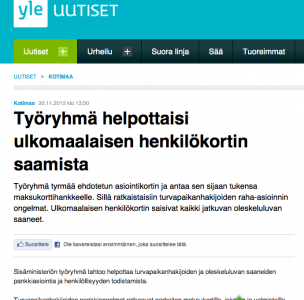
There’s some hope on the way. The ministry of interior wants to change matters so it would be easier for newly arrived immigrants to get an id card with which to get a debit card from the bank, according to YLE.

How long will it take before this very important issue is addressed effectively by the bank and state authorities?

Because it appears that the aim of these two institutions is to make life as difficult as possible for these people, don’t expect anything soon to happen.

Per-Looks: A taste of one’s own medicine for the PS of Finland

Posted on October 8, 2012 by Migrant Tales

I’ve been reading with some interest the ongoing debate on social media about the Per-Looks blog that has outraged some Perussuomalaiset (PS) party members. The blog shows a number of PS candidates running for office in the October 28 municipal elections.

Just for the record, I don’t like to make fun of people due to their ethnic background, religion, culture or looks and dress as is the case with Pers-Looks.

While the pictures published on Per-Looks aim to give an image that the PS are a bunch of Finnish hillbillies, the blog does offers the anti-immigration and anti-Islam party a taste of its own medicine.

Possibly those who feel offended by Per-Looks now understand how it feels to be a visible immigrant attacked in the Finnish media by politicians of parties like the PS.

Blaming the social democrats for the prank, Matti Puukkonen of the PS said that Per-Looks  was “a cowardly act made by losers who are in politics.”

Just like former Italian Prime Minister Silvio Berlusconi, who commonly blamed negative media coverage on communists, the PS like to criticize eco-socialists for the critical coverage they receive in the Finnish media.

The person who made Per-Looks was quoted as saying on Nelonen TV that the aim of the blog was not to ridicule the PS candidates.

“The [purpose of the] Per-Looks blog is not to make fun or to make a political statement with the pictures,” the person said in a statement sent by email. “The pictures on displayed are just as they are found on different web sites [of the PS].”

Since the publishing of Per-Looks, other ones have appeared such as one for the National Coalition Party (Kok-Looks), Pirate Party (Pir-Looks) and Greens (Vih-Looks).


EU Commissioner for Human Rights: Protection against discrimination should be strengthened in Finland

Posted on September 25, 2012 by Migrant Tales


This is a statement by the EU Commissioner for Human Rights:

Strasbourg, 25/9/2012 – “The Finnish Government has started a timely reform of the national equal treatment legislation. It is now crucial to ensure accessibility of the protection framework to all victims of discrimination and avoid unnecessary fragmentation of equality bodies” said today Nils Muižnieks, the Council of Europe Commissioner for Human Rights, releasing a report based on the findings of his visit to Finland carried out on 11-13 June.

The Commissioner welcomed the new National Action Plan on Fundamental and Human Rights, but pointed out that it lacked measures for human rights education. “The recently created independent Human Rights Centre and Human Rights Delegation should aim to fill in some of the gaps of the National Action Plan. It is important that these two bodies, which are going to constitute a National Human Rights Institution together with the Parliamentary Ombudsman, are provided with adequate resources and means to fulfil their extensive mandates.”

The Commissioner is concerned that a gender pay gap of 17.9% still remains, and that violence against women continues to be a serious problem. “The authorities should improve coordination in their responses to violence against women and extend the network of emergency shelters.”

Commissioner Muižnieks is particularly concerned about racist hate speech, also coming from certain politicians, and the extreme marginalisation of young Somali persons. “Further efforts are needed to address discrimination experienced by Roma, Russian-speakers and Somalis who face considerable obstacles in many fields of life, including employment.”

While welcoming the Finnish plan to deinstitutionalise persons with intellectual disabilities, the Commissioner recommends the prompt ratification of the UN Convention on the rights of persons with disabilities and the involvement of disabled people in its monitoring.

The Commissioner also urges Finland to recognise Sámi rights to land and to reindeer herding in the traditional manner, and to ratify the International Labour Organization Convention No. 169 concerning indigenous peoples. ”The close participation of Sámi representatives in the ratification process is essential.”

  • Read the report

Press contact in the Commissioner’s Office:
Stefano Montanari, +33 (0)6 61 14 70 37 ; [email protected]

Keep up to date with the Commissioner on Twitter


  • Previous
  • 1
  • …
  • 9
  • 10
  • 11
  • 12
  • 13
  • 14
  • 15
  • Next
Read more about documentary film
Read more

Recent Posts

  • Finland’s tabloids Iltalehti and Ilta-Sanomat are the pits
  • Riikka Purra’s Dr Jekyll and Mr Hyde mask
  • Double standards
  • Perussuomalaiset: Uusi logo, sama vanha juttu
  • Taco Trump

Recent Comments

  1. Absolutely Socking: Racist Finnish Facebook group against human rights gets flooded with socks on Musta Barbaari’s mother and sister charged by the police in “ethnic profiling” case
  2. Ilkka Nuotio on Pekka Myrskylä: “Tilastot kertovat toista kuin poliittinen keskustelu”
  3. Genrih Soinkara on The war in Ukraine and the Russian-Finnish border crisis are showing Finland’s ugly side
  4. Ahti Tolvanen on Comment by Ahti Tolvanen on the Helsinki +50 conference
  5. Angel Barrientos on Angel Barrientos is one of the kind beacons of Finland’s Chilean community

Archives

  • June 2026
  • May 2026
  • April 2026
  • March 2026
  • February 2026
  • January 2026
  • December 2025
  • November 2025
  • October 2025
  • September 2025
  • August 2025
  • July 2025
  • June 2025
  • May 2025
  • April 2025
  • March 2025
  • February 2025
  • January 2025
  • December 2024
  • November 2024
  • October 2024
  • September 2024
  • August 2024
  • July 2024
  • June 2024
  • May 2024
  • April 2024
  • March 2024
  • February 2024
  • January 2024
  • December 2023
  • November 2023
  • October 2023
  • September 2023
  • August 2023
  • July 2023
  • June 2023
  • May 2023
  • April 2023
  • March 2023
  • February 2023
  • January 2023
  • December 2022
  • November 2022
  • October 2022
  • September 2022
  • August 2022
  • July 2022
  • June 2022
  • May 2022
  • April 2022
  • March 2022
  • February 2022
  • January 2022
  • December 2021
  • November 2021
  • October 2021
  • September 2021
  • August 2021
  • July 2021
  • June 2021
  • May 2021
  • April 2021
  • March 2021
  • February 2021
  • January 2021
  • December 2020
  • November 2020
  • October 2020
  • September 2020
  • August 2020
  • July 2020
  • June 2020
  • May 2020
  • April 2020
  • March 2020
  • February 2020
  • January 2020
  • December 2019
  • November 2019
  • October 2019
  • September 2019
  • August 2019
  • July 2019
  • June 2019
  • May 2019
  • April 2019
  • March 2019
  • February 2019
  • January 2019
  • December 2018
  • November 2018
  • October 2018
  • September 2018
  • August 2018
  • July 2018
  • June 2018
  • May 2018
  • April 2018
  • March 2018
  • February 2018
  • January 2018
  • December 2017
  • November 2017
  • October 2017
  • September 2017
  • August 2017
  • July 2017
  • June 2017
  • May 2017
  • April 2017
  • March 2017
  • February 2017
  • January 2017
  • December 2016
  • November 2016
  • October 2016
  • September 2016
  • August 2016
  • July 2016
  • June 2016
  • May 2016
  • April 2016
  • March 2016
  • February 2016
  • January 2016
  • December 2015
  • November 2015
  • October 2015
  • September 2015
  • August 2015
  • July 2015
  • June 2015
  • May 2015
  • April 2015
  • March 2015
  • February 2015
  • January 2015
  • December 2014
  • November 2014
  • October 2014
  • September 2014
  • August 2014
  • July 2014
  • June 2014
  • May 2014
  • April 2014
  • March 2014
  • February 2014
  • January 2014
  • December 2013
  • November 2013
  • October 2013
  • September 2013
  • August 2013
  • July 2013
  • June 2013
  • May 2013
  • April 2013
  • March 2013
  • February 2013
  • January 2013
  • December 2012
  • November 2012
  • October 2012
  • September 2012
  • August 2012
  • July 2012
  • June 2012
  • May 2012
  • April 2012
  • March 2012
  • February 2012
  • January 2012
  • December 2011
  • November 2011
  • October 2011
  • September 2011
  • August 2011
  • July 2011
  • June 2011
  • May 2011
  • April 2011
  • March 2011
  • February 2011
  • January 2011
  • December 2010
  • November 2010
  • October 2010
  • September 2010
  • August 2010
  • July 2010
  • June 2010
  • May 2010
  • April 2010
  • March 2010
  • February 2010
  • January 2010
  • December 2009
  • November 2009
  • October 2009
  • September 2009
  • August 2009
  • July 2009
  • December 2008
  • November 2008
  • October 2008
  • September 2008
  • August 2008
  • July 2008
  • June 2008
  • May 2008
  • April 2008
  • March 2008
  • February 2008
  • January 2008
  • November 2007
  • October 2007
  • September 2007
  • August 2007
  • July 2007
  • June 2007
  • May 2007

Categories

  • ?? Gia L?c
  • ????? ?????? ????? ???????? ?? ??????
  • ???????
  • @HerraAhmed
  • @mondepasrond
  • @nohatefinland
  • @oula_silver
  • @Varathas
  • A Pakistani family
  • äärioikeisto
  • Abbas Bahmanpour
  • Abdi Muhis
  • Abdirahim Hussein Mohamed
  • Abdirahim Husu Hussein
  • Abdirisak Mahamed
  • About Migrant Tales
  • activism
  • Adam Al-Sawad
  • Adel Abidin
  • Afrofinland
  • Ahmed IJ
  • Ahti Tolvanen
  • Aino Pennanen
  • Aisha Maniar
  • Alan Ali
  • Alan Anstead
  • Alejandro Díaz Ortiz
  • Alekey Bulavsev
  • Aleksander Hemon
  • Aleksanterinliitto
  • Aleksanterinliitto ry
  • Aleksanterinliitto ry:n hallitus
  • Alex Alex
  • Alex Mckie
  • Alexander Nix
  • Alexandra Ayse Albayrak
  • Alexis Neuberg
  • Ali Asaad Hasan Alzuhairi
  • Ali Hossein Mir Ali
  • Ali Rashid
  • Ali Sagal Abdikarim
  • Alina Tsui
  • Aline Müller
  • All categories
  • Aman Heidari
  • Amiirah Salleh-Hoddin & Jana Turk
  • Amin A. Alem
  • Amir Zuhairi
  • Amkelwa Mbekeni
  • Ana María Gutiérrez Sorainen
  • Anachoma
  • Anders Adlecreutz
  • Angeliina Koskinen
  • Anna De Mutiis
  • Anna María Gutiérrez Sorainen
  • Anna-Kaisa Kuusisto ja Jaakko Tuominen
  • Annastiina Kallius
  • Anneli Juise Friman Lindeman
  • Announcement
  • Anonymous
  • Antero Leitzinger
  • anti-black racism
  • Anti-Hate Crime Organisation Finland
  • Anudari Boldbaatar
  • Arshiya Nasser
  • Aspergers Syndrome
  • Asylum Corner
  • Asylum seeker 406
  • Athena Griffin and Joe Feagin
  • Autism
  • Avaaz.org
  • Awale Olad
  • Ayan Said Mohamed
  • AYY
  • Barachiel
  • Bashy Quraishy
  • Beatrice Kabutakapua
  • Beri Jamal
  • Beri Jamal and Enrique Tessieri
  • Bertolt Brecht
  • Boiata
  • Boodi Kabbani
  • Bruno Gronow
  • Carmen Pekkarinen
  • Çelen Oben and Sheila Riikonen
  • Chiara Costa-Virtanen
  • Chiara Costa-Virtanen
  • Chiara Sorbello
  • Christian Thibault
  • Christopher Wylie
  • Clara Dublanc
  • Dana
  • Daniel Malpica
  • Danilo Canguçu
  • David Papineau
  • David Schneider
  • Dexter He
  • Don Flynn
  • Dr Masoud Kamali
  • Dr. Faith Mkwesha
  • Dr. Theodoros Fouskas
  • Edna Chun
  • Eeva Kilpi
  • Emanuela Susheela
  • En castellano
  • ENAR
  • Enrique
  • Enrique Tessieri
  • Enrique Tessieri & Raghad Mchawh
  • Enrique Tessieri & Yahya Rouissi
  • Enrique Tessieri and Muhammed Shire
  • Enrique Tessieri and Sira Moksi
  • Enrique Tessieri and Tom Vandenbosch
  • Enrique Tessieri and Wael Che
  • Enrique Tessieri and Yahya Rouissi
  • Enrique Tessieri and Zimema Mhone
  • Epäluottamusmies
  • EU
  • Europe
  • European Islamophobia Report
  • European Islamophobia Report 2019,
  • European Union
  • Eve Kyntäjä
  • Ezequiel Caldeiro
  • Facebook
  • Fadumo Dayib
  • Faisa Kahiye
  • Farhad Manjoo
  • Fasismi
  • Finland
  • Fizza Qureshi
  • Flyktingar och asyl
  • Foreign Student
  • Fozia Mir-Ali
  • Frances Webber
  • Frida Selim
  • Gareth Rice
  • Ghyslain Vedeaux
  • Global Art Point
  • Great Replacement
  • Habiba Ali
  • Hami Bahadori
  • Hami Bahdori
  • Hamid
  • Hamid Alsaameere
  • Hamid Bahdori
  • Handshake
  • Harmit Athwal
  • Hassan Abdi Ali
  • Hassan Muhumud
  • Heikki Huttunen
  • Heikki Wilenius
  • Helsingin Sanomat
  • Henning van der Hoeven
  • Henrika Mälmsröm
  • Hser Hser
  • Hser Hser ja Mustafa Isman
  • Husein Muhammed
  • Hussain Kazemian
  • Hussain Kazmenian
  • Ibrahim Khan
  • Ida
  • Ignacio Pérez Pérez
  • Iise Ali Hassan
  • Ilari Kaila & Tuomas Kaila
  • Imam Ka
  • inside-an-airport
  • Institute of Race Relations
  • Iraqi asylum seeker
  • IRR European News Team
  • IRR News Team
  • Islamic Society of Norhern FInland
  • Islamic Society of Northern Finland
  • Islamophobia
  • Jacobinmag.com
  • Jallow Momodou
  • Jan Holmberg
  • Jane Elliott
  • Jani Mäkelä
  • Jari Luoto
  • Jari Taponen
  • Jegor Nazarov
  • Jenni Stammeier
  • Jenny Bourne
  • Jessie Daniels
  • Joe Davidow
  • Johannes Koski
  • John D. Foster
  • John Grayson
  • John Marriott
  • Jon Burnett
  • Jorma Härkönen
  • Jos Schuurmans
  • José León Toro Mejías
  • Josue Tumayine
  • Jouni Karnasaari
  • Juan Camilo
  • Jukka Eräkare
  • Julian Abagond
  • Julie Pascoet
  • Jussi Halla-aho
  • Jussi Hallla-aho
  • Jussi Jalonen
  • JusticeDemon
  • Kadar Gelle
  • Kaksoiskansalaisuus
  • Kansainvälinen Mikkeli
  • Kansainvälinen Mikkeli ry
  • Katherine Tonkiss
  • Kati Lepistö
  • Kati van der Hoeven-Lepistö
  • Katie Bell
  • Kättely
  • Kerstin Ögård
  • Keshia Fredua-Mensah & Jamie Schearer
  • Khadidiatou Sylla
  • Khadra Abdirazak Sugulle
  • Kiihotus kansanryhmää vastaan
  • Kirsi Crowley
  • Koko Hubara
  • Kristiina Toivikko
  • Kubra Amini
  • KuRI
  • La Colectiva
  • La incitación al odio
  • Laura Huhtasaari
  • Lauri Finér
  • Leif Hagert
  • Léo Custódio
  • Leo Honka
  • Leontios Christodoulou
  • Lessie Branch
  • Lex Gaudius
  • Leyes de Finlandia
  • Liikkukaa!
  • Linda Hyökki
  • Liz Fekete
  • M. Blanc
  • Maarit Snellman
  • Mahad Sheikh Musse
  • Maija Vilkkumaa
  • Malmin Kebab Pizzeria Port Arthur
  • Marcell Lorincz
  • Mari Aaltola
  • María Paz López
  • Maria Rittis Ikola
  • Maria Tjader
  • Marja-Liisa Tolvanen
  • Mark
  • Markku Heikkinen
  • Marshall Niles
  • Martin Al-Laji
  • Maryan Siyad
  • Matt Carr
  • Mauricio Farah Gebara
  • Media Monitoring Group of Finland
  • Micah J. Christian
  • Michael McEachrane
  • Michele Levoy
  • Michelle Kaila
  • Migrant Tales
  • Migrant Tales Literary
  • Migrantes News
  • Migrants' Rights Network
  • MigriLeaks
  • Mikko Kapanen
  • Miriam Attias and Camila Haavisto
  • Mohamed Adan
  • Mohammad Javid
  • Mohammad M.
  • Monikulttuurisuus
  • Monisha Bhatia and Victoria Canning
  • Mor Ndiaye
  • Muh'ed
  • Muhamed Abdimajed Murshid
  • Muhammed Shire
  • Muhammed Shire and Enrique Tessieri
  • Muhis Azizi
  • Musimenta Dansila
  • Muslimiviha
  • Musulmanes
  • Namir al-Azzawi
  • Natsismi
  • Neurodiversity
  • New Women Connectors
  • Nils Muižnieks
  • No Labels No Walls
  • Noel Dandes
  • Nuor Dawood
  • Omar Khan
  • Otavanmedia
  • Oula Silvennoinen
  • Paco Diop
  • Pakistani family
  • Pentti Stranius
  • Perussuomalaiset
  • perustuslaki
  • Petra Laiti
  • Petri Cederlöf
  • Pia Grochowski
  • Podcast-lukija Bea Bergholm
  • Pohjois – Suomen Islamilainen Yhdyskunta
  • Pohjois Suomen Islamilainen Yhyskunta
  • Polina Kopylova
  • Race Files
  • racism
  • Racism Review
  • Raghad Mchawh
  • Ranska
  • Rashid H. and Migrant Tales
  • Rasismi
  • Raul Perez
  • Rebecka Holm
  • Reem Abu-Hayyeh
  • Refugees
  • Reija Härkönen
  • Remiel
  • Reza Nasri
  • Richard Gresswell
  • Riikka Purra
  • Risto Laakkonen
  • Rita Chahda
  • Ritva Kondi
  • Robito Ibrahim
  • Roble Bashir
  • Rockhaya Sylla
  • Rodolfo Walsh
  • Roger Casale
  • Rostam Atai
  • Roxana Crisólogo Correa
  • Ruth Grove-White
  • Ruth Waweru-Folabit
  • S-worldview
  • Sadio Ali Nuur
  • Sami Rusanen
  • Sandhu Bhamra
  • Sara de Jong
  • Sarah Crowther
  • Sari Alhariri
  • Sarkawt Khalil
  • Sasu
  • Scot Nakagawa
  • Shabana Ahmadzai
  • Shada Islam
  • Sharon Chang blogs
  • Shenita Ann McLean
  • Shirlene Green Newball
  • Sini Savolainen
  • Sira Moksi
  • Sonia K.
  • Sonia Maria Koo
  • Steverp
  • Stop Deportations
  • Suldaan Said Ahmed
  • Suomen mediaseurantakollektiivi
  • Suomen Muslimifoorumi ry
  • Suomen viharikosvastainen yhdistys
  • Suomen viharikosvastainen yhdistys ry
  • Suomi
  • Supermen
  • Susannah
  • Suva
  • Syrjintä
  • Talous
  • Tapio Tuomala
  • Taw Reh
  • Teivo Teivainen
  • The Daily Show
  • The Heino
  • The Supermen
  • Thomas Elfgren
  • Thulfiqar Abdulkarim
  • Tim McGettigan
  • Tino Singh
  • Tito Moustafa Sliem
  • Tobias Hübinette and L. Janelle Dance
  • Transport
  • Trica Danielle Keaton
  • Trilce Garcia
  • Trish Pääkkönen
  • Trish Pääkkönen and Enrique Tessieri
  • Tuulia Reponen
  • Uncategorized
  • UNITED
  • University of Eastern Finland
  • Uyi Osazee
  • Väkivalta
  • Vapaa Liikkuvuus
  • Venla-Sofia Saariaho
  • Vieraskynä
  • W. Che
  • W. Che an Enrique Tessieri
  • Wael Ch.
  • Wan Wei
  • Women for Refugee Women
  • Xaan Kaafi Maxamed Xalane
  • Xassan Kaafi Maxamed Xalane
  • Xassan-Kaafi Mohamed Halane & Enrique Tessieri
  • Yahya Rouissi
  • Yasmin Yusuf
  • Yassen Ghaleb
  • Yle Puhe
  • Yuliet Tresa
  • Yve Shepherd
  • Zahra Khavari
  • Zaker
  • Zalina Ametova
  • Zamzam Ahmed Ali
  • Zeinab Amini ja Soheila Khavari
  • Zimema Mahone and Enrique Tessieri
  • Zimema Mhone
  • Zoila Forss Crespo Moreyra
  • ZT
  • Zulma Sierra
  • Zuzeeko Tegha Abeng
© 2026 Migrant tales | Powered by Minimalist Blog WordPress Theme