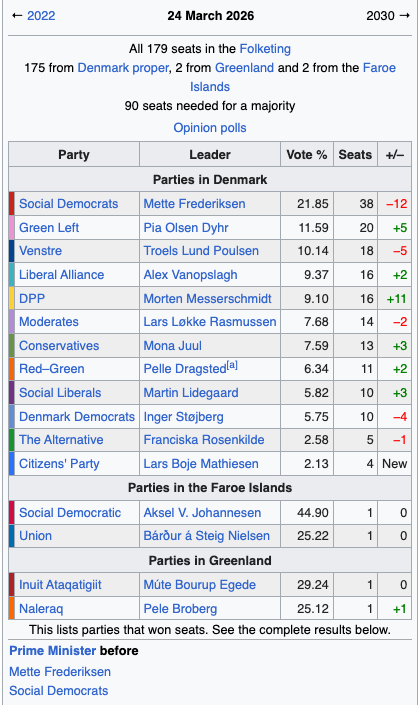
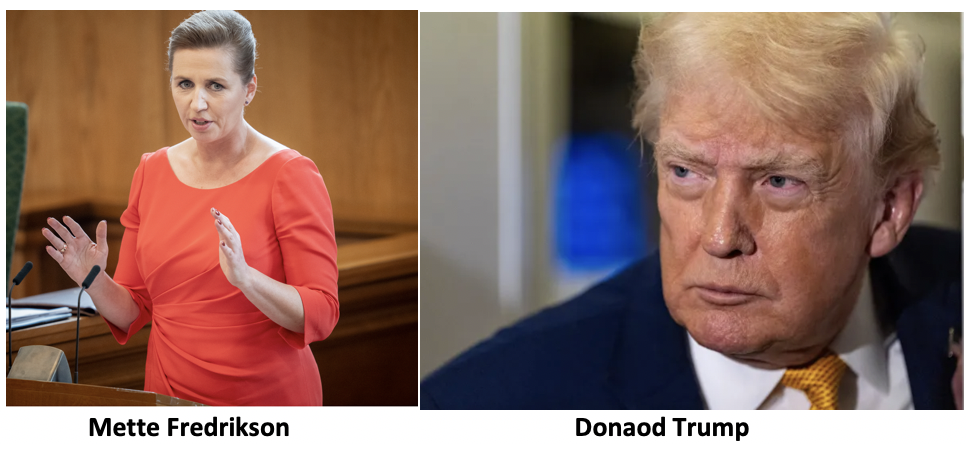
The recent parliamentary election in Denmark, one of Europe’s most Islmophobic countries, was a rude awakening to its Social Democratic Prime Minister Mette Frederiksen, who thought she could capitalize with the row over Greenland with the United States. Her party lost 12 MPs to receive only 21.85% of the vote compared to 27.54% in 2022.
Even if Federikson is a Social Democrat, her immigration policy is Islamophobic.
It is a sweet irony that while she has warned about Islamization, it was actually a white supremacist US adminitration that posed the greater threat to national security by wanting to take over Greenland.
“Media and politicians, including Prime Minister Mette Frederiksen, Frederik Vad, and Ida Auken, contributed to a public discourse in which Muslims’ motives and loy- alties were openly questioned. Key figures such as Eva Gregersen and Thomas Hoff- mann played central roles in monitoring and casting suspicion on Muslims and their civic engagement.”
If anything, the result proves that there is a certain saturation point for Islamophobic policies and campaigns.
It will be interesting to see how much the Perussuomalaiset (PS)* capitalize on their aggressive and hostile campaign against Muslims and other migrants.
The recent warnings by US President Donald Trump of taking over Greenland “whether they like it or not” raises and exposes a lot of questions about Denmark. For one, Denmark, considered one of the most Islamophobic countries in the EU, got it all wrong. Not Muslims but white supremacists from the United States are the greatest threat.
What we are seeing is the implementation of the US’ National Security Strategy and its support of a new world order government by far-right parties in Europe.
The whole debacle over Greenland exposes as well the hypocrisy and racism of Denmark, which is not a country guided by Nordic values of mutual respect but by racism and discrimination. The image of Denmark as a progressive country has been false for over forty years.
Denmark’s openly racist policies toward Muslims and other non-Europeans have come home to roost by targetting the wrong “enemy.” Starting wth Social Democrat Prime Minister Mette Fredrikson, who has propagated exclusive anti-Muslim policies, all political parties in the country are complicit for their shortsightedness and racism.”
Taking into account the openly exclusive policies of Denmark against minorities, it is doubtful the country will be able to correct its ways because all of the political parties have contributed to the situation.
Liz Fekete wrote in “Europe’s Fault Line,” a few years ago that there has been a massive shift to the right with racism of all parties complicit with this becoming widespread.
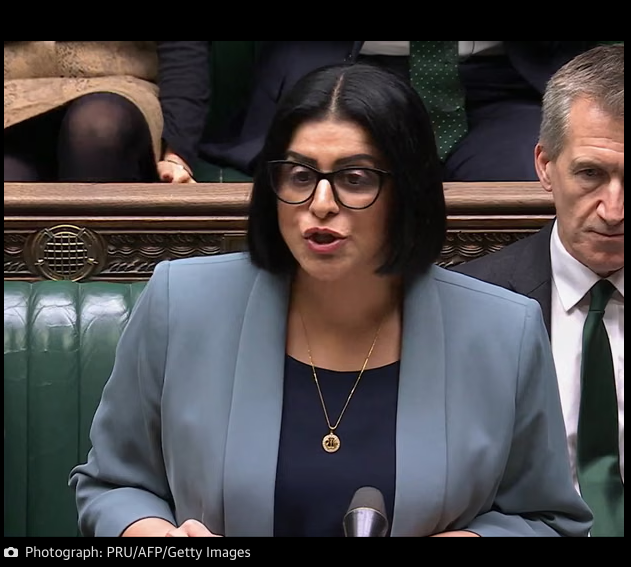
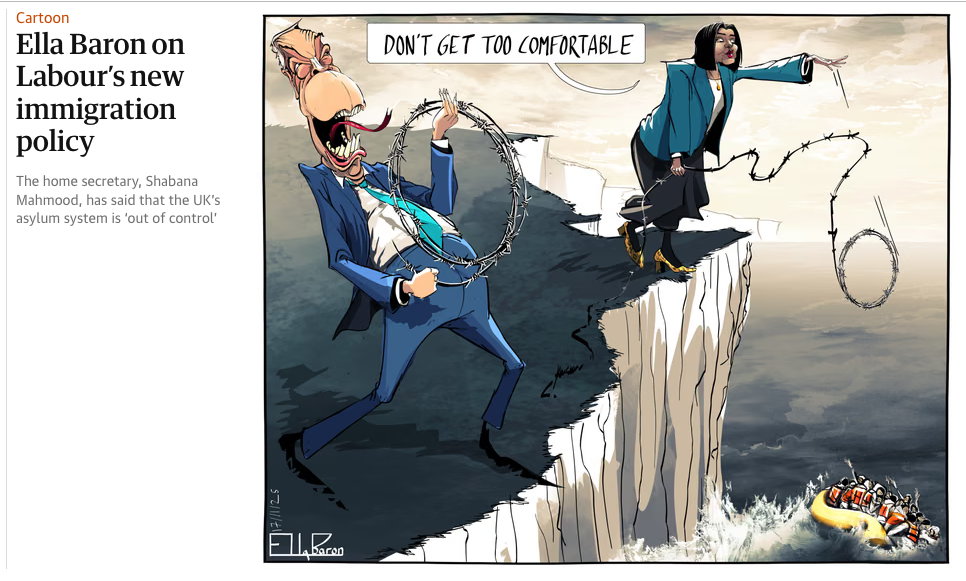
Why are home secretaries of minority ethnic backgrounds pushing the most racist and radical immigration policies? Home Secretary Shabana Mahmoud follows in the footsteps of other dubious home secretaries like Sajid Javid (2018-19), Pritte Partal (2019-22), Suela Braveman (2022-23), and James Cleverly (2023-24).
All of the above have something in common: they hate migrants, especially asylum seekers.
In some respects, these home secretaries represent the role of the Ukrainians at Nazi concentration camps who did the dirty work, like terrorizing victims and sending them to the gas chambers. In the same way, these home secretaries want to make the lives of asylum seekers are difficult and painful as possible.
Some may believe that since it is a brown person adopting such a draconian migration policy, it must be ok. It’s not, but disgraceful.
If there is something we can learn from these ideological hard-right home secretaries masquerading as members of the Labor Party, ethnic background has little to do with your political views. The most important matter is your upbringing and what moral lessons forged you into a human being.
Mahmoud is a disgrace to her immigrant parents and their suffering.
Some see Denmark as an Islamophobic country on steroids. Mahmoud wants to adopt Denmark’s immigration policy in the UK.
In an interview with Helsingin Sanomat, Danish MP and Minister for European Affairs Maria Bjerre only had positive things to say about her country’s migration policy, one of the most restrictive in the EU. The interview by Elina Kervinen was in my opinion a good example of how the media feeds xenophobia by sidestepping some crucial points.
The whole article tells us things we already know, and its purpose is to absolve Denmark’s migration policy of racism, which we have described on Migrant Tales as working on steroids.
Why does this interview wreak of opinionated hogwash?
– It mentions things we already know like doing away with “pull” factors that will discourage asylum seekers (the article brands them as “illegals”) from coming here. – Bjerre is speaking in code. What she is saying are ways to effectively stop Muslims and other Third Worlders from comig to Europe. No mention in the article about the 6.168 million Ukrainian refugees in Europe, according to the United Nations High Commissioner for Refugees (UNHCR). – In the face of the millions of Ukrainian refugees, it is absurd that Bjerre opportunistically claims that we have the biggest crisis since 2015 when over a million refugees came to Europe from the Middle East and elsehere. – The chart below shows you that we are not in a crisis. In fact, Europe only gets the minority of refugees. – If we make it difficult for migrants to come here – excluding Ukrainians – who is going to replenish our aging population?
One of the matters the reporter does not answer is why other EU countries agree with Denmark’s extreme migration policy. There is no mention in the story about the rise of the rise of the xenophobic far right in many EU countries and their support for Albania-type refugee centers.
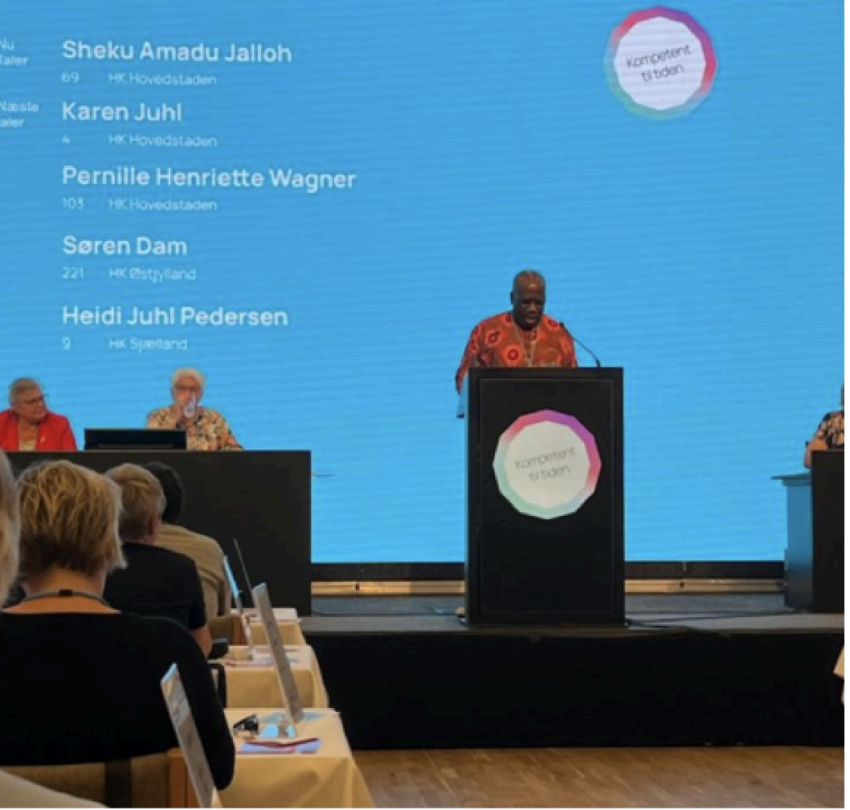
In November 1990, Sheku Amadu Jalloh arrived in Denmark from Sierra Leone as a stowaway, escaping the political turmoil of his homeland. Over three decades later, the stowaway, Jalloh who has studied journalism at the University of Liberia with a three-month training program in the USA, is a Danish citizen and a dedicated employee at the Royal Library. Jalloh is also a celebrated activist committed to combating racism and discrimination.
Making a speech on 21 March during the UN International Day for the Elimination of Racial Discrimination.
A Journey from Sierra Leone to Denmark
Jalloh left Sierra Leone due to the political instability and civil war that plagued the West African country for 11 years and sought a better life in Denmark. Since then, 30 years have passed and he has deeply integrated into Danish society. He recently celebrated 30 years working at the Royal Library.
At a trade union congress.
Leadership in the Fight Against Racism
“A Denmark in which justice and equality are not just ideals, but realities for all of its inhabitants,”
As chairman of SOS Racism Denmark and board member of the Afro-Danish Collective, Jalloh advocates against racism and discrimination. These organizations aim to create a society where everyone has equal opportunities, regardless of their background. Jalloh states that their mission is to prevent the spread of racism and discrimination. Despite Denmark ranking fourth in Europe as a racist country, according to Information in November 2023, Jalloh notes that this view is not representative of all political parties. Some parties offer support to immigrants and people of foreign descent.
Making speech on workers day on May 1st (Left picture) – From a meeting with Rosa Lund (right front photo sitting), an MP of the Red-Green Alliance political party. An anti-discrimination action plan was discussed at the meeting. (right picture)
A broader alliance for equality
In addition to participating in the Afro-Danish Collective and SOS Racism, Jalloh is a strong advocate of Mellemfolkeligt Samvirke, a coalition organizing activities and protests to encourage communication with legislators and lobbying for anti-discrimination laws. In the face of the government’s erratic refugee quotas, which were lowered from 500 to 50 and are currently 200, Jalloh and his associates are unwavering in their demands for greater acceptance rates. They stress that, in light of other countries’ efforts, even the former quota of 500 is insufficient.
Celebrating the UN International Day for the Elimination of Racial Discrimination.
The Role of Trade Unions
A major component of Jalloh’s approach is mobilizing trade unions for the cause. He anticipates using the combined might of organized labor to present a unified front against racism and discrimination. “My goal is to involve more trade unions in the anti-discrimination battle and every year on March 21, we celebrate the UN International Day for the Elimination of Racial Discrimination Day together with five to six trade unions participating in the events,” he said.
A vision for the future
Jalloh and his fellow activists were instrumental in the adoption and enactment of the anti-discrimination action plan in Copenhagen in 2023. Seeing that their efforts have proven fruitful, he has now resolved to attain similar outcomes with an equivalent national legislation.
Addressing delegates at the HK Stat Trade Union congress.
Despite the many challenges, Jalloh remains unfazed and his vision is clear: “A Denmark in which justice and equality are not just ideals, but realities for all of its inhabitants,” he continued. “One thing we have to work very hard on is coming together to fight racism and discrimination.”
Jalloh’s story is one of zeal, perseverance, and unflinching dedication. From his beginnings in Sierra Leone to his current position as an activist in Denmark, he shows the impact that one person can have in the battle for a more equitable, inclusive society. Through his work, he continues to inspire and motivate others, demonstrating that the route to equality, while arduous, is “undoubtedly worth every step”.
The Islamophobic Perussuomalaiset (PS)* party has had a long love affair with Denmark’s anti-Muslim immigration policy, one of the toughest in Europe. With loaded guns in government, the PS must be happy that they can adopt, with the blessings of National Coalition Party (NCP) Prime Minister Petteri Orpo and the two minor coalition partners, the Swedish People’s Party (SPP) and Christian Democrats (KD), that country’s harsh immigration policy.
The Danish People’s Party (DPP) used to call the anti-immigration shots in government but in recent years their support has declined abruptly. In the 2022 election, the DPP lost 11 seats to remain with five seats in parliament, which is a far cry from the 37 seats they won in 2015.
The fortunes of the DPP have been undermined by the Social Democrats who have adopted and succumbed to the same hardline immigration policy and rehotirc of the far-right party.
While some are debating if a radical right party becomes more moderate when in government, Denmark offers us an answer: it radicalizes other parties who must adopt more hostile stances in order to survive and not be devoured by a populist party.
Apart from the government’s immigration policy that disenfranchises migrants by weakening more their civil rights and making them vulnerable to exploitation by employers, one wonders how far the PS – with the blessing of the NCP, SPP and KD – will go in order to make life difficult for migrants.
in Denmark, the DPP went as far as to force migrants to speak only Danish at home and deport whole families if a member is convicted of a crime. When will we see the following aims below in Finland?
Spearheading these radical changes in Finland’s immigration policy is PS Interior Minister Mari Rantanen. She recently announced plans to speed up the asylum process to four weeks. The asylum seeker will wait for the decision at the border.
I would go as far as to predict that after the election in April, the youth gang issue will disappear. It was the case in Oulu when Finland became hysterical about sexual assaults committed by migrants.
We’re in the same situation today. True, we have to address social problems with good social policy. Fortunately, Finland has a comprehensive welfare state. Still, parties like the Perusuomalaiset (PS)* and the National Coalition Party (Kokoomus), who want to slash such spending if they win the election, lead us towards a cycle of exclusion and deception.
Remember what happened in Oulu in 2008-2009?
Let me refresh your memory. The media, politicians, and even the police caved into their exaggerated lies by turning an important issue into a storm in a teacup.
Every sexual assault is too much, period. However, if we look at the coverage of these cases, we see the same problem as in 2018-2019 with the so-called “rising” of youth gang violence that Yle and other media are spiking.
Similarities with the Oulu sexual assault cases: parliamentary elections, gang violence, a winning issue in Sweden’s election, and lack of correct checks and balances by the media and politicians.
For the police, it is also a winning issue. It ensures that more funds will be earmarked for them.
Have any of you seen any statistics about youth crime violence?
Why are the police and politicians holding back?
Considering that Finland’s gang “problem” is only a drop in the bucket compared to Sweden, the debate has revealed some nasty things about politicians and the media: washing our hands of the problem, simplifying and scapegoating migrants and minorities, and outright racism. President Sauli Niinistö, who never has anything positive to say about Muslims and people of color, joined the populist bandwagon over a week ago. Shameful.
Despite all the fear-mongering, it is a good sign that papers like Helsingin Sanomat are questioning the populism and hardline stance to solve the problem by parties like the PS and Kokoomus.
Quoting David Saudsdal, a sociologist at Lund University, he claims there is no proof that tougher laws against gang violence in Denmark have worked.
The election in Sweden was of special interest to me since I live next door to the country in Finland. Will the good showing of the far-right Sweden Democrats boost our far-right Perussuomalaiset (PS)* party in the April parliamentary election?
While it is fair to predict that the election result in Sweden should not hurt the election prospects of the PS, I am certain that the party took a lot of notes from the election and is now drafting a campaign strategy that hinges on migration.
Like many, I am not surprised by the election result in Sweden and the rise of the Sweden Democrats. Considering that all the Nordic countries now have large far-right parties that wield political power, it was only a question of when the chickens would come home to roost in Sweden. In Finland, the PS plays the same anti-Muslim tune as in Denmark (Social Democrats today and formerly Danish People’s Party) and Norway’s Progressive Party (FrP).
How can affluent countries with a comprehensive social welfare system that values and professes social equality end up with far-right parties that are hostile and want to exclude people from society who come from different backgrounds?
If we can’t receive an answer to the latter question, could we figure out how got here? Possibly we were always there. Our Nordic social welfare system and values were not meant for people who aren’t like us.
While some will blame migrants for the success of the Sweden Democrats, I would point the finger at the media and political parties like the Moderates, which gave the far-right party a platform of legitimacy to strike.
As of September 11, the future looks bleaker in Sweden and the Nordic region if you are a migrant or minority.
Incumbent Social Democratic Prime Minister Magdalena Andersson conceded defeat in Sweden’s nail-biter election to the rightwing parties led by the far-right Sweden Democrats, reports The Guardian.The rightwing parties received 49.6% of the votes, with the left bloc securing 48.9%.
If anything, it was a long overdue nasty surprise that permitted a far-right Islamophobic party to gain power in Sweden. Today, all Nordic countries have large far-right Islamophobic parties spreading fear and hatred against vulnerable migrants like Muslims and people of color.
While it is unlikely that the Sweden Democrats may hold ministerial posts, the new government led by the Moderate Party may resemble what happened in Denmark. In Denmark, the far-right Danish People’s Party (DPP) supported minority governments in return for tightening immigration policy
In the lowliest of political stunts to gain power, the Social Democrats in Denmark took up the rhetoric of the DPP and won the elections in 2019. The Danish Islamophobic party saw its popularity nosedive by 12.4 percentage points to 8.7% (16 MPs) from 21.1%(37 MPs) previously.
Denmark, the Nordic region’s most Islamophobic country, plans to tighten (again) its immigration laws by deporting all foreigners who are handed prison sentences, according to DR of Denmark.
DR writes that the government wants to introduce changes in the law so that any foreigner slapped with an unconditional prison sentence will be deported. “Today, a foreigner can avoid deportation despite being handed a prison sentence,” said Denmark’s Social Democratic minister for immigration and integration, Kaare Dybvad Bek.
While some idealize the Nordic welfare system because it is supposed to promote social equality, nothing could be further from the truth than Denmark, which some have correctly called a xenophobic country on steroids.