Asmaa is a black woman born in Finland who studies at the South-Eastern Finland University of Applied Sciences (Xamx). She was adamant about why she does not trust,never mind reads, the Finnish media. She emaileda response: I don’t read Finnish newspapers and none in particular. I find them very taxing to read. Constantly, people who look like me are vilified, branded as the devil himself and the root cause of all problems.“
Asmaa’s reply is an earnest response to a problem that reflects the media and Finnish society.
What are Finnish media giants like Helsingin Sanomat and others doing to fix the chronic lack of credibility in the eyes of some minorities? I suspect the answer is short and to the point: Nothing spectacular.
Although we remain hopeful and trust that the Finnish strive for impartial and equitable reporting that acknowledges the nation’s growing cultural diversity, progress has been sluggish.
d. Yle published an opinion poll today showing the radical-right Perussuomalaiset (PS)*, Social Democrats, and National Coalition Party (Kokoomus) neck and neck.
Another poll published Wednesday by Helsingin Sanomat showed Kokoomus leading (19.8%), followed by the Social Democrats and PS, tied at 19.2% apiece.
Considering how close the three parties are in the opinion polls, anything can happen and have for the first time a PS prime minister. That would be quite a feat in the face of the party’s historic victory in 2011 when it raised the number of MPs to 39 from 5 previously.
I remember apprehension that election day 11 years ago. Some were in shock, while others played it down. You’ll see, it is only a matter before they implode, some said, assuring themselves.
One of the lessons learned from the entry of a major Islamophobic party in Finnish politics in the last decade is that matters only get more polarized and the rhetoric more hostile.
The PS bases its politics on anti-immigration sentiment, which has crippled Finland’s ability to debate the topic and cultural diversity civilly. Spreading fear of other groups is the elixir that the PS drinks to get political power.
The rise of the PS in Finnish politics is a blow to its exceptionalism and alleged “happiness,” as it has won for a sixth time in a row the title of the happiest country in the world. How can such a happy country house so much hatred for other groups?
A political analyst told me recently that he hoped the PS would win big on Sunday.
The role of the media in shaping public discourse about minorities before the April parliamentary election is evident. We saw this in the case of Oulu in 2018-2019 and its present coverage of “youth gangs” from the fall. It is disheartening that no media has challenged politicians about how they exploit a topic like “youth gangs” and if there are links with Sweden’s and Finland’s parliamentary elections.
In December, we even saw President Sauli Niinistö, no friend of Finland’s culturally and ethnically diverse communities, give impetus to the toxic labeling of brown and black youths.
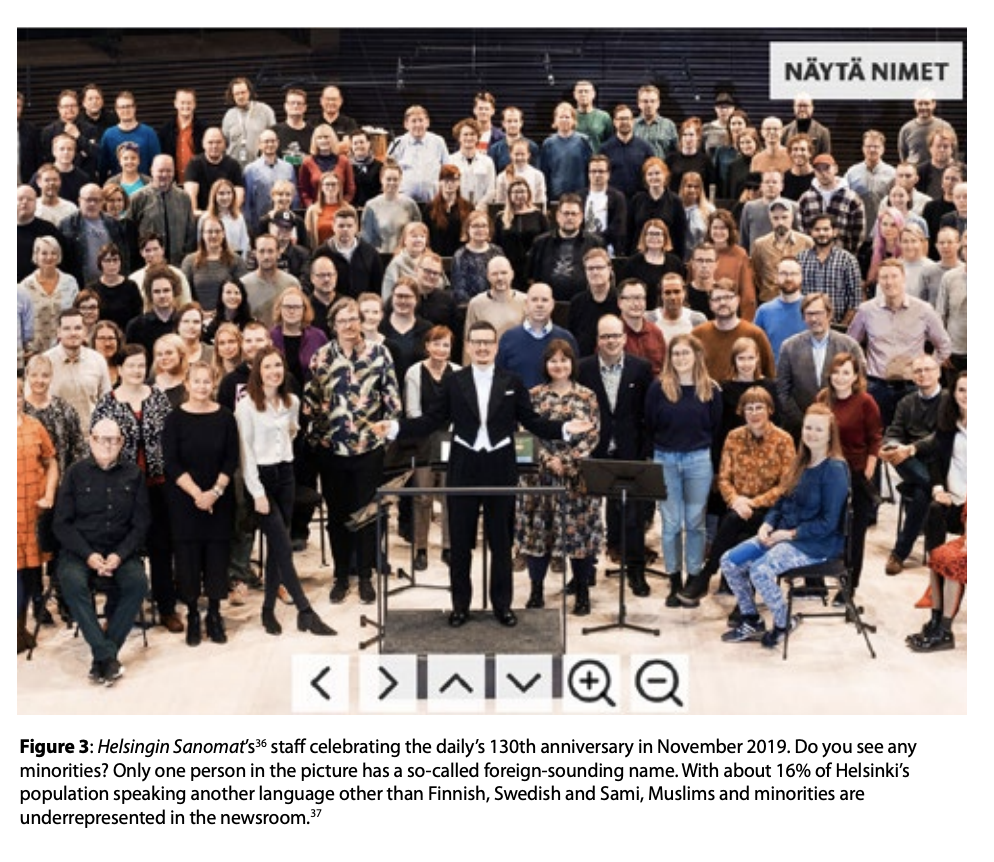
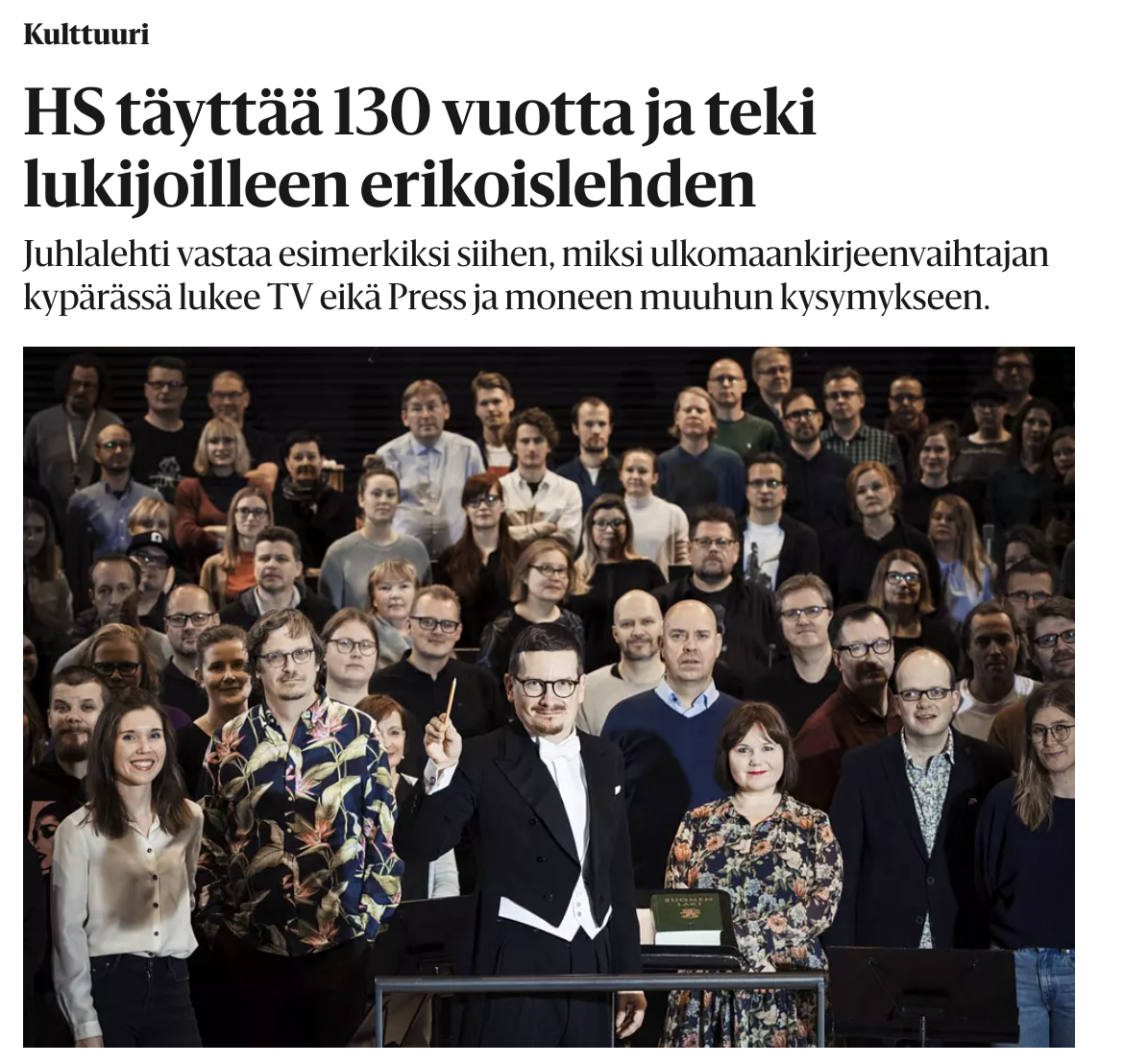
Helsingin Sanomat celebrated its 130th anniversary in 2019. The overwhelming majority of the daily’s newsroom comprises of white Finns. Source: Helsingin Sanomart
The coverage of “youth gangs,” which are referred to in Sweden as criminal gangs to avoid blanket labeling of whole groups, exposes in Finland how the media, police, and politicians collaborate to spread a toxic narrative about marginalized groups.
Each of the three groups involved (media, police, and politicians) have a vested interest in exploiting stories about minorities:
– The media gains viewers and advertisers. – The police can secure more funding. – Politicians attract voters.
Then Perussuomalaiset (PS)* head Timo Soini celebrated the party’s historic 2011 election victory as a “jytky,” or a loud bang. We may witness in April a counter “jytky.”
I live in a small city of about 53,000 people 230km north of Helsinki’s capital. It is a good example of the demographic challenges facing Finland. Occasionally, you may read in the local daily, Länsi-Savo, the threat of an ever-growing population of pensioners is threatening the region’s future.
None of the stories in the daily ask if Mikkeli has awoken too late to challenge the demographic problem.
To give you some fast figures, in 2022, 27,2% of Mikkeli’s population was over 64 years old and growing!
In many respects, Mikkeli is an extreme cosmos of Finland.
As we know, migration is a hot topic, especially during an election year. The PS, traditionally bases its popularity on the topic. Instead of making our society more welcoming to foreigners and offering them inclusive paths towards being a part of it, the medicine it prescribes is far worse than the illness.
Eight years of residence, speaking near-perfect Finnish, and work, before granting a permanent residence permit;
Raise the residence requirement for citizenship to 10 years from five years now;
Tighten further language requirements for the naturalization test;
Only citizens of OECD countries can have dual citizenship;
Exclude foreigners from getting social welfare;
Tighten further already strict family reunification requirements;
Only people within the EU can apply for asylum;
End labor immigration from outside the EU;
Only highly educated people from outside the EU can move to Finland.
Source: ETLA, an independent, private, non-profit economic research institute. Read the original posting here.
As any sensible person can understand, following the PS’ advice on immigration policy would be a disaster that would impoverish Finland economically, socially, and politically.
“That’s the central issue, people who want to be here need to accept our core values: democracy, equality, human rights and all of that. If they don’t, they can’t stay in Finland.”
During the many years I have written about President Sauli Niinistö, he has always disappointed me. For me, he represents a Finland where time will steamroll over it. If you read many of his comments throughout the years, one matter stands out like a sore thumb: He does not like anti-racism activists, Muslims, and minorities like people of color.
Instead of uniting all the people in this country from diverse cultural and ethnic backgrounds, his populism gets the better of him.
There are many examples, like when he addressed parliament in 2020. Without mentioning radical-right parties like the Perussuomalaiset (PS)*, he warned about the rise of “anti-Semitism and racism.” There is nothing wrong with that, but what was odd was he did not mention a word about Muslims and Islamophobia.
Cartoonist Ville Ranta’s view of President Sauli Niinistö’s two-extremes argument.
Islam is Finland’s second-biggest religion, with 120,000-130,000 followers.
A good example that he does not respect cultural diversity is the following statement he made in 2018, which is the worst of the worst.
He said: “I read in a newspaper about an Iraqi who had lived a long time in Finland, and he said that this [his culture] isn’t any problem. When I leave home for work, go to the store, or anywhere, I behave like a Finn. In this society, [I] follow the rules of the [cultural] game. But when I come home, I have Iraqi culture – truly impressive. And together with acquaintances can practice [my culture] very well, but the starting point is that Finland’s values are respected, democracy, gender equality.”
Two hard-hitting editorials by Helsingin Sanomat on the mistreatment of labor migrants could indicate how the Islamophobic Perussuomalaiset* will do in the parliamentary election. I makesuch a claim because I am an optimist.
We saw something similar in the US Midterm elections, which showed how voters rebuked Donald Trump and his election deniers.
Apart from two important editorials, good reporting on the case of a Mongolian nurse showed the good side of the media exposing and defending people’s rights.
The first Helsingin Sanomat editorial, published on Saturday, highlights what Migrant Tales mentioned weeks ago: Youth gang violence is a campaign topic for the opposition. The last one strongly criticizes the Finnish Immigration Service for arbitrarily mishandling Mongolian nurse Anudari Boldbaatar.
Struggling with the slow pace of due process in Finland to challenge Migri’s deportation order, a district court eventually overturned it, Boldbaatar had had enough and moved to another country.
I agree with both editorials and commend Finland’s biggest daily for speaking out against the hostile environment against migrants and minorities. The editorial on Boldbaatar asks how it is possible that Migri can ruin a person’s live and get away with an apology.
“The Agency [Migri] has traditionally played an important role in Finland’s immigration policy, mainly aimed at preventing foreigners from entering Finland.”
The Finnish mainstream media has a poor reputation in the eyes of racialized Finns for spreading and labeling them. Yle did it again on its 8:30 pm news, where it led with a picture of a white youth giving the finger, followed by no sources except for “the police believes” that street gang criminal activity has taken a turn for the worst.
Then the reporter gives her verdict, sourcing her opinions to the police without mentioning statistical information, never mind an official’s name.
“Shootings in public places, bragging about criminals and showing it on social media indicate that street gang criminal activity has grown in Finland, according to the police.”
The Yle reporter states that the National Bureau of Investigation (KRP) said four years ago that there were no youth street gangs in Finland. Today there are about ten gangs, mainly in Turku and Helsinki and surroundings, with about 200 members, according to the police.
Surprise, surprise: “Youth gangs are different from motorcycle gangs,” the reporter states, “since they listen to rap music, they are mainly men of foreign background and exert influence in the neighborhoods they live.”
Helsingin Sanomat, Finland’s largest-circulation daily, writes in an editorial about why the country needs labor migrants to secure economic growth and services offered by the welfare state. We are at a critical crossroads: It is the first time in history that more people die than there are newborns.
While the editorial invites debate on Finland’s serious demographic woes, it is misleading because it only highlights the usual talking points by leaving out new arguments offered by brown and black Finn migrant researchers.
The reaction of some Finns can turn violent against migrants and minorities, as we saw after the Turku stabbings in 2017 by a Moroccan asylum seeker. Source: Migrant Tales
The editorial bases its call for more labor migrants on the pension insurance group Varma CEO Risto Murto’s book, Puuttuvat puoli miljoonaa, The missing half a million.
Murto’s book does not reveal anything new about Finland’s demographic woes. Over one-fourth of about 8% of Finland’s foreign population in 2020 lives in Helsinki; in 2035, it will rise to over a third; the low employment levels of people who came to Finland as refugees.
While Murto does not explain why the employment level of Afghans, Iraqis, Somalis, and other people of color is low in Finland, he and Helsingin Sanomat leave out the fact that their employment level rises the longer they live in Finland.
For some odd reason, the Helsingin Sanomat editorial and Murto forget to mention that refugees in Finland comprise about 10% of all foreigners. As we know and have seen, Finland’s hostile environment against visible migrants spread by parties like the far-right Perussuomalaiset (PS)*, National Coalition Party (Kokoomus), Christian Democrats, and others.
When they attack foreigners, such parties speak of this group as one group, “migrants.”
Finland has historically shunned immigrants, even if it is a country of emigrants. In the 1970s, when hundreds of thousands of Finns were moving to Sweden, the country decided against labor immigration to plug the economically active population deficit.
Several questions arise on how Finland could be a magnet for labor migrants. Less bureaucracy, family reunification, child education, Finnish- and Swedish-language lessons.
Of all of the factors Murto believes would attract labor migrants, the most important one is missing: a migrant and minority-friendly society that is inclusive.
The latter is easier said than done. Historically and politically today, Finland has shot itself in the demographic leg by allowing its suspicion of outsiders to overtake the better of them.
Any serious student of Finnish society should eventually grasp that institutional racism is one of the mothers of all social ills in the country. Institutional racism gives cover to racists and to the toxic white saviors who do irreparable harm to migrants and minorities.
You don’t need a lot of research to figure out the latter. Look at people who have the power to enforce and regulate it.
If the issue is institutional racism, why does Finlan do so little to challenge it? One of many examples of discrimination is the labor market. Why do we rarely read in the media about the authorities clamping down on this problem? It is, instead, a new study over an old one highlighting this problem.
The answer reveals a sad truth: there is no intention or political will to change matters. The situation is what it is because they are supposed to be that way.
US social thinker James Baldwin put it in the following words:
Without any intention of changing matters, rest assured that most projects with newcomers will miss the mark or fail outright. The integration authorities will feed newcomers the usual half-truths about Finnish social justice, which is highly selective.
Unfortunately, the latter will happen with some of the blessings of our culturally diverse communities.
Even so, I am confident the more Finland’s culturally diverse population grows, the more evident this social ill will be, and the need to change it permanently.
An article in Yle News brings us back again to one of the biggest challenges for multilingual children at Finnish schools: How the Finnish education system treats cultural diversity.
Language and cultural interpreter and early childhood educator Nadezda Kärmeniemi admitted that multilingual children are caught between differing attitudes at schools.
She is saying that there is no uniform system on how Finnish children, who speak more than one language, are treated at schools.
“Unfortunately, there are instance in our society where speaking oner’s mother tongue is not allowed,” she said. “When a child goes to school, the multilingual ‘coat’ may be left at home, with only Finnish used at school, as there is a sense that the language used at home does not belong there.”
Cultural diversity means for me two-way adaption. All cultural and ethnic groups in society have space to express and be themselves. The glue that holds them together with other groups is building respect through learning from each other.
This picture was taken from the former Urpola School of Mikkeli. It tells multilingual children that they should speak Finnish and that they are mamus, a derogatory term no longer used to mean migrants. Photo: Enrique Tessieri
Having taught and worked at a folk high school with multicultural backgrounds for thirteen years, I have noticed the following challenges: