Migrant tales
Menu
  • #MakeRacismHistory “In Your Eyes”
  • About Migrant Tales
  • It’s all about Human Rights
  • Literary
  • Migrant Tales Media Monitoring
  • NoHateFinland.org
  • Tales from Europe
Menu

Tag: Cultural diversity

Dana: Why doesn’t President Sauli Niinistö care about immigrants? What’s his stance on racism?

Posted on October 23, 2013 by Migrant Tales

Dana

OLYMPUS DIGITAL CAMERA

Finland is a small country but a very proud one about its political and legal system. Some Finns believe they are, however, so different from other people on this planet and they can’t explain why.

For example…in Finland the law functions like magic; they believe that the law is so comprehensive that no-one in this country can behave in a racist manner and make the same mistake over and over again.

You can ask questions about the political and legal system but no-one will answer your questions…the Finnish system is supposed to respect human rights and give you a lot of freedom but still there’s a reject stamp on each question you ask, especially if it’s about family reunification.

This blog entry is about Sauli Niinistö, the President of Finalnd.

I have never seen him once organize a seminar or meeting with our immigrant community. Have you?

Why hasn’t he??? Is there a Finn that can answer this question? What about a foreigner?

What does Niinistö think about immigrants, refugees, or about me as a foreigner who lives here?

Who knows? Come on! Hands up! Speak up! Why doesn’t anyone ask this question to Niinistö: “Why don’t you speak up and defend our ever-growing culturally diverse society? Why haven’t you shown any interest in us, immigrants and refugees alike?

IS IT FEAR MR PRESIDENT???

Or is it because we are still such a small community that you still haven’t noticed that we’re here?

Small in size maybe but in which respect? In values, in will?

Do you have any news or information about the president’s new, even old thoughts about foreigners?

Can Niinistö understand my suffering – or aren’t I worthy of his attention?

He’s been president of Finland for some time. During his mandate he has hosted Independence Day celebrations at the Presidential Palace. He’s been seen dancing among supermen and superwomen on that day. Everyone has their eyes on him. The media watches him like white on rice but they don’t speak about anything else except how he’s dressed.

I believe the media in this country is materialistic because it is more interested in expensive clothes than in the suffering of others never mind growing social problems like poverty.

Niinistö went on official trips abroad, here and there; he spoke about different things but he NEVER EVER noticed our community, us foreigners, his neighbors who live in same country.

Tell me WHY??????

The rich people of the UAE are just like him. Since the Finnish governments needs money, they only respect rich foreigners from countries like the UAE.

No-one can call me a second-class citizen of this country. I am first-class and will always be no matter what anyone does.

In a nutshell, this is the course of humanity in Finland: Some treat me well while others look down on me.

Those that want to relegate me to the lower human leagues make my blood boil!
Dana: Ymmärrättekö Finland – wild culture, wild picture and wild future

Posted on October 20, 2013 by Migrant Tales

Dana

OLYMPUS DIGITAL CAMERA
How long will I have to endure these racist attacks and hostile looks? And what’s wrong with being a foreigner in Finland anyway?

There are no rainbows here if there’s only one color: white. No matter how much you paint your society white, I’m alive and will always feel victorious before you.

I have never met a Finnish person who can discuss with me what is wrong with this country. If I open my mouth, I’m attacked, even if I talk freely and with an open mind.

In Finland I never seen people with different ideas. NO… I’ve only seen one thing, one idea. Yes, there r different groups, organizations, even in sick parliament there r different political parties, but they are all the same. There’s no difference between them. They think they’re different in their minds but they’re not. They cannot fool a human like me. The only party that doesn’t use  a MASK is the PS (Perussuomalaiset) because they are openly racist. That’s the only difference between them and other parties.

In don’t lead a normal life in Finland, but i should defend myself at all times in public, no? Those who attack me are everywhere and ready to abuse u and make u feel u r nothing except a slave.

That’s why u see foreigners in shops owned by foreigners, because even in shops racists can attack u; yes, even when i pay with cash and contribute taxes.

The racists always think they know everything and that u, a foreigner, don’t know anything, They give the image of being wise, but tell me why would a wise person attack you because of ur skin color???

One of the famous words and sentences that they use in Finland is:  Ymmärrättekö, do you understand?

They don’t, however, use this word not in a normal way. It’s used a very harsh, insulting, dry and wild way…..OH U R ALL WILD! Wild, cranky, nervous and full anger in your souls.

Yes i understand and i understand more than u, so much more than u but what about you? Can’t you see that I am a human being like you? Can’t you understand this, Finland? Ymmärrättekö?

I understand the racists well. You are a big percentage in Finland and anywhere u can imagine. You fight back by ignoring me; you cannot argue, discuss, you cannot even figure out a simple matter, u cannot talk in peace. I, a foreigner, make you tremble. Ur afraid of me. You yell back repeating rauha, rauha (calm down, calm down) but where’s your rauha??? How and why do you lose ur rauha when you see a foreigner? You cannot see that we foreigners are different, from different places, different cultures, and different families… you always treat us the same way… looks like you have problems in seeing people as individuals.

Finland can never be my home because it isn’t a safe country. Home is a safe place. It’s the most important thing, more important than food for a human.

You awaken the fighting spirit in me, my face turns red and my blood boils.

Ur racist behavior reveals how weak you are.

Cultural diversity is unstoppable – it exposes Finland’s white privilege and intolerance

Posted on October 18, 2013 by Migrant Tales

A Silminnäkijä television program exposed Thursday something we all knew: how you are treated in Finland depends on the color of your skin and ethnic-national background. Should this surprise us?

What is more incredible? Is it the indifference of the police, bouncers and near-silence of society as people are openly discriminated right before our very eyes? Answer: all of the above.

How we got to become a society that condones intolerance and open discrimination isn’t difficult to understand. Look at the Romany minority, which has lived here for five centuries, the Saami and study closely our history. When you read our history, read it critically and don’t allow yourself to be spoonfed by the codewords that hide our intolerance.

Outright denial is the oxygen that intolerance, prejudice and Finnish white privilege use survive. No matter how qualified and how big the scoop you have on this issue, it will rarely receive the needed public attention and, most importantly, a long-overdue public response. Why? Because we’re still in denial mode.

Because too few really care enough about your rights in this society if you are an immigrant or visible minority, it means that you will be relegated to second- and third-class status. No matter how much you try or how qualified you are, you will never be able to compete, be treated equally and feel at home.

In the process you may become a mamu, a modern Finnish Uncle Tom, and rise a notch or two in status but never ever be equal and enjoy the privileges of white Finns.

Is it your fault that Finland is becoming a culturally diverse society? Is it your fault that white Finnish society has defense mechanisms to show its hostility and loathing for you in the form of politicians like Jussi Halla-aho, James Hirvisaari, Susanna Koski, Wille Rydman and many others including the media and the whole establishment?

Certainly it isn’t your fault. The cards are stacked against you in this society because that’s how they are meant to be.

And why wouldn’t they be? The police service is white, political parties are white, the media is white, universities are white, our history is painted with strong brushes of white paint that constantly remind “us” against “them.” Add to this mix the element of denial and self-righteousness at the cost of others, which drown out the New Finland, and we begin to understand the severity of the problem.

Do you have to be a social scientist to grasp that Finland is having a hard time accepting cultural diversity? Check out the Restricting Act of 1939, which made Finland a closed country to foreign investment, and the fact that immigrants got their firs Aliens Act in 1983, or 65 years after independence.

A Helsingin Sanomat article on Finland’s largest-ever march for immigrant rights in 1981 wrote the following: “Moreover, foreigners should be given the right, among other things, to join a political party, to be a member of a union, and the right to own a home.”

Folks! This article was written 32 years ago!

The Restricting Act of 1939 prohibited foreigners from owning real estate and acquiring a majority stake in Finnish companies – limiting this to 20% normally and 40% under special permission. The Act stipulated that foreigners could not own shares in sectors such as forestry, securities trading, transportation, mining, real estate and shipping.

Imagine how a society must educate its children and how it must maintain and feed certain prejudices in order to justify such a closed model of society?

Like it or not, Finland is a growing culturally diverse society. No matter how extreme and hostile the arguments become against the acceptance of other groups as equal members of society during this century, our culturally diversity will continue to grow. Nothing will stop it. Those who attempt to, will look like modern Finnish Don Quixotes charging against windmills.

As our cultural diversity grows and as our voices become louder and put intolerance on the defensive, the closer we’ll be to making this country a just place for everyone.

Jussi Halla-aho gets cold feet – another lie exposed

Posted on October 15, 2013 by Migrant Tales

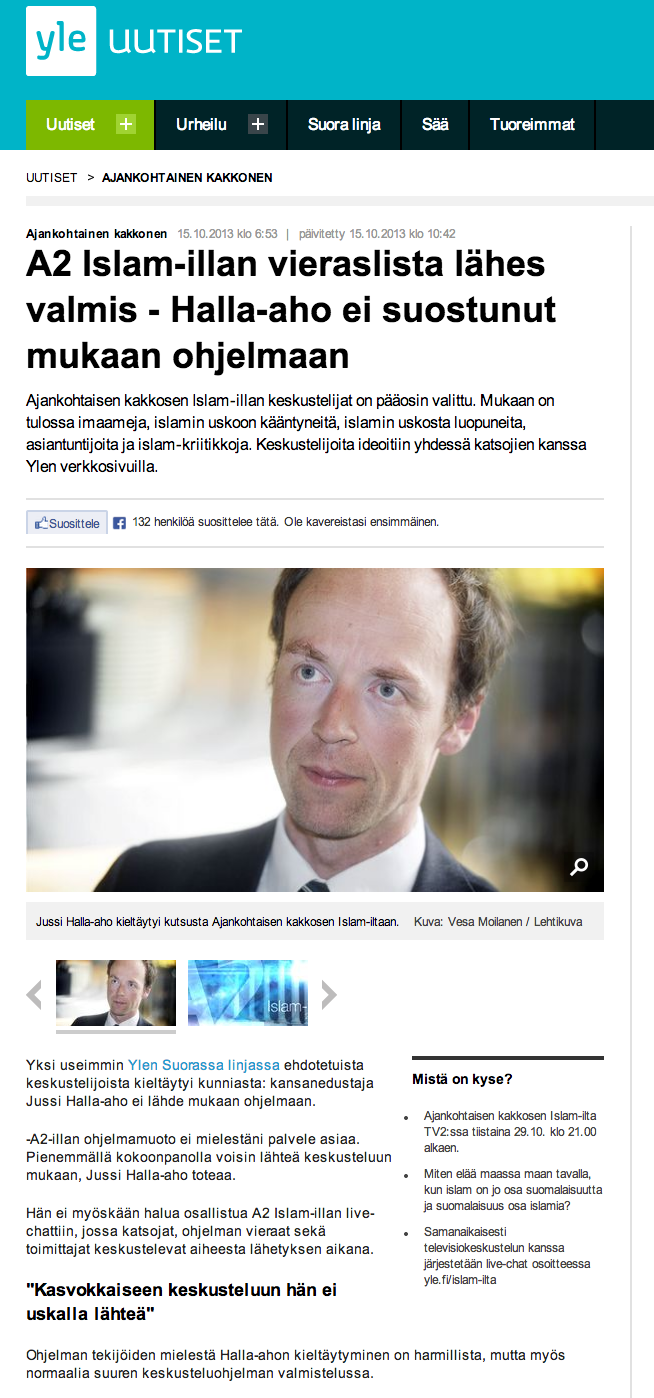
Perussuomalaiset (PS) MP Jussi Halla-aho announced that he will not take part in a live A2 televised debate on Islam, reports YLE. The MP, who has been convicted for ethnic agitation, said that the debate doesn’t serve the issue. He would, however, be ready to take part in a debate with fewer people.

Kuvankaappaus 2013-10-15 kello 11.08.00Read full story (in Finnish) here.

Just like Helsingin Sanomat helped senior lecturer Kyösti Tarvainen to spread fear about Muslim birth rates, another important fabricated story of the far right and anti-immigration groups is that they are not allowed to speak openly about Islam.

Kuvankaappaus 2013-10-15 kello 11.40.55

See Facebook wall here.

The A2 program gave Halla-aho an opportunity to speak his heart out if he wished about Islam but he turned it down.

Why?

Because the arguments used by anti-immigration groups and personalities like Halla-aho hinge on prejudice and gross exaggerations. There’s very little truth in them.

Politicians like Halla-aho and anti-immigration groups live in bubbles.  Their biggest fear is that their constantly changing arguments, which say the same thing, hate group x and y, will be exposed.

National Coalition Party city councilman, Mohammad Azizi, wasn’t surprised by Halla-aho’s decision.

”It’s easy to speak behind [the vail] of a blog and screen about anything, but he doesn’t dare to take part in a face-to-face debate,” he said. ”I am ready to talk about everything related to Islam, including the most difficult issues like circumcision.”

Even if it will take some time for Finland and Europe to wake up from its present far-right anti-immigration menace, it’s unlikely that Halla-aho’s arguments will be revered 20-30 years from now. 

These code words of hate used to attack immigrants and visible minorities will be remembered with shame. They will look just like the arguments used by white racists in Southern United States to justify Jim Crow Laws during the Civil Rights Movement of the 1950s and 1960s.


Red Sociology: ASSIMILATION AS ASSASSINATION

Posted on October 14, 2013 by Migrant Tales

MT comment: Even if the blog entry below speaks of assimilation, or one-way integration of blacks in the United States, it’s pretty certain that these types of discussions will pick up in Finland as we become a more culturally diverse society. Who is being assimilated into Finnish society? Are blacks and visible minorities expected to assimilate while for white Europeans it’s a two-way process (integration)? 

__________________

Much of what I have studied & come to understand through history is that the true definition of an American is to be a White male who owns a home.  This definition is crucial because it is based on how assimilation has ACTUALLY worked throughout history instead of how the larger society has told people how it works.  As a Black African woman, I fit no where in that definition  & my chances of being a “true” American are completely shot because those who define what it means to be “American” never intended for me to be able to access such a status.  Many people discuss how the process of assimilating into a specific culture requires the shedding of one’s own culture & history & then embracing the prickly culture of the target/dominant society.  The truth is assimilation in American society means that one must lose everything for the hopes of gaining a specific status, gaining approval from the dominant society; but for most Africans, this hope is never fulfilled, never met.

Shadeism

What is assimilation for Black Africans in America?

For the African in America, in many ways assimilation tells us to be something that we can never become without first assassinating our true selves.  Assimilation is a process where a people of a minority group has shed their own culture & adapt to that of a dominant society.  This assimilation requires that you shed your culture, forget your history, & embrace the mindset of an entirely different people.  When African Americans during the Civil Rights Movement asked for integration, they most likely were NOT asking for White/Euro-Washing.  But, truth be told, that is exactly what we have today among Black Africans in America.  Many of the goals & definitions of Black Americans today are defined by how well Blacks adjust to the backwards American society.  Black Africans are told to forget their history, forget slavery happened; & when they do remember slavery, remember that it wasn’t that bad anyway & White people don’t like for people to talk about it.  This supposed assimilation & in many cases maladjustment is really a means of pacification.  It ensures that an individual is not dangerous or a threat to dominant White supremacy.  We all see what happens to Black Africans when they don’t know their history right?  They further the White supremist, imperialist, & capitalist agenda better than any White/Euro-American ever could.  Assimilation into American society & culture is marketed as “standards of success” to all peoples of color, all oppressed peoples.  Everyone is told that the bar is set at chronic individualism, social sociopathy, selfishness, White supremacy, capitalism, sexism, patriarchy, & ignorance.  People are strangling each other to try to meet these standards.  You may have heard many Black Africans claim that many of us are “just crabs in a bucket”.  It is true in a number of ways, many of us kill each other as we strive to achieve assimilation & adjustment to a society maladjusted to sociopathy.   Measuring the success of the oppressed peoples by how many of us have adjusted & assimilated to this sick American society is NOT success at all.  It is time for Black Africans to create their own means/measurements of success instead of accepting the White washed criteria that was handed to us.

35cxe1 Colorism & the Lily Complex as Part of the Assimilation Curriculum.

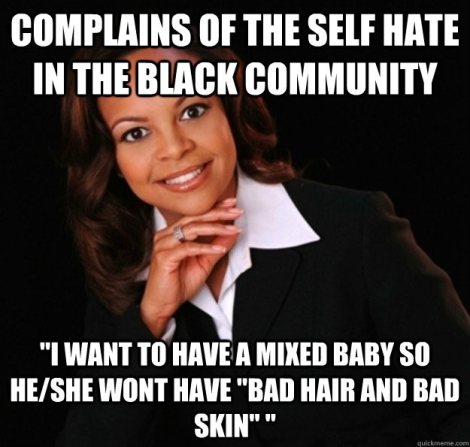
One of the leading mindsets among the assimilation initiative is “Colorism”.  Colorism is a mindset/belief that lighter-skinned sisters & brothers are better in EVERY way possible than their darker-skinned brothers & sisters.  Colorism is the result of racism.  Colorism is a symptom of racism that plagues the Black African community.  I mention colorism because through colorism & the lily complex, one can see how assimilation may be more of an “achievable” goal for those of the lighter complexion within the Black African community.  Now with that in mind, we can see how colorism works with racism to deem the lily complex as the only means for proper assimilation for those of the darker complexion.  The lily complex is when Black African women “whiten” their appearance in an aim to cover up their physical selves to assimilate & be accepted as attractive.  Colorism & the Lily complex are two versions of internalized oppression within the Black community, the end result when Black Africans buy into the negative perceptions & stereotypes of the dominant society.  The use/employment of the lily complex goes hand in hand with self-rejection.  It is part of the belief that one’s natural self is not good enough & not attractive enough.  Embracing colorism is the first step in embracing the inferiority complex then the lily complex is employed as a means of assimilation, a means of conforming.  As Shorter-Gooden & Jones state, “…African American women across the country feel pressure to alter their appearance as best they can, and many are wracked with feelings of inferiority. … It is possible to dye your brown tresses platinum and still love your Blackness.  For many women, such changes may simply be another means of self-expression.  And for others, shifting their appearance is just one of many conscious compromises they make to ensure that their White coworkers and peers feel comfortable with them and don’t make presumptions about their attitude or politics based on the way they dress, the way they style their hair, or other superficialities.  These women are aware that others may find Eurocentric characteristics more appealing and that being seen as attractive can help them integrate certain circles and access certain opportunities.  So they conform to survive, to get along, to achieve” (2008, p.178-9).  These maladjustments to the dominant society result in Black African women & men using bleaching products on their skin, dying their hair blonde, rejecting their history, rejecting their people, & Black African women being 5 times more likely to use beauty products than White/Euro-American women.

Assimilation As Assassination

Much of what is required for Black Africans to assimilate requires that they embrace dangerously poisonous mindsets.  They have to reject the self, reject their heritage, reject their people, & run towards the cold embrace of their oppressor. Embracing America’s rigid standards & hatred for everything Black & Brown have resulted in self-hate among the Black African communities in America.  America is not a melting pot, America is a bleaching pot.  The encouragement of Black Africans to forget their history, heritage, hate themselves & fade to Whiteness is in no way safe.  It does not result in a healthy society filled with people who do not see race, it results in a world dictated by White supremist standards & structuralism.

If you must hate & reject your natural self in order to assimilate (& keep in mind that the hopes for success & approval from White America is not guaranteed & its success rate is less than 0.0000009%), then it is NOT worth it.  Assimilation requires the assassination of the truth, the assassination of who YOU are.  Too many Black Africans are walking around thinking that the norm is a White standard & that it has always been that way. NO, White supremacy & racism do not need to have a monopoly on your hair, your body, your history, your community, your mindset, your people, your perceptions, YOU.  Assimilation is defeat.  Assimilation is assassination.

Read original story here.

This piece was reprinted by Migrant Tales with permission.

Zuzeeko’s blog: Finland’s population registry website excludes visible minorities

Posted on October 13, 2013 by Migrant Tales

Zuzeeko Tegha Abeng*

Finland is still very much a racially homogeneous country — predominantly made up of white Finnish-speaking and Swedish-speaking people. The homogeneous nature of the population is reflected in most walks of life in the country where people of African descent or visible minorities are not represented or are relegated to the background. A look at the homepage of the population registry’s website supports this assertion.

Kuvankaappaus 2013-10-14 kello 0.29.12

The website of the Population Register Centre (in Finnish: Väestörekisterikeskus) portrays a complete lack of racial and ethnic diversity in Finland. The last time I checked, photos displayed on the home page (see screenshot) of the website showed diversity in terms on gender, sex and age — which is good. But ethnic or racial diversity was completely out of the picture despite the fact that Finland has visible minorities registered in the population register.

Finland has a total population of over 5 million people and it is estimated that the population will hit 5.5 million in 2015. As a member of Finnish society, I can attest to the fact that the country’s population is racially diverse — although a first look at the website of the population registry suggests otherwise. Even the website of Kela, the social insurance institute, shows a racially homogeneous Finland.

The population of Finland increased by 13,050 persons between January and July 2013 and the main reason for population growth was immigration. According to Statistics Finland’s statistics on population structure, every tenth person aged 25 to 34 living permanently in Finland in 2012 was of foreign origin — approximately 12 per cent of all persons with foreign origin were of African descent and about one-quarter were of Asian origin.

In my view, Finland’s non-whites or so-called people of color have been relegated to the background and are not portrayed as part of the society. Many do not occupy prominent positions in public life as journalists, police officers, lawmakers, ministers or teachers. Visible minorities are not even portrayed as part of the society on national and governmental websites like that of Kela and Väestorekisterikeskus. It might take some time for visible minorities to occupy elevated positions in public life — but I am convinced that simple changes in graphics and photographs on national and governmental websites will go a long way to show visible minorities that they are welcomed and accepted as part of the society.

In this age of information technology websites send resounding messages. The last time I checked, the website of Finland’s population registry sent a disturbing message, in my interpretation, that visible minorities are not part of Finland’s population structure. The population registry’s home page should be updated to include racial and ethnic diversity that is representative of Finland’s population structure.

Read original blog entry here.

*Zuzeeko Tegha Abeng is an associate editor of Migrant Tales. 


Does Finland promote two-way or one-way adaption of immigrants?

Posted on September 21, 2013 by Migrant Tales

Our integration law promotes two-way adaption as opposed to assimilation, which is a one-way process. Section 17 of the Finnish Constitution states that each person living in this country has the right to maintain and develop their own language and culture. What do these two important laws mean in practice and how are they applied?

Sensible Finns understand what cultural diversity implies but a poll published by Helsingin Sanomat Friday shows that 53% fully (22%) or partially agreed (31%) that immigrants should aim at becoming as Finnish as possible. That compares with 48% in 2011 an 37% in 2006.

While these types of surveys are problematic because they reveal more the prejudices of the respondents, market research companies and the newspapers that publish the poll results, it shows, among other things, general expectations that give little to no insight on how to move ahead as our society becomes more diverse.

What does being Finnish imply never mind mean? Are we using the nineteenth century cultural yardstick or a totally different one in this century to make our society more inclusive to new groups who are and want to be Finnish according to their cultural backgrounds?

The crux of the matter, in my opinion, is that our ideal is two-way adaption but the rule is one-way assimilation.

This can be even be seen in our exemplary educational system, where we still promote “us” and “them” by openly labeling third-culture pupils as children “with immigrant backgrounds” (maahanmuuttajataustainen).

I personally believe that Finland is on the right track and should continue to promote and defend its present laws that ensure cultural diversity.

If you think of it, the whole debate on immigration and refugees presently taking place in this country hinges on one important point: acceptance of cultural diversity. Do we accept people moving to our country who are from different cultures? What must we give up in order to accommodate these new groups and what must these newcomers do to be included?

We have always spoken of two-way acceptance and respect on Migrant Tales. Why? Because it is inclusive and the most effective way to integrate people.

Why would you want to have a system that fuels prejudice and intolerance? At the end of the day our prejudices will cost us dearly because they will fuel social exclusion and high unemployment already so evident in many European countries.

Even if Finland is a society that has the right tools and resources to promote two-way acceptance and respect between groups, or cultural diversity, our prejudices continue to be part of the problem. They don’t permit us to have a clearer bigger picture of how to move ahead.

The answers and models that can be employed are lying right under our very noses. We have good laws and Nordic democratic values in this country to build a vibrant society where we can celebrate our diversity.

The challenge then is applying these laws and values to include Finland’s new inhabitants.

It’s that simple.

Helsingin Sanomat poll reveals Finns’ opposition to cultural diversity

Posted on September 20, 2013 by Migrant Tales

A poll commissioned by Helsingin Sanomt, Finland’s largest-circulation daily, reveals that 53% of those polled agreed (22%) or partially agreed (31%) that immigrants should aim at becoming as Finnish as possible. That compares with 18% and 30%, respectively, in 2011. If there is something worrying that the poll shows, it’s Finland’s growing opposition to cultural diversity. 

Kuvankaappaus 2013-9-20 kello 20.08.06

 Compared with 2006, when the poll was first taken, a growing number of Finns want immigrants to adopt their values and culture. Read full story here.  

What the poll doesn’t make clear is what becoming Finnish means.

Those that are in favor of one-way adaption, or assimilation, would probably have a difficult time explaining what being or becoming Finnish means or implies.

The poll is another sad example of how newspapers perceive immigrants and Finland’s ever-growing cultural diversity.

The question asked by the poll is similar to asking white people if they think there is racism in our country or if they would want more immigrants to move here. The answers we’d get are obvious.

Moreover, the poll reveals contradictions of how some Finns feel the law should be applied to immigrants and visible minority groups.

If Section 17 of the Finnish Constitution defends every person’s right in this country to maintain and develop their own language and culture, why do the majority of those polled by Helsingin Sanomat disagree? What does it reveal about our attitudes to people who are different from us?

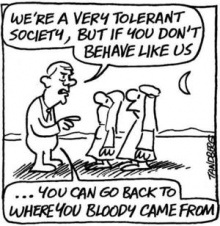
It’s pretty clear that it shows how intolerance functions in Finland. The following cartoon below says it all.

220px-svvalues_narrowweb_300x3080

These type of polls not only show our intolerance and prejudices, they reveal as well similar attitudes of the Finnish media that publish them. They show a worrying trend: Finland’s growing opposition to our cultural diversity as more immigrants move to this country.


Artist Kiba Lumberg: “Don’t box me in!”

Posted on September 16, 2013 by Migrant Tales

In order to understand Kiba Lumberg, 57, you need to know some Finnish history, the plight of minorities like the Roma, and what it is like to live in worlds shaded by different hues of grey. Since this story is about an artist who doesn’t want to conform to set norms imposed on her by society, it’s useless for me to fence her in with the help of words. 

Roma Pavilion, Lumberg, Crazy Artist Diary

Kiba Lumberg, Diary of a Mad Artist,  2010–11. Her work has been widely published in comic books, illustrations and scripts.

If there’s a quote that could possibly describe Lumberg, who wants to stay as faraway as possible from ethnic labels, it’s what Martin Luther King Jr. said in his famous ”I have a dream” speech of 1963:

”I have a dream that my four little children will one day live in a nation where they will not be judged by the color of their skin but by the content of their character.”

No other person is better qualified than Lumberg to throw a monkey wrench in the works of those who want to box people in groups and dress them up with stereotypes.

Lumberg was raised by Romany parents and is a lesbian.

”I’m against anyone boxing me in an ethnic group because I am first and foremost a human being,” she said. ”I’m against groups, like heterosexuals, who try to torpedo who I am.”

She says that the heterosexual world is so imposing in our society that it doesn’t permit her to share her experiences and stories with others.

“As a lesbian you are seen as a threat because you change the so-called natural order of things of heterosexuals,” she said. ”What about my relationships with people who are important in my life?  Why can’t I openly share them with others?”

Not being white but a member of a minority like the Roma and a lesbian in Finland not only makes it hard for some people to accept you, but the same rejection and suspicion comes from the Roma community.

Lumberg states emphatically that she doesn’t seek the acceptance of any group.

Understanding the struggles that she has faced to find her identity and sense of balance, it shouldn’t come to any surprise that much of her artwork deals with issues like multiple identities, gender diversity, sexual politics, cultural understanding and otherness. All these are essential if we live a culturally diverse society that is not only heterosexual but respects sexual minorities as well, she said.

“In a way I understand what the Perussuomalaiset are saying because their message of intolerance comes from fear,” she said. ”For a multicultural society to work, it not only requires mutual acceptance and respect between people and groups, but similarly not bowing to any culture at the cost of who you are and what you think. Respecting human rights is key.”

Lumberg adds that while group identity is important, we should never forget the person as an individual human being and his or her right to choose his or her lifestyle and thoughts independently.

The artist, who ran for parliament in 2011 on the Left Alliance ticket, admits that ethnicity does play a role in Finland and can impact a person’s life.

Help how can I get

Kiba Lumberg, Diary of a Mad Artist, 2010–11.

“In Finland it’s usually easier to get a job and get ahead in life if you are white,”  she said, adding that the 10,000-strong Romany minority doesn’t need any lessons on what prejudice and racism are because they have lived in this country for five centuries.

Suzana Milevska in Call the Witness Roma Pavilion, a review of Lumberg’s 2010-11 exhibition, sums up who the artist is as a person, or how her gender and sexual orientation have joined hands and created a multifaceted identity full of contradictions, which have worked in her favor.

She writes: ”Yet life on the edge of these two worlds could be exactly the space where a new subjectivity is born, a loudly speaking subject who testifies about her disenchantments, while simultaneously constructing her singular destiny with confidence.”

Doesn't look good

Kiba Lumberg, Diary of a Mad Artist, 2010–11.

I would take what Milevska wrote a bit further to a poem I wrote a long, long time ago. It was about a transgender cowboy, who was a communist that lived in Texas during the Cold War. 

The transgender cowboy represents for some the worst thing a person can be in a state that is not only openly conservative, but anti-communist and anti-gay. Even so, there’s one side of the poem that you must understand to get it: It takes raw guts to be openly those things in Texas.

That’s why the transgender cowboy is the bravest son of a bitch to ever ride the West.

Old Finnish national social constructs still fuel intolerance and exclude visible minorities

Posted on August 24, 2013 by Migrant Tales

The Association of Finnish Culture and Identity (Suomalaisuuden liitto) is an association founded in 1906 to “strengthen the sense of national identity, to promote Finnish education and culture.” While this statement may appear innocent at first, the association endorses the intolerance white Finnish speakers have today against Swedish speakers never mind immigrants and visible minorities.

In sum, the Association of Finnish Culture and Identity is an enemy of Finland’s inevitable cultural diversity.

The values and attitudes of the association are maintained with the help of myths tucked deep in the nineteenth and twentieth century. In their world, Finnish-speaking culture is static and supposed to remain in a time warp. They promote an exclusive ethnic club that has no place in modern Finland today.

One of its campaigns is to undermine cultural diversity in Finland together with Vapaa kielivalinta, the youth wings of the PS and National Coalition Party. These four groups succeeded at gathering over 50,000 signatures for a direct initiative to demote the Swedish language  to elective status at schools.

Swedish is a minority language in Finland. It is the country’s second official language together with Finnish.

593-Etela-Savon_maakuntaliitto_logoHere’s a logo used before by the Regional Council of South Savo. It depicts the inhabitants of this region as indigenous natives, which fuels “us” versus “them.” Anti-immigration groups in Finland argue that they are “vulnerable natives” being attacked by “immigrant colonizers.”


When the association speaks in defense of “Finnish culture,” it is defending only the rights of white Finnish speakers and not that of other groups who are Finns as well.

It shouldn’t be surprising that in the face of Finland’s ever-growing cultural diversity, there’s still no non-white Finns on the board “strengthening our national identity.”

The Association of Finnish Culture and Identity is today led by anti-immigration and anti-EU Perussuomalaiset (PS) party members. Its chairman is Sampo Terho, a PS Euro MP.

When building a social construct like Finnish national identity, like what happened to Swedish and foreign surnames in 1906-07 and in the 1930s that were changed into Finnish ones, there are bad side effects like xenophobia and racism.

Groups like the Association of Finnish Culture and Identity continue to promote intolerance, indirectly and directly, by not questioning, or even recognizing, how some of its former causes, like strengthen Finnish identity, promoted, and continue to fuel, intolerance and hostility towards non-white Finns.  

One of the biggest decision that Finland must make in order to take that first crucial step towards cultural diversity is acceptance and respect for other groups. This process is a two-way street.

While many of us are acceptant of cultural diversity, the shadow of our own national identity social construct continues to intimidate us into not accepting that our national identity in this century is very different from what it was before.

Apart from being a proud nation of its accomplishments, it is a nation that accepts and is respectful of its cultural diversity that is inclusive.


  • Previous
  • 1
  • …
  • 16
  • 17
  • 18
  • 19
  • 20
  • 21
  • 22
  • …
  • 30
  • Next
Read more about documentary film
Read more

Recent Posts

  • Finland’s tabloids Iltalehti and Ilta-Sanomat are the pits
  • Riikka Purra’s Dr Jekyll and Mr Hyde mask
  • Double standards
  • Perussuomalaiset: Uusi logo, sama vanha juttu
  • Taco Trump

Recent Comments

  1. Absolutely Socking: Racist Finnish Facebook group against human rights gets flooded with socks on Musta Barbaari’s mother and sister charged by the police in “ethnic profiling” case
  2. Ilkka Nuotio on Pekka Myrskylä: “Tilastot kertovat toista kuin poliittinen keskustelu”
  3. Genrih Soinkara on The war in Ukraine and the Russian-Finnish border crisis are showing Finland’s ugly side
  4. Ahti Tolvanen on Comment by Ahti Tolvanen on the Helsinki +50 conference
  5. Angel Barrientos on Angel Barrientos is one of the kind beacons of Finland’s Chilean community

Archives

  • June 2026
  • May 2026
  • April 2026
  • March 2026
  • February 2026
  • January 2026
  • December 2025
  • November 2025
  • October 2025
  • September 2025
  • August 2025
  • July 2025
  • June 2025
  • May 2025
  • April 2025
  • March 2025
  • February 2025
  • January 2025
  • December 2024
  • November 2024
  • October 2024
  • September 2024
  • August 2024
  • July 2024
  • June 2024
  • May 2024
  • April 2024
  • March 2024
  • February 2024
  • January 2024
  • December 2023
  • November 2023
  • October 2023
  • September 2023
  • August 2023
  • July 2023
  • June 2023
  • May 2023
  • April 2023
  • March 2023
  • February 2023
  • January 2023
  • December 2022
  • November 2022
  • October 2022
  • September 2022
  • August 2022
  • July 2022
  • June 2022
  • May 2022
  • April 2022
  • March 2022
  • February 2022
  • January 2022
  • December 2021
  • November 2021
  • October 2021
  • September 2021
  • August 2021
  • July 2021
  • June 2021
  • May 2021
  • April 2021
  • March 2021
  • February 2021
  • January 2021
  • December 2020
  • November 2020
  • October 2020
  • September 2020
  • August 2020
  • July 2020
  • June 2020
  • May 2020
  • April 2020
  • March 2020
  • February 2020
  • January 2020
  • December 2019
  • November 2019
  • October 2019
  • September 2019
  • August 2019
  • July 2019
  • June 2019
  • May 2019
  • April 2019
  • March 2019
  • February 2019
  • January 2019
  • December 2018
  • November 2018
  • October 2018
  • September 2018
  • August 2018
  • July 2018
  • June 2018
  • May 2018
  • April 2018
  • March 2018
  • February 2018
  • January 2018
  • December 2017
  • November 2017
  • October 2017
  • September 2017
  • August 2017
  • July 2017
  • June 2017
  • May 2017
  • April 2017
  • March 2017
  • February 2017
  • January 2017
  • December 2016
  • November 2016
  • October 2016
  • September 2016
  • August 2016
  • July 2016
  • June 2016
  • May 2016
  • April 2016
  • March 2016
  • February 2016
  • January 2016
  • December 2015
  • November 2015
  • October 2015
  • September 2015
  • August 2015
  • July 2015
  • June 2015
  • May 2015
  • April 2015
  • March 2015
  • February 2015
  • January 2015
  • December 2014
  • November 2014
  • October 2014
  • September 2014
  • August 2014
  • July 2014
  • June 2014
  • May 2014
  • April 2014
  • March 2014
  • February 2014
  • January 2014
  • December 2013
  • November 2013
  • October 2013
  • September 2013
  • August 2013
  • July 2013
  • June 2013
  • May 2013
  • April 2013
  • March 2013
  • February 2013
  • January 2013
  • December 2012
  • November 2012
  • October 2012
  • September 2012
  • August 2012
  • July 2012
  • June 2012
  • May 2012
  • April 2012
  • March 2012
  • February 2012
  • January 2012
  • December 2011
  • November 2011
  • October 2011
  • September 2011
  • August 2011
  • July 2011
  • June 2011
  • May 2011
  • April 2011
  • March 2011
  • February 2011
  • January 2011
  • December 2010
  • November 2010
  • October 2010
  • September 2010
  • August 2010
  • July 2010
  • June 2010
  • May 2010
  • April 2010
  • March 2010
  • February 2010
  • January 2010
  • December 2009
  • November 2009
  • October 2009
  • September 2009
  • August 2009
  • July 2009
  • December 2008
  • November 2008
  • October 2008
  • September 2008
  • August 2008
  • July 2008
  • June 2008
  • May 2008
  • April 2008
  • March 2008
  • February 2008
  • January 2008
  • November 2007
  • October 2007
  • September 2007
  • August 2007
  • July 2007
  • June 2007
  • May 2007

Categories

  • ?? Gia L?c
  • ????? ?????? ????? ???????? ?? ??????
  • ???????
  • @HerraAhmed
  • @mondepasrond
  • @nohatefinland
  • @oula_silver
  • @Varathas
  • A Pakistani family
  • äärioikeisto
  • Abbas Bahmanpour
  • Abdi Muhis
  • Abdirahim Hussein Mohamed
  • Abdirahim Husu Hussein
  • Abdirisak Mahamed
  • About Migrant Tales
  • activism
  • Adam Al-Sawad
  • Adel Abidin
  • Afrofinland
  • Ahmed IJ
  • Ahti Tolvanen
  • Aino Pennanen
  • Aisha Maniar
  • Alan Ali
  • Alan Anstead
  • Alejandro Díaz Ortiz
  • Alekey Bulavsev
  • Aleksander Hemon
  • Aleksanterinliitto
  • Aleksanterinliitto ry
  • Aleksanterinliitto ry:n hallitus
  • Alex Alex
  • Alex Mckie
  • Alexander Nix
  • Alexandra Ayse Albayrak
  • Alexis Neuberg
  • Ali Asaad Hasan Alzuhairi
  • Ali Hossein Mir Ali
  • Ali Rashid
  • Ali Sagal Abdikarim
  • Alina Tsui
  • Aline Müller
  • All categories
  • Aman Heidari
  • Amiirah Salleh-Hoddin & Jana Turk
  • Amin A. Alem
  • Amir Zuhairi
  • Amkelwa Mbekeni
  • Ana María Gutiérrez Sorainen
  • Anachoma
  • Anders Adlecreutz
  • Angeliina Koskinen
  • Anna De Mutiis
  • Anna María Gutiérrez Sorainen
  • Anna-Kaisa Kuusisto ja Jaakko Tuominen
  • Annastiina Kallius
  • Anneli Juise Friman Lindeman
  • Announcement
  • Anonymous
  • Antero Leitzinger
  • anti-black racism
  • Anti-Hate Crime Organisation Finland
  • Anudari Boldbaatar
  • Arshiya Nasser
  • Aspergers Syndrome
  • Asylum Corner
  • Asylum seeker 406
  • Athena Griffin and Joe Feagin
  • Autism
  • Avaaz.org
  • Awale Olad
  • Ayan Said Mohamed
  • AYY
  • Barachiel
  • Bashy Quraishy
  • Beatrice Kabutakapua
  • Beri Jamal
  • Beri Jamal and Enrique Tessieri
  • Bertolt Brecht
  • Boiata
  • Boodi Kabbani
  • Bruno Gronow
  • Carmen Pekkarinen
  • Çelen Oben and Sheila Riikonen
  • Chiara Costa-Virtanen
  • Chiara Costa-Virtanen
  • Chiara Sorbello
  • Christian Thibault
  • Christopher Wylie
  • Clara Dublanc
  • Dana
  • Daniel Malpica
  • Danilo Canguçu
  • David Papineau
  • David Schneider
  • Dexter He
  • Don Flynn
  • Dr Masoud Kamali
  • Dr. Faith Mkwesha
  • Dr. Theodoros Fouskas
  • Edna Chun
  • Eeva Kilpi
  • Emanuela Susheela
  • En castellano
  • ENAR
  • Enrique
  • Enrique Tessieri
  • Enrique Tessieri & Raghad Mchawh
  • Enrique Tessieri & Yahya Rouissi
  • Enrique Tessieri and Muhammed Shire
  • Enrique Tessieri and Sira Moksi
  • Enrique Tessieri and Tom Vandenbosch
  • Enrique Tessieri and Wael Che
  • Enrique Tessieri and Yahya Rouissi
  • Enrique Tessieri and Zimema Mhone
  • Epäluottamusmies
  • EU
  • Europe
  • European Islamophobia Report
  • European Islamophobia Report 2019,
  • European Union
  • Eve Kyntäjä
  • Ezequiel Caldeiro
  • Facebook
  • Fadumo Dayib
  • Faisa Kahiye
  • Farhad Manjoo
  • Fasismi
  • Finland
  • Fizza Qureshi
  • Flyktingar och asyl
  • Foreign Student
  • Fozia Mir-Ali
  • Frances Webber
  • Frida Selim
  • Gareth Rice
  • Ghyslain Vedeaux
  • Global Art Point
  • Great Replacement
  • Habiba Ali
  • Hami Bahadori
  • Hami Bahdori
  • Hamid
  • Hamid Alsaameere
  • Hamid Bahdori
  • Handshake
  • Harmit Athwal
  • Hassan Abdi Ali
  • Hassan Muhumud
  • Heikki Huttunen
  • Heikki Wilenius
  • Helsingin Sanomat
  • Henning van der Hoeven
  • Henrika Mälmsröm
  • Hser Hser
  • Hser Hser ja Mustafa Isman
  • Husein Muhammed
  • Hussain Kazemian
  • Hussain Kazmenian
  • Ibrahim Khan
  • Ida
  • Ignacio Pérez Pérez
  • Iise Ali Hassan
  • Ilari Kaila & Tuomas Kaila
  • Imam Ka
  • inside-an-airport
  • Institute of Race Relations
  • Iraqi asylum seeker
  • IRR European News Team
  • IRR News Team
  • Islamic Society of Norhern FInland
  • Islamic Society of Northern Finland
  • Islamophobia
  • Jacobinmag.com
  • Jallow Momodou
  • Jan Holmberg
  • Jane Elliott
  • Jani Mäkelä
  • Jari Luoto
  • Jari Taponen
  • Jegor Nazarov
  • Jenni Stammeier
  • Jenny Bourne
  • Jessie Daniels
  • Joe Davidow
  • Johannes Koski
  • John D. Foster
  • John Grayson
  • John Marriott
  • Jon Burnett
  • Jorma Härkönen
  • Jos Schuurmans
  • José León Toro Mejías
  • Josue Tumayine
  • Jouni Karnasaari
  • Juan Camilo
  • Jukka Eräkare
  • Julian Abagond
  • Julie Pascoet
  • Jussi Halla-aho
  • Jussi Hallla-aho
  • Jussi Jalonen
  • JusticeDemon
  • Kadar Gelle
  • Kaksoiskansalaisuus
  • Kansainvälinen Mikkeli
  • Kansainvälinen Mikkeli ry
  • Katherine Tonkiss
  • Kati Lepistö
  • Kati van der Hoeven-Lepistö
  • Katie Bell
  • Kättely
  • Kerstin Ögård
  • Keshia Fredua-Mensah & Jamie Schearer
  • Khadidiatou Sylla
  • Khadra Abdirazak Sugulle
  • Kiihotus kansanryhmää vastaan
  • Kirsi Crowley
  • Koko Hubara
  • Kristiina Toivikko
  • Kubra Amini
  • KuRI
  • La Colectiva
  • La incitación al odio
  • Laura Huhtasaari
  • Lauri Finér
  • Leif Hagert
  • Léo Custódio
  • Leo Honka
  • Leontios Christodoulou
  • Lessie Branch
  • Lex Gaudius
  • Leyes de Finlandia
  • Liikkukaa!
  • Linda Hyökki
  • Liz Fekete
  • M. Blanc
  • Maarit Snellman
  • Mahad Sheikh Musse
  • Maija Vilkkumaa
  • Malmin Kebab Pizzeria Port Arthur
  • Marcell Lorincz
  • Mari Aaltola
  • María Paz López
  • Maria Rittis Ikola
  • Maria Tjader
  • Marja-Liisa Tolvanen
  • Mark
  • Markku Heikkinen
  • Marshall Niles
  • Martin Al-Laji
  • Maryan Siyad
  • Matt Carr
  • Mauricio Farah Gebara
  • Media Monitoring Group of Finland
  • Micah J. Christian
  • Michael McEachrane
  • Michele Levoy
  • Michelle Kaila
  • Migrant Tales
  • Migrant Tales Literary
  • Migrantes News
  • Migrants' Rights Network
  • MigriLeaks
  • Mikko Kapanen
  • Miriam Attias and Camila Haavisto
  • Mohamed Adan
  • Mohammad Javid
  • Mohammad M.
  • Monikulttuurisuus
  • Monisha Bhatia and Victoria Canning
  • Mor Ndiaye
  • Muh'ed
  • Muhamed Abdimajed Murshid
  • Muhammed Shire
  • Muhammed Shire and Enrique Tessieri
  • Muhis Azizi
  • Musimenta Dansila
  • Muslimiviha
  • Musulmanes
  • Namir al-Azzawi
  • Natsismi
  • Neurodiversity
  • New Women Connectors
  • Nils Muižnieks
  • No Labels No Walls
  • Noel Dandes
  • Nuor Dawood
  • Omar Khan
  • Otavanmedia
  • Oula Silvennoinen
  • Paco Diop
  • Pakistani family
  • Pentti Stranius
  • Perussuomalaiset
  • perustuslaki
  • Petra Laiti
  • Petri Cederlöf
  • Pia Grochowski
  • Podcast-lukija Bea Bergholm
  • Pohjois – Suomen Islamilainen Yhdyskunta
  • Pohjois Suomen Islamilainen Yhyskunta
  • Polina Kopylova
  • Race Files
  • racism
  • Racism Review
  • Raghad Mchawh
  • Ranska
  • Rashid H. and Migrant Tales
  • Rasismi
  • Raul Perez
  • Rebecka Holm
  • Reem Abu-Hayyeh
  • Refugees
  • Reija Härkönen
  • Remiel
  • Reza Nasri
  • Richard Gresswell
  • Riikka Purra
  • Risto Laakkonen
  • Rita Chahda
  • Ritva Kondi
  • Robito Ibrahim
  • Roble Bashir
  • Rockhaya Sylla
  • Rodolfo Walsh
  • Roger Casale
  • Rostam Atai
  • Roxana Crisólogo Correa
  • Ruth Grove-White
  • Ruth Waweru-Folabit
  • S-worldview
  • Sadio Ali Nuur
  • Sami Rusanen
  • Sandhu Bhamra
  • Sara de Jong
  • Sarah Crowther
  • Sari Alhariri
  • Sarkawt Khalil
  • Sasu
  • Scot Nakagawa
  • Shabana Ahmadzai
  • Shada Islam
  • Sharon Chang blogs
  • Shenita Ann McLean
  • Shirlene Green Newball
  • Sini Savolainen
  • Sira Moksi
  • Sonia K.
  • Sonia Maria Koo
  • Steverp
  • Stop Deportations
  • Suldaan Said Ahmed
  • Suomen mediaseurantakollektiivi
  • Suomen Muslimifoorumi ry
  • Suomen viharikosvastainen yhdistys
  • Suomen viharikosvastainen yhdistys ry
  • Suomi
  • Supermen
  • Susannah
  • Suva
  • Syrjintä
  • Talous
  • Tapio Tuomala
  • Taw Reh
  • Teivo Teivainen
  • The Daily Show
  • The Heino
  • The Supermen
  • Thomas Elfgren
  • Thulfiqar Abdulkarim
  • Tim McGettigan
  • Tino Singh
  • Tito Moustafa Sliem
  • Tobias Hübinette and L. Janelle Dance
  • Transport
  • Trica Danielle Keaton
  • Trilce Garcia
  • Trish Pääkkönen
  • Trish Pääkkönen and Enrique Tessieri
  • Tuulia Reponen
  • Uncategorized
  • UNITED
  • University of Eastern Finland
  • Uyi Osazee
  • Väkivalta
  • Vapaa Liikkuvuus
  • Venla-Sofia Saariaho
  • Vieraskynä
  • W. Che
  • W. Che an Enrique Tessieri
  • Wael Ch.
  • Wan Wei
  • Women for Refugee Women
  • Xaan Kaafi Maxamed Xalane
  • Xassan Kaafi Maxamed Xalane
  • Xassan-Kaafi Mohamed Halane & Enrique Tessieri
  • Yahya Rouissi
  • Yasmin Yusuf
  • Yassen Ghaleb
  • Yle Puhe
  • Yuliet Tresa
  • Yve Shepherd
  • Zahra Khavari
  • Zaker
  • Zalina Ametova
  • Zamzam Ahmed Ali
  • Zeinab Amini ja Soheila Khavari
  • Zimema Mahone and Enrique Tessieri
  • Zimema Mhone
  • Zoila Forss Crespo Moreyra
  • ZT
  • Zulma Sierra
  • Zuzeeko Tegha Abeng
© 2026 Migrant tales | Powered by Minimalist Blog WordPress Theme