Migrant tales
Menu
  • #MakeRacismHistory “In Your Eyes”
  • About Migrant Tales
  • It’s all about Human Rights
  • Literary
  • Migrant Tales Media Monitoring
  • NoHateFinland.org
  • Tales from Europe
Menu

Tag: Cultural diversity

Statement: EU elections 2014: the way towards more equality in Europe, 7 demands from ENAR

Posted on March 7, 2014 by Migrant Tales

The next European Parliament to be elected in May 2014 has a crucial role to play when it comes to reducing the entrenched inequalities faced by its citizens and residents. Among these are ethnic minorities and migrants who often face discrimination on multiple grounds: ethnic origin, nationality, social status, income, gender or age. The European Network Against Racism (ENAR) therefore puts forward 7 key demands for more equality in Europe to upcoming Members of the European Parliament. Leading Members of the European Parliament have already endorsed our demands because they are convinced that they will lead to a better and more equal Europe and are also sound, concrete and achievable.

Kuvankaappaus 2014-3-7 kello 19.25.59
Read full statement here.

Starting with the basics, we ask parties to open up their lists and decision making structures to ethnic minorities and migrants. Fighting toxic and xenophobic political discourses and policies as well as structural discrimination starts at home. Political decision makers need to be exemplary to generate constructive emulation within broader society. We need a more diverse European Parliament. As a minimum, the next European Parliament and its political groups should hire professionals from minority communities..

“If you are not counted, you don’t count”: combating discrimination begins with knowing the extent of it. Today, we only have comparable and reliable Europe-wide equality data on the grounds of sex and age. We need more. There are 6 grounds of discrimination covered by the EU treaties and 17 by the Charter of Fundamental Rights – there is thus much room for improvement in collecting and analysing data about discrimination in Europe. Ethnic and religious groups want to count and to use data to ask governments to be accountable for their actions. These 60 million Europeans deserve justice.

Racist violence has multiple effects on individual victims, but also on their families and communities. They are not targeted randomly by perpetrators, but because of who they are. The European Parliament has a crucial role to play in bringing the European Commission and Member States to support victims in seeking redress and avoiding re-victimisation. Equality at work is not just a matter of preventing discrimination from happening. It is also about ensuring the workplace caters for the needs of an increasingly diverse workforce. Accommodating diversity at work will result in developing workers’ potential, employee retention, a safe working environment and a better work-life balance. The adoption of the European framework for national Roma integration strategies demonstrated the EU’s political will to fight discrimination against its largest ethnic minority. Black Europeans, People of African Descent, Muslims and Jews need to benefit from similar strategies which will ensure their social inclusion and protection from discrimination, and therefore contribute to the overall reduction of poverty and exclusion in Europe.

Finally, we call for the continuation of the current Anti-Racism and Diversity Intergroup in the European Parliament. This will ensure MEPs committed to equality have a platform to voice and tackle challenges relating to inequality and discrimination.

Our 7 demands can contribute to a leap forward towards equality in Europe. Time for commitment has come. The future of a diverse and resilient Europe is at stake: we encourage parties and individual candidates to endorse them and mainstream them in their own programmes ahead – and after – the elections.

Olen suomalainen, a video that says we’re Finns on our terms

Posted on March 2, 2014 by Migrant Tales

What kind of questions does the Olen suomalainen (I’m a Finn) video clip raise about Finland and Finnish identity in the new century? For one, shows that there is wide support for the idea that being Finnish is a personal matter and can be embraced on one’s terms.

In less than a week since it got published on February 25, the video clip attracted on Sunday over 137,775 views.


The video clip has been reported by the Italian media since the original song, L’italiano, came out in 1983 and was sung by Toto Cotugno.

The song was made into a Finnish hit by Kari Tapio.

The news that a song like Olen suomalainen, which promotes cultural diversity and respect, must come as a shock to Finland’s anti-immigration camp.

But let’s make one matter clear, the new version of Olen suomalainen means in my opinion that migrants and minorities can embrace Finnish identity on their terms. In other words: I am who I am and if you don’t like it it’s your problem, not mine.

Identity is a personal matter.

The video has the following message: We are Finns and we should receive the respect and recognition that everyone deserves.

Landmark decision in Finland: Sikh busman said “it was a nice feeling” to wear a turban at work

Posted on February 25, 2014 by Migrant Tales

The long ordeal over whether Sikh bus driver Gill Sukhdarshan Singh could wear a turban to work ended on February 21. “I got a call from the AKT (Transport Workers’ Union) on Friday and they said that it’s been resolved,” he told Migrant Tales. “I have the right to wear a turban at work.”   

Kuvankaappaus 2014-2-25 kello 0.44.39

Read full story here.

“It was a nice feeling to go to work [and wear a turban],” he continued. “Everybody was happy: my coworkers and the passengers. They said it was a good thing that I could use a turban at work.”

Sukhdarshan Singh said that he went to work on that historic Friday at 10am. Even so, he had been struggling with his employer for about a year to have the right to wear a turban at work.

“[The long struggle] wasn’t nice but it’s now over,” he admitted.

The Sikh busman, who has lived in Finland for 28 years, said that it’s a good matter that Finland starts to accept people from other cultures.

“This is a very positive matter,” he said. “Finland is part of a wider world.”

Helsingin Sanomat  reported  Monday that a decision was reached last week between the Finnish Employers’ Federation of Road Transport (ALT) and Transport Workers’ Union AKT over the interpretation of the bus driver’s employment contract.

According to ALT and AKT, Sukhdarshan Singh has the right to wear a turban at work if he wants.

Sukhdashan Singh’s employer Veolia has promised to abide by ALT’s and AKT’s interpretation as well as Helsingin Bussiliikkene, Helsinki’s municipal bus company.

The right to wear a turban at work is a historical decision that Sikh bus drivers got in England in the 1969.


A must-see video about who we Finns are

Posted on February 25, 2014 by Migrant Tales

If there is one matter where Finland’s ever-growing culturally diverse society must still work on, it’s instilling greater acceptance and respect for those who are different from white Finns. For me, this is central in our struggle to live in a country that is acceptant and respects others irrespective of their backgrounds. 

After moving over thirty years to this country, there’s finally a video below that reflects and promotes this important fact.

I dedicate it to all those who still believe that Finnish identity is monolithic, or, as Heikki Waris claimed in the 1960s on page two of “An introduction to Finnish history,” the following (note how he forgets to mention the 10,000-strong Romany minority):  

A fourth aspect is the high degree of homogeneity of Finnish society. Racial homogeneity particularly characterizes the Finnish people who have practically no racial minorities, the less than three thousand Lapps in the northernmost arctic communities making up the largest racial minority group. Consequently, racial prejudice and discrimination are nonexistent.

Waris is very selective when he writes about so-called racial homogeneity. He simply forgets that 1.2 million Finns emigrated and mixed with people and cultures in other lands. He denies and plays down who we’ve always been and will be.

To all those Finns who still believe that this country only belongs to them, I have some news for you. This land belongs to all of us.

We won’t wait for generations for acceptance.

Acceptance begins with us.

Landmark decision in Finland: Sikh bus driver may wear turban at work

Posted on February 25, 2014 by Migrant Tales

The long ordeal over whether Sikh bus driver Gill Sukhdarshan Singh could wear a turban to work has been decided in his favor, reports Helsingin Sanomat. A decision was reached last week between the Finnish Employers’ Federation of Road Transport (ALT) and Transport Workers’ Union AKT over the interpretation of the bus driver’s employment contract. 

According to ALT and AKT, Sukhdarshan Singh has the right to wear a turban at work if he wants.

Kuvankaappaus 2014-2-25 kello 0.44.39

Read full story here.

Sukhdashan Singh’s employer Veolia has promised to abide by ALT’s and AKT’s interpretation as well as Helsingin Bussiliikkene, Helsinki’s municipal bus company.

The right to wear a turban at work is a historical decision that Sikh bus drivers got in England in the 1969.

Migrant Tales will publish more Tuesday on this landmark decision.

Read update here.

Passage of gay marriage law will benefit all minorities in Finland

Posted on February 22, 2014 by Migrant Tales

The ongoing passionate debate in parliament on same-sex marriage reveals, in my opinion, something we’ve known all along about Finland: How we accept and respect people who are different from us. Alongside the present debate on gay marriage is another one being contested in public about our ever-growing cultural diversity.

A draft law to legalize gay marriage in Finland was defeated in February 2013 by a vote of 9-8 by the legal committee of parliament.

Finland is still the only Nordic country that doesn’t recognize same-sex marriages.

After that dramatic vote in the legal committee last year, a lot of matters have happened. A citizen’s initiative got over 166,000 signatures. A citizen’s initiative gets 50,000 signatures in six months it must be put to a vote in parliament.

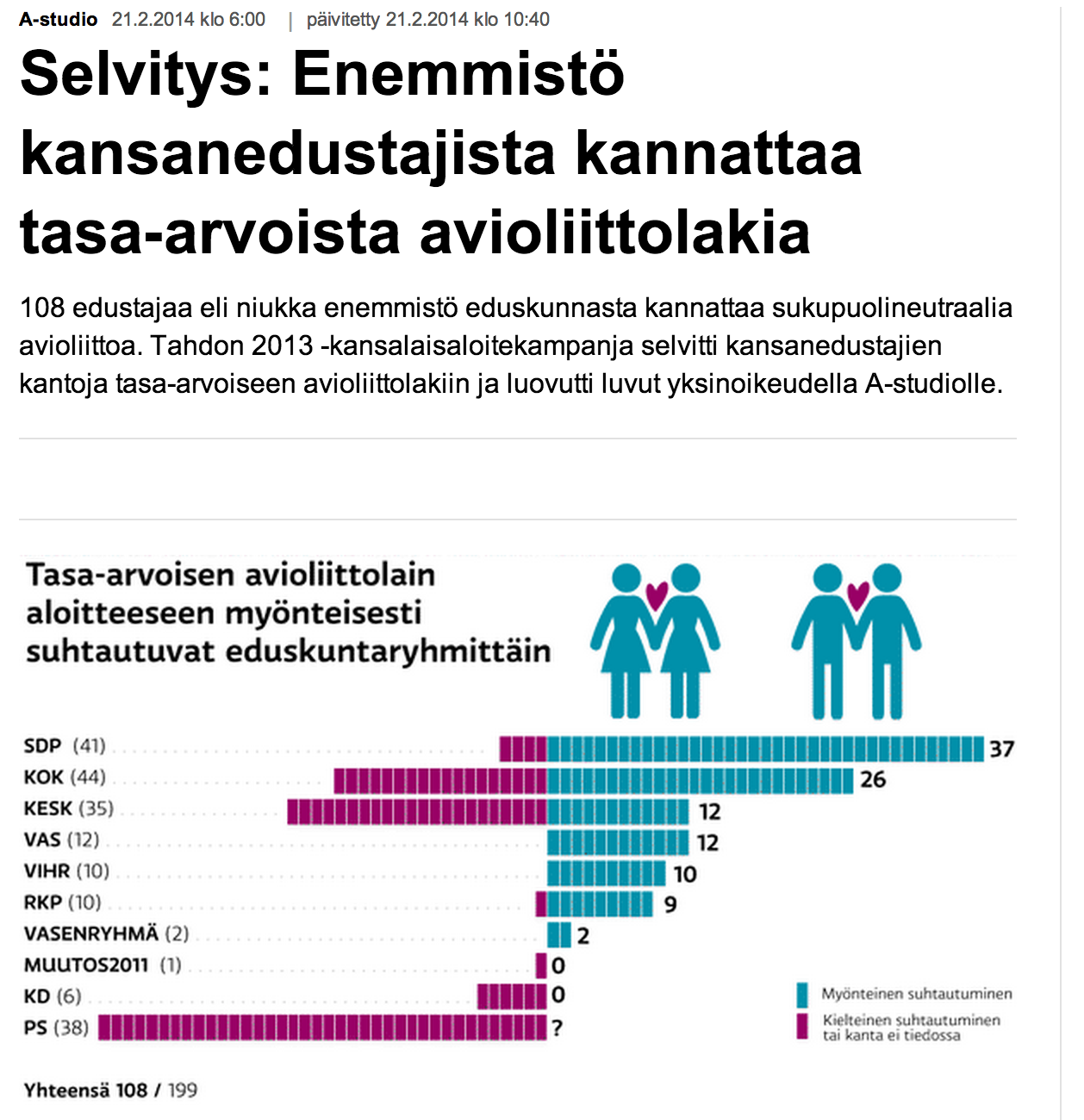
If we look at an A-Studio poll that was published Thursday, it shouldn’t surprise us that the same political parties that oppose gay marriage are against cultural diversity.

Which parties oppose gay marriage? It shouldn’t surprise us that at the head of the list is the anti-EU, anti-immigration and especially anti-Islam Perussuomalaiset (PS) party followed by smaller ones like the Christian Democrats.  The Center Party and National Coalition Party, are still split on the new law.

Kuvankaappaus 2014-2-22 kello 9.10.46

 A poll by A-Studio shows that 108 out of 199 MPs support the same-sex marriage initiative. Read full story here.

One could rightfully ask why is legalizing gay marriage important for Finland. The answer to this question is clear because there is a direct relationship with the ongoing debate on our ever-growing cultural diversity and how minorities should be accepted and respected in this country.

Finland has always been culturally diverse, according to Professor Jeremy Gould of Jyväskylä University.

“Culture is always diverse – people everywhere have different tastes, beliefs, habits, and values,” he told Migrant Tales. “This has been true of Finland for centuries. For me the so-called ‘debate about multiculturalism’ is a code word for racism in our society. Finland is already culturally diverse. The issue is that people of color don’t receive the respect and recognition they deserve as human beings.”

In the same way, the debate on granting gays the right to marriage is a code word for homophobia.

The same parties that aren’t ready to give gays the right to marriage are those that are doing everything possible to sabotage and deny our cultural diversity. Spearheading this campaign is none other than the PS.

When the new law is passed, not only will gays benefit from it but other minorities in our society. It will lead and fuel the long-overdue recognition and respect due to all minorities living in Finland.

That is why a lot rides on the passage of the gay marriage law.

David Papineau: Civil Society and why Adnan Januzaj should be Eligible for England (Though He Isn’t)

Posted on February 20, 2014 by Migrant Tales

David Papineau

Adnan Januzaj is what American sports journalists call a ‘phenom’. Barely eighteen when he was called into the Manchester United first team last August, he immediately proved a match-winner and has been exuding class all season. If he can stay fit and keep his form, he is destined to become one of the footballing greats.
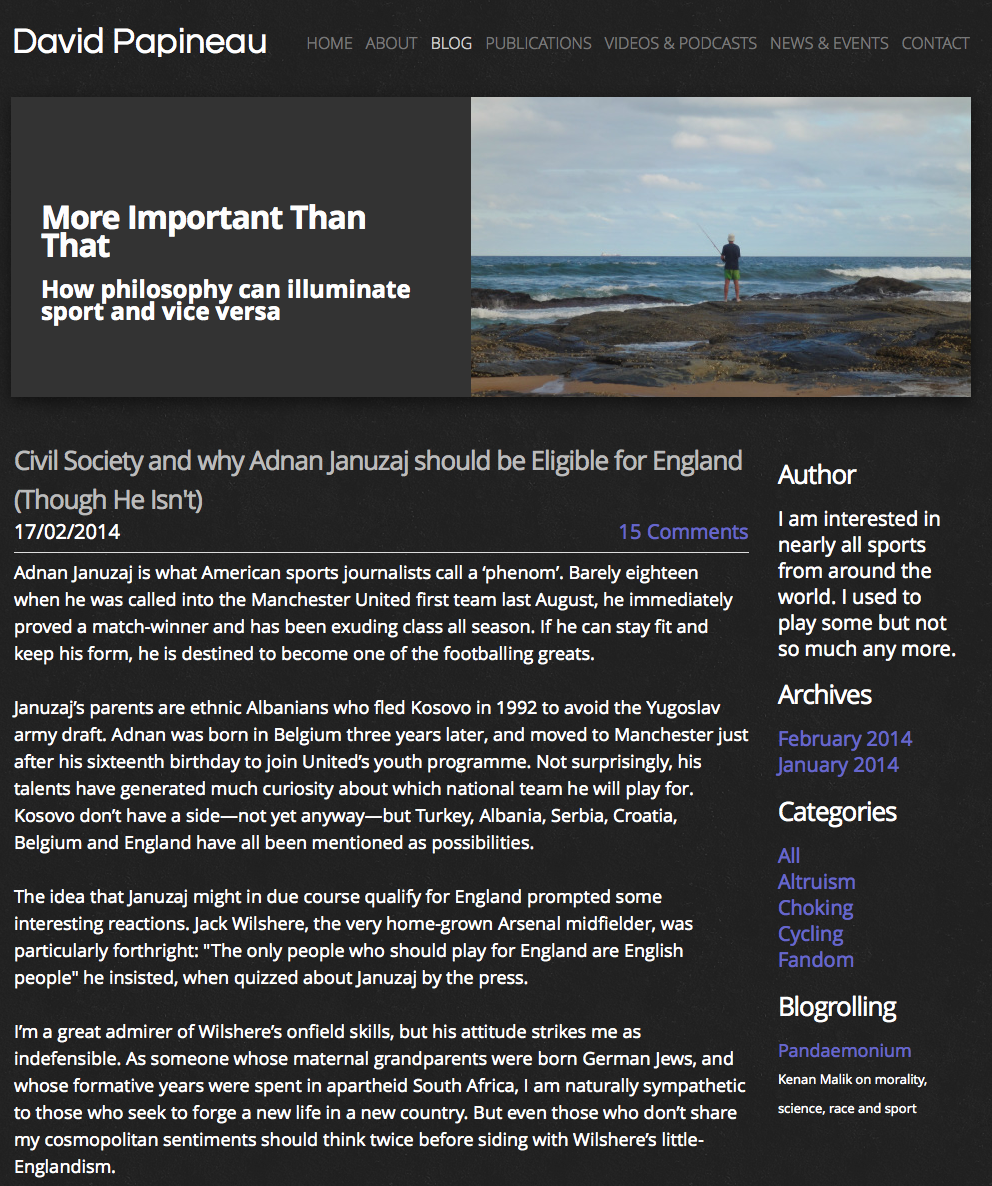
Kuvankaappaus 2014-2-20 kello 10.46.14Read original column here. 

Januzaj’s parents are ethnic Albanians who fled Kosovo in 1992 to avoid the Yugoslav army draft. Adnan was born in Belgium three years later, and moved to Manchester just after his sixteenth birthday to join United’s youth programme. Not surprisingly, his talents have generated much curiosity about which national team he will play for. Kosovo don’t have a side—not yet anyway—but Turkey, Albania, Serbia, Croatia, Belgium and England have all been mentioned as possibilities.

The idea that Januzaj might in due course qualify for England prompted some interesting reactions. Jack Wilshere, the very home-grown Arsenal midfielder, was particularly forthright: “The only people who should play for England are English people” he insisted, when quizzed about Januzaj by the press.

I’m a great admirer of Wilshere’s onfield skills, but his attitude strikes me as indefensible. As someone whose maternal grandparents were born German Jews, and whose formative years were spent in apartheid South Africa, I am naturally sympathetic to those who seek to forge a new life in a new country. But even those who don’t share my cosmopolitan sentiments should think twice before siding with Wilshere’s little-Englandism.

Let me explain. By and large, national sporting eligibility in the modern world depends on citizenship. And citizenship in turn depends on residence. Nearly all countries allow those who have been legally resident for some fixed period to become ‘naturalized’ citizens. In Britain the required period is five years, which means that in the natural course of events Junuzaj could become British in 2016.

 Somewhat less familiarly, most countries make residence necessary for citizenship, as well as sufficient. True, you can be a citizen of a country that you have never set foot in, courtesy of your parent’s citizenship. But this is basically a device to avoid mothers having to scurry back to their homeland to give birth, and you aren’t allowed to iterate it indefinitely. As things now stand in Britain, for example, citizenship by descent runs out after one generation, as the grandchildren of emigrants often discover to their cost.


It might seem surprising that residence counts for so much and ancestry for so little. After all, chauvinism is an easy vote-winner pretty much everywhere. Moreover, prejudice isn’t the only motivation for wanting to restrict citizenship to those with a shared background. You don’t have to be Enoch Powell to recognize that civil society depends on more than common geographical boundaries. A healthy community requires a mutual sense of acceptable public behaviour, of how to settle disputes, of your obligations to neighbours and acquaintances, and so on.

Still, there is a basic reason why most nations aim to preserve the foundations of civil society without tying citizenship to ethnic origin. Movement of people across national boundaries has long been inevitable. Political realignments, surreptitious immigration, and above all commerce lead inexorably to a build-up of non-citizens inside national regions. And the obvious problem is that, if these newcomers are left as non-citizens indefinitely, they are likely to start resenting it and stirring up trouble.

The smart solution is to incorporate them, to sign them up to the deal on which all modern democracies rest. We will make you full citizens with all accompanying rights, and in return you will respect our shared way of doing things.

Pessimists say it won’t work. How can a Ghanaian become Italian, or a Vietnamese Australian, or indeed a Kosovan English? But history is on the side of optimism. Maybe you can’t lose your ethnicity easily (though that in itself is an interesting question), but this is no barrier to gaining a nationality. My grandparents, who remained loyal to the orthodox synagogue all their lives, were obsessed with becoming English. (My mother was an encyclopedia on the niceties of English manners.) Or just think of modern America, where successive waves of ethnic immigrants embraced their new national identity with excitement and pride.

Of course, the deal works best when the welcome is sincere. You won’t get buy-in from the newcomers if they think they are still being treated as second class citizens. They need to feel that all institutions are open to them—including national sports teams. That’s why I find Wilshere’s attitude not only mean-spirited but destructive. Once people are living in your country, it does nobody any good to discriminate against them. Imagine what it would do to social relations in Sweden or Germany if Zlatan Ibrahimovic and Mesut Özil were kept out of the national teams because of their ethnic origin.

Sadly, though, it seems as though Adnan Januszaj won’t be eligible for England after all, at least not unless the rules are changed. The reason is that nowadays sporting eligibility doesn’t always follow nationality. A number of international sporting bodies have become uneasy about the readiness with which some countries hand out citizenship, and so have imposed a blanket residence requirement. In particular, FIFA, the football authority, got fed up with the number of Brazilians turning up in other countries’ sides, and so since 2008 have demanded that, in addition to citizenship, you must have lived in a country for five years before you can represent it on the football field.

Why is that a problem for Januzaj? If he becomes British on the basis of five years residence, won’t that automatically satisfy the extra FIFA requirement too? Ah, well that would work fine if there were a British football team—but there isn’t. So the so-called Home Nations have had to devise some extra rules to decide who can play for England, Scotland, Wales and Northern Ireland. And in their wisdom they have decreed that from 2009 you need to have been born in the relevant country, or to have a parent or grandparent born there, or to have been educated there for five years before the age of eighteen.

So even if Adnan becomes British, and lives here for the rest of his life, he will never be able to play for England. Nor, if you think about it, will anybody who moves here after they are thirteen. I’d say the Home Nations have got it badly wrong. They have put too much weight on descent, and left no room for newcomers to opt in.

Consider what their rules mean. If cricket had applied them in recent decades, carpetbaggers like Kevin Pietersen and Allan Lamb would have been fine, courtesy of their English parents, but Basil D’Oliveira would have been out. And in soccer the Canadian Owen Hargreaves would have been in, because of his English father, but Cyrille Regis MBE would never have been able to play for his country—as he didn’t move here from the Caribbean until he was fifteen.

Perhaps the Home Nations authorities didn’t fully appreciate the implications of their new policy. One would hope so. But in any case their regulations strike me as badly in need of reassessment. Perhaps this new controversy will serve to draw attention to their failings. Adnan Januzaj for England, I say.

Read original blog entry here.

This piece was reprinted by Migrant Tales with permission.

What’s really being discussed in the ongoing debate about immigration in Finland?

Posted on February 16, 2014 by Migrant Tales

After taking part actively in the ongoing debate about immigration and immigrants, some crucial points always expose themselves in the debate. I personally believe that there is one very important issue that few care to admit: accepting our cultural and ethnic diversity and how some white Finns accept the latter. 

I’m overjoyed that there are more people from different ethnic backgrounds taking part in the ongoing debate. We may or not agree with some of our points of view, but the most important point is that there are other voices out there today.

A good example of those “other” voices is Abdirahim Hussein Mohamed’s initiative to bring the anti-immigration and anti-Islam Perussuomalaiset (PS) to the same table as the Muslim congregation. The visit was widely commented on Facebook as well.

Kuvankaappaus 2014-2-16 kello 12.32.02

Hussein Mohamed said that he organized the event, which was successful according to him, because he was tired of the “us and them” debate.

Professor Jeremy Gould, who spoke to some students and staff members at Otava Folk High School last spring, said that it’s difficult to quantify racism in Finland since there are so few migrants living in the country. “The basic issue that we’re looking at in Finland today is the acceptance of people who are look, or sound different,” he said.

Professor Gould, who teaches Development Studies at Jyväskylä University, asked why we need to defend ‘multiculturalism.’

IMG_0887

Professor Jeremy Gould speaking to students at Otava Folk High School in spring.

“Culture is always diverse – people everywhere have different tastes, beliefs, habits, and values, Gould said. “This has been true of Finland for centuries. For me the so-called ‘debate about multiculturalism’ is a code word for racism in our society. Finland is already culturally diverse. The issue is that people of color don’t receive the respect and recognition they deserve as human beings.”

Matters were very different before the 2011 parliamentary elections, when the anti-immigration and especially anti-Islam Perussuomalaiset (PS) won 39 seats from 5 previously. The debate was basically controlled by anti-immigration groups and hate sites like Hommaforum.

Having been a journalist and foreign correspondent for 25 years with a background in anthropology, I was truly surprised by what was being written and debated over immigration and immigrants in Finland. The urban tales that were being published as “solid analysis” were nothing more than points of views that exposed the writer’s prejudices and intolerance.

I once gave a talk in 2010 to students about what the Finnish media was writing at the time about migrants and visible minorities. I grouped the stories in the following manner: Those opinion pieces and stories that made my blood boil and those that didn’t.

Here’s one editorial by Jyväskylä-based Keskisuomalainen written in 2010 that was in the “blood-boiling” category.  It reads:

…the most effective way of helping refugees is to earmark help to their home country (sic!). Accepting refugees in Finland is the last resort.

As one can see, the editorial carries all the arguments of the anti-immigration camp. One of the favorites to this date is the following:

Certain migrant or refugee groups will never adapt to our country and therefore we must do everything possible from allowing them to come here. My intolerant and racist views are justified.

Kuvankaappaus 2014-2-16 kello 13.50.47

Read full editorial (in Finnish) here.

The extremely one-sided debate before the 2011 elections bore a striking resemblance to the arguments used by  xenophobic parties like National Front in the UK during the 1970s and 1980s. Just like in the United Kingdom, the media in Finland was and still is part of the problem because it continues to give racists inflated respectability and importance.

Migrant Tales has written that we think carefully what we write because our grandchildren, great grandchildren and others will read and quote what we say today.

What do you think will be the fate of the writings of anti-immigration politicians like Halla-aho, James Hirvisaari, Olli Immonen and many others anti-immigration writers in the future? If some of their points of views sound ludicrous today, think of how they’ll read in the future.

The more we take part in the ongoing debate and reveal those urban tales, the shorter their lifespan will be.

Despite the fact that the debate on our ever-growing cultural diversity (I believe this is the big issue) has changed, the arguments are the same. There are basically two: Those who want to keep Finland “white” at any cost, and those who accept our cultural diversity.

Those in the former group are naturally against multiculturalism. They attack everything that promotes cultural diversity and try their hardest not to be labelled as racists. Some of the issues they attack are immigration policy and, most importantly, defending equal rights for migrants and visible minorities.

A good example of the keep-Finland-white camp is PS MP Olli Immonen’s written question to parliament in December that Finland should start classifying people according to ethnic background.

Personally, I consider it absurd to be against cultural diversity in Finland since over 1.2 million Finns emigrated from this country between 1860 and 1999 and that we have – and need – more migrants.


To all the Other Finns like me: Nobody can deny who you are

Posted on January 15, 2014 by Migrant Tales

After spending a brief moment of my childhood in Finland, and growing roots in other lands, I longed to move back to the country I was once from.  I was fortunate and able to visit Finland every summer.

Those days I spent as a child and adolescent in the company of my grandparents in the Finnish countryside changed my life. If a person changes after a long journey, every journey to Finland changed me.   

Visiting Finland in the summer didn’t only give me an opportunity to relearn the Finnish language and strengthen my bonds with this land, it recharged my soul and gave me strength to face life of a huge city like Los Angeles.

Image1-34_edited-1

My Finnish roots are as deep as my roots in Argentina and Southern California. As Finland continues to deny its cultural diversity, it continues to deny others their right to their identity. The Perussuomalaiset is one party that has openly declared war on people like us.

I’m grateful for my Finnish roots and for those summers I spent with my grandparents. I am who I am today because of them and those summers.

But with the rise of intolerance in this country, and political parties that have declared war on Finland’s ever-growing cultural diversity, I have one important message for them: Nothing, absolutely nothing, can erase who we are.

Today there are tens of thousands of us. We come from diverse backgrounds but one matter unites us: Finland is our home. Some of us have appeared on Migrant Tales: Joseph, Ida, Abdulah, Ariela and other multicultural Finns like Aune and Anna.

Don’t allow those that take their prejudice and intolerance seriously erase who you are. No ethnic group in Finland can claim this land as their own. This land belongs to all those who live here irrespective of their background.

I fear that I will not live long enough to see that day when most of us in this land, irrespective of his or her background, will be accepted and respected as equals.  Maybe it’ll be you or your children or grandchildren that will witness that day.

Those who want to exclude us aim to erase and deny our history.

Rodolfo Walsh, an Argentinean journalist and writer, said something that we should never forget when we write our history. Even if it was written in the 1970s, it still applies to immigrants and multicultural Finns:

Our dominant classes have made sure that the worker has no history, doesn’t have a doctrine, any heroes or any martyrs. Every struggle has to be started from scratch, separated from previous struggles; the collective history is lost, their lessons are forgotten. History appears as it if were private property, whose owners are the owners of everything.

When someone tells you that you’re a “half-Finn,” answer them back kindly that you’re not “half” of anything but a full human being. Remind them of the 1.2 million Finns that emigrated abroad between 1860 and 1999.

Ask them why they have conveniently forgotten these Finns and how they integrated and become a part of a greater world family.

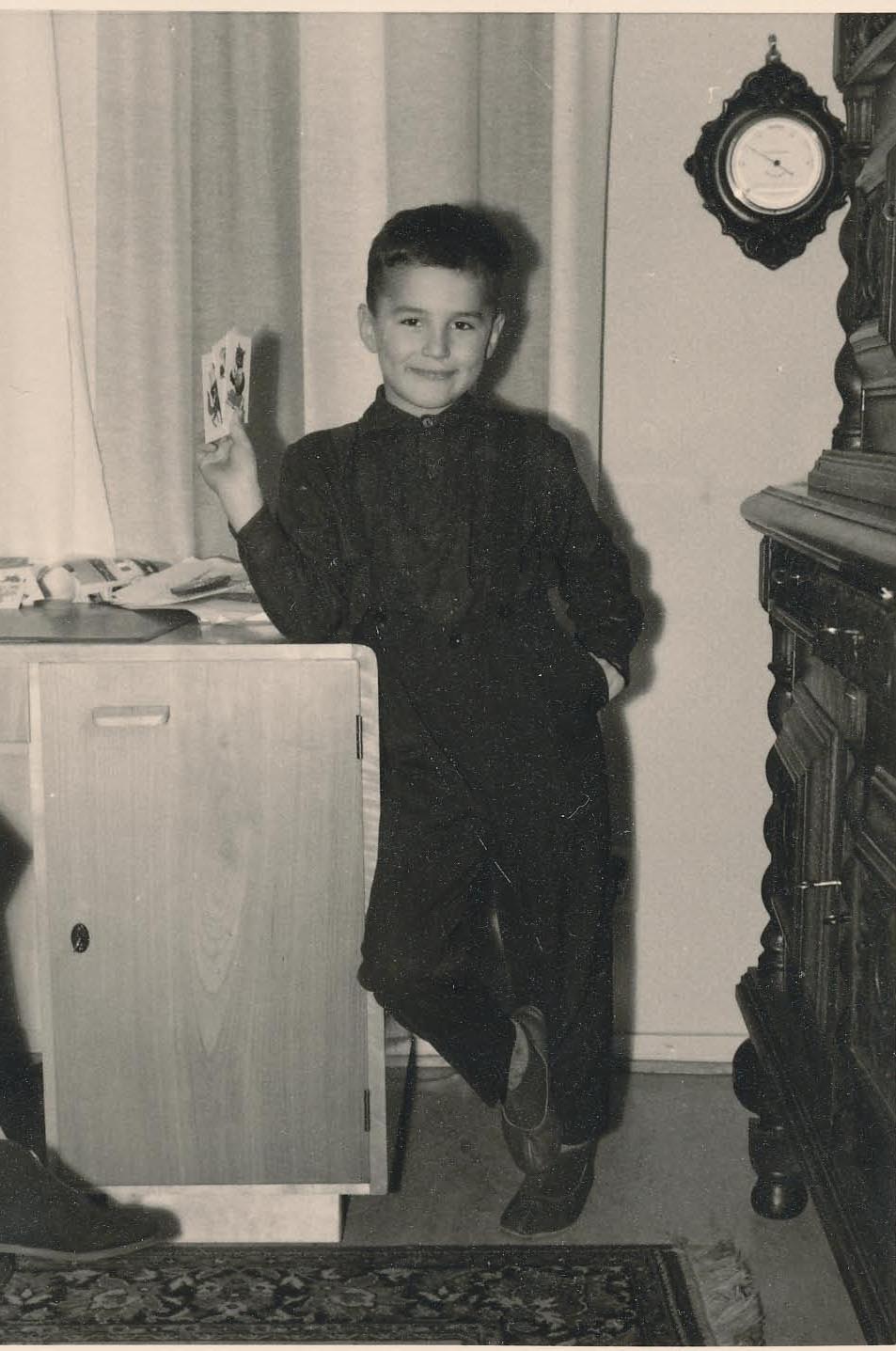
Image1-35_edited-1(1)This picture is of one of the saddest moments in my life. It’s a day before we moved from Finland to Argentina. I made a vow to return back to Finland one day and I did about sixteen years later, in 1978.

Joseph, Ida, Abdulah, Ariel, Aune, Anna and many Other Finns like me, don’t forget who you are and remember above everything else, nobody can deny who you are.

As Nelson Mandela said, you are the captain of your destiny, or in our case, the captain of your identity, the master of your narrative.

Nobody can erase who you are because you have memory.

Finland is a highly racialized country

Posted on January 5, 2014 by Migrant Tales

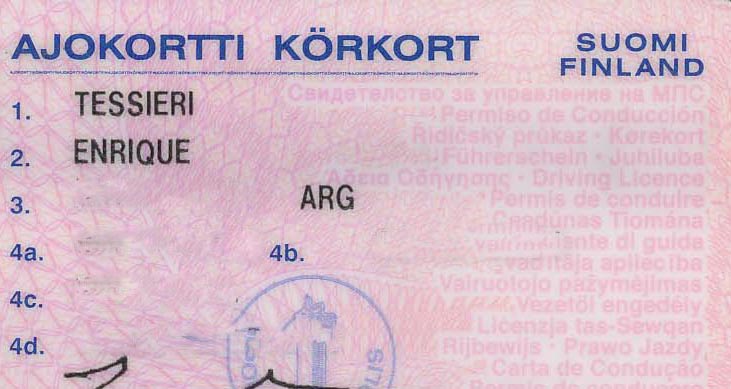
Racialization, or ethnicization, is a sociological concept that ascribes racial or ethnic identities to a relationship. In simple terms it is the way that a dominant group ascribes an identity on minorities in order to dominate them. In Finland this is so common that our nationality is mentioned on our drivers license even if we’re Finnish citizens. 

Image1-42_edited-2(4)

On the third line of my drivers license after name and surname, there’s my date of birth and place of birth. In my case it’s ARG, or Argentina.

I was born in Argentina but grew up in California and lived in cities like London and Helsinki when I was a minor. Why aren’t these reflected on my drivers license?

This practice smells of Helena Eronen’s suggestion that immigrants should start wearing sleeve badges and what the Nazis did when they obliged Jews to sew the Star of David on their clothing.

The question is why do we have to have this information on our drivers license?

Does the information give the police who stop you more information about your background? Does it encourage ethnic profiling and make the difference whether you’ll get off with a warning or a ticket?

Why is it anyone’s business to know where I’m from? What about if I show my drivers license to a shop keeper as ID? Why should he or she know where I was born?

The Finnish state and its employees like the police, who are paid to serve us, appear to be obsessed by race and blood as well as ethnicity. Since this information appears to be crucial to them, why not include sexual preference? Why not classify Finns according to the region they were born or which ethnic group they belong to?

Instead of encouraging inclusiveness, these types of practices are one of many ways that the Finnish state continues to remind you that you aren’t an equal member of this society.


  • Previous
  • 1
  • …
  • 13
  • 14
  • 15
  • 16
  • 17
  • 18
  • 19
  • …
  • 30
  • Next
Read more about documentary film
Read more

Recent Posts

  • Finland’s tabloids Iltalehti and Ilta-Sanomat are the pits
  • Riikka Purra’s Dr Jekyll and Mr Hyde mask
  • Double standards
  • Perussuomalaiset: Uusi logo, sama vanha juttu
  • Taco Trump

Recent Comments

  1. Absolutely Socking: Racist Finnish Facebook group against human rights gets flooded with socks on Musta Barbaari’s mother and sister charged by the police in “ethnic profiling” case
  2. Ilkka Nuotio on Pekka Myrskylä: “Tilastot kertovat toista kuin poliittinen keskustelu”
  3. Genrih Soinkara on The war in Ukraine and the Russian-Finnish border crisis are showing Finland’s ugly side
  4. Ahti Tolvanen on Comment by Ahti Tolvanen on the Helsinki +50 conference
  5. Angel Barrientos on Angel Barrientos is one of the kind beacons of Finland’s Chilean community

Archives

  • June 2026
  • May 2026
  • April 2026
  • March 2026
  • February 2026
  • January 2026
  • December 2025
  • November 2025
  • October 2025
  • September 2025
  • August 2025
  • July 2025
  • June 2025
  • May 2025
  • April 2025
  • March 2025
  • February 2025
  • January 2025
  • December 2024
  • November 2024
  • October 2024
  • September 2024
  • August 2024
  • July 2024
  • June 2024
  • May 2024
  • April 2024
  • March 2024
  • February 2024
  • January 2024
  • December 2023
  • November 2023
  • October 2023
  • September 2023
  • August 2023
  • July 2023
  • June 2023
  • May 2023
  • April 2023
  • March 2023
  • February 2023
  • January 2023
  • December 2022
  • November 2022
  • October 2022
  • September 2022
  • August 2022
  • July 2022
  • June 2022
  • May 2022
  • April 2022
  • March 2022
  • February 2022
  • January 2022
  • December 2021
  • November 2021
  • October 2021
  • September 2021
  • August 2021
  • July 2021
  • June 2021
  • May 2021
  • April 2021
  • March 2021
  • February 2021
  • January 2021
  • December 2020
  • November 2020
  • October 2020
  • September 2020
  • August 2020
  • July 2020
  • June 2020
  • May 2020
  • April 2020
  • March 2020
  • February 2020
  • January 2020
  • December 2019
  • November 2019
  • October 2019
  • September 2019
  • August 2019
  • July 2019
  • June 2019
  • May 2019
  • April 2019
  • March 2019
  • February 2019
  • January 2019
  • December 2018
  • November 2018
  • October 2018
  • September 2018
  • August 2018
  • July 2018
  • June 2018
  • May 2018
  • April 2018
  • March 2018
  • February 2018
  • January 2018
  • December 2017
  • November 2017
  • October 2017
  • September 2017
  • August 2017
  • July 2017
  • June 2017
  • May 2017
  • April 2017
  • March 2017
  • February 2017
  • January 2017
  • December 2016
  • November 2016
  • October 2016
  • September 2016
  • August 2016
  • July 2016
  • June 2016
  • May 2016
  • April 2016
  • March 2016
  • February 2016
  • January 2016
  • December 2015
  • November 2015
  • October 2015
  • September 2015
  • August 2015
  • July 2015
  • June 2015
  • May 2015
  • April 2015
  • March 2015
  • February 2015
  • January 2015
  • December 2014
  • November 2014
  • October 2014
  • September 2014
  • August 2014
  • July 2014
  • June 2014
  • May 2014
  • April 2014
  • March 2014
  • February 2014
  • January 2014
  • December 2013
  • November 2013
  • October 2013
  • September 2013
  • August 2013
  • July 2013
  • June 2013
  • May 2013
  • April 2013
  • March 2013
  • February 2013
  • January 2013
  • December 2012
  • November 2012
  • October 2012
  • September 2012
  • August 2012
  • July 2012
  • June 2012
  • May 2012
  • April 2012
  • March 2012
  • February 2012
  • January 2012
  • December 2011
  • November 2011
  • October 2011
  • September 2011
  • August 2011
  • July 2011
  • June 2011
  • May 2011
  • April 2011
  • March 2011
  • February 2011
  • January 2011
  • December 2010
  • November 2010
  • October 2010
  • September 2010
  • August 2010
  • July 2010
  • June 2010
  • May 2010
  • April 2010
  • March 2010
  • February 2010
  • January 2010
  • December 2009
  • November 2009
  • October 2009
  • September 2009
  • August 2009
  • July 2009
  • December 2008
  • November 2008
  • October 2008
  • September 2008
  • August 2008
  • July 2008
  • June 2008
  • May 2008
  • April 2008
  • March 2008
  • February 2008
  • January 2008
  • November 2007
  • October 2007
  • September 2007
  • August 2007
  • July 2007
  • June 2007
  • May 2007

Categories

  • ?? Gia L?c
  • ????? ?????? ????? ???????? ?? ??????
  • ???????
  • @HerraAhmed
  • @mondepasrond
  • @nohatefinland
  • @oula_silver
  • @Varathas
  • A Pakistani family
  • äärioikeisto
  • Abbas Bahmanpour
  • Abdi Muhis
  • Abdirahim Hussein Mohamed
  • Abdirahim Husu Hussein
  • Abdirisak Mahamed
  • About Migrant Tales
  • activism
  • Adam Al-Sawad
  • Adel Abidin
  • Afrofinland
  • Ahmed IJ
  • Ahti Tolvanen
  • Aino Pennanen
  • Aisha Maniar
  • Alan Ali
  • Alan Anstead
  • Alejandro Díaz Ortiz
  • Alekey Bulavsev
  • Aleksander Hemon
  • Aleksanterinliitto
  • Aleksanterinliitto ry
  • Aleksanterinliitto ry:n hallitus
  • Alex Alex
  • Alex Mckie
  • Alexander Nix
  • Alexandra Ayse Albayrak
  • Alexis Neuberg
  • Ali Asaad Hasan Alzuhairi
  • Ali Hossein Mir Ali
  • Ali Rashid
  • Ali Sagal Abdikarim
  • Alina Tsui
  • Aline Müller
  • All categories
  • Aman Heidari
  • Amiirah Salleh-Hoddin & Jana Turk
  • Amin A. Alem
  • Amir Zuhairi
  • Amkelwa Mbekeni
  • Ana María Gutiérrez Sorainen
  • Anachoma
  • Anders Adlecreutz
  • Angeliina Koskinen
  • Anna De Mutiis
  • Anna María Gutiérrez Sorainen
  • Anna-Kaisa Kuusisto ja Jaakko Tuominen
  • Annastiina Kallius
  • Anneli Juise Friman Lindeman
  • Announcement
  • Anonymous
  • Antero Leitzinger
  • anti-black racism
  • Anti-Hate Crime Organisation Finland
  • Anudari Boldbaatar
  • Arshiya Nasser
  • Aspergers Syndrome
  • Asylum Corner
  • Asylum seeker 406
  • Athena Griffin and Joe Feagin
  • Autism
  • Avaaz.org
  • Awale Olad
  • Ayan Said Mohamed
  • AYY
  • Barachiel
  • Bashy Quraishy
  • Beatrice Kabutakapua
  • Beri Jamal
  • Beri Jamal and Enrique Tessieri
  • Bertolt Brecht
  • Boiata
  • Boodi Kabbani
  • Bruno Gronow
  • Carmen Pekkarinen
  • Çelen Oben and Sheila Riikonen
  • Chiara Costa-Virtanen
  • Chiara Costa-Virtanen
  • Chiara Sorbello
  • Christian Thibault
  • Christopher Wylie
  • Clara Dublanc
  • Dana
  • Daniel Malpica
  • Danilo Canguçu
  • David Papineau
  • David Schneider
  • Dexter He
  • Don Flynn
  • Dr Masoud Kamali
  • Dr. Faith Mkwesha
  • Dr. Theodoros Fouskas
  • Edna Chun
  • Eeva Kilpi
  • Emanuela Susheela
  • En castellano
  • ENAR
  • Enrique
  • Enrique Tessieri
  • Enrique Tessieri & Raghad Mchawh
  • Enrique Tessieri & Yahya Rouissi
  • Enrique Tessieri and Muhammed Shire
  • Enrique Tessieri and Sira Moksi
  • Enrique Tessieri and Tom Vandenbosch
  • Enrique Tessieri and Wael Che
  • Enrique Tessieri and Yahya Rouissi
  • Enrique Tessieri and Zimema Mhone
  • Epäluottamusmies
  • EU
  • Europe
  • European Islamophobia Report
  • European Islamophobia Report 2019,
  • European Union
  • Eve Kyntäjä
  • Ezequiel Caldeiro
  • Facebook
  • Fadumo Dayib
  • Faisa Kahiye
  • Farhad Manjoo
  • Fasismi
  • Finland
  • Fizza Qureshi
  • Flyktingar och asyl
  • Foreign Student
  • Fozia Mir-Ali
  • Frances Webber
  • Frida Selim
  • Gareth Rice
  • Ghyslain Vedeaux
  • Global Art Point
  • Great Replacement
  • Habiba Ali
  • Hami Bahadori
  • Hami Bahdori
  • Hamid
  • Hamid Alsaameere
  • Hamid Bahdori
  • Handshake
  • Harmit Athwal
  • Hassan Abdi Ali
  • Hassan Muhumud
  • Heikki Huttunen
  • Heikki Wilenius
  • Helsingin Sanomat
  • Henning van der Hoeven
  • Henrika Mälmsröm
  • Hser Hser
  • Hser Hser ja Mustafa Isman
  • Husein Muhammed
  • Hussain Kazemian
  • Hussain Kazmenian
  • Ibrahim Khan
  • Ida
  • Ignacio Pérez Pérez
  • Iise Ali Hassan
  • Ilari Kaila & Tuomas Kaila
  • Imam Ka
  • inside-an-airport
  • Institute of Race Relations
  • Iraqi asylum seeker
  • IRR European News Team
  • IRR News Team
  • Islamic Society of Norhern FInland
  • Islamic Society of Northern Finland
  • Islamophobia
  • Jacobinmag.com
  • Jallow Momodou
  • Jan Holmberg
  • Jane Elliott
  • Jani Mäkelä
  • Jari Luoto
  • Jari Taponen
  • Jegor Nazarov
  • Jenni Stammeier
  • Jenny Bourne
  • Jessie Daniels
  • Joe Davidow
  • Johannes Koski
  • John D. Foster
  • John Grayson
  • John Marriott
  • Jon Burnett
  • Jorma Härkönen
  • Jos Schuurmans
  • José León Toro Mejías
  • Josue Tumayine
  • Jouni Karnasaari
  • Juan Camilo
  • Jukka Eräkare
  • Julian Abagond
  • Julie Pascoet
  • Jussi Halla-aho
  • Jussi Hallla-aho
  • Jussi Jalonen
  • JusticeDemon
  • Kadar Gelle
  • Kaksoiskansalaisuus
  • Kansainvälinen Mikkeli
  • Kansainvälinen Mikkeli ry
  • Katherine Tonkiss
  • Kati Lepistö
  • Kati van der Hoeven-Lepistö
  • Katie Bell
  • Kättely
  • Kerstin Ögård
  • Keshia Fredua-Mensah & Jamie Schearer
  • Khadidiatou Sylla
  • Khadra Abdirazak Sugulle
  • Kiihotus kansanryhmää vastaan
  • Kirsi Crowley
  • Koko Hubara
  • Kristiina Toivikko
  • Kubra Amini
  • KuRI
  • La Colectiva
  • La incitación al odio
  • Laura Huhtasaari
  • Lauri Finér
  • Leif Hagert
  • Léo Custódio
  • Leo Honka
  • Leontios Christodoulou
  • Lessie Branch
  • Lex Gaudius
  • Leyes de Finlandia
  • Liikkukaa!
  • Linda Hyökki
  • Liz Fekete
  • M. Blanc
  • Maarit Snellman
  • Mahad Sheikh Musse
  • Maija Vilkkumaa
  • Malmin Kebab Pizzeria Port Arthur
  • Marcell Lorincz
  • Mari Aaltola
  • María Paz López
  • Maria Rittis Ikola
  • Maria Tjader
  • Marja-Liisa Tolvanen
  • Mark
  • Markku Heikkinen
  • Marshall Niles
  • Martin Al-Laji
  • Maryan Siyad
  • Matt Carr
  • Mauricio Farah Gebara
  • Media Monitoring Group of Finland
  • Micah J. Christian
  • Michael McEachrane
  • Michele Levoy
  • Michelle Kaila
  • Migrant Tales
  • Migrant Tales Literary
  • Migrantes News
  • Migrants' Rights Network
  • MigriLeaks
  • Mikko Kapanen
  • Miriam Attias and Camila Haavisto
  • Mohamed Adan
  • Mohammad Javid
  • Mohammad M.
  • Monikulttuurisuus
  • Monisha Bhatia and Victoria Canning
  • Mor Ndiaye
  • Muh'ed
  • Muhamed Abdimajed Murshid
  • Muhammed Shire
  • Muhammed Shire and Enrique Tessieri
  • Muhis Azizi
  • Musimenta Dansila
  • Muslimiviha
  • Musulmanes
  • Namir al-Azzawi
  • Natsismi
  • Neurodiversity
  • New Women Connectors
  • Nils Muižnieks
  • No Labels No Walls
  • Noel Dandes
  • Nuor Dawood
  • Omar Khan
  • Otavanmedia
  • Oula Silvennoinen
  • Paco Diop
  • Pakistani family
  • Pentti Stranius
  • Perussuomalaiset
  • perustuslaki
  • Petra Laiti
  • Petri Cederlöf
  • Pia Grochowski
  • Podcast-lukija Bea Bergholm
  • Pohjois – Suomen Islamilainen Yhdyskunta
  • Pohjois Suomen Islamilainen Yhyskunta
  • Polina Kopylova
  • Race Files
  • racism
  • Racism Review
  • Raghad Mchawh
  • Ranska
  • Rashid H. and Migrant Tales
  • Rasismi
  • Raul Perez
  • Rebecka Holm
  • Reem Abu-Hayyeh
  • Refugees
  • Reija Härkönen
  • Remiel
  • Reza Nasri
  • Richard Gresswell
  • Riikka Purra
  • Risto Laakkonen
  • Rita Chahda
  • Ritva Kondi
  • Robito Ibrahim
  • Roble Bashir
  • Rockhaya Sylla
  • Rodolfo Walsh
  • Roger Casale
  • Rostam Atai
  • Roxana Crisólogo Correa
  • Ruth Grove-White
  • Ruth Waweru-Folabit
  • S-worldview
  • Sadio Ali Nuur
  • Sami Rusanen
  • Sandhu Bhamra
  • Sara de Jong
  • Sarah Crowther
  • Sari Alhariri
  • Sarkawt Khalil
  • Sasu
  • Scot Nakagawa
  • Shabana Ahmadzai
  • Shada Islam
  • Sharon Chang blogs
  • Shenita Ann McLean
  • Shirlene Green Newball
  • Sini Savolainen
  • Sira Moksi
  • Sonia K.
  • Sonia Maria Koo
  • Steverp
  • Stop Deportations
  • Suldaan Said Ahmed
  • Suomen mediaseurantakollektiivi
  • Suomen Muslimifoorumi ry
  • Suomen viharikosvastainen yhdistys
  • Suomen viharikosvastainen yhdistys ry
  • Suomi
  • Supermen
  • Susannah
  • Suva
  • Syrjintä
  • Talous
  • Tapio Tuomala
  • Taw Reh
  • Teivo Teivainen
  • The Daily Show
  • The Heino
  • The Supermen
  • Thomas Elfgren
  • Thulfiqar Abdulkarim
  • Tim McGettigan
  • Tino Singh
  • Tito Moustafa Sliem
  • Tobias Hübinette and L. Janelle Dance
  • Transport
  • Trica Danielle Keaton
  • Trilce Garcia
  • Trish Pääkkönen
  • Trish Pääkkönen and Enrique Tessieri
  • Tuulia Reponen
  • Uncategorized
  • UNITED
  • University of Eastern Finland
  • Uyi Osazee
  • Väkivalta
  • Vapaa Liikkuvuus
  • Venla-Sofia Saariaho
  • Vieraskynä
  • W. Che
  • W. Che an Enrique Tessieri
  • Wael Ch.
  • Wan Wei
  • Women for Refugee Women
  • Xaan Kaafi Maxamed Xalane
  • Xassan Kaafi Maxamed Xalane
  • Xassan-Kaafi Mohamed Halane & Enrique Tessieri
  • Yahya Rouissi
  • Yasmin Yusuf
  • Yassen Ghaleb
  • Yle Puhe
  • Yuliet Tresa
  • Yve Shepherd
  • Zahra Khavari
  • Zaker
  • Zalina Ametova
  • Zamzam Ahmed Ali
  • Zeinab Amini ja Soheila Khavari
  • Zimema Mahone and Enrique Tessieri
  • Zimema Mhone
  • Zoila Forss Crespo Moreyra
  • ZT
  • Zulma Sierra
  • Zuzeeko Tegha Abeng
© 2026 Migrant tales | Powered by Minimalist Blog WordPress Theme