Migrant tales
Menu
  • #MakeRacismHistory “In Your Eyes”
  • About Migrant Tales
  • It’s all about Human Rights
  • Literary
  • Migrant Tales Media Monitoring
  • NoHateFinland.org
  • Tales from Europe
Menu

Tag: Cultural diversity

Nura Farah: A blooming flower with a pen that many aimed to destroy

Posted on October 21, 2014 by Migrant Tales

There is an interesting interview of Nura Farah, Finland’s first Somali-born writer, who speaks openly about growing up as a black person in this country from the 1990s, when even middle-school teachers took part in the racist bullying of non-white Finns.

Racist bullying and racism are white privilege weapons used by this society to destroy another person by wiping out his or her self-esteem.

Migrant Tales has published a number of stories about racist bullying at Finnish schools. While it’s clear that some Finnish teachers didn’t take part in this type of school vigilante behavior, those who did are a shame to our school system and society, especially those who remained silent.

One of the problems of the 1990s concerning racism and racist bullying was that it wasn’t even seen as a problem at schools. If it occurred, it was given low priority by the teacher, school and society.

A story by YLE (in Finnish) tells about how hostile this society was to some non-white Finns and migrants during the 1990s, when our migrant population started to grow rapidly.

Racist bullying doesn’t end after you leave the school but can continue in the town where the victim grew up. And why shouldn’t racist bullying continue to be a problem at our schools and society? Aren’t National Coalition Party MP Pia Kauma and Perussuomalaiset (PS)* MP Tom Packalén unfortunate recent examples of this type of behavior?

It should be made clear that racism and racist bullying at school are hostile acts that aim to destroy the victim’s self-esteem and shatter him or her into tiny pieces. You’re not supposed to ever pick up those pieces of your shattered self.

But you can be defiant and strong and do something bold like accepting yourself.

This is what Farah did when she was 20.


Näyttökuva 2014-10-21 kello 8.21.18

Read full story (in Finnish) here.


Farah’s family moved to the eastern Helsinki neighborhood of Kontula in the 1990s. She was 13 years old.

According to her, racism in the 1990s was terrible. Even some middle-school teachers took part in the bullying using the n-word freely and even asking in class why don’t Somalis go back to where they came from.

Somalia has been gripped by a terrible civil war since 1991, when then de facto President Siad Barre was toppled and fled the country.

Another very important message that Farah gives is that children born in Finland, irrespective if they come from different ethnic and cultural backgrounds,  shouldn’t be made to feel like outsiders. She said that the most important matter for third-culture children is to learn the language well and to get involved.

One important step in the latter direction is, in my opinion, to stop using terms like ‘pupil with migrant background,’ or maahanmuuttajataustainen,  to label non-white or third-culture students at school. In today’s strong anti-Otherness context, such labels have a tendency to remind the pupil that he or she is an outsider.

It’s clear that with writers like Farah we’re taking those first important steps in ensuring that our children and grandchildren don’t get treated in the same way as some of us did at school.

* The Finnish name for the Finns Party is the Perussuomalaiset (PS). The English names of the party adopted by the PS, like True Finns or Finns Party, promote in our opinion nativist nationalism and xenophobia. We therefore prefer to use the Finnish name of the party on our postings.

What will the April 2015 elections of Finland reveal about ourselves as a country?

Posted on October 3, 2014 by Migrant Tales

It’s clear that the parliamentary elections of April 2015 in Finland will reveal a lot of matters about this country. In many respects it’s like strip tease joint where women or men, disguised as political parties, take off their clothes. Sexuality isn’t being shown in bare flesh but in political ideologies such as racism, whiteness, anti-cultural diversity, anti-EU and nostalgia of a Finland that only existed in our imagination. 

The anti-immigration, far-right and populist winds blowing over Europe should concern us. But it is a good sign as well that there is a lot of opposition, thanks to social media, against such social ills. Pulling a 1933 political stunt on a country could be more difficult today than over eighty years ago, when Nazi Germany came into being.

As April 19 nears in Finland, it’s clear that anti-immigration voices are getting louder and more hostile. Should it surprise us then that the Perussuomalaiset (PS),* which claims to have sacked all of its racists and fascists, is leading the charge on this front?

Finland’s darkest political period in this century (2011-15) could be seen in the same light as the half-a-century old rants made by USAmerican racists of the South. What these Finnish politicians say today will make their great grandchildren’s faces turn red with shame. Racists always look ugly as time unmasks their lies.

Näyttökuva 2014-10-3 kello 13.37.31

There’s a very good column on City by Taneli Hämäläinen that summarizes, in my opinion, the way PS politicians switch the argument around. We’ve seen this on Migrant Tales on a number of occasions used by far-right anti-immigration voices. It’s like claiming that the Jews unleashed the Holocaust and the Nazis were their victims.

The issue is not asking how racist a country like Finland is, even though this is an important question, but what is our response as a society to such a social ill.  Is there a response? If so, is it effective? If not, why?

You don’t have to be black or a member of an ethnic minority to understand how insulting and lowly some politicians will act to get votes and feed their narcism in the process.

But let’s go back to the main question of this posting: What will the April 2015 elections of Finland reveal about ourselves as a country?

It will reveal two things: If racism and fascism (1) are are growing or on the defensive.

* The Finnish name for the Finns Party is the Perussuomalaiset (PS). The English names of the party adopted by the PS, like True Finns or Finns Party, promote in our opinion nativist nationalism and xenophobia. We therefore prefer to use the Finnish name of the party on our postings.

(1) Tiina Rosenberg gives a good definition of fascism as a political ideology that want to exclude other groups. The aim of fascism in Nazi Germany was based on an argument that they had to kick out and/or exterminate other minorities like the Jews, Roma and their political enemies in order to become a super race.  Nazi war criminal Alfred Rosenberg, who was sentenced and hanged for war crimes, is a good example of this type of ideology. He writes about it in The myth of the twentieth century.


New dissertation about migrants sheds light on our ignorance and prejudices

Posted on September 19, 2014 by Migrant Tales

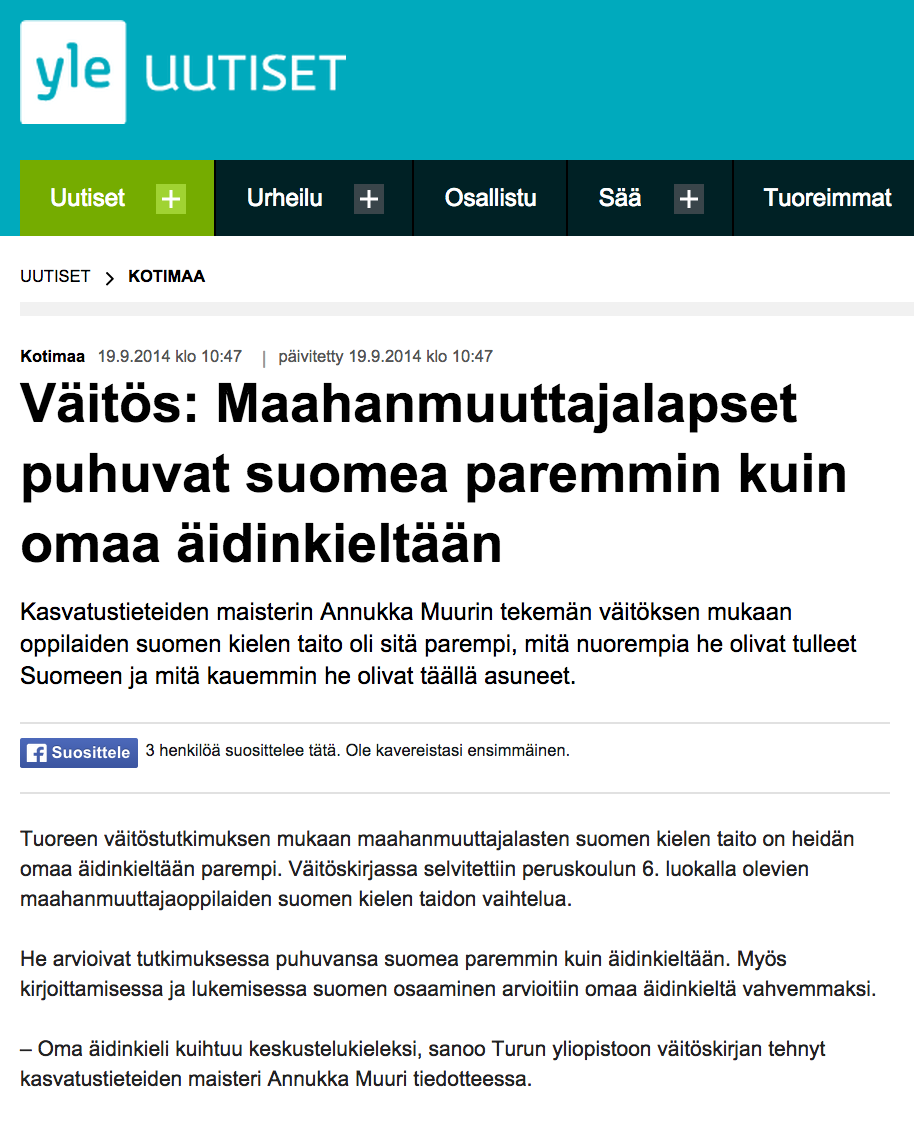
Two news stories published this week highlight in my opinion why intolerance continues to dominate debate in these parts. The latest story published by YLE was about a dissertation by Annukka Muurin, which showed that multicultural, or third-culture Finns, speak Finnish better than their parents’ language. 

Isn’t this a pretty obvious finding if the child grew up and goes to school in Finland?

Näyttökuva 2014-9-19 kello 12.36.12

Read full story (in Finnish) here.


Another important story was published on Wednesday by THL, which confirmed that first-generation “immigrants” at schools experience more bullying, physical threats and sexual harassment than white Finns.

In spring, Pekka Myrskylä, wrote that around 60% of migrants live in poverty in Finland.

The valuable work done by Muurin raises a lot of other important questions about how we accept cultural diversity and about third-culture Finns. What does her dissertation say about how our schools, which are supposed to be an example to the world, treat pupils from different cultural and ethnic backgrounds?

What does it say about how schools prepare non-white Finns to become active and equal citizens of our society?

What does mother tongue mean anyway? What about if your father were a single parent and you’d learn his so-called native language?  Would that be called “father tongue?”

Considering that we live in an ever-diverse world where people grow up in culturally and linguistically diverse places, is it correct to simply define language in simplistic “mother-tongue” terms? Moreover, what impact does the majority culture labeling you with a certain “mother tongue” have on your identity and place in society?

Language is, unfortunately, treated as something like “race” or ethnicity that there is something “pure” about it (sic!).

Another question that Muurin, the THL survey and Myrkylä bring to light is the following question: Why do most of these myths and prejudices exist if they aren’t true?

The answer to that question is pretty clear: Politicians, political parties, policy makers, institutions and white privilege have a lot going for them under the present system. Ignorance and prejudice are the armies that keep them in power.

Helsingin Sanomat: Non-white taxi drivers face suspicion and outright racism from customers

Posted on August 22, 2014 by Migrant Tales

There’s an interesting article on Helsingin Sanomat today about how non-white Finnish taxi drivers face suspicion and outright racism from potential customers. It’s refreshing to see the country’s biggest daily taking a more serious attitude towards discrimination. It’s a big improvement from the days when it published polls in 2010 about what Finns thought about migrants. 

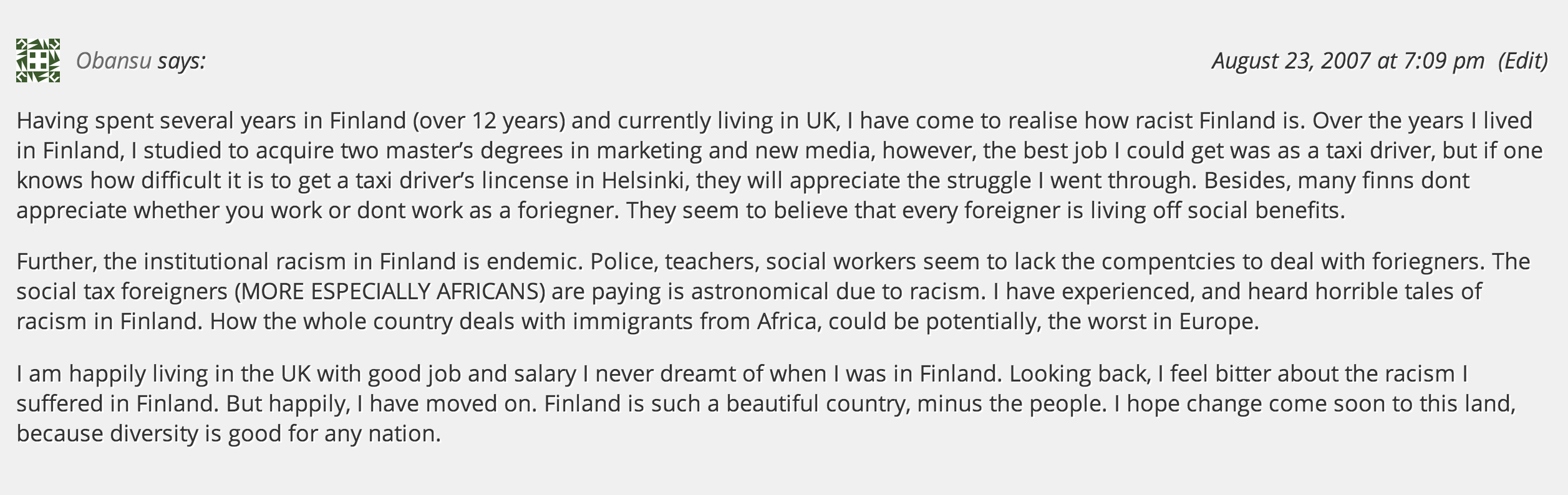
Obansu, a black African taxi driver with two master’s degrees, was the first reader to post a comment in August 2007 on Migrant Tales’ most popular posting, Are you a target of racism in Finland.

He wrote below:

Näyttökuva 2014-8-22 kello 7.49.35
While it is a good matter that Helsingin Sanomat writes about the suspicion and racism that non-Finnish taxi drivers face in Helsinki, Migrant Tales this problem was already reported by Obansu in 2007.

Have things changed since then? Ghanian taxi driver Stanley Nyarko AboAgve is quoted as saying on Helsingin Sanomat: ”I’m in mmline and a customer comes in the car. Fucken n-word, he says and takes another taxi.”

While it’s clear that some non-white taxi drivers face racist insults while at work, the question is what is being done about it? Since too much of Finland is in denial about doing something to challenge intolerance, it’s clear that too little will be done about racist and rude customers.

Näyttökuva 2014-8-22 kello 8.08.31

Read full story (in Finnish) here.


As long as some Finns believe it’s fine to admit they are racists in public, the problem will persist. Racism, like any form of discrimination, must be made and turned into something shameful.

It’s one of the many ways we can send this social ill back to where it belongs: the gutter.


Racism, children and football in Finland

Posted on July 22, 2014 by Migrant Tales

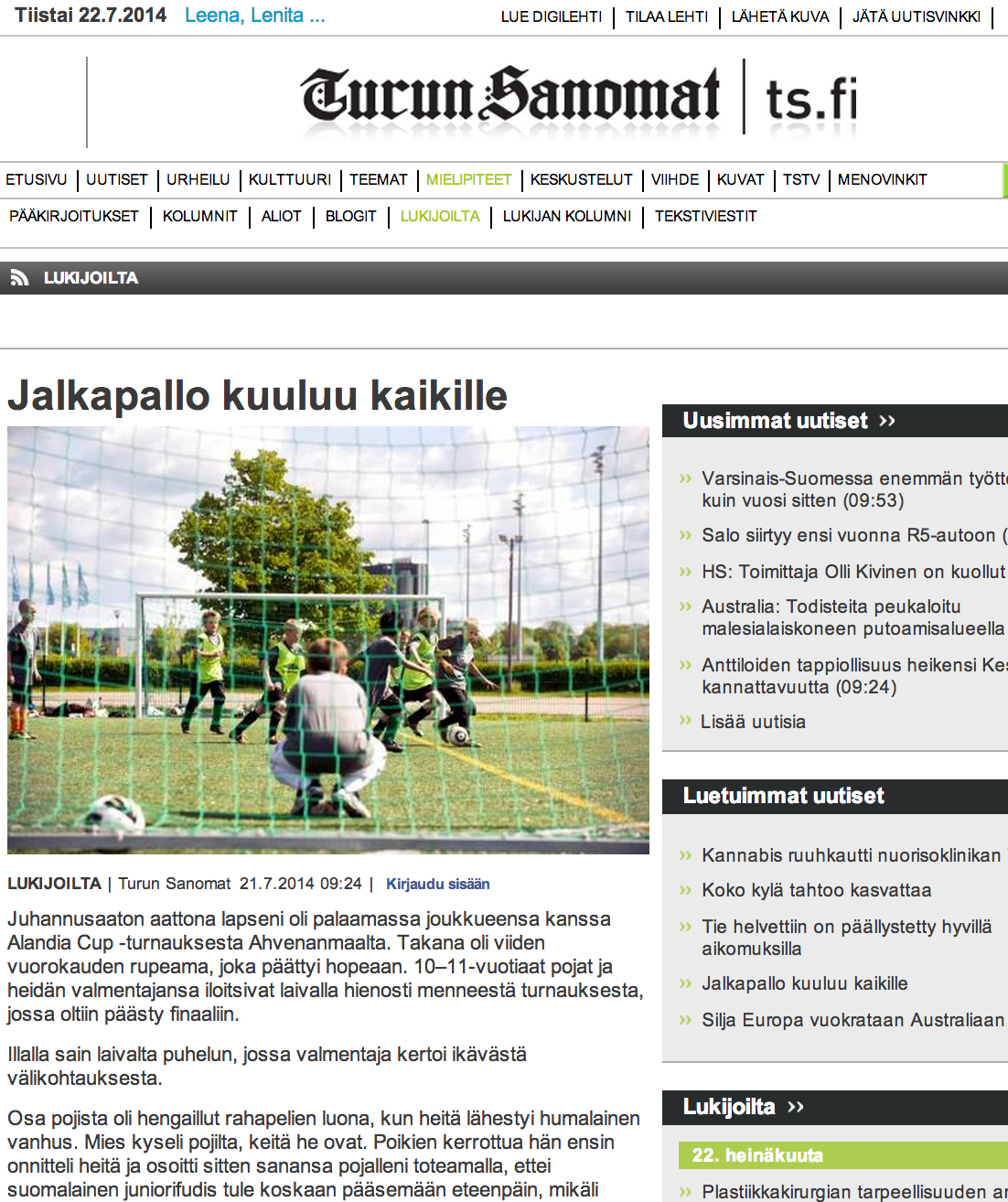
If you want to find a short cut into racism in Finland, read the anonymous comments after a news story on the topic. One such story, published Monday by Turku-based daily Turun Sanomat, is a perfect example.

The news story is about a group of 10-11-year-old boys who were returning by ship to the mainland from the Alandia football tournament in the Åland Islands. A drunk man approached a few of the boys by the slot machines and told them that Finnish junior football would never improve as long as foreigners played on teams.

One of the boys, whose father is from South America, told the man that he is a Finn. The drunk man scolded the boy.

“Are you a racist?” the boy asked.

The man responded in the affirmative.

At this point the boy’s  teammates got involved and asked the man if he ” was stupid.”

Näyttökuva 2014-7-22 kello 11.29.45


Read full story (in Finnish) here.


The whole affair ended when the boys’ coach turned up and spoke to the man.

“You’re an eighty-year-old man and that child is 10 years old,” he said. “Aren’t you ashamed [of your behavior]?”

On top of his racist and aggressive behavior, the man told the 10-year-old that he pays taxes and doesn’t like foreigners playing football in this country. The boys asked the man to leave, which he didn’t.

Apart from pushing a women on the breast, the man called the boy a mulato, a term that comes from the Spanish word mula, or mule.

The man was eventually escorted handcuffed by security personnel and locked up at port in a police cell.

Should it surprise us that some of the comments that followed the Turun Sanomat story defended the old man’s actions?

One in particular, who calls himself anonymously Faktoja, revealed in a comment the issue of racism and lack of inclusiveness in Finnish society.

 Writes Faktoja: “The boy [who claimed to be Finnish] lied because he was ethnically half a Finn. His nationality was of course ‘Finnish.'”

The boy “lied?” Are white Finns taught that a naturalized Finn is a second-class Finn because one of his parents is a white Finn?

Since when were Finns only white? Everyone in this country was once a migrant unless you believe in wise tales like that the Garden of Eden originated in Finland.

Faktoja’s narrative, then, is a pretty common perception that white Finns have of themselves and how they construct reality about themselves. The way Finns make sense of their identity in Finland is by forgetting that their relatives were once, a long or a short time ago, migrants as well.

Why have they forgotten such an important piece of information from their narrative? Because it gives them power over migrants and newcomers by reminding them that they are from somewhere else or Other.

Christian Thibault, chairman of Rasmus, a Finnish anti-racism NGO, said that the latest incident on the boat comes after two other ones recently involving premier league coaches, Juha Malinen and Mika Lehkosuo. 

“Where is the official reaction?” he was quoted as saying on Facebook. “How long can we leave the children, their coaches and parents alone with this [issue]??”

This important question made by Thibault could be expanded and asked why politicians, civil servants, teachers and most of Finnish society doesn’t say anything or very little about inclusion of newcomers?

Taking into account that the majority of foreigners in Finland live in poverty, according to Pekka Myrskylä of Statistics Finland, the Finnish dream should be much more than being an eternal outsider, collecting indefinitely less welfare than white Finns and looking at a dead-end.


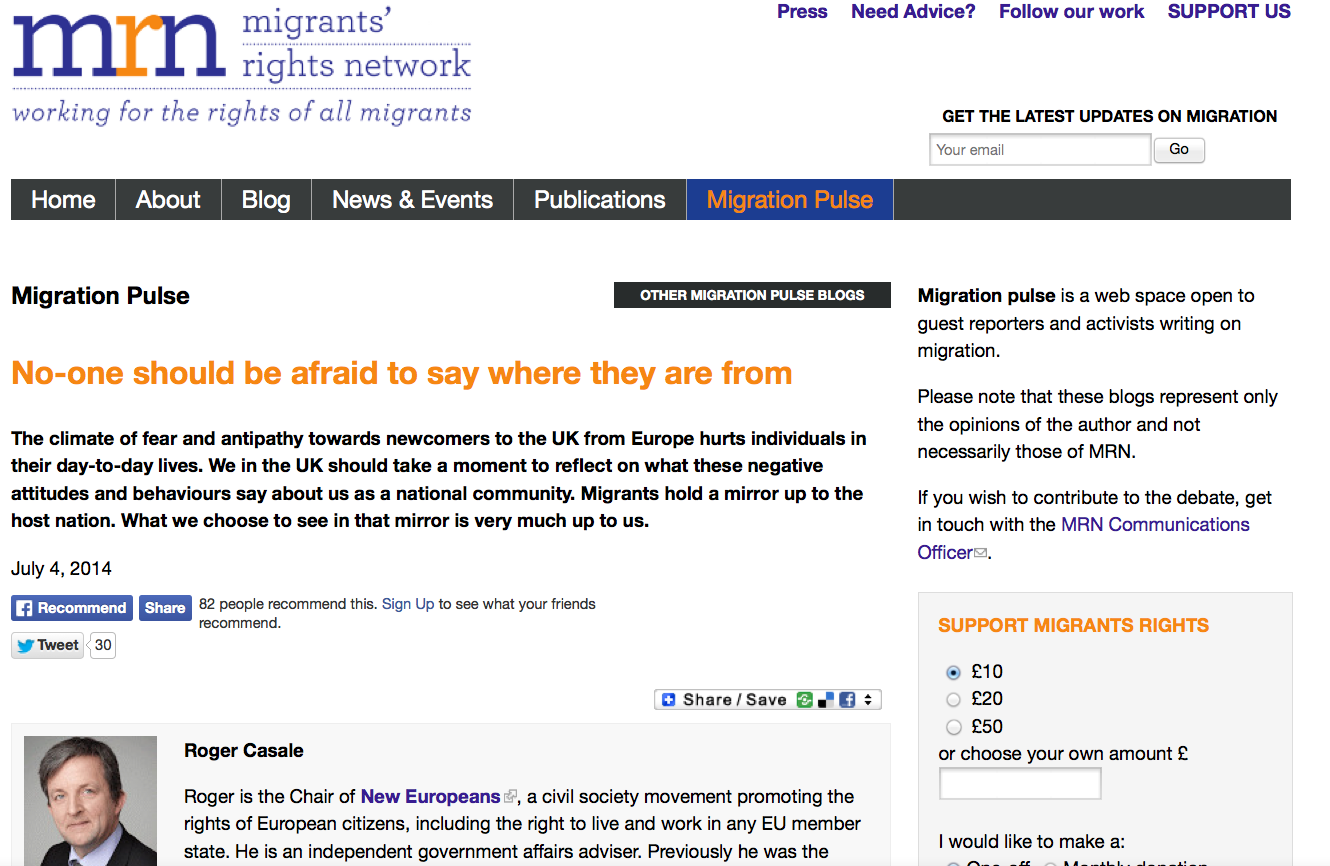
Migrants’ Rights Network: No-one should be afraid to say where they are from

Posted on July 8, 2014 by Migrant Tales

Roger Casale*

new_europeans

The climate of fear and antipathy towards newcomers to the UK from Europe hurts individuals in their day-to-day lives. We in the UK should take a moment to reflect on what these negative attitudes and behaviours say about us as a national community. Migrants hold a mirror up to the host nation. What we choose to see in that mirror is very much up to us.

Näyttökuva 2014-7-8 kello 6.49.16

Read original blog entry here.


At the beginning of April, a young woman came to my door collecting for Battersea Cats and Dogs Home. We have one dog and two cats in our house so we struck up a good conversation.

It turned out that the young woman was a trained lawyer, about to start a Masters course at UCL. “That’s wonderful” I said,  “I noticed a slight accent in your voice, do you mind if I ask where you were born?”

“I’m afraid I can’t tell you that” the young woman replied “ in Britain it is considered a weakness if you come from my country”.

It may me feel very uncomfortable to think that things had got to this point in Britain.

This young woman, with so much to offer this country, felt that the climate of opinion was so negative in Britain – and this in London – that she was unable to acknowledge where she came from.

“Well you’ve knocked on the right door,” I replied, “because I am part of an organisation called New Europeans, which is working with other groups to change the narrative on migration.”

The young woman’s name is Mihaela. I gave her the contact details for New Europeans and she then told me she is from Romania and offered to help with our campaigns.

“Thank you, I said, we need you, but don’t get distracted from your studies! The UK also needs your contribution and I wish you every success!”

Two years ago, we all celebrated with the world at the London Olympics. Britain showed a face that was warm, open, tolerant, welcoming and strong.

Above all, we celebrated our diversity as a nation – our unity in diversity. There were no trucks driving around the streets at that time with pointy fingers telling immigrants to go home.

One reason why this nation needs migration is because men and women from other countries help to remind us who we are.

They hold the mirror up to us. We see our shortcomings but we also see our own potential, including our potential for change.

The challenge of change upsets many people – the idea that things can be done differently, that life doesn’t always have to go on as before.

The migrant, the outsider, represents change, embodies change in the journey he or she has made to be with us in Britain today.

Without migration, Britain can neither sustain its economy and public services nor grow as a nation and as a community.

We are fortunate in Britain that we are a country of migration, a nation of migrants.

We are fortunate in Britain that we are a country in which you can still breathe the air of freedom.

We are fortunate in Britain that people like Mihaela come here to study, to work and to contribute to our society.

This does not make the British better or worse than anybody else – but it does mean that we are a nation, which is able to understand and celebrate difference. Migrants remind us who we are.

New Europeans have joined the Migrants Contribute campaign because we firmly believe that migration is a powerful and positive force in our society.

It is high time that we the ‘open’, ‘tolerant’, ‘fair-minded’, ‘diverse’, British were shaken up and reminded of that fact.

And as for the politicians who play politics with the issue of migration – well in my view, we need to send a clear, simple, co-ordinated message with these three words “Don’t you dare!”.

We want to live in a country where Mihaela and others like her feel comfortable and proud to say where they come from, don’t we?

Read original story here.

This piece was reprinted by Migrant Tales with permission.


* Roger Casale is the Chair of New Europeans, a civil society movement promoting the rights of European citizens, including the right to live and work in any EU member state. He is an independent government affairs adviser. Previously he was the Labour MP for Wimbledon and a parliamentary private secretary in the Foreign Office.

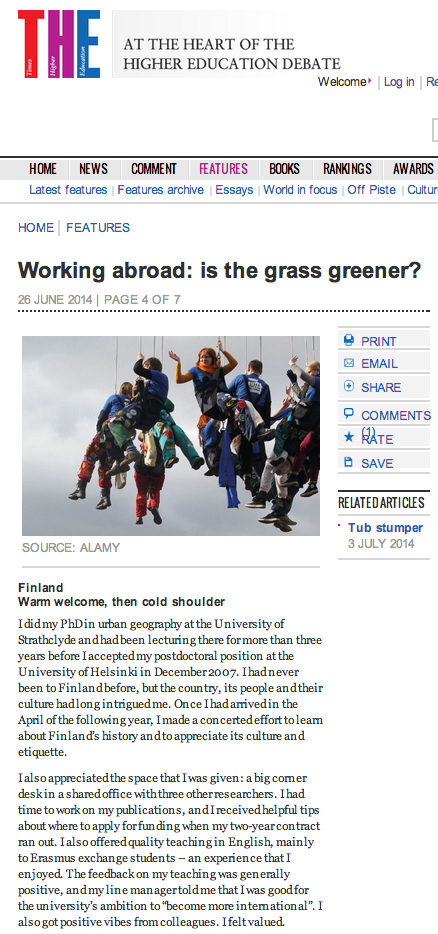
Gareth Rice: Finland Warm welcome, then cold shoulder

Posted on July 3, 2014 by Migrant Tales

Gareth Rice

I did my PhD in urban geography at the University of Strathclyde and had been lecturing there for more than three years before I accepted my postdoctoral position at the University of Helsinki in December 2007. I had never been to Finland before, but the country, its people and their culture had long intrigued me. Once I had arrived in the April of the following year, I made a concerted effort to learn about Finland’s history and to appreciate its culture and etiquette.

Näyttökuva 2014-7-3 kello 15.04.30

Read full story here.

I also appreciated the space that I was given: a big corner desk in a shared office with three other researchers. I had time to work on my publications, and I received helpful tips about where to apply for funding when my two-year contract ran out. I also offered quality teaching in English, mainly to Erasmus exchange students – an experience that I enjoyed. The feedback on my teaching was generally positive, and my line manager told me that I was good for the university’s ambition to “become more international”. I also got positive vibes from colleagues. I felt valued.

At the start of 2009, I began making plans to become a permanent fixture in Finnish higher education. No positions were available in my faculty, but I won a year’s funding from a Finnish foundation to keep me going – albeit on a lower salary. However, subsequent applications to Finnish funding bodies were unsuccessful, as were my attempts to secure a permanent academic contract. I could get only part-time teaching jobs in a variety of universities in the south of the country.

The most frustrating aspect of applying for a position in Finnish higher education is the silence. When you apply for academic posts in UK universities, you can expect to be informed about the outcome even if you are unsuccessful. Finnish universities do not work in this way. It feels as though you are hassling human resources staff when you ask them for feedback. I suggested to a Finnish colleague that this silence might be viewed as discourteous, only to be told that Finns would rather not be seen to be rejecting people.

Still without a proper contract, my Finnish partner and I thought about leaving Finland last year. But then, in December, a permanent lectureship was finally advertised in my own department, the details for which included the words “open” and “international”, and I was encouraged to apply by my line manager. But again, I heard nothing for several months until one of the other candidates, based in France, sent me a copy of the official letter which stated that a Finn who had only just completed their PhD had been appointed to the post. The letter had not been translated from Finnish despite the supposedly international nature of the search. The head of department told me that no ranking of candidates existed and explained that it was “a strategic recruitment, where we hired a qualified person with strong existing ties to the research group”.

There has been some progress in opening up the Finnish higher education system to more foreign academic talent, but it has been slow. To get a sense of the wider view, I emailed all universities in Finland and asked them for statistics about their foreign staff. The University of Turku reflects the national picture. Of its 500 academic staff currently holding permanent contracts, only 21 are not Finnish citizens and just eight have a mother tongue other than Finnish, Swedish or Sami. I have lost count of the number of brilliant foreign academics who have upped and left this supposedly fair and open Nordic country because they are made to feel belittled and marginalised by a higher education system apparently designed to guarantee that Finns progress the fastest.

Finnish colleagues have given me four different explanations for this. One is foreigners’ difficulties with learning Finnish – from which I am certainly not immune. Another is that Finns trust other Finns and thus prefer to employ them. A third is that some Finns believe that they are more entitled to permanent academic contracts because it is “their” country. But the most surprising reason is that Finnish academics feel insecure and don’t wish to be challenged and undermined by foreign scholars.

The most important lesson I have learned was succinctly put by Michael Ignatieff in his recent memoir Fire and Ashes: “When you live in other people’s countries, you eventually bang up against glass doors and cordoned-off areas reserved for insiders. You realise you understand only what the insiders say, not what they really mean.”

Gareth Rice has just finished his last part-time lecturing contract with the University of Helsinki.

Read original story here.

This piece was reprinted by Migrant Tales with permission.

World Café ponders if Porvoo, Finland, is a multicultural city

Posted on June 12, 2014 by Migrant Tales

Migrant Tales insight:  The World Café concept is an excellent way to empower and encourage people to participate and promote active citizenship. This World Café session, which took place in Porvoo on May 17, and asked participants to give their views on how cultural diversity is faring in the city.

One of the important findings of the event was that Porvoo needed to do more work in inclusion of migrants. Write the organizers: “All agreed Porvoo is a good place to live and the issues here are no different from any other city in Finland. There will be an even greater racial mix but this does not mean we will understand or communicate better with each other unless we take action now to make this happen.”

The event was organized by Citizens’ Forum, whose mission is to build civil society through culture and civic education offered by organizations.

___________________

The idea

The hearing was a part of the Participatory Community work –project of Citizens´ Forum. The project had two main elements; Identity work and active citizenship. The hearing in Porvoo concentrated on the latter. The idea in Porvoo was to build an open space for discussion of the people in Porvoo. The theme for the hearing was Porvoo – the city of many cultures. It was selected because we wanted to raise the issue that there are many people from other countries living in Porvoo who are not a problem or a threat but a possibility and a source for building a better Porvoo.


This video will give you an idea of how the World Café concepts works.

The basic work

We noticed that to be able to do participatory community work in the real sense of the word we had to find some way to get a position in the community where we can have a dialogue with the different actors (Finns, ethnic minorities, officials of the city, associations, educational institutions) who work with the theme of multiculturalism. One challenge for us was also to find ways to support the co-operation between the different institutions with common goals.

To do this basic work Alex McKie from Citizens´ Forum worked in Porvoo for three months before the Word Café Hearing. He also made tight co-operation with Kepa and the Mahdollisuuksien tori project group which was organising the Mahdollisuuksien Tori (Marketplace of Possibilities) event 2014 in Porvoo. To get the synergy effects there was a decision made that the Citizens´ Forum World Café will take place on the same day as the Mahdollisuuksien tori on the 17th of May.

In the process of making the hearing possible there were many actors working together with us. We have to mention some of the partners in the network. The Culture House Grand was giving us the possibility to use the culture house as a venue for the hearing. Amisto – ammattiopisto prepared a devising drama performance with which the hearing was opened. Luckan was helping us to connect us with many important actors eg. the ombudsman for minorities Eva Biaudet. Eva Biaudet sent a video greeting to the participants of the hearing. We also had contact with Mikaela Nylander, a member of the Parliament and the chair of the Porvoo city council. The Red Cross of Porvoo was marketing the event actively and they also had a work shop on Young people and voluntary work right after the World Café on the 17th of May.

The Word Café

It was a long process to choose the actual method for the hearing. We were first thinking of a panel on our theme but we decided that it was not deliberative enough to meet our needs. For a long time we were discussing whether the hearing should be organized as a World Café or as an open space discussion. As we didn’t know if 5 or 50 people would turn up or how many languages the discussion would include etc. , we decided to do it as a Word Café.

In the process we had four Café tables and for questions: Is Porvoo Multicultural? How has multiculturalism affected your life? How can people from different cultures talk together? How will my Porvoo look like in the year 2020? We also had four discussion rounds, so each participant could discuss all the themes.

We had a team of facilitators which reflected the cultural and language construction of the Porvoo community. About 20 citizens turned up. As all of them were able to communicate in English we decided to make the hearing in English.

The four discussion round lasted about one hour. Afterwards we had a feedback discussion where the facilitators of each Café table introduced the discussions which had taken place in their group. These introductions are presented beneath.

Café Table nr 1: Is Porvoo multicultural?

The initial response to this question was: yes, and this was given without hesitation. However, with each group there was also the same response that there are not many people from other cultures visible, at least not in the city centre. They also seem to keep a low profile wherever they are. A group of six young ethnic minority youth disclosed that if you are from an ethnic minority group you are more likely to be picked on. People know that what they are doing is wrong but they do it anyway. The young participants also felt that they are blamed for most things before their white counterparts. They especially didn’t feel listened to or understood by their teachers and their message to them was: “open your ears”.

Other group members who have had contact with newcomers to Finland stated that it is very hard for people from ethnic minority groups to access mainstream services and they gave sport as an example. People from ethnic minority groups are likely to live in two areas of the city and don’t tend to travel beyond these areas. They also spoke of young people who are acting as carers for the rest of the family due their language skills. They felt that many people from ethnic minority groups are isolated and especially they need courage to access anything mainstream.

All agreed that Porvoo is multicultural but only in the smallest sense. The mere fact that there are people from many cultures in Porvoo, doesn’t make Porvoo Multicultural in strict meaning of the word. What matters is the quality of the dialogue between the people and cultures. Some participants thought that there is an expectation for ethnic minorities to assimilate into Finnish Culture at the cost of their own.

There was a sense of disappointment. At the same time the Mahdollisuuksien tori (Marketplace for Possibilities) was taking place outside and candidates of the European election were campaigning and yet so few people were willing to discuss such important issues. They felt that we spend a lot of time in festivals and events, which are multicultural but there is no open discussion of the effects of multiculturalism. This dismay was expressed as to why there were no city officials taking part in the forum and why were these issues being avoided.

Café Table nr 2: How has multiculturalism affected your life.

All participants of this discussion felt that multiculturalism had affected their lives in positive ways. The overall view was that in last five years Porvoo has become a much better place for different cultures to live together. This cultural mix gives new ideas and freshens to the society. There were also positive ideas about what newcomers contribute to the economy and culture of the city.

Many of the white Finnish participants said they work together with people from ethnic minority groups on a daily basis and they feel it has improved their lives. They feel that the attitude is important and if you have an international view of the world it helps you accept other cultures. In their work they come across vulnerable people from other cultures and they feel that helping them is an important step in building mutual trust.
The participants felt that friendship between cultures is possible when we see the person as human beings. There can be some challenges, but if you do the work, it enriches every ones life.

Café Table nr 3: How can people from different cultures talk together?

The participants felt that one of the key obstacles to intercultural communication is language. People have to have some kind of common language to be able to communicate with each other. But this is not enough. We have to build a solid foundation for people to have an opportunity to communicate as equals. First of all there should implement a measurable integration strategy. This strategy take into account the holistic needs of individuals and their families (incl. questions of education, employment, social services and rights as citizens).

There should be education on multiculturalism in schools as early as possible and education for employers to recognize the skills and professionalism of ethnic minorities. The Media should also have a clear agenda in questions relating to multiculturalism. In this way we would get more of a balanced perspective and understanding about the underlying issues.

There are very good examples of cultural cooperation between people in Porvoo. But many issues that immigrants face in their every day lives are not spoken of. It was thought that there is not a good mix of the different cultural groups in Porvoo and people tend to stay within their own culture. This was one of the contributory features of isolation and creates barriers to positive interaction.

All agreed there was a need to empower and strengthen ethnic minority groups in positive ways which would include them in decision making processes. Some examples where this kind of participation could take place are decisions about social services, recreation and education. Sport was also an area of concern, because there are many young people who would like to take part in sports but don’t. They consider the main reason for this is an inadequate understanding of the needs of these young people by the coaches and the overall atmosphere which makes it difficult to join.

Café Table nr 4: What will my Porvoo look like in the year 2020?

Porvoo will become more international and less traditional due to the expansion of the Helsinki metropolis. There will be a greater cultural mix but this will not necessarily lead to better understanding of each other. Dialogue between cultures will become an even more complicated issue. Although we will be more aware of other cultures there may be little interaction between groups if we don’t take action to address this issue. The participants recommended that we take positive steps towards creating spaces for cultural interaction. This would be where different cultures can meet equally and take proactive action to strengthen cultural identity and encourage inclusion. They would like to see more meeting points where issues can be discussed and give Citeizens’ Forum World Café as an example.

The younger members of the forum also described Porvoo as the best place to live and expressed this in writing on the table cloths of the World Café: “Porvoo is best”. In the discussions there was a sense of optimism that Porvoo is a good place to live and that the issues raised are to be found all over the country. They feel that there are the resources and will to meet the needs of 2020 Porvoo. However, this needs openness and a place where contrasting views can be heard.

Conclusions and recommendations.

Porvoo is multicultural and that is not going to change. This gives the citizens many challenges and experiences that can improve the quality of our lives. For this to happen we need to listen and to learn from each other. The forum was described by its members as the first time they had been able to learn from others in this way about the themes of multiculturalism. One of the biggest issues that all expressed was the disappointment that city officials and politicians had not taken part in the forum. They also wondered why it is so difficult to talk about issues we are not so comfortable with like discrimination end exclusion.

On a positive note they think that they have now found their voices and a way to work together that can find a way forward. But for this to happen it needs greater awareness and understanding of how discrimination affects the quality of people’s lives. For attitudes to change there needs to be more forums like this Citizens’ forum World Café.

We had spoken of the need to break down stereotypes and to start to look at each other as people. This worked both ways and a need was identified for ethnic minorities to stop stereotyping our Finnish counterparts and to understand their situation and story as well. The forum had established trust between us as people free from institutional or cultural constraints.

We identified many issues but did not have the time to form actions. We felt that to do this we would want to give our decisions to the representatives of the local government of Porvoo to decide what action can be taken.

How long will the Finnish police resist ethnic and cultural diversity?

Posted on June 8, 2014 by Migrant Tales

Much of Finland is still living in a world where nothing is supposed to change as our society becomes ever-culturally and ethnically diverse. We read about the Sikh busman Gill Sukhdarshan Singh, who had to wait for a year to get the right to wear a turban at work, a Muslim woman who was fired the first day at work for wearing a headscarf, and yet another case of a Muslim woman who was not admitted to the police training school because she wouldn’t take off her headscarf during working hours. 

While some companies are allowing their workers to use headscarves, institutions like the police service appear to be resisting tooth and nail our cultural and ethnic diversity.

Näyttökuva 2014-6-8 kello 15.37.13

Migrant Tales wrote in April about a Muslim woman who could not enter the police training school because she wore a headscarf. Read full story here.

Peter Holley, a PhD candidate, highlighted on his Facebook page the official reasons why the National Police Board of Finland prohibits religious headwear:

  • Scarves and turbans could cause health and safety risk to the wearer or his colleague (strangulation or other injury);
  • Headgear could cause aggression or a negative attitude in people the police come in contact with;
  • Allowing headgear could lead to other requests for religion-related rights, for example the right to break for prayer;
  • Use of headgear could risk the police reputation for impartiality and trustworthiness.

Holley responds to each of the arguments put by the National Police Board of Finland:

  •  If other countries (such as the UK and Sweden) have managed to include religious headwear in their uniforms without endangering officers’ safety, why is the Finnish Police Force unable to do so?
  • This justification could be used for prohibiting women and ethnic minorities from serving in the police force. Is this perhaps why we see so few women and ethnic minorities in Poliisi uniforms?
  •  Does allowing such headwear really open the floodgates for such claims? This seems highly suspect to me. 
  • Is the Poliisi uniform responsible for the its reputation as impartial and trustworthy? Or to put this question another way, is the reputation the police as an institution dependent to a large extent upon the uniform its officers wear? I’m of the opinion that the reputation of the police as impartial and trustworthy would be strengthened by the accommodation of religious headwear and the inclusion of ethnic minorities. Can one remain impartial and trustworthy if others remain unrepresented?

Migrant Tales got in touch with Dr. Jonathan Hadley, a consultant and senior fellow at UNICRI – United Nations Interregional Crime and Justice research Institute.

His approach to the decision by the National Police Board of Finland not to allow headscarves is highlighted in a long paper, Policing and Integration in Britain: A Question of Social Change,* which we’ll publish a part of the introduction below. In a nuthsel, the matter hinges a lot on inclusion of multicultural individuals and acknowledging that that shouldn’t be a disadvantage.

One of the questions I asked Dr. Hadley is what we observe too many time in Finland: integration is the rule in theory but what happens too often is assimilation.

He writes in an email:

…Based on work by David Theo Goldberg in the 1990s that seems even more relevant today than then, it basically rejects models of ‘assimilation’ and ‘integration’ as flawed by the same premise of the host’s power relationship over the ‘immigrant’. Instead, it advocates an ‘incorporative’ model as a more ‘authentic multiculturalism’ premised on the equalization of power relations through the transformational impact of cultural hybridity.   

Below are a quote and two paragraphs of Policing and Integration in Britain; A Question of Social Change that synthesize the issue in Finland.

A truly multicultural society is one which is composed of multicultural individuals; people who are able to synthesize different worlds in one body and live comfortably with these different worlds. In order for a society to tolerate such individuals the society must by definition be open, fluid and confident. In other words, the society must be everything that Britain was not when the first Caribbean migrants stepped off the ships in the 1940s and 1950s.”[1]

(Caryl Phillips 2002. The Pioneers)

Introduction

Born in postcolonial St Kitts, Caryl Phillips reflects deeply upon what it means to be both of and not of Britain as the country of his parent’s migration in the late fifties. His argument, in a collection of essays that acknowledge the continued legacy of racism in Britain, is that there is ‘a new world order’ of cultural plurality emerging – one that is being promoted by the increasingly central role of the migrant and the refugee in the modern world[2]. This may be a challenge for policing: for where the police role is to maintain the status quo, at a societal and symbolic level that can also include conservative ideas of national identity and related values. Thus policing may find itself in conflict with a culturally diverse society and contemporary ideas of multiculturalism.

In an anthology of positive police roles for immigrant integration in Finland, the contribution of this chapter is to reflect upon the long and deeply troubled experience of policing and immigrant integration in modern Britain. It is told primarily, but not exclusively, through the post-war experience of West Indian/African-Caribbean migration to Britain. The central argument, however, is that contemporary policing – in Britain, Finland or elsewhere – needs to see itself as presiding over a period of significant social change characterized by the cultural plurality brought on by today’s global migration flows. This is not confined to countries with colonial histories. Countries with strong national histories may also feel their sense of identity challenged by European integration on the one hand and immigration from around the world on the other. To be sure, eastern European immigration is fast becoming a populist scapegoat for the present array of perennial social ills.

[1](Phillips 2002) page 279

[2](Phillips 2002)

* Policing and Integration in Britain’. This was translated into Finnish and published as a chapter entitled ‘Poliisitoiminta ja kotouttaminen Britanniassa: sosiaalisen muutoksen merkitys.’ in a 2008 Police College of Finland Publication: Poliisi ja Maahanmuuttajat (Edited by Arno Tanner), Polamk Report 67/2008.


Integration by perkele

Posted on May 20, 2014 by Migrant Tales

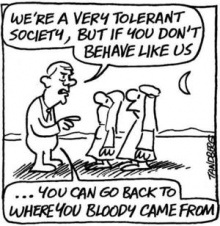
Some have heard of the expression of management by perkele, which means swift decision-making by management and where your opinion as an employee counts little. In Finland the goal is integration, or two-way adaption, but what happens on too many occasions is integration by perkele. 

Integration by perkele has a clear message: This is our country, perkele, and don’t forget it! Since this is my country, you are going to adapt to me. In plain English integration by perkele means assimilation.

The cartoon below offers a good example of integration by perkele.

220px-svvalues_narrowweb_300x3080

How do you recognize integration by perkele? Here are some good examples:

  • They have to adapt to us;
  • We’ve always done things this way;
  • Read my lips: This is our country!
  •  Learn Finnish!
  • Too bad you’re not white like me;
  • If you don’t like our country, you can always move elsewhere;
  • Maassa maan tavalla, or in Rome do as the Romans do;
  • “Debating immigrant issues in this country doesn’t mean you’re racist”
  • The Perussuomalaiset* aren’t against immigrants and they’re not racist.

Is integration by perkele an effective way to adapt migrants and minorities? If you want an answer to the that question, why not ask Amerindians, who were victims of systematic genocide, the Roma, Muslims and gays in Russia, Poles in the UK, Turks in Germany, Moroccans and Latin Americans in Spain, Africans in France, asylum-seekers in Greece as well as other migrants and minorities?

Certainly they’ll tell you about the hostility they face daily thanks to integration by perkele.

* The Finnish name for the Finns Party is the Perussuomalaiset (PS). The names adopted by the PS, like True Finns or Finns Party, promote in our opinion nativist nationalism and xenophobia. We therefore prefer to use the Finnish name of the party on our postings. 


  • Previous
  • 1
  • …
  • 11
  • 12
  • 13
  • 14
  • 15
  • 16
  • 17
  • …
  • 30
  • Next
Read more about documentary film
Read more

Recent Posts

  • Finland’s tabloids Iltalehti and Ilta-Sanomat are the pits
  • Riikka Purra’s Dr Jekyll and Mr Hyde mask
  • Double standards
  • Perussuomalaiset: Uusi logo, sama vanha juttu
  • Taco Trump

Recent Comments

  1. Absolutely Socking: Racist Finnish Facebook group against human rights gets flooded with socks on Musta Barbaari’s mother and sister charged by the police in “ethnic profiling” case
  2. Ilkka Nuotio on Pekka Myrskylä: “Tilastot kertovat toista kuin poliittinen keskustelu”
  3. Genrih Soinkara on The war in Ukraine and the Russian-Finnish border crisis are showing Finland’s ugly side
  4. Ahti Tolvanen on Comment by Ahti Tolvanen on the Helsinki +50 conference
  5. Angel Barrientos on Angel Barrientos is one of the kind beacons of Finland’s Chilean community

Archives

  • June 2026
  • May 2026
  • April 2026
  • March 2026
  • February 2026
  • January 2026
  • December 2025
  • November 2025
  • October 2025
  • September 2025
  • August 2025
  • July 2025
  • June 2025
  • May 2025
  • April 2025
  • March 2025
  • February 2025
  • January 2025
  • December 2024
  • November 2024
  • October 2024
  • September 2024
  • August 2024
  • July 2024
  • June 2024
  • May 2024
  • April 2024
  • March 2024
  • February 2024
  • January 2024
  • December 2023
  • November 2023
  • October 2023
  • September 2023
  • August 2023
  • July 2023
  • June 2023
  • May 2023
  • April 2023
  • March 2023
  • February 2023
  • January 2023
  • December 2022
  • November 2022
  • October 2022
  • September 2022
  • August 2022
  • July 2022
  • June 2022
  • May 2022
  • April 2022
  • March 2022
  • February 2022
  • January 2022
  • December 2021
  • November 2021
  • October 2021
  • September 2021
  • August 2021
  • July 2021
  • June 2021
  • May 2021
  • April 2021
  • March 2021
  • February 2021
  • January 2021
  • December 2020
  • November 2020
  • October 2020
  • September 2020
  • August 2020
  • July 2020
  • June 2020
  • May 2020
  • April 2020
  • March 2020
  • February 2020
  • January 2020
  • December 2019
  • November 2019
  • October 2019
  • September 2019
  • August 2019
  • July 2019
  • June 2019
  • May 2019
  • April 2019
  • March 2019
  • February 2019
  • January 2019
  • December 2018
  • November 2018
  • October 2018
  • September 2018
  • August 2018
  • July 2018
  • June 2018
  • May 2018
  • April 2018
  • March 2018
  • February 2018
  • January 2018
  • December 2017
  • November 2017
  • October 2017
  • September 2017
  • August 2017
  • July 2017
  • June 2017
  • May 2017
  • April 2017
  • March 2017
  • February 2017
  • January 2017
  • December 2016
  • November 2016
  • October 2016
  • September 2016
  • August 2016
  • July 2016
  • June 2016
  • May 2016
  • April 2016
  • March 2016
  • February 2016
  • January 2016
  • December 2015
  • November 2015
  • October 2015
  • September 2015
  • August 2015
  • July 2015
  • June 2015
  • May 2015
  • April 2015
  • March 2015
  • February 2015
  • January 2015
  • December 2014
  • November 2014
  • October 2014
  • September 2014
  • August 2014
  • July 2014
  • June 2014
  • May 2014
  • April 2014
  • March 2014
  • February 2014
  • January 2014
  • December 2013
  • November 2013
  • October 2013
  • September 2013
  • August 2013
  • July 2013
  • June 2013
  • May 2013
  • April 2013
  • March 2013
  • February 2013
  • January 2013
  • December 2012
  • November 2012
  • October 2012
  • September 2012
  • August 2012
  • July 2012
  • June 2012
  • May 2012
  • April 2012
  • March 2012
  • February 2012
  • January 2012
  • December 2011
  • November 2011
  • October 2011
  • September 2011
  • August 2011
  • July 2011
  • June 2011
  • May 2011
  • April 2011
  • March 2011
  • February 2011
  • January 2011
  • December 2010
  • November 2010
  • October 2010
  • September 2010
  • August 2010
  • July 2010
  • June 2010
  • May 2010
  • April 2010
  • March 2010
  • February 2010
  • January 2010
  • December 2009
  • November 2009
  • October 2009
  • September 2009
  • August 2009
  • July 2009
  • December 2008
  • November 2008
  • October 2008
  • September 2008
  • August 2008
  • July 2008
  • June 2008
  • May 2008
  • April 2008
  • March 2008
  • February 2008
  • January 2008
  • November 2007
  • October 2007
  • September 2007
  • August 2007
  • July 2007
  • June 2007
  • May 2007

Categories

  • ?? Gia L?c
  • ????? ?????? ????? ???????? ?? ??????
  • ???????
  • @HerraAhmed
  • @mondepasrond
  • @nohatefinland
  • @oula_silver
  • @Varathas
  • A Pakistani family
  • äärioikeisto
  • Abbas Bahmanpour
  • Abdi Muhis
  • Abdirahim Hussein Mohamed
  • Abdirahim Husu Hussein
  • Abdirisak Mahamed
  • About Migrant Tales
  • activism
  • Adam Al-Sawad
  • Adel Abidin
  • Afrofinland
  • Ahmed IJ
  • Ahti Tolvanen
  • Aino Pennanen
  • Aisha Maniar
  • Alan Ali
  • Alan Anstead
  • Alejandro Díaz Ortiz
  • Alekey Bulavsev
  • Aleksander Hemon
  • Aleksanterinliitto
  • Aleksanterinliitto ry
  • Aleksanterinliitto ry:n hallitus
  • Alex Alex
  • Alex Mckie
  • Alexander Nix
  • Alexandra Ayse Albayrak
  • Alexis Neuberg
  • Ali Asaad Hasan Alzuhairi
  • Ali Hossein Mir Ali
  • Ali Rashid
  • Ali Sagal Abdikarim
  • Alina Tsui
  • Aline Müller
  • All categories
  • Aman Heidari
  • Amiirah Salleh-Hoddin & Jana Turk
  • Amin A. Alem
  • Amir Zuhairi
  • Amkelwa Mbekeni
  • Ana María Gutiérrez Sorainen
  • Anachoma
  • Anders Adlecreutz
  • Angeliina Koskinen
  • Anna De Mutiis
  • Anna María Gutiérrez Sorainen
  • Anna-Kaisa Kuusisto ja Jaakko Tuominen
  • Annastiina Kallius
  • Anneli Juise Friman Lindeman
  • Announcement
  • Anonymous
  • Antero Leitzinger
  • anti-black racism
  • Anti-Hate Crime Organisation Finland
  • Anudari Boldbaatar
  • Arshiya Nasser
  • Aspergers Syndrome
  • Asylum Corner
  • Asylum seeker 406
  • Athena Griffin and Joe Feagin
  • Autism
  • Avaaz.org
  • Awale Olad
  • Ayan Said Mohamed
  • AYY
  • Barachiel
  • Bashy Quraishy
  • Beatrice Kabutakapua
  • Beri Jamal
  • Beri Jamal and Enrique Tessieri
  • Bertolt Brecht
  • Boiata
  • Boodi Kabbani
  • Bruno Gronow
  • Carmen Pekkarinen
  • Çelen Oben and Sheila Riikonen
  • Chiara Costa-Virtanen
  • Chiara Costa-Virtanen
  • Chiara Sorbello
  • Christian Thibault
  • Christopher Wylie
  • Clara Dublanc
  • Dana
  • Daniel Malpica
  • Danilo Canguçu
  • David Papineau
  • David Schneider
  • Dexter He
  • Don Flynn
  • Dr Masoud Kamali
  • Dr. Faith Mkwesha
  • Dr. Theodoros Fouskas
  • Edna Chun
  • Eeva Kilpi
  • Emanuela Susheela
  • En castellano
  • ENAR
  • Enrique
  • Enrique Tessieri
  • Enrique Tessieri & Raghad Mchawh
  • Enrique Tessieri & Yahya Rouissi
  • Enrique Tessieri and Muhammed Shire
  • Enrique Tessieri and Sira Moksi
  • Enrique Tessieri and Tom Vandenbosch
  • Enrique Tessieri and Wael Che
  • Enrique Tessieri and Yahya Rouissi
  • Enrique Tessieri and Zimema Mhone
  • Epäluottamusmies
  • EU
  • Europe
  • European Islamophobia Report
  • European Islamophobia Report 2019,
  • European Union
  • Eve Kyntäjä
  • Ezequiel Caldeiro
  • Facebook
  • Fadumo Dayib
  • Faisa Kahiye
  • Farhad Manjoo
  • Fasismi
  • Finland
  • Fizza Qureshi
  • Flyktingar och asyl
  • Foreign Student
  • Fozia Mir-Ali
  • Frances Webber
  • Frida Selim
  • Gareth Rice
  • Ghyslain Vedeaux
  • Global Art Point
  • Great Replacement
  • Habiba Ali
  • Hami Bahadori
  • Hami Bahdori
  • Hamid
  • Hamid Alsaameere
  • Hamid Bahdori
  • Handshake
  • Harmit Athwal
  • Hassan Abdi Ali
  • Hassan Muhumud
  • Heikki Huttunen
  • Heikki Wilenius
  • Helsingin Sanomat
  • Henning van der Hoeven
  • Henrika Mälmsröm
  • Hser Hser
  • Hser Hser ja Mustafa Isman
  • Husein Muhammed
  • Hussain Kazemian
  • Hussain Kazmenian
  • Ibrahim Khan
  • Ida
  • Ignacio Pérez Pérez
  • Iise Ali Hassan
  • Ilari Kaila & Tuomas Kaila
  • Imam Ka
  • inside-an-airport
  • Institute of Race Relations
  • Iraqi asylum seeker
  • IRR European News Team
  • IRR News Team
  • Islamic Society of Norhern FInland
  • Islamic Society of Northern Finland
  • Islamophobia
  • Jacobinmag.com
  • Jallow Momodou
  • Jan Holmberg
  • Jane Elliott
  • Jani Mäkelä
  • Jari Luoto
  • Jari Taponen
  • Jegor Nazarov
  • Jenni Stammeier
  • Jenny Bourne
  • Jessie Daniels
  • Joe Davidow
  • Johannes Koski
  • John D. Foster
  • John Grayson
  • John Marriott
  • Jon Burnett
  • Jorma Härkönen
  • Jos Schuurmans
  • José León Toro Mejías
  • Josue Tumayine
  • Jouni Karnasaari
  • Juan Camilo
  • Jukka Eräkare
  • Julian Abagond
  • Julie Pascoet
  • Jussi Halla-aho
  • Jussi Hallla-aho
  • Jussi Jalonen
  • JusticeDemon
  • Kadar Gelle
  • Kaksoiskansalaisuus
  • Kansainvälinen Mikkeli
  • Kansainvälinen Mikkeli ry
  • Katherine Tonkiss
  • Kati Lepistö
  • Kati van der Hoeven-Lepistö
  • Katie Bell
  • Kättely
  • Kerstin Ögård
  • Keshia Fredua-Mensah & Jamie Schearer
  • Khadidiatou Sylla
  • Khadra Abdirazak Sugulle
  • Kiihotus kansanryhmää vastaan
  • Kirsi Crowley
  • Koko Hubara
  • Kristiina Toivikko
  • Kubra Amini
  • KuRI
  • La Colectiva
  • La incitación al odio
  • Laura Huhtasaari
  • Lauri Finér
  • Leif Hagert
  • Léo Custódio
  • Leo Honka
  • Leontios Christodoulou
  • Lessie Branch
  • Lex Gaudius
  • Leyes de Finlandia
  • Liikkukaa!
  • Linda Hyökki
  • Liz Fekete
  • M. Blanc
  • Maarit Snellman
  • Mahad Sheikh Musse
  • Maija Vilkkumaa
  • Malmin Kebab Pizzeria Port Arthur
  • Marcell Lorincz
  • Mari Aaltola
  • María Paz López
  • Maria Rittis Ikola
  • Maria Tjader
  • Marja-Liisa Tolvanen
  • Mark
  • Markku Heikkinen
  • Marshall Niles
  • Martin Al-Laji
  • Maryan Siyad
  • Matt Carr
  • Mauricio Farah Gebara
  • Media Monitoring Group of Finland
  • Micah J. Christian
  • Michael McEachrane
  • Michele Levoy
  • Michelle Kaila
  • Migrant Tales
  • Migrant Tales Literary
  • Migrantes News
  • Migrants' Rights Network
  • MigriLeaks
  • Mikko Kapanen
  • Miriam Attias and Camila Haavisto
  • Mohamed Adan
  • Mohammad Javid
  • Mohammad M.
  • Monikulttuurisuus
  • Monisha Bhatia and Victoria Canning
  • Mor Ndiaye
  • Muh'ed
  • Muhamed Abdimajed Murshid
  • Muhammed Shire
  • Muhammed Shire and Enrique Tessieri
  • Muhis Azizi
  • Musimenta Dansila
  • Muslimiviha
  • Musulmanes
  • Namir al-Azzawi
  • Natsismi
  • Neurodiversity
  • New Women Connectors
  • Nils Muižnieks
  • No Labels No Walls
  • Noel Dandes
  • Nuor Dawood
  • Omar Khan
  • Otavanmedia
  • Oula Silvennoinen
  • Paco Diop
  • Pakistani family
  • Pentti Stranius
  • Perussuomalaiset
  • perustuslaki
  • Petra Laiti
  • Petri Cederlöf
  • Pia Grochowski
  • Podcast-lukija Bea Bergholm
  • Pohjois – Suomen Islamilainen Yhdyskunta
  • Pohjois Suomen Islamilainen Yhyskunta
  • Polina Kopylova
  • Race Files
  • racism
  • Racism Review
  • Raghad Mchawh
  • Ranska
  • Rashid H. and Migrant Tales
  • Rasismi
  • Raul Perez
  • Rebecka Holm
  • Reem Abu-Hayyeh
  • Refugees
  • Reija Härkönen
  • Remiel
  • Reza Nasri
  • Richard Gresswell
  • Riikka Purra
  • Risto Laakkonen
  • Rita Chahda
  • Ritva Kondi
  • Robito Ibrahim
  • Roble Bashir
  • Rockhaya Sylla
  • Rodolfo Walsh
  • Roger Casale
  • Rostam Atai
  • Roxana Crisólogo Correa
  • Ruth Grove-White
  • Ruth Waweru-Folabit
  • S-worldview
  • Sadio Ali Nuur
  • Sami Rusanen
  • Sandhu Bhamra
  • Sara de Jong
  • Sarah Crowther
  • Sari Alhariri
  • Sarkawt Khalil
  • Sasu
  • Scot Nakagawa
  • Shabana Ahmadzai
  • Shada Islam
  • Sharon Chang blogs
  • Shenita Ann McLean
  • Shirlene Green Newball
  • Sini Savolainen
  • Sira Moksi
  • Sonia K.
  • Sonia Maria Koo
  • Steverp
  • Stop Deportations
  • Suldaan Said Ahmed
  • Suomen mediaseurantakollektiivi
  • Suomen Muslimifoorumi ry
  • Suomen viharikosvastainen yhdistys
  • Suomen viharikosvastainen yhdistys ry
  • Suomi
  • Supermen
  • Susannah
  • Suva
  • Syrjintä
  • Talous
  • Tapio Tuomala
  • Taw Reh
  • Teivo Teivainen
  • The Daily Show
  • The Heino
  • The Supermen
  • Thomas Elfgren
  • Thulfiqar Abdulkarim
  • Tim McGettigan
  • Tino Singh
  • Tito Moustafa Sliem
  • Tobias Hübinette and L. Janelle Dance
  • Transport
  • Trica Danielle Keaton
  • Trilce Garcia
  • Trish Pääkkönen
  • Trish Pääkkönen and Enrique Tessieri
  • Tuulia Reponen
  • Uncategorized
  • UNITED
  • University of Eastern Finland
  • Uyi Osazee
  • Väkivalta
  • Vapaa Liikkuvuus
  • Venla-Sofia Saariaho
  • Vieraskynä
  • W. Che
  • W. Che an Enrique Tessieri
  • Wael Ch.
  • Wan Wei
  • Women for Refugee Women
  • Xaan Kaafi Maxamed Xalane
  • Xassan Kaafi Maxamed Xalane
  • Xassan-Kaafi Mohamed Halane & Enrique Tessieri
  • Yahya Rouissi
  • Yasmin Yusuf
  • Yassen Ghaleb
  • Yle Puhe
  • Yuliet Tresa
  • Yve Shepherd
  • Zahra Khavari
  • Zaker
  • Zalina Ametova
  • Zamzam Ahmed Ali
  • Zeinab Amini ja Soheila Khavari
  • Zimema Mahone and Enrique Tessieri
  • Zimema Mhone
  • Zoila Forss Crespo Moreyra
  • ZT
  • Zulma Sierra
  • Zuzeeko Tegha Abeng
© 2026 Migrant tales | Powered by Minimalist Blog WordPress Theme