Migrant tales
Menu
  • #MakeRacismHistory “In Your Eyes”
  • About Migrant Tales
  • It’s all about Human Rights
  • Literary
  • Migrant Tales Media Monitoring
  • NoHateFinland.org
  • Tales from Europe
Menu

Tag: Cultural diversity

Futsal Club Persia of Finland explains why its players walked out of game in protest

Posted on February 5, 2015 by Migrant Tales

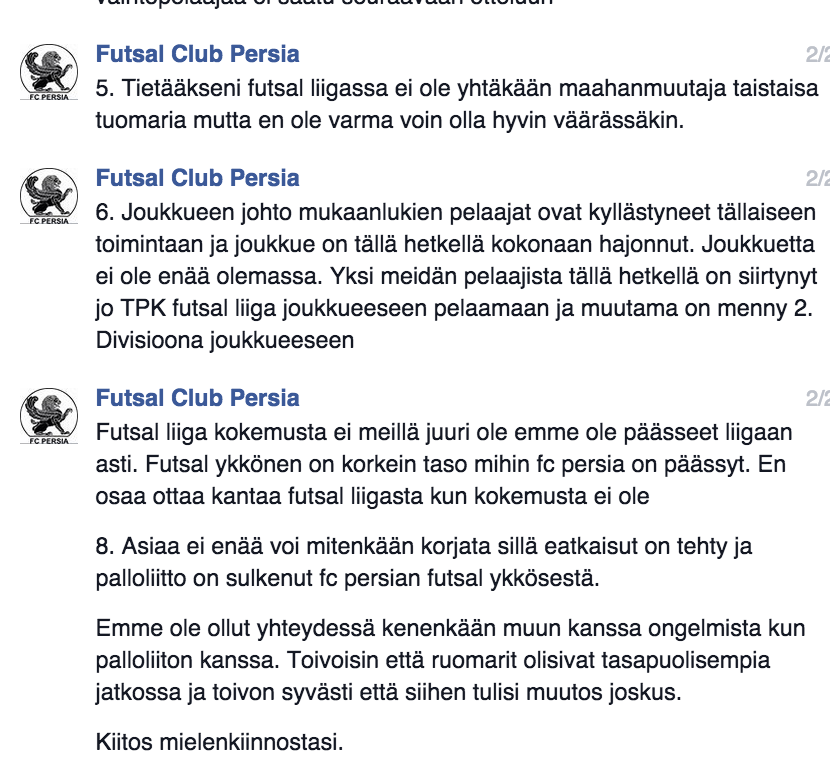
Migrant Tales had the opportunity to speak to Futsal Club Persia, the futsal gym football team that got expelled from the league by the Finnish Football Federation for walking out of a game in protest. The saddest matter about the whole affair is that there is now one less team comprising of migrant and New Finn players in this country. 

Christian Thibault, executive director of Liikkukaa – Sports for All, said that the Finnish Football Federation succeeded at one meeting to destroy all that had been built by volunteers for a long time.

“We have seen the same happen in Helsinki over the past 10 years,”  he said, “where more than 20 teams who were specialized in peer activities for migrants and refugees no longer exist.”

Näyttökuva 2015-2-5 kello 13.05.53

Read full story here.


According to the Futsal Club Persia source, who spoke on condition of anonymity, said that the problems started when when a referee called Adnan I. refused to ref a game when the gym football team played in second division.

“The feeling was mutual [we didn’t want him to ref our games and he didn’t want to ref our games],” said the Futsal Club Persia source.  “The Turku branch of the Finnish Football Federation made an agreement that this referee would not ref our games but he was present at the one we walked out in protest.”

The Futsal Club Persia source said that the players of the team were fed up with this type of policy [by the Finnish Football Federation] and that the team no longer exists since it has disbanded.

“One of our players has transferred over to TPK team futsal league and a few other are playing for second division [teams],” the source said.


Näyttökuva 2015-2-5 kello 13.58.48

Thibault said that it wasn’t the first time when a migrant football team has run into problems with the Finnish Football Federation.

“FC Nations United in Turku had been awarded the multicultural integration award by the city of Turku, only to run into trouble with the referee association of Turku a few weeks later,” he continued. “We will suffer the consequences for a long time. Now in Turku we will see the same happen all over again.”

Thibault said that Liikkukaa – Sports for All have had good results when there is dialogue between all parties concerned.

“Such efforts can be seen in Finnish Football Federation statistics, where the number of red and yellow cards for the team in question had fallen substantially immediately after we arranged round tables [to resolve differences],” he said. “We would much prefer the Football Federation to engage in dialog before taking disciplinary measures. At least FC Persia had informed them in time about their problems [with referees] and there were also other signs that were loud and clear.”

This video clip shows Futsal Club Persia (in blue) getting a red card in February. Despite protests to the Football Association, nothing was changed and the team lost their next game due to a lack of substitutes.

When will Finland change its suspicious views of migrants and cultural diversity?

Posted on January 24, 2015 by Migrant Tales

Christian Thibault, chairman of Rasmus, told Migrant Tales a while back something significant about how matters change in Finland concerning migrants in this country. He said that the Finnish Football Federation wasn’t very active in providing referee courses in different languages. When they noticed that ere was a chronic shortage of referees, matters changed. 

In the same way the the Finnish Football Federation understood that it must serve people that speak different languages in this country, it is pretty much what is going on in Finland concerning our ever-growing cultural diversity. We speak a lot about integration, two-way adaption, but what happens at the end of the day is assimilation, one-way adaption.

images (1)

Assimilation, or one-way adaption, is an expectation that society won’t change no matter how many people from different cultures and religions move to your country. The process is a bit like sitting on a sofa and telling newcomers that they must adapt to me. There are many types of sofas like in the above picture that could represent regions or countries. All have the sofas, however, have the same expectation in assimilation: I have privileges, you don’t. I therefore call the shots in this country.  Source: Sairafurniture.


So the first step, when Finland starts to notice that it needs migrants to do those jobs that they don’t want to and when they notice that migrants work for less and twice as much as any white Finns, only then will matters begin to change. 

The latter attitude change is only the first step. We’re still light years away from other subsequent steps where migrants and non-white Finns will be treated equally by this society.

That last stage, which is the core of our struggle in this country, will take generations. We can always speed up the process by forming a social movement like the Civil Rights Movement in the United States (1955-68).

White Finns don’t have to worry about migrants rising up and demanding equal rights because too many of us are more conservative and anti-immigration than some white Finns.

Some may choose to be Finnish Uncle Toms, or Teemu-setäs, or mamus as a means to gain greater acceptance.


Fatbardhe Hetemaj: Who will speak up for us if you don’t?

Posted on January 17, 2015 by Migrant Tales

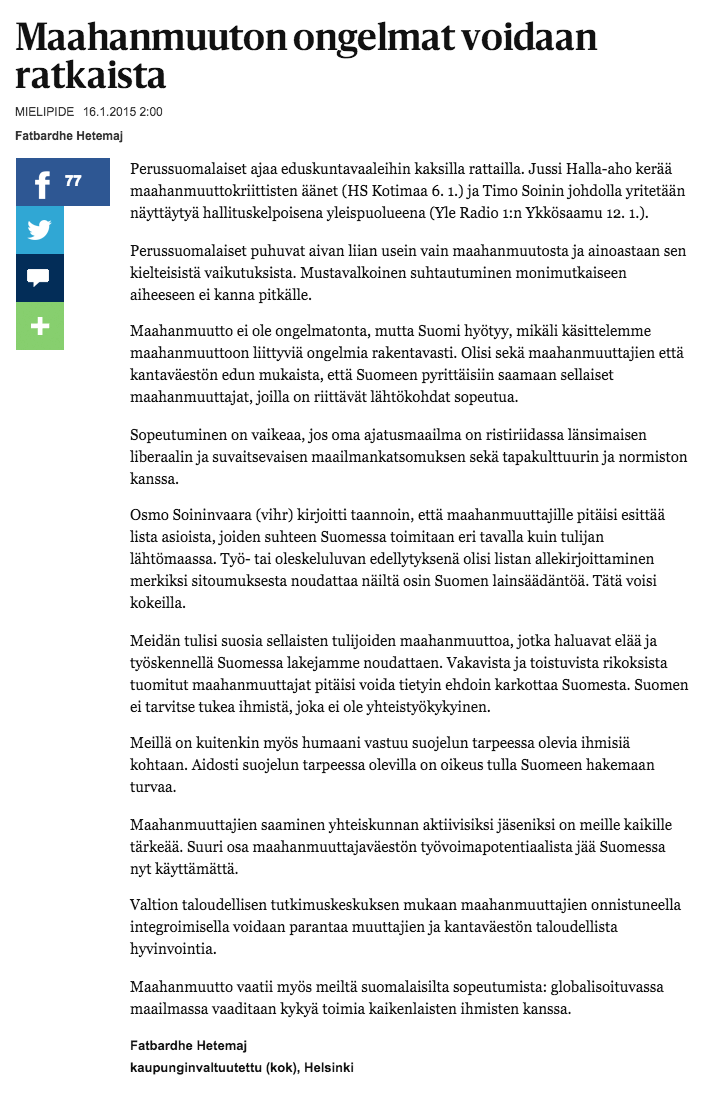
Fatbardhe Hetemaj is a promising National Coalition Party Helsinki city councilwoman who moved to Finland at the age of seven. Since people like Hetemaj are becoming more common in Finland as we become a more culturally and ethnically diverse society, it is important that they speak out against discrimination and promote tolerance and respect for other groups.   

Hetemaj came to Finland with her family as a quota refugee from Kosovo. She was named in 2009 as the Refugee Woman of the Year.

In a letter to the editor on Helsingin Sanomat, Hetemaj unfortunately uses the same arguments and language that anti-immigration politicians use and which she criticizes in her piece.

The headline, which claims that immigration is “a problem,” is the first matter that catch’s your eye. While Helsingin Sanomat decides on the headline, it does represent pretty well what Hetemaj wrote.

For those who have been following the debate on immigration and migrants in this country know that it revolves too much around the assumption that immigration and immigrants are “problems” instead of an asset. Even if unemployment is two- to three-times higher among immigrants than the national average, the vast majority of migrants that live in this country work, pay taxes and lead normal lives.

Fueling such an urban tale, that migrants should be treated as a problem, does tremendous harm to the whole migrant and New Finn community. How can you resolve a problem if those judging you see you in almost the same light as an illness?

Näyttökuva 2015-1-16 kello 22.48.35


Read full letter to the editor here.


Probably the most incredible statement made by the National Coalition Party councilwoman is that migrants that move to Finland should sign a contract to ensure they’ll respect our laws. She also claims that we should only accept those types of migrants that respect our laws and have a good chance of adapting to our country.

Apart from suggesting that migrants are prone not respect our laws and therefore must sign a contract, in which countries is such a contract mandatory? The contract for migrants that Hetemaj supports reveals more her prejudices and simplistic views about migrants.

Migrant Tales has great respect for all those who excel in our society. Hetemaj is a good example that second-generation Finns or third-culture members of our society can succeed as well.

One of the important matters to remember as our society becomes more culturally and ethnically diverse is that we do not forget our own roots and identity. Moreover, our country is a Nordic welfare state that speaks of two-way not one-way adaption, or assimilation.

We hope that Hetemaj won’t forget to speak up for those who don’t have and are in need of a voice in this society.


Institute of Race Relations: Where monoculturalism leads

Posted on January 16, 2015 by Migrant Tales

Migrant Tales insight: This perception or problem, monoculturalism, is affecting Finland as well. It explains why an anti-immigration party like the Perussuomalaiset (PS)* can raise the number of MPs in four years from 5 in 2007 to 39 in 2011. It explains why there is so little interest to tackle institutional racism and why so many are colorblind. 

The opinion pice below gives us more insights in understanding the lack of cultural diversity. 

________________

Liz Fekete

As France grieves for those whose lives have been so brutally taken, and more emergency and counter-radicalisation measures are discussed, the future for a peaceful Europe rests on how our leaders diagnose the problems that we collectively face.

Näyttökuva 2015-1-16 kello 23.49.02

Read full story here.


It may seem counter-intuitive, but far from suffering from an excess of multiculturalism, European thought and culture are suffering from too much monoculturalism. And as Simone de Beauvoir, Sartre, Camus, Fanon and all the great intellectuals who once strode like giants over French culture knew, a Europe that does not understand ‘the Other’ does not understand itself.

Following the events of 9/11, all European countries re-aligned their ‘race’ policies towards an assimilationist, monocultural approach to integration. The ‘colour-blind’ approach to integration (in the UK, Eric Pickles calls it ‘mainstreaming’), was no approach at all, and, in France, where ethnic monitoring is illegal and assimilation is the norm, the problems of discrimination and police racism were simply ignored. As long as the youths fouled their own nest, and violence was turned inwards, the Socialists and the Union for a Popular Movement paid little attention. No French government of whatever political colour has ever acknowledged the structured racism faced by those living in the banlieues, nor attempted to check aggressive policing, particularly around identity checks. And this despite, year in year out, urban unrest and rioting.

The Front National leader Marine Le Pen has called for the reinstatement of the death penalty, but many young people have come to believe that French police, who are armed, already operate an undeclared policy of lethal neutralisation. Most of these ‘riots’ came in response to a police shooting or a death in police custody, of which there have been literally hundreds in France over the last three decades (and at least 127 between 2000 and 2014, according to ‘Urgence notre police assassine’), for which no police officer has ever been held to account. These were spontaneous uprisings but in recent years no progressive movement has emerged to direct the anger. Gone are the national movements for social justice that once characterised the banlieues, such as the Marche des Beurs, or the more recent Social Forum of the Banlieues. As left politics was dissipated, angry youngsters, feeling both abandoned and/or manipulated by the ‘official’ anti-racist movements and constantly harassed and racially abused by the police (and by Sarkozy, who called them ‘scum’), found in street life and hustling, and then, in a kind of ghetto Salafism, a means of existence. Just look at all the profiles of the recent ‘terrorists’ in France – from Mohammed Merah to Amédy Coulibaly. They started out as juvenile delinquents, drug pushers and petty criminals, subsequently radicalised in prison. Chérif and Saïd Kouachi, whose French-Algerian parents died when they were 12 and 14, were subsequently raised in a French orphanage, hardly the Islamic upbringing of Nigel Farage’s nightmares. (Similarly, the British-Nigerian murderers of drummer Lee Rigby, also petty criminals, were both converts, having been brought up in a Christian household.) The profiles of all these young men are remarkably similar. Deprivation, criminality, a childhood scarred by racism and exclusion, ignorance, all these formative experiences made them all easy prey for, what David Cameron has now described as, ‘fanatical death cults’.

If Europe is to come out of its darkness, we need to name the problem for what it is. It is a problem of deprivation and alienation, and it affects many of our poor youngsters, whether neo-Nazis or jihadists. And naturally this deep and structured alienation has been made worse by the global violence, broadcast live every minute of the day, that has emanated from the war on terror and now through international fanatical movements, of whatever fundamentalist or ideological bent.

But we need to go further – Europe needs to come to terms with itself, with the violence and decay, the greed and corruption, the dissipation and anomie, at the heart of its political and intellectual life. Just as today there is a revolving door between politics and corporations, with former senior ministers and even prime ministers and Presidents sliding from office straight into lucrative jobs for themselves in the oil and security industry, journalists today are not always what they seem. Too many journalists have become ideologues. Robert Ménard, a founder and former head of Reporters Without Borders – which campaigns for press freedom – is now the FN-backed mayor of Beziers.

Nor is satire free from some of the most harmful ideologies of our times. Cartoonists serve a similar function in society to court jesters, a necessary antidote to hypocrisy, a way of laughing at ourselves. The poor massacred cartoonists of Charlie Hebdo were indeed jesters, but jesters tragically blind to the Islamophobic current they served.

Read original story here.

This piece was reprinted by Migrant Tales with permission.

* The Finnish name for the Finns Party is the Perussuomalaiset (PS). The English names of the party adopted by the PS, like True Finns or Finns Party, promote in our opinion nativist nationalism and xenophobia. We therefore prefer to use the Finnish name of the party on our postings.

PS MP Packalén is still in the dark about integration and cultural identity

Posted on January 14, 2015 by Migrant Tales

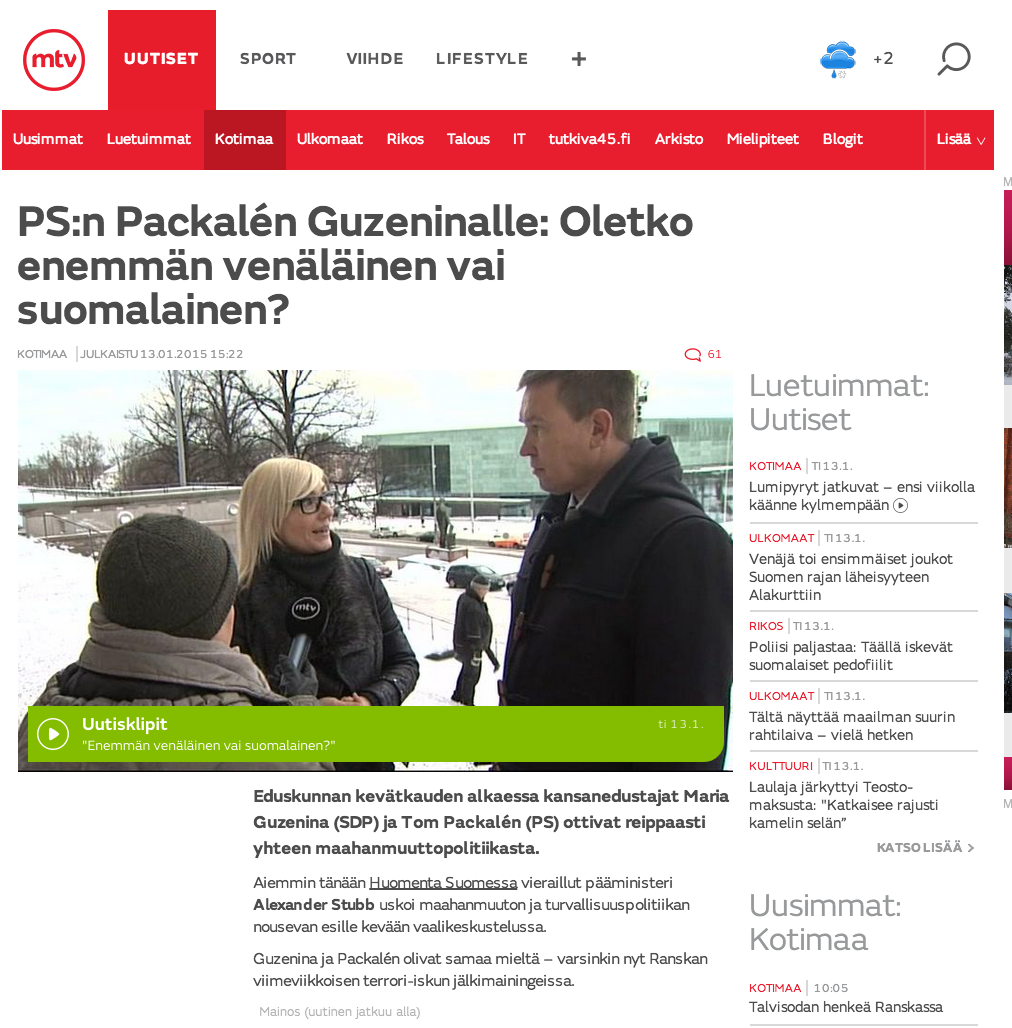
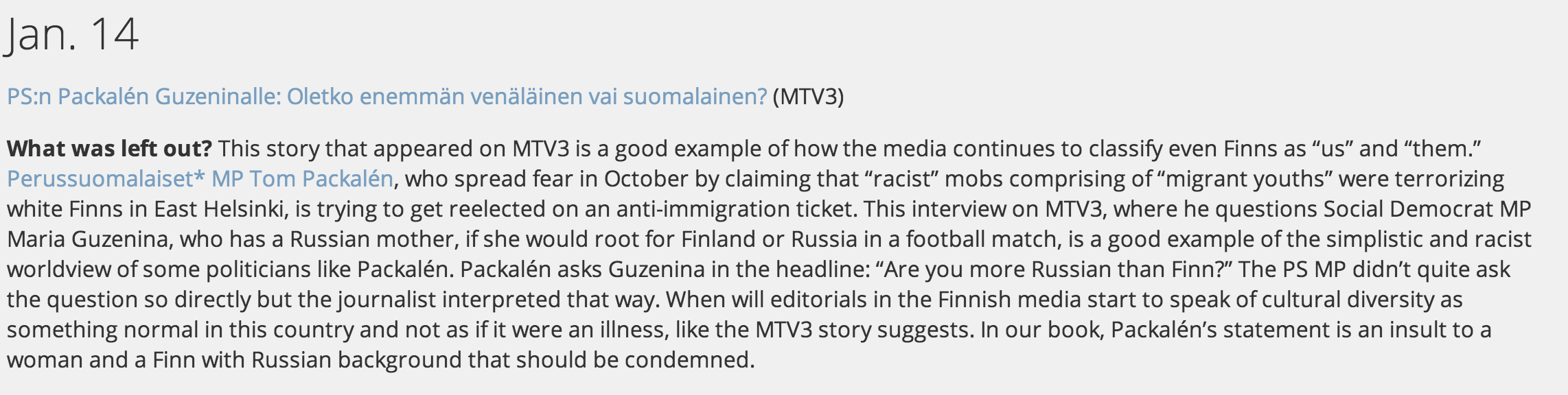
The media is part of the problem when it comes to racism in Finland because it gives such people and politicians inflated respectability and importance. A good example of the problem is a story on MTV3 where Perussuomalaiset (PS)* MP Tom Packalén asks Social Democrat MP Maria Guzenina if she would root in a football match for the Russian or the Finnish team.

Guzenina’s mother is Russian.

Näyttökuva 2015-1-14 kello 10.28.29


Read full story (in Finnish) here.


Packalén states that Finland should strive towards “real” integration. What the PS MP means by “real” integration is a mystery. Does Packlén mean one-way adaption or assimilation? Don’t our laws and Constitution speak of two-way adaption or integration?

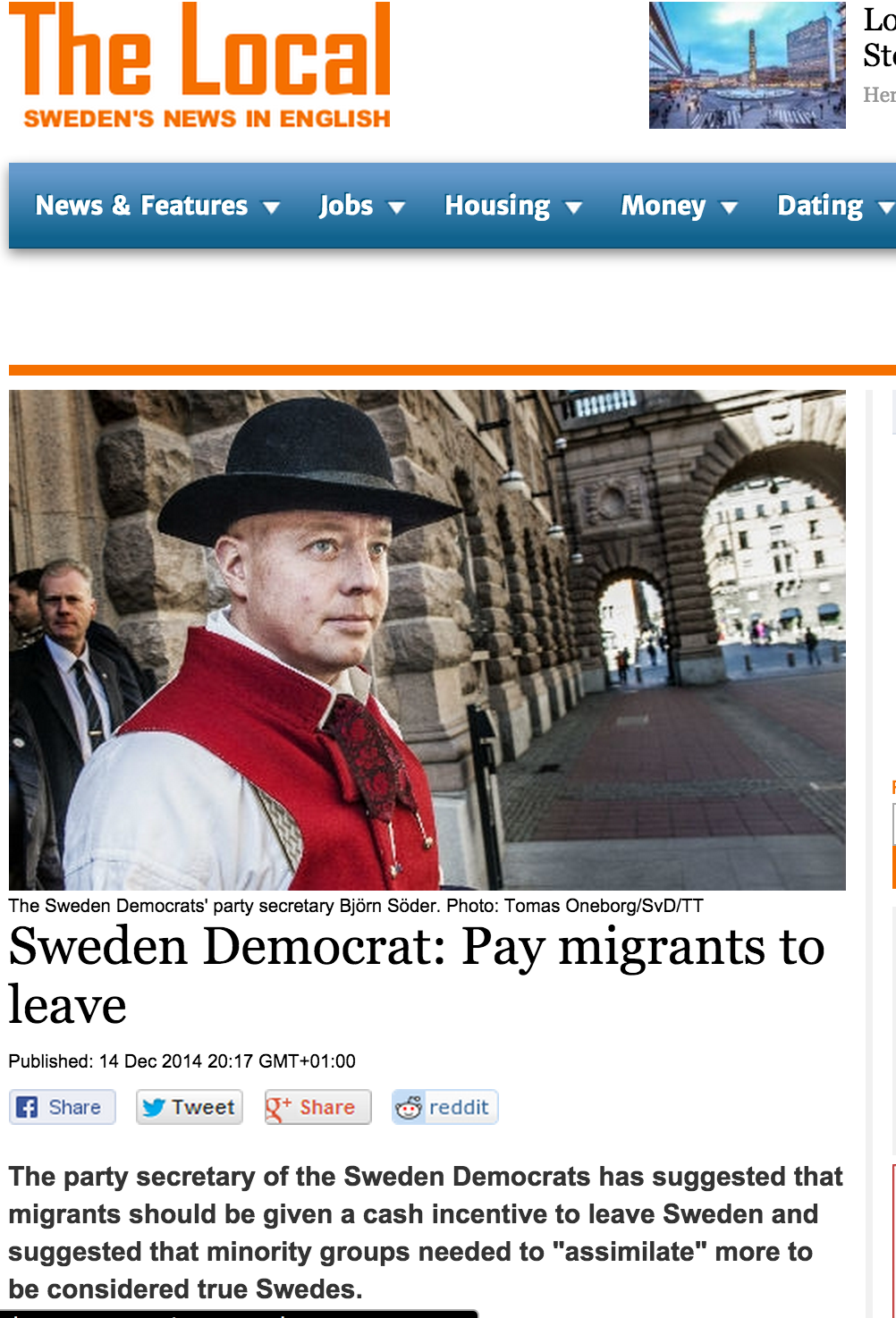
The PS MP’s idea of how immigrants should adapt in Finland is no different to what Sweden Democrat party secretary Björn Söder said in December about the Saami, Jews and Kurds. He said that even if these groups have a Swedish passport they must give up their identity in order to be considered “real” Swedes.

Making comments that put into question a person’s loyalty or demote his or her status and right to be treated equally in Finland should never be tolerated by the media. This is why MTV3 was chosen as the latest addition to Migrant Tales‘ Hall of Fame of poor journalism.

Näyttökuva 2015-1-14 kello 14.37.04

Read original posting here.

As the April parliamentary elections near, be ready to read a lot of xenophobic and racist comments by politicians like Packalén.

* The Finnish name for the Finns Party is the Perussuomalaiset (PS). The English names of the party adopted by the PS, like True Finns or Finns Party, promote in our opinion nativist nationalism and xenophobia. We therefore prefer to use the Finnish name of the party on our postings.
Excuses and arguments to eat our prejudices and keep our bigotry

Posted on January 4, 2015 by Migrant Tales

One common argument one hears when you try to show cultural understanding for Muslims is that if Saudi Arabia, one of the most extremist Muslim countries in the world, doesn’t permit us to eat pork then we shouldn’t offer halal meat at schools.

Why do we compare a country like Saudi Arabia? Why not compare a Muslim country like Malaysia, where it is possible to eat pork just as long as you don’t do it in a halal-certified restaurant.

Why don’t we ever speak of Muslim countries like Malaysia and Indonesia (see video clip below of UC Riverside professor, Reza Aslan) but prefer instead to use one of the most extremist Muslim countries in the world to drive home our point?

Here’s another example that follows the same logic why we don’t have to change even if our society become more culturally diverse: Migrants that move here cannot expect us to change our habits and traditions because this would never happen in their country.

Which country are they talking about? Canada? Australia, maybe? Or are we going to compare Finland to Saudi Arabia again?


What kind of a year was 2014 for our ever-growing culturally diverse society?

Posted on December 30, 2014 by Migrant Tales

For Finland’s ever-growing culturally and ethnically diverse community, 2014 will be remembered for many good and bad things. At the top of the good things, there’s the Olen suomalainen video but the list of toxic news far outweighs the latter like Tom Packalén’s “racist youth mobs with migrant backgrounds” and Pia Kauma’s “baby carriages.” 

IMG_3052

Migrant Tales wishes its readers a wonderful New Year.


The year brought us some disturbing stories about migrant children, who lag two years in Pisa tests when compared with white Finns. Children with migrant parents were also more prone to face bullying, physical and sexual harassment at schools.

One of the best myth-busting stories written in the year was by Pekka Myrksylä, who claimed in a blog entry  that the majority of migrants in Finland live in poverty.

There were many, many more stories in 2014 about our cultural diversity that will be published more in detail in Finland & cultural diversity 2014  in the beginning of January.

Migrant Tales is a blog community. We therefore seek your opinions and input about what you considered the biggest story or challenges facing our culturally diverse community this year in Finland and Europe.

We’d love to hear from you on our Facebook page, email ([email protected]) or Twitter @MigrantTales.

Thank you!

Sweden Democrats openly attack cultural diversity – will the PS of Finland follow their example?

Posted on December 15, 2014 by Migrant Tales

In a clear attempt to cash in on the anti-immigration sentiment, Sweden Democrat party secretary Björn Söder said that minorities like the Saami could never be Swedes and was willing to pay immigrants to leave the country, reports The Local.

The mere suggestion that Sweden is only a country of white Swedes reveals the racist and exclusive mindset of the Sweden Democrats. In a US context it would be something like encouraging Hispanics, blacks and other minorities to go back to where they came from because white USAmericans rule the country.

“Yes, and that is good,” Söder was quoted as saying on The Local. “We must make it easer for those considering moving back to their country. Then we’ll be in a better condition to create a society of common identity.”

Näyttökuva 2014-12-15 kello 0.17.03

 Read full story here.

In Söder’s views, Jews, Kurds and the Sami are examples of groups that are Swedish citizens but cannot be considered “true” Swedes if they don’t assimilate into Swedish society.

Has anybody asked Söder who is a so-called “true” Swede? Why does he think he is a “true” Swede? Is there any such thing as a “true” Swede?

What Söder is claiming is what is exactly wrong in the Nordic region. White Nordic people think that this land is exclusively theirs. This is malarkey.

The language of the Sweden Democrat party secretary is regurgitated by parties like the Perussuomalaiset (PS) of Finland, Danish People’s Party and Progress Party of Norway. All four of them believe that only white Nordic people are the right people that should live in this region.

Willy Silberstein, chairperson of the Swedish committee against anti-Semitism disagrees with Söder.

“I am Jewish and born in Sweden,” he said. “I am just as much Swedish as Björn Söder. There is an us and them mentality which I think is a characteristic of the party.”

While the PS in Finland have distanced themselves from the Sweden Democrats, their success in the March elections will be watched closely by the PS. Finland holds parliamentary elections in April 2015.

* The Finnish name for the Finns Party is the Perussuomalaiset (PS). The names adopted by the PS, like True Finns or Finns Party, promote in our opinion nativist nationalism and xenophobia. We therefore prefer to use the Finnish name of the party on our postings.

Finland: A nation of emigrants

Posted on November 26, 2014 by Migrant Tales

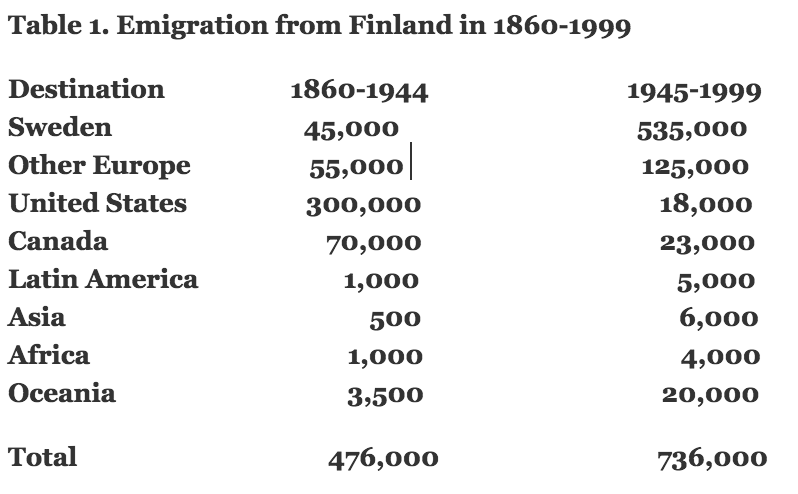
While some heads of state like Barack Obama speak of the United States as a nation of immigrants, Finland has historically been a nation of emigrants. How does being a nation of emigrants differ from being a nation of immigrants? There is a big difference and reveals in part why some Finns are so hostile to immigration. 

Finland is a good example of a country made up of emigrants. During 1860-1999, over 1.2 million emigrated, with the majority moving to Sweden (580,000) and North America (411,000).

If all of these emigrants would have stayed put in Finland, our population would be today about 7 million instead of 5.470 million.

Emigration has had a big demographic never mind social impact on Finland.

Näyttökuva 2014-11-26 kello 12.49.51

Source: Jouni Korkiasaari and Ismo Söderling: Finnish emigration and immigration after World War II. Migration Institute 2003.    Source: http://www.migrationinstitute.fi/articles/011_Korkiasaari_Soderling.pdf

Since we are a nation of emigrants, it explains in part why some of our politicians and society don’t see immigration as a positive matter.

Being a land of emigration has distorted our view of things. Instead of seeing the world as an opportunity, it’s seen by too many as a threat. This is understandable considering our difficult history with the former Soviet Union. Even so, wars and conflicts end and we must learn to move on, even if the Ukraine crisis has reinforced our worst prejudices.

Finland is slowly learning to become a nation of immigrants. When we’ll be able to call ourselves a nation of immigrants, that’s when our perceptions of foreigners and newcomers will change, hopefully for the better.

This will take time. But we’re already on that road no matter how some resist this fact tooth and nail and throw everything they have against our ever-growing culturally and ethnically diverse nation.

An effective way of putting racism in context in Finland

Posted on October 26, 2014 by Migrant Tales

There are many ways to understand ethnic hatred and racism in Finland. One of these is by substituting the word ‘migrant’ for your ethnic group and/or ‘woman’ in a text that’s aimed at fueling ‘us’ and ‘them.’ Let’s take the recent claims of two politicians, MPs Tom Packalén and Pia Kauma, to see how passions are fueled or can be smothered. 

Original claim by Perussuomalaiset (PS)* MP Packalén.

Before: Gangs made up only of young people with migrant backgrounds said their motives are racist because their aim is to hurt white Finns.

After: Gangs made up of only young white Finns said their motives are racist because their aim is to hurt migrants and minorities.

Näyttökuva 2014-10-26 kello 10.24.24

Before and after. Racism is like the fly agaric (Amanita muscaria) mushroom. It looks beautiful when it fruits and may invite some to eat its hallucinogenic poison. Time, like racism, reveals the true face of this mushroom when it ages and dies.


As we all know, Packalén pulled a fast one on the media and public. The problem with the PS MP’s claim is that it just isn’t true and an inflated exaggeration. Even so, his claims have spread fear and labelled non-white Finns, encouraging even neo-Nazi groups like the Kansallinen Vastarinta and members of the PS to patrol the streets of Helsinki.

Here’s National Coalition Party MP Kauma’s claim.

Before: Migrant mothers buy new baby carriages with social aid.

After: White Finnish mothers buy new baby carriages with social aid.

Like with Packalén, Kauma’s claim is stuffed as well with lots of baloney.

Even if these two MPs made up these stories in light of the April parliamentary elections, is one point. But the other very important one is that they succeeded at getting a lot of media coverage, which was their original aim.

Check out the two postings below on how by just changing a few key words in a vengeful and racist text reveals the underhanded motives of the writer and brings the topic closer to home:

  • Let’s play fill in the blanks with far-right Finnish MP Teuvo Hakkarainen
  • Let’s play fill in the blanks with far-right Finnish MP James Hirvisaari

If you still are trying to grasp these two disgraceful examples, why not replace migrant or ethnic group with ‘woman.’

Remember how urban tales about women were and still may be rampant in Finland? Women can’t drive, they’re poor in math, all they know what to do is have babies and cook…This is the exact anatomy of racist discourse in Finland today. Migrants live off welfare, they’re lazy, sly and shouldn’t be trusted…

How many generations did such outright lies about women still continue to oppress them?

Ever figure out how it feels to be in a university math class and be the only women? Think about how much pressure there is on that woman and how much energy she must expend to prove that she’s just as good as her male classmates.

This exact feeling is what many migrants feel in society. They’re constantly trying to prove that they are just as good and worthy of being treated as equal members of society.

Thus there is nothing harmless when politicians reinforce prejudices about migrants. On the contrary – it is a violent act that aims through power to dominate others.

Add to the latter the near-silence of society and a bigger picture of the social ill emerges.

Racism is not only costly to society but especially to the victim.


* The Finnish name for the Finns Party is the Perussuomalaiset (PS). The English names of the party adopted by the PS, like True Finns or Finns Party, promote in our opinion nativist nationalism and xenophobia. We therefore prefer to use the Finnish name of the party on our postings.
  • Previous
  • 1
  • …
  • 10
  • 11
  • 12
  • 13
  • 14
  • 15
  • 16
  • …
  • 30
  • Next
Read more about documentary film
Read more

Recent Posts

  • Finland’s tabloids Iltalehti and Ilta-Sanomat are the pits
  • Riikka Purra’s Dr Jekyll and Mr Hyde mask
  • Double standards
  • Perussuomalaiset: Uusi logo, sama vanha juttu
  • Taco Trump

Recent Comments

  1. Absolutely Socking: Racist Finnish Facebook group against human rights gets flooded with socks on Musta Barbaari’s mother and sister charged by the police in “ethnic profiling” case
  2. Ilkka Nuotio on Pekka Myrskylä: “Tilastot kertovat toista kuin poliittinen keskustelu”
  3. Genrih Soinkara on The war in Ukraine and the Russian-Finnish border crisis are showing Finland’s ugly side
  4. Ahti Tolvanen on Comment by Ahti Tolvanen on the Helsinki +50 conference
  5. Angel Barrientos on Angel Barrientos is one of the kind beacons of Finland’s Chilean community

Archives

  • June 2026
  • May 2026
  • April 2026
  • March 2026
  • February 2026
  • January 2026
  • December 2025
  • November 2025
  • October 2025
  • September 2025
  • August 2025
  • July 2025
  • June 2025
  • May 2025
  • April 2025
  • March 2025
  • February 2025
  • January 2025
  • December 2024
  • November 2024
  • October 2024
  • September 2024
  • August 2024
  • July 2024
  • June 2024
  • May 2024
  • April 2024
  • March 2024
  • February 2024
  • January 2024
  • December 2023
  • November 2023
  • October 2023
  • September 2023
  • August 2023
  • July 2023
  • June 2023
  • May 2023
  • April 2023
  • March 2023
  • February 2023
  • January 2023
  • December 2022
  • November 2022
  • October 2022
  • September 2022
  • August 2022
  • July 2022
  • June 2022
  • May 2022
  • April 2022
  • March 2022
  • February 2022
  • January 2022
  • December 2021
  • November 2021
  • October 2021
  • September 2021
  • August 2021
  • July 2021
  • June 2021
  • May 2021
  • April 2021
  • March 2021
  • February 2021
  • January 2021
  • December 2020
  • November 2020
  • October 2020
  • September 2020
  • August 2020
  • July 2020
  • June 2020
  • May 2020
  • April 2020
  • March 2020
  • February 2020
  • January 2020
  • December 2019
  • November 2019
  • October 2019
  • September 2019
  • August 2019
  • July 2019
  • June 2019
  • May 2019
  • April 2019
  • March 2019
  • February 2019
  • January 2019
  • December 2018
  • November 2018
  • October 2018
  • September 2018
  • August 2018
  • July 2018
  • June 2018
  • May 2018
  • April 2018
  • March 2018
  • February 2018
  • January 2018
  • December 2017
  • November 2017
  • October 2017
  • September 2017
  • August 2017
  • July 2017
  • June 2017
  • May 2017
  • April 2017
  • March 2017
  • February 2017
  • January 2017
  • December 2016
  • November 2016
  • October 2016
  • September 2016
  • August 2016
  • July 2016
  • June 2016
  • May 2016
  • April 2016
  • March 2016
  • February 2016
  • January 2016
  • December 2015
  • November 2015
  • October 2015
  • September 2015
  • August 2015
  • July 2015
  • June 2015
  • May 2015
  • April 2015
  • March 2015
  • February 2015
  • January 2015
  • December 2014
  • November 2014
  • October 2014
  • September 2014
  • August 2014
  • July 2014
  • June 2014
  • May 2014
  • April 2014
  • March 2014
  • February 2014
  • January 2014
  • December 2013
  • November 2013
  • October 2013
  • September 2013
  • August 2013
  • July 2013
  • June 2013
  • May 2013
  • April 2013
  • March 2013
  • February 2013
  • January 2013
  • December 2012
  • November 2012
  • October 2012
  • September 2012
  • August 2012
  • July 2012
  • June 2012
  • May 2012
  • April 2012
  • March 2012
  • February 2012
  • January 2012
  • December 2011
  • November 2011
  • October 2011
  • September 2011
  • August 2011
  • July 2011
  • June 2011
  • May 2011
  • April 2011
  • March 2011
  • February 2011
  • January 2011
  • December 2010
  • November 2010
  • October 2010
  • September 2010
  • August 2010
  • July 2010
  • June 2010
  • May 2010
  • April 2010
  • March 2010
  • February 2010
  • January 2010
  • December 2009
  • November 2009
  • October 2009
  • September 2009
  • August 2009
  • July 2009
  • December 2008
  • November 2008
  • October 2008
  • September 2008
  • August 2008
  • July 2008
  • June 2008
  • May 2008
  • April 2008
  • March 2008
  • February 2008
  • January 2008
  • November 2007
  • October 2007
  • September 2007
  • August 2007
  • July 2007
  • June 2007
  • May 2007

Categories

  • ?? Gia L?c
  • ????? ?????? ????? ???????? ?? ??????
  • ???????
  • @HerraAhmed
  • @mondepasrond
  • @nohatefinland
  • @oula_silver
  • @Varathas
  • A Pakistani family
  • äärioikeisto
  • Abbas Bahmanpour
  • Abdi Muhis
  • Abdirahim Hussein Mohamed
  • Abdirahim Husu Hussein
  • Abdirisak Mahamed
  • About Migrant Tales
  • activism
  • Adam Al-Sawad
  • Adel Abidin
  • Afrofinland
  • Ahmed IJ
  • Ahti Tolvanen
  • Aino Pennanen
  • Aisha Maniar
  • Alan Ali
  • Alan Anstead
  • Alejandro Díaz Ortiz
  • Alekey Bulavsev
  • Aleksander Hemon
  • Aleksanterinliitto
  • Aleksanterinliitto ry
  • Aleksanterinliitto ry:n hallitus
  • Alex Alex
  • Alex Mckie
  • Alexander Nix
  • Alexandra Ayse Albayrak
  • Alexis Neuberg
  • Ali Asaad Hasan Alzuhairi
  • Ali Hossein Mir Ali
  • Ali Rashid
  • Ali Sagal Abdikarim
  • Alina Tsui
  • Aline Müller
  • All categories
  • Aman Heidari
  • Amiirah Salleh-Hoddin & Jana Turk
  • Amin A. Alem
  • Amir Zuhairi
  • Amkelwa Mbekeni
  • Ana María Gutiérrez Sorainen
  • Anachoma
  • Anders Adlecreutz
  • Angeliina Koskinen
  • Anna De Mutiis
  • Anna María Gutiérrez Sorainen
  • Anna-Kaisa Kuusisto ja Jaakko Tuominen
  • Annastiina Kallius
  • Anneli Juise Friman Lindeman
  • Announcement
  • Anonymous
  • Antero Leitzinger
  • anti-black racism
  • Anti-Hate Crime Organisation Finland
  • Anudari Boldbaatar
  • Arshiya Nasser
  • Aspergers Syndrome
  • Asylum Corner
  • Asylum seeker 406
  • Athena Griffin and Joe Feagin
  • Autism
  • Avaaz.org
  • Awale Olad
  • Ayan Said Mohamed
  • AYY
  • Barachiel
  • Bashy Quraishy
  • Beatrice Kabutakapua
  • Beri Jamal
  • Beri Jamal and Enrique Tessieri
  • Bertolt Brecht
  • Boiata
  • Boodi Kabbani
  • Bruno Gronow
  • Carmen Pekkarinen
  • Çelen Oben and Sheila Riikonen
  • Chiara Costa-Virtanen
  • Chiara Costa-Virtanen
  • Chiara Sorbello
  • Christian Thibault
  • Christopher Wylie
  • Clara Dublanc
  • Dana
  • Daniel Malpica
  • Danilo Canguçu
  • David Papineau
  • David Schneider
  • Dexter He
  • Don Flynn
  • Dr Masoud Kamali
  • Dr. Faith Mkwesha
  • Dr. Theodoros Fouskas
  • Edna Chun
  • Eeva Kilpi
  • Emanuela Susheela
  • En castellano
  • ENAR
  • Enrique
  • Enrique Tessieri
  • Enrique Tessieri & Raghad Mchawh
  • Enrique Tessieri & Yahya Rouissi
  • Enrique Tessieri and Muhammed Shire
  • Enrique Tessieri and Sira Moksi
  • Enrique Tessieri and Tom Vandenbosch
  • Enrique Tessieri and Wael Che
  • Enrique Tessieri and Yahya Rouissi
  • Enrique Tessieri and Zimema Mhone
  • Epäluottamusmies
  • EU
  • Europe
  • European Islamophobia Report
  • European Islamophobia Report 2019,
  • European Union
  • Eve Kyntäjä
  • Ezequiel Caldeiro
  • Facebook
  • Fadumo Dayib
  • Faisa Kahiye
  • Farhad Manjoo
  • Fasismi
  • Finland
  • Fizza Qureshi
  • Flyktingar och asyl
  • Foreign Student
  • Fozia Mir-Ali
  • Frances Webber
  • Frida Selim
  • Gareth Rice
  • Ghyslain Vedeaux
  • Global Art Point
  • Great Replacement
  • Habiba Ali
  • Hami Bahadori
  • Hami Bahdori
  • Hamid
  • Hamid Alsaameere
  • Hamid Bahdori
  • Handshake
  • Harmit Athwal
  • Hassan Abdi Ali
  • Hassan Muhumud
  • Heikki Huttunen
  • Heikki Wilenius
  • Helsingin Sanomat
  • Henning van der Hoeven
  • Henrika Mälmsröm
  • Hser Hser
  • Hser Hser ja Mustafa Isman
  • Husein Muhammed
  • Hussain Kazemian
  • Hussain Kazmenian
  • Ibrahim Khan
  • Ida
  • Ignacio Pérez Pérez
  • Iise Ali Hassan
  • Ilari Kaila & Tuomas Kaila
  • Imam Ka
  • inside-an-airport
  • Institute of Race Relations
  • Iraqi asylum seeker
  • IRR European News Team
  • IRR News Team
  • Islamic Society of Norhern FInland
  • Islamic Society of Northern Finland
  • Islamophobia
  • Jacobinmag.com
  • Jallow Momodou
  • Jan Holmberg
  • Jane Elliott
  • Jani Mäkelä
  • Jari Luoto
  • Jari Taponen
  • Jegor Nazarov
  • Jenni Stammeier
  • Jenny Bourne
  • Jessie Daniels
  • Joe Davidow
  • Johannes Koski
  • John D. Foster
  • John Grayson
  • John Marriott
  • Jon Burnett
  • Jorma Härkönen
  • Jos Schuurmans
  • José León Toro Mejías
  • Josue Tumayine
  • Jouni Karnasaari
  • Juan Camilo
  • Jukka Eräkare
  • Julian Abagond
  • Julie Pascoet
  • Jussi Halla-aho
  • Jussi Hallla-aho
  • Jussi Jalonen
  • JusticeDemon
  • Kadar Gelle
  • Kaksoiskansalaisuus
  • Kansainvälinen Mikkeli
  • Kansainvälinen Mikkeli ry
  • Katherine Tonkiss
  • Kati Lepistö
  • Kati van der Hoeven-Lepistö
  • Katie Bell
  • Kättely
  • Kerstin Ögård
  • Keshia Fredua-Mensah & Jamie Schearer
  • Khadidiatou Sylla
  • Khadra Abdirazak Sugulle
  • Kiihotus kansanryhmää vastaan
  • Kirsi Crowley
  • Koko Hubara
  • Kristiina Toivikko
  • Kubra Amini
  • KuRI
  • La Colectiva
  • La incitación al odio
  • Laura Huhtasaari
  • Lauri Finér
  • Leif Hagert
  • Léo Custódio
  • Leo Honka
  • Leontios Christodoulou
  • Lessie Branch
  • Lex Gaudius
  • Leyes de Finlandia
  • Liikkukaa!
  • Linda Hyökki
  • Liz Fekete
  • M. Blanc
  • Maarit Snellman
  • Mahad Sheikh Musse
  • Maija Vilkkumaa
  • Malmin Kebab Pizzeria Port Arthur
  • Marcell Lorincz
  • Mari Aaltola
  • María Paz López
  • Maria Rittis Ikola
  • Maria Tjader
  • Marja-Liisa Tolvanen
  • Mark
  • Markku Heikkinen
  • Marshall Niles
  • Martin Al-Laji
  • Maryan Siyad
  • Matt Carr
  • Mauricio Farah Gebara
  • Media Monitoring Group of Finland
  • Micah J. Christian
  • Michael McEachrane
  • Michele Levoy
  • Michelle Kaila
  • Migrant Tales
  • Migrant Tales Literary
  • Migrantes News
  • Migrants' Rights Network
  • MigriLeaks
  • Mikko Kapanen
  • Miriam Attias and Camila Haavisto
  • Mohamed Adan
  • Mohammad Javid
  • Mohammad M.
  • Monikulttuurisuus
  • Monisha Bhatia and Victoria Canning
  • Mor Ndiaye
  • Muh'ed
  • Muhamed Abdimajed Murshid
  • Muhammed Shire
  • Muhammed Shire and Enrique Tessieri
  • Muhis Azizi
  • Musimenta Dansila
  • Muslimiviha
  • Musulmanes
  • Namir al-Azzawi
  • Natsismi
  • Neurodiversity
  • New Women Connectors
  • Nils Muižnieks
  • No Labels No Walls
  • Noel Dandes
  • Nuor Dawood
  • Omar Khan
  • Otavanmedia
  • Oula Silvennoinen
  • Paco Diop
  • Pakistani family
  • Pentti Stranius
  • Perussuomalaiset
  • perustuslaki
  • Petra Laiti
  • Petri Cederlöf
  • Pia Grochowski
  • Podcast-lukija Bea Bergholm
  • Pohjois – Suomen Islamilainen Yhdyskunta
  • Pohjois Suomen Islamilainen Yhyskunta
  • Polina Kopylova
  • Race Files
  • racism
  • Racism Review
  • Raghad Mchawh
  • Ranska
  • Rashid H. and Migrant Tales
  • Rasismi
  • Raul Perez
  • Rebecka Holm
  • Reem Abu-Hayyeh
  • Refugees
  • Reija Härkönen
  • Remiel
  • Reza Nasri
  • Richard Gresswell
  • Riikka Purra
  • Risto Laakkonen
  • Rita Chahda
  • Ritva Kondi
  • Robito Ibrahim
  • Roble Bashir
  • Rockhaya Sylla
  • Rodolfo Walsh
  • Roger Casale
  • Rostam Atai
  • Roxana Crisólogo Correa
  • Ruth Grove-White
  • Ruth Waweru-Folabit
  • S-worldview
  • Sadio Ali Nuur
  • Sami Rusanen
  • Sandhu Bhamra
  • Sara de Jong
  • Sarah Crowther
  • Sari Alhariri
  • Sarkawt Khalil
  • Sasu
  • Scot Nakagawa
  • Shabana Ahmadzai
  • Shada Islam
  • Sharon Chang blogs
  • Shenita Ann McLean
  • Shirlene Green Newball
  • Sini Savolainen
  • Sira Moksi
  • Sonia K.
  • Sonia Maria Koo
  • Steverp
  • Stop Deportations
  • Suldaan Said Ahmed
  • Suomen mediaseurantakollektiivi
  • Suomen Muslimifoorumi ry
  • Suomen viharikosvastainen yhdistys
  • Suomen viharikosvastainen yhdistys ry
  • Suomi
  • Supermen
  • Susannah
  • Suva
  • Syrjintä
  • Talous
  • Tapio Tuomala
  • Taw Reh
  • Teivo Teivainen
  • The Daily Show
  • The Heino
  • The Supermen
  • Thomas Elfgren
  • Thulfiqar Abdulkarim
  • Tim McGettigan
  • Tino Singh
  • Tito Moustafa Sliem
  • Tobias Hübinette and L. Janelle Dance
  • Transport
  • Trica Danielle Keaton
  • Trilce Garcia
  • Trish Pääkkönen
  • Trish Pääkkönen and Enrique Tessieri
  • Tuulia Reponen
  • Uncategorized
  • UNITED
  • University of Eastern Finland
  • Uyi Osazee
  • Väkivalta
  • Vapaa Liikkuvuus
  • Venla-Sofia Saariaho
  • Vieraskynä
  • W. Che
  • W. Che an Enrique Tessieri
  • Wael Ch.
  • Wan Wei
  • Women for Refugee Women
  • Xaan Kaafi Maxamed Xalane
  • Xassan Kaafi Maxamed Xalane
  • Xassan-Kaafi Mohamed Halane & Enrique Tessieri
  • Yahya Rouissi
  • Yasmin Yusuf
  • Yassen Ghaleb
  • Yle Puhe
  • Yuliet Tresa
  • Yve Shepherd
  • Zahra Khavari
  • Zaker
  • Zalina Ametova
  • Zamzam Ahmed Ali
  • Zeinab Amini ja Soheila Khavari
  • Zimema Mahone and Enrique Tessieri
  • Zimema Mhone
  • Zoila Forss Crespo Moreyra
  • ZT
  • Zulma Sierra
  • Zuzeeko Tegha Abeng
© 2026 Migrant tales | Powered by Minimalist Blog WordPress Theme