Migrant tales
Menu
  • #MakeRacismHistory “In Your Eyes”
  • About Migrant Tales
  • It’s all about Human Rights
  • Literary
  • Migrant Tales Media Monitoring
  • NoHateFinland.org
  • Tales from Europe
Menu

Tag: Cultural diversity

The question that everyone forgot to ask: Are the Tapanila sexual assault suspects Finns?

Posted on March 19, 2015 by Migrant Tales

The Tapanila gang sexual assault case last week revealed a lot of ugly things about our society like our lack of willingness to help people in distress, and racism. The debate has raged on with the media and social media leading the charge. 

The violent reaction we have seen on social media to what happened isn’t surprising since the aim of the crime in Tapanila appears to be to strengthen our prejudices of other groups and bolster our sense of “us” at the cost of “them.”

An extremely important question that the case has revealed is who is considered a Finn by this society and who is not. In Finland we consider a person a Finn if he or she has Finnish citizenship. Why are we, or specifically the police, calling these five suspects people “with foreign backgrounds” if some of them are Finns?

Is the police using a code word that means “you have Finnish citizenship but you’re not a real Finn?”

Näyttökuva 2015-3-19 kello 12.13.54

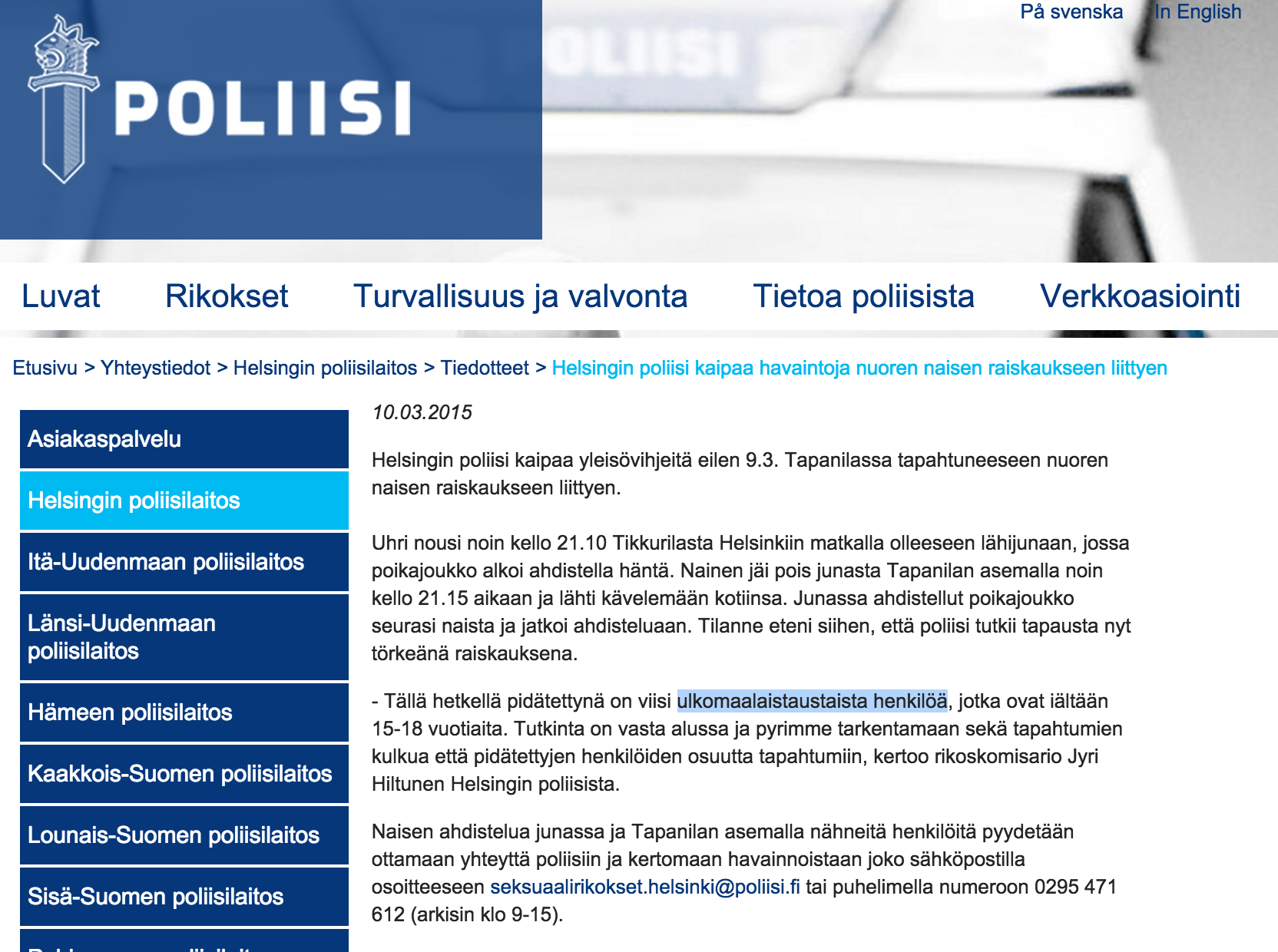
In the statement above, the police claimed that the suspects were “five persons with foreign backgrounds” even if the majority were born and grew up in Finland. Is a person with “foreign or immigrant background” anyone we don’t like and do we use the term to reveal that we are a pretty exclusive white society?

Continue reading “The question that everyone forgot to ask: Are the Tapanila sexual assault suspects Finns?”

Tapanila sexual assault in Finland sends a disturbing signal about our society

Posted on March 12, 2015 by Migrant Tales

Something terrible happened on Monday night after 9pm at the Tapanila train station of northern Helsinki. A group of 15-18-year-olds were reportedly harassing a young woman on a train, who was later sexually assaulted by the same suspects outside the station, according to Helsingin Sanomat. 

No respectable news organization or police force with integrity should be interested in spreading racial stereotypes or fueling racial hatred. It’s not considered ethical in journalism to mention the suspect’s ethnicity if the person is under police custody.

Näyttökuva 2015-3-12 kello 0.45.18

Read full story here.

Identifying somebody by ethnicity can be problematic as well. Even if the suspects had been apprehended, the police mentioned in a statement that those under custody were of “foreign background.”

Continue reading “Tapanila sexual assault in Finland sends a disturbing signal about our society”

Koko Hubara: The brave woman who founded the brown girl’s blog

Posted on March 7, 2015 by Migrant Tales

Koko Hubara is a young energetic woman who founded a few weeks ago on Valentine’s Day a blog called Ruskeat Tytöt, or brown girls. The interest that her blog has received in such a short time surprised her.

Why would anyone be interested in a blog about Other Finns? Is it because there are already so many of them but so little attention is paid to such people?


Näyttökuva 2015-3-7 kello 17.14.17

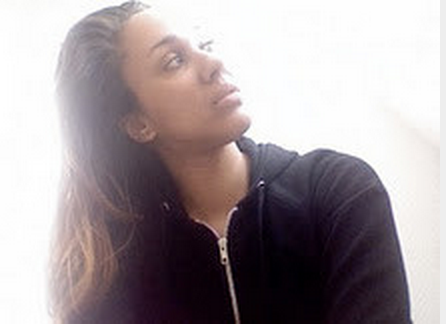
Koko Hubara founded Ruskeat Tytöt blog on Valentine’s Day.

For anyone like Koko, who has had the courage to make that long and difficult journey to her own identity, requires patience and courage. Her sojourn is like building a bridge across a body of water with no banks in sight. Is it a river? A lake? Or, possibly, it could be a vast and endless ocean.

How long will it take to reach the other side, if ever?

Continue reading “Koko Hubara: The brave woman who founded the brown girl’s blog”

UPDATE (Mar. 6): Migrant Tales’ 2015 Hall of Poor and Sloppy Journalism

Posted on March 6, 2015 by Migrant Tales

Migrant Tales’ 2015 Hall of Poor and Sloppy Journalism will be updated separately. To see other examples of opinionated journalism in Finland about cultural diversity, please go to this link.

Mar. 6

Yli puolet nuorista on kokenut syrjintää – ongelmia eniten kouluissa (Helsingin Sanomat)

What’s the missing story in this story? Migrant Tales has written before about how migrants, or children of migrant parents, are together with sexual minorities victims of bullying. The findings of the survey, which is monitored every year,  doesn’t reveal anything new except that the problem persists. The survey showed that 85% of those aged 15-28 years, and especially migrants and sexual minorities, suffered greater bullying than white Finns. But there is an important question missing in the story: What steps are being taken to challenge this type of anti-social behavior? What do the politicians and policy-makers think about the findings? What do they plan to do about the problem? Continue reading “UPDATE (Mar. 6): Migrant Tales’ 2015 Hall of Poor and Sloppy Journalism”

Politicians who fuel and support opportunistically segregation in Finland

Posted on March 5, 2015December 30, 2024 by Migrant Tales

Tanja Hartonen-Pulkka is a Perussuomalaiset (PS)* candidate in April’s parliamentary elections. Last year she was noticed by Migrant Tales for all the wrong reasons. Hartonen-Pulkka lives in Mäntyharju, a small town in Eastern Finland with a population of 6,200 people that has a handful of foreign residents. She claimed in fall that at the present rate, white Finns will become a minority in this country. 

Hartonen-Pulkka’s anti-immigration rhetoric hasn’t ended even if she got her fingers burned in August. In a campaign poster she hands you the usual anti-immigration rhetoric that is hostile to migrants and minorities living in Finland:

We must limit immigration. We have to get a handle on social welfare immigration and the cost of immigration has to be lowered. We must first create jobs in order that Finns have work before we can think about increasing the number of skilled migrants [to Finland].

Continue reading “Politicians who fuel and support opportunistically segregation in Finland”

Where to catch up on news about immigration, immigrants and cultural diversity

Posted on February 26, 2015 by Migrant Tales

Where does Migrant Tales get its information? Apart from getting tip-offs from readers, another important source is Uutiskynnys as well as other social media sites like Facebook (Rasmus and others) and Twitter. We only read racist diatribe on Facebook instead of following hate sites like Hommaforum and Scripta. 

Following the latter sites as well as other ones like James Hirvisaari is an absolute waste of time because what they put out only confirms what you read about them over five years ago.

Näyttökuva 2015-2-26 kello 16.26.11

I used to visit Mediaseuranta but stopped going there after it became clear that the editor appears to be connected to the Hommaforum network. We recommend a thousand times Uutiskynnys over Mediaseuranta.

One of the best blogs on cultural diversity in Finland is Uuninpankkopoika Saku Tiimonen, Reija Härkönen, Marian Abdulkarim and Zuzeeko. There are many others that I read like Abdirahim Husu Hussein and Anna Gutiérrez Sorainen.

A “new” blogger on the block is Ozan Yanar, who knows his stuff and writes well.

It’s great to see today that the ongoing debate on our ever-growing cultural diversity is no longer controlled by anti-immigration bloggers. This has been the case for some time but matters are changing.

Other good sites include I Care, which gives you a good picture of what is happening in other countries.

Being informed and having a good network to access and double check information is crucial if you want to take part in the ongoing debate on immigration, immigrants and cultural diversity.

When it comes to the Finnish media, only a few publications get it right most of the time when it comes to migration and cultural diversity. Some of these include Karjalainen, Savon Sanomat, Kainuun Sanomat, Hämen Kaiku and Kansan Uutiset.


The rise and fall of the Perussuomalaiset of Finland

Posted on February 21, 2015 by Migrant Tales

As support for the Perussuomalaiset (PS)[1] wanes with parliamentary elections only a heartbeat away on April 19, we are seeing a very different party  from four years ago. Back then, PS chairman Timo Soini was self-confident and campaigning confidently. He was the darling of the media, the new kid on the block, the underdog, the only credible anti-EU voice in the country romping opinion polls and sending political shock tremors. 

Matters have changed radically from 2011. We no longer see a self-confident Soini but a party that has run out of populist arguments and is scrambling unsuccessfully to repeat its historic election victory. Moreover, Soini doesn’t look even youthful as before but his image is a cause for worry since he has aged prematurely and there are health issues as well.

1305926778886

Happy Flappy Soini is a popular game mocking the PS chairman. You can download the game (in Finnish) here.


The charismatic leader, who helped the PS rise from political obscurity to the third-biggest party in parliament in four years is now in retreat and on the defensive.

What happened?

An article in the New Statesman gives the following reason for the rise and fall of the PS:

In opposition, and rebranded as simply “the Finns”, the far-right revolution began to fade. The Finns soon found they outside of a coaliton, they were powerless. Meanwhile, they suffered a long string of very public controversies. In 2013, their MP James Hirvisaari was expelled for photographing of a friend posing in a Nazi salute outside [sic][2] Parliament, having previously been reprimanded for a series of Islamophobic and racist comments. Another high-ranking Finns Party MP, Jussi Halla-aho, has been investigated several times for inciting racial hatred.

Migrant Tales has always been critical of the PS and their motives. Their anti-immigration, homophobic and nativist nationalistic message is unsustainable politically.

PS MP Teuvo Hakkarainen is one of many good examples of the party’s fall from political grace. Here’s an MP that has issues with alcohol and racism. Hakkarainen has even sent on his work phone pictures of his phallus, among other scandals.

It is incredible that in the age of the Internet, relatively cheap travel and globalization that some extremist groups are still hellbent on excluding others from being equal members of society. Behind all the rhetoric and political malarkey of the PS is its underlying message: Keep Finland white. 

Despite Soini’s repeated claims, that his party doesn’t even flirt with racism (sic!), the best example of how it uses a nativist nationalistic message in inciting nationalist fervor, which in turn fuels racism, was his decision to allow  MEP Jussi Halla-aho to draft the party’s program on immigration policy.

Soini claimed in 2009 that he’d sack any PS member if they got sentenced for inciting ethnic hatred. Halla-aho did but nothing happened to him. Soini instead defended his decision not to sack Halla-aho on BBC’s HARDTalk.

Another problem with the PS is that it has lost crediblity among voters because it is a volatile mixed bag of ideologies ranging from neo-Nazis and fascists to former communists. It hasn’t done anything in the opposition except whine.

Even if the PS will suffer a defeat in the April elections and even if there is a big possibility that it will eventually splinter and implode, the big question is what will emerge from the wreckage of the PS? Will we see in Finland openly far-right parties like the Sweden Democrats and Danish People’s Party?

That is one of the fears that the demise of the PS raises.


[1] The English name of the Perussuomalaiset (PS) is officially the Finns Party. The names adopted by the PS, like True Finns or Finns Party, promote in our opinion nativist nationalism and xenophobia. We therefore prefer to use the Finnish name of the party on our postings. 

[2] Then PS MP James Hirvisaari, who was sentenced for ethnic agitation, took a picture of Seppo Lehto making a Nazi salute inside the parliament building.

European Network Against Racism: Muslims in Europe – Questions and Answers

Posted on February 21, 2015 by Migrant Tales

European Network Against Racism (ENAR)*

As anti-Muslim manifestations increase in Europe, particularly in the aftermath of the Paris and Copenhagen attacks, we clarify some misconceptions and answer some of the most frequent questions about Muslims in Europe.

Näyttökuva 2015-2-21 kello 9.55.11

Visit original posting here.


Q: Who are Muslim Europeans?

Muslims have been present in Europe since the 7th century. Diplomacy and trade exchanges have always existed between the Muslim world and Europe. After World War II, a large immigrant labour force coming primarily from Mediterranean countries with majority Muslim populations were recruited to support rebuilding efforts in Europe. Nowadays, Muslim communities are as diverse as European countries are. Different ethnic and cultural origins, nationalities, political views, social classes mean that there is no such thing as one ‘Muslim community’. While in Europe, Islam is often associated with Arabs, the latter make up only 15% of the world’s Muslim population. Muslims refer to different understandings and lectures of the Islamic literature and to a great variety of theological, juridical and spiritual schools, obedience and traditions. Muslims are spread across the spectrum of potential religious practice: from total non-practice to intensive practice – the level of practice evolving also during a life time. Levels of practice differ also according to the religious practice: whereas estimates consider that only 10% of Muslims are engaging in regular prayers, more than 70% tend to respect fasting during the month of Ramadan.

Q: How many Muslims are there in Europe?

Most EU countries do not collect data disaggregated by religion in censuses, so it is impossible to know exactly how many Muslims live in Europe. However, research based on proxies has estimated that around 19 million Muslims live in Europe, which represents 6% of the total European population. Populist and far-right parties tend to increase this number to support the argument of an “islamisation of Europe”. Recent public opinion surveys have shown that the number of European Muslims is often overestimated. A 2014 survey found that French respondents thought that 31% of their compatriots were Muslim, while actual figures show that only 8% of French residents are Muslims – including non-practising Muslims. UK respondents thought there were 21% Muslims in Britain, when they constitute only 5 % of the British population.

Q: Are all Muslims violent, terrorist extremists?

While there is no single interpretation of Islam, renowned Islamic authorities across the world have repeatedly affirmed that terrorism cannot be justified by the teachings of their religion, which aims to promote justice and peace. Muslim leaders and scholars often speak out against terrorism and seek to counter misinterpreted or twisted teachings based on a theology of violence and death that fringe groups use to justify their violent actions. Most Muslims feel as threatened as anyone else by these violent extremists who say they act in the name of Islam. Muslims have been the target of terrorist attacks too, and are in no way protected because of their religion. To date, worldwide, Muslims suffer the highest death toll due to jihadist terror groups. Some of the victims of the Paris attacks were Muslims.

Q: If all Muslims are not terrorists, are all terrorists Muslims?

A survey conducted by the Center for Research and Globalization found that the terrorists acts perpetrated by Muslim extremists constitute only 2.5% of all terrorist attacks on U.S. soil between 1970 and 2012. In 2013, 152 terrorist attacks occurred in Europe with only one attack being religiously motivated while 84 were motivated by ethno-nationalist or separatist beliefs. The massive media coverage of Muslims extremists’ acts contributes to feeding the myth that all terrorist acts are perpetrated by Muslims. Far-right movements are also a form of extremism present in Europe, which poses a similar threat to society and peaceful coexistence.

Q: Do Muslims agree with the Paris and Copenhagen terror attacks?

Some Muslims have felt offended by some of Charlie Hebdo’s cartoons. But this in no way means that they support the deadly attacks. Most Muslim organisations publically condemned these murders, recalling that words should be countered with words, and that Islam shouldn’t be used as a way to justify terror attacks. Many of these organisations were present on 11th January to peacefully march in Paris and other French and European capitals. A number of European Muslim intellectuals have also insisted on the importance of freedom of expression.

Q: Are European Muslims increasingly anti-Semites?

Anti-Semitism is not new in Europe and is still very much present across European society. Muslims are not immune to anti-Semitism. Some Muslims are influenced by theological discourses rooted in anti-Semitism, far-right ideologues, negationists and those spreading confusion between Israel and Jews in general. However, a recent Pew Research Center study shows that negative opinions on Jews are growing in Europe, reaching 25 % of unfavourable opinion in Germany, where only 6 % of the population is Muslim. In Spain, where less than 3 % of the population is Muslim, close to 50 % of the population hold negative opinions about Jews. In France, research and surveys have showed that an ‘old’ type of far-right anti-Semitism is still dominant and goes hand in hand with other forms of prejudice, including Islamophobia. Affirmations that Muslims are the only source of anti-Semitism in Europe are based on an attempt to pit Jews and Muslims against each other, divide society and spread both Islamophobia and anti-Semitism.

Q: What are the consequences of the Paris attacks on Muslim communities?

Muslims have been publicly called to condemn the attacks, implying that Muslims intrinsically support the perpetrators of the attacks. As a consequence, some Muslims have feared retaliation. The attacks took place in a context of growing Islamophobia in Europe (47% increase in recorded Islamophobic acts in France in 2013 compared to 2012), anti-Muslim marches organised by the far-right Pegida movement, and regular attacks of mosques in Sweden. From 7 January 2015 to 7 February 2015, there were 153 Islamophobic incidents against individuals and places of worship in France, which represents a 70% increase compared to January 2014.

Q: Are young Muslims in Europe becoming more radicalised?

Discrimination and social exclusion are key factors leading young Muslims, among others, to feel excluded and humiliated in Europe and become easy targets for radicalisation. It is necessary to address social segregation and discrimination in employment to include those who no longer believe in the structures that regulate our societies: families, education and employment.

Former and current armed conflicts in the Middle East and beyond have left abandoned populations in chaos in countries that are not able to guaranty a minimum level of security. These conflicts are used in narratives and easily spread by violent extremists to justify terrorist acts. This propaganda is widely spread via social media and mostly appealing to young people’s emotions. Worrying trends show an increase of the number of European young Muslims leaving to join jihadist organisations. However, estimates show that these represent less than 0.1% of the total Muslim youth.

Q: What is Islamophobia? How can it be a form of racism as Islam is not a race?

Islamophobia is a specific form of racism that refers to acts of violence and discrimination, as well as racist speech, fuelled by historical abuses and negative stereotyping and leading to exclusion and dehumanisation of Muslims, and all those perceived as such. Islamophobia can also be the result of structural discrimination. Islamophobia is a form of racism in the sense that it is the result of the social construction of a group as a race and to which specificities and stereotypes are attributed. These characteristics are considered genetic (for instance “Islam is violent, thus Muslims and their kids are violent”). Consequently, even those who choose not to practice Islam but who are perceived as Muslim are subjected to discrimination. Islamophobia has nothing to do with criticism of Islam. Islam, as a religion, as an ideology, is subject to criticism as any other religion or ideology.

Q: Is racial profiling the solution to prevent radicalism?

Data mining and surveillances practices have not yield conclusive results on combating terrorism or radicalisation. These data collection practices can lead to discriminatory practices and prohibited processing of data revealing race, ethnic origin or religion through the use of proxies. Information such as residency status, home address, nationality, place of birth, phone calls to certain countries, time of bank operations or physical appearance (a beard, a veil, etc.) can be used to racially profile individuals. Racial profiling is a form of racial discrimination that is prohibited under international law. It is also ineffective and counter-productive in that it alienates the very communities whose support is necessary for fighting crime and terrorism. Racial profiling is not effective in terms of law enforcement. Policing depends on cooperation from the public to report crime, provide suspect descriptions and give witness testimonies. Research shows that poor police-citizen contacts and bad treatment by law enforcement officers can have a negative impact on public confidence in law enforcement and also result in reduced cooperation with the latter.

*Migrant Tales is a member of the European Network Against Racism.

A young black woman in a small Finnish city

Posted on February 12, 2015 by Migrant Tales

Finns are adamant that there is no racial discrimination in their society.

Josephy Wandera Owindi*

For some white people it’s difficult to comprehend how a black woman could be treated in a small city like Mikkeli, located 230km northeast of Helsinki. Is she a victim of microaggressions and/or of outright sexism and racism? 

The aim of a microaggression is the casual degradation of any socially marginalized group like disabled people, sexual minorities, migrants and their children. A microaggression can be a comment that may sound as a compliment but hides an insult to the person and his or her group.

Microaggressions


Read more about microaggressions here.


A black person could be born in Finland and speak the Finnish language perfectly as a native. Even if the person is a Finn and speaks Finnish as his mother language, he’s complimented on his Finnish language. The seemingly innocent comment, which is done unconsciously and subtly, implies that the person isn’t a true Finn but is made to feel like a perceived foreigner in his own country.

Some of the treatment that the young black woman receives in Mikkeli aren’t  only microaggressions but outright sexist and racist. Russian women can be placed in the same group since some Finnish men label all of them as prostitutes.

“I’ve lived in Mikkeli for a number of years and every time I leave home usually middle-aged men approach me in public,” she said. “Some think I’m a prostitute and others think that I live off social welfare and am unemployed. They ask me in English why I don’t speak Finnish, which I do, or tell me to go back to the country I came from.”

Her treatment by other men has made her especially conscious about how she dresses in public.

“If I wear a short skirt and use makeup men approach me with greater ease and start talking to me and ask uncomfortable questions,” she said. “I don’t like to go outside alone but feel safe when I’m accompanied by a friend. As I mentioned, some men are very rude and don’t care if they insult me.”

“Sometimes I answer back,” she continued, “and tell them that I don’t live off welfare and study and work in Finland.”

The young woman believes that young black people of Southern Sudan, Turkey and members of the Romany minority suffer the most discrimination in Mikkeli because of their ethnic background.

The woman has a child who is still too young to attend school. She believes that her child will suffer at school because of  ethnic background.  When her child was a baby, she remembers a group of fifteen-year-old teenagers at a fast-food restaurant who commented: “Look at that monkey.”

“When I’m with my child I feel that people give me angry looks as if asking ‘why did I have a child with a [white] Finn,'” she said. “How do I deal with this type of treatment that I get on a [near-]daily basis? I try to forget what happened, even if it’s difficult. It’s a horrible situation.”

The woman said that Finland should do more to educate people so that they’d learn to treat people who are different from them with the respect they expect to receive from others.

* Kato, kato nekru. WSOY. Porvoo 1972. p. 47.

Defining white Finnish privilege #16: Rosa Emilia Clay and my history versus yours

Posted on February 7, 2015 by Migrant Tales

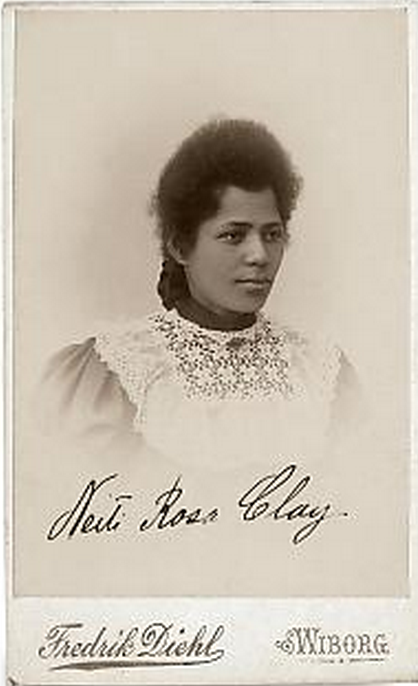
Ever wondered why all of Finland’s history is white? Ever wondered why you probably never heard of Rosa Emilia Clay (1875-1959), Finland’s first black citizen? 

According to Helsingin Sanomat, Finland’s oldest daily established in 1824, Åbo Underrättelser, ran a story of “a mulatto girl born in Africa and baptized there [in Amboland in northern Namibia].” Then thirteen-year-old Rosa Emila Clay was traveling to Finland with Finnish missionary Karl Weikkolin. She described her first impressions according to a biography published in 1942 by Arvo Lindewall:

“Immediately when the Turku archipelago came into sight, I started to like the environment for some unknown reason, and when the mainland came into view, I immediately fell in love with this new home country of mine in the far north, although I knew that being an African, I might suffer from much derision and scorn.”

Clay studied to become a teacher in 1898 and got her Finnish citizenship a year later. Her first job as a teacher was in the Northern Savo village of Mustinlahti, located 67km south of Kuopio.

An interesting question is how a dark-skinned teacher got along in a small rural Finnish village at the turn of the century. We know that when she arrived at Mustinlahti a farmer had spat at her and stated: “Did they send this kind of black Negro hag to us as a teacher? Even the kids would be afraid of a devil like that.”

Clay moved to Tampere and taught there for three years until she migrated to the United States in the summer of 1904.

Näyttökuva 2015-2-7 kello 15.45.58


Her acceptance by the local Finnish community in the United States was made easy thanks to her perfect Finnish. Clay joined the Finnish socialists, directed a choir, plays, sang and performed at Finnish community halls, according to Helsingin Sanomat.

Her grandchild Normalee Johnsson wrote in a letter dated June 2009: “When mother died, we learned her secret: we had African blood in our veins! Finally, we understood why mother always wore a bonnet and long sleeves in the summer. What we could not understand is why she kept our African, Arab, and English heritage a secret. For a while, it was shocking that I didn’t know who I really was.”

Definition #16

It doesn’t matter who Clay was ethnically whether African, Arab or English. One matter, however, is for certain: She was a prominent member of our culturally and ethnically diverse society, which Finland denied existed.

A blog called Sielunmaisema correctly points out that there were black people living in Finland before the nineteenth century.

She writes:  “The story of Africans in Finland goes back to the 19th century, when the country was a remote Grand Duchy under Russia. Which is true in a way because there was no Finland as we think of it before that time, but also a big fat white washing lie, because there most definitely were Black people in these parts of the world throughout the history, even if we’re not taught about them in school. It had never even crossed my mind that we get taught a white washed version of our own history, except in regards of the erasure of Sami and Roma peoples, but it seems obvious now that I think of it.”

Clay is a perfect example of how white Finnish privilege is taught at schools. It means that visible minorities, never mind migrants, have no official history. Everything important that took place in Finland during independence was done by whites or people who hid their backgrounds.

This myth and social construct of the white Finn is what has killed cultural diversity.

We must not allow this to happen any longer. We must start writing Finland’s Other history.

See also:

  • Defining white Finnish privilege #1: I have it and you don’t
  • Defining white Finnish privilege #2: Third culture children versus “pupil with immigrant background” 
  • Defining white Finnish privilege #3 No history, no doctrine, no heroes and no martyrs
  • Defining white Finnish privilege #4 Holding the short end of the stick
  • Defining white Finnish privilege #5 It’s ok to be a racist
  • Defining white Finnish privilege #6 Not having a voice and the media
  • Defining white Finnish privilege #7 A definitive guide
  • Defining white Finnish privilege #8 Underrated and less intelligent
  • Defining white Finnish privilege #9 Mohammad Ali’s insight
  • Defining white Finnish privilege #10 I can victimize and make up any story I like about migrants because I’m white
  • Defining white Finnish privilege #11: Case Teuvo Hakkarainen
  • Defining white Finnish privilege #12: Case Tom Packalén
  • Defining white Finnish privilege #13: Case Matti Putkonen
  • Defining white Finnish privilege #14: Losing sight of the real issue
  • Defining white Finnish privilege #15: Case Halla-aho and the PS
  • Previous
  • 1
  • …
  • 9
  • 10
  • 11
  • 12
  • 13
  • 14
  • 15
  • …
  • 30
  • Next
Read more about documentary film
Read more

Recent Posts

  • Finland’s tabloids Iltalehti and Ilta-Sanomat are the pits
  • Riikka Purra’s Dr Jekyll and Mr Hyde mask
  • Double standards
  • Perussuomalaiset: Uusi logo, sama vanha juttu
  • Taco Trump

Recent Comments

  1. Absolutely Socking: Racist Finnish Facebook group against human rights gets flooded with socks on Musta Barbaari’s mother and sister charged by the police in “ethnic profiling” case
  2. Ilkka Nuotio on Pekka Myrskylä: “Tilastot kertovat toista kuin poliittinen keskustelu”
  3. Genrih Soinkara on The war in Ukraine and the Russian-Finnish border crisis are showing Finland’s ugly side
  4. Ahti Tolvanen on Comment by Ahti Tolvanen on the Helsinki +50 conference
  5. Angel Barrientos on Angel Barrientos is one of the kind beacons of Finland’s Chilean community

Archives

  • June 2026
  • May 2026
  • April 2026
  • March 2026
  • February 2026
  • January 2026
  • December 2025
  • November 2025
  • October 2025
  • September 2025
  • August 2025
  • July 2025
  • June 2025
  • May 2025
  • April 2025
  • March 2025
  • February 2025
  • January 2025
  • December 2024
  • November 2024
  • October 2024
  • September 2024
  • August 2024
  • July 2024
  • June 2024
  • May 2024
  • April 2024
  • March 2024
  • February 2024
  • January 2024
  • December 2023
  • November 2023
  • October 2023
  • September 2023
  • August 2023
  • July 2023
  • June 2023
  • May 2023
  • April 2023
  • March 2023
  • February 2023
  • January 2023
  • December 2022
  • November 2022
  • October 2022
  • September 2022
  • August 2022
  • July 2022
  • June 2022
  • May 2022
  • April 2022
  • March 2022
  • February 2022
  • January 2022
  • December 2021
  • November 2021
  • October 2021
  • September 2021
  • August 2021
  • July 2021
  • June 2021
  • May 2021
  • April 2021
  • March 2021
  • February 2021
  • January 2021
  • December 2020
  • November 2020
  • October 2020
  • September 2020
  • August 2020
  • July 2020
  • June 2020
  • May 2020
  • April 2020
  • March 2020
  • February 2020
  • January 2020
  • December 2019
  • November 2019
  • October 2019
  • September 2019
  • August 2019
  • July 2019
  • June 2019
  • May 2019
  • April 2019
  • March 2019
  • February 2019
  • January 2019
  • December 2018
  • November 2018
  • October 2018
  • September 2018
  • August 2018
  • July 2018
  • June 2018
  • May 2018
  • April 2018
  • March 2018
  • February 2018
  • January 2018
  • December 2017
  • November 2017
  • October 2017
  • September 2017
  • August 2017
  • July 2017
  • June 2017
  • May 2017
  • April 2017
  • March 2017
  • February 2017
  • January 2017
  • December 2016
  • November 2016
  • October 2016
  • September 2016
  • August 2016
  • July 2016
  • June 2016
  • May 2016
  • April 2016
  • March 2016
  • February 2016
  • January 2016
  • December 2015
  • November 2015
  • October 2015
  • September 2015
  • August 2015
  • July 2015
  • June 2015
  • May 2015
  • April 2015
  • March 2015
  • February 2015
  • January 2015
  • December 2014
  • November 2014
  • October 2014
  • September 2014
  • August 2014
  • July 2014
  • June 2014
  • May 2014
  • April 2014
  • March 2014
  • February 2014
  • January 2014
  • December 2013
  • November 2013
  • October 2013
  • September 2013
  • August 2013
  • July 2013
  • June 2013
  • May 2013
  • April 2013
  • March 2013
  • February 2013
  • January 2013
  • December 2012
  • November 2012
  • October 2012
  • September 2012
  • August 2012
  • July 2012
  • June 2012
  • May 2012
  • April 2012
  • March 2012
  • February 2012
  • January 2012
  • December 2011
  • November 2011
  • October 2011
  • September 2011
  • August 2011
  • July 2011
  • June 2011
  • May 2011
  • April 2011
  • March 2011
  • February 2011
  • January 2011
  • December 2010
  • November 2010
  • October 2010
  • September 2010
  • August 2010
  • July 2010
  • June 2010
  • May 2010
  • April 2010
  • March 2010
  • February 2010
  • January 2010
  • December 2009
  • November 2009
  • October 2009
  • September 2009
  • August 2009
  • July 2009
  • December 2008
  • November 2008
  • October 2008
  • September 2008
  • August 2008
  • July 2008
  • June 2008
  • May 2008
  • April 2008
  • March 2008
  • February 2008
  • January 2008
  • November 2007
  • October 2007
  • September 2007
  • August 2007
  • July 2007
  • June 2007
  • May 2007

Categories

  • ?? Gia L?c
  • ????? ?????? ????? ???????? ?? ??????
  • ???????
  • @HerraAhmed
  • @mondepasrond
  • @nohatefinland
  • @oula_silver
  • @Varathas
  • A Pakistani family
  • äärioikeisto
  • Abbas Bahmanpour
  • Abdi Muhis
  • Abdirahim Hussein Mohamed
  • Abdirahim Husu Hussein
  • Abdirisak Mahamed
  • About Migrant Tales
  • activism
  • Adam Al-Sawad
  • Adel Abidin
  • Afrofinland
  • Ahmed IJ
  • Ahti Tolvanen
  • Aino Pennanen
  • Aisha Maniar
  • Alan Ali
  • Alan Anstead
  • Alejandro Díaz Ortiz
  • Alekey Bulavsev
  • Aleksander Hemon
  • Aleksanterinliitto
  • Aleksanterinliitto ry
  • Aleksanterinliitto ry:n hallitus
  • Alex Alex
  • Alex Mckie
  • Alexander Nix
  • Alexandra Ayse Albayrak
  • Alexis Neuberg
  • Ali Asaad Hasan Alzuhairi
  • Ali Hossein Mir Ali
  • Ali Rashid
  • Ali Sagal Abdikarim
  • Alina Tsui
  • Aline Müller
  • All categories
  • Aman Heidari
  • Amiirah Salleh-Hoddin & Jana Turk
  • Amin A. Alem
  • Amir Zuhairi
  • Amkelwa Mbekeni
  • Ana María Gutiérrez Sorainen
  • Anachoma
  • Anders Adlecreutz
  • Angeliina Koskinen
  • Anna De Mutiis
  • Anna María Gutiérrez Sorainen
  • Anna-Kaisa Kuusisto ja Jaakko Tuominen
  • Annastiina Kallius
  • Anneli Juise Friman Lindeman
  • Announcement
  • Anonymous
  • Antero Leitzinger
  • anti-black racism
  • Anti-Hate Crime Organisation Finland
  • Anudari Boldbaatar
  • Arshiya Nasser
  • Aspergers Syndrome
  • Asylum Corner
  • Asylum seeker 406
  • Athena Griffin and Joe Feagin
  • Autism
  • Avaaz.org
  • Awale Olad
  • Ayan Said Mohamed
  • AYY
  • Barachiel
  • Bashy Quraishy
  • Beatrice Kabutakapua
  • Beri Jamal
  • Beri Jamal and Enrique Tessieri
  • Bertolt Brecht
  • Boiata
  • Boodi Kabbani
  • Bruno Gronow
  • Carmen Pekkarinen
  • Çelen Oben and Sheila Riikonen
  • Chiara Costa-Virtanen
  • Chiara Costa-Virtanen
  • Chiara Sorbello
  • Christian Thibault
  • Christopher Wylie
  • Clara Dublanc
  • Dana
  • Daniel Malpica
  • Danilo Canguçu
  • David Papineau
  • David Schneider
  • Dexter He
  • Don Flynn
  • Dr Masoud Kamali
  • Dr. Faith Mkwesha
  • Dr. Theodoros Fouskas
  • Edna Chun
  • Eeva Kilpi
  • Emanuela Susheela
  • En castellano
  • ENAR
  • Enrique
  • Enrique Tessieri
  • Enrique Tessieri & Raghad Mchawh
  • Enrique Tessieri & Yahya Rouissi
  • Enrique Tessieri and Muhammed Shire
  • Enrique Tessieri and Sira Moksi
  • Enrique Tessieri and Tom Vandenbosch
  • Enrique Tessieri and Wael Che
  • Enrique Tessieri and Yahya Rouissi
  • Enrique Tessieri and Zimema Mhone
  • Epäluottamusmies
  • EU
  • Europe
  • European Islamophobia Report
  • European Islamophobia Report 2019,
  • European Union
  • Eve Kyntäjä
  • Ezequiel Caldeiro
  • Facebook
  • Fadumo Dayib
  • Faisa Kahiye
  • Farhad Manjoo
  • Fasismi
  • Finland
  • Fizza Qureshi
  • Flyktingar och asyl
  • Foreign Student
  • Fozia Mir-Ali
  • Frances Webber
  • Frida Selim
  • Gareth Rice
  • Ghyslain Vedeaux
  • Global Art Point
  • Great Replacement
  • Habiba Ali
  • Hami Bahadori
  • Hami Bahdori
  • Hamid
  • Hamid Alsaameere
  • Hamid Bahdori
  • Handshake
  • Harmit Athwal
  • Hassan Abdi Ali
  • Hassan Muhumud
  • Heikki Huttunen
  • Heikki Wilenius
  • Helsingin Sanomat
  • Henning van der Hoeven
  • Henrika Mälmsröm
  • Hser Hser
  • Hser Hser ja Mustafa Isman
  • Husein Muhammed
  • Hussain Kazemian
  • Hussain Kazmenian
  • Ibrahim Khan
  • Ida
  • Ignacio Pérez Pérez
  • Iise Ali Hassan
  • Ilari Kaila & Tuomas Kaila
  • Imam Ka
  • inside-an-airport
  • Institute of Race Relations
  • Iraqi asylum seeker
  • IRR European News Team
  • IRR News Team
  • Islamic Society of Norhern FInland
  • Islamic Society of Northern Finland
  • Islamophobia
  • Jacobinmag.com
  • Jallow Momodou
  • Jan Holmberg
  • Jane Elliott
  • Jani Mäkelä
  • Jari Luoto
  • Jari Taponen
  • Jegor Nazarov
  • Jenni Stammeier
  • Jenny Bourne
  • Jessie Daniels
  • Joe Davidow
  • Johannes Koski
  • John D. Foster
  • John Grayson
  • John Marriott
  • Jon Burnett
  • Jorma Härkönen
  • Jos Schuurmans
  • José León Toro Mejías
  • Josue Tumayine
  • Jouni Karnasaari
  • Juan Camilo
  • Jukka Eräkare
  • Julian Abagond
  • Julie Pascoet
  • Jussi Halla-aho
  • Jussi Hallla-aho
  • Jussi Jalonen
  • JusticeDemon
  • Kadar Gelle
  • Kaksoiskansalaisuus
  • Kansainvälinen Mikkeli
  • Kansainvälinen Mikkeli ry
  • Katherine Tonkiss
  • Kati Lepistö
  • Kati van der Hoeven-Lepistö
  • Katie Bell
  • Kättely
  • Kerstin Ögård
  • Keshia Fredua-Mensah & Jamie Schearer
  • Khadidiatou Sylla
  • Khadra Abdirazak Sugulle
  • Kiihotus kansanryhmää vastaan
  • Kirsi Crowley
  • Koko Hubara
  • Kristiina Toivikko
  • Kubra Amini
  • KuRI
  • La Colectiva
  • La incitación al odio
  • Laura Huhtasaari
  • Lauri Finér
  • Leif Hagert
  • Léo Custódio
  • Leo Honka
  • Leontios Christodoulou
  • Lessie Branch
  • Lex Gaudius
  • Leyes de Finlandia
  • Liikkukaa!
  • Linda Hyökki
  • Liz Fekete
  • M. Blanc
  • Maarit Snellman
  • Mahad Sheikh Musse
  • Maija Vilkkumaa
  • Malmin Kebab Pizzeria Port Arthur
  • Marcell Lorincz
  • Mari Aaltola
  • María Paz López
  • Maria Rittis Ikola
  • Maria Tjader
  • Marja-Liisa Tolvanen
  • Mark
  • Markku Heikkinen
  • Marshall Niles
  • Martin Al-Laji
  • Maryan Siyad
  • Matt Carr
  • Mauricio Farah Gebara
  • Media Monitoring Group of Finland
  • Micah J. Christian
  • Michael McEachrane
  • Michele Levoy
  • Michelle Kaila
  • Migrant Tales
  • Migrant Tales Literary
  • Migrantes News
  • Migrants' Rights Network
  • MigriLeaks
  • Mikko Kapanen
  • Miriam Attias and Camila Haavisto
  • Mohamed Adan
  • Mohammad Javid
  • Mohammad M.
  • Monikulttuurisuus
  • Monisha Bhatia and Victoria Canning
  • Mor Ndiaye
  • Muh'ed
  • Muhamed Abdimajed Murshid
  • Muhammed Shire
  • Muhammed Shire and Enrique Tessieri
  • Muhis Azizi
  • Musimenta Dansila
  • Muslimiviha
  • Musulmanes
  • Namir al-Azzawi
  • Natsismi
  • Neurodiversity
  • New Women Connectors
  • Nils Muižnieks
  • No Labels No Walls
  • Noel Dandes
  • Nuor Dawood
  • Omar Khan
  • Otavanmedia
  • Oula Silvennoinen
  • Paco Diop
  • Pakistani family
  • Pentti Stranius
  • Perussuomalaiset
  • perustuslaki
  • Petra Laiti
  • Petri Cederlöf
  • Pia Grochowski
  • Podcast-lukija Bea Bergholm
  • Pohjois – Suomen Islamilainen Yhdyskunta
  • Pohjois Suomen Islamilainen Yhyskunta
  • Polina Kopylova
  • Race Files
  • racism
  • Racism Review
  • Raghad Mchawh
  • Ranska
  • Rashid H. and Migrant Tales
  • Rasismi
  • Raul Perez
  • Rebecka Holm
  • Reem Abu-Hayyeh
  • Refugees
  • Reija Härkönen
  • Remiel
  • Reza Nasri
  • Richard Gresswell
  • Riikka Purra
  • Risto Laakkonen
  • Rita Chahda
  • Ritva Kondi
  • Robito Ibrahim
  • Roble Bashir
  • Rockhaya Sylla
  • Rodolfo Walsh
  • Roger Casale
  • Rostam Atai
  • Roxana Crisólogo Correa
  • Ruth Grove-White
  • Ruth Waweru-Folabit
  • S-worldview
  • Sadio Ali Nuur
  • Sami Rusanen
  • Sandhu Bhamra
  • Sara de Jong
  • Sarah Crowther
  • Sari Alhariri
  • Sarkawt Khalil
  • Sasu
  • Scot Nakagawa
  • Shabana Ahmadzai
  • Shada Islam
  • Sharon Chang blogs
  • Shenita Ann McLean
  • Shirlene Green Newball
  • Sini Savolainen
  • Sira Moksi
  • Sonia K.
  • Sonia Maria Koo
  • Steverp
  • Stop Deportations
  • Suldaan Said Ahmed
  • Suomen mediaseurantakollektiivi
  • Suomen Muslimifoorumi ry
  • Suomen viharikosvastainen yhdistys
  • Suomen viharikosvastainen yhdistys ry
  • Suomi
  • Supermen
  • Susannah
  • Suva
  • Syrjintä
  • Talous
  • Tapio Tuomala
  • Taw Reh
  • Teivo Teivainen
  • The Daily Show
  • The Heino
  • The Supermen
  • Thomas Elfgren
  • Thulfiqar Abdulkarim
  • Tim McGettigan
  • Tino Singh
  • Tito Moustafa Sliem
  • Tobias Hübinette and L. Janelle Dance
  • Transport
  • Trica Danielle Keaton
  • Trilce Garcia
  • Trish Pääkkönen
  • Trish Pääkkönen and Enrique Tessieri
  • Tuulia Reponen
  • Uncategorized
  • UNITED
  • University of Eastern Finland
  • Uyi Osazee
  • Väkivalta
  • Vapaa Liikkuvuus
  • Venla-Sofia Saariaho
  • Vieraskynä
  • W. Che
  • W. Che an Enrique Tessieri
  • Wael Ch.
  • Wan Wei
  • Women for Refugee Women
  • Xaan Kaafi Maxamed Xalane
  • Xassan Kaafi Maxamed Xalane
  • Xassan-Kaafi Mohamed Halane & Enrique Tessieri
  • Yahya Rouissi
  • Yasmin Yusuf
  • Yassen Ghaleb
  • Yle Puhe
  • Yuliet Tresa
  • Yve Shepherd
  • Zahra Khavari
  • Zaker
  • Zalina Ametova
  • Zamzam Ahmed Ali
  • Zeinab Amini ja Soheila Khavari
  • Zimema Mahone and Enrique Tessieri
  • Zimema Mhone
  • Zoila Forss Crespo Moreyra
  • ZT
  • Zulma Sierra
  • Zuzeeko Tegha Abeng
© 2026 Migrant tales | Powered by Minimalist Blog WordPress Theme