US President Donald Trump’s most recent tirade against Somalis should not only be seen as hostile racism, but show once again how such a social ill us used to seek attention and power. On Thursday we heard about the US’ National Security Strategy, which warns Europe of “white civilization erasure” and throws its support to far-right parties.
The Kremlin came out and gave its full support or the strategy.
Reports the Guardian: “The Kremlin has heaped praise on Donald Trump’s latest national security strategy, calling it an encouraging change of policy that largely aligns with Russian thinking.
While the National Security Strategy offers us a glimpse of the Trump Administration’s racist and colonial mindset, I wonder if it support for nationalist far-right parties includes the Perussuomalaiset (PS)?*
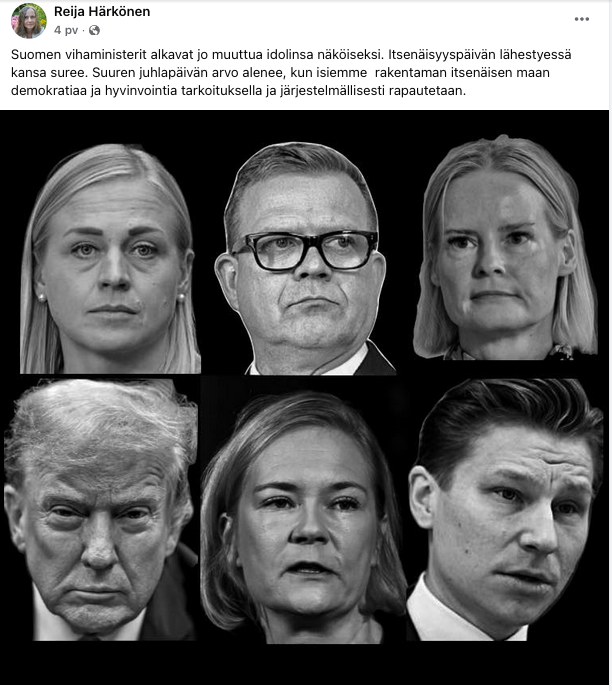
Even if Finland’s far-right party candidate in the US’ National Security Strategy would be the PS, it could also include the National Coalition Party (NCP), which is in government with the PS. Promoting anti-democratic measures would be (top left to right) NCP Foreign Minister Elina Valtonen, who is an apologist of Israel’s atrocities in Gaza, NCP Prime Minister Petteri Orpo who has helped racism grow in Finland, PS Finance Minister Riikka Purra, who impoverishes the country and puts the racism icing on it; (bottom left to right) Donald Trump, a racist felon, PS Mari Rantanen who sees migrant monsters under her bed, and NCP Defense Minister Antti Häkkänen, who fuels fear of the Russians.
Write Reija Härkonen on the Facebook posting: “Finland’s ministers of hate are already beginning to resemble their idols. As Independence Day nears, the nation mourns. The significance of this great holiday is shut when the democracy and welfare of the independent country, built by our forefathers, are deliberately and systematically eroded [by them|.“
The PS’ view of US Vice President J.D. Vance’s las year’s speech at the Munich Security Conference was more than supportive and a turning point in US-Europe relations. Vance, who gave his direct support to far-right policiatl groups like AfD of Germany, did not mention the PS. However, PS Minsiter of Finance Riikka Purra praised Vance’s speech.
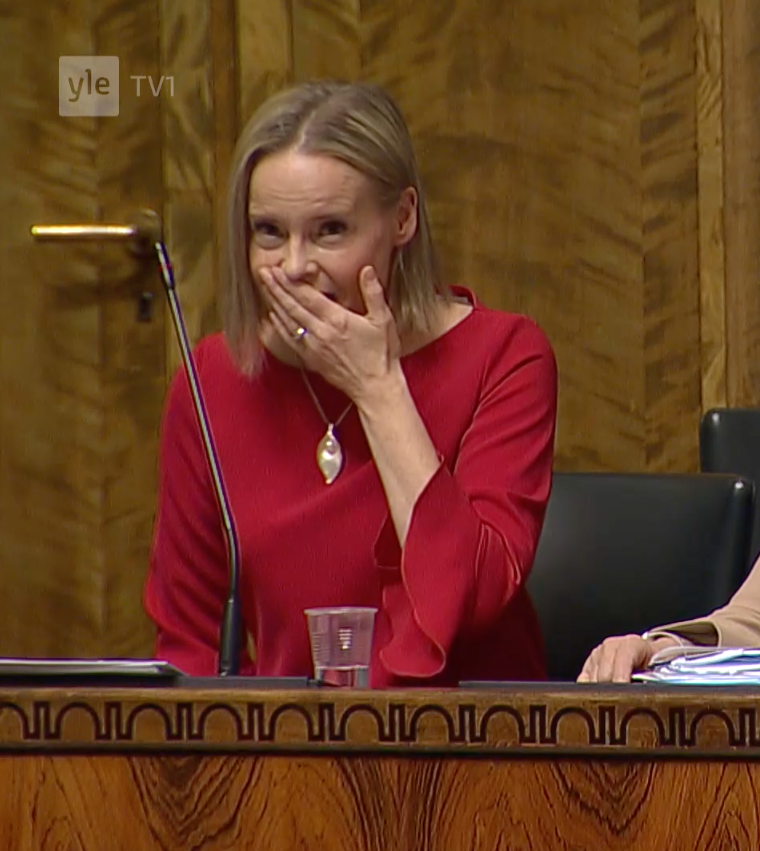
During Thursday’s question time between the government parties and opposition, Green League MP Atte Harjanne spoke highly of Sweden’s success story, which included immigration. The suggestion by Harjanne forced Perussuomalaiset (PS)* chairperson Riikka Purra to let out a demeaning gesture as if stating you cannot seriously claim that Sweden’s immigration policy is a success.
One of the biggest lies of the PS and a way to maintain and feed Finland’s xenophobic atmosphere is Sweden. We have mentioned before that the gang violence in Sweden is unique in Europe. One of the factors behind it is Sweden’s failure and abandonment of migrants and minorities.
Another factor not mentioned is that, thanks to immigration, 600,000 Finns emigrated there after World War 2, Sweden is economically more robust than Finland. Finland is struggling with becoming a gerontocracy, while Sweden has other issues, like dealing with its exclusion of migrants and minorities.
The migrant policy of Prime Minister Petteri Orpo’s government, as well as those of other governments, is in denial and a slap in the face to Finland’s economic growth and well-being.
Thanks to immigration, Sweden’s economic growth is one of the fastest in the OECD and has one of the lowest debt levels. Moreover, there aren’t any issues about labor shortages like in Finland.
Surprisingly, a country that has seen over 1.2 million people emigrate between 1860 and 1999 is so resistant to acknowledging the benefits of migration.
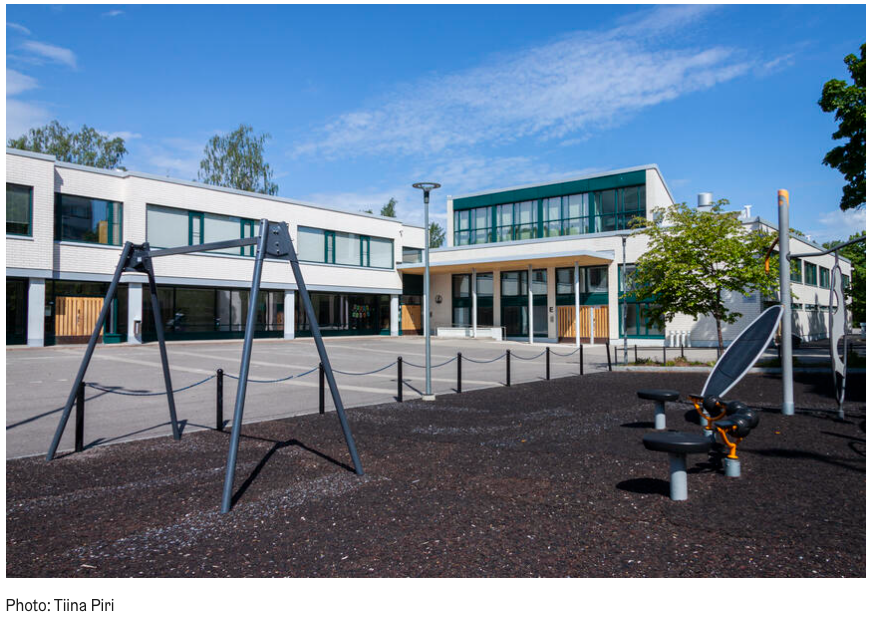
Thanks to migration, Finland’s demographic makeup has changed. In Helsinki alone, the number of pupils in 2024 who have another mother tongue other than Finnish, Swedish, and Sami, has risen to 25.7% of the city’s population from 13.5% ten years ago. Such demographic changes have placed new challenges and a rethink on comprehensive schools and education in general.
For Suaad Onniselkä, a deputy principal of Helsinki’s Puistopolku Comprehsnvie School, the challenge is is not merely a logistical issue—it’s a matter of equity and dignity. She believes that Finnish schools, while striving for neutrality, often overlook how structural and cultural biases shape the experiences of minority students.
Onniselkä describes the holy month of Ramadan as one of the clearest moments when Islamophobia appears in schools.
“In some extreme cases, pupils are forced to eat while fasting,” she said. “Even if poverty is an issue in some homes and food may be scarce, some schools are especially worried that a Muslim student might die during one month of the year. Forcing a pupil to eat doesn’t belong anywhere.”
There have even been cases in smaller cities, where social workers have suggested reporting fasting families to child protection authorities.
The Finnish Muslim Forum (Suomen Muslimifoorumi) has repeatedly emphasized that fasting during Ramadan is a matter of religious freedom, not neglect.
“Yet, no one [at school] even says ‘Happy Ramadan’ to me,” Onniselkä noted. “Then they talk in a negative tone. But I’m the principal of the school—and I feel bad about it. How does that young student feel? How much time and energy would it take for a teacher to simply say, ‘Hey, happy Ramadan, it’s wonderful that this special time has begun?’ That’s what amazes me.”
According to Onniselkä, prejudice in schools often manifests in subtle ways: through low expectations, stereotypes, or lack of representation.
“You can either ‘other’ or empower,” she said. “Too many pupils are victims of prejudice at school. The question is whether teachers see the student on their own terms—or through the lens of the majority culture.”
Finland’s national curriculum allows teaching pupils’ mother tongues and religions, but qualified teachers of Islam remain in short supply.
“In many schools, non-Muslim teachers are hired to teach Islam,” she explained. The main textbook, Salam by Sirkku Aboulfaouz and published by the Finnish National Agency for Education, does not address Islamophobia directly. “It’s up to the teacher to bring up the topic, even though many students experience it daily.”
Structural racism and the “gang” narrative
Onniselkä also connects Islamophobia to broader social anxieties, including recent societal and political debates on youth “gangs” and urban safety.
“I think the political parties like Perussuomalaiset (PS)*, the police, and even the press have taken advantage of this,” said Onniselkä. “They all win—except for the [labelled] young people involved. Teachers’ fears make the situation seem much worse than it really is.”
The so-called gang problem, she argued, has its roots in structural racism and stereotyping rather than in real organized violence.
“In the 2000s, white Finnish students would tattoo their postal code numbers—like ‘94’ for th eastern Helsinki nighborhood of Kontula—and no one called it gang behavior. Now, if a Muslim or if a student of so-called migrant background does the same, it’ becomes a ‘gang issue.’ That double standard speaks volumes.”
Onniselkä is also concerned about ethnic profiling by police, which she says is “quite commonplace” in some Helsinki neighborhoods.
“Students are stopped, photographed, and asked for ID,” she said. “Yes, there are human rights violations happening. And yet, police receive little or no anti-racism training.”
Anti-racism education
In her view, Finland lacks genuine anti-racism education.
“The fact that we get a 90-minute anti-racism course once every five years is basically a joke,” she said. “It should be systematic and part of every school’s equality plan.”
Onniselkä also challenges Finland’s narrow interpretation of equality.
“Equality doesn’t mean treating everyone the same,” she argued. “It means giving each student what they need to succeed. The new legislation on learning support recognizes this for academic needs—but not for cultural or linguistic ones.”
Structural racism also extends to teacher recruitment, according to her.
The Perussuomalaiset (PS)* party is waging a hostile Islamophobic campaign to boost their low standings in opinion polls. The party is confident that the job will be done by increasing attacks on the migrant and minority community. That is the reason you hear and read PS politicians bashing migrants to divert attention from their disastrous economic policies.
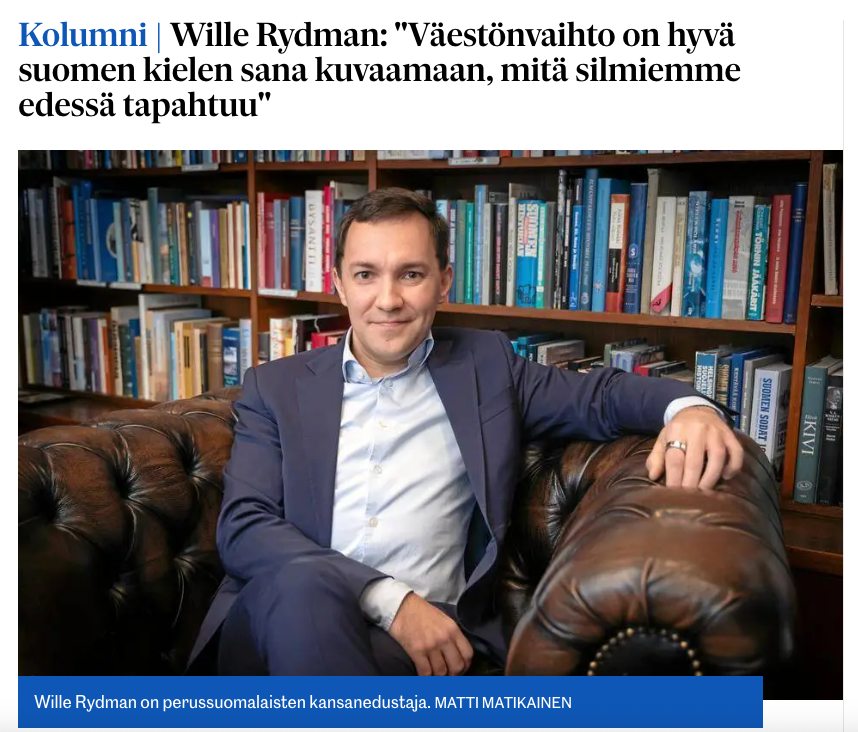
One of these PS politicians is Wille Rydman whose shameful writing exposes the lie behind the story.
He claims in a column in a community paper, which the mainstream media would most likely never publish, that the far-right Great Replacement Theory is a perfect term to describe what is happening in Finland.
“All this is happening completely openly and largely as a result of political decisions. There is no conspiracy, nor is one needed. The end result is a Finland that is becoming less and less Finnish. A country that is rapidly being populated by people who are anything but Finnish,” he claimed.
So what’s wrong with the statement? For one, he is talking about foreigners taking over Finland and that white Finns will become a minority, a typical Great Replacement Theory conspiracy theory that has led in 2019 to the mass killing of Muslims in Christchurch, New Zealand.
When you read the writings of people like Rydman, they forget to mention that following matters:
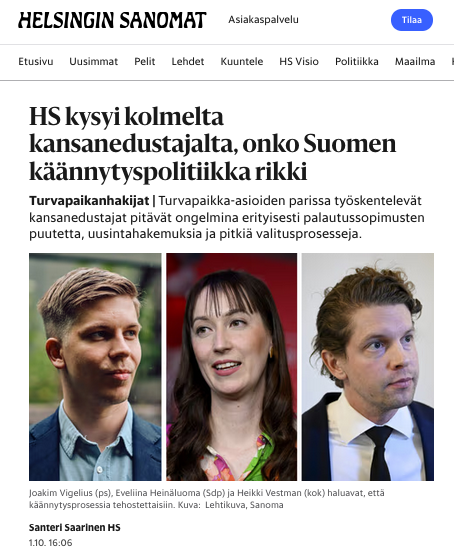
Think of it. Finland’s largest daily, Helsingin Sanomat, publishes a story if the country’s deportation. system is broken. For the story, the daily uses as sources well-known xenophobie Joakim Vigelius of the Perussuomalaiset (PS)* party, Social Democrat MP Eveliina Heinäluoma, who has a wishy-washy stance on migrants, and National Coalition Party MP Heikki Vestman, who justified as chairperson of the constitutional committee the shelving of Finland’s human rights obligations on the passage of the pushback law.
The migration debate in Finland seems very much like the lack of pushback against President Donald Trump by republican legislators. In Finland, we consider migrants, especially Muslim asylum seekers as a threat. We do not give such people the benefit of doubt.
The article is highly revealing exposing what Helsingin Sanomat thinks of undocumented migrants which it slaps on the “illegal” label.
Vigelius, who like Vestman to trash international agreements, said that the present asylum system is based on “outdated” international human rights conventions and that these should change.
‘It cannot be right that even after ten years and ten rejected applications, an asylum seeker is still residing in Finland,” he pointed out.
Apart from using MPs who would care less about undocumented migrants, a big shortfall of the article is that is does not care to mention the suffering present laws cause on such people. Migrant Tales has documented many such cases.
The Ulysses Syndrome is a chronic disorder and helps understand the trauma suffered by undocumented migrants.
The great replacement [Islamization] spells the end of the welfare society, the end of Finnish society.
Riikka Purra, finance minister and chairperson of the Perussuomalaiset (PS)* party
Wednesday’s A-studio with PS Vice President Teemu Keskisarja, Pia Kauma of the National Coalition Party, and Sofia Virta of the Green League was an eye-opener, a stark reminder of the racist undercurrents flowing beneath Finnish society and how the media perpetuates the social ill.
Even if Keskisarja has received a dubious reputation for his vocal fear-mongering of Muslims, his hateful ideology is rooted deeply in PS and Finnish ideology.
“The feast will not improve by changing [replacing the ethnicity of] people,” he was quoted as saying in A-studio. “Rather, the opposite is true. Those who enable this replacement will turn [Finland] into a developing country of pig stys and bloodbaths. These are the reasons why the great replacement angers me and the Finns Party.”
And the icing on the cake, he said that migrants have already destoyerd the Finnish welfare state but have partly created a catastrophe.
PS Vice President Teemu Keskisarja.
While some blame the PS’s poor showing in recent elections and opinion polls, the truth is that what Keskisarja said is not only harmful to migrants trying to find work and a place in society, but the toothless pushback from Prime Minister Petteri Orpo’s government, which is set to take the country down a runious path to weaken labor laws and social security benefits.
Days later,representatives of the Somali community come out and state that the tragic deaths of Somali boys should not be politicized. What on earth does the Finnish media, like Yle, wants to frame and message when they state that those who died of drowning were of Somali backgrounds?
It took several days for Yle to publish the Somali community’s concern about the harmful labeling.
Abdirazak Sugulle Mohamed, a representative of the Uusimaa Mosque Association, hopes that decision-makers will take a responsible approach to the issue. He believes that swimming skills should also be discussed in general in Finland, not just for Somalis or so-called people of foreign background.
“We shouldn’t just talk about the swimming skills of immigrants or Somalis,” he said.
But one could take this matter a big further and ask what the purpose of singling out people of color is? Is it to reinforce our racism and show falsely that white Finns are superior swimmers? Probably the most striking matter it reveals is the mainstream media’s racism problem.
Moreover, Helsingin Sanomat, Finland’s biggest daily, has not published a word about how the media labels minorities. They did, however, publish an article about how Muslim women go to swimming school. It was like a cultural peep show.
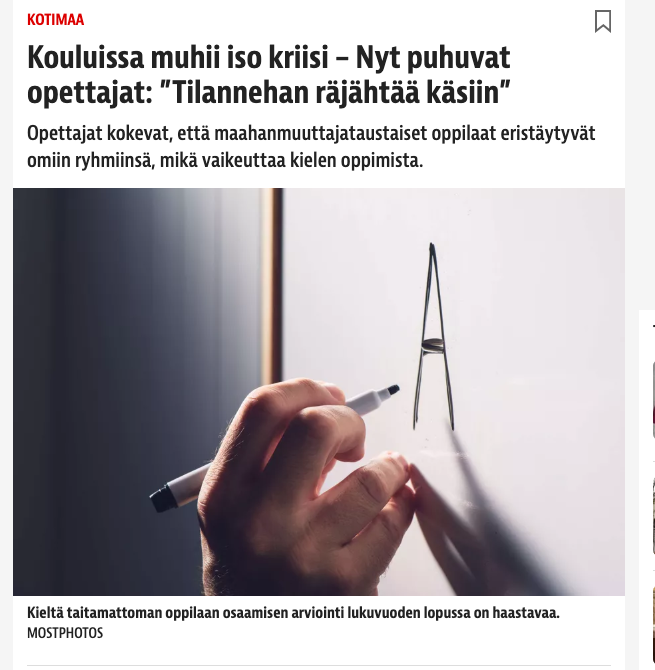
An article in tabloid Iltalehti aims to reinforce readers about why “kids with migrant backgrounds” are a problem, but instead reveals the racist attitudes of the tabloid and of some comprehensive school teachers. I suspect that one of the reasons why Iltalehti uses anonymous sources is because no respecting teacher would go on the record with such claims.
Let’s dissect the article’s most outrageous claims:
The article concerned why brown and black children, specifically Muslims, are marginalized and don’t want to be Finns, which affects their Finnish language-learning abilities. One good start would be to stop labeling them “children with migrant backgrounds.” The label alone excludes.
One reason why kids don’t want to identify as Finns is that they are not even accepted as Finns. As mentioned above, why would some of these kids want to identify with white Finns, which the article labels “ethnic” Finns (kantasuomalainen), if their backgrounds are not taken into account?
What about institutional racism and the xenophobic and bigoted comments by politicians in particular, like the Perussuomalaiset (PS)*, who have made their political message by spreading racism and lies about migrants? Would you want to be part of a society that holds you in contempt?
I have said it before and will say it again: I never want to be a white Finn but a Finn on my terms. The article does not mention how these children could be seen and taught to be Finns on their terms.
The article claims: “Some children with an immigrant background who were born in Finland do not speak Finnish well enough to attend school.” If this is the case, it reveals the failure of the school system and ineffective social policy. Nowhere is it mentioned in the article how we tackle this problem.
Why do three teachers cited in the story speak anonymously? “Paula,” who teaches the Islman religion, claims that some of her students don’t want to be Finns. If “Paula” is a teacher, she should know better the importance of retaining your culture instead of erasing it. Over 1.2 million Finns emigrated from Finland between 1860 and 1999. Even the children of the first generation, still in their fifth generation, continue to see themselves as Finns. Is this strange? No.
“Karla” is another consultant teacher who speaks anonymously in the article. She believes that the best way to solve Finnish-language learning issues is to send such families to the countryside. Apart from being illegal, I’m certain that some teachers feel this is an effective way to teach Finnish.
“Helena” is a Finnish-language teacher who also appears anonymously in the story. She is in favor of limiting the number of non-Finnish-speaking students. There was a big discussion in 2011 about limiting the number of “students with foreign backgrounds” in classes. One of the questions that these polls asked over ten years ago is if public servants like teachers can limit or choose who they’ll teach. Can the police do the same? Is segregating schools by placing caps constitutional?
The Iltalehti article leads: “Kouluissa on suuri kriisi – opettajat puhuvat ääneen: Opettajien mielestä maahanmuuttajataustaiset oppilaat eristäytyvät ryhmiinsä, mikä vaikeuttaa kielen oppimista.”
These types of stories in the Finnish media only serve to reinforce stereotypes and suspicion about migrants.
Migrant Tales insight:I stumbled upon this posting published over twelve years ago. I reposted it because it shows the fuel that I have used to push the blog ahead. Finland is a very different country than it was in 2012. We are slowly but surely awakening to the fact that racism is a dangerous social ill that robs us of our potential.
I write about racism and social exclusion in Finland because it affects me and those I care about. I should know because I used to live marginalized from this society for decades.
I didn’t live marginalized because I was maladapted. I was marginalized because I was well-adapted.
Too many didn’t consider me a “real” Finn for a number of reasons. Was it because I wasn’t white enough or was it because the name I carried made me stick out ethnically like a sore thumb?
But what could I have done in 1978, when I moved back permanently to this country? There were so few immigrants never mind people of my ethnic background that you were culturally and ethnically unimportant and out of the loop.
It is a paradox, but the very matters that I loved and admired the most about this country back then were the very things that marginalized and excluded me from this society.
The prototype Finn is a case in point. This social construct of the so-called model Finn that was taught and reinforced in the last century is being challenged as our society becomes more culturally diverse.
Finnish society’s lack of inclusiveness was and still is the main obstacle to equal integration and acceptance.
If you want to find where racism grows its roots in this society, you will find it in the arguments that some white Finns use to exclude you from society. If you want to challenge Finnish racism, the best place to begin is to contest the arguments and actions that reinforce white Finnish exclusiveness.
I write a lot about racism and social exclusion on Migrant Tales. I write about this topic because Finland is my home and because I want a better future for visible and invisible minorities. In cultural diversity we will find strength.
I am grateful that I have found such a platform and opportunity to be a part of an ever-growing national debate and social movement that aims to make our society inclusive to all groups.
I’m surprised that the media and politicians are surprised by far-right Finns Party (PS)Interior Minister Mari Rantanen’s double-talk about favoring Christians over Muslims in next year’s quota refugee pick.
Rantanen’s fishy denials that next year’s selection of quota refugees had anything to do with preferring Christians over Muslims, prompted the non-discrimination ombudsman to do some investigating, and guess what they uncovered: There was a plan after all to prefer Christian quota refugees over Muslims.
But let’s not take Rantanen’s or her temporary replacement, Lulu Ranne’s word. It is a clear matter that one of the Perussuomalaiset’s (PS) aims is to stop Muslim and other asylum seekers from coming to Finland.
In an Interview with the tabloid Iltalehtiin 2023, PS chairperson Riikka Purra acknowledged that she aims for zero asylum seekers, like Denmark, from Muslim countries. Speaker of parliament, Jussi Halla-aho, who was convicted for ethnic agitation in 2012, has repeated the same aim.
One of the motivating factors behind the US Republican’s wish to promote anti-abortion is the fear that white USAmericans will become a minority in an ever-ethnically diverse country.
The PS expresses the same fear and motivation. They also believe that Finland will be “Islamized” and taken over by non-white people. Such a phobia is one of the biggest motives for the PS’ xenophobic migration and zero-tolerance refugee policy.
It’s still too early to see what political impact Rantanen’s lies will have on the party and trust in the rule of law in Finland. Like a slippery slope after the passage of the pushback law in July, which emboldened xenophobes in the government, was it a factor that encouraged the PS to introduce changes in the quota refugee system in Finland?
As the PS and government tear down the rule of law and stain our international and national image, all of this is done to feed the voracious hunger for racism and bolster sagging opinion polls.