Migrant tales
Menu
  • #MakeRacismHistory “In Your Eyes”
  • About Migrant Tales
  • It’s all about Human Rights
  • Literary
  • Migrant Tales Media Monitoring
  • NoHateFinland.org
  • Tales from Europe
Menu

Tag: Civil rights

Time has shown us that our anti-racism efforts in Finland haven’t been in vain

Posted on November 14, 2013 by Migrant Tales

It was only a few years ago when Migrant Tales was openly challenged by some for speaking out against racism in Finland. According to the more hostile commentators that posted on our site back then, racism didn’t exist in this country. If it existed, it was minor and exceptional.

Even after the anti-immigration and anti-EU Perussuomalaiset (PS) party scored their historic election victory in 2011, some Finns continued to live in denial about this social ill.  As intolerance was played down, Finland become an ever-hostile place for immigrants and visible minorities.

Here’s one comment Allan in May 2011 that sums it up:

That is exactly what Enrique is trying to achieve with his hate speech, or has already along with your kind of sycophants. Always there is a foreigner anything happens it is “racism” be it from having to pay a bus ticket and someone not sitting next to him, its “racism”. So that is why there is no racism in Finland, as it is all imagined. Boy called wolf one time too many.

Allan’s comment about racism in Finland is highly revealing because it shows how intolerance is able to see another day thanks to denial.

The question is no longer whether there is racism in Finland or not, but to what extent this social illness has found roots in this country. Those roots of intolerance are very deep and cover a wide area.

Still in denial?

Why then do some Finns still refuse to recognize that there are “other” Finns, who have the same rights as they to live here?

Why don’t you ask immigrants and visible minorities if they feel secure in Finland? How can they be if they are underemployed or unemployed? Why not ask third-culture children who, despite having lived all their lives here, are still labelled as pupils “with immigrant backgrounds” by teachers?

Why not ask why such youths have a greater chance of becoming marginalized than white Finns?

Why are we asking this question over and over again, if there is racism in Finland, if we have the answer and proof? Ever thought about asking the Romany minority of Finland, which have lived here for five centuries?

Tim Wise puts the whole issue in the following manner when he speaks of white privilege in the United States:

To be a person of color in this country, is to always have to know what the other guy thinks. It is to always have to know what the other person thinks about you. I you don’t, if you for one minute, you forget what other people think, your life is in danger.

The intolerance that Wise speaks of is already here in Finland and will reach the same intensity as in the United States if we do not take concrete steps to challenge such a social ill.

But why should a white Finn challenge intolerance? He’s the top dog, a member of the dominant group.

Sensible people understand that if racism isn’t challenged in our society, the biggest loser we’ll be the whole of society. White Finns will be able to keep their privilege but at a huge social cost.

To find a good answer whether intolerance is an issue in this country, it’s important to listen to those that are at the receiving end like Laura Eklund Nhaga.

I hope that more Finns, especially those with non-white backgrounds, stand up for their rights like this young woman.  

http://www.youtube.com/watch?v=sGts9CSbz1Y&list=PLUE9_qAC5gmHAME78ahFkFtCP5o1uG9T2


Fifty years from Martin Luther King’s “I have a dream” speech

Posted on August 27, 2013 by Migrant Tales

Today marks the 50th anniversary when Martin Luther King Jr.(1929-68) gave his historic “I have a dream” speech. When he gave the speech in Washington on August 28,1963, I was eight years old. Even if I knew nothing  about MLK at the time never mind anything about his famous speech, his words would have a profound effect on me throughout my life.

His historic speech was not only meant for black Americans, but applies to any minority struggling for equality and justice irrespective of the country.

Much of the Civil Rights Movement of the 1950s and 1960s starting from Rosa Parks and others before them like Frederick Douglass and nineteenth century abolitionists like William Lloyd Garrison and  John Brown, who paid with his life to end slavery.

There are also other ones who showed the way with their lives but never imagined we’d remember them today with so much affection and sadness: Treyvon Martin, George Stinney, and Emmet Till.

In many respects, the same message that MLK gave should be the strategy used by anti-racists groups in Finland and Europe. As he said: “Now is the time to lift our nation from the quicksands of racial injustice to the solid rock of brotherhood.”
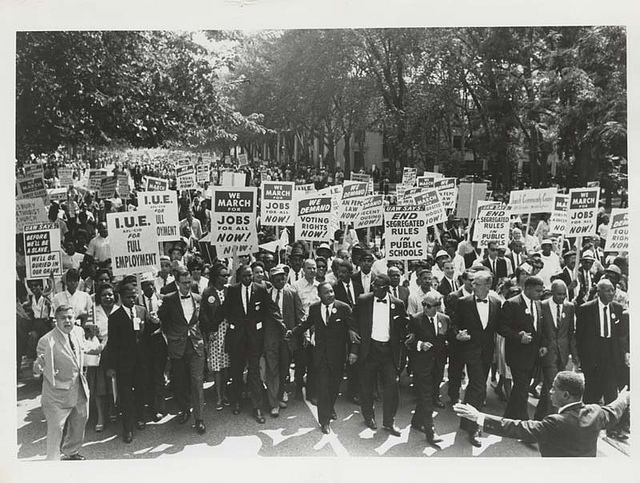
6891546499_d4a6f32215_z

Today marks the 50th anniversary march on Washington and I have a dream speech. Source: Flickr.

The jury is still out if our Nordic way of life and values will help us to stand togethers on that solid rock of brotherhood.  Anders Breivik on 22/7, the rise of the Sweden Democrats and Perussuomalaiset in Finland suggest that attitudes have toughened in this region of Europe as well.

Europe not only has the burden of the legacy of slavery and colonialism hanging over it, it has appeared time and again to haunt us and ravage our continent with wars and mass devastation.

Ethnic discrimination is an aberration and one of the worst social ills that can inflict us. There is a cure according to MLK: “Darkness cannot drive out darkness; only light can do that. Hate cannot drive out hate; only love can do that.”  

Great speeches like the one MLK gave half a century ago and the gains made by the Civil Rights Movement in the 1960s are clear examples that the most oppressed minorities can have a dream of a better life and challenge intolerance.

There are many parts of his speech that move me. One passage in particular I especially like: “I have a dream that my four little children will one day live in a nation where they will not be judged by the color of their skin but by their character.”

Hear MLK’s full speech here.

______________

Martin Luther King’s “I Have a Dream” speech, August 28, 1963

I am happy to join with you today in what will go down in history as the greatest demonstration for freedom in the history of our nation.

Five score years ago, a great American, in whose symbolic shadow we stand today, signed the Emancipation Proclamation. This momentous decree came as a great beacon of hope to millions of slaves, who had been seared in the flames of withering injustice. It came as a joyous daybreak to end the long night of their captivity. But one hundred years later, the colored America is still not free. One hundred years later, the life of the colored American is still sadly crippled by the manacle of segregation and the chains of discrimination.

One hundred years later, the colored American lives on a lonely island of poverty in the midst of a vast ocean of material prosperity. One hundred years later, the colored American is still languishing in the corners of American society and finds himself an exile in his own land So we have come here today to dramatize a shameful condition.

In a sense we have come to our Nation’s Capital to cash a check. When the architects of our great republic wrote the magnificent words of the Constitution and the Declaration of Independence, they were signing a promissory note to which every American was to fall heir.

This note was a promise that all men, yes, black men as well as white men, would be guaranteed to the inalienable rights of life liberty and the pursuit of happiness.

It is obvious today that America has defaulted on this promissory note insofar as her citizens of color are concerned. Instead of honoring this sacred obligation, America has given its colored people a bad check, a check that has come back marked “insufficient funds.”

But we refuse to believe that the bank of justice is bankrupt. We refuse to believe that there are insufficient funds in the great vaults of opportunity of this nation. So we have come to cash this check, a check that will give us upon demand the riches of freedom and security of justice.

We have also come to his hallowed spot to remind America of the fierce urgency of Now. This is not time to engage in the luxury of cooling off or to take the tranquilizing drug of gradualism.

Now is the time to make real the promise of democracy.

Now it the time to rise from the dark and desolate valley of segregation to the sunlit path of racial justice.

Now it the time to lift our nation from the quicksands of racial injustice to the solid rock of brotherhood.

Now is the time to make justice a reality to all of God’s children.

It would be fatal for the nation to overlook the urgency of the moment and to underestimate the determination of its colored citizens. This sweltering summer of the colored people’s legitimate discontent will not pass until there is an invigorating autumn of freedom and equality. Nineteen sixty-three is not an end but a beginning. Those who hope that the colored Americans needed to blow off steam and will now be content will have a rude awakening if the nation returns to business as usual.

There will be neither rest nor tranquility in America until the colored citizen is granted his citizenship rights. The whirlwinds of revolt will continue to shake the foundations of our nation until the bright day of justice emerges.

We can never be satisfied as long as our bodies, heavy with the fatigue of travel, cannot gain lodging in the motels of the highways and the hotels of the cities.

We cannot be satisfied as long as the colored person’s basic mobility is from a smaller ghetto to a larger one.

We can never be satisfied as long as our children are stripped of their selfhood and robbed of their dignity by signs stating “for white only.”

We cannot be satisfied as long as a colored person in Mississippi cannot vote and a colored person in New York believes he has nothing for which to vote.

No, we are not satisfied and we will not be satisfied until justice rolls down like waters and righteousness like a mighty stream.

I am not unmindful that some of you have come here out of your trials and tribulations. Some of you have come from areas where your quest for freedom left you battered by storms of persecutions and staggered by the winds of police brutality.

You have been the veterans of creative suffering. Continue to work with the faith that unearned suffering is redemptive.

Go back to Mississippi, go back to Alabama, go back to South Carolina go back to Georgia, go back to Louisiana, go back to the slums and ghettos of our modern cities, knowing that somehow this situation can and will be changed.

Let us not wallow in the valley of despair. I say to you, my friends, we have the difficulties of today and tomorrow.

I still have a dream. It is a dream deeply rooted in the American dream.

I have a dream that one day this nation will rise up and live out the true meaning of its creed. We hold these truths to be self-evident that all men are created equal.

I have a dream that one day out in the red hills of Georgia the sons of former slaves and the sons of former slaveowners will be able to sit down together at the table of brotherhood.

I have a dream that one day even the state of Mississippi, a state sweltering with the heat of oppression, will be transformed into an oasis of freedom and justice.

I have a dream that my four little children will one day live in a nation where they will not be judged by the color of their skin but by their character.

I have a dream today.

I have a dream that one day down in Alabama, with its vicious racists, with its governor having his lips dripping with the words of interpostion and nullification; that one day right down in Alabama little black boys and black girls will be able to join hands with little white boys and white girls as sisters and brothers.

I have a dream today.

I have a dream that one day every valley shall be engulfed, every hill shall be exalted and every mountain shall be made low, the rough places will be made plains and the crooked places will be made straight and the glory of the Lord shall be revealed and all flesh shall see it together.

This is our hope. This is the faith that I will go back to the South with. With this faith we will be able to hew out of the mountain of despair a stone of hope.

With this faith we will be able to transform the jangling discords of our nation into a beautiful symphony of brotherhood.

With this faith we will be able to work together, to pray together, to struggle together, to go to jail together, to climb up for freedom together, knowing that we will be free one day.

This will be the day when all of God’s children will be able to sing with new meaning “My country ’tis of thee, sweet land of liberty, of thee I sing. Land where my father’s died, land of the Pilgrim’s pride, from every mountainside, let freedom ring!”

And if America is to be a great nation, this must become true. So let freedom ring from the hilltops of New Hampshire. Let freedom ring from the mighty mountains of New York.

Let freedom ring from the heightening Alleghenies of Pennsylvania.

Let freedom ring from the snow-capped Rockies of Colorado.

Let freedom ring from the curvaceous slopes of California.

But not only that, let freedom ring from Stone Mountain of Georgia.

Let freedom ring from every hill and molehill of Mississippi and every mountainside.

When we let freedom ring, when we let it ring from every tenement and every hamlet, from every state and every city, we will be able to speed up that day when all of God’s children, black men and white men, Jews and Gentiles, Protestants and Catholics, will be able to join hands and sing in the words of the old spiritual, “Free at last, free at last. Thank God Almighty, we are free at last.”

Prepared by Gerald Murphy (The Cleveland Free-Net – aa300) Distributed by the Cybercasting Services Division of the National Public Telecomputing Network (NPTN).

Racism Review: United Nations’ Universal Declaration Of Human Rights: A Personal Perspective

Posted on July 9, 2013 by Migrant Tales
By Edna Chun

At the conclusion of the forthcoming third edition of Joe Feagin’s Racist America: Roots, Current Realities, and Future Reparations, he recommends that a new constitutional convention for a true multiracial democracy begin with the United Nation’s Universal Declaration of Human Rights ratified in 1948. Feagin points out that the United States has never had a constitutional convention that represented all or even the majority of the population. As he notes, the original constitutional convention that met in Philadelphia in 1787 was comprised of 55 white men, representing only 5 percent of the population, and did not include white women, Native Americans, or African Americans.

Kuvankaappaus 2013-7-9 kello 8.24.29

See original posting here.

Feagin’s identification of the U.N.’s Universal Declaration of Human Rights brings to mind the work of my father, Dr. Hung-Ti Chu, at the United Nations and his great personal admiration for Eleanor Roosevelt who shepherded the Universal Declaration of Human Rights to its ratification by the General Assembly. My father joined the United Nations in 1946 during the time the Declaration was drafted as a member of the Human Rights Division, and remained at the U.N. in the Secretariat until he retired more than twenty years later. He recalled that Eleanor Roosevelt considered the Universal Declaration of Human Rights to be the Magna Carta for all humankind. She viewed her role in securing adoption of the Declaration of Human Rights as her greatest achievement. Several years earlier, as a member of the steering committee of the International Student Conference representing the five great world powers, my father had breakfasted with her in the White House and was invited to sit in on FDR’s Fireside Chats over the radio.

My father came to this country as a scholarship student in recognition of his work in the Chinese nationalist movement, receiving his Ph.D. in Political Science from the University of Illinois in 1937. In 1942, he was invited to become President of Yunnan University in his home province of Yunnan, China, but due to political events and the Communist takeover, was not able to return. After joining the United Nations, he later served as the Principal Secretary of the United Nations Temporary Commission on Korea, and gave the opening speech of the first democratically-elected National Assembly in Korean history.

Following the death of Franklin Delano Roosevelt in 1946, Eleanor Roosevelt accepted a position offered by President Harry Truman on the first United States delegation to the United Nations. At the time she was the only woman on the delegation and in her words:

I knew that as the only woman, I ‘d better be better than anybody else. So I read every paper. And they were very dull sometimes, because State Department papers can be very dull. And I used to almost go to sleep over them, and– [laughs] But I did read them all. I knew that if I in any way failed, it would not be just my failure; it would be the failure of all women. There’d never be another woman on the delegation.

In a perceptive article titled “Eleanor Roosevelt and the Universal Declaration of Human Rights” John Sears states that many believe that the U.N. Commission on Human Rights that drafted the Declaration of Human Rights would not have succeeded without the skillful leadership of Eleanor Roosevelt in chairing the Commission. Without legal or parliamentary training, she oversaw the drafting of the Declaration through weeks of arguing over the meaning of each word and phrase.

The initial commission appointed to recommend a structure for the Human Rights Commission consisted ofEleanor Roosevelt and representatives from Norway, Belgium, China, India, Yugoslavia and the ambassador to the United States from China, Dr. C.L. Hsia. Dr. Hsia was a close personal friend and mentor of my father.

Furthermore, as Sears notes, Eleanor Roosevelt insisted upon the unequivocal anti-discrimination article in the Declaration. She believed it would support the struggle for civil rights in the United States and was aware of the shortcomings of this country in attaining these rights. She even clashed with members of the State Department who did not believe that economic and social rights belonged in a bill of human rights.

The U.N.’s Declaration of Universal Human Rights adopted by the U.N. General Assembly in 1948 asserts that “all human beings are born free and equal in dignity and rights” and that “all are equal before the law and are entitled without any discrimination to equal protection of the law.” Eleanor Roosevelt’s uncompromising view of universal human rights identifies the source of such rights in events close to home, such as in our everyday interactions:

Where, after all, do universal rights begin? In small places, close to home (…) Unless these rights have meaning there, they have little meaning anywhere.

In a time when women’s leadership was not widely accepted, Eleanor Roosevelt was truly “the first lady of the United States,” a skillful and practical negotiator, able to maneuver in confidence in male-dominated diplomatic circles, able to build the consensus necessary to forge a lasting testament to the freedom, equality, and dignity of all human beings.

Read original blog entry here.

This piece was reprinted by Migrant Tales with permission.

Kamppailu rasismia vastaan on usein kaksisuuntaista

Posted on April 7, 2012 by Sasu

Sasu Xinkang Ölander

Kamppailu rasismia vastaan on usein historiallisesti polarisoitunut kahteen suuntaukseen. Suvaitsevaiset, monikulttuurisuutta ihannoivat, monimuotoisuutta tukevat ja maltilliset vastaan ”suvaitsemattomat”, radikaalit, itsensä pelastajat ja pessimistit. Tämä jako menee usein valkoisten ja keskiluokkaisten värillisten ja köyhien tai muulla tavoin huonommassa asemassa olevien värillisten välillä. Toisaalta tämä jako menee enemmän valkoisten ja värillisten välillä, koska valkoiset useimmiten hakevat maltillista muutosta jos muutosta laisinkaan. Silmiin pistävää on, että värilliset helpommin siirtävät rasismi syytöksen yhteiskuntaan kuin yksilöön. Valkoiset melkeinpä rakastavat syyttää yksilöitä rasismista, mutta jättävät rakenteellisen rasismin aivan koskemattomaksi.

Maltillisen rasismin vastustaminen kulminoituu usein Nelson Mandela:aan ja Marti Luther Kingiin. He ovat olleet maailmanlaajuisesti tämän lähestymistavan ainoita personifikaatioita. On ehkä hyvä mainita, että kumpikaan ei ollut puhtaasti maltillisen näkökulman edustajia. Nelson itse oli nuoruudessaan ANC:een militantti nuorisojärjestön johtaja. Hän jopa julisti aseellisen kamppailun välttämättömyyttä juuri ennen pidätystä vuona 1964. King taas vaati massiivisia muutoksia amerikkalaiseen yhteiskuntaan ja loppua uusimperialisteille/ uuskolonialisteille sotilas operaatioille. Riverside Church New York, puheessaan hän avoimesti julisti, että Vietnamin sota on vain Yhdysvaltojen ja laajemmassa mielessä Länsimaisen ylpeyden ja globaalin rasismin huipentuma. King kehtasi jopa syyttää Yhdysvaltojen Pohjoisia liberaaleja rasististen systeemien puolustamisesta ja niiden uudelleen järjestelystä. Hän oli elämänsä lopussa inhottu monien valkoisten liberaalien keskuudessa. Niiden samojen, jotka olivat auttaneet tuhoamaan Etelän Jim Crow systeemin.

King uskoi maltillisuuteen. Hän ei puoltanut milloinkaan väkivaltaista vallankumousta. Me voimme nähdä tämän lähestymistavan juontavan suoraan kristillisestä uskostaan. King uskoi kirjaimellisesti uuteen testamenttiin. Väkivallaton vastarinta nousi suoraan Vuoren saarnoista. Ne jotka sanovat Kingin olleen Gandhin seuraaja tai matkia, eivät tunne Kingiä ollenkaan. Jos joku lyö sinua oikealle poskelle, käännä hänelle vasenkin (Matt 6: 39) oli Kingin vahvin rekrytointi väline Yhdysvaltojen Pohjoisia liberaaleja vastaan. Tässä urakassa auttoi suuresti hänen kielelliset taidot. King oli käynyt Etelän parhaimpia kouluja ja hänellä oli professuuri Bostonin yliopistosta. Rehellisesti voi sanoa hänen olevan malli esimerkki Etelän mustan keskiluokan menestyksestä.

Kingin etuoikeutettu asema mustassa yhteiskunnassa ja nuoruus teki hänestä keulakuvan. Joskus lukijat varmasti sanoivat Kingin olleen keulakuva, koska hän oli tosi taitava. Todellisuudessa King teki hyvin vähän organisointia. Suurempi kiitos menee Ella Bakerille ja isolle joukolle paikallisia aktivisteja. Keilakuvana King alkoi pitää puheita Etelän rasismista. Hänen puheensa harvoin jos ollenkaan käsittelivät Pohjoisen ghettoja. King kyllä tiesi niiden olemassa olosta, mutta päätti joko taktisista syistä tai yksi rintama kerralla ajattelu tavan kautta olla mainitsematta niistä. Näin hän vahvisti ajattelua siitä, että rasismi on Etelässä mutta ei Pohjoisessa.

King joutui pelottavasti todistamaan, miten rauhanomainen liike alkoi pikku hiljaa katkeroitua. King jopa itsekin alkoi pikku hiljaa katkeroitua. Pää syy oli siinä, että Pohjoisen valkoiset liittolaiset olivat haluttomia tekemään muutoksia muualla kuin laki pykälissä. ”You are creating hatred and hostility in the white communities in which you are marching”* Sanottiin Kingille kun hän marssi Chicagon ghettojen olojen puolesta. On selvää että 1960 luvun puolivälissä King yksinkertaisesti lopetti valkoisten liberaalien kanssa leikkimisen. Hän oli päättänyt viedä kansan vapauteen ilman valkoisten tukea jos niin on oltava.

Kingin saavutus Etelässä ei olisi voinut olla niin täydellinen, jos niin sanotut suvaitsemattomat mustat eivät olisi olleet olemassa. Suvaitsemattomat personifioituu Malcolm X:sään ja muihin hänen kaltaisiin. Malcolm X oli kummitus, joka kertoi mitä tapahtuu jos maltilliset epäonnistuvat. Malcolm oli pikkurikollinen New Yorkin ja Bostonin ghetoissa. Siinä missä King oppi ymmärtämään valkoiset yliopisto ympäristössä, pääsi Malcolm X murhien ja ghettojen kautta. Malcolm X:n isä kuoli Klu Kulx Klan:in (KKK) matkijoiden johdosta ja äiti oli lähetetty mielisairaalaan.

Malcolm X ymmärsi jo nuoresta pitäen, että Etelän rasistit ei oikeasti eroa tippaakaan Pohjoisen rasisteista. Malcolm X halveksi suuresti liberaaleja valkoisia, jotka yrittivät auttaa mustia. Liberaalit auttoivat Malcolm X:n näkökulmasta mustia, koska mustat ovat synnynnäisesti avuttomia. Hän huomasi mulatti äidin kautta, että jopa mustat uskoivat, että heistä vaalein on parempi. Kun hän aloitti elämän ghetoissa, hän oli jo oppinut, että mustalla ei voi olla suurempaa unelmaa kuin puuseppä tai pikkurikollinen.

Vankilassa hän tutustui järjestöön nimeltä Nation Of Islam. Tämä järjestö oli rasistisen yhteisön peilikuva: Mustien oma versio rasismista. He opettivat jumalan olevan musta ja valkoisen miehen olevan paholainen. Heidän silmissä mustien ainoa keino pelastautua on perustaa oma valtio. Tämä separatistinen ajattelu on ”suvaitsemattoman” siiven ytimessä. Idea on alunperin Marcu Garveyn kulminoima. Hän uskoi, että mustien on palattava takaisin Afrikkaan. Toisaaltaan tämän ajattelun keskiössä on myös Booker T. Washington joka uskoi oma-aloitteisuuteen. Ajatus on ottaa kaikki hyödyt apartheidistä. Näistä ajattelutavoista nousee Musta nationalismin liike ja Etelä-Afrikan Musta tietoisuus.

Malcolm X puhui mustille massoille eikä valkoisille liberaaleille. Tämä ero on huomattava, kun mietimme miksi hän puhui niin kuin puhui. King oli suuren osan ajastaan sidottu sanomaan asioita, jotka miellyttävät valkoisia liberaaleja. Malcolm sen sijaan sai aivan vapaasti kirota rasistista yhteiskuntaa mustien taputtaessa. Malcolmin viesti mustille oli: älä odota valkoista miestä pelastamaan sinua vaan pelasta itsesi. Mustien kuuluisi osoittaa teoilla, että he ovat aivan yhtä hyviä kuin valkoiset. Samalla hän kannusti mustia tekemään ghetoista heidän taloudellisen voiman lähteitä. Taloudellinen omavaraisuus juontuu siitä tosiasiasta, että lähes kaikki kaupat ja talot ghetossa olivat valkoisten omistuksessa. Musta yhteisö ilman mustia kauppoja oli hänen mielestä hirveä ongelma.

Malcolm X oli integroitumista vastaan suoralta kädeltä niin kauan, kuin hän kuului Nation Of Islamiin. Vasta sitten, kun hän oli eronnut Nation Of Islamista ja lähtenyt pyhiin vaellukseen Mekkaan, otti hän sunni islamin vastaan ja siirtyi integroitumisen vastustajasta osittaiseksi kannattajaksi, mutta säilyttäen kyynisyytensä. Malcolm ei uskonut integroitumisen auttavan mustia yhtään. Tämän ymmärtämiseksi on muistettava että hän koki suurimman osan rasismista Pohjoiseen integroituneessa yhteiskunnassa. Malcolm oli käynyt valkoista koulua ja hänet oli kasvattanut valkoinen äiti mielisairauden jälkeen. Hän tiesi erittäin hyvin miten mädäntyneet Pohjoisen ghetot olivat ja miten poliisi terrorisoi siellä. Malcolmin uusi kanta integroitumiseen oli että mustien ei kuuluisi suin päin integroitua valkoiseen yhteiskuntaan. Heidän pitäisi rakentaa oman arvon tunnetta ja rakentaa omaa yhteiskuntaa, kun he sitten integroituvat niin se tehdään samalta viivalta. Malcolm itse sanoi, että orja ei voi integroitua mestariin. Vain tasaveroiset voivat integroitua.

Oma-aloitteisuuden lisäksi hän kannusti ylpeyttä. Malcolm X  itse oli todiste, miten rasismi tuhoaa kyvyn uskoa omiin mahdollisuuksiin. Näin ollen vahvin vastalääke olisi täyttää mustat ylpeydellä omaan rotuun ja uskolla omiin kykyihin. Mustille annettaisiin jotakin mitä unelmoida. Melkein kymmenen vuotta Malcolm X  kuoleman jälkeen Steven Biko tiivisti ajattelun lauseeseen Liberation of the black man begins first with liberation from psychological oppresion by himself through an inferiority complex.

Malcolm X ei ikinä ollut kovin innostunut kansallisoikeus liikkeestä. Hän kyllä kannatti liikkeen tavoitteita, mutta hänellä oli hyvin erilainen käsitys siitä miten asiaa pitäisi edistää ja hän ei ikinä uskonut, että kansallisoikeus termi olisi oikea. Malcolm uskoi silmä silmästä periaatteeseen. Hänen mielestä mustien kuuluisi aseistautua ja puolustaa itseänsä KKK:n tai poliisin terrorilta. 1964 kesällä Malcolm X  lähetti viestin Kingille. Pyysi lupaa lähettää St. Augustinen mielenosoituksiin omia kannattajia, jotta he voisivat muodostaa itsepuolustus järjestön jolloin KKK saisi maistaa omaa lääkettä. King tietenkin kauhistui jo itse ajatuksesta. Malcolm X oli sitä mieltä, että termi kansallisoikeus vapauttaa valkoisen miehen tuomioistuimilta.

Valkoisia liittolaisia kohtaan Malcolm X oli vähintään kyyninen. Hän myönsi heidän työnsä tärkeyden, mutta epäili motiiveja. Hänen silmissä liittolainen tarkoittaa ihmistä, joka seisoo sorrettujen rinnalla ja antaa sorrettujen määrittää mihin suuntaan pitää mennä. Malcolm X huomasi nopeasti, että valkoiset ylimielisyydessään uskoivat tietävän sorrettuja paremmin miten rasismi hoidetaan. Hän piti näitä auttajia vain toisenlaisina sortajina. Usein Malcolm X sanoikin, että ainoa kunnon liittolainen on John Brown kaltainen liittolainen. Brown oli valkoinen mies joka 1850 luvun lopulla syyllistyi pahimman laatuiseen rikokseen. Hän sarjamurhasi orjan omistajia ja vapautti orjia. Siitä hän maksoi hengellään. Sellaisia liittolaisia Malcolm kaipasi. Hän ei halunnut kuulla sanoja suvaitsevaisuus tai maltillisuus. Ne olivat melkeinpä kirosanoja hänelle.

Valkoisille amerikkalaisille Malcolm X oli samaa kuin Steven Biko Etelä-Afrikan valkoisille, pahin painajainen. Musta joka on ylpeä mutta ei ole kiinnostunut valkoisten liehittelystä oli jotakin mikä voisi aloittaa rotu sodan. Valkoisten pelko on hyvin samanlainen, nurkkaan ajetun diktaattorin.

Pelko siitä mitä tapahtuu jos sorretut saavat rohkeutta vastustaa sortajia heidän omilla aseilla. Kumpikaan Malcolm X ja Steven Biko eivät sanoneet suoraan kannattavan rotu sotaa, mutta eivät he sitä kieltäneetkään. He olivat pelottavan varmoja siitä, että valkoisten pillien mukaan taisteleminen ei johda mihinkään. Parempi taistella ilman valkoisia. Erona Malcolmiin X Steven Biko onnistui hankimaan joitakin kannattajia valkoisten joukosta, mutta suuri enemmistö valkoisia alkoi demonisoida heitä. Heitä kutsuttiin vihanlietsojiksi, mustan rasismin profeetoiksi ja tunteilla leikkijöiksi. Yhteen vedottuna voisi sanoa, että valkoisille he olivat populisteja.

Harvoin me muistamme, että King oli pelottavan usein samaa mieltä Malcolm X:sän kanssa. Hänen viimeinen kirja Where Do We Go From Here chaos or community käsittelee sellaisia asioita joihin Malcolm X yhtyisi. Kirjassa hän vaatii valkoisia liittolaisia tekemään enemmän ja lopettamaan viisastelu. Siinä argumentoidaan vahvasti oma-aloitteisuuden ja omavaraisuuden puolesta. King kannusti mustia olemaan ylpeä omasta rodustaan. Hän puhui globaalista rasismista vaikka hän ei sitä termiä vielä käyttänyt. Pelottavinta valkoisille oli hänen vaatimus erityiskohtelusta mustille, jotta rasismin synnyttämä varallisuus kuilu saataisiin umpeen. King sai maksaa näistä mielipiteistä kovan hinnan.

Malcolm X:n sanat lausuttiin 1960-luvun Yhdysvalloissa, mutta niissä on totuutta. Mehän julistamme Kingin sanoja mutta emme sano niiden olleen ymmärrettäviä aikakaudelta. Sen sijaan sanomme mustien nationalistien ja musta tietoisuuden ajatusten olleen ymmärrettäviä aikakaudelle ihan kuin ne eivät olisi totta nykyään. Useimmin me pyyhimme heidät pois ja otamme vain I Have Dream Kingin mukaan. Radikalismi pyyhitään jotta valkoiset eivät tuntisi oloansa epämukavasi. 1960-luvun Yhdysvallan rasismi on silti pitkälti samaa rasismia mitä nykyään. Ei ehkä niin avoin, mutta silti sama.

Kirjoittaja on 18-vuotias lukiolainen Helsingistä. Hän määrittele itsensä aasialais-suomalaiseksi.

* Where Do We Go From Here chaos or community s,96


Colorlines: How to Be a Racial Justice Hero, on MLK Day and All Year Long

Posted on January 16, 2012 by Migrant Tales

Comment: Today is Martin Luther King Day in the United States. Like many who lived in the 1960s, MLK and the Civil Rights Movement he led in the 1950s and 1960s continues to inspire many like me today. 

I still remember the day when in junior high school in Hollywood we were told that Martin Luther King Jr. was killed.  It was in the afternoon in California since King Jr. was killed at 6:01 pm at the Lorraine Motel in Memphis, Tennessee.  Of that day I remember two things: a sense of despair since, like the John F. Kennedy assassination, another great man had been killed; a white man on the radio said that he was happy that King Jr. had been killed. 

[youtube=http://www.youtube.com/watch?v=3eD_joYaasM&feature=youtu.be]

What can we learn in Finland about MLK and others that fought for social justice at the time like Malcolm X?

The most important lesson is that we can change and make history. 

_______________

by Hatty Lee, Terry Keleher

As we celebrate a new year and another Martin Luther King holiday, it’s a good time to reflect on how you can be part of some positive change in the year ahead. Rather than the typical resolutions, which can get a bit self-absorbed, why not resolve to step up your game in making social change? The good news is that you already have everything you need, just as you are, to become a powerful force for racial justice. You can be a Racial Transformer. 

What’s that, you ask?

Read whole story.

Journalism and Blog Writing for Immigrants and Finns (March 2012)

Posted on November 2, 2011 by Migrant Tales

When? 22.-23.3.2012 & 29.-30.3.2012                                                                                                                                          Where? Otava Folk High School

Journalism and Blog Writing for Immigrants and Finns is a course designed for those who have an interest in journalism/blog writing and who speak English as a second language. The course offers the participant an opportunity to learn reporting and interviewing techniques as well as writing news stories, editorials, and columns. Another important part of the course is to study the role journalism plays in guaranteeing civil liberties such as freedom of expression and furthering acceptance of minorities such as immigrants.  

Journalism and Blog Writing for Immigrants and Finns -kurssi on tarkoitettu englantia toisena kielenä puhuville henkilöille, jotka ovat kiinnostuneita vaikuttamaan kirjoittamisen kautta. Kurssilla tutustutaan journalismin maailmaan ja menestyvän blogin rakentamiseen. Haastattelun rakenne, uutisjuttujen kirjoittaminen, pääkirjoitukset ja kolumnit ovat tärkeä osa kurssia. Kurssilla tarkastellaan eettisiä kysymyksiä ja sananvapauden roolia yhteiskunnassa. Opetuskieli kurssilla on englanti.

For further information click here.


Rosa Parks and Finland

Posted on September 3, 2011 by Migrant Tales

By Enrique Tessieri

Rosa Parks (1913-2005) is not only a symbol of the US civil rights movement but of countries like Finland as well. In order for history to change you don’t need a lot of firepower but people who lead by example. Rosa Parks is one of these we should not forget as Multicultural Finns and other minorities struggle for greater acceptance recognition in Finland.

                                                                                                             US civil rights activist  Rosa Parks.

One cannot change the world but one can with his or her example impact those that live around them. That is in a sense the story of Rosa Parks, who refused to give up her seat to a white person on a bus in December 1955 in Montgomery, Alabama.  Contrary to other brave blacks who had refused to give up their seat to a white person, Parks’ arrest sparked a bus boycott in Montgomery.

What is even more important was that Parks’ civil disobedience turned into an important symbol of the civil rights movement and against racial segregation.

Blacks were forced to sit in the back of buses in Montgomery and if the bus was full they were required to give up their seat to a white.

Even if this type of racial segregation does not exist in countries like Finland, there are more ingenious ways of forcing people to sit in back of the bus of society.  Just like blacks were forced to give up their seats to whites on buses, immigrants and minorities in Finland are the last ones to get employed and the first ones to be laid off.

The ways racism is practiced may have changed but it is still the same ogre that segregated blacks in the United States but created one of its greatest symbols.

Finland’s Tahrir Square is located on Facebook

Posted on May 28, 2011 by Migrant Tales

How deep in denial is Finland concerning the Perussuomalaiset (PS) and the values they represent? It’s pretty clear that the shameful racist gaffes of PS MP Teuvo Hakkarainen and the party’s public statement on Thursday condemning racism are fuelling Finland’s Tahrir Square on social media sites like Facebook.

Just like what ignited the Arab street to rise up against their despotic rulers, we are seeing in Finland candid outrage to social ills like racism that have been accepted in silence for so long but never seriously challenged.

The PS’ public statement denouncing all forms of racism is a good example of how Timo Soini’s party is emboldening Finns to take action in our own Tahrir Square. We saw it gain strength right after the April 17 election when about 1,000 people demonstrated against the PS in front of parliament.

Apart from PS MP Hakkarainen, whose racist gaffes have made Finland a worse place to live for minorities like immigrants, the public statement by the PS denouncing all forms of racism is a good example of their cat-and-mouse game stance on racism.

But what else could be expected from a party that mixes too often facts with populism and hearsay? The statement against racism by the PS is another unfortunate example: We agree to be against all forms of racism and discrimination as long as we destroy minority rights by doing away with so-called positive discrimination.

Some professors like Kaarlo Tuomi, Tuomas Ojanen and Veli-Pekka Viljanen warned in Saturday’s Helsingin Sanomat that the PS statement was “terrible” and “very problematic” because it is in conflict with our Constitution. Instead of promoting equality it would undermine it fatally.

The PS have crossed once again another line but have revealed to us their double-talk and how they plan to further their jumbled political agenda for this country.

Since leading political parties like Kokoomus and the Social Democrats underestimated the PS and did not consider their challenge a menace to our society on matters like racism, it is then the job of common people to take action, which they have started on different social media sites.

The continued willingness of different political leaders to continue to see Soini as a “moderate” and “nice guy” is synonymous with burying one’s head in the sand. They should look at the big picture: The PS has 39 MPs in parliament that would be ready to water down minority rights for their brand of populist nationalism.

Recent attacks reported in the media of immigrants by thugs and the PS’ wishy-washy stand on racism ensure that Finland’s Tahrir Square will continue to gain strength.

Does Finland and Europe need a civil rights movement?

Posted on October 5, 2008 by Migrant Tales

One of the things that has surprised me about this blog are the overtly racist comments. These types of opinions resemble how some whites saw blacks in the United States before the civil rights movement. I do not think it has anything to do with expressing one’s opinions freely nor that some Finns and Europeans are too blunt or sincere.

Even when we deal with people from our same national group, we do not go around insulting them because we know that it is counterproductive and only creates conflict. Would you want to integrate and embrace the values of a society if it is openly hostile to you?

If we want good relations, we have to know how to moderate our thoughts and take the other person into consideration. It is that easy, folks. It does not need political correctness or any magic tricks — only consideration for others.

Some people in Finland and Europe think that it is still “politically correct” to openly insult other national groups with their racist opinions. Here is an example of a comment I picked up recently from another blog:

Certainly there is discrimination in Finland, hatred for the Russians, chauvinism as well as other things – but what of it? Couldn’t we point out that these things are part of Finnish culture? Since they are a part of our official culture, we could make a point that they have to be protected from immigrants. It could certainly work that way – or maybe not?

Taking into account the racial cleansing we saw in the former Yugoslavia and horrors like the Holocaust, Europe can learn a lot from the United States and Canada about how to resolve long blistering race issues. Possibly a civil rights movement in Europe would help wipe out much of the overt racism that exists mostly unscathed.

The day will come when a blacks, Muslims, people from all religions, dark and white people from any nation will be able to walk the streets of Finland and Europe as equals. Certainly the most important step in this direction is accepting and respecting each others diversity.

  • Previous
  • 1
  • 2
Read more about documentary film
Read more

Recent Posts

  • Finland’s tabloids Iltalehti and Ilta-Sanomat are the pits
  • Riikka Purra’s Dr Jekyll and Mr Hyde mask
  • Double standards
  • Perussuomalaiset: Uusi logo, sama vanha juttu
  • Taco Trump

Recent Comments

  1. Absolutely Socking: Racist Finnish Facebook group against human rights gets flooded with socks on Musta Barbaari’s mother and sister charged by the police in “ethnic profiling” case
  2. Ilkka Nuotio on Pekka Myrskylä: “Tilastot kertovat toista kuin poliittinen keskustelu”
  3. Genrih Soinkara on The war in Ukraine and the Russian-Finnish border crisis are showing Finland’s ugly side
  4. Ahti Tolvanen on Comment by Ahti Tolvanen on the Helsinki +50 conference
  5. Angel Barrientos on Angel Barrientos is one of the kind beacons of Finland’s Chilean community

Archives

  • June 2026
  • May 2026
  • April 2026
  • March 2026
  • February 2026
  • January 2026
  • December 2025
  • November 2025
  • October 2025
  • September 2025
  • August 2025
  • July 2025
  • June 2025
  • May 2025
  • April 2025
  • March 2025
  • February 2025
  • January 2025
  • December 2024
  • November 2024
  • October 2024
  • September 2024
  • August 2024
  • July 2024
  • June 2024
  • May 2024
  • April 2024
  • March 2024
  • February 2024
  • January 2024
  • December 2023
  • November 2023
  • October 2023
  • September 2023
  • August 2023
  • July 2023
  • June 2023
  • May 2023
  • April 2023
  • March 2023
  • February 2023
  • January 2023
  • December 2022
  • November 2022
  • October 2022
  • September 2022
  • August 2022
  • July 2022
  • June 2022
  • May 2022
  • April 2022
  • March 2022
  • February 2022
  • January 2022
  • December 2021
  • November 2021
  • October 2021
  • September 2021
  • August 2021
  • July 2021
  • June 2021
  • May 2021
  • April 2021
  • March 2021
  • February 2021
  • January 2021
  • December 2020
  • November 2020
  • October 2020
  • September 2020
  • August 2020
  • July 2020
  • June 2020
  • May 2020
  • April 2020
  • March 2020
  • February 2020
  • January 2020
  • December 2019
  • November 2019
  • October 2019
  • September 2019
  • August 2019
  • July 2019
  • June 2019
  • May 2019
  • April 2019
  • March 2019
  • February 2019
  • January 2019
  • December 2018
  • November 2018
  • October 2018
  • September 2018
  • August 2018
  • July 2018
  • June 2018
  • May 2018
  • April 2018
  • March 2018
  • February 2018
  • January 2018
  • December 2017
  • November 2017
  • October 2017
  • September 2017
  • August 2017
  • July 2017
  • June 2017
  • May 2017
  • April 2017
  • March 2017
  • February 2017
  • January 2017
  • December 2016
  • November 2016
  • October 2016
  • September 2016
  • August 2016
  • July 2016
  • June 2016
  • May 2016
  • April 2016
  • March 2016
  • February 2016
  • January 2016
  • December 2015
  • November 2015
  • October 2015
  • September 2015
  • August 2015
  • July 2015
  • June 2015
  • May 2015
  • April 2015
  • March 2015
  • February 2015
  • January 2015
  • December 2014
  • November 2014
  • October 2014
  • September 2014
  • August 2014
  • July 2014
  • June 2014
  • May 2014
  • April 2014
  • March 2014
  • February 2014
  • January 2014
  • December 2013
  • November 2013
  • October 2013
  • September 2013
  • August 2013
  • July 2013
  • June 2013
  • May 2013
  • April 2013
  • March 2013
  • February 2013
  • January 2013
  • December 2012
  • November 2012
  • October 2012
  • September 2012
  • August 2012
  • July 2012
  • June 2012
  • May 2012
  • April 2012
  • March 2012
  • February 2012
  • January 2012
  • December 2011
  • November 2011
  • October 2011
  • September 2011
  • August 2011
  • July 2011
  • June 2011
  • May 2011
  • April 2011
  • March 2011
  • February 2011
  • January 2011
  • December 2010
  • November 2010
  • October 2010
  • September 2010
  • August 2010
  • July 2010
  • June 2010
  • May 2010
  • April 2010
  • March 2010
  • February 2010
  • January 2010
  • December 2009
  • November 2009
  • October 2009
  • September 2009
  • August 2009
  • July 2009
  • December 2008
  • November 2008
  • October 2008
  • September 2008
  • August 2008
  • July 2008
  • June 2008
  • May 2008
  • April 2008
  • March 2008
  • February 2008
  • January 2008
  • November 2007
  • October 2007
  • September 2007
  • August 2007
  • July 2007
  • June 2007
  • May 2007

Categories

  • ?? Gia L?c
  • ????? ?????? ????? ???????? ?? ??????
  • ???????
  • @HerraAhmed
  • @mondepasrond
  • @nohatefinland
  • @oula_silver
  • @Varathas
  • A Pakistani family
  • äärioikeisto
  • Abbas Bahmanpour
  • Abdi Muhis
  • Abdirahim Hussein Mohamed
  • Abdirahim Husu Hussein
  • Abdirisak Mahamed
  • About Migrant Tales
  • activism
  • Adam Al-Sawad
  • Adel Abidin
  • Afrofinland
  • Ahmed IJ
  • Ahti Tolvanen
  • Aino Pennanen
  • Aisha Maniar
  • Alan Ali
  • Alan Anstead
  • Alejandro Díaz Ortiz
  • Alekey Bulavsev
  • Aleksander Hemon
  • Aleksanterinliitto
  • Aleksanterinliitto ry
  • Aleksanterinliitto ry:n hallitus
  • Alex Alex
  • Alex Mckie
  • Alexander Nix
  • Alexandra Ayse Albayrak
  • Alexis Neuberg
  • Ali Asaad Hasan Alzuhairi
  • Ali Hossein Mir Ali
  • Ali Rashid
  • Ali Sagal Abdikarim
  • Alina Tsui
  • Aline Müller
  • All categories
  • Aman Heidari
  • Amiirah Salleh-Hoddin & Jana Turk
  • Amin A. Alem
  • Amir Zuhairi
  • Amkelwa Mbekeni
  • Ana María Gutiérrez Sorainen
  • Anachoma
  • Anders Adlecreutz
  • Angeliina Koskinen
  • Anna De Mutiis
  • Anna María Gutiérrez Sorainen
  • Anna-Kaisa Kuusisto ja Jaakko Tuominen
  • Annastiina Kallius
  • Anneli Juise Friman Lindeman
  • Announcement
  • Anonymous
  • Antero Leitzinger
  • anti-black racism
  • Anti-Hate Crime Organisation Finland
  • Anudari Boldbaatar
  • Arshiya Nasser
  • Aspergers Syndrome
  • Asylum Corner
  • Asylum seeker 406
  • Athena Griffin and Joe Feagin
  • Autism
  • Avaaz.org
  • Awale Olad
  • Ayan Said Mohamed
  • AYY
  • Barachiel
  • Bashy Quraishy
  • Beatrice Kabutakapua
  • Beri Jamal
  • Beri Jamal and Enrique Tessieri
  • Bertolt Brecht
  • Boiata
  • Boodi Kabbani
  • Bruno Gronow
  • Carmen Pekkarinen
  • Çelen Oben and Sheila Riikonen
  • Chiara Costa-Virtanen
  • Chiara Costa-Virtanen
  • Chiara Sorbello
  • Christian Thibault
  • Christopher Wylie
  • Clara Dublanc
  • Dana
  • Daniel Malpica
  • Danilo Canguçu
  • David Papineau
  • David Schneider
  • Dexter He
  • Don Flynn
  • Dr Masoud Kamali
  • Dr. Faith Mkwesha
  • Dr. Theodoros Fouskas
  • Edna Chun
  • Eeva Kilpi
  • Emanuela Susheela
  • En castellano
  • ENAR
  • Enrique
  • Enrique Tessieri
  • Enrique Tessieri & Raghad Mchawh
  • Enrique Tessieri & Yahya Rouissi
  • Enrique Tessieri and Muhammed Shire
  • Enrique Tessieri and Sira Moksi
  • Enrique Tessieri and Tom Vandenbosch
  • Enrique Tessieri and Wael Che
  • Enrique Tessieri and Yahya Rouissi
  • Enrique Tessieri and Zimema Mhone
  • Epäluottamusmies
  • EU
  • Europe
  • European Islamophobia Report
  • European Islamophobia Report 2019,
  • European Union
  • Eve Kyntäjä
  • Ezequiel Caldeiro
  • Facebook
  • Fadumo Dayib
  • Faisa Kahiye
  • Farhad Manjoo
  • Fasismi
  • Finland
  • Fizza Qureshi
  • Flyktingar och asyl
  • Foreign Student
  • Fozia Mir-Ali
  • Frances Webber
  • Frida Selim
  • Gareth Rice
  • Ghyslain Vedeaux
  • Global Art Point
  • Great Replacement
  • Habiba Ali
  • Hami Bahadori
  • Hami Bahdori
  • Hamid
  • Hamid Alsaameere
  • Hamid Bahdori
  • Handshake
  • Harmit Athwal
  • Hassan Abdi Ali
  • Hassan Muhumud
  • Heikki Huttunen
  • Heikki Wilenius
  • Helsingin Sanomat
  • Henning van der Hoeven
  • Henrika Mälmsröm
  • Hser Hser
  • Hser Hser ja Mustafa Isman
  • Husein Muhammed
  • Hussain Kazemian
  • Hussain Kazmenian
  • Ibrahim Khan
  • Ida
  • Ignacio Pérez Pérez
  • Iise Ali Hassan
  • Ilari Kaila & Tuomas Kaila
  • Imam Ka
  • inside-an-airport
  • Institute of Race Relations
  • Iraqi asylum seeker
  • IRR European News Team
  • IRR News Team
  • Islamic Society of Norhern FInland
  • Islamic Society of Northern Finland
  • Islamophobia
  • Jacobinmag.com
  • Jallow Momodou
  • Jan Holmberg
  • Jane Elliott
  • Jani Mäkelä
  • Jari Luoto
  • Jari Taponen
  • Jegor Nazarov
  • Jenni Stammeier
  • Jenny Bourne
  • Jessie Daniels
  • Joe Davidow
  • Johannes Koski
  • John D. Foster
  • John Grayson
  • John Marriott
  • Jon Burnett
  • Jorma Härkönen
  • Jos Schuurmans
  • José León Toro Mejías
  • Josue Tumayine
  • Jouni Karnasaari
  • Juan Camilo
  • Jukka Eräkare
  • Julian Abagond
  • Julie Pascoet
  • Jussi Halla-aho
  • Jussi Hallla-aho
  • Jussi Jalonen
  • JusticeDemon
  • Kadar Gelle
  • Kaksoiskansalaisuus
  • Kansainvälinen Mikkeli
  • Kansainvälinen Mikkeli ry
  • Katherine Tonkiss
  • Kati Lepistö
  • Kati van der Hoeven-Lepistö
  • Katie Bell
  • Kättely
  • Kerstin Ögård
  • Keshia Fredua-Mensah & Jamie Schearer
  • Khadidiatou Sylla
  • Khadra Abdirazak Sugulle
  • Kiihotus kansanryhmää vastaan
  • Kirsi Crowley
  • Koko Hubara
  • Kristiina Toivikko
  • Kubra Amini
  • KuRI
  • La Colectiva
  • La incitación al odio
  • Laura Huhtasaari
  • Lauri Finér
  • Leif Hagert
  • Léo Custódio
  • Leo Honka
  • Leontios Christodoulou
  • Lessie Branch
  • Lex Gaudius
  • Leyes de Finlandia
  • Liikkukaa!
  • Linda Hyökki
  • Liz Fekete
  • M. Blanc
  • Maarit Snellman
  • Mahad Sheikh Musse
  • Maija Vilkkumaa
  • Malmin Kebab Pizzeria Port Arthur
  • Marcell Lorincz
  • Mari Aaltola
  • María Paz López
  • Maria Rittis Ikola
  • Maria Tjader
  • Marja-Liisa Tolvanen
  • Mark
  • Markku Heikkinen
  • Marshall Niles
  • Martin Al-Laji
  • Maryan Siyad
  • Matt Carr
  • Mauricio Farah Gebara
  • Media Monitoring Group of Finland
  • Micah J. Christian
  • Michael McEachrane
  • Michele Levoy
  • Michelle Kaila
  • Migrant Tales
  • Migrant Tales Literary
  • Migrantes News
  • Migrants' Rights Network
  • MigriLeaks
  • Mikko Kapanen
  • Miriam Attias and Camila Haavisto
  • Mohamed Adan
  • Mohammad Javid
  • Mohammad M.
  • Monikulttuurisuus
  • Monisha Bhatia and Victoria Canning
  • Mor Ndiaye
  • Muh'ed
  • Muhamed Abdimajed Murshid
  • Muhammed Shire
  • Muhammed Shire and Enrique Tessieri
  • Muhis Azizi
  • Musimenta Dansila
  • Muslimiviha
  • Musulmanes
  • Namir al-Azzawi
  • Natsismi
  • Neurodiversity
  • New Women Connectors
  • Nils Muižnieks
  • No Labels No Walls
  • Noel Dandes
  • Nuor Dawood
  • Omar Khan
  • Otavanmedia
  • Oula Silvennoinen
  • Paco Diop
  • Pakistani family
  • Pentti Stranius
  • Perussuomalaiset
  • perustuslaki
  • Petra Laiti
  • Petri Cederlöf
  • Pia Grochowski
  • Podcast-lukija Bea Bergholm
  • Pohjois – Suomen Islamilainen Yhdyskunta
  • Pohjois Suomen Islamilainen Yhyskunta
  • Polina Kopylova
  • Race Files
  • racism
  • Racism Review
  • Raghad Mchawh
  • Ranska
  • Rashid H. and Migrant Tales
  • Rasismi
  • Raul Perez
  • Rebecka Holm
  • Reem Abu-Hayyeh
  • Refugees
  • Reija Härkönen
  • Remiel
  • Reza Nasri
  • Richard Gresswell
  • Riikka Purra
  • Risto Laakkonen
  • Rita Chahda
  • Ritva Kondi
  • Robito Ibrahim
  • Roble Bashir
  • Rockhaya Sylla
  • Rodolfo Walsh
  • Roger Casale
  • Rostam Atai
  • Roxana Crisólogo Correa
  • Ruth Grove-White
  • Ruth Waweru-Folabit
  • S-worldview
  • Sadio Ali Nuur
  • Sami Rusanen
  • Sandhu Bhamra
  • Sara de Jong
  • Sarah Crowther
  • Sari Alhariri
  • Sarkawt Khalil
  • Sasu
  • Scot Nakagawa
  • Shabana Ahmadzai
  • Shada Islam
  • Sharon Chang blogs
  • Shenita Ann McLean
  • Shirlene Green Newball
  • Sini Savolainen
  • Sira Moksi
  • Sonia K.
  • Sonia Maria Koo
  • Steverp
  • Stop Deportations
  • Suldaan Said Ahmed
  • Suomen mediaseurantakollektiivi
  • Suomen Muslimifoorumi ry
  • Suomen viharikosvastainen yhdistys
  • Suomen viharikosvastainen yhdistys ry
  • Suomi
  • Supermen
  • Susannah
  • Suva
  • Syrjintä
  • Talous
  • Tapio Tuomala
  • Taw Reh
  • Teivo Teivainen
  • The Daily Show
  • The Heino
  • The Supermen
  • Thomas Elfgren
  • Thulfiqar Abdulkarim
  • Tim McGettigan
  • Tino Singh
  • Tito Moustafa Sliem
  • Tobias Hübinette and L. Janelle Dance
  • Transport
  • Trica Danielle Keaton
  • Trilce Garcia
  • Trish Pääkkönen
  • Trish Pääkkönen and Enrique Tessieri
  • Tuulia Reponen
  • Uncategorized
  • UNITED
  • University of Eastern Finland
  • Uyi Osazee
  • Väkivalta
  • Vapaa Liikkuvuus
  • Venla-Sofia Saariaho
  • Vieraskynä
  • W. Che
  • W. Che an Enrique Tessieri
  • Wael Ch.
  • Wan Wei
  • Women for Refugee Women
  • Xaan Kaafi Maxamed Xalane
  • Xassan Kaafi Maxamed Xalane
  • Xassan-Kaafi Mohamed Halane & Enrique Tessieri
  • Yahya Rouissi
  • Yasmin Yusuf
  • Yassen Ghaleb
  • Yle Puhe
  • Yuliet Tresa
  • Yve Shepherd
  • Zahra Khavari
  • Zaker
  • Zalina Ametova
  • Zamzam Ahmed Ali
  • Zeinab Amini ja Soheila Khavari
  • Zimema Mahone and Enrique Tessieri
  • Zimema Mhone
  • Zoila Forss Crespo Moreyra
  • ZT
  • Zulma Sierra
  • Zuzeeko Tegha Abeng
© 2026 Migrant tales | Powered by Minimalist Blog WordPress Theme