Ezequiel Caldeiro es mi primo de Buenos Aires, Argentina, al que le gusta fotografiar a la gente en la calle. Para quienes no conocen Buenos Aires, suele tomar fotos los domingos en el barrio de San Telmo, una zona pintoresca y tradicional que parece una máquina del tiempo capaz de transportarte a otras épocas.
Ezequiel utiliza una cámara Nikon DC7500. Dice que a la gente no suele importarle que les haga fotos.
Le pedí que eligiera seis de sus últimas fotos que más le gustar.
Además, Ezequiel también vende pensamientos.
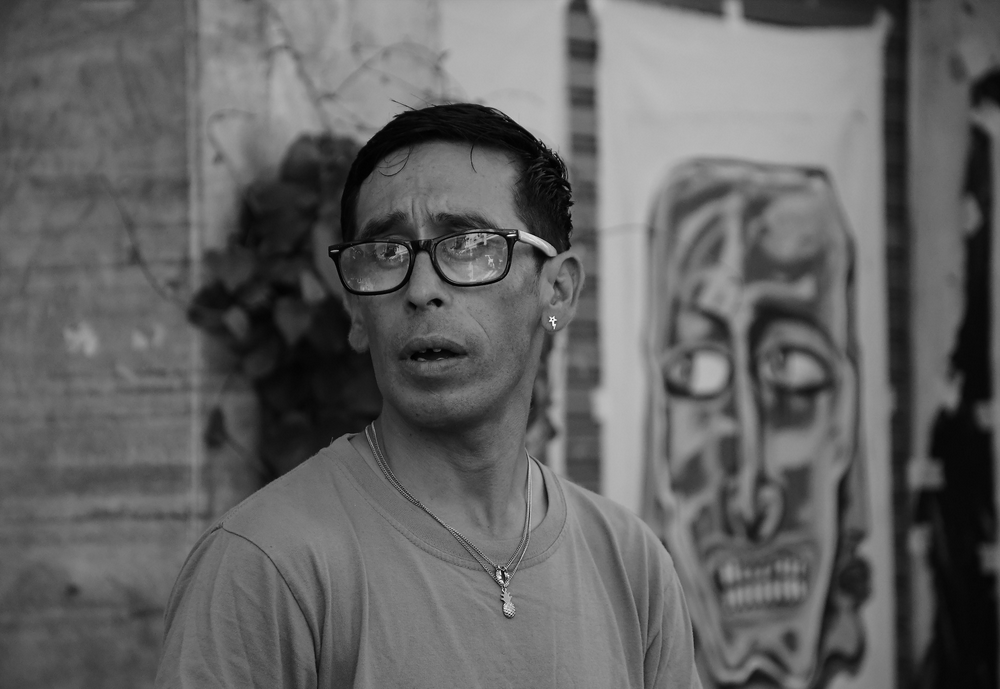
A Ezequiel le gustó esta foto por la imagen en el fondo.
Aparte del cabello de la mujer, el aro le da un toque mágico.
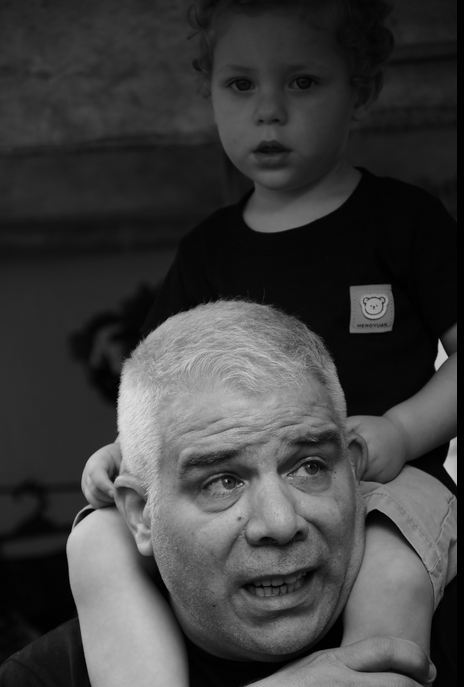
Ezequiel dice que le gusta el contraste del hombre con el chico.
Traveling is almost like talking with those of other centuries.
Rene Descartes (1506-1650)
The statement by the French philosopher and mathematician is true and may provide an answer on why some of us are restless travelers. When we move to a new city of country, do we subconsciously stay in contact with our former hoe, cherished relatives, friends and memories? Does our wish to remain spiritually connected to such matters reveal why – after many generations – some of us in faraway lands stubbornly refuse to severe ties with a country like Finland?
Possibly, some of us are nothing more than antique collectors of culture, which decorate the shelves of our soul. If you had a chance to see my soul, you’d notice shelves extending as far as the eyes can see with ornaments and heirlooms of Finnish and other cultures gathering soul dust.
A book publsihed in 2006 to commemorate the 100th anniversary of the founding of Colonia Finlandesa, Argentina.
I still can’t place my finer on it, but there’s something bewitching that the streets of bygone times house. Is it a lost dream? A passionate desire? An eternal gut feeling that spiritual and material wealth are around the corner? Or will we find our former relatives on such streets and have the opportunity to ask them the immigrant question of all questions: What did you search so hard for?
What they searched for
Since Argentina has been on the front pages of the world’s major dailies, with your permission, we will momentarily travel to the streets of that country, where my Italian great grandparents migrated to in the end of 1890s.
Like the U.S., Canada and Australia, millions of Europeans moved to Argentina in the 19th and early 20th century. Most of these migrants were Italians and Spaniards. A tiny group of Finns founded in 1906 a colony in the subtropical jungles of north-eastern Argentina.
In the 1914 census, 30% of Argentina’s population comprised o foreigners and its capital city, Buenos Aires, the figure stood at 49%! Add to these percentages the children of these migrants and the foreign-to-native ratio becomes even more impressive.
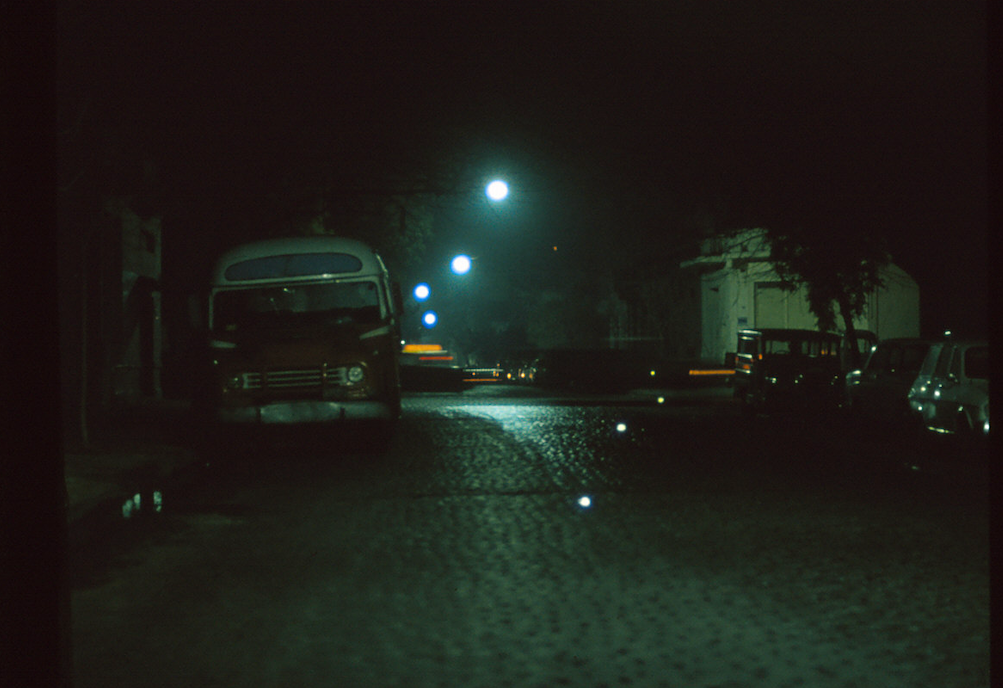
If you visit a residential neighborhood of Buenos Aires like Flores, where my grandparents once lived, you’ll still find early-20th-century Parisian-style houses adorning sleepy oak-lined cobblestone streets.
Many of the older residents of Flores despise time because they say it distances them from those they love and who where from distant European lands. The residents of the neighborhood have ingenious methods of stopping time: They park vintage cars like Fords from the 1930s in front of their homes. Some have portraits of ancient heads of state like King Victor Emmanuel II of Italy, Spain’s Francisco Franco and Czar Nicholas II hanging on the walls of their homes.
The inhabitants understand that if time is allowed to wander freely, it turns into the worst ogre devouring everything in its path.
El 24 de marzo de 1976 marcó un día infame que es imposible de olvidar tanta violencia. Aunque esa pesadilla sigue viva, la esperanza no se deja de conquistar por el terror.
Atrás del dibujo por Anikó Szabó, hay un mensaje de una amiga que me mandó en 1978 en plena dictadura militar. Lo conservo todavía después de 47 años.
“Esta tarjeta es una realidad para que siempre te recuerdes de estos pagos tan lejanos, practicamente en el FIN del mndo pero que es tan querido por nosotros. Ya va a llegar un día en que el sol saldrá realmente para todos en estas latitudes, el asunto es seguir siendo como somos y formar a la gente, educarla para que comprenda y comience a espertar, a abrir sus ojos. Claudia”
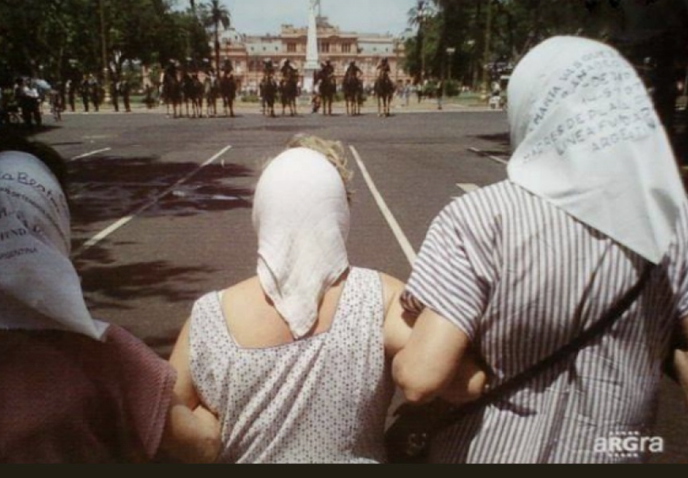
Las Madres de Plaza de Maho son una constante fuente de lucha y esperanza.
In a world where migration constantly weaves new identities and is even seen as a threat to national identities, countries in Europe are throwing all their political weight to slow such a natural process. Being from a multicultural and multinational background can be a problem in a world that sees new identities as a threat.
On my life’s journey, I made over four decades ago one of the greatest discoveries and found peace with my multicultural self in my native Buenos Aires, Argentina, at the Finnish Seaman’s Church. Even if such pleasant landscapes no longer witness my patient silence and stance, they are now memories that have turned into imaginary cities of the mind, where every building stands out eager to tell you a story.
Even though I have visited the Finnish Seaman’s Church on many occasions, the days I spent there as a brief tenant in 1999 brought me back to the beginning of a long journey I began in the 1990s.
The Finnish Seaman’s Church at aт San Juan 234, Buenos Aires. Photo by Enrique Tessieri.
For months, I kept the secret to myself. I didn’t even dare reveal it to my wife. Living a few years later in the northern part of South America, in the twilight quagmire of the violence and strife that has gripped Colombia for decades, I have decided to share the secret with you.
Dante and Jacob
William Blake (1757-1827) once said that improvements make straight roads but the crooked ones without improvement are roads of genius. Was my multicultural background my crooked road?
Both of my great-grandparents had migrant migrant backgrounds. One of them, Dante, was an anarchist sent to a prison on the island of Pantelleria, located between Sicily and Tunisia. Jacob’s great-grandfather, Jacob Weikain, a tinsmith, had emigrated to Finland from Latvia in 1799.
My family has been on the move for generations. A journey may take generations to complete, if ever. Is this the reason why in my deepest thoughts I am always traveling somewhere else, searching elsewhere? Does it reveal why I feel many times like standing alone in a railway station waiting for the last train home, feeling like being in the land of nowhere with a sense of being somewhere else?
At the end of the last century, the Finns were sowing the seeds of their independence from the Russian Empire. Italy comprising several kingdoms, duchies, and city-states, became a unified country in 1861.
Even if Dante and Jacob are talks of the past, and when they were alive I was talk of the future, I can say confidently that the yearning and restlessness that I feel is because of them or possibly it has to do with the fact that I was born in an enormous transit lounge called Argentina. I am like many that were born in that land: my great-grandparents arrived as migrants and after three generations, their great-grandchildren became migrants again.
Due to my multinational background, I used to feel out of place but understand such feelings were nothing more than my prejudices. Thanks to the Finnish Seamen’s Church of Buenos Aires, I don’t feel out of place at all no matter where I am.
The world is becoming a very small place as time races ahead. For this reason, I believe that my children and grandchildren will be luckier than I am. In the millennium we’ll be able to enter and leave cultures and lifestyles and be if I wish – from many places and will not be judged as a result.
As long as we are not overcome by racial hatred, greed, and power, life in the millennium will be like being in a vast city like Buenos Aires, London, or New York, where everyone is from somewhere but where no one is a real or imagined native.
If we all learned to understand that we are nothing more than temporary beings on Earth searching endlessly for that hill where the grass is greener on the other side where we can be from nowhere to be from everywhere.
President Jimmy Carter, you don’t know me but I’d like to thank you from the bottom of my heart for giving me hope during one of my darkest hours when I was in Argentina during the dirty war (1976-83).
At the time when you mentioned that human rights would form a part of US foreign policy, I was arrested in Buenos Aires and thrown in a prison cell for forgetting my ID at home. There was no habeas corpus, no due process and everything appeared to be left to chance as I stared out through the barred opening into the overcast day from the cold cell.
I remember that day so clearly and didn’t feel forsaken because you had spoken about human rights. I was a young man back then and started to study more in detail the thirty sections of the UN Declaration of Human Rights.
I write this email to you, Mr. President, because I read that President Donald Trump has asked Argentine President Mauricio Macri to rescind a decision to give you the Order of San Martin, Argentina’s most prestigious medal.
I am ashamed and saddened by the actions of Argentina’s president.
Even so, I want you to know that your foreign policy of human rights during your mandate as US president will never be forgotten by me. It gave me hope during one of the darkest moments of my life, when I was physically detained in a cell on a Saturday afternoon.
I recovered from that incident but haven’t ever forgotten it. I work today as a techer and anti-racism activist during my spare time.
Contrary to the last three parliamentary elections in 2011, 2015, and 2019, the upcoming parliamentary election on April 2 is different for several reasons: war rages in the Ukeraine, Finland has sought Nato membership, economic growth, and chronic labor shortages are just a few.
Apart from labeling people from outside the EU as “harmful” migrants, the radical right Perussuomalaiset (PS)* attempts to argue with several CEOs of Finnish companies that rely on foreign workers that the party has nothing against qualified immigrants but is against what it labels “social welfare” immigrants.
“Finland is not very successful in attracting immigration that is economically beneficial, but it receives a lot of immigration that is economically detrimental,” Riikka Purra, the head of the PS, was quoted as saying in Kauppalehti, adding that she is against what she calls “social welfare” migrants.
Purra’s argument reminds me of a story I published in Savon Sanomat in 2012.
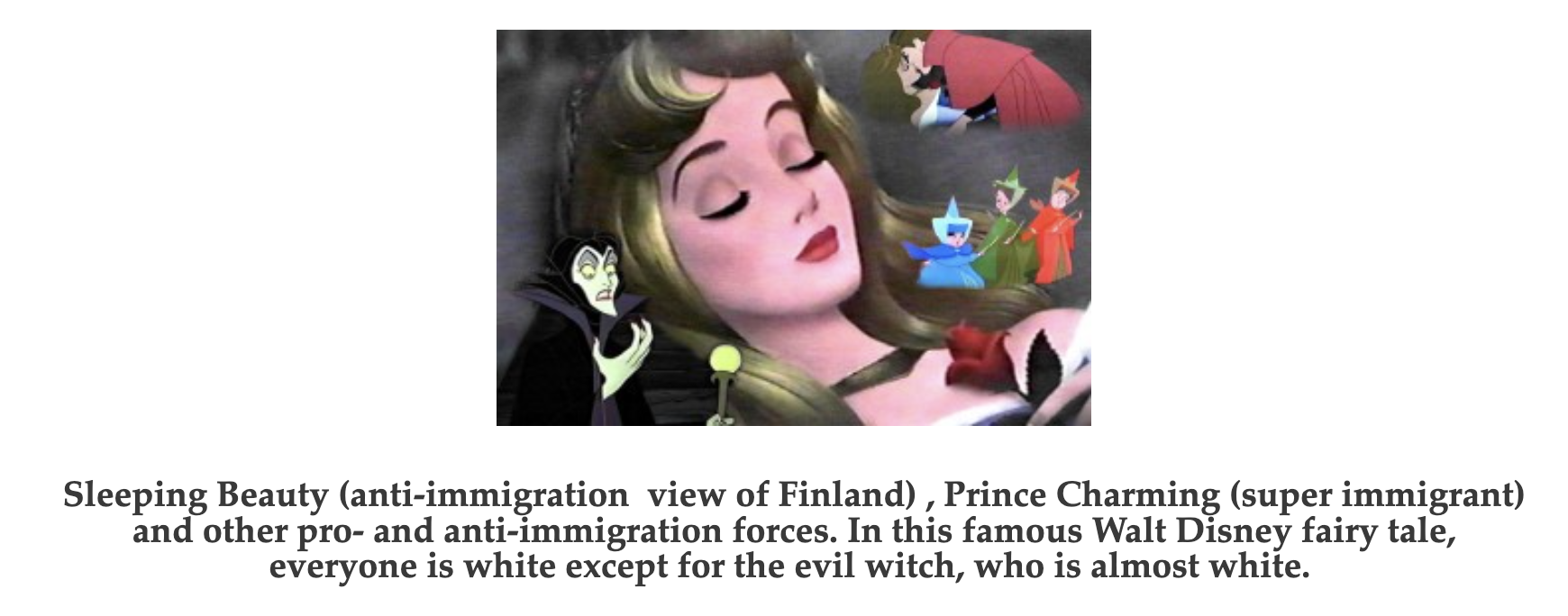
Back then, I wrote in the English version of the story that anti-immigration groups were using the same arguments. It’s like eating and having your cake at the same time while you put a picture of Sleeping Beauty and Prince Charming.
The PS has viciously labeled some migrants in Finland as “harmful” and “social welfare” recipients. They will tell you with a poker face that as long as the newcomer is a “super” migrant, things are ok.
Who are the so-called super migrants that some wish for in Finland?
Tuve el placer de ser entrvistado por José León Toro Mejías, editor de Migrantes News. El está en la Argentina y yo en Finlandia. Aunque la distancia entre nuestros países es enorme, los temas de migración son bastantes parecidas. La xenofobia y el rasismo no reconoce distancias.
Su trabajo de periodista le permitió recorrer varios países, mientras sus profesiones le han hecho mirar las fibras en los valores sociales de los lugares que ha visitado.
Este 24 de marzo, conmemorando a esta fecha infame en la historia argentina, dedico este humilde escrito a Rodolfo Walsh quien murió un día después del primer aniversario de la dictadura militar de Jorge Rafael Videla.
Aquí publicamos su “Carta abierta a la Junta militar en 1977, al cumplirse un año del golpe de Estado de 1976:”
CARTA ABIERTA DE UN ESCRITOR A LA JUNTA MILITAR
1. La censura de prensa, la persecución a intelectuales, el allanamiento de mi casa en el Tigre, el asesinato de amigos queridos y la pérdida de una hija que murió combatiéndolos, son algunos de los hechos que me obligan a esta forma de expresión clandestina después de haber opinado libremente como escritor y periodista durante casi treinta años.
El primer aniversario de esta Junta Militar ha motivado un balance de la acción de gobierno en documentos y discursos oficiales, donde lo que ustedes llaman aciertos son errores, los que reconocen como errores son crímenes y lo que omiten son calamidades.
El 24 de marzo de 1976 derrocaron ustedes a un gobierno del que formaban parte, a cuyo desprestigio contribuyeron como ejecutores de su política represiva, y cuyo término estaba señalado por elecciones convocadas para nueve meses más tarde.
En esa perspectiva lo que ustedes liquidaron no fue el mandato transitorio de Isabel Martínez sino la posibilidad de un proceso democrático donde el pueblo remediara males que ustedes continuaron y agravaron.
Ilegítimo en su origen, el gobierno que ustedes ejercen pudo legitimarse en los hechos recuperando el programa en que coincidieron en las elecciones de 1973 el ochenta por ciento de los argentinos y que sigue en pie como expresión objetiva de la voluntad del pueblo, único significado posible de ese “ser nacional” que ustedes invocan tan a menudo.
Invirtiendo ese camino han restaurado ustedes la corriente de ideas e intereses de minorías derrotadas que traban el desarrollo de las fuerzas productivas, explotan al pueblo y disgregan la Nación.
Una política semejante solo puede imponerse transitoriamente prohibiendo los partidos, interviniendo los sindicatos, amordazando la prensa e implantando el terror más profundo que ha conocido la sociedad argentina.
2. Quince mil desaparecidos, diez mil presos, cuatro mil muertos, decenas de miles de desterrados son la cifra desnuda de ese terror. Colmadas las cárceles ordinarias, crearon ustedes en las principales guarniciones del país virtuales campos de concentración donde no entra ningún juez, abogado, periodista, observador internacional. El secreto militar de los procedimientos, invocado como necesidad de la investigación, convierte a la mayoría de las detenciones en secuestros que permiten la tortura sin límite y el fusilamiento sin juicio. (1)