Migrant tales
Menu
  • #MakeRacismHistory “In Your Eyes”
  • About Migrant Tales
  • It’s all about Human Rights
  • Literary
  • Migrant Tales Media Monitoring
  • NoHateFinland.org
  • Tales from Europe
Menu

Tag: Anti-immigration groups

Migrants and minorities of the Nordic region: It’s time to organize and face the rude music

Posted on January 26, 2016 by Migrant Tales

Europe is in a moral quandary these days. It’s ironic that the more it attempts to instill a sense of security by building ever-higher outside boundaries and treat those who flee war, strife and poverty with disdain, the more it feeds our sense of insecurity. 

Denmark’s plans to confiscate asylum seekers’ valuables and delay for three years family reunification is one shameful example of how some countries in Europe are destroying their values in return for a false sense of security. For Norway, one of the most affluent countries in the world, to return asylum seekers to Russia is another example of the moral demise we are suffering today.

In Finland too the police and the government are unable to agree if neo-Nazi street patrol gangs or clowns that mock at them a threat to our society and values.

What do Denmark, Norway and Finland have in common? They are all Nordic countries and have populist anti-immigration parties in government. In Norway, we have the Progress Party (FrP), in Finland the Perussuomalaiset (PS)*, and the Danish People’s Party (DPP).

But blaming these three anti-immigration parties for the rise of xenophobia in the Nordic region would be missing the point. All three parties are in government and have got more power in their respective countries thanks to the support and near-silence of the mainstream parties.

Without the help and support of these mainstream parties the FrP, PS and DPP would never have grown to have so much power.

Na?ytto?kuva 2016-1-25 kello 22.42.36

The Finnish police arresting clowns who mock neo-Nazi street patrols.

Continue reading “Migrants and minorities of the Nordic region: It’s time to organize and face the rude music”

Why do we consider Timo Soini to be “a good cop” if he brought all these “bad cops” to power?

Posted on April 23, 2014 by Migrant Tales

Doesn’t Perussuomalaiset (PS) leader Timo Soini bear responsibility for giving people like Jussi Halla-aho, James Hirvisaari, Teuvo Hakkarainen, Olli Immonen and a very long list of others a platform to spread their hatred and intolerance?  Why does the media let Soini get off the hook so easily?

Is Soini the culprit for anti-immigration sentiment and xenophobia or does he represent something much deeper about ourselves that we’re not yet ready to openly admit never mind challenge in earnest?

If I’d draw a cartoon of Soini, I’d put him in a concentration camp standing in front of people like Jussi Halla-aho, Olli Immonen, Teuvo Hakkarainen and many others. Soini would tell the media with a poker face and then smile at the end of the following statement: “I’m against anti-Semitism and racism.”

One matter that has perplexed me for quite a while is how the media and journalists, who should know better, is that they treat Soini as some “good guy” in the face of the party’s near-constant anti-EU, anti-immigration, anti-Islam, homophobic and conservative values.

If we search through the maze of answers and explanations, I believe that what we’ll find at the end of the day will find the word denial as the root of the problem.

I’ll never forget April 17, 2011 when the PS won their historic election victory, rising from the minor leagues with 5 to 39 MPs! Some thought it was something passing that wouldn’t last too long. They claimed that it’s only a question of time when internal bickering would cause the PS to implode like the Rural Party did in the 1970s.

One of the most incredible matters about the rise of the PS is how little opposition it has had and how easily it has been allowed to spread its intolerance. Institutions like the media have played a helping role. From a migrant’s or minority’s standpoint, however, the view is quite different since the PS is seen as hostile and dangerous.

Since one of the PS’ main messages is that non-white migrants and refugees should not be allowed to move to Finland never mind marry Finns because they are lazy and even stupid, it’s pretty clear how the PS exploits fear and racism.

Certainly the denial that takes place in our society of the PS wouldn’t be possible without the help as well of the other parties, which may have the same closest racists among their ranks like the most outspoken anti-immigration voices of Soini’s party.

The PS are not a threat to Finland per se, but our denial of them and our own intolerance are.

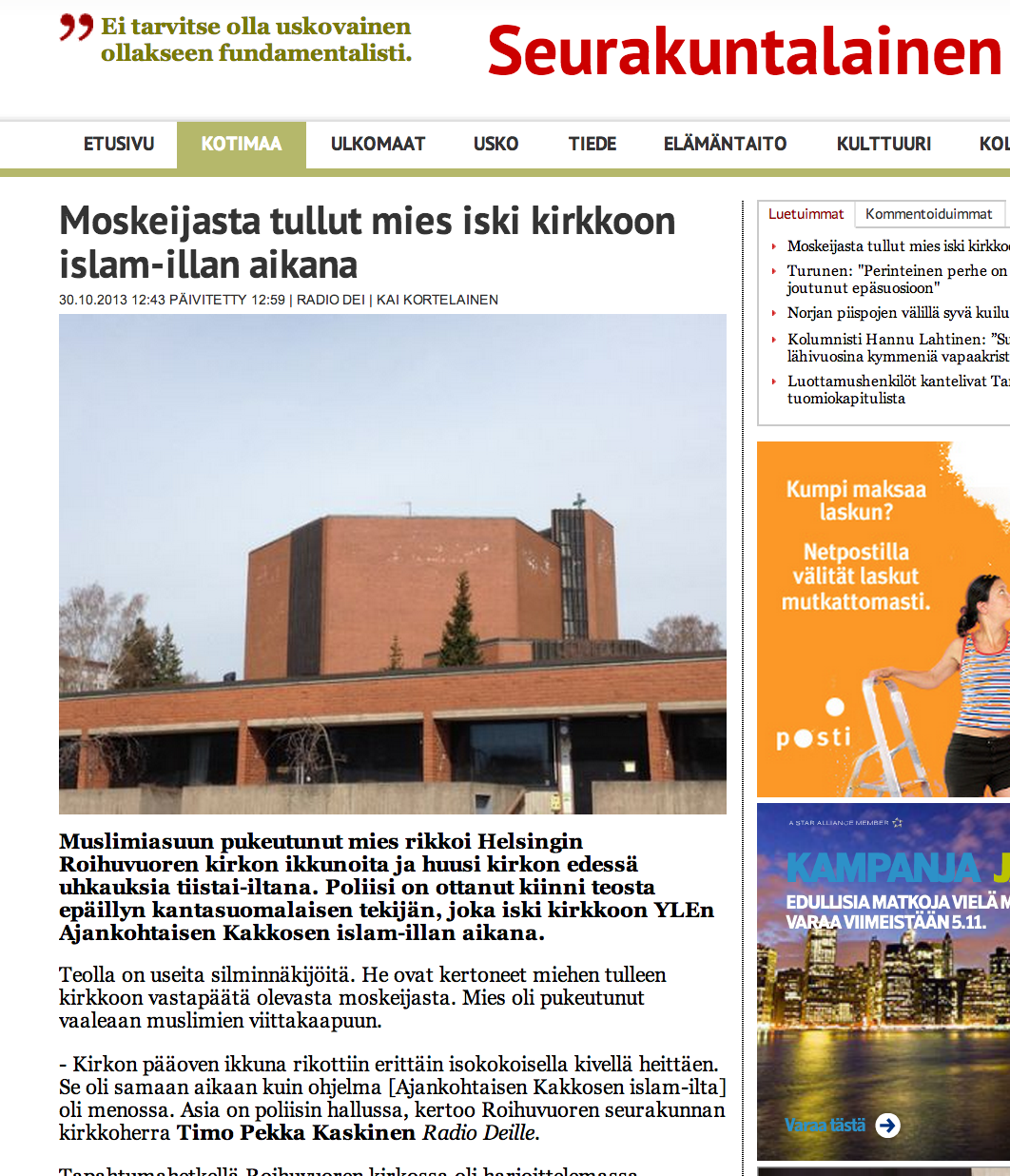
Alleged white Finn attacks Helsinki church dressed as a Muslim

Posted on November 1, 2013 by Migrant Tales

What would you say if a white Finn dressed like a Muslim attacked a Lutheran church in Helsinki by breaking its windows, yelling and obstructing window repairmen from repairing the damage he caused? What would you say if this happened on Tuesday night, when YLE aired A2 Islam debate on television?

Would you say it was an isolated case or yet another example of how Islamophobia has raised its ugly head in this country?

What your answer is depends on your personal perspective.

What is my answer? Since Finland is my country and since it is my home, I have an obligation to defend it from threats that weaken and undermine its values. One matter that is threatening and challenging Finland is outright intolerance.

If you deny and believe what happened is an isolated incident, you should then ask what the election of 39 MPs of an anti-EU and anti-immigration party to parliament in 2011 signaled.

Kuvankaappaus 2013-11-1 kello 8.52.14Read full story here.  

So what happened on Tuesday night?

According to Seurakuntalainen, eyewitnesses who saw what happened called the police and a window repair company. The suspect tried to stop the window repair men from changing the windows. He was reported to have told them that what he did was a message and warning. 

A warning against what? That there are Muslims living in this country? That there are Islamophobes in this country that think it is perfectly find to spread hatred and feed our racism?

It will be interesting to see what kind of charges are brought against the suspect and how the authorities weigh this incident.

UPDATE (4.11.13): It appears that the religious affiliation of the man that attacked the Roihuvuoren Church on Tuesday isn’t clear. Migrant Tales is investigating and will publish something on the matter this afternoon. 

Pressiklubi exposes MP James Hirvisaari’s fabricated lies and ignorance of immigrants and minorities

Posted on October 12, 2013 by Migrant Tales

MP James Hirvisaari, who got expelled from the Perussuomalaiset (PS) party last week, appeared on Ruben Stiller’s Pressiklubi Friday. Compared with his appearance on Enbuske & Linnanahde Crew’s talk show the previous day, the new Muutos 2011 MP’s fabricated lies and ignorance were exposed in the raw.

Kuvankaappaus 2013-10-12 kello 8.13.52

See full program (in Finnish) here.

Just like the many urban tales spread by anti-immigration politicians like Hirvisaari, one of their favorite deceptions is to portray themselves as champions of free speech. In the case of Hirvisaari, it’s the state prosecutor and hazy ethnic agitation laws that attempt to limit his freedom of expression.

If we look at what Hirvisaari has written before about immigrants and Muslims, we’d notice that the MP has had a lot of freedom to insult and victimize other minorities in order to further his political career.

The fact that racist Islamophobic diatribe has found a home in Finland through the writings of people like Hirvisaari, reveals that this country has serious intolerance issues to deal with.

Before the historic 2011 elections, in which the PS won 39 seats versus  5 in the previous election, far-right voices like Hirvisaari were elected to parliament thanks to their fear-mongering and lynch-mob style writings, which spread like wildfire thanks to the social media and national media.

Pressiklubi did a good job at exposing Hirvisaari’s exaggerations and outright lies. Johanna Korhonen asked the MP if he could give one concrete example how his right to express himself about Islam was limited.

Hirvisaari didn’t answer the question because it would have exposed the secret of his fabricated lies and exaggerations.

Another fast one pulled by Hirvisaari on the show was claiming that criticizing multiculturalism was forbidden in this country. If this is true, why is their so much intolerance and criticism of cultural diversity on many social media websites and forums in Finland?  

When the media and the general public understand that intolerance, racism and victimization of immigrants and minorities have nothing to do with our national interests but are harmful to our society, it will be easier to nip characters like Hirvisaari in the bud before they sprout into political Frankensteins.

Why does intolerance get so much attention in the media?

Posted on August 21, 2013 by Migrant Tales

Why does racism, xenophobia and intolerance get so much space in the media and so little condemnation by politicians and society? Is it because racism strikes a chord inside of us or is it because we are taught from a very early age to leave if alone? 

We can make the following argument as well: Do we give too much attention in the media and blogs like Migrant Tales to politicians who make their racist views public? Would turning our backs on them make the problem go away?

It’s pretty clear that silence is a poor response to a social ill like racism. History has taught us that if you don’t openly challenge intolerance, it will grow and not only live another day but many.

There is another important question we should be asking: If we are taught that racism is bad, why do we have so few tools to challenge it?

Jennifer Harvey, an associate professor of religion at Drake University in the United States, offers us some insight.

You can read her blog entry, “For Whites (Like Me): On White Kids,” here.

Harvey writes:

So, if it’s your 4-year-old starting to notice darker skin (which happens when we raise our kids in predominantly white environments), the platitude “we’re all the same underneath” implies they’re noticing something they shouldn’t and insinuates there’s something wrong with darker skin we must need to overlook (meanwhile, your child hears remarks about beautiful blue eyes and blonde hair all the time). How about discussions about and images of the many different beautiful shades of dark skin instead?

And continues:

I know “everybody’s equal” means “we all deserve to be treated with fairness.” And when we tell kids we’re all the same underneath skin, gender, sexuality, physical abilities and other differences we’re trying to tell them we share human dignity and worth.

Obviously, I believe these things.

But, have you ever actually met a “generic” human? Someone without a race or a gender?

Well, guess what? Neither has your child.

In many respects, we do the same thing in Finland. We speak about the virtues of “social equality” but in fact we are taught at the same time to be colorblind and see everyone as “we’re all the same underneath.”

One way to put the issue in context is to replace the word “migrant” with “women.”

Would it be ok to make a case for sexism and claim that the only purpose of women in our society is to make children and serve their chauvinistic husbands?

Certainly not!

If you think of it, this is exactly the argument that anti-immigration groups are making: Migrants have no rights, you are second-class citizens, go back to where you came from.

We know such a statement is wrong because we are taught that “we’re all the same underneath.”


Confessions of a recovering racist

Posted on July 20, 2013 by Mark

Society has achieved at least one significant victory in the fight against racism – it has succeeded in making open racism a dirty concept. The power of stigma that worked so effectively to reinforce racism has been harnessed to turn the tide against open discrimination – at least in polite society. Today, in most public discourse, it is social suicide to admit to any kind of open racism. This stigmatisation of racism is only one victory however in the long fight to rid society of its most pernicious form of exploitation.

Racism is the invention of social categories based on arbitrary physical and cultural characteristics so that a dominant ethnicity can justify and exercise dominance over other ethnicities. Cutting through the social science verbiage, it is when the ‘big noses’ suddenly announce that only people with big noses are smart enough and advanced enough to rule the roost. I’m sure you get the idea.

Even though society has succeeded in making open racism a social anathema, racism hasn’t disappeared. Likewise, there has always been disguised racism – the kinds of discrimination that are hard to identify, very hard to prove outwardly and sometimes also very hard to admit. Following the successes of civil rights movements, covert racism has become the default position for a significant portion of whites. The same is certainly true of Finland also.

For example, ideas of racial superiority have given way to ideas of cultural superiority. Industrial and economic advantage are taken as signs not of exploitation or historical expedience, but of superiority in cultural evolution, something to be celebrated, defended and held as a matter of national pride. Indeed, such a position of superiority is taken as a perfectly natural justification for advancing second-class or stigmatised citizenship for all manner of peoples from other places, particularly those from the developing world.

The notion of the ‘developing world’ is problematic for this reason. It has built into it a value system that naturally places societies – and by implication their citizens – into a scale, a  hierarchy in social development and evolution, with Western societies standing aloft of the developing world. This hierarchy in turn serves as implicit evidence of the cultural superiority of the white races over other ethnicities. Even if it is nowadays recognised as an accident of history, it is still defended to the hilt as a justification for a wall of separation, to keep out the economic migrants from the South, Asia and the Middle East.

But it’s not merely an economic argument. In the populist/fascist discourses, disadvantaged migrants always morph naturally into the barbarians. Cultural superiority over the barbarians is assumed in all areas of society, politics, science, morality, technology, education, lifestyle, freedoms etc. Moreover, we are told we must protect our hard-won resources and superiority from the threat of the uncivilized barbarians.

This is so taken for granted that it seems impossible to argue anything other than the total superiority of the West. This is the pernicious nature of racism and its implicit notions of superiority – where social values are attached not to human beings, as emotional and intellectual beings of ‘equal standing’, but rather as units of an economic powerhouse whose economic advantage and cultural development is assumed to provide moral authority in all matters cultural and political. So that when people of other ethnicities attempt to articulate the nature of discrimination, the default position is that there must be some intellectual or cultural deficiency behind it.

There is a tremendous irony here. People of colour fought tooth and nail (as did many whites) for civil rights to be enshrined within the core of Western democracies. Not merely enshrined, but enacted, defended and supported by legislation and institutions to defend those rights. And now, this very advancement in civil and human rights is offered as part of the key evidence that maintains a sense of social superiority over the developing world. Time and again you hear today attacks on Muslim or African immigrants on the basis of human rights or civil organisation, with little or no thought to how those rights were actually won and by whom.

Today, the naturalistic (genetic) parts of racist dogmas have to a large extent been abandoned, but the ‘order’ and cultural hierarchies remain, and the ‘order’ is almost exactly as it was before, except that in addition to Jews, Gypsies, Africans and Indigenous peoples, you now have Muslims added to that list of untouchables. And for many of those opposed to Muslims, a very cynical strategy of the enemy of my enemy is my friend is adopted, much to the disbelief and disgust of the vast majority of Jews.

The ideology of the big noses today tells us that the West has fought hard to win its dominant position in the world and must therefore defend itself against the barbarian horde waiting at the gates  (infamously dubbed the ‘Gates of Vienna’ by the fascists). In the cold light of day you could see this as a justifiable form of self-preservation, were it not for the fact that it’s totally unnecessary. It’s quite feasible to accept that economically, the West must preserve a border and control levels of immigration. It’s merely a practical necessity related to the difficulties of any migrating population. Even if the most educated of Americans were to head en masse for Europe, the difficulties of catering for increased housing, increased jobs in the economy, language training, cultural adaptation and integration would require time and resources to manage effectively.

So when it comes to controlling immigration, the notion of having to defend cultural superiority is a red herring. Deprivation is not the sole preserve of cultural Others – all parts of Europe have experienced varying degrees of social deprivation over the centuries, brought about not by any innate cultural inferiority, but by exploitation, poverty and an enforced class system.

The new class system being put forward by Europe’s and Finland’s populists demands second-class citizenship for citizens whose origins are outside of Europe, or who are Roma, or who are Muslim, or who are homosexual. This class system says it’s okay to take immigrants from North Africa to clean and cook for Europe’s capitalists just as long as they go home again when the economy starts to tank due to the excesses of the banking elites. This class system says it’s okay to bleed the developing world of its very limited resources in health care personnel to cater for the ever growing numbers of older persons in Europe. This class system says that it’s okay to put financial and practical obstacles in front of immigrants that result in parents being kept apart from their children and husbands from their wives.

Indeed, a further irony is that today’s populism serves only to detract attention from the excesses of corporate elites by focusing on immigration as the pressing problems of the day. We are encouraged to turn a blind eye to the problems of growing inequalities within European societies. Better yet, for some, all inequalities can be reduced in their final analysis to those evil immigrants sucking out the slack from the welfare economy.

The whole notion of cultural superiority, while a useful distraction for those that cook the books in the guise of ‘investment practices’, is unnecessary to understanding or debating how to manage immigration effectively. It’s a practical issue after all. If you accept a new population to exploit and then fail to properly finance the transition process, then deprivation and all of its evils will emerge. If the global community fails to properly address economic development outside of the wealthy economies, then this will create migration pressures, the conditions for war and its subsequent population displacements, and provide further fuel for extremists within the developed and developing countries.

Today’s racists are somewhat immature. I’m being kind, of course. They see the barbarian hordes waiting at the gates. That’s the narrative and they push it at every single opportunity. They ignore social problems as facets of all societies. Crime becomes a problem especially of ethnic groups. Human rights violations become a problem especially of ethnic groups. Language problems become the problems especially of ethnic groups. Cultural tension and misunderstanding become the problems especially of ethnic groups. They ignore the fact that each of these issues applies to every population regardless of ethnicity. They ignore the significant problems of stigmatisation that result from their peddling of this narrative. They ignore the problems of heightened inter-ethnic tension and increased assaults against visible minorities. They see only the barbarians – like Trojan horses – attacking the fabric of their superiority from within and waiting at the walls to attack from without.

So, in defending the rights of Westerners they actually envisage ways in which the barbarians are to be denied the full rights of citizenship: the right to family, the right to equal status before the law, the right to political advocacy, the right to security, the right to dignity.

The racists of today run around in nappies. It’s a fantastical notion, I know, but quite telling. These nappy-clad racists wallow in their own ideological manure, completely oblivious to the crap that swims in their underwear and the stench of racism that fills the air wherever they go. They wave imaginary swords and play at heroes fighting the barbarians. They imagine themselves belonging to an order of knights sworn to protect the virtue of Western superiority.

In one sense, this has nothing to do with the grown-up world, but the victims of this would-be macho heroism are real nonetheless. The harms of racism, overt or covert, are very real. The potential for undermining the rights-based society they say they value is very real too, as populist groups make inroads into the political establishment across the EU by exploiting this narrative of the barbarian hordes and its implicit notions of cultural superiority.

When Timo Soini and the PS cross the political point of no return

Posted on June 4, 2013 by Migrant Tales

When do you know when Timo Soini and the Perussuomalaiset (PS) have crossed the line and passed a political point of no return? The 50,000-euro ad on the front page of Helsingin Sanomat, Finland’s largest-circulation daily,  blasting the government’s euro bailout policy is one of many examples. While more voters are turning their backs to the PS, the party has burned as well important bridges with other political groups in this country. 

Kuvankaappaus 2013-6-4 kello 6.59.22

Timo Soini and the PS have got a lot of people pissed off in Finland. One of these is Paavo Pyykkönen.

Just like the party’s rhetoric and criticism of the EU, euro, gay marriage, immigrants and Muslims, the biggest threat to the PS doesn’t come from abroad or from outside the party but from within.  The PS comprises of such a rambunctious group of people that anything can happen. It is a wild card that bases its future political exploits on chance, never on concrete workable policies.

An opinion poll published by YLE last week revealed that the PS  is “hemorrhaging support” to the opposition Center Party, which has taken a less openly hostile position in the opposition than Soini’s party. Yle in English quotes Jari Pajunen, head researcher at Taloustutkimus, as saying that the Center Party has managed to attract low-income workers into its ranks.

Voters appear to  be getting tired with the PS’ anti-EU message, which sounds like a broken record playing over and over again the same rhetoric without any solutions.

“There must be some significance [that the PS’ anti-EU message is wearing thin], because here at home the discussion is on rather concrete issues that touch everyone. EU matters are always a bit more abstract,” Pajunen said.

While Soini is raising the stakes on next year’s EU parliamentary elections to help the PS score a similar parliamentary election victory in 2015 as in 2011, it’s doubtful that this will happen. If anything, the PS appears to be heading south in the polls and in the eyes of the voters.

Migrant Tales has never doubted that the PS is a pernicious political force whose rhetoric and actions polarize people living in this country. If the PS  had its way, immigrants and visible minorities would be relegated to fourth- and fifth-class status in this country.

In the minds of too many PS politicians, there would be one set of laws for white Finns and another one for non-white “not-real” Finns.

Even if the PS tries to portray itself as a party close to “the masses,” it’s nothing more than a conservative party in the same ideological league as the right-wing populist Tea Party of the United States.

The Boston bombings reveal a deadlier blowback

Posted on April 17, 2013 by Migrant Tales

I was shocked to hear about the twin bombs in Boston and my heart goes to the victims. Two days after the incident, however, speculation has been rife about the probable ethnicity of the perpetrator. The eerie silence of the killer suggests that this was probably carried out individually.  

Kuvankaappaus 2013-4-17 kello 10.16.30

The latest story on the Boston Globe reveals no clues on who the killers could be.

Anupreet Sandhu Bhamra, a Canadian journalist who has published on Migrant Tales, read the following tweet after the bombings: ”Oh God, please, let it not be a Muslim.”

The sense of dread that was mentioned in the tweet was felt by the small visible immigrant community in Finland after we learned about the assassination of Swedish Prime Minister Olof Palme on February 28, 1986.

I too hoped that the assassin that killed Palme isn’t an immigrant.

Not only was anti-immigration sentiment in Finland a fact of life back then, it was alive and kicking despite the fact that only 0.3% of the population (17,039 people) were immigrants.

Initial media coverage of the Boston tragedy revealed that US authorities suspected the killer to be a man who spoke with an accent. That man turned out to be a Saudi Arabian man who was later released by officials.

While the bombings were a cowardly act, the blowback from it proves even more devastating by revealing our prejudices and hatred of other groups.

You may have initially asked who could commit such a heinous crime in the US? It couldn’t be a white man, right?

The bombings raise an important question: If labeling, victimizing and generalizing of different groups are wrong, why do we persist in doing so?

The answer to that question should reveal the role that racism plays in our society and why the battle against this social ill is halfhearted.

Bhamra writes: ”The Oklahoma City bombing was a terrorist bomb attack in downtown Oklahoma on April 19, 1995. Initial news stories were quick to wrongly suggest Islamic terrorists were behind the attack. As a result, Muslims and people of Arab descent were attacked. Later, when the suggestions turned out to be incorrect and the suspect turned out to be a White man, the racial framework was quickly and conveniently dropped.”

On July 22, 2011, we suffered a similar tragedy when Anders Breivik went on the rampage in Norway and killed in cold blood 77 innocent victims. In the same way that initial coverage in Oklahoma pointed the finger at Muslims, some thought that the killer in Norway to be a Middle Easterner as well.

Norwegian Prime Minister Jens Stoltenberg showed exceptional leadership as Norway was mourning its victims. Contrary to Washington’s reaction to 9/11, the Norwegian prime minister said that his country’s response to the mass killings will be more openness and more democracy. According to him, Norway had become after July 22 “more tolerant, [and] more careful not to judge people” by ethnic origin.

Another tragedy that we are witnessing after 22/7 is how the media, politicians and public are collectively forgetting what Breivik did never mind its causes, which haver their roots in Islamophobia and anti-immigration sentiment.

While racism is an effective tool to divide and conquer other groups, we should never forget that it is a rabid dog on a short leash that can bite back and hard at its master.

Finland’s response to extremism should be more openess and democracy

Posted on April 4, 2013September 10, 2023 by Migrant Tales

An editorial on Thursday’s Helsingin Sanomat comments about Anjem Choudary’s visit to Finland last week. It points out correctly that hate speech should be condemned irrespective who makes it. Living in a culturally diverse society requires more mutual acceptance, not less acceptance and respect.

Some of the controversial statements made by the cleric was that it was only a question of time when the flag of Islam would be waving on our parliament building. It was an interesting coincidence that on the same day of Choudary’s visit, Image magazine exposed a Perussuomalaiset (PS) councilman from Vaasa who gave a clock with Adolf Hitler and swastikas to a neo-Nazi club in that city.

Which of the two are the greatest danger to our democracy? Choudary or the Vaasa councilman who appears fascinated by a dictator who dragged Europe into World War 2, unleashing mass war that claimed an estimated 60 million lives?

How seriously should we take Choudary’s threats? If we react to them violently by censoring them, or as PS youth leader Simon Elo suggested that the cleric should be banned from coming to Finland, we’d do a favor to their causes.

It’s unfortunate that too many editorials like the one in today’s Helsingin Sanomat sideline the big picture: Why does radical Islam exist? If we look at the West’s colonial history with the Arab World as well as in other parts of the world, there are a lot of arguments and grievances to justify radicalism. Even so, our democratic system offers us the opportunity to challenge and correct those past and present injustices.

Just like radical Islam, we have to look at the causes of far right and right-wing populist anti-immigration sentiment in Europe these days. On this front, we have a lot of historical and sociological information on their causes. One of the most frightening of examples is the rise and fall of Nazi Germany.

We were horrified by 9/11 but some of us were even more alarmed by our reaction to it.  Former President George W. Bush’s so-called war on terror fueled greater radicalization among Muslims. If anything, the attack on the WTC Twin Towers showed the United States as a perpetrator of violence and not as a victim of terrorism.

Our reaction to terrorism and radicalism should be the total opposite to Bush’s. Norwegian Prime Minister Jens Stoltenberg showed the way after Norway was mourning 77 victims murdered in cold blood by Anders Breivik. Contrary to Washington’s reaction after 9/11, the Norwegian prime minister said that his country’s response to the mass killings will be more openness and more democracy.

We must be on our guard against those politicians and groups that demand less democracy during these difficult times, when far right anti-immigration radicalism is raising its head throughout Europe.  What is especially worrying is that such opinions are being echoed by the mainstream media as well.

Jyväskylä may turn into another blow to Finland’s Counterjihadist -anti-immigration hardliners

Posted on February 3, 2013 by Migrant Tales

If the Counterjihadist-anti-immigration tide turned in Finland and the Nordic region after 22/7, when Anders Breivik went on the rampage killing 77 innocent people, the attack in Jyväskylä on Wednesday by suspected far-right thugs could be a serious blow to anti-immigration and far right groups in Finland. 

Whenever hatred metamorphoses into violence, like in the case of Breivik, and now the attack on the event in Jyväskylä, people get scared  and think twice before jumping on the hate bandwagon again.

It’s like picking and bullying somebody in a group. It may seem “fun” at first but when it turns messy that’s when people start regretting what they did.

Since politicians who built their popularity on racism and intolerance are the worst opportunists, it’s clear that they will play down what happened in Norway, as Jussi Halla-aho and James Hirvisaari did, and as Juho Eerola now does with Jyväskylä.

Eerola not only told the suspected neo-Nazis in Jyväskylä how to crash the next book event, but that the organizers had staged what happened in order to sell more books.

Halla-aho, Hirvisaari and Eerola are Perussuomalaiset (PS) MPs who have built their political careers by spreading hatred and intolerance of immigrants. All three are or have been members of the extremist href=”http://www.migranttales.net/supo-suomen-sisu-is-an-extremist-group/”>Suomen Sisu association.

Migrant Tales has written before that you cannot keep racism on a short leash. Intolerance knows now master. It can bite back at its keeper and hard as we saw in Norway in July 2011.


  • 1
  • 2
  • 3
  • Next
Read more about documentary film
Read more

Recent Posts

  • Finland’s tabloids Iltalehti and Ilta-Sanomat are the pits
  • Riikka Purra’s Dr Jekyll and Mr Hyde mask
  • Double standards
  • Perussuomalaiset: Uusi logo, sama vanha juttu
  • Taco Trump

Recent Comments

  1. Absolutely Socking: Racist Finnish Facebook group against human rights gets flooded with socks on Musta Barbaari’s mother and sister charged by the police in “ethnic profiling” case
  2. Ilkka Nuotio on Pekka Myrskylä: “Tilastot kertovat toista kuin poliittinen keskustelu”
  3. Genrih Soinkara on The war in Ukraine and the Russian-Finnish border crisis are showing Finland’s ugly side
  4. Ahti Tolvanen on Comment by Ahti Tolvanen on the Helsinki +50 conference
  5. Angel Barrientos on Angel Barrientos is one of the kind beacons of Finland’s Chilean community

Archives

  • June 2026
  • May 2026
  • April 2026
  • March 2026
  • February 2026
  • January 2026
  • December 2025
  • November 2025
  • October 2025
  • September 2025
  • August 2025
  • July 2025
  • June 2025
  • May 2025
  • April 2025
  • March 2025
  • February 2025
  • January 2025
  • December 2024
  • November 2024
  • October 2024
  • September 2024
  • August 2024
  • July 2024
  • June 2024
  • May 2024
  • April 2024
  • March 2024
  • February 2024
  • January 2024
  • December 2023
  • November 2023
  • October 2023
  • September 2023
  • August 2023
  • July 2023
  • June 2023
  • May 2023
  • April 2023
  • March 2023
  • February 2023
  • January 2023
  • December 2022
  • November 2022
  • October 2022
  • September 2022
  • August 2022
  • July 2022
  • June 2022
  • May 2022
  • April 2022
  • March 2022
  • February 2022
  • January 2022
  • December 2021
  • November 2021
  • October 2021
  • September 2021
  • August 2021
  • July 2021
  • June 2021
  • May 2021
  • April 2021
  • March 2021
  • February 2021
  • January 2021
  • December 2020
  • November 2020
  • October 2020
  • September 2020
  • August 2020
  • July 2020
  • June 2020
  • May 2020
  • April 2020
  • March 2020
  • February 2020
  • January 2020
  • December 2019
  • November 2019
  • October 2019
  • September 2019
  • August 2019
  • July 2019
  • June 2019
  • May 2019
  • April 2019
  • March 2019
  • February 2019
  • January 2019
  • December 2018
  • November 2018
  • October 2018
  • September 2018
  • August 2018
  • July 2018
  • June 2018
  • May 2018
  • April 2018
  • March 2018
  • February 2018
  • January 2018
  • December 2017
  • November 2017
  • October 2017
  • September 2017
  • August 2017
  • July 2017
  • June 2017
  • May 2017
  • April 2017
  • March 2017
  • February 2017
  • January 2017
  • December 2016
  • November 2016
  • October 2016
  • September 2016
  • August 2016
  • July 2016
  • June 2016
  • May 2016
  • April 2016
  • March 2016
  • February 2016
  • January 2016
  • December 2015
  • November 2015
  • October 2015
  • September 2015
  • August 2015
  • July 2015
  • June 2015
  • May 2015
  • April 2015
  • March 2015
  • February 2015
  • January 2015
  • December 2014
  • November 2014
  • October 2014
  • September 2014
  • August 2014
  • July 2014
  • June 2014
  • May 2014
  • April 2014
  • March 2014
  • February 2014
  • January 2014
  • December 2013
  • November 2013
  • October 2013
  • September 2013
  • August 2013
  • July 2013
  • June 2013
  • May 2013
  • April 2013
  • March 2013
  • February 2013
  • January 2013
  • December 2012
  • November 2012
  • October 2012
  • September 2012
  • August 2012
  • July 2012
  • June 2012
  • May 2012
  • April 2012
  • March 2012
  • February 2012
  • January 2012
  • December 2011
  • November 2011
  • October 2011
  • September 2011
  • August 2011
  • July 2011
  • June 2011
  • May 2011
  • April 2011
  • March 2011
  • February 2011
  • January 2011
  • December 2010
  • November 2010
  • October 2010
  • September 2010
  • August 2010
  • July 2010
  • June 2010
  • May 2010
  • April 2010
  • March 2010
  • February 2010
  • January 2010
  • December 2009
  • November 2009
  • October 2009
  • September 2009
  • August 2009
  • July 2009
  • December 2008
  • November 2008
  • October 2008
  • September 2008
  • August 2008
  • July 2008
  • June 2008
  • May 2008
  • April 2008
  • March 2008
  • February 2008
  • January 2008
  • November 2007
  • October 2007
  • September 2007
  • August 2007
  • July 2007
  • June 2007
  • May 2007

Categories

  • ?? Gia L?c
  • ????? ?????? ????? ???????? ?? ??????
  • ???????
  • @HerraAhmed
  • @mondepasrond
  • @nohatefinland
  • @oula_silver
  • @Varathas
  • A Pakistani family
  • äärioikeisto
  • Abbas Bahmanpour
  • Abdi Muhis
  • Abdirahim Hussein Mohamed
  • Abdirahim Husu Hussein
  • Abdirisak Mahamed
  • About Migrant Tales
  • activism
  • Adam Al-Sawad
  • Adel Abidin
  • Afrofinland
  • Ahmed IJ
  • Ahti Tolvanen
  • Aino Pennanen
  • Aisha Maniar
  • Alan Ali
  • Alan Anstead
  • Alejandro Díaz Ortiz
  • Alekey Bulavsev
  • Aleksander Hemon
  • Aleksanterinliitto
  • Aleksanterinliitto ry
  • Aleksanterinliitto ry:n hallitus
  • Alex Alex
  • Alex Mckie
  • Alexander Nix
  • Alexandra Ayse Albayrak
  • Alexis Neuberg
  • Ali Asaad Hasan Alzuhairi
  • Ali Hossein Mir Ali
  • Ali Rashid
  • Ali Sagal Abdikarim
  • Alina Tsui
  • Aline Müller
  • All categories
  • Aman Heidari
  • Amiirah Salleh-Hoddin & Jana Turk
  • Amin A. Alem
  • Amir Zuhairi
  • Amkelwa Mbekeni
  • Ana María Gutiérrez Sorainen
  • Anachoma
  • Anders Adlecreutz
  • Angeliina Koskinen
  • Anna De Mutiis
  • Anna María Gutiérrez Sorainen
  • Anna-Kaisa Kuusisto ja Jaakko Tuominen
  • Annastiina Kallius
  • Anneli Juise Friman Lindeman
  • Announcement
  • Anonymous
  • Antero Leitzinger
  • anti-black racism
  • Anti-Hate Crime Organisation Finland
  • Anudari Boldbaatar
  • Arshiya Nasser
  • Aspergers Syndrome
  • Asylum Corner
  • Asylum seeker 406
  • Athena Griffin and Joe Feagin
  • Autism
  • Avaaz.org
  • Awale Olad
  • Ayan Said Mohamed
  • AYY
  • Barachiel
  • Bashy Quraishy
  • Beatrice Kabutakapua
  • Beri Jamal
  • Beri Jamal and Enrique Tessieri
  • Bertolt Brecht
  • Boiata
  • Boodi Kabbani
  • Bruno Gronow
  • Carmen Pekkarinen
  • Çelen Oben and Sheila Riikonen
  • Chiara Costa-Virtanen
  • Chiara Costa-Virtanen
  • Chiara Sorbello
  • Christian Thibault
  • Christopher Wylie
  • Clara Dublanc
  • Dana
  • Daniel Malpica
  • Danilo Canguçu
  • David Papineau
  • David Schneider
  • Dexter He
  • Don Flynn
  • Dr Masoud Kamali
  • Dr. Faith Mkwesha
  • Dr. Theodoros Fouskas
  • Edna Chun
  • Eeva Kilpi
  • Emanuela Susheela
  • En castellano
  • ENAR
  • Enrique
  • Enrique Tessieri
  • Enrique Tessieri & Raghad Mchawh
  • Enrique Tessieri & Yahya Rouissi
  • Enrique Tessieri and Muhammed Shire
  • Enrique Tessieri and Sira Moksi
  • Enrique Tessieri and Tom Vandenbosch
  • Enrique Tessieri and Wael Che
  • Enrique Tessieri and Yahya Rouissi
  • Enrique Tessieri and Zimema Mhone
  • Epäluottamusmies
  • EU
  • Europe
  • European Islamophobia Report
  • European Islamophobia Report 2019,
  • European Union
  • Eve Kyntäjä
  • Ezequiel Caldeiro
  • Facebook
  • Fadumo Dayib
  • Faisa Kahiye
  • Farhad Manjoo
  • Fasismi
  • Finland
  • Fizza Qureshi
  • Flyktingar och asyl
  • Foreign Student
  • Fozia Mir-Ali
  • Frances Webber
  • Frida Selim
  • Gareth Rice
  • Ghyslain Vedeaux
  • Global Art Point
  • Great Replacement
  • Habiba Ali
  • Hami Bahadori
  • Hami Bahdori
  • Hamid
  • Hamid Alsaameere
  • Hamid Bahdori
  • Handshake
  • Harmit Athwal
  • Hassan Abdi Ali
  • Hassan Muhumud
  • Heikki Huttunen
  • Heikki Wilenius
  • Helsingin Sanomat
  • Henning van der Hoeven
  • Henrika Mälmsröm
  • Hser Hser
  • Hser Hser ja Mustafa Isman
  • Husein Muhammed
  • Hussain Kazemian
  • Hussain Kazmenian
  • Ibrahim Khan
  • Ida
  • Ignacio Pérez Pérez
  • Iise Ali Hassan
  • Ilari Kaila & Tuomas Kaila
  • Imam Ka
  • inside-an-airport
  • Institute of Race Relations
  • Iraqi asylum seeker
  • IRR European News Team
  • IRR News Team
  • Islamic Society of Norhern FInland
  • Islamic Society of Northern Finland
  • Islamophobia
  • Jacobinmag.com
  • Jallow Momodou
  • Jan Holmberg
  • Jane Elliott
  • Jani Mäkelä
  • Jari Luoto
  • Jari Taponen
  • Jegor Nazarov
  • Jenni Stammeier
  • Jenny Bourne
  • Jessie Daniels
  • Joe Davidow
  • Johannes Koski
  • John D. Foster
  • John Grayson
  • John Marriott
  • Jon Burnett
  • Jorma Härkönen
  • Jos Schuurmans
  • José León Toro Mejías
  • Josue Tumayine
  • Jouni Karnasaari
  • Juan Camilo
  • Jukka Eräkare
  • Julian Abagond
  • Julie Pascoet
  • Jussi Halla-aho
  • Jussi Hallla-aho
  • Jussi Jalonen
  • JusticeDemon
  • Kadar Gelle
  • Kaksoiskansalaisuus
  • Kansainvälinen Mikkeli
  • Kansainvälinen Mikkeli ry
  • Katherine Tonkiss
  • Kati Lepistö
  • Kati van der Hoeven-Lepistö
  • Katie Bell
  • Kättely
  • Kerstin Ögård
  • Keshia Fredua-Mensah & Jamie Schearer
  • Khadidiatou Sylla
  • Khadra Abdirazak Sugulle
  • Kiihotus kansanryhmää vastaan
  • Kirsi Crowley
  • Koko Hubara
  • Kristiina Toivikko
  • Kubra Amini
  • KuRI
  • La Colectiva
  • La incitación al odio
  • Laura Huhtasaari
  • Lauri Finér
  • Leif Hagert
  • Léo Custódio
  • Leo Honka
  • Leontios Christodoulou
  • Lessie Branch
  • Lex Gaudius
  • Leyes de Finlandia
  • Liikkukaa!
  • Linda Hyökki
  • Liz Fekete
  • M. Blanc
  • Maarit Snellman
  • Mahad Sheikh Musse
  • Maija Vilkkumaa
  • Malmin Kebab Pizzeria Port Arthur
  • Marcell Lorincz
  • Mari Aaltola
  • María Paz López
  • Maria Rittis Ikola
  • Maria Tjader
  • Marja-Liisa Tolvanen
  • Mark
  • Markku Heikkinen
  • Marshall Niles
  • Martin Al-Laji
  • Maryan Siyad
  • Matt Carr
  • Mauricio Farah Gebara
  • Media Monitoring Group of Finland
  • Micah J. Christian
  • Michael McEachrane
  • Michele Levoy
  • Michelle Kaila
  • Migrant Tales
  • Migrant Tales Literary
  • Migrantes News
  • Migrants' Rights Network
  • MigriLeaks
  • Mikko Kapanen
  • Miriam Attias and Camila Haavisto
  • Mohamed Adan
  • Mohammad Javid
  • Mohammad M.
  • Monikulttuurisuus
  • Monisha Bhatia and Victoria Canning
  • Mor Ndiaye
  • Muh'ed
  • Muhamed Abdimajed Murshid
  • Muhammed Shire
  • Muhammed Shire and Enrique Tessieri
  • Muhis Azizi
  • Musimenta Dansila
  • Muslimiviha
  • Musulmanes
  • Namir al-Azzawi
  • Natsismi
  • Neurodiversity
  • New Women Connectors
  • Nils Muižnieks
  • No Labels No Walls
  • Noel Dandes
  • Nuor Dawood
  • Omar Khan
  • Otavanmedia
  • Oula Silvennoinen
  • Paco Diop
  • Pakistani family
  • Pentti Stranius
  • Perussuomalaiset
  • perustuslaki
  • Petra Laiti
  • Petri Cederlöf
  • Pia Grochowski
  • Podcast-lukija Bea Bergholm
  • Pohjois – Suomen Islamilainen Yhdyskunta
  • Pohjois Suomen Islamilainen Yhyskunta
  • Polina Kopylova
  • Race Files
  • racism
  • Racism Review
  • Raghad Mchawh
  • Ranska
  • Rashid H. and Migrant Tales
  • Rasismi
  • Raul Perez
  • Rebecka Holm
  • Reem Abu-Hayyeh
  • Refugees
  • Reija Härkönen
  • Remiel
  • Reza Nasri
  • Richard Gresswell
  • Riikka Purra
  • Risto Laakkonen
  • Rita Chahda
  • Ritva Kondi
  • Robito Ibrahim
  • Roble Bashir
  • Rockhaya Sylla
  • Rodolfo Walsh
  • Roger Casale
  • Rostam Atai
  • Roxana Crisólogo Correa
  • Ruth Grove-White
  • Ruth Waweru-Folabit
  • S-worldview
  • Sadio Ali Nuur
  • Sami Rusanen
  • Sandhu Bhamra
  • Sara de Jong
  • Sarah Crowther
  • Sari Alhariri
  • Sarkawt Khalil
  • Sasu
  • Scot Nakagawa
  • Shabana Ahmadzai
  • Shada Islam
  • Sharon Chang blogs
  • Shenita Ann McLean
  • Shirlene Green Newball
  • Sini Savolainen
  • Sira Moksi
  • Sonia K.
  • Sonia Maria Koo
  • Steverp
  • Stop Deportations
  • Suldaan Said Ahmed
  • Suomen mediaseurantakollektiivi
  • Suomen Muslimifoorumi ry
  • Suomen viharikosvastainen yhdistys
  • Suomen viharikosvastainen yhdistys ry
  • Suomi
  • Supermen
  • Susannah
  • Suva
  • Syrjintä
  • Talous
  • Tapio Tuomala
  • Taw Reh
  • Teivo Teivainen
  • The Daily Show
  • The Heino
  • The Supermen
  • Thomas Elfgren
  • Thulfiqar Abdulkarim
  • Tim McGettigan
  • Tino Singh
  • Tito Moustafa Sliem
  • Tobias Hübinette and L. Janelle Dance
  • Transport
  • Trica Danielle Keaton
  • Trilce Garcia
  • Trish Pääkkönen
  • Trish Pääkkönen and Enrique Tessieri
  • Tuulia Reponen
  • Uncategorized
  • UNITED
  • University of Eastern Finland
  • Uyi Osazee
  • Väkivalta
  • Vapaa Liikkuvuus
  • Venla-Sofia Saariaho
  • Vieraskynä
  • W. Che
  • W. Che an Enrique Tessieri
  • Wael Ch.
  • Wan Wei
  • Women for Refugee Women
  • Xaan Kaafi Maxamed Xalane
  • Xassan Kaafi Maxamed Xalane
  • Xassan-Kaafi Mohamed Halane & Enrique Tessieri
  • Yahya Rouissi
  • Yasmin Yusuf
  • Yassen Ghaleb
  • Yle Puhe
  • Yuliet Tresa
  • Yve Shepherd
  • Zahra Khavari
  • Zaker
  • Zalina Ametova
  • Zamzam Ahmed Ali
  • Zeinab Amini ja Soheila Khavari
  • Zimema Mahone and Enrique Tessieri
  • Zimema Mhone
  • Zoila Forss Crespo Moreyra
  • ZT
  • Zulma Sierra
  • Zuzeeko Tegha Abeng
© 2026 Migrant tales | Powered by Minimalist Blog WordPress Theme