Migrant tales
Menu
  • #MakeRacismHistory “In Your Eyes”
  • About Migrant Tales
  • It’s all about Human Rights
  • Literary
  • Migrant Tales Media Monitoring
  • NoHateFinland.org
  • Tales from Europe
Menu

Tag: Africa

Tales from Europe: Luxembourg’s first ever Black History Month event

Posted on October 23, 2023November 2, 2023 by Yahya Rouissi

At One People ASBL, our most cherished quote is: “Anti-racism is a team sport.”

Celebrating Black History Month is a diverse and inclusive event that highlights and promotes the rich culture and history of the Afro community. It caters to people of all backgrounds, including children, youths, entrepreneurs, and employees. The event includes a wide range of activities such as concerts, discussions, topics such as the role of technology like AI in combating discrimination, explorations of Afro-feminism and Pan-Africanism, and screenings of media and films that delve into the experiences and contributions of the Black community.

Migrant Tales had the opportunity to talk to One People ASBL Madeline Yougye, One People chairperon.

“I was born in Cameroon, moved to France at the age of 3, and have been living in Luxembourg for nearly a decade,” she said. “I was immediately drawn to the cultural diversity of Luxembourg, with 70% of the capital’s residents hailing from different parts of the world, such as Africa, Asia, and Europe.

Yougye said that upon moving to Luxembourg, she noticed the disparities in the treatment of expatriates. “This realization inspired me to become involved in the local community, particularly after the death of George Floyd,” she said. “In collaboration with like-minded individuals, I founded One People dedicated to fighting racism and promoting equality of opportunity.”

Black History Month is celebrated during the month of October and organized by One People ASBL of Luxembourg and aims to forster fosters a sense of belonging and unity among all communities while promoting a deeper understanding of the challenges and achievements of the Black community.

One People ASBL Chairperson Madeleine Yougye.


Yahya Rouissi: Can you tell us a little about your organization?

Madeline Yougye: One People is a not-for-profit association created in Luxembourg in 2021 that works to strengthen citizen and intercultural anti-racism, for real equal opportunities while respecting everyone’s fundamental rights.

Our aim is to raise awareness of the exclusion suffered by people who are discriminated against because they belong to an ethnic group.”

YR: Are there any role models or experiences that have shaped your activism and work?

MY: My father used to wait for Mohammed Alie’s fights all night long with jet lag, I didn’t understand why, it was only afterward that I became interested in this personality and understood his commitment.

My first real job was as an event organizer for the AIDS association in Paris. I had the opportunity to go to the French West Indies when I was 25, and it was the first time for me to see a book with a Black person on the cover. I realized that after a more or less successful schooling, after having read Molière, Zola and Orwell, I had never read an Afro-descendant writer. So I bought this book and several others: “Peau noir masque blanc” by Frantz Fanon.  It was this book that helped me answer many of the questions I was asking myself at the time, and awakened my awareness of the profound nature of systemic racism and the biases it could introduce into my own vision of the world and the way others looked at me because of my skin. Then I start reading all books i could find written by people of color, like Cheik Anta Diop, Aimé Cesaire, Tony Morrison… “

YR: What are the key objectives of your association to fight against racism?

Continue reading “Tales from Europe: Luxembourg’s first ever Black History Month event”

European Agency of Fundamental Rights: Finland has the most racial harassment cases against PAD of 12 EU countries surveyed

Posted on November 28, 2018October 28, 2023 by Migrant Tales

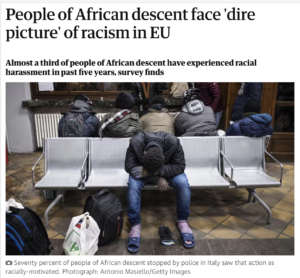
A new study by the European Agency of Fundamental Rights (FRA) reveals that a third of people of African descent (PAD) surveyed have experienced racial harassment in the last five years. That’s not all: Perceived racist harassment was highest in Finland (63%) and least prevalent in Malta 20% (see chart below).

“It is a reality both shameful and infuriating: racism based on the colour of a person’s skin remains a pervasive scourge throughout the European Union,” writes FRA director Michael O’Flaherty in the report’s forward. “…It is a reality both shameful and infuriating: racism based on the colour of a person’s skin remains a pervasive scourge throughout the European Union.”

Finland’s dubious ranking as the highest five-year rate of perceived racist violence against PAD has only ourselves to blame and a result of our lost decade (2011-2019), where we allowed racism and our silence to create the hostile migrants against migrants, especially PAD, today.

Migrant Tales wrote: “Why are the Center Party and National Coalition Party in bed with an anti-immigration and nationalist party like the PS [Perussuomalaiset]?*”

Such a bedfellow has cost Finland dearly in racism, discrimination and hostile environment.


Read the full Guardian story here.

Continue reading “European Agency of Fundamental Rights: Finland has the most racial harassment cases against PAD of 12 EU countries surveyed”

Thailand versus the Mediterranean: Your human value hinges on ethnic and cultural background

Posted on July 9, 2018 by Migrant Tales

We have all been reading about the rescue operation in northern Thailand and it raises a worrisome question: Why is there so much media coverage of twelve children trapped for sixteen days in a cave when between 23,000 and 28,500 of people have perished in the Mediterranean during 1993-2018 while trying to come to Europe?

While all lives are sacred, the reporting by the media of the trapped boys in Thailand expose the hypocrisy of our values. What the media stories are saying in between the lines is that your value as a human being hinges on the color of your ethnic and cultural background.


Read the full story here.

Those who disagree have only to look at the bloody and racist history of countries like the United States, the Americas and others like Australia.

Those tens of millions of Europeans that fled their continent not only carried their physical belongings but their spiritual baggage like racism and toxic attitudes. By turning a blind eye to the deaths in the Mediterranean, we are only confirming those attributes that enabled so much death and devastation in the world.

Continue reading “Thailand versus the Mediterranean: Your human value hinges on ethnic and cultural background”

Migrant Tales (June 16, 2012): The crux of European racism – too little inclusion, too much race and blood

Posted on April 27, 2015 by Migrant Tales

Much of the way Europeans perceive themselves as a group today is still deeply embedded in racism. The fact that we haven’t yet even started to confront the legacy of colonialism, which fuels our ”us” and ”them” view of the world, reveals a disturbing fact: There’s still too little inclusion and acceptance in this part of the world. 

Sadder still is the fact that too few of us openly promote more inclusion and acceptance in our society. How many times have you heard your local politician use terms like “mutual acceptance” and “respect” when speaking of immigrants and visible minorities?

Our race-and- blood view of ourselves and “others” explains why some Europeans still have difficulty overcoming the “us vs. them” mindset.

It would be naive, even foolhardy, to claim that the root of European racism does not date back to the nineteenth century, when we were a colonial power.

Racist views of other groups, especially blacks, is still predominant. The drawing is from the Golden Book Encyclopedia. The 1959 edition sold over 60 million volumes. 

Continue reading “Migrant Tales (June 16, 2012): The crux of European racism – too little inclusion, too much race and blood”

Dissecting Finnish racism and bigotry

Posted on June 5, 2013 by Migrant Tales

“Racism is like a Cadillac, they bring out a new model every year.”

 Malcolm X (1925-65)

The quote by one of the most powerful voices to emerge from the U.S. Civil Rights Movements, reveals how racism survived in the 1960s to see another day. Even though the quote by Malcolm X was made about a half a century ago, it still sheds light on how racism survives another day to oppress, exploit and disenfranchise.

When speaking of racism in a country like Finland, the first question we should address is where did it come from. The over 1.2 million Finns that emigrated from this land between 1860 and 1999 offer one answer as does Germany, our former historical big brother.

Like many European countries, Germany had colonies in Africa and elsewhere. Like any world colonial power, it too had to establish a racist system that gave it the moral right to pillage, exploit and commit genocide.

European racism was so rampant in the nineteenth century that it had lost touch with reality and created a pseudoscience called eugenics,  whose sole purpose was to justify the extermination of so-called undesirable non-white ethnic groups. Any group that was deemed undesirable was one that threatened white or colonial privilege.

What kind of colonial masters were the Germans?  They were just as ruthless as the British, French, Spaniards, Italians, Dutch, Belgians, white U.S. Americans, Japanese and others.

Between 1904 and 1908, Germans systematically massacred ancestors of the Herero and Nama people for daring to rebel against their colonial ruler. The first concentration camps were not built by the Nazis in World War 2 but in Namibia by the Germans.

European colonialism was directly responsible for the mass extermination of non-white groups in Tasmania, Latin America and other regions like the former Belgian Congo, where an estimated half of the 20 million inhabitants died to satisfy King Leopold II’s greed. Not only did colonialism bring hardships like mass slavery, it turned against its master in World War I and II by causing the death of some 100 million people.

While there are many examples of how racism found its way to far-flung Finland, it survives amongst us today for the same reasons as it did  in the past.

Any sensible person agrees that racism is horrible and none of us would endorse it openly. We do support such a social ill, however, through our silence, denials and prejudice.

Migrant Tales is living proof of how little we have done in this country to challenge intolerance. It’s sad but true: intolerance will become a bigger problem in Finland as our society become more culturally diverse. The rise of the anti-immigration Perussuomalaiset (PS) party is one example that reinforces the latter.

Since racism is a pernicious force, we need leadership to challenge it. We don’t need to mobilize hundreds of thousands of people, only a few are enough to leave a lasting impression.

Leadership can be shown on a public tram by Helsinki Deputy Mayor Pekka Sauri, and by others like Rebecka Holm, an adolescent who decided to do something about racist harassment, and Ricky Ghansha, who forced a “super racist” to apologize publicly for his behavior.

Our struggle against intolerance doesn’t even have to be so public. We can do a lot at the workplace just by reacting to a racist, homophobic or sexist comment. The message must be clear: We won’t tolerate intolerance.

Tim Soutphommasane, who wrote an interesting opinion piece on Australian racism, says the following: “It’s [political correctness] nonsense because the worst form of censorship comes from the opposite direction. Nothing shuts down debate more than the idea that any allegation of racism must involve a moral charge against each and every Australian [or Finn in our case]. That it must mean we are saying there’s something fundamentally rotten about the Australian character.”

Soutphommasane explains why it’s difficult to debate a social ill like racism in Australia and even in Finland since we’re at a loss on how to confront the issue. A strange logic takes place when we play down racism and allow self-censorship to muffle our arguments.

He asks: “Do we go to the trouble of making such fine distinctions between hooligan behavior  and hooligans? Or between criminal behavior and criminals? Why must we take such extraordinary care to avoid offending those who engage in racist behaviour? This is a grotesque form of self-censorship, if ever there was one.”

Not only must we understanding where and how a phenomenon like racism has lodged itself in our society, we must rally leadership and resolve to confront it with its real name.

If we succeed at this,  we’d have made significant progress in stopping new Cadillac models from entering the market every year.


Our Finnish modern-day eugenicists are no different from the past

Posted on February 17, 2013 by Migrant Tales

Who are those modern-day eugenicists breathing life back into this disgraced pseudo-science whose aim was to create a master white race by wiping out other ones? If we look at Europe and the Nordic region today, we can find many politicians with the same nineteenth-century agenda but in a different context. 

Some may rightfully argue that eugenics is long dead. True, but what hasn’t died is racism that manifests itself in new forms.

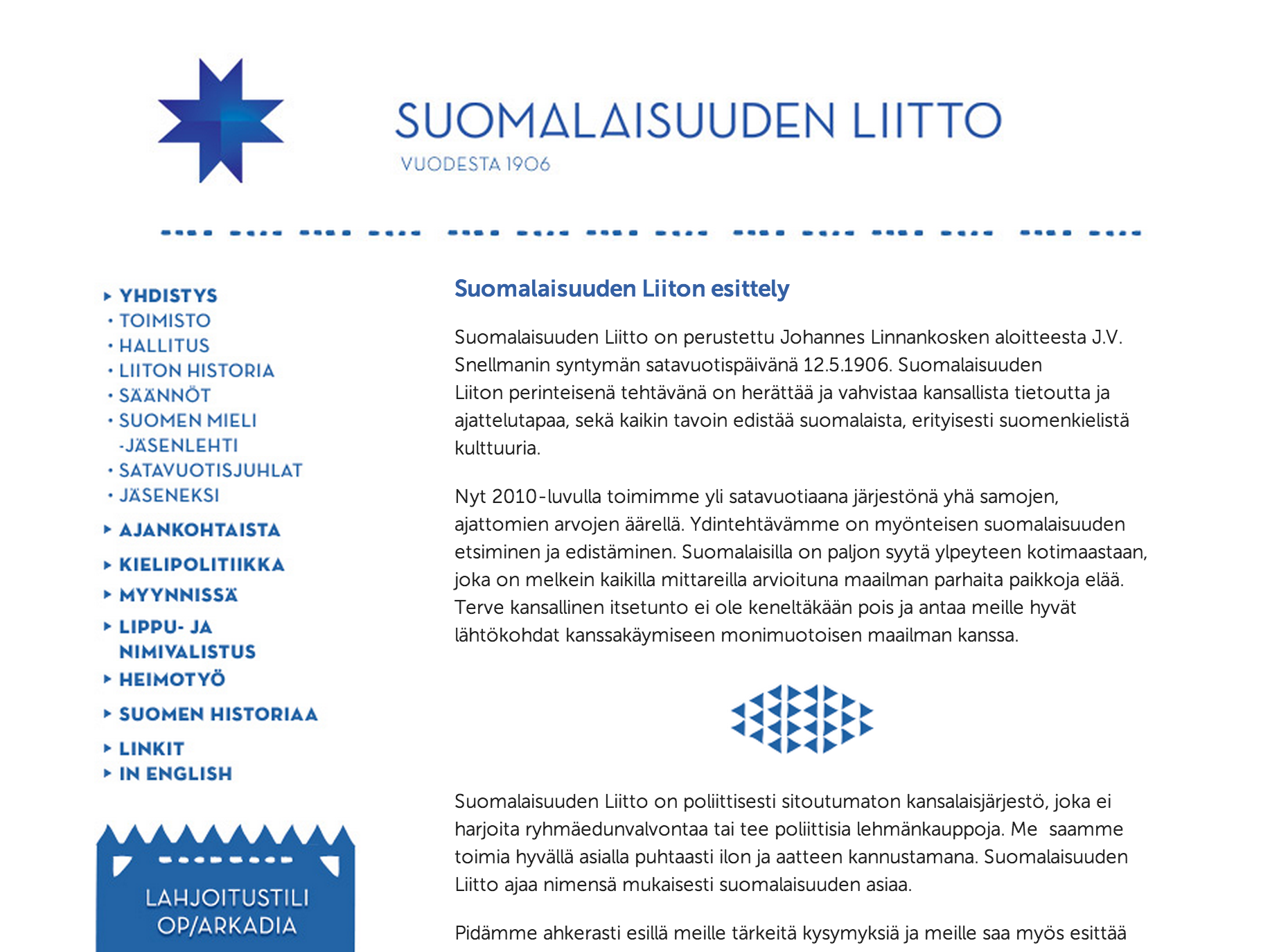
In Finland, you will find them in groups like Suomen Sisu, Suomalaisuuden liitto, neo-Nazi Suomen Kansalinen Vastarinta, in parliament and city councils as well as in all walks of life in Finland.

Kuvankaappaus 2013-2-17 kello 11.21.50

Suomalaisuuden liitto, or the Association of Finnish Culture and Identity, is one of many eugenicist-spirited associations in Finland that want to keep Finland white.

They are present as well in anti-immigration right-wing populist parties like the Danish People’s Party, Sweden Democrats and Progress Party of Norway. While these types of modern-day eugenicists can be found throughout Europe in parties like Golden Dawn of Greece, Hungary’s Jobbik and the National Front of France, their message is the same: We must keep our country white.

What these anti-immigration and xenophobic groups haven’t told us yet is how they plan to keep their countries’ white. Is it only a matter of time when they’ll begin drafting legislation to deport Muslims and other visible minorities to where they came from? Think of the consequences to our democracy and way of life if we permit this type of hatred to get the better of us.

When I moved to Finland permanently in December 1978, the first matter that surprised me was prejudice. It seemed that the only contact some Finns had with blacks was through Archie Bunker’s TV series. Finns were not only prejudiced to outsiders but placed labels on themselves as well.

If Finns housed such views of themselves, one can only imagine how they saw non-Finns like blacks and Southern Europeans.

The same idea, that we are being invaded by criminals, was evident in Finland’s immigration policy. Finland got its first Aliens Act in 1983, about 66 years after independence. Immigrants had no rights before the Act and could be held indefinitely and deported by the police without a fair trial.

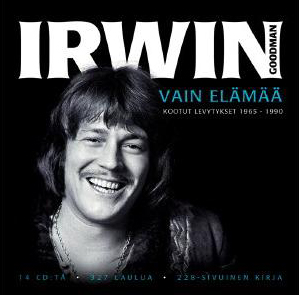
The answer to how some Finns saw foreigners can be found in popular culture and in Irwin Mutakuono ja lakupelle (Mudfaces and n-clowns). The lyrics were written by Veikko Salmi.

vainelamaa14cd

Another racist hit by Irwin Goodman was Marcello Macaroni. The song was sung as well by Esa Pakarinen, a Finnish movie star.

If you check out former song on YouTube, it has over 1.2 million hits.

Continue reading “Our Finnish modern-day eugenicists are no different from the past”

Amkelwa Mbekeni: An African perspective of “The Marshal of Finland”

Posted on November 18, 2012 by Migrant Tales

By Amkelwa Mbekeni

“They shouldn’t have made it in Kenya — that was a bad idea,” says a man I find myself sitting next to in a bus. I am in Helsinki, Finland, and seldom do I ever initiate conversation with a stranger in public transport, especially not here. It is as if there is an unwritten and unspoken rule that is observed by most within the Finnish society, but we are two Africans and in true African style, we do not hesitate to start exchanging pleasantries in this country where otherness is our relegated identity. He tells me he’s Kenyan and immediately my interest is piqued, for Kenya has recently occupied center stage in Finnish mainstream media. A moment earlier I had asked him the one question I had been itching to ask many a Kenyan national living in Finland: what do they think of The Marshal of Finland, the film recently shot in Kenya with a Kenyan cast about G.E. Mannerheim, Second World War head of the Finnish military, former president and national icon whose statue — on horseback — overlooks Helsinki’s main street, which is also named after him.

Erkko Lyytinen, a producer from the Finnish public broadcaster, Yle, and his Estonian colleague Ken Saan decided, in what can be described as an unusual move, to produce the much spoken of, long awaited and previously difficult to make film project on Mannerheim. Due to budgetary constraints, a decision was taken to do so in Kenya, using a local production company. Their initial estimation was that it would set them back to the tune of US$5000, however due to unforeseen circumstances, it is said the film ended up costing three times the estimated amount — and an unspeakable amount of public scrutiny.

I had been acutely aware that a heated debate had been ongoing around me, and I also had gathered that it had left a lot of feathers ruffled. Unfortunately, due to the language barrier, I had found myself on the outside looking in, which is why I felt the need to speak to more people; to find out more about the impact this film had on the society I live in. Somehow, someway, I felt involved.

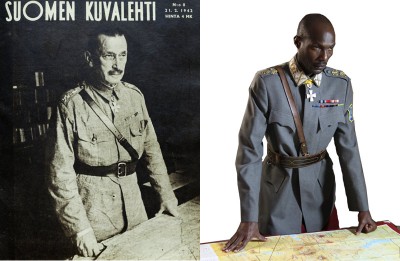
Based on the sensationalist media coverage The Marshal of Finland took the country by storm, and elicited a reaction of outrage by offended members of the public. One tabloid claimed that “the people don’t approve of a black Mannerheim,” with the expected lack of explaining what is meant by ‘the people’. The allegation in general was that the Finnish public had been lied to and deceived by the Yle producer, who stood accused of having deliberately and underhandedly omitted to mention the fact that Mannerheim was to be played by an African and thus — according to them — making a mockery of the national hero.

But not only is the project about the actual film, it also is about a six part making of documentary series which portrays the chaotic and oftentimes frustrating process of filming in Kenya, having chosen to work with one of  the most affordable production companies available. The documentary is called “Operation Mannerheim”. Here’s the trailer:

http://www.youtube.com/watch?v=PvG4U6zpwDg

The documentary was aired on one of Yle’s less viewed channels and its content didn’t create as much debate as all preceding speculation of the film hinted at, however it helped me gain more insight into what the whole furor and media frenzy was about. This documentary series also clarified the motives of the film’s producer and it appears that his intentions were good; very ambitious even if a bit naïve, and how this film was, to a large extent, his project. Amongst other things, the documentary told its own story of working with Kenyan people, and both directly and indirectly reinforced the already existing stereotypes of poverty, inefficiency, lack of punctuality of Africans and so on. Another predictable sad story of Africa from a western perspective, one could say.

It is common knowledge that for most foreign nationals in Finland, the language barrier is a real handicap. It often leaves one feeling a little disadvantaged when it comes to following and keeping up with public debates. Barring from seeing the face of one Telley Savalas Otieno, the lead actor playing Gustaf Mannerheim, on all manner of tabloid newspaper on offer, I was pretty much in the dark about the details of what the fuss was all about until the film and documentary came out and even then I was, to a degree, relying on interpretation by my Finnish husband. Incidentally, it was also when the film and the documentary finally did come out that the public debate for the most part ended. The whole thing, it seemed, had mainly been pre-emptive and based on assumptions, rumours and guesses.

The Marshal of Finland is told from an African storytelling  perspective in a setting where a bunch of children are seated around a fire, listening to a grown-up — a grandfather figure — telling the story of a hero from a faraway land. The young African children imagine this story based on their frame of reference with all the characters looking like people they know; African.

“I thought it was an interesting idea. I guess I was more relieved than impressed after watching the film itself,” says Wanjiku wa Ngugi, a Kenyan in Finland who is the founder and director of the HAFF – Helsinki African Film Festival, when I asked her for her thoughts. “In terms of actual production, sound, picture quality, development of the storyline — perhaps more work could have been dedicated towards these. Otherwise for me it just looks like the film was not the point of the project, but the documentary. And if this is the case, I can say a huge opportunity was lost.”

At some point the film was said to be a Kenyan interpretation of the story of Gustav Mannerheim.

“The Marshal of Finland was not a Kenyan production,” replies Wanjiku, “It was a production done for the benefit of making a documentary, made to prove a point — or points — or introduce new ways of thinking about heroes, but what it most certainly was not, was a Kenyan film. It was just a film made in Kenya.”

“Besides,” she adds, “it’s as if the film was set up to fail, for the purposes of making an interesting documentary, and it was therefore a poor production artistically speaking.”

Previously, a mainstream Finnish production company also had played with the idea to make a film about Mannerheim. The plan was for Renny Harlin, the most accomplished Finnish Hollywood director (cue Cliffhanger, Die Hard 2, Deep Blue Sea etc.), to direct the film, but this project had publicly struggled with funding for years.

So having a Mannerheim film in the news was nothing particularly new.

Basically, as long as there has been talk about making a Mannerheim film, money has been the big issue and Yle, having no big budget either, employed the most cost effective means of production within the budding Kenyan film industry, while ultimately — one would assume — hoping for a high quality product.

Due to this small budget, the film is made under some unusual circumstances with often disastrous outcomes.

“If a production team is hired that doesn’t have much experience dealing with the production issues, much less dealing with a professional production of a film and with a minimalist budget, one can only expect the catastrophe that we saw on the documentary,” Wanjiku adds, “It is by no means a realistic standard of production of what Kenyans are capable of.”

Wanjiku wa Ngugi.

It had been frustration with the evident misinformation about Africa and African people that had lead Wanjiku to found HAFF. She had discovered that even Finland was susceptible to the negative representation of Africa and Africans in the news and Hollywood films. Having lived in this country for a few years, she has also been privy to the conversations that have been happening locally around issues of race and multiculturalism.

“It was disturbing how much hostility was showcased, but I think it also speaks to how Africans are viewed in Finland. And it all boils down to how much people really know about Africans. It is my hope that collaborations of this nature, if done genuinely, can help resolve some of the issues. It is important to note that there was also great support for the film, for the idea.”

At a press conference held before the movie premiered, a flustered Erkko stood in defense of his decision to film The Marshal of Finland in Kenya. As seen in the documentary, a few journalists bombard him with questions accusing him of wanting to provoke the people and for having no sensitivity towards how this film may affect the sensibilities of war veterans. It’s noteworthy to mention that, again, this is not a first time the story of Mannerheim has caused such controversy; in 2008, a twenty-seven-minute puppet animation suggested an alternative view on the Marshal’s sexual orientation.

This whole recent media driven debacle has been at least equally disturbing; mostly due to the apparent lack of awareness of the racist tone of some of the public views. Nothing can be said categorically, but if the bone of contention is the fact that Erkko failed to divulge ahead of time to the Finnish society that he would have an African to play the main role, then by logical extension, there seems to have been a problem with an African playing the main role. Even if only in the imaginations of African children as was the case in this film. The reason why this storyline was not a consideration in the public debate was because the offence was taken before the film was even out.

As the debate unraveled, more and more hostile responses were aired, on tabloids’ front pages (above) but especially via social media. One particularly unmistakable venomous tweet said only one word, “niggaheim”. This was tweeted not by a wayward, uninformed teenager, but by an opinion leader and journalist respected by many. This spoke volumes, and left me more confused about what to think of the whole convoluted story, wondering whether this was indeed a true reflection of the feeling of Finns by and large.

Considering that the face of Finland is gradually changing as more and more foreigners find their way here, the question of what effect this can have on relations between Africans and Finns after all is said and done, still remains. Has this even served as a mirror to reflect attitudes within a society?

“I thought that despite the backlash a conversation so badly needed in this country about race happened,” Wanjiku starts. “I think getting people out of their comfort zone is sometimes good — it may not look like it, but it really does help remove, people’s biased view of the world around them, even if only a little bit. In terms of a change between Kenyan nationals and Finnish society, I doubt that much difference happened as a result. I think it will take more than one controversial film to change how black people are viewed in this country.”

The debate around multiculturalism is a complicated one, compounded by the language barrier in Finland. Naima Mohamud, who is of Somali background, stated in a column in the nation’s leading newspaper that with this whole drama, the public broadcaster gave a lot of ammunition to the immigration skeptics and the ones leaning towards negative thoughts on multiculturalism. That it was the immigrants in Finland that got the short end of the stick as now the bigoted opinions expressed got veiled behind a shock of having a disgraced national hero.

Wanjiku, on the other hand, concludes on a more optimistic note, “I am hopeful. As much as the debate has moved to the extreme right, there are also others who are equally opposed to it.”

Perhaps by choosing to tell a Finnish story about a national hero, employing a foreign production company, casting foreign actors and shooting it in a foreign country, more than one story got told. A Finnish story was told using Kenyan actors, then the documentary with Finns telling a Kenyan story was made, and finally in Finnish tabloids, an African otherness story is told displaying extreme views as mainstream views.

But after all of this storytelling, the question is, at what cost have these stories been told?

The crux of European racism: Too little inclusion, too much race and blood

Posted on June 16, 2012 by Migrant Tales

Much of the way Europeans perceive themselves as a group today is still deeply embedded in racism. The fact that we haven’t yet even started to confront the legacy of colonialism, which fuels our ”us” and ”them” view of the world, reveals a disturbing fact: There’s still too little inclusion and acceptance in this part of the world. 

Sadder still is the fact that too few of us openly promote more inclusion and acceptance in our society. How many times have you heard your local politician use terms like “mutual acceptance” and “respect” when speaking of immigrants and visible minorities?

Our race-and- blood view of ourselves and “others” explains why some Europeans still have difficulty overcoming the “us vs. them” mindset.

It would be naive, even foolhardy, to claim that the root of European racism does not date back to the nineteenth century, when we were a colonial power.

Racist views of other groups, especially blacks, is still predominant. The drawing is from the Golden Book Encyclopedia. The 1959 edition sold over 60 million volumes. 

While nineteenth century evolutionism played a crucial role in justifying the exploitation of Africans, Asians and other regions, it was a very effective excuse to justify our domination of other groups. These same arguments are still used today by different groups to justify our racist views.

Julian Abagond asks in a blog entry whether blacks would have raided, pillaged and enslaved so many people if they had had guns and ocean-going ships before whites.

He writes: “Technology advances and spreads unevenly. It is common for one region to have a technological edge over another – yet it is rare for it to lead to genocide, even when the edge is military.”

While Europe’s new inhabitants want to adapt and see their living standards rise in their new homeland, they too are part of the “us-vs.-them” problem. Some immigrants come from countries and societies that are just as racist as Europe.

While the latter may be true, everyone can learn new rules and values in our new or old homelands that promote a well-functioning society.  We should learn that racism and social exclusion are our biggest threats.

European Uncle Toms are as much of a danger to our ever-growing culturally diverse society as far-right groups. They are hindering the creation of a more-inclusive and culturally diverse Europe that can live side by side in harmony and reap synergies.

Writes Migrant Tales:  “The Finnish Uncle Tom is a pretty opportunistic person. He or she believes that the only way to escape discrimination is by accepting those values that promote social exclusion of other groups like immigrants.”

In order to avoid the terrible wars that once ravaged this part of the world, we must strive to create and teach present and future European generations the crucial role that mutual acceptance and respect play in inclusion.

Racism  is the shovel we Europeans use to dig our common grave.

We need more social inclusion in Europe to build a better society tomorrow.


Africa is a country: The geo-branding war

Posted on May 1, 2012 by Migrant Tales

By Mikko Kapanen*

Geo-branding is a serious matter. It is particularly serious when people from other geographic areas decide to brand your geographical area and the people in it, in the way they see fit and in the way that fits their purposes. No other country, region or continent, I’d argue, suffers from other peoples’ nonsense as much as the continent of Africa. Actually, the reason why people generally and casually talk about Africa as one place is because of what Nigerian-American author C. P. Eze refers to as “their geo-branding war”.

Warfare indeed. Eze of course is concerned with business. He argues that the image issues instigated by outsiders – oftentimes the representatives of the aid industry – hurt the business sector as the whole continent is seen as unworthy of investment. Very importantly, according to Eze, an increase of just 1% in Africa’s share of global trade would bring in US$70 billion annually; more than all aid and debt relief combined. Yet trade with African countries is not encouraged much in the West. I have made mention of Eze’s book before, and I, as much as many others here, have written about the role the NGO sector plays in news gathering from the African continent – in short a very central one. There is no shortage of these pseudo-selfless, supposedly well meaning case studies around so lets have a look at a current one.

At the moment I am based in Helsinki, Finland, and currently all over town we are bombarded with images of a new advertising campaign.

Seemingly endless numbers of paid posters with a model depicting a generic shirtless African rebel soldier with baby-oiled-slash-sweaty body and an intense look, carrying a rifle on his back, squeezing the strap in his fist and wearing some kind of necklace, which may or may not be intended to appear witchcrafty, and a belt full of ammunition. All this makes him look like some kind of Nollywood version of Rambo against a dramatic black background. The text in the advert says “future chef” and the key that is dangling from the aforementioned necklace suggests that he needs to be given the key to a better job opportunity. That metaphorical key in real terms means our financial donation and perhaps a signature on a petition which, the campaign promises, can change the destiny of this poor soul.

There are other images too; some of them featuring other models, some with the same male model, now smiling with a little less witchcrafty necklace and his upper body no longer bare, but covered with a worn-out t-shirt advertising the first US Iraq war effort from the early nineties. I am scared to even attempt to attach meaning to it. According to the photographer Antti Viitala, these photos were taken in Cape Town, South Africa and the campaign was designed by a Helsinki-based advertising agency Dynamo. Viitala says that the models had been spotted on the streets of Cape Town.

So they are just that; models who broadly appear to fit the purposes of the campaign. For the gentleman in the leading image that means that basically he’s black. That is enough.

The campaign is run by Finn Church Aid, a missionary and aid wing of the Finnish Lutheran Church – the state church – which especially in recent years has struggled with negative stereotypes of its own in the form of the homophobia that undeniable exists within its ranks. They don’t like to be represented in a simplified manner themselves, but when it comes to others, this moral consideration is less central. The campaign is a high profile one. Its patron is Nobel Peace Prize laureate and former President of Finland Martti Ahtisaari (1994-2000) and the purpose is to both influence politicians and to raise funds. Of course it has to be said here that the problem at hand is bigger than this campaign. It’s a global issue, mainly instigated by the civil sectors, some media and a traditionally inaccurate and one-sided history of colonialism that is still being read and told in the countries of the global north. True, the Finnish church is a follower rather than a leader in this, but I am curious to know a bit more about what goes on when an idea like this is born. After asking the photographer – who was helpful but who also wasn’t sure what my point was; and I felt that this in itself was noteworthy – I e-mailed the public relations and communications officer Veera Hämäläinen, who is part of the team behind this campaign, to hear her version of the story.

The first thing I realised from our correspondence is that Hämäläinen and I really see this whole phenomenon differently. She insists that the campaign is a positive one. She mainly feels that way because the text in the middle of the poster suggests that this shirtless rebel soldier is a future chef. So this is a positive transformation and the video version of the advert and further reading material on the campaign’s website explains this to her satisfaction.

Here is that video:

[youtube=http://www.youtube.com/watch?v=r_meVAH20w4&w=594&h=365]

Hämäläinen also believes that Finns are clever enough people to understand the simplification. I, as a human being, but one who could also be described as a Finn, would strongly disagree.

I watched the ad online, but haven’t seen it on TV yet – even though in our household the TV is on quite a bit (maybe our family doesn’t watch channels where the church would advertise). What I have seen, however, are tons and tons of these posters. I couldn’t imagine that under any circumstances would I have read the additional information online if I hadn’t decided to write about this. I think it’s ambitious to think that people would take anything other from this campaign than, yeah, that’s Africa alright; always in trouble and always needing help –our help– nothing new. I wish this wasn’t the case, but I have lived this life and heard people speak, even many very clever ones, so I am not just trying to be negative about it. I am trying to be realistic: these images have just been used as they were considered the most effective, regardless of their character. Also — and I really don’t even wish to take this opportunity to be too sarcastic about it — questioning its sources hasn’t traditionally been the church’s, or its followers’, strongest suit.

So I’d argue that what we are really left with is the poster and, for the most part, its photograph. There are a lot of these images everywhere – there hasn’t been this kind of ‘military presence’ on the streets of Helsinki since the 1940s – but now this apparently two-dimensional cloned nondescript African rebel army stares at me from my neighborhood bus stop, all the way to the office, into town and pretty much anywhere else I might want to go. From a distance, in a hurry or uninterested, one is not able to read the text – or even care to read it – and the imaging is building on our collective prejudices, our pre-existing ideas of Africa. I am not talking about any silly magic bullet theory here, but this is part of the same narrative that has been explained to us in the media, in school textbooks and also, very importantly, in these aid campaigns. It’s not a question of this, or any other country’s collective cleverness, because this doesn’t break a pattern. It continues it like there simply was nothing wrong with it, and based on my correspondence with campaign people I am getting a distinct sense that they don’t have any qualms about this representation.

It’s quite curious how it is possible to see one thing differently. Hämäläinen explains that this campaign is unlike those before it: “We have chosen a different angle,” she says, “not always using images of starving children, but for a change strong young people from developing countries, who are able to be in charge of their future as long as they are given the right tools.”

So that’s what this is about: breaking the pattern. I admit this guy is no child – even though they may have been generous with the baby oil – but I just can’t see how this is a complete departure from the traditional style of imaging aid campaigns. It still communicates three very traditional ideas: 1) Africa,  2) problem and 3) ’our help needed’.I am wondering how this impacts the many people from around Africa who live and work in Finland?

Is there no chance that the negative attitudes towards immigrants will be reinforced if the native people conclude that we have basically done a massive favour to each and every one of them? I ask my South African wife and she’s not impressed, but of course the point here must be that one doesn’t have to be from Africa to see and condemn the problems of such image politics. Too many people still think that if it’s not directly about you, then why complain? But that’s nonsense. We are all people here.

Then Hämäläinen surprises me by mentioning that this is not just about Africa though. Youth unemployment is a global issue. Of course she’s right. She continues to say that for this campaign, however, the developing world is the target. So not Africa as such but, (even) more broadly, the developing countries in general — and this single image has been selected to communicate that. If you read the website carefully, then you’ll find mention of specific countries such as the Democratic Republic of Congo and Honduras, although by now I think it is evident that my focus is less on what the project is about and more on how they choose to communicate it. I think it would also be misleading to suggest that the small print and the large print are as effective. I’d venture a guess that few people who see the poster will read all of the material available.

How about the trade aspect? I am wondering what this kind of campaign that very much supports our existing negative ideas of Africa – again, very generally – does in the long run to trade? To the attitudes of the business sector? Does it matter? “The trade aspect is important,” she admits, “it’s important for it to grow. In this campaign we have sought to highlight one angle and describe the magnitude of the problem at hand – 80 million unemployed young adults; most of them in the developing world – and something must be done at grassroots level although of course, politicians could also use their own forums to make a difference.”

Fair play, except essentially that is to say politely that — as important as trade may be — it’s got nothing to do with us.

I am not suggesting that any overtly positive spin should necessarily be applied – just information that is more accurate, balanced and with a bit more context. Are we Europeans (North Americans, Australians, etc.) so jaded that we need to be hit on the head with the worst problems before we will react? I am asking genuinely since I don’t have an answer to this question. I have been thinking about the ethics of development aid work a lot, and I think it’s still something where a lot of dialogue needs to be had.

Neither am I suggesting that these campaigns never have any positive results, but I have seen this sector enough to say that they advertise to both justify and secure their own existence and function. I know that these organisations often have glass ceilings for staff members from southern partner countries, and I think that the aid industrial complex is altogether… well, a complex matter, but is there a realistic way for it to be something other than patronising and promoting of pre-existing ideas of geographical – and I can’t leave it unsaid, ethnic – hierarchies that are around, no matter how much you or I may wish they were not?

My understanding of this whole situation could be summarised by my five year old son’s current key phrase. “This is unfair.” I would like to think that this is more inconsiderate than evil, but we are playing with images of real people, and therefore their lives here. People are not some kind of mascots you can freely use in any way you wish for fundraising purposes in order to be able to hire yourself to help them. One problem doesn’t mandate you to create another problem. At the very latest, now is the time to discard ‘good intentions’ as sufficient justification for absolutely any shock tactics or otherwise. The Finnish church and its ilk won’t do it, but as people, surely we need to start questioning the dominant practices of aid advertising. It would still be better late than never.

You can read the original blog entry here.

* Mikko Kapanen produces weekly radio sagements for New York’s WBAI and eFM stations in Sarajevo. He is a coordinator of certain cultural exchanges. Kapanen is an avid blogger and photographer.

This piece was reprinted by Migrant Tales with permission.

AFP: ‘Tintin in the Congo’ racism trial opens

Posted on September 30, 2011 by Migrant Tales

Comment: Bienvenu Mbutu Mondondo, a native of the Democratic Republic of Congo, wants Tintin in the Congo to be removed from bookshelves in Belgium.

“Imagine a seven-year-old black girl discovering ‘Tintin in the Congo’ with her classmates,” he said. Mondondo denounced the book’s depiction of blacks as “lazy, docile and stupid” and “incapable of speak(ing) French correctly.”

Another matter that adds generous quantities of salt to injury is Belgian rule in the Democratic Republic of Congo.

Writes Time magazine in a 2010 issue: “Belgian Congo was one of the most bloody and cruel colonial regimes in Africa. The original inspiration for Joseph Conrad’s Heart of Darkness, it was claimed for King Leopold II in 1885 by the explorer Henry Morton Stanley. For 23 years, the area — the size of France, Germany, Norway, Spain and Sweden combined — was the King’s personal possession. Leopold’s agents pioneered a ruthless forced-labor system for gathering wild rubber: villages that failed to meet the rubber-collection quotas were required to pay the remaining amount in amputated hands. Some estimates say Congo’s population fell by 10 million during that time.”

Hergé, who had never visited the Congo, changed some of the racist content in the book in 1946, when the color version was published. In the first black-and-white scene he said to the pupils about Belgian geograph: “Let’s talk about your country, Belgium!” That was changed to a math class.

“Will we continue to tolerate such a book today?” asked Mondondo, whose case against Tintin’s publisher is backed by a French anti-racism group.

Should we continue to tolerate any kinds of books that reinforce stereotypes and racism of different ethnic groups?

_____________

A Congolese man pleaded with a Belgian court on Friday to remove “Tintin in the Congo” from bookshelves, arguing that the comic book is littered with racist stereotypes about Africans.  “It is a racist comic book that celebrates colonialism and the supremacy of the white race over the black race,” Bienvenu Mbutu Mondondo said as he arrived for the opening of the civil trial in Brussels.

Read whole story.

Read more about documentary film
Read more

Recent Posts

  • Finland’s tabloids Iltalehti and Ilta-Sanomat are the pits
  • Riikka Purra’s Dr Jekyll and Mr Hyde mask
  • Double standards
  • Perussuomalaiset: Uusi logo, sama vanha juttu
  • Taco Trump

Recent Comments

  1. Absolutely Socking: Racist Finnish Facebook group against human rights gets flooded with socks on Musta Barbaari’s mother and sister charged by the police in “ethnic profiling” case
  2. Ilkka Nuotio on Pekka Myrskylä: “Tilastot kertovat toista kuin poliittinen keskustelu”
  3. Genrih Soinkara on The war in Ukraine and the Russian-Finnish border crisis are showing Finland’s ugly side
  4. Ahti Tolvanen on Comment by Ahti Tolvanen on the Helsinki +50 conference
  5. Angel Barrientos on Angel Barrientos is one of the kind beacons of Finland’s Chilean community

Archives

  • June 2026
  • May 2026
  • April 2026
  • March 2026
  • February 2026
  • January 2026
  • December 2025
  • November 2025
  • October 2025
  • September 2025
  • August 2025
  • July 2025
  • June 2025
  • May 2025
  • April 2025
  • March 2025
  • February 2025
  • January 2025
  • December 2024
  • November 2024
  • October 2024
  • September 2024
  • August 2024
  • July 2024
  • June 2024
  • May 2024
  • April 2024
  • March 2024
  • February 2024
  • January 2024
  • December 2023
  • November 2023
  • October 2023
  • September 2023
  • August 2023
  • July 2023
  • June 2023
  • May 2023
  • April 2023
  • March 2023
  • February 2023
  • January 2023
  • December 2022
  • November 2022
  • October 2022
  • September 2022
  • August 2022
  • July 2022
  • June 2022
  • May 2022
  • April 2022
  • March 2022
  • February 2022
  • January 2022
  • December 2021
  • November 2021
  • October 2021
  • September 2021
  • August 2021
  • July 2021
  • June 2021
  • May 2021
  • April 2021
  • March 2021
  • February 2021
  • January 2021
  • December 2020
  • November 2020
  • October 2020
  • September 2020
  • August 2020
  • July 2020
  • June 2020
  • May 2020
  • April 2020
  • March 2020
  • February 2020
  • January 2020
  • December 2019
  • November 2019
  • October 2019
  • September 2019
  • August 2019
  • July 2019
  • June 2019
  • May 2019
  • April 2019
  • March 2019
  • February 2019
  • January 2019
  • December 2018
  • November 2018
  • October 2018
  • September 2018
  • August 2018
  • July 2018
  • June 2018
  • May 2018
  • April 2018
  • March 2018
  • February 2018
  • January 2018
  • December 2017
  • November 2017
  • October 2017
  • September 2017
  • August 2017
  • July 2017
  • June 2017
  • May 2017
  • April 2017
  • March 2017
  • February 2017
  • January 2017
  • December 2016
  • November 2016
  • October 2016
  • September 2016
  • August 2016
  • July 2016
  • June 2016
  • May 2016
  • April 2016
  • March 2016
  • February 2016
  • January 2016
  • December 2015
  • November 2015
  • October 2015
  • September 2015
  • August 2015
  • July 2015
  • June 2015
  • May 2015
  • April 2015
  • March 2015
  • February 2015
  • January 2015
  • December 2014
  • November 2014
  • October 2014
  • September 2014
  • August 2014
  • July 2014
  • June 2014
  • May 2014
  • April 2014
  • March 2014
  • February 2014
  • January 2014
  • December 2013
  • November 2013
  • October 2013
  • September 2013
  • August 2013
  • July 2013
  • June 2013
  • May 2013
  • April 2013
  • March 2013
  • February 2013
  • January 2013
  • December 2012
  • November 2012
  • October 2012
  • September 2012
  • August 2012
  • July 2012
  • June 2012
  • May 2012
  • April 2012
  • March 2012
  • February 2012
  • January 2012
  • December 2011
  • November 2011
  • October 2011
  • September 2011
  • August 2011
  • July 2011
  • June 2011
  • May 2011
  • April 2011
  • March 2011
  • February 2011
  • January 2011
  • December 2010
  • November 2010
  • October 2010
  • September 2010
  • August 2010
  • July 2010
  • June 2010
  • May 2010
  • April 2010
  • March 2010
  • February 2010
  • January 2010
  • December 2009
  • November 2009
  • October 2009
  • September 2009
  • August 2009
  • July 2009
  • December 2008
  • November 2008
  • October 2008
  • September 2008
  • August 2008
  • July 2008
  • June 2008
  • May 2008
  • April 2008
  • March 2008
  • February 2008
  • January 2008
  • November 2007
  • October 2007
  • September 2007
  • August 2007
  • July 2007
  • June 2007
  • May 2007

Categories

  • ?? Gia L?c
  • ????? ?????? ????? ???????? ?? ??????
  • ???????
  • @HerraAhmed
  • @mondepasrond
  • @nohatefinland
  • @oula_silver
  • @Varathas
  • A Pakistani family
  • äärioikeisto
  • Abbas Bahmanpour
  • Abdi Muhis
  • Abdirahim Hussein Mohamed
  • Abdirahim Husu Hussein
  • Abdirisak Mahamed
  • About Migrant Tales
  • activism
  • Adam Al-Sawad
  • Adel Abidin
  • Afrofinland
  • Ahmed IJ
  • Ahti Tolvanen
  • Aino Pennanen
  • Aisha Maniar
  • Alan Ali
  • Alan Anstead
  • Alejandro Díaz Ortiz
  • Alekey Bulavsev
  • Aleksander Hemon
  • Aleksanterinliitto
  • Aleksanterinliitto ry
  • Aleksanterinliitto ry:n hallitus
  • Alex Alex
  • Alex Mckie
  • Alexander Nix
  • Alexandra Ayse Albayrak
  • Alexis Neuberg
  • Ali Asaad Hasan Alzuhairi
  • Ali Hossein Mir Ali
  • Ali Rashid
  • Ali Sagal Abdikarim
  • Alina Tsui
  • Aline Müller
  • All categories
  • Aman Heidari
  • Amiirah Salleh-Hoddin & Jana Turk
  • Amin A. Alem
  • Amir Zuhairi
  • Amkelwa Mbekeni
  • Ana María Gutiérrez Sorainen
  • Anachoma
  • Anders Adlecreutz
  • Angeliina Koskinen
  • Anna De Mutiis
  • Anna María Gutiérrez Sorainen
  • Anna-Kaisa Kuusisto ja Jaakko Tuominen
  • Annastiina Kallius
  • Anneli Juise Friman Lindeman
  • Announcement
  • Anonymous
  • Antero Leitzinger
  • anti-black racism
  • Anti-Hate Crime Organisation Finland
  • Anudari Boldbaatar
  • Arshiya Nasser
  • Aspergers Syndrome
  • Asylum Corner
  • Asylum seeker 406
  • Athena Griffin and Joe Feagin
  • Autism
  • Avaaz.org
  • Awale Olad
  • Ayan Said Mohamed
  • AYY
  • Barachiel
  • Bashy Quraishy
  • Beatrice Kabutakapua
  • Beri Jamal
  • Beri Jamal and Enrique Tessieri
  • Bertolt Brecht
  • Boiata
  • Boodi Kabbani
  • Bruno Gronow
  • Carmen Pekkarinen
  • Çelen Oben and Sheila Riikonen
  • Chiara Costa-Virtanen
  • Chiara Costa-Virtanen
  • Chiara Sorbello
  • Christian Thibault
  • Christopher Wylie
  • Clara Dublanc
  • Dana
  • Daniel Malpica
  • Danilo Canguçu
  • David Papineau
  • David Schneider
  • Dexter He
  • Don Flynn
  • Dr Masoud Kamali
  • Dr. Faith Mkwesha
  • Dr. Theodoros Fouskas
  • Edna Chun
  • Eeva Kilpi
  • Emanuela Susheela
  • En castellano
  • ENAR
  • Enrique
  • Enrique Tessieri
  • Enrique Tessieri & Raghad Mchawh
  • Enrique Tessieri & Yahya Rouissi
  • Enrique Tessieri and Muhammed Shire
  • Enrique Tessieri and Sira Moksi
  • Enrique Tessieri and Tom Vandenbosch
  • Enrique Tessieri and Wael Che
  • Enrique Tessieri and Yahya Rouissi
  • Enrique Tessieri and Zimema Mhone
  • Epäluottamusmies
  • EU
  • Europe
  • European Islamophobia Report
  • European Islamophobia Report 2019,
  • European Union
  • Eve Kyntäjä
  • Ezequiel Caldeiro
  • Facebook
  • Fadumo Dayib
  • Faisa Kahiye
  • Farhad Manjoo
  • Fasismi
  • Finland
  • Fizza Qureshi
  • Flyktingar och asyl
  • Foreign Student
  • Fozia Mir-Ali
  • Frances Webber
  • Frida Selim
  • Gareth Rice
  • Ghyslain Vedeaux
  • Global Art Point
  • Great Replacement
  • Habiba Ali
  • Hami Bahadori
  • Hami Bahdori
  • Hamid
  • Hamid Alsaameere
  • Hamid Bahdori
  • Handshake
  • Harmit Athwal
  • Hassan Abdi Ali
  • Hassan Muhumud
  • Heikki Huttunen
  • Heikki Wilenius
  • Helsingin Sanomat
  • Henning van der Hoeven
  • Henrika Mälmsröm
  • Hser Hser
  • Hser Hser ja Mustafa Isman
  • Husein Muhammed
  • Hussain Kazemian
  • Hussain Kazmenian
  • Ibrahim Khan
  • Ida
  • Ignacio Pérez Pérez
  • Iise Ali Hassan
  • Ilari Kaila & Tuomas Kaila
  • Imam Ka
  • inside-an-airport
  • Institute of Race Relations
  • Iraqi asylum seeker
  • IRR European News Team
  • IRR News Team
  • Islamic Society of Norhern FInland
  • Islamic Society of Northern Finland
  • Islamophobia
  • Jacobinmag.com
  • Jallow Momodou
  • Jan Holmberg
  • Jane Elliott
  • Jani Mäkelä
  • Jari Luoto
  • Jari Taponen
  • Jegor Nazarov
  • Jenni Stammeier
  • Jenny Bourne
  • Jessie Daniels
  • Joe Davidow
  • Johannes Koski
  • John D. Foster
  • John Grayson
  • John Marriott
  • Jon Burnett
  • Jorma Härkönen
  • Jos Schuurmans
  • José León Toro Mejías
  • Josue Tumayine
  • Jouni Karnasaari
  • Juan Camilo
  • Jukka Eräkare
  • Julian Abagond
  • Julie Pascoet
  • Jussi Halla-aho
  • Jussi Hallla-aho
  • Jussi Jalonen
  • JusticeDemon
  • Kadar Gelle
  • Kaksoiskansalaisuus
  • Kansainvälinen Mikkeli
  • Kansainvälinen Mikkeli ry
  • Katherine Tonkiss
  • Kati Lepistö
  • Kati van der Hoeven-Lepistö
  • Katie Bell
  • Kättely
  • Kerstin Ögård
  • Keshia Fredua-Mensah & Jamie Schearer
  • Khadidiatou Sylla
  • Khadra Abdirazak Sugulle
  • Kiihotus kansanryhmää vastaan
  • Kirsi Crowley
  • Koko Hubara
  • Kristiina Toivikko
  • Kubra Amini
  • KuRI
  • La Colectiva
  • La incitación al odio
  • Laura Huhtasaari
  • Lauri Finér
  • Leif Hagert
  • Léo Custódio
  • Leo Honka
  • Leontios Christodoulou
  • Lessie Branch
  • Lex Gaudius
  • Leyes de Finlandia
  • Liikkukaa!
  • Linda Hyökki
  • Liz Fekete
  • M. Blanc
  • Maarit Snellman
  • Mahad Sheikh Musse
  • Maija Vilkkumaa
  • Malmin Kebab Pizzeria Port Arthur
  • Marcell Lorincz
  • Mari Aaltola
  • María Paz López
  • Maria Rittis Ikola
  • Maria Tjader
  • Marja-Liisa Tolvanen
  • Mark
  • Markku Heikkinen
  • Marshall Niles
  • Martin Al-Laji
  • Maryan Siyad
  • Matt Carr
  • Mauricio Farah Gebara
  • Media Monitoring Group of Finland
  • Micah J. Christian
  • Michael McEachrane
  • Michele Levoy
  • Michelle Kaila
  • Migrant Tales
  • Migrant Tales Literary
  • Migrantes News
  • Migrants' Rights Network
  • MigriLeaks
  • Mikko Kapanen
  • Miriam Attias and Camila Haavisto
  • Mohamed Adan
  • Mohammad Javid
  • Mohammad M.
  • Monikulttuurisuus
  • Monisha Bhatia and Victoria Canning
  • Mor Ndiaye
  • Muh'ed
  • Muhamed Abdimajed Murshid
  • Muhammed Shire
  • Muhammed Shire and Enrique Tessieri
  • Muhis Azizi
  • Musimenta Dansila
  • Muslimiviha
  • Musulmanes
  • Namir al-Azzawi
  • Natsismi
  • Neurodiversity
  • New Women Connectors
  • Nils Muižnieks
  • No Labels No Walls
  • Noel Dandes
  • Nuor Dawood
  • Omar Khan
  • Otavanmedia
  • Oula Silvennoinen
  • Paco Diop
  • Pakistani family
  • Pentti Stranius
  • Perussuomalaiset
  • perustuslaki
  • Petra Laiti
  • Petri Cederlöf
  • Pia Grochowski
  • Podcast-lukija Bea Bergholm
  • Pohjois – Suomen Islamilainen Yhdyskunta
  • Pohjois Suomen Islamilainen Yhyskunta
  • Polina Kopylova
  • Race Files
  • racism
  • Racism Review
  • Raghad Mchawh
  • Ranska
  • Rashid H. and Migrant Tales
  • Rasismi
  • Raul Perez
  • Rebecka Holm
  • Reem Abu-Hayyeh
  • Refugees
  • Reija Härkönen
  • Remiel
  • Reza Nasri
  • Richard Gresswell
  • Riikka Purra
  • Risto Laakkonen
  • Rita Chahda
  • Ritva Kondi
  • Robito Ibrahim
  • Roble Bashir
  • Rockhaya Sylla
  • Rodolfo Walsh
  • Roger Casale
  • Rostam Atai
  • Roxana Crisólogo Correa
  • Ruth Grove-White
  • Ruth Waweru-Folabit
  • S-worldview
  • Sadio Ali Nuur
  • Sami Rusanen
  • Sandhu Bhamra
  • Sara de Jong
  • Sarah Crowther
  • Sari Alhariri
  • Sarkawt Khalil
  • Sasu
  • Scot Nakagawa
  • Shabana Ahmadzai
  • Shada Islam
  • Sharon Chang blogs
  • Shenita Ann McLean
  • Shirlene Green Newball
  • Sini Savolainen
  • Sira Moksi
  • Sonia K.
  • Sonia Maria Koo
  • Steverp
  • Stop Deportations
  • Suldaan Said Ahmed
  • Suomen mediaseurantakollektiivi
  • Suomen Muslimifoorumi ry
  • Suomen viharikosvastainen yhdistys
  • Suomen viharikosvastainen yhdistys ry
  • Suomi
  • Supermen
  • Susannah
  • Suva
  • Syrjintä
  • Talous
  • Tapio Tuomala
  • Taw Reh
  • Teivo Teivainen
  • The Daily Show
  • The Heino
  • The Supermen
  • Thomas Elfgren
  • Thulfiqar Abdulkarim
  • Tim McGettigan
  • Tino Singh
  • Tito Moustafa Sliem
  • Tobias Hübinette and L. Janelle Dance
  • Transport
  • Trica Danielle Keaton
  • Trilce Garcia
  • Trish Pääkkönen
  • Trish Pääkkönen and Enrique Tessieri
  • Tuulia Reponen
  • Uncategorized
  • UNITED
  • University of Eastern Finland
  • Uyi Osazee
  • Väkivalta
  • Vapaa Liikkuvuus
  • Venla-Sofia Saariaho
  • Vieraskynä
  • W. Che
  • W. Che an Enrique Tessieri
  • Wael Ch.
  • Wan Wei
  • Women for Refugee Women
  • Xaan Kaafi Maxamed Xalane
  • Xassan Kaafi Maxamed Xalane
  • Xassan-Kaafi Mohamed Halane & Enrique Tessieri
  • Yahya Rouissi
  • Yasmin Yusuf
  • Yassen Ghaleb
  • Yle Puhe
  • Yuliet Tresa
  • Yve Shepherd
  • Zahra Khavari
  • Zaker
  • Zalina Ametova
  • Zamzam Ahmed Ali
  • Zeinab Amini ja Soheila Khavari
  • Zimema Mahone and Enrique Tessieri
  • Zimema Mhone
  • Zoila Forss Crespo Moreyra
  • ZT
  • Zulma Sierra
  • Zuzeeko Tegha Abeng
© 2026 Migrant tales | Powered by Minimalist Blog WordPress Theme